
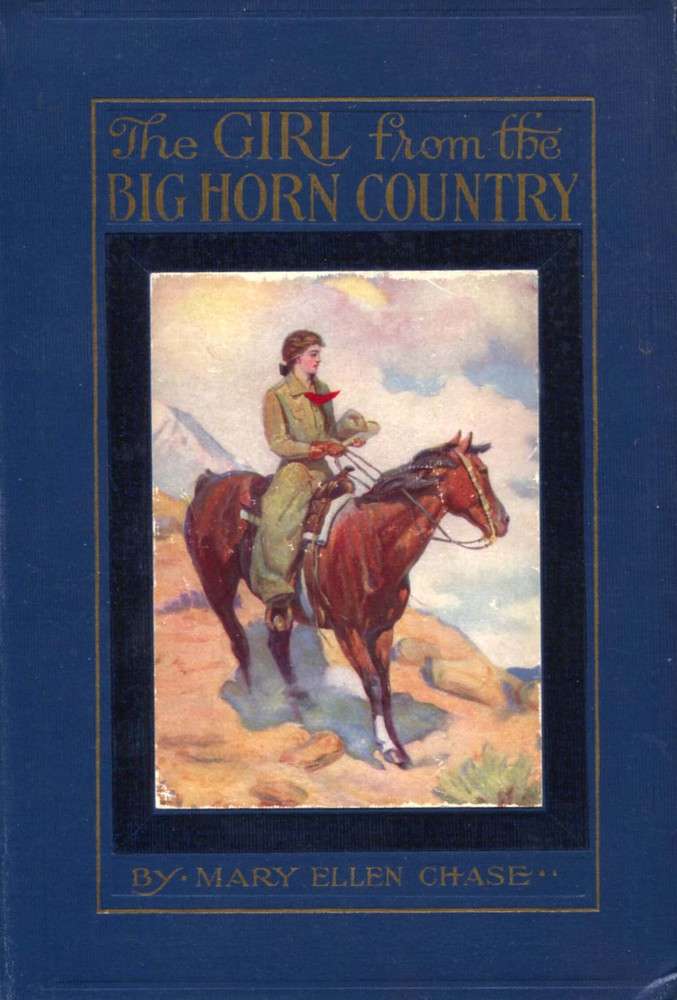
The Project Gutenberg eBook of The Girl from the Big Horn Country
Title: The Girl from the Big Horn Country
Author: Mary Ellen Chase
Illustrator: Robert Farrington Elwell
Release date: March 9, 2013 [eBook #42287]
Language: English
Credits: E-text prepared by Roger Frank
E-text prepared by Roger Frank
“Rode down the hill into the valley.”
By
MARY ELLEN CHASE
Illustrated by
R. FARRINGTON ELWELL
THE PAGE COMPANY
BOSTON—MDCCCCXVI
by the Page Company
All rights reserved
First Impression, January, 1916
Second Impression, March, 1916
Third Impression, May, 1916
Fourth Impression, June, 1916
Fifth Impression, August, 1916
PRESSWORK BY
THE COLONIAL PRESS
C. H. SIMONDS COMPANY, BOSTON, U. S. A.
OF MY FATHER
WHO, PERHAPS, KNOWS, AND IS GLAD
CONTENTS
CHAPTER I—VIRGINIA'S COUNTRY
CHAPTER II—THE LAST NIGHT AT HOME
CHAPTER III—THE JOURNEY EAST
CHAPTER IV—VERMONT AS VIRGINIA SAW IT
CHAPTER V—THE "BROADENING EXPERIENCE" BEGINS
CHAPTER VI—ST. HELEN'S AND THE HERMITAGE
CHAPTER VII—"PERTAINING ESPECIALLY TO DECORUM"
CHAPTER VIII—THE LAST STRAW
CHAPTER IX—THE THANKSGIVING ORATION OF LUCILE DU BOSE
CHAPTER X—THANKSGIVING AND MISS WALLACE
CHAPTER XI—THE DISCIPLINING OF MISS VAN RENSAELAR
CHAPTER XII—THE VIGILANTES
CHAPTER XIII—THE TEST OF CARVER STANDISH III
CHAPTER XIV—WYOMING HOSPITALITY.
CHAPTER XV—VESPER SERVICE
CHAPTER XVI—A SPRING-TIME ROMANCE
CHAPTER XVII—THE VIGILANTES INITIATE
CHAPTER XVIII—THE HEART-BROKEN MISS WALLACE
CHAPTER XIX—THE SENIOR PAGEANT
CHAPTER XX—THE VIGILANTES’ LAST MEETING
CHAPTER XXI—HOME ONCE MORE
LIST OF ILLUSTRATIONS
“Rode down the hill into the valley.”
“Forded the creek in a mad splash of water.”
“Jim, scorning assistance, had risen from his chair and stood facing his audience.”
“Some rods ahead, Virginia espied a lone figure in a gray shawl.”
“Virginia knelt by the altar rail.”
“She sat her horse like a knight of old.”
“The road lay at the very base of the green foot-hills.”
THE GIRL FROM THE BIG HORN COUNTRY
CHAPTER I—VIRGINIA’S COUNTRY
A September afternoon in the Big Horn mountains! The air crystal clear; the sky cloudless; the outlines of the hills distinct! Elk Creek Valley lay golden in the sunshine, silent save for the incessant hum of locust and cricket, the hurrying of the creek waters, and the occasional bellowing of steers on the range beyond the foot-hills; deserted except for the distant cattle, a coyote stealing across the hills, a pheasant scurrying through the buck-brush by the creek, and some cotton-tail rabbits and prairie dogs, who, sure of safety, meant to enjoy the sunshine while they might.
The foot-hills more than half-encircled the Valley. North, east, and south they tumbled, their brown, closely-cropped sides glowing here and there with the yellow of the quaking-asps, the red of hawthorn, and the bronze of service-berry. Above them rose the higher ranges, clothed in gray-green sagebrush and scant timber, and cut by canyon-forming mountain storms, invisible from the Valley; and far above all, seemingly near, but in reality miles away, the mountains extended their blue, snow-furrowed summits toward a bluer sky. Peak above peak they rose—some isolated and alone, others leaning upon the shoulders of the higher—all silent, majestic, mysterious, as though they held in their great hearts the secrets of the world—secrets of which Elk Creek Valley could never know. Yet the Valley looked very happy and content. Perhaps it had lain so long beneath their protection that it knew no fear.
The creek, rushing madly from the northern foothills, and fed by melting snow from the higher mountains, had cut a canyon for itself in its tumultuous journey from the hills; but as the land became more level, it slackened its pace, content to make but a slight depression through the Valley. Across it toward the west, beyond a great gap in the foothills, stretched an open plateau, which rose in undulations, and extended as far as one could see toward other far distant mountains, on less clear days dim and hazy of outline, to-day almost as blue and distinct as the nearer ranges, though sixty miles away. This great sea of open prairie rolling westward was cut in as many pieces and bore as many colors as a patchwork quilt. Golden wheat-fields, the wheat shocked and piled in wigwams on the plain, met acres of black, freshly-plowed soil, which, in turn, bordered upon the tender green of alfalfa and of newly grown winter grain. Scattered over the prairie stretches, at intervals of a mile, perhaps of several, were homes—here, large ranch houses with out-lying buildings—there, the rough shack of a lone homesteader.
Yes, it was a golden land—smiling and peaceful in the September sunshine. Save for horses and cattle dotted here and there, the prairie seemed almost as deserted as Elk Creek Valley, though its homes promised inhabitants, and a blue line of distant smoke showed where the threshers were at work. Moreover, on the barely visible brown road that threaded its way across the prairie, two specks were moving rapidly in the direction of the Gap. The specks took form, became two riders, a boy and a girl, on wildly galloping horses, which, neck to neck, tore at last through the Gap, forded the creek in a mad splash of water, stirrup-high, and dashed away up the Valley. Reaching the foot-hills a trifle in advance of his companion, the boy pulled in his restive horse, and called over his shoulder to the girl just behind.
“Are Pedro’s feet all right, Virginia?”
“Yes, Don. Jim fixed them yesterday.”
“Let’s take the Mine then, shall we?”
“Yes, let’s!”
And away they went, allowing the sure-footed horses to have their way up one of the foot-hills, called the “Mine,” because some lone prospector, dreaming of a fortune, had dug from its side some poor coal; and then, perhaps discouraged, had abandoned the fruit of his labors, leaving the black heap as a monument to his zeal, and a testimony to the vanity of mere dreams.
They reached the hill-top almost at the same instant, their good steeds panting; they quite undisturbed, and, turning their horses’ heads, drew rein and looked across the Valley. They were a robust-looking pair, red-cheeked and khaki-clad, and as good riders as Wyoming could produce. The boy was seventeen, or thereabouts, well-knit and tall for his years, with dark, heavy hair and clear, blue eyes that looked bluer through his coat of tan. His features were cleanly-cut and strong, and his mouth had a laugh in the corners. A merry, honest, manly-looking lad—Donald Keith by name, and the son of a ranchman on the other side of the Valley.
“Forded the creek in a mad splash of water.”
She—Virginia Hunter—was a year younger, and for sixteen as tall and strong as he for seventeen. She was not pretty, but there was something singularly attractive about her clear, fresh skin, brown now, except for the red of her cheeks, her even white teeth, and her earnest gray eyes, at times merry, but often thoughtful, which looked so straight at you from under brows and lashes of black. Her golden-brown hair curled about her temples, but it was brushed back quite simply and braided down her back where it was well out of her way. A person riding could not bother about her hair. She sat her horse as though he were a part of her, holding her reins loosely in her brown left hand, her right hanging idly at her side. The wind blew back the loosened hair about her face, and the ends of the red handkerchief, knotted cow-boy fashion, under the collar of her khaki shirt. She, like the boy, seemed a part of the country—free, natural, wholesome—and she shared its charm.
They had been comrades for years—these two—for, in the ranch country, homes are often widely separated, and the frequent society of many persons rare. Virginia’s home lay up the Valley, beyond the first range of the foot-hills, while the Keith ranch was situated on the prairie, west beyond the Gap. Three miles apart across country, four by the road; but three or four miles in Wyoming are like so many squares in Boston, and the Keiths and Hunters considered themselves near neighbors. This afternoon Virginia had ridden over to say good-by to all the dear Keiths—Mr. David, Mother Mary, Donald’s older brother Malcolm, and his younger, Kenneth, the farm-hands busy with the threshing, and the men in from the range to help with the wheat; for they were all her friends, and now that she was going so far away to school, they seemed nearer and dearer—indeed, next to her father and those upon their own ranch, the dearest of her world.
They had been quite as sad as she to say good-by. “The country won’t be the same without you, my lass,” Mr. David had said in his genial Scotch way; and Donald’s mother, whom Virginia had called “Mother Mary,” since the death of her own dear mother six years ago, had kissed her quite as though she were her own daughter. Even Malcolm had come in from the wheat field to shake her by the hand and wish her good luck, and little Kenneth’s feelings had been quite wounded because Virginia felt she must decline to carry one of his pet foxes away with her to boarding-school. Then Donald’s father had granted the request in the boy’s eyes that he might be excused from threshing to ride up the Valley and home with Virginia. So now their horses, good friends, too, stood side by side on the brow of the Mine, while their riders looked down the Valley, beyond the cottonwood-bordered creek, and across the wide, rolling prairie to the far away mountains; and then, turning in their saddles, to those ranges and peaks towering above them.
Virginia drew a long breath.
“We’re like Moses on Mount Nebo, looking away into the Promised Land, aren’t we, Don?” Then, as he laughed, “Do you suppose there’s any country so lovely as ours? Is there anything in the East like this? Do you think I’ll be homesick, Don?”
He laughed again, used to her questions.
“I suppose every fellow thinks his own State is the best, Virginia, but I don’t believe there can be any lovelier than this. You know I told you about spending a vacation when I was at school last year with Jack Williams in the Berkshires. Some of those hills aren’t higher than the Mine, you know, and he called them mountains. It seemed like a mighty small country to me, but he thought there was no place like it. I wish he could get this sweep of country from here. No, the East isn’t like this,—not a bit—and maybe you won’t like it, but you’re too plucky to be homesick, Virginia.”
Little did Virginia realize how often those words would ring in her ears through the months that were to follow. She drew another long breath—almost a sigh this time.
“Oh, I wish you were going East again, Don, instead of to Colorado! ’Twould be such fun traveling together, and you could tell me all about the states as we went through them. But, instead, I’m going all alone, and Aunt Louise has warned me a dozen times about talking to strangers. Four days without talking, Don! I shall die! Is it very bad taste to talk to good, oldish-looking people, do you think?”
“I think your aunt’s mighty particular, if you ask me,” the boy said bluntly. “You’ll have to talk to some one, Virginia. You’ll never last four days without it, and I don’t think it’s any harm. But, you see, your aunt’s from the East, and they’re not so sociable as we are out here. I thought she was going East with you.”
“No, she decided not to, and went to Los Angeles this morning; but I’m bursting with watch-words that she left. All the way to your house I said them over, and I nearly ran Pedro into a prairie dog’s hole, I was thinking so hard. I. It is very bad form to talk to strangers. II. Try to be as neat in appearance on the train as you are at home. (Aunt Lou really means neater, Don.) III. Don’t forget to tip the waiter after each meal in the dining-car. IV. Be polite to your traveling companions, but not familiar. That’s all for the journey, but I’ve heaps more for Vermont and for school. Oh, why did you choose Colorado, Don?”
“Oh, I don’t know, except that it’s nearer home, and since I’m going there to college in another year, I may as well get used to it. The East is all right, Virginia, but some way I like it out here better. I’m a rank cow-boy, I guess. That’s what they used to call me at school. Then, besides, the Colorado fellows ride a lot, and they don’t in the East—that is, so much, you know,” he added hastily, as he saw the dismay on her face.
“Don’t ride, Don! Why, I can’t stand it not to ride! Don’t they have horses? Don’t they—know how to ride?”
Her genuine distress disturbed him, and he hastened to reassure her as best he could.
“You’ll find something to ride, I’m sure,” he said. “Don’t worry. Maybe the horses won’t be like Pedro, but they’ll do. You see, your school’s in a larger town than mine. You’ll write me all about it, won’t you, Virginia?”
“Of course, I will—every little thing. If the boys thought you were a cow-boy, the girls will probably think I’m very queer, too.”
“Oh, no, they won’t! You’re—you’re different some way. And, anyway, they won’t be as nice as you,” he finished awkwardly.
Virginia, full of questions, did not heed the honest compliment.
“What are Eastern girls like, Don? Have you seen many? You see, I’ve never known one, except in books. Margaret Montfort certainly was different. Besides, you know what a time Peggy had when she went East to school, and she was only from Ohio.”
Donald knew nothing of Margaret or Peggy, and felt incompetent to remark upon them; but he answered Virginia’s questions.
“I used to see them last year at school,” he said, “at the dances and at Commencement. And in the Berkshires, I knew Jack’s sister, Mary. She’s great, Virginia. I hope there are some like her. She’s at some school, but I forget where. Oh, I guess they’re nice. You see, at parties, when they’re all dressed up, you can’t get real well-acquainted.”
“Dressed up!” cried Virginia. “Don, you ought to see the clothes I’ve got! And trunks like closets?—two of them! Aunt Lou bought my things in Chicago for father. He told her to get what I’d need, and when all the boxes came, he grew more and more surprised. He thought they had sent a lot for us to choose from; and when Aunt Lou told him it was only my ‘necessary wardrobe,’ he just sat down and laughed. Then I had to try them all on—six pairs of shoes, and sailor-suits, and coats and sweaters and dinner dresses, and goodness knows what all! It took the whole afternoon. That was the one last week, you know, when I didn’t get to go hunting prairie chickens with you. And Aunt Lou made me walk back and forth in the dinner dresses until I could ‘act natural,’ she said.” She paused laughing, and the boy looked at her, his face troubled.
“I hope all those things and going away off there won’t make you different, Virginia,” he said, a little wistfully.
“Of course, they won’t!” she told him. “I couldn’t be any different, Don. If it weren’t for the fun of wondering about things, I’d never want to go even a little, but it will be new and interesting. Besides, you know Aunt Lou says it’s ‘imperative’ that I go. I heard her say that to father one night this summer. ‘It’s imperative that Virginia go,’ she said. ‘She’s getting really wild out here with just you men, and that woman in the kitchen.’ ‘That woman’ means old Hannah, who’s been so good to us ever since mother died!”
Donald looked angry for a moment. Apparently he did not care a great deal for Virginia’s Aunt Louise.
“What did your father say?”
“He didn’t say anything, like he doesn’t when he’s thinking or troubled; but, next morning, he told me he was going to send me East to mother’s old school. He said he guessed I needed to see different things. Aunt Lou was there when he told me, and she said, ‘It will be the making of you, Virginia,—a very broadening experience!’”
“I don’t think I’d like your aunt very well,” Donald announced bluntly.
Virginia was not surprised. “No, I’m sure you wouldn’t, and I don’t think she’d like you either. That is, she ought to like you, and maybe she would, but she probably wouldn’t approve. She’s a person that doesn’t often approve of things. She doesn’t approve of my shooting, or of Jim teaching me to lasso the steers in the corral; and that afternoon when I wanted to go rabbit hunting with you instead of trying on dresses, I heard her tell father that I was getting to be rather too much of a young lady to ride the country over with you. But father laughed and laughed, and said he’d as soon have me with you as with himself.”
Donald looked pleased. Then—
“I hope you won’t get to be too much of a young lady while you’re gone, Virginia,” he said, “so you won’t care for hunting and—and things like that, next summer.”
“Don’t worry,” she said. “I won’t be a young lady for years. I hate to even think of it! But we must go down, Don. The sun says five o’clock, and it’s my last evening with father.”
Her gray eyes, thoughtful and almost sad, swept the country before her.
“I hate to leave you all,” she said softly, a little catch in her voice. “The valley and the creek and the cottonwoods and the prairie—all of you. And, most of all, the foot-hills. You know, Don,” she continued, turning toward him, “I think I like the foot-hills best. They’re so sort of friendly, and they don’t make you feel little like the mountains. You know what I mean!”
He nodded with quick understanding. They turned their horses to look at the peaks towering above them.
“Sometimes they really scare me,” she said almost in a whisper. “They’re so big, and look as though they knew so many things. Sometimes I wish they’d talk, and then I know if they did, I’d run and hide, I’d be so frightened at what they were going to say.” Her eyes left the mountains and swept across the nearer hills. Suddenly she grasped his arm, all excitement. “Hst, Don!” she whispered, her eyes gleaming. “There! Behind that clump of pine on the range! Not a quarter of a mile away! Bess and the new colt! I know the way she holds her head. Wait a minute! There she is! She’s seen us, and there she goes!”
With a wild snort, which they could hear distinctly in the clear air, and a mad kick of the heels, the horse tore away across the range, her colt trying manfully with his long ungainly legs to keep near his mother. Months on the range had transformed Bess from a corral pet to a wild steed, suspicious even of her mistress, and mindful only of her safety and that of her colt.
“A nice colt,” said Don, “and now she’s down this far she won’t go far away. Doesn’t your father brand this week? They’ll probably mark the little fellow with the rest.”
“Yes, I suppose they will. That’s one thing I can’t bear to see—the branding. Father and Jim will be so glad to know about the colt. You can break it for me, Don, when it’s two years old.”
“All right, I’ll not forget,” he promised.
Then they turned again, and rode down the hill into the valley. This time they did not ford the creek, but turned north, following an old trail up the valley and through another gap in the hills a mile above. This brought them again to the open, where Virginia’s home lay—a long, rambling house with its back against the foot-hills and its front looking westward across the prairie. Tall cottonwoods shaded the brown road that led to it; and down this road, beneath the trees, they rode, more slowly now.
A tall man, reading on the broad front porch, rose as they drew rein under the cottonwoods.
“Come in to supper, Don,” he called cordially. “It’s all ready, and we’re glad to have you.”
“Thank you, Mr. Hunter, but I can’t. I’ve got to be making for home. Good-by, Virginia,” he said, jumping from his horse to shake hands with her, as she stood beside her father. “I’m going to be lonesome without you. Don’t forget us, will you?”
“Good-by, Don.” She had the same little catch in her voice as upon the hills, and her eyes were grave again. “I’ll miss you, and, of course, I won’t forget. And, Don,” she called, as he swung himself into his saddle and galloped away, “remember, I’ll not be a young lady when I come back!”
CHAPTER II—THE LAST NIGHT AT HOME
In the mountain country the twilights are longer and the sunset colors lovelier than anywhere else. Long after Virginia and her father, supper over, had come out upon the porch to sit together, the golden light lingered in the western sky, making more blue the far distant mountains, throwing the prairie into shadow, and casting upon the nearer eastern foot-hills a strange, almost violet glow. Slowly the gold changed to the deep, almost transparent blue of the mountain sky at night. The sunset light faded to give place to the stars, which, when the twilight was almost gone, seemed to shine out all at once, as if fearful of the sunset’s lingering too long.
It was very still everywhere. Virginia sat in her favorite way—on a low stool by her father’s chair, her head upon his knees, his hand in hers. Together they watched the light fade and the stars come out, as they had done for so many nights. No sound anywhere, except Hannah’s steps in the kitchen, an occasional distant laugh or song from the men in the bunk-house, and the night noises—the stirring of the cottonwoods and the singing of the insects.
For a long time neither of them spoke, and the realization coming closer every moment that this evening would be their last chance to talk together for many months, did not seem to make conversation easier. The big man in his chair was reviewing the years—thinking of the time, twenty-five years back, when he had first come to this country—then wild and unbroken like its own animals and roaming horses. He had come like countless other young men, seeking a new life, adventure, fortune; and he had stayed, having found an abundance of the first two, and enough of the last. In the darkness he saw the distant, widely separated lights of the homes on the prairie—that prairie which he as a young man had ridden across, then sagebrush-covered, the home of the antelope, the prairie dog, and the rattler; now, intersected with irrigation ditches, covered with wheat fields, dotted with homes. Yet the land possessed its old charm for him. It was still a big country. The mountains had not changed; the plains, though different in feature, stretched as wide; the sky was as vast. He loved this land, so much that it had become a part of him; but his little daughter at his feet he was sending away that she might know another life.
He looked down at her. She was thinking, too—filled with a great desire to stay in her own dear, Western country, and with another as great to experience all the new things which this year was to bring her. Homesickness and anticipation were fighting hard. She looked up at her father, and even in the darkness saw the sadness in his face. Lost in her own thoughts, she had left him out—him, whose loneliness would be far greater than her own. She sprang up from her stool and into his lap, as she had always done before the years had made her such a big girl; and he held her close in his strong arms, while she cried softly against his shoulder.
“Daddy,” she whispered, her voice breaking. “Daddy, dear, do you suppose people often want two different things so much that they can’t tell which they want the most? Did you ever?”
He held her closer. “Yes, little girl. I expect many people do that very thing when it comes to deciding. And your dad is doing that very thing this minute. He thinks he wants to keep you right here with him, but he knows away down deep that he wouldn’t let you stay if he could. He knows he wants his little daughter to go away to her mother’s school, and to have everything this big world can give her.”
“But it’s going to be so lonely for you, father. I’m so selfish, just thinking of me, and never of you. I can’t leave you all alone!” And the tears came again.
Silently he smoothed her hair, until with a choking little laugh she raised her head.
“Don would call me a quitter, I guess,” she said. “I’m homesick already, and he said to-day of course I’d be too plucky to be homesick.” She laughed again. “I’m not going to cry another tear. And there are so many things I want to ask you. Father, tell me truly, do you like the folks in Vermont? Will I like them, do you think?”
She waited for what seemed to her long minutes before he answered her.
“Virginia,” he said at last, “your mother’s people are not like us away out here. They are of New England stock and know nothing of our life here, and it naturally seems rough to them. Your mother seemed to have a different strain in her, else she had never come to Wyoming, and stayed to marry a ranchman like me. But they are your mother’s people, and as such I honor and respect them. And I want you to like them, Virginia, for your mother’s sake.”
“I will, father,” she whispered, clinging to him. “I promise I will!” A minute later she laughed again.
“I’ve written down all of Aunt Lou’s warnings, and I’ll learn them all on the train. Are grandmother and Aunt Nan like Aunt Lou, father?”
“I don’t quite remember. Your grandmother is a lady, and looks it. Your Aunt Nan was but a little girl of your age when I saw her, but I think she’s—well, a little less particular than your Aunt Lou, judging from her letters. I have been wrong,” he continued after a pause, “in not sending you on to them in the summers, but I could not go, and it seemed a long way to have you go without me. And though we’ve always asked them, none of them has ever come here, until your Aunt Lou came this summer.”
“Why didn’t mother go oftener?”
He hesitated a moment. “Some way she didn’t want to leave for so long. She loved this Big Horn country as much as you and I. We went together once before you came; and then the summer you were five years old she took you and went again. But that was the last time. Do you remember it?”
“I remember the tall clock on the stairs. I held the pendulum one day and stopped it, and grandmother said it had not stopped for seventy-five years. Then she scolded me, and told mother I was a little wild thing—not a bit like my mother—and mother cried and said she wished we were back home with you.”
They were silent again, listening to the wind in the cottonwoods. A long silence, then her father said quietly,
“Your grandmother was wrong. You are very like your mother. But I am sorry you had to look like your dad. It will disappoint them in Vermont.”
Virginia’s eyes in the darkness sparkled dangerously. She sat up very straight.
“If they don’t like the way I look,” she announced deliberately, “I’ll go on to school, and not trouble them. I’m proud of looking like my father, and I shall tell them so!”
Her father watched her proudly. Back through the years he heard her mother’s voice:
“If they don’t like the man I’ve married, we’ll come back to the mountains, and not torment them!”
A creaking sound, occurring regularly at intervals of a few seconds, came from the road back of the house leading to the ranch buildings, and gradually grew more distinct.
“Jim’s coming,” said Virginia. “He isn’t going on the round-up to-morrow, is he, father? Don’t let him go, please!”
The creaking drew nearer, accompanied by hard, exhausted breathing.
“No,” her father told her, his voice low. “I’m not going to let him go. He’s too worn out and old for that work, though it’s wonderful how he rides with that wooden leg; but I can’t tell him he shan’t take charge of the branding. He couldn’t stand that disappointment. Come on, Jim,” he called cheerily. “We’re on the porch.”
Virginia echoed her father. “Come and talk with us, Jim.”
“I’m a-comin’,” came from the corner of the porch, “fast as this old stick’ll bring me. Ain’t much the way I used to come, is it, sir? But stick or leg, I’m good for years yet. Lord, Miss Virginia, I’m a-goin’ to teach your boys and girls how to throw the rope!” And talking as he wheezed and creaked, Jim reached the porch and laboriously stumped up the steps.
Jim was an old man, fifty of whose seventy years had been spent on the ranges and ranches of the Great West. He had grown with the country, moving westward as the tide moved, from Iowa to Kansas and Nebraska, Nebraska to the Dakotas, and from the Dakotas to Montana and Wyoming. No phase of the life West had escaped Jim. He had fought Indians and cattle-thieves, punched cattle and homesteaded, prospected and mined. Twenty years before, seeking more adventure, he had made his way on horseback through the mountains to Arizona. Whether he found what he sought, he never told, but five years later, he appeared again in Wyoming, and since that time he had been with Mr. Hunter, whom he had known when the country was new. Had his education equaled his honesty and foresight, Mr. Hunter would long ago have made him foreman, for he had no man whom he so fully trusted; but Jim’s limited knowledge of letters and figures prohibited that distinction, and he remained in one sense an ordinary ranch-hand, apparently content. Still, in another sense, there was something unique about his position. The younger men looked up to him, because of his wide experience and fund of practical knowledge; Mr. Hunter relied implicitly upon his honesty, and consulted him upon many matters of ranch management; and, next to her father, there was no one in all Wyoming whom Virginia so loved.
Jim had taught her to ride when her short legs could hardly reach the stirrups; had told her the names of every tree, bush, and flower of the hills and plains; and had been her guard and companion on expeditions far and wide. As she grew older, he gave and taught her how to use her small rifle; and of late had even given her lessons in swinging the lasso in the corral, in which art he was dexterity itself. And last winter Virginia had been able to repay him,—though all through the years she had given him far more than she knew,—for in the autumn round-up, Jim, galloping over the range, had been thrown from his horse, when the animal stumbled into a prairie dog’s hole, and the fall had broken his leg.
The chagrin of the old cow-puncher was more pitiable to witness than his pain, when the boys brought him in to the ranch. That he, the veteran of the range, should have behaved thus—“like the rankest tenderfoot”—was almost more than his proud spirit could withstand; and later, when the doctor said the leg below the knee must be sacrificed, the pain and loss, even the necessity of stumping about the rest of his days, seemed as nothing to him compared with the shame he felt over his “tenderfoot foolishness.”
The winter days would have been endless, indeed, had not Virginia been there to cheer him. Mr. Hunter would not hear of his staying in the bunk-house, but brought him to the ranch,—and there, under Hannah’s faithful nursing, and Virginia’s companionship, the old man forgot a little of his chagrin and humiliation. Virginia read to him by the hour, nearly everything she had, and her books were many. Seventy is a strange age to receive a long-deferred education, but Jim profited by every chapter, even from “David Copperfield,” who, he privately thought, was “a white-livered kind of fool” and his patience in listening to David, Virginia rewarded by the convict scene in her own dear “Great Expectations,” or by “Treasure Island,” both of which he never tired.
Then, when he was able to sit up, even to stump about a little, Virginia, having reviewed the venture in her own mind, suggested bravely one day that he learn to read, for he barely knew his letters, so that while she was at school the hours might not drag so wearily for him. A little to her surprise, the old man assented eagerly, and took his first lesson that very hour, He learned rapidly, to write as well as read, and now that his labors on the ranch were so impaired he had found it a blessing, indeed.
Of Jim’s early life no one knew. He was always reticent concerning it, and no one safely tried to penetrate his reserve. His accent betokened Scotch ancestry, but his birth-place, his parents, and his name were alike a mystery. He was known to miles of country as “Jim.” That was all. Enough, he said.
As he stood there in the open doorway, the light falling upon his bent figure, and bronzed, bearded face, Virginia realized with a quick pang of how much of her life Jim had been the center. She realized, too, how worn he looked, and how out of breath he was, and she sprang from her father’s lap.
“Come in, Jim,” she said, taking his hand in hers. “It’s cold out here. Come, father.”
They went into the big, low-storied living-room, where Hannah had lighted a fire in the great stone fire-place. The spruce logs were burning brightly, and Virginia drew her father’s big arm-chair toward the fire.
“Sit here, Jim, where it’s warm, and rest.”
Jim about to sit down, hesitated. “You see, sir, I come up on an errand with a message from the boys. If it’s all well and pleasin’ to you both, they’d like to beg permission to come up for a minute. You see, they’re leavin’ early in the mornin’ for the round-up, and they want to wish Miss Virginia good luck. If they was to come, I wasn’t to go back.”
“Why, of course, they’re to come!” cried Virginia, while her father nodded his approval. “I’d forgotten they go so early on the range, and I wouldn’t go for the world without seeing them all. Sit down, Jim. Do! Will they be right up?”
Jim sank gratefully into the big chair, placed his broad-brimmed hat on his knee, and gave a final twist to his clean bandanna.
“They was a-sprucin’ up when I left the bunk-house, kind o’ reckonin’ on your sayin’ to come along. Beats all how walkin’ with a stick takes your wind.” He was still breathing hard. Virginia watched him anxiously.
“Jim,” said Mr. Hunter, after a pause, “I wish you’d look out for the place to-morrow. I’ve some matters in town to attend to after taking Virginia in for the train, and it may be late when I get back. A man from Willow Creek thought he’d be around this week to look at some sheep. I’m thinking of selling one hundred or so of that last year lot, and I’ll leave the choice and price to your judgment.”
“All right, sir.” This helped matters considerably. Jim himself had decided that he could not go upon the range, but here was afforded a valid excuse to give the boys. His tired face brightened.
“And, Jim,” continued Virginia, eagerly, “I almost forgot to tell you. Don and I spied Bess and the colt to-day on the lower range, not two miles from the corral. The colt’s black like Bess, and a darling! Don’t hurt it any more than you can help when you brand it, will you, Jim? Does it hurt much, do you suppose?”
“Sho’ now, don’t you worry, Miss Virginia. You see, brandin’s like most other things that don’t hurt nearly so much as you think they’re goin’ to. It ain’t bad after a minute. I’ll be careful of the little fellow. Here come the boys.”
Five stalwart forms passed the window and came to the porch, cleaning their feet carefully upon the iron mud-scraper screwed to the side of the lowest step for that very purpose. Then, a little embarrassed, they filed up the steps and into the house, the two last bearing between them a large box which they placed near the door. They were hardy men, used to a rough life, of ages varying from young Dick Norton, who was eighteen and a newcomer, to John Weeks, the foreman, a man of fifty. Roughly dressed though they were, in flannel shirts and knee-boots, they were clean, having, as Jim said, “spruced up” for the occasion. For a moment they stood ill at ease, sombreros in their hands, but only for a moment, for Mr. Hunter found them chairs, talking meanwhile of the round-up, and Virginia ran to the kitchen to ask Hannah for cider and gingerbread.
“Come in yourself, Hannah,” she said to the kind soul, who sat by the spotless pine table, knitting busily; and she begged until Hannah changed her apron and joined the circle about the fire.
“Joe,” said Virginia to a big man of thirty, whose feet worried him because they demanded so much room. “Joe, you’ll keep an eye on the littlest pup, won’t you? He has a lump in his throat, and the others pick on him. I wish you’d rub the lump with liniment; and don’t forget to tell me how he is.”
Joe promised. If the service had been for the Queen, he could not have been more honored.
“And, Alec,” to a tall Scotchman, who had a wife and family in the nearest town, “I’m leaving my black Sampson and all his clothes to little David. You’ll take them when you go in Saturday night?”
Alec beamed his thanks.
“I wish you’d use Pedro all you can, Dick.” This to the young lad, who colored and smiled. “He gets sore if he isn’t used; and give him some sugar now and then for me. He’ll miss me at first.”
She turned toward the farthest corner of the room where a man sat apart from the others—a man with a kind, almost sad face, upon the features of which the town saloon had left its mark. This was William, one of the best cattle hands in the county when he could keep away from town. To every one but Virginia he was “Bill,” but Virginia said he needed to be called William.
“William,” she said, “if you kill any snakes, I wish you’d save me the rattles. I’m collecting them. And, if you have any time, I wish you’d plant some perennial things in the bed under my window, so they’ll bloom early in June. You choose whatever you like. It’ll be more fun not to know, and then see them all in blossom when I get home. Don’t you think it would be a good plan?”
William’s tired face, on which were written the records of many hopes and failures, grew so bright with interest that he did not look like “Bill” at all. Moreover, he loved flowers.
“Just the thing, Miss Virginia,” he said. “I’ll have it ready for you in June, and I won’t forget them rattles, either.”
She thanked him. “And oh, Mr. Weeks,” she said, for she dignified the foreman by a title, “you won’t let father work too hard, will you? Because I shall worry if you don’t promise me.”
So the delighted Mr. Weeks promised, while they all laughed. Then the men looked from one another to Jim with shy, embarrassed glances, as though they were waiting for something. Jim was equal to the occasion.
“You, Joe and Dick, bring that box in front of the fire while I get up.”
Joe and Dick, glad of something to do, obeyed, lifting the big box before the fire, while Virginia stared in surprise, and her father smiled, watching her. Jim, scorning assistance, had risen from his chair and stood facing his audience, but his eyes were on Virginia.
“Miss Virginia,” he began, while the boys fumbled with their hats, “none of us ain’t forgot what you’ve been to us while you’ve been a-growin’ up. Some of us have been here a good while, and some ain’t been so long, but we’ve all been long enough to think a deal o’ you. You’ve always treated us like gentlemen, and we ain’t them that forget. This old ranch ain’t goin’ to seem the same without you, but we’re glad you’re goin’ to be educated in that school your mother went to, for those of us who knowed her, knowed a lady.
“Now there ain’t a better rider in all this country than yourself, Miss Virginia, and I can just see how you’ll make them Easterners’ eyes stick out. And we boys don’t want you to have to ride on any o’ them flat-seated English saddles, that ain’t fit for any one but a tenderfoot. So we’ve just took the liberty of gettin’ you a little remembrance of us. Joe and Dick, suppose you lift the cover, and show Miss Virginia her present.”