
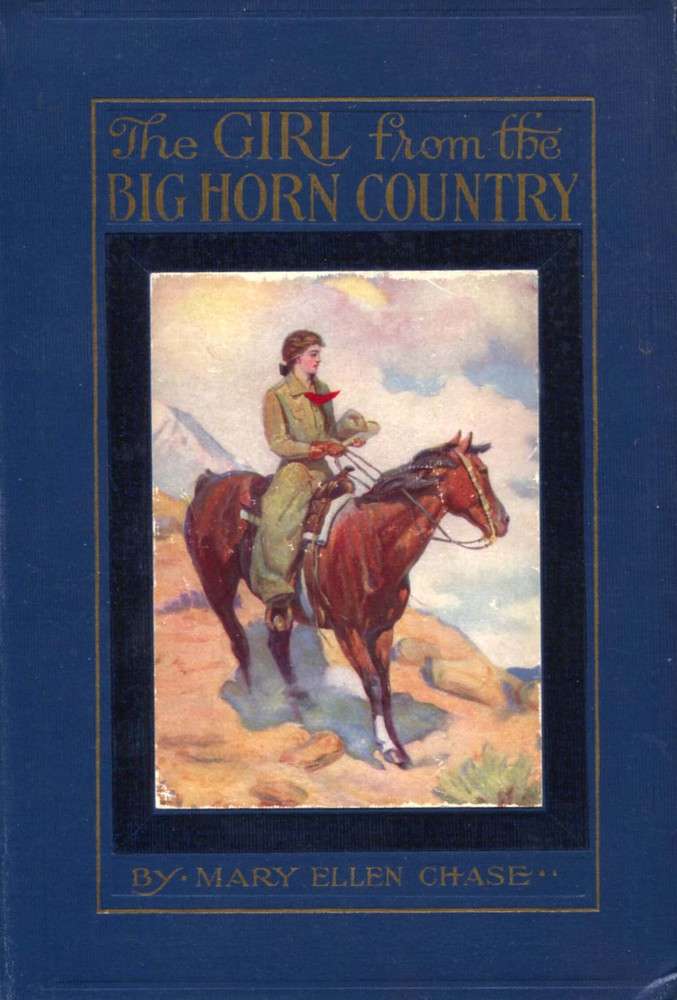
“Jim, scorning assistance, had risen from his chairand stood facing his audience.”
Joe and Dick raised the cover of the box, and lifted from it before Virginia’s shining eyes a new Western saddle. It was made from russet leather with trappings complete, and could not be surpassed in design and workmanship. On its brass-topped saddle-horn were engraved the letters “V. H.”; the same monogram was embroidered on the four corners of the heavy brown saddle blanket; and the brass of the bridle, suspended from the saddle-horn, was cunningly engraved with the same design.
Virginia gazed at the saddle, at her father, at the men, one by one, at Hannah, who was wiping her eyes; and then suddenly the tears came into her own eyes, and her voice, when she tried to thank them, broke at every word.
“Oh, I—just—can’t—thank—you—” she managed to say, while the men’s rough faces twitched, and tears filled the furrows of Jim’s cheeks, “but I’ll—never forget you, never, because you’re my very best friends!” And she went from one to the other, shaking hands with each, while her father followed her example, for he was quite as touched and delighted as she.
Then, after she had examined all over again every part of the saddle; after Jim had explained how they were to pack and ship it so that it would reach school by the time she arrived; after gingerbread and cider had helped them all to regain composure, Virginia went to her room and returned with a tiny box, and her fountain pen.
“Aunt Lou says that every girl who goes away to school must have calling cards,” she explained, “and I’m going to use mine for the very first time to-night to write my address for each one of you. And every time you look at it, please remember how much I thank you every one, and how much I’m missing you.”
So when the men went back to the bunk-house, after an hour they would always remember, each carried in the pocket of his flannel shirt a calling-card, given by a “lady” to a “gentleman.”
“Oh, daddy,” cried Virginia, as the last faint creak of Jim’s stick died away on the road to the bunk-house. “Oh, daddy, why did they ever do it for me? And I’ve never done a thing for them, except perhaps reading to Jim!”
Her father gathered her in his lap for the last few minutes before the fire.
“Virginia,” he said, “I learned long ago that we often help others most by just being ourselves. When you grow older, perhaps you’ll understand what the men mean.” They sat silently for a while, neither wanting to leave the fire and each other. From the bunk-house came the sound of voices singing some lusty song of the range. The boys apparently were happy, too. “And now, little girl, it’s a long drive to-morrow, and we must be off early. Kiss your father, and run to bed.”
Closely she clung to him, and kissed him again and again; but when the lump in her throat threatened to burst with bigness, she ran to her own room, leaving her father to watch the fire die away and to think of many things. Pinned to her pillow, she found a brown paper parcel, with “From Hannah” written in ungainly characters upon it. Inside were red mittens, knitted by the same rough fingers that had penned the words. The lump in Virginia’s throat swelled bigger. She ran across the hall to the little room where Hannah, muffled in flannel gown and night-cap, lay in bed, and kissed her gratefully.
“Run to bed, dearie,” muttered the old servant. “It’s cold these nights in the mountains.”
But Virginia’s mind was too full of thoughts for sleep. She reviewed her ride with Donald, her talk with her father, all the dear events of the evening with its crowning joy. It seemed hours when she heard her father go to his room, and yet she could not sleep. At last she sat up in bed, bundling the covers about her, for the air was cold, and looked out of her window. At night the mountains seemed nearer still, and more friendly—more protecting, less strange and secretive. She looked at them wondering. Did they really know all things? Were they millions of years old, as she had read? Did they care at all for people who looked at them, and wondered, and wanted to be like them?
“To-night I half believe you do care,” she whispered. “Anyway, I’m not frightened of you at all. And oh, do take care of those I love till I come back again!”
Then she lay down again, and soon was fast asleep.
CHAPTER III—THE JOURNEY EAST
As the great Puget Sound Limited was about to pull out of the little Wyoming way-station to which Virginia and her father had driven in the early morning, a white-haired, soldierly looking gentleman in gray overcoat and traveling cap watched with amused interest a gray-eyed girl in a blue suit, who, leaning over the railing of the observation car, gave hurried and excited requests to her father who stood alone on the station platform.
“Father, dear,” she begged, “don’t work too hard or read too late at night; and don’t forget to take the indigestion tablets. And, father, I think it would be fine if Jim could have my room when it gets cold. The bunk-house is bad for his rheumatism. And I do hope you can keep William away from town. You’ll try hard, won’t you?” The train slowly began to move, but she must say one thing more. “Daddy,” she called, beckoning him nearer, and making a trumpet of her hands; “daddy, you trust me, don’t you, to use my judgment about talking on the journey?”
The man on the platform smiled and nodded. Then, taking his handkerchief from his pocket, he waved to his little daughter, who, waving her own, watched him until the now rapidly moving train quite hid his lonely figure from sight. Then she sighed, tucked her handkerchief in her coat pocket, and sat down beside the old gentleman, who was apparently still amused and interested, perhaps also touched.
“Well,” he heard her say to herself with a little break in her voice, “it’s all over and it’s just begun.” Then she settled herself back in her chair, while her neighbor wondered at this somewhat puzzling remark.
“How can it be all over and at the same time just begun, my dear?” he ventured to ask, his kind blue eyes studying her face.
Virginia looked at him. They two were quite alone on the platform. The old gentleman, having heard her last request of her father, concluded that she was using her judgment and deciding whether or not she had best talk to him. His conclusion was quite right. “He certainly is oldish, and very kind looking,” Virginia was thinking. “I guess it wouldn’t be familiar.”
“Why, you see, sir,” she answered, having in her own mind satisfied herself and her father, and allowing herself to forget all about Aunt Lou, “it’s all over because I’ve said good-by to father, and it’s just begun—that is, the making of me is just begun—because I’m on my way East to school.”
“So going East to school is going to be the making of you, is it?”
“That’s what Aunt Lou says; and, besides, ‘a very broadening experience.’”
“I see; and who is Aunt Lou?”
“She’s my mother’s sister from Vermont. You see, my mother lived in Vermont when she was a girl, and went to St. Helen’s, too; but when she got older, she came to Wyoming to teach school and married my father. My mother is dead, sir,” she finished softly.
His eyes grew kinder than ever. “I’m sorry for that,” he said softly, too.
She thanked him. She had never seen a more kindly face. Certainly even Aunt Lou could plainly see he was a gentleman. Secretly she hoped he was going all the way East.
The train all at once seemed to be slowly stopping. There was no station near. She went to the railing to look ahead, and the gentleman followed her. Apparently the engine had struck something, for a dark object was visible some yards distant by the track. They drew near it slowly, and as they passed, now again gathering speed, Virginia’s quick eyes saw that it was a dead steer, and that on its shoulder was branded a horseshoe with a “C” in the center.
“My!” she cried excitedly, half to herself and half to her companion in the gray coat. “That’s a Cunningham steer, strayed from the range. Even one steer will make old Mr. Cunningham cross for a week. He’ll say there’s rustlers around Elk Creek.” She laughed.
“How did you know it belonged to Cunningham? Who is he, and what’s a rustler?”
Virginia laughed again. “You’re like me,” she said frankly. “I ask questions all at once, too. Why, Mr. Cunningham is a ranchman who lives over the hills north of us; and I knew it belonged to him because I saw the brand. He brands his with a horseshoe mark, and a ‘C’ in the center. And a rustler is a horse and cattle thief. There used to be a lot of them, you know, who went about putting their own brands on young cattle and colts. But there aren’t any more now, you see, because the range isn’t open like it used to be. There are too many people now. And, besides, no one would be likely to rustle cattle which are branded already. You see,” she went on, “Mr. Cunningham’s mean, though he’s very rich, and he makes his men round up his cattle ever so many times even when they’re not branding or shipping, so he can tell if a single one is missing. Every one laughs at him, because people in our country think it’s very small to make such a fuss over one steer when you have hundreds.”
“I should think so. And how many cattle have you?”
“Oh, not so many now as we used to have,” she explained, while he listened interested. “You see, sir, the range isn’t so open any more, because people are taking up the land from the government every year; and so there isn’t so much room for the cattle. Besides, we’ve been irrigating the last few years and raising wheat, because by and by almost all the cattle land that’s good for grain will be gone. The boys are rounding up our cattle to-day. I guess we have perhaps a thousand. Does that seem many to you?” she added, because the old gentleman looked go surprised.
Yes, it did seem a good number to him, he told her, since he was accustomed to seeing five or six meek old cows in a New England pasture. Then he asked her more and more about her home and the land about, and, as she told him, she liked him more and more, and wished he were her grandfather. He, in turn, told her that he lived in Boston, but had been to Portland, Oregon, on a visit to his married daughter, and was now returning home. “Then he will go all the way,” thought Virginia gladly. Also, after she had candidly told him that he looked like a soldier, he told her that he had been a Colonel in the Civil War, and ended by telling her that his name was Colonel Carver Standish. At that Virginia felt a longing to take from her bag one of her new cards and present it to him; but it would be silly, she concluded, since he had only told her his name, and so she said quite simply:
“And my name is Virginia Hunter,” which pleased the old Colonel far better than a calling card would have done.
“And now, Miss Virginia,” he said, “if you will pardon me for what looks like curiosity, will you tell me about Jim and William? I couldn’t exactly help overhearing what you said to your father. I hope you’ll excuse me?”
Virginia smiled. She did enjoy being treated like a young lady. “Certainly,” she said. And she told him all about poor old Jim, his wooden leg, the accident that necessitated it, his learning to read, which greatly interested the old Colonel, and his kindness to her ever since she was a little girl. Then, seeing that he really liked to know, she told him of the evening before, and the new saddle which the boys had given her.
“Capital!” cried the Colonel, slapping his knee in his excitement, quite to the amusement of a little boy, who had come out-of-doors and who sat with his mother on the other side of the platform. “Capital! Just what they should have done, too! They must be fine fellows. I’d like to know them.”
“Oh, you would like them!” she told him. “I know you would! I love them all, but Jim the best. And this morning, Colonel Standish” (for if he called her by name she must return the courtesy), “this morning when the other men had all gone to the round-up, Jim harnessed the horses for father to drive me to the station. But he felt so bad to have me go away that he couldn’t bear to bring the horses up to the door, so he tied them and called to father; and when we drove away and I looked back, he was leaning all alone against the bunk-house. And, some way, I think he was crying.”
She looked up at the Colonel, her eyes filled with tears. The Colonel slapped his knee again, and blew his nose vigorously.
“I shouldn’t wonder a bit if that’s what he was doing, Miss Virginia,” he said. “Fine old man! And what about William?” he asked after a few moments.
“Oh, William,” said Virginia. “You’d like William; and I’m sure you wouldn’t call him ‘Bill’ like some do. It makes such a difference to him! If you call him ‘Bill’ most of the time, he’s just Bill, and it’s a lot easier for him to stay around the saloon. But if you say ‘William,’ it makes it easier for him to keep away—he told me so one day. And in his spare time, he loves to take care of flowers, and plant vines and trees.”
The Colonel liked William. Indeed, he liked him so thoroughly that he asked question after question concerning him; and then about Alec and Joe and Dick. It was amazing how the time flew! Another hour passed before either of them imagined it. The country was changing. Already it was becoming more open, less mountainous. Some peaks towered in the distance—blue and hazy and snow-covered.
“We can see those from home,” Virginia told the Colonel. “They’re the highest in all the country round. They’re the last landmark of home I’ll see, I suppose,” she finished wistfully, and was sorry when a bend of the road hid them from sight.
“You love the mountains?” he said, half-questioning.
“Oh, yes,” she cried, “better than anything!” And then they talked of the mountains, and of how different they were at different times, like persons with joys and disappointments and ideals. How on some days they seemed silent and reserved and solemn, and on others sunny and joyous and almost friendly; and how at night one somehow felt better acquainted with them than in the day-time.
“But the foot-hills are always friendly,” Virginia told him. “And they’re really more like people, because you can get acquainted with them more easily. The mountains, after all, seem more like God. Don’t you think so?”
The Colonel did think so, most decidedly, now that he thought at all about it. He admitted to himself that perhaps in his long journeys across the mountains and through the foot-hills on his visits West, he had not thought much about them, especially as related to himself. He wished he had had this gray-eyed girl with him for she breathed the very spirit of the country. It had been rare good fortune for him that by chance he was standing on the platform when she said “Good-by” to her father, else he had missed much. It was dinner time before either of them realized how quickly the morning had passed; and Virginia ran to wash her hands, after the Colonel had raised his cap with a soldierly bow, saying that he hoped to see her again in the afternoon.
He did see her again in the afternoon, for they discovered that their sections were in the same car, in fact, directly opposite; and again the next morning, until by the time they reached Omaha they were old friends. They talked more about the country, which, after leaving the mountains, was new to Virginia’s interested eyes; and then about books; and after that about the war, the old soldier telling a most flattering listener story after story of his experiences.
The conductor, coming through the car with telegrams at Omaha, found them both so interested that he was obliged to call her name twice before her astonished ears rightly understood him.
“Aren’t you Miss Virginia Hunter?” he asked amused.
“Yes, sir,” she managed to say. “But it can’t be for me, is it? I never had a telegram in my life.”
“It’s for you,” he said, more amused than ever, while the Colonel smiled, too, at her surprise, and left the yellow envelope in her lap.
“Whom can it be from?” she asked herself, puzzled. “The spell of having a real telegram is so nice that I almost hate to break it by finding out. But I guess I’d best.”
She tore open the envelope, and drew out the slip inside. When she had read it, she gazed perplexed at the Colonel. She was half-troubled, half-amused, but at length she laughed.
“I’ll read it to you, I think,” she said, “because in a way it’s about you.” The Colonel in his turn looked amazed. “You see,” she went on, “it’s from my Aunt Lou, and she warned me about talking to strangers on the way. I suppose she thought I’d forget, and so she sent this.” She again unfolded the telegram, and read to him:
“Los Angeles, Cal., Sept. 15.
“I hope you are remembering instructions, and
having a pleasant journey.
“Aunt Louise.”
“But I’m sure she would approve of you,” she assured him; “and I’ve talked with almost no one else, except the baby in the end of the car and his mother; and babies certainly would be exempt, don’t you think? No one could help talking to a baby.”
He agreed with her. “Aren’t you going to send her a wire in return?” he asked.
“Why, I never thought of that. Could I? Is there time? What can I tell her?”
“Of course, you could, and there’s plenty of time. Ten minutes yet. I’ll get you a blank, and you can be thinking what you’ll tell her.”
While he was gone, Virginia studied her aunt’s message, and decided upon her own. She was ready when he returned.
“Don’t go away, Colonel Standish, please,” she said, when he would have left her to complete her message. “I never sent a telegram before, and besides I want you to tell me if you think this is all right. I’ve said:
“Delightful journey. No talking except with
baby, mother, and oldish gentleman.”
The Colonel slapped his knee, and laughed. “Capital!” he said. “Capital! You’ve got us all in.” He laughed again, but stopped as he noted her puzzled expression. “Not satisfied, Miss Virginia?”
“Not quite,” she admitted. “You see it doesn’t sound exactly honest. I’ve said, ‘No talking ex-cept—’ Now that sounds as though I’d talked only occasionally with the three of you, and most of the time sat by myself, when really I’ve talked hours with you. I think I’ll change the ‘No talking,’ and say, ‘Have talked with baby, mother, and oldish gentleman.’ I’d feel better about it.” She paused, waiting his approval.
“If I’d feel better about it, Miss Virginia, I’d surely make the change,” he said approvingly. “That queer thing inside of us that tells us how to make ourselves most comfortable, is a pretty safe guide to follow.”
So she rewrote the message, while he waited, and while he went to attend to its dispatch, wondered how Aunt Lou would feel when she received it.
At Chicago, Miss Cobb, a friend of Aunt Louise, met her and took her across the city to the station from which she was to take the Eastern train; and though Virginia had said “Good-by” to the Colonel until they should again meet two hours later, it so happened that he was in the very bus which took them with others across the city. Virginia introduced him to Miss Cobb, and under her breath, while the Colonel was looking out of the window, asked if Aunt Lou could possibly object to her talking with such an evident gentleman. Miss Cobb, who, perhaps, fortunately for herself, was not quite so particular as Virginia’s aunt, felt very sure there could not be the slightest objection, of which she was more than ever convinced after a half hour’s talk with the gentleman in question.
So Virginia with a clear conscience continued her journey from Chicago on, and enjoyed the Colonel more than ever. As they went through the Berkshires on the last day of the journey, she told him more about Donald, his experience at school, and how he couldn’t seem to feel at home.
“I wish my grandson knew that fellow,” said the old gentleman. “Just what he needs. Too much fol-de-rol in bringing up boys now-a-days, Miss Virginia. The world’s made too easy for them, altogether too easy!” And he slapped his knee vigorously to emphasize his remark. “By the way, what’s the name of that school of yours?”
“St. Helen’s at Hillcrest, sir.”
“Exactly. Just what I thought you told me the first day I saw you. If I’m not mistaken, that’s in the neighborhood of the very school that grandson of mine attends. And if you’ll allow me, Miss Virginia, some day when I’m there I’m going to bring that boy of mine over to see you. You’d do him good; and I want him to see a girl who thinks of something besides furbelows.”
Virginia smiled, pleased at the thought of seeing the Colonel again.
“I’d love to have you come to see me,” she said, “and bring him, too, if he’d like to come. What is his name, and how old is he?”
“Why, he has my name, the third one of the family, Carver Standish, and he’s just turned seventeen. He has two more years at school, and then he goes up to Williams where his father and I were educated. He’s a good lad, Miss Virginia, if they don’t spoil him with too much attention and too much society. I tell you these boys of to-day get too much attention and too few hard knocks. I want this fellow to be a man. He’s the only grandson I’ve got.”
So they talked while the train bore them nearer and nearer Springfield where Virginia’s grandmother and aunt were to meet her. At last there were but a few minutes left, and she ran to wash and brush her hair, so that she might carry out the first of Aunt Lou’s instructions: “Be sure you are tidy when you meet your grandmother.”
She was very “tidy,” at least so the Colonel thought, when, with freshly brushed suit and hat, new gloves and little silk umbrella, she stood with beating heart and wide-open, half-frightened eyes on the platform of the slowly moving train. The Colonel was behind her with her bag.
“You see,” she told him, a little tremulously, “I’m so anxious for them to approve of me.”
“Well, if they don’t—” he ejaculated almost angry, and perhaps it was just as well that the train stopped that moment.
Virginia’s eyes were searching the faces about her for those who might be her grandmother and aunt; and, at the same time, farther up the platform, the eyes of a stately, white-haired lady in black and of a fresh-faced younger woman in blue were searching for a certain little girl whom they had not seen for years.
“There she is, mother,” cried the younger woman at last, quickening her steps, “there in the blue suit. She walks with her head high just as Mary did.”
Tears came into the eyes of the white-haired lady. “But there’s a gentleman with her, Nan. Who can he be?”
“Oh, probably just some one she’s met. If she’s like her mother, she’d be sure to meet some one.”
She hurried forward, and so sure was she that the girl in the blue suit was Virginia, that she put both arms around her, and kissed her at once without saying a word.
“Oh, Aunt Nan,” breathed Virginia, her heart beating less fast. She knew that moment that she should love Aunt Nan. But her heart beat fast again, as Aunt Nan drew her forward to meet her grandmother, who was drawing near more slowly.
“And this is Virginia,” said that lady, extending her perfectly gloved hand, and kissing Virginia’s cheek. “I am glad to see you, my dear. Mary’s little girl!” she murmured to herself, and at that tears came again to her eyes.
Virginia liked her for the tears, but could somehow find nothing to say in response to her grandmother’s greeting. She stood embarrassed; and then all at once she remembered the Colonel. He stood, hat in hand, with her bag—a soldierly, dignified figure, who must impress her grandmother.
“I—I beg your pardon, grandmother,” she stammered. “This is my friend, Colonel Standish, who has been kind to me on the way.”
Her grandmother acknowledged the introduction, her Aunt Nan also. The Colonel shook hands with Virginia, and reiterated his intention to call upon her at school. “With your permission, my dear madam,” he added, by his cultured manner quite convincing Mrs. Webster that he was a gentleman. Then he hurried aboard his train, and left a gray-eyed girl with a heart beating tumultuously inside a blue suit to go on a waiting northbound train toward Vermont. As his train pulled out from the station, the Colonel completed his sentence.
“If they don’t approve of that little girl,” he said to himself, with an emphatic slap upon his knee; “if they don’t approve of her, then they’re-they’re hopeless, as that grandson of mine says, and I shouldn’t care to make their acquaintance further.”
Meanwhile Virginia was fixedly gazing out of the window, as the train, leaving Springfield, carried them northward. She tried to be interested in the strange, new country about her; but some way, instead of the crimson maples and yellow goldenrod, there would come before her eyes a cottonwood bordered creek, a gap between brown foothills, a stretch of rolling prairie land, black and green and gold, and in the distance the hazy, snow-covered summits of far away mountains. But with the picture came again Donald’s words—words that made her swallow the lump in her throat, and smile at her grandmother and Aunt Nan.
“No, the East isn’t like this—not a bit, and maybe you won’t like it; but you’re too plucky to be homesick, Virginia!”
CHAPTER IV—VERMONT AS VIRGINIA SAW IT
It was not until the afternoon of the second day in Vermont that Virginia wrote her father. The evening before she had said “Good-night” as early as she thought polite to her grandmother, Aunt Nan, and the minister who had come to call, and, upon being asked, willingly stayed to tea, and had gone up-stairs to the room which had been her mother’s to write her father about everything. But somehow the words would not come, though she sat for an hour at the quaint little mahogany desk and tried to write; and it all ended by her going to bed, holding close her mother’s old copy of “Scottish Chiefs,” which Aunt Nan had placed in her room, and forgetting in sleep the thoughts that would come in spite of her.
But now that the hardest first night was over, and the first forenoon, which she had spent walking with Aunt Nan, had gone, she must write him all about it. She sat down again at the quaint little desk, over which hung the picture of a girl of sixteen with clear, frank eyes, and began:
“Webster, Vermont, Sept. 18, 19—
“Father dearest:
“Do you remember how the poor queen in the fairy tale dreaded to meet the dwarf because she knew she didn’t know his name? Well, that was just like me when the train was near Springfield. If it hadn’t been for the dear Colonel, whom I told you about in my train letter, I don’t believe I could ever have been as calm as I truly outwardly was; because, daddy, I felt as though I didn’t know grandmother at all, any more than the poor queen, and I did dread seeing her. But I was tidy, and my heart didn’t beat on the outside, for which blessings I could well be thankful. The Colonel carried my bag for me, and that made it easier, for, of course, family pride forbade my allowing him to see that my grandmother and I weren’t really well acquainted.
“And, after all, it wasn’t so bad. Aunt Nan is dear, father, like mother, I know, and I love her already. She is not so proper as grandmother. I kissed Aunt Nan, and grandmother kissed me. That explains the way they made me feel, Grandmother is handsome, isn’t she? And stately, like an old portrait. But when you talk with her you feel as though there were some one else inside your skin.
“I do hope they don’t disapprove of me now, and will by and by care for me for mother’s sake and yours. Aunt Nan likes me now, I am sure, and grandmother, I am reasonably sure, doesn’t dislike me, though I think she considers me somewhat puzzling. She looks at me sometimes like we used to look at the tame foxes, when we weren’t sure what they were going to do next.
“Do you remember how the country looked coming from Springfield to Webster, when you came with mother? It was in September when you came, you said, and I remembered it. The creeks, which they call ‘brooks’ here, are lovely, though not so swift as ours, and the oaks and maples are a wonderful color in among the fir trees. I know you remember the goldenrod and asters, because mother always told about them. Didn’t you miss the quaking-asps, father? I did the first thing, and asked grandmother about them,—if none grew in Vermont. She didn’t know what I was talking about. She had no idea it was a tree, and thought I meant a bug, like that which killed poor Cleopatra. But I missed them, and I think the fall is sadder without them, because they are always so merry. I missed the cottonwoods, too. Aunt Nan said there were a few of those in New England, but they called them Carolina poplars.
“The little villages in among the hills are pretty, aren’t they?—so clean and white—but they don’t seem to care about the rest of the world at all, it seems to me. Webster is like that, too, I think, though it is lovely. If you remember how it looked when you were here, then I don’t need to describe it, for Aunt Nan says it hasn’t changed any. When we reached here, and were driving up towards the house, grandmother asked me how I liked Webster, and I said it was beautiful, but it seemed very small. She couldn’t understand me at all, and said she didn’t see how it could seem small to me when we didn’t live in a town at all in Wyoming. I was afraid I had been impolite, and I was just trying to explain that I meant it seemed shut in because you couldn’t see the country all around like you could at home, when we stopped at the house, and saw a gentleman coming toward us with a black suit and a cane. Grandmother looked at Aunt Nan, and Aunt Nan at grandmother, and they both said at once, ‘Dr. Baxter!’
“‘We must invite him to tea,’ said grandmother. ‘It would never do not to!’
“‘Nonsense!’ said Aunt Nan. ‘I don’t see why.’
“Well, he came up to the carriage just as grandmother finished whispering, ‘Our pastor, Virginia,’ and handed grandmother out, and then Aunt Nan, and lastly me. I tried to be especially polite when grandmother introduced me, remembering how she had warned me that he was the minister; but somehow all I could think of was the parson in the ‘Birds of Killingworth,’ because, when I first saw him coming down the street, he was hitting the goldenrod with his cane, and some way I just know he preaches about the ‘wrath of God,’ too, just like the Killingworth parson. He did stay to tea, though I’m sure Aunt Nan didn’t want him, and I, not being used to ministers, didn’t want him either; but I put on one of my new dresses, as grandmother said, and tried to be an asset and not a liability. But, father, I know grandmother was troubled, and, in a way, displeased, because of the following incident:
“Dr. Baxter is bald and wears eye-glasses on a string, and the end of his nose quivers like a rabbit’s, and he rubs his hands, which are rather plump, together a great deal. Some way, father, you just feel as though he didn’t care away down deep about you at all, but was just curious. I am sorry if I am wrong about him, but I can’t help feeling that way. All through tea he talked about the Christianizing of Korea, and the increased sale of the Bible, and how terrible it was that China wasn’t going to make Christianity the state religion. He didn’t pay much attention to me, and I thought he had forgotten all about me, when all at once he looked at me across the table and said:
“‘And to what church do you belong, Miss Virginia?’
“Poor grandmother looked so uncomfortable that I felt sorry for her, and after I had said, ‘I don’t belong to any, Dr. Baxter,’ she tried to explain about our living on a ‘large farm’ (I don’t believe grandmother thinks ranches are real proper) and not being near a church.
“Aunt Nan tried to change the subject, but Dr. Baxter just wouldn’t have it changed, and after looking at me thoughtfully for a few moments, he said:
“‘I wonder that our Home Mission Board does not send candidates to that needy field. Do you have no traveling preachers, Miss Virginia?’
“Grandmother looked so uneasy that I did try to say just the right thing, father, but I guess I made a mistake, because I told him that we did have traveling preachers sometimes, only we didn’t feel that we needed just the kind of preaching they gave. His nose quivered more than ever, and grandmother tried to explain again only she didn’t know how, and at last he said:
“‘If the Word is not appreciated in Wyoming, it is elsewhere, thank God!’—just as though Wyoming were a wilderness where ‘heathen in their blindness bow down to wood and stone.’ Grandmother looked more mortified than ever, and the silence grew so heavy that you could hear it whirring in your ears. By and by we did leave the table, and then I excused myself to write to you, but I couldn’t seem to write at all, I felt so troubled about mortifying poor grandmother. This morning I thought she would speak of it, but she didn’t, and perhaps, if I make no more slips, she will forget about it. It is very difficult to be a constant credit to one’s family, especially when it requires so much forethought.
“Grandmother feels very bad because she has no son to carry on the family name. When she and Aunt Nan and Aunt Lou die, she says ‘the name will vanish from this town where it has been looked up to for two hundred years.’
“It makes a great difference in Webster how one does things—even more than what one does. This morning, when Aunt Nan and I were going to walk, Aunt Nan said, ‘I think we’ll run in to see Mrs. Dexter, mother. She’ll want to see Virginia.’ And grandmother said, ‘Not in the morning, Nan. It would never do!’ So we have to go in the afternoon. I told Aunt Nan when we were walking that at home we called on our friends any time, and she said she wished she lived in Wyoming! She could ‘belong’ to us, father, but I’m afraid grandmother never could enjoy Jim and William and the others. She is too Websterized.
“Wasn’t it thoughtful of Aunt Nan to put mother’s old ‘Scottish Chiefs’ on my table? It has all her markings in it. Last night—but I won’t tell you, because you will think I am homesick, and I’m not! Please tell Don.
“Do you remember the view of the Green Mountains from the window in mother’s room? I can see them now as I write you. They are beautiful, but so dressed up with trees that they don’t seem so friendly and honest as our little brown foot-hills. Oh, daddy, I do miss the mountains so, and our great big country! Last night when I tried to write you and couldn’t, I stood by the window and watched the moon come up over the hills; and I couldn’t think of anything but a poem that kept running through my head like this:
To gaze on the mountains with those you love
Inspires you to do right;
But the hills of Vermont without those you love
Are but a sorry sight!
“Aunt Nan is waiting for me down-stairs. I can hear her and grandmother talking together. Oh, I wonder if they do approve of me!
“Father, dear, give my love to Jim and Hannah and Mr. Weeks and Alec and William and Joe and Dick and all the Keiths, and tell them I think of them every day. Give Pedro sugar as often as you remember, won’t you?—and if the lump in the littlest collie’s throat doesn’t go away soon, please kill him, because I don’t want him to suffer.
“I do love you so much, father dearest, that if I tell you any more about it, I’ll quite break my promise to myself.
“Virginia.
“P. S. Just think, daddy, Aunt Nan says you must come East in June to get me and visit them. She said also when we were walking that you were a fine-looking man; and I told her that you were not only that, but that you were fine all the way through, and that every one in Sheridan County knew it!—V. W. H.”
And while Virginia wrote her letter to her father in the room which had been her mother’s, downstairs, in the library, her grandmother and Aunt Nan talked together.
“I must admit, Nan, she isn’t nearly so wild as I expected after having been brought up in that wilderness.”
“Wild, mother? She’s a dear, that’s what she is! And Wyoming isn’t a wilderness. You must remember the country has grown.”
“I know, but it can hardly afford the advantages of New England. I mean in a cultural way, my dear.”
Aunt Nan actually sniffed. “Maybe not, mother. I’m sick of culture! I like something more genuine. And as to good manners, I’m sure Virginia has them.”
“Yes,” her mother assented. “And I must say I’m surprised after what Louise wrote as to the ranch life. Mary’s husband has done well by Virginia, I must grant that.”
“Lou is too particular for any use, mother. I’ve always said so. And as for Virginia’s father, you’ve never half appreciated him!”
Virginia’s grandmother felt rebuked—perhaps, a little justly.
“Of course,” she said, a little deprecatingly, “there are crudities. Now as to that matter last evening with Dr. Baxter. I fear he was rather—”
“Shocked!” finished Aunt Nan. “And I’m glad he was! Virginia only told the truth. If he knew more about Wyoming geography and less about Korean idolatry, he’d appear to better advantage! He needs shocking!”
“My dear Nan!” interposed her mother.
“Well, he does, mother, and I hope he’s so shocked that he won’t come to tea again for a month!”
And with that Aunt Nan, leaving her mother somewhat disturbed in mind, went to call her niece.
CHAPTER V—THE “BROADENING EXPERIENCE” BEGINS
“I’m afraid it will look as though we didn’t show proper interest, Nan. Besides, I never did like the idea of a child starting out alone for boarding-school. None of my children ever did. But what can we do?” It was Virginia’s grandmother who spoke.
“Now, mother dear, don’t worry about ‘proper interest.’ I’ve written Miss King all about it, so that she understands. And since I was careless enough to sprain my ankle, and you unfortunate enough to have to entertain the Mission Circle, we can’t do anything but let Virginia go alone.” This from Aunt Nan, who lay on the couch with a bandaged ankle, the result of a bad wrench the day before.
Virginia spoke next. “Don’t worry at all, please, grandmother. It isn’t as though I hadn’t traveled way from Wyoming. I’ll be very careful—truly, I will—and try to do everything just as you would wish.”
“Oh, I don’t suppose it’s absolutely necessary that one of us go. It’s just that I have always considered it very essential that a young and inexperienced girl should be accompanied by some member of her family when she enters upon such an important step. But circumstances certainly dictate the course of events, and it looks as though you must go alone, Virginia. Miss King remembers your mother, and will welcome you for her sake; and she assures me you are to room with a wholly desirable girl of excellent family. My dear, you will try, I know, to be a credit to the Websters!”
Away back in Virginia’s eyes gleamed a flash of light, but she answered quietly:
“Certainly, grandmother, and to the Hunters, too, because father is just as anxious that I should do well as you and Aunt Nan and Aunt Lou. Please don’t forget how anxious he is,” she finished, a little wistfully.
Aunt Nan gave her hand a friendly little squeeze. “Of course, he’s the most interested of us all,” she said. “We mustn’t be selfish, mother. They’ll send the carriage to meet you, Virginia, and Miss King will understand about everything. It will seem strange at first, but you’ll soon get acquainted, and love it, I know you will.”
So it happened that on account of a sprained ankle and the Mission Circle, Virginia again boarded the train after five days in Vermont, and started with a heart filled with dreams and hopes to discover whether school were really as dear and delightful as Peggy Montfort had found it.
Hillcrest was a five hours’ journey from Webster, and to-day Virginia could look at the countrysides which they passed with a less perturbed spirit than that with which she had so unsuccessfully tried to watch them nearly a week before. The visit in Vermont was over, and after all it had not been so hard. She really loved dear, frank, funny Aunt Nan very dearly, and she somehow felt sure that Aunt Nan loved her. As for Grandmother Webster, perhaps she did not love her Wyoming granddaughter just yet; but, Virginia assured herself, remembering her grandmother’s warm kiss at parting, she at least did not entirely disapprove of her. After all, it was hard to have one’s only granddaughter from Wyoming—especially hard when one could not understand that Wyoming was not a wilderness.
But as she reviewed the five days, she could not find any glaring improprieties or mistakes, except perhaps shocking poor Dr. Baxter. But even then, she had only told the truth. After all, manners are quite the same in Wyoming as in Vermont, she thought. To be sure her a’s were hardly broad to suit Grandmother Webster, and her r’s quite too prominent. In Vermont there were no r’s—that is, where they belonged. If used at all, they were hinged in the funniest sort of way to the ends of words. Virginia laughed as she remembered how grandmother had called her “Virginiar” and the maid “Emmar,” but pronounced Webster, which possessed a real r at the end “Websta.” She wondered if the girls at St. Helen’s would all speak like that. If so, they would find her funny, indeed; but she did not mind.
New England was lovely. She did not wonder that her mother had always talked so much of its fir-covered hills, its rocky, sunny pastures, its little white-churched villages nestling in the hollows, its crimson maples, its goldenrod and asters. And this very journey to St. Helen’s, which she was now taking, her own mother years before had taken many, many times in going back and forth to school before and after vacations Quick tears filled her eyes as she remembered. Her mother would be glad if she knew her little daughter was on her way to her mother’s old school. Perhaps she did know after all. And with this thought came a resolve to be an honor and a credit to them all.
At one of the larger stations where the train stopped longer than usual was gathered on the platform a merry group of persons, saying good-by to two girls, who were apparently going to take the train. Perhaps they also were going to St. Helen’s, thought Virginia, and she studied the group as closely as politeness would allow.
“Now, Priscilla, do be careful, and don’t get into any more scrapes this year,” she heard a sweet-voiced, motherly-looking woman say, as she kissed one of the girls good-by.
“Mother dear, I’m going to be the model of the school, wait and see,” the girl cried, laughing. “Dorothy is, too, aren’t you, Dot?”
“Of course, I am, Mrs. Winthrop. Dad’s going to cut down my allowance if I don’t get all A’s. Oh, Mrs. Winthrop, I’ve had such a heavenly time! Thank you so much for everything.”
“You must come again,” said a tall gentleman in white flannels, evidently Priscilla’s father, as he shook hands, while his invitation was echoed heartily by two jolly-looking boys—one of about Donald’s age, though not nearly so nice-looking, Virginia thought, and the other younger. The train gave a warning whistle.
“Priscilla, are you sure you haven’t forgotten something?”
“First time in her life if she hasn’t!”
“Have you your ticket and purse, daughter?”
“And did you put your rubbers in your suitcase?”
“Yes, mother, yes, daddy, I’ve got everything. Come on, Dot. The conductor’s purple with rage at us! Good-by.”
They hurried on board the train, and into the car in which Virginia sat. Then the one they had called Priscilla apparently remembered something, for she flew to the platform. Already the train was moving, but she frantically shouted to her mother:
“Oh, mother, my ‘Thought Book’ is under my pillow! I’d die without it! Send it right away, please, and don’t read a word on pain of death!”
The younger boy on the station platform executed a kind of improvised war-dance as he heard the words, meaning apparently to convey to his troubled sister his intention of reading as soon as possible her recorded thoughts. Priscilla returned to the car and took her seat, directly opposite the interested Virginia.
“If Alden Winthrop reads that ‘Thought Book,’ Dot, I’ll never speak to him again. ’Twould be just like him to make a bee line for my room, and capture it, and then repeat my thoughts for years afterward!”
“That’s just the trouble with keeping a diary. I never do. My cousin would be sure to find it. Besides, half the time I’m ashamed of my thoughts after I write them down.”
Virginia, sitting opposite, could not resist stealing shy and hurried glances at the two girls, because she felt sure that they also were bound for St. Helen’s. She liked them both, she told herself. They were apparently about the same age—probably sixteen or thereabouts. The one who had been so solicitous about the “Thought Book,” and whom they had called Priscilla, had brown eyes and unruly brown hair, which would fall about her face. She was very much tanned, wore a blue suit, and little white felt hat, and looked merry, Virginia thought, though she could hardly be called pretty. The other, whose name evidently was Dorothy, was very pretty. Virginia thought she had never seen a prettier girl. Her complexion was very fair, her eyes a deep, lovely blue, her hair golden and fluffy about her face, her features even, and her teeth perfect. She was dressed in dark green, and to Virginia’s admiring eyes looked just like an apple-blossom. Undeniably, she was lovely; but, as Virginia shyly studied the two faces, she found herself liking Priscilla’s the better. The other some way did not look so contented, so frank, or so merry. Still, Virginia liked Dorothy—Dorothy what—she wondered.
As they continued talking, she became convinced that they were going to St. Helen’s, that they had been there a year already, and that Dorothy had been visiting Priscilla for a month before school opened. She longed to speak to them, but, remembering what Donald had said about Easterners not being so sociable with strangers, she checked the impulse, not knowing how they would regard it, and not wishing to intrude. Still, she could not resist listening to the conversation, which she could hardly have helped hearing, had she wished not to do so.
“Dear me! I wish now we hadn’t been so silly, Dorothy, and done all those crazy things. Then we could have roomed together this year.”
“I know. Maybe ’twas foolish, but I’ll never forget them. Especially the time when we dropped the pumpkin pie before Miss Green’s door.” They both laughed. “And, anyway, Priscilla, with Greenie in The Hermitage, if we’d been saints, we couldn’t have roomed together. She thinks we’re both heathen, and I worse than you; and just because she does think I’m so bad, I feel like being just as bad as I can be. I wish Miss Wallace would have the cottage alone this year. She’s such a darling! I just adore her! I’d scrub floors for her! My dear, she wrote me the most divine letter this summer! It absolutely thrilled me, and I was good for a week afterward!”
Virginia looked out of the window amused. What queer ways of saying things! She had never heard a letter called “divine” before; nor had she realized that scrubbing floors and adoring some one were harmonious occupations. She listened again. Priscilla was talking this time.
“I adore Miss Wallace, too,” she said. “She makes you want to be fine just by never talking about it. I wish I could like poor Miss Green—she seems so sort of left out some way—but she just goes at you the wrong way. Mother and daddy think she must be splendid because she enforces rules, and they say we’re prejudiced; but I don’t think they understand. It isn’t enforcing the rules; it’s the way she has of doing it.”
Dorothy acquiesced. “I suppose we’ll have to make the best of her if she’s there. Miss Wallace’s being there, too, will make it better. I’m wondering whom I’ll draw for a room-mate. Do you know who’s yours?”
“No, Miss King wrote mother and said she’d selected a wholly desirable one for me. I do hope she doesn’t chew gum, or want fish-nets up, or like to borrow.”
Virginia recalled Miss King’s words to her grandmother—“a wholly desirable girl ”—but then that was just a form of expression. There was no reason to believe, much as she would like to hope, that Priscilla was to be her room-mate. At all events, if such a thing by any possibility should come to pass, she was glad she did not chew gum. As to fish-nets, she had never heard of one in a room, and as for borrowing, she had never had any one in her life from whom she might borrow.
At that moment she saw the girls looking at her. Perhaps they had suspected that she, too, was a St. Helen’s girl. They whispered one to the other and exchanged glances, while Virginia, a little embarrassed, looked out of the window. She only hoped they liked her half as much as she liked them. They began to talk again.
“My dear,” this from the extravagant Dorothy, “when you see my Navajo rug, your eyes will leave your head for a week! It’s positively heavenly! Daddy had it sent from California. Whoever my room-mate is, she ought to be grateful for having that on the floor. It makes up for me.”
“I won’t hope for a Navajo just so long as I get some one I’ll like.”
Virginia thought of her two Navajos in her trunk—one a gift from her father, the other made and given her by a New Mexican Indian, whom she had known from her babyhood. Oh, if only Priscilla might be the one!
“Do you suppose Imogene and Vivian will be back?” Priscilla continued.
“Imogene wrote me she was coming.” Somehow Virginia detected embarrassment in Dorothy’s answer. Who was Imogene? she wondered. “You know, Priscilla, Imogene’s lots of fun. Of course, she isn’t like you or Mary Williams or Anne, but you can’t help liking her all the same.”
“I know she’s fun, Dot, but I don’t think her fun is a very good kind; and I don’t like the way she influences Vivian. Vivian’s a dear when Imogene’s not around; but the minute they’re together she follows Imogene’s lead in everything.”
Somehow Virginia knew she should not care for Imogene. But where before had she heard the name Mary Williams? Just then they passed a tiny village surrounded by elm trees.
“There’s Riverside now,” cried the girls opposite, “and Hillcrest is the next.”
They hurriedly gathered together their belongings, and put on their hats. Virginia did the same, and as they noticed her preparing to leave the train, Priscilla smiled, and Dorothy looked at her with interest. But there was little time for exchange of greetings, for the train was already stopping. As they went with their suit-cases toward the door, Virginia, following, heard Priscilla say,
“Probably Mary Williams will be at the station. Senior officers usually meet new girls.”
Then it all came back to her. Mary Williams was Jack Williams’ sister, the girl in the Berkshires whom Don had liked so much. Her heart beat fast with excitement. Could she be the very same Mary Williams?
A moment more and they were all on the platform; and while Virginia stood a little shyly by her suit-case, she saw running down the platform toward them a tall, golden-haired girl in a white sweater. Priscilla and Dorothy dropped their luggage, and ran to meet her.
“Oh, Mary, you darling!” they both cried at once, and embraced her until the tall girl was quite smothered.
“I knew you’d be down. I just told Dorothy.”
“How is every one?”
“Is Greenie in The Hermitage?”
“Is Miss Wallace back?”
“Where’s Anne?”
“Oh, let me go, please, a minute!” begged the tall girl, looking at Virginia. “I came down to meet a new girl. She must have come with you on your train. Wait and see her.”
“I told you she was coming to St. Helen’s,” Priscilla whispered to Dorothy, while the tall girl went up to Virginia.
“You’re Virginia Hunter, aren’t you?” they heard her say cordially, “from that wonderful Big Horn country I’ve heard so much about! Miss King couldn’t come down to-day, and the teachers in our cottage were away, so she sent me. I’m Mary Williams.” And she put out her hand, which Virginia grasped heartily.
“Oh,” she cried, her eyes shining, “aren’t you Jack Williams’ sister, and don’t you live in the Berkshires, and don’t you know Donald Keith. He’s my best friend. Oh, I do hope you’re the one!”
Mary’s first surprise had turned to pleasure. She shook hands with Virginia again, and more heartily.
“Why, of course, I know Donald Keith! He’s the most interesting boy I ever met in my life. Why, now I remember, of course! When Miss King told me your name I tried to think where I’d heard it before. Why, you’re the girl Donald talked about so much, who could ride so wonderfully and shoot and lasso cattle and kill rattle-snakes!”
Virginia blushed, a little embarrassed. She did not know how such accomplishments would be regarded by Eastern girls. Mary apparently admired them; but Virginia was not so sure of Priscilla and Dorothy. They stood a little apart and listened, certainly with interest, but whether with approval Virginia was not sure. However, she had little time for wondering, for Mary drew her forward to where they stood.
“Isn’t it wonderful to have a girl way from Wyoming?” she said. “And isn’t it lovely that I know all about her? Her best friend is my brother’s best friend, too. This is Virginia Hunter, and these are Priscilla Winthrop and Dorothy Richards. Why, I almost forgot! You and Priscilla are room-mates. Miss King just told me.”
So the longed-for joy was to become a reality! Virginia was radiant. She wondered if Priscilla were really glad. The handshake with which she greeted her was surely cordial. Mary and Dorothy walked on ahead toward the waiting carriage, and left the new room-mates to follow.
“It’s ever so interesting to room with a girl way from Wyoming,” Priscilla said sweetly. “You’ll have to tell me all about it. I don’t know a thing!”
“I will,” said Virginia. Then she laughed. “And I really don’t chew gum, or borrow things. And what is a fish-net?”
Priscilla laughed, too. “Oh, did you hear those silly things I said? Why, a fish-net is a hideous thing to put pictures in. I loathe them!”
“Besides, I have two Navajo rugs,” Virginia continued. “I hope I wasn’t rude! I couldn’t help hearing, really, and I was so interested.”
“You weren’t rude at all, and I’m wild over Navajos. Dorothy will be plain peeved, because we have two in our room.”
Virginia gathered from the tone that “plain peeved” must mean something akin to jealous. But she was so happy that she forgot all about Navajos.
“I’m so glad I’m going to room with you,” she couldn’t help saying. “I knew I’d like you the moment you got on the train, and I like you better every minute!”
Priscilla in her turn was embarrassed. She was not used to such frankness of speech, especially on first acquaintance. But very likely the manner of speaking in Wyoming, just as Virginia’s speech, so full of r’s was different from her own. And she was ready to go half-way at least.
“Why,” she stammered, “I—I’m—sure I’m glad, and I—I—know I’ll like you, too.” Which was quite an admission for a member of the conservative Winthrop family to make to a stranger!
CHAPTER VI—ST. HELEN’S AND THE HERMITAGE
St. Helen’s lay a mile west of the station, and half a mile from the village itself, through whose quiet, elm-shaded streets they were soon driving in the big, open carriage. The girls pointed out to Virginia the places of especial interest—the little white church which they attended on Sundays; Mrs. Brown’s cottage, where pumpkin pies and “heavenly chocolate cake” might be purchased, if not too frequently; and, chief of attractions, the “Forget-me-not,” whose sundaes, once eaten, were never forgotten.
At the little post-office, another girl joined them, and was in turn embraced quite as rapturously by Priscilla and Dorothy as Mary had been. She was introduced to Virginia as Anne Hill, Mary’s roommate, and another Senior.
“The two sharks and faculty pets of St. Helen’s,” observed Dorothy, supplementing the introduction, and including Mary and Anne with a wave of her pretty hand,
Virginia had not the vaguest idea of what a shark might be. Most apparently, not a fish; but she saw that Dorothy’s remark embarrassed both Mary and Anne. She liked Anne at once. She was rather short and plump, with a sweet face and soft Southern accent.
“She comes from Virginia,” Priscilla said in a whisper to her new room-mate, as they drove along.
Virginia divided her attention between her great interest in the country and her absorbing eagerness to hear all that the girls had to say, for Mary and Anne were kept busy answering Priscilla’s and Dorothy’s questions. Yes, Imogene Meredith had returned, and she and Vivian Winters were rooming together as they did last year. Miss Green was to be in The Hermitage—(a long sigh from Priscilla and Dorothy)—but the adorable Miss Wallace was to be there likewise. The fortunate girl, who was to be blessed with Dorothy’s Navajo rug, and, incidentally, with Dorothy herself, was new, and a protégée of Miss Wallace’s. (Sighs of envy from all.) Her name was Lucile Du Bose, and Miss Wallace had become acquainted with her in France through mutual friends. She was doubtless very nice, but a little shy and apparently lonely, and Miss Wallace had asked as a special favor to herself that the girls try to make her feel at home. Moreover, Miss Wallace had proposed Dorothy as a room-mate.
“That settles it,” announced Dorothy. “I shall be angelic to Lucile, even if she’s positively hopeless; since I’m doing Miss Wallace a favor!”
“Who has the big up-stairs room?” asked Priscilla.
Mary and Anne laughed. “Somebody very important,” said Anne in her pretty Southern accent. “She hasn’t come herself, but she has trunks and bags enough for the whole family, and they keep on coming. Up to this noon there were three trunks, two bags, a shawl strap, and four express packages. And the trunks and bags are all marked ‘K. Van R.— New York’ in big letters. Mary and I were so wild with curiosity that we had the impoliteness to turn over one of the express packages to see the name on it, and ’twas ‘Miss Katrina Van Rensaelar.’ We asked Miss Green about her, but gleaned no information except that she would be here in a few days, and was to room alone, as her guardian had especially requested it.”
“Dear me! How select!” observed Dorothy.
“She ought to be Katrina Van Tassel, like Katrina in ‘The Legend of Sleepy Hollow,’” said Virginia, whereupon every one laughed, and Mary said that “Sleepy Hollow” would be a very appropriate name for the room, as the girls who had it last year never heard the rising bell, and were invariably late for breakfast.
“We’re getting very near now, Virginia,” said her new room-mate. And, a moment later, they drove through some stone gate-posts and up a lovely curving road bordered by pines, which edged the woodland on either side.
“There are always hepaticas here in the spring the first of any place,” they told her.
Then they crossed a rustic bridge over a little brook, after which the pines gave way to maples and oaks, on either side of which were open fields and meadows. They snow-shoed here, they told her; and in the spring the ground was fairly blue with violets. Now the roadsides, as well as the land near the brook, were yellow with goldenrod and purple with asters, her mother’s flowers. The road commenced to be more hilly above the meadow, and as the horses walked slowly along, Virginia noticed with interest the shrubs and trees which grew in tangled masses on either side. She knew the sumac, now in its autumn scarlet, and the birches; but there were many which she had never seen, and she missed the service-berry and the buck-brush, which bordered the Wyoming roads, the cottonwoods and her own dear quaking-asps, which always seemed so merry and friendly in the fall. What a lovely place for a school, she kept thinking to herself, as they climbed the hill, and, suddenly leaving the wood road behind, came out upon an open campus, dotted here and there with fine old elms and maples.
“And this is St. Helen’s,” the girls told her, as they followed the elm-shaded driveway, while her delighted eyes wandered across the lawns to the gray stone buildings, upon which the ivy was already turning red.
“It’s lovely,” she said softly, “just as lovely as mother used to tell me. You see, years ago my mother came here to school, too.”
Perhaps the softness of her voice told the girls more than she herself had done, for they were silent for a moment. Then Mary said,
“Miss King wanted me to bring Virginia over to the office as soon as she came, so you girls can go on to The Hermitage. You might as well leave your bag in the carriage, Virginia. They’ll put it in your room.”
Miss King’s office was in the largest of the gray stone buildings, which, Mary told Virginia, held the gymnasium, the big assembly hall, some recitation rooms, and the offices of the principal and other important personages.
“You’ll love Miss King,” Mary reassured her, perhaps guessing that Virginia felt a little shy. “You see, she doesn’t teach any more, and she leaves most of the care of the girls to the younger teachers; but she always conducts chapel, and arranges with each girl separately about her studies. It’s wonderful how she knows every girl in St. Helen’s, and she’s interested in every little thing that concerns us. We just love her!”
They went up the steps, and into a large, open hall, at the end of which a fire blazed in a big stone fire-place.
“We don’t really need a fire now,” Mary explained, “but Miss King says it seems more homelike and cheerful when the girls come in.”
From the hall many doors led to different rooms, and through two big central ones they passed into a large office. A young woman at the desk rose to greet them.
“You’re to take the young lady to Miss King’s private office, Miss Williams,” she said.
Mary thanked her, and crossing the room, rapped upon the door of an inner office. A sweet, cheery voice said, “Come in,” and they entered a large sunny room, by the western window of which sat a gray-haired lady, who rose with girlish eagerness to greet them.
“I have been waiting for you, my dears,” she said, and Virginia thought she had never heard such a sweet voice. “And I have been waiting years for you, Virginia,” she continued. “Come to the window. I want to look at my dear Mary Webster’s little girl.”
She took them by either hand, and drew them to the window. Then she took off Virginia’s hat, and with tears in her sweet, almost sad blue eyes studied the girl’s face.
“My dear,” she said at last, “you don’t look like your mother, and yet you do. Your eyes are gray, while hers were blue, but the light in them is just the same, and your mouth is hers. But it is only fair that you should look also like that fine father of yours whom your mother brought to see me eighteen years ago. It was twenty years ago that Mary Webster left St. Helen’s the sadder for her leaving; and now the same St. Helen’s is gladder for her coming again in her little daughter. Oh, my dear, my dear, how glad I am to have you here!”
With that her blue eyes quite brimmed over with tears, and she held Virginia close a moment and kissed her.
A lump rose in Virginia’s throat and she could not speak. The dear memory of her mother, and more than all else, the genuine praise and appreciation of her father, the first she had heard since she came East, with the exception of Aunt Nan’s compliment, quite overcame her. Tears filled her eyes, and her chin quivered, when she tried to thank Miss King. But the dear lady understood, and, still holding her hand, turned to talk with Mary until Virginia should be herself again.
“And, now,” she said gayly, a few moments later, “you’re both to have tea with me, for I’ve told Miss Weston I’m not to be interrupted on any condition. We don’t have girls from Wyoming every day, do we, Mary? You like my room, Virginia?” For Virginia’s eyes were wandering about the room, charmed with everything.
“I just love it, Miss King,” she said, in her natural, unaffected way. “It makes me think of a sunny autumn afternoon at home. The walls are just the color of our brown foot-hills, and the yellow curtains against them are like the sunlight on the hills. And I love the marigolds on the table, I always have them in mother’s garden at home. She loved them so.”
“I’m so glad it seems like that to you,” Miss King told her, “because it always makes me think of October, my favorite month.” And she looked about contentedly at the soft brown walls, the pale yellow silk curtains, the darker furniture, and the bowl of yellow and brown marigolds which saw their reflection in the polished table. The pictures were largely soft landscapes in sepia, Corot’s and Millet’s; but here and there was hung a water color in a sunny, golden frame.
“I wanted a restful room with soft colors, and soothing pictures—not profound, energy-inspiring ones—for in this room I rest and read and talk with my girls. And some way it satisfies me—the way I have furnished and arranged it. Now, Virginia, I want to know about that wonderful country of yours. You must tell us while we drink our tea.”
Then followed one of the most memorable hours of Virginia’s school life. Years afterward the remembrance of it was to stay with her—a sweet and helpful influence. They sat in the brown and gold room, which the sun setting made more golden, and talked of school plans, of the new girls, of the summer just passed, and most of all of Virginia’s country, which neither Miss King nor Mary had seen. The subjects of their conversation were simple enough, but in some way the gray-haired woman by the window made everything said doubly memorable and precious; and when they left, as the school clock was striking five, they felt, as many before them had felt, strangely helped and strengthened.
“Isn’t she wonderful?” breathed Virginia, as they went down the steps together.
“Yes, she is,” Mary said thoughtfully. “And after I’ve been with her I wonder what it is about her that helps one so. She doesn’t say very much—she always makes you talk; but there’s just something beautiful about her that you always feel. I guess that’s why St. Helen’s is such a fine school.”
They took the long way around the campus so that Virginia might see the buildings. In addition to the large main one, there were two others, also of gray stone—one for recitations and the other containing the laboratories and Domestic Science rooms. There was also, Mary told her, in the pine woods below the hill, a little gray stone chapel, called St. Helen’s Retreat, where they held their vesper services, and where the girls were free to go when they wished. It was the quietest, dearest place, Mary said. She did not see how she had happened to forget to show Virginia the woodsy path that led to it, as they came up the driveway. The cottages for the girls were scattered about the campus. There were six of them,—King Cottage, West, Overlook, Hathaway, Willow, and The Hermitage. Each accommodated fifteen girls, with the exception of The Hermitage, which was smaller than the others and held but nine. Miss King did not like dormitories, Mary explained, as they went along. She thought they lacked a home feeling, and so St. Helen’s had never built dormitories for its girls. Moreover, in spite of many requests, Miss King limited her number of girls to eighty-five—a large enough family, she said, since she wished to know each member of it. The cottages did look homelike certainly, Virginia thought, with their wide porches, well-kept lawns, shrubs, and garden flowers. The Hermitage was the tiniest of them all, and stood quite apart from the others behind a clump of fir trees, through which a gravel path led to the cottage itself.
“Really, The Hermitage isn’t a very appropriate name for a house full of girls,” Mary said, as they drew nearer the little cottage; “but one of the older graduates gave the money for it and asked the privilege of naming it herself. So she selected that name on account of the location, forgetting that girls aren’t a bit like hermits.”
Virginia thought the name and location alike lovely; and as they passed through the fir trees and reached the porch which surrounded the house, her satisfaction was complete. Inside, The Hermitage was quite as attractive as its brown-shingled exterior. On the first floor were the living-room, with a wide stone fire-place and book-lined walls, the sunny, homelike dining-room, and the rooms of the two teachers. Up-stairs were the four rooms of the girls, each large and sunny, and opening upon a porch, and away up on the third floor was one large room, which was this year to be occupied by the mysterious Katrina Van Rensaelar.
All was hurry and bustle on the second floor of The Hermitage as Mary and Virginia went up the stairs. Five girls were frantically and unsystematically unpacking—pausing every other minute to go the rounds for the sake of exhibiting some new possession acquired during the summer. Two of the girls Virginia had not seen, and her new room-mate promptly introduced them.