
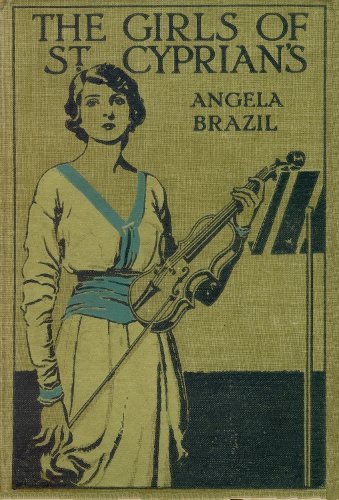
TANTIE TELLS MILDRED THE HISTORY OF HER VIOLIN, WHICH IS A VERY OLD AND VALUABLE ONE MADE BY STRADIVARIUS HIMSELF.
"My brother and I would look with a kind of fascination at the gloomy old dwelling just outside the precincts which the Comte had bought, and at once surrounded with such a very high wall that it went in future by the name of 'The Hidden House'. We used to pass it every day on our way to school, and I remember how, by a mutual understanding, we always crossed the road exactly at the corner near the lamp-post, so as to avoid walking too close to what, in our childish imagination, might be the abode of an anarchist or worse. Your father was my only brother, five years younger than myself, my greatest companion, and my special charge after our mother's death. He had the most charming, lovable, careless, happy-go-lucky, and irresponsible disposition that I have ever known. I fear both my father and I spoilt him, for he was very winning, and when he would ask in his coaxing way it was difficult to refuse him anything. From a little child he had shown the most wonderful love for music. He seemed to learn the piano almost by instinct, and his greatest amusement was to play by ear all the chants and anthems which were sung by the cathedral choir. An air once heard never escaped his memory, and he would put such beautiful harmonies to it, and make such elaborate variations upon it, that I have often listened to him with amazement. Our father was proud of his boy's talent, and, wishing him to play the organ, made arrangements that he should take lessons from the cathedral organist.
"At first Bertram was pleased to have the great instrument respond to his little fingers, but he found the stops and pedals were troublesome and confusing to manage, and he did not make the progress we had hoped for. His one longing was to learn the violin. He used to implore our dancing-master to allow him to try the small instrument by which we were taught to regulate the steps of our quadrilles and polkas, and he would even bribe the blind old street musician who played before our house on Saturday mornings to lend him his fiddle and bow. There was no one in the town, however, whom my father considered worthy to teach him, so he was obliged to content himself with trying to pick out tunes on a guitar which had belonged to my mother, and which he had found stowed away in the lumber-room. One day my brother and I were walking down the narrow paved street on our way home from the cathedral, when, passing by the mysterious 'Hidden House', we heard the wailing strains of a violin. Bertram at once stopped to listen, and seeing that the door in the high wall, which was generally fast locked, to-day stood open, he crept inside the garden, so that he might hear the better. I followed, to try and persuade him to return, but I, too, was so attracted by the enchanting music which flowed through the open window that together we stood concealed behind a syringa bush, almost holding our breath for pleasure.
"I know now that it was a composition of Rubenstein's that Monsieur le Comte was playing, but we had never heard it before. It was a style of foreign music quite new to us, and the wild romance, the weird beauty and pathos, the bewitching, haunting ring of the melody, rendered by a master hand, together with the strangeness of the unusual rhythm, roused my brother to a degree of excitement I had never seen him show before. As the last soft notes sank quivering away, he rushed from his hiding-place, and running up the steps to the French window, dashed impulsively into the room where Monsieur Strelezki stood with his violin.
"'Oh, thank you! Thank you!' he cried. 'I've never heard anything so wonderful in all my life. Will you please tell me what it's called? And oh! if you would play it over again!'
"To say that the Comte was astonished will very poorly describe the scene that followed, but finding that the boy was in earnest, he bade us be seated, and gave us such a bewildering and utterly charming selection of quaint Polish and Hungarian airs that Bertram was wild with delight. He sealed a friendship then and there with Monsieur Strelezki, and whenever he had a half-hour to spare he would hurry away to the 'Hidden House' to listen to more of the fascinating music.
"It was perhaps only natural that the Comte, seeing my brother's enthusiasm, should offer to teach him the violin; and though my father was somewhat doubtful about allowing him to accept so great a favour from our eccentric neighbour, he could not, in the end, resist Bertram's pleadings, so the lessons began. I think teacher and pupil enjoyed them equally, and the boy's progress was simply marvellous. He not only learned with a rapidity which astonished even his master, but about this time he began to compose pieces himself, and could hardly contain his joy in this newly-discovered talent. I would often beg him to write them down, as he was apt to forget them; but he did not like the trouble of transcribing music, and would declare with a laugh that it did not matter, as he always had a new one in his head. His school work suffered very much. He would spend over his violin hours which ought to have been given to preparing Greek and Latin, and my father was often angry over his bad reports. It seemed little use, however, to scold him; he was full of promises of amendment, but he never kept any of them.
"This had gone on for perhaps three years, when one day my brother went round early to the 'Hidden House'. He found everything in a state of confusion and upset. Monsieur Strelezki had died suddenly of heart failure during the night. The old housekeeper had discovered him, when she entered the dining-room in the morning, sitting, as she supposed, writing, with his violin on the table by his side; but the eyes bent over the paper were sightless, and the fingers that still held the pen were stiff and cold. On a half-sheet of note-paper he had written in a shaky hand:
"'To Bertram Lancaster.
"'Farewell, dear pupil and friend! The King of the Musicians has called me. We shall meet no more in this world. I bequeath you my Stradivarius. May it prove for you the key to fame. Remember always that there is only one secret of true success, and that is....'
"But here the messenger had come for Monsieur le Comte, and he had obeyed the summons, leaving the secret he had tried to tell for ever untold.
"As my brother grew older his passion for music seemed only to increase. My father wished him to study law, so that he might in time give him a partnership in the steadygoing old-fashioned solicitor's practice which had been in our family for several generations, but Bertram utterly refused. He had set his heart on a musical career, and after a bitter quarrel with his father, he left home altogether, taking with him the small fortune he had inherited from our mother, and went away with the avowed intention of devoting himself to his violin.
"'I feel I have a future before me, Alice,' he said, as he bade me good-bye. 'I shall solve the Comte's secret yet. If it was talent he referred to' (and he flushed a little) 'I think I've my fair share of that, so perhaps the Stradivarius may really prove the key to fame, in spite of everything!'
"It is a very sad part of the story that comes now, but I must tell it to you all the same. Bertram left us in high hopes, and for a time, while his enthusiasm was fresh, and the change still new, I believe he studied hard at his music. But he had a curious lack of any real effort or steady concentrated purpose. He was always going to do great things, which somehow were never accomplished. I cannot tell you how many operas and oratorios he began to compose, which were to take the public by storm; but none of them was ever finished, though the fragments which I heard were of so rare a quality that they were fit to rank among the works of men of genius. Sometimes he would be at the very height of exaltation, and sometimes in the lowest depths of despair; there were periods of wild ambition, when he was determined to have the world at his feet, but they never lasted long enough to carry him through the whole of an opera.
"A few of his shorter compositions were published, and were very highly thought of by musicians, and he had splendid opportunities of playing at concerts and recitals. His appearances in public were always successful; yet he so often refused to fulfil his engagements, for no apparent reason except the whim of the moment, that the managers grew tired of him. He fell under the influence of bad companions, who led him to neglect his work, and to think of nothing but pleasure, and he had not the moral courage to say 'No' to them. His little fortune was soon spent, and as my father refused to help him, he was obliged at last to earn his bread as a teacher of music. It was in this capacity that he made the acquaintance of your mother, whose father, Sir John Lorraine, could not forgive her runaway match with one whom he considered utterly unworthy of her, and forbade her name to be mentioned again in his presence. You cannot remember her, Mildred, for she only lived long enough to put her little golden-haired baby into my arms, and beg me to be a friend to it—a trust that I have never forgotten, both for your sake and hers.
"After this matters went from bad to worse. Your father, in his grief, took no trouble over his teaching, pupils slipped away, and he also lost the post in an orchestra which for some time had been his chief resource. I helped him to my uttermost, but it was little enough, after all, that I could do for him. His health, never robust, seemed suddenly to fail, and before the year was out he had died, broken-hearted, in the prime of his youth, the success he had dreamt of still unwon. I was with him at the last, and as he put his poor worn hand in mine, he said:
"'Alice, I discovered the Comte's secret too late! Give the Stradivarius to my child. It's the only inheritance I have to leave her. Perhaps my wasted life may teach her to use hers to better advantage, and some day she may meet with the fame and success that I always hoped for but never gained.'"
Mildred sat very silent for a moment or two when Mrs. Graham had finished her story.
"What was the Comte's secret?" she asked at length, with a break in her voice.
"Perseverance and hard work. Talent is of very little use without these. Nothing can be gained in this world without taking pains, and any success worth having must be at the cost of the best effort that's in us. Do you see why I've told you this to-day?"
"Yes," replied Mildred thoughtfully. "I didn't know my violin had such a history. I loved it before, but I shall love it ten thousand times better now. Tantie, I think I'll tussle with the 'Frühlingslied' after all. I believe if I really slave at it I can manage it. It'll be hateful, but I declare I'll try, if I break every string, and wear my bow out in the attempt."
"That's my brave girl! Shall we have a resolutions, not only for the 'Frühlingslied', but for all-round work at school? Miss Cartwright says you can do so well when you choose. Won't you promise?"
"Honour bright, Tantie! I'll do my best!"
CHAPTER IV
Concerns Va
Mildred's resolution to work was a huge effort to her easy-going, unpractical temperament, but she could not have made it at a more favourable time. The new Alliance had aroused a general wave of enthusiasm at St. Cyprian's, and many girls who before had been inclined to shirk were now determined to put their shoulders to the wheel. There is a great deal in public opinion, and while a do-as-you-please attitude had hitherto been in vogue, keenness and strenuousness now became the fashion. The school was divided into "Sloggers" and "Slackers", and the latter were looked down upon, and made to feel their inferiority. Among the seventeen girls who composed Va there was of course every variety of disposition, from Laura Kirby, who was nicknamed "the walking dictionary", to Sheila Moore, who was a byword for silliness. Naturally they had their different little sets and cliques, but these were only affairs of secondary importance; as a Form they were remarkably united, and anxious to maintain the credit of Va against the rest of the school.
It was especially with regard to their seniors that they felt an element of competition. To beat juniors was always a poor triumph, and nothing much to boast of, but the Form perpetually cherished the ambition to (as they expressed it) "go one better than the Sixth". The Sixth were not disposed to lay aside their laurels, so the struggle went on, in quite an amicable fashion, but with a spirit of rivalry all the same. It was the custom every few weeks for each of the three top forms to give a short dialogue in French or German. These had nothing to do with the Dramatic Society, being merely part of the school course, to accustom the girls to converse in foreign languages, and they were performed with very little ceremony before an audience of teachers and juniors. This month a German scene had been apportioned to Va, and Kitty Fletcher, Bess Harrison, Mona Bradley, and Mildred Lancaster were chosen by Fräulein Schulte to represent the principal characters. It was not difficult to learn their short parts, and last term, when once they had committed them to memory, they would have thought no more of the matter until the afternoon of the performance. Now, however, in view of the generally-raised standard, they were disposed to take more trouble.
"I'd just like to show the Sixth what we can do," said Kitty. "Suppose our dialogue turned out better than theirs? It would be such a triumph!"
"It strikes me the Sixth intend to turn the tables, and spring a surprise on us," said Mildred. "I'm quite sure they're concocting something."
"Oh, how did you get to know? What is it?"
"That I can't say, but I heard them murmuring something about a rehearsal, and they all scooted off to the small studio."
"Are they there now? I vote we go and see," suggested Bess Harrison.
The four girls hurried upstairs at once, only to find the door of the studio locked, and the Sixth firm in their refusal to open it.
"I want to get my drawing-board!" wailed Mona through the keyhole.
"Then you ought to have got it before. You'll have to wait now," was the stern reply.
"But I must have it. And my chalk pencils. Let me in just for an instant!"
"I tell you I can't!"
"What are you all doing in there?"
"That's our concern."
"Oh, you are mean!"
"Go away this minute, and leave us in peace. What business have you intruding here?"
Finding knocks and thumps on the door as useless as their entreaties, and that the keyhole had been carefully stopped up with a piece of soft paper, the four beat a retreat. They were consumed with curiosity, however.
"I just mean to get to know, somehow!" exploded Bess.
"Look here," said Mona, "I've an idea. Let us creep out through that skylight window on the landing, crawl over the roof, and then we can peep right down through the studio skylight. We'd see for ourselves then. It would be better than keyholes."
Mona's brilliant suggestion was hailed with joy. The only obstacle which offered itself was the difficulty of climbing up to the skylight. But Mona was resourceful. She remembered the housemaids' cupboard at the top of the stairs, and promptly purloined the step-ladder which stood there. Fortunately it was a tall one, so without any superhuman display of agility they were able to reach the roof. A narrow parapet ran round the edge of the house, which afforded some slight security, but perhaps all four girls felt qualms when they found themselves at such a giddy height. Not one would confess her fear, though, so they commenced to creep cautiously forward in the direction of the studio.
"It's like Alpine climbing!" gasped Kitty as they ascended the steep angle. "We've got to go over that ridge! Oh! I say, aren't the slates hot?"
Giggling a little to hide their tremors, the adventurous four reached the chimney-stack, and paused for a moment to survey the prospect. They could obtain a truly bird's-eye view of the playground and the street beyond.
"I know what it must feel like to see things from an aeroplane," said Mildred. "You just get the tops instead of the sides. Look at those hats down there!"
"Oh, don't let us waste time in looking!" said Mona. "Suppose the Sixth should have gone when we get to the studio? It would be such a stupendous sell!"
Urged by the mere idea of such a fiasco, the girls plucked up their courage again, and pursued their caterpillar-like progress. They soon reached the studio skylight, and, peering down, were able easily to see into the room. The Sixth were still there, and very busily employed. Apparently they were holding a rehearsal, and they were dressed up in costumes suitable to the occasion. Dorrie Barlow wore a large French peasant cap, Kathleen Hodson sported a cloak and top-boots, and Edith Armitage, in a blue silk dress with a train, was evidently a lady of high degree. Sublimely unconscious of the four spies above them, the seniors went on complacently with their work. Most of their conversation only ascended as a general buzz, but every now and then a remark in a louder tone than usual was audible on the roof.
"That's capital, Gertie!"
"No one's an idea what we're doing."
"We routed those Fifth-Formers!"
"Cheek of them to come prying here!"
"They went away no wiser, though!"
"We must hide these costumes."
The spectators above absolutely gurgled with joy, but they were careful not to betray their presence. Making a sign to the others, Mona motioned them to withdraw their heads.
"We've seen enough!" she whispered. "They might look up at any moment. Better beat a retreat now."
Four very satisfied girls climbed back over the ridge of the roof. They had gained exactly the information they wanted, and they meant to act upon it. They considered their action was a benefit to their Form.
"We've done it so quickly," said Mona, who was leading the way, "we shall have time to scoot downstairs, and be just innocently loitering about the playground before the Sixth have finished. They'll never guess!—Oh, I say, here's a go!"
"Why, if the wretched skylight isn't shut!"
This was bad news indeed. With consternation in their faces they crept closer, and tried to lift the skylight up. They pulled till their fingers were sore, but with no success.
"Somebody must have come along the passage and shut it," said Kitty. "It's a nuisance to have to give ourselves away, but I can't see anything for it but to knock and get the window opened."
"Someone's sure to be going along the passage," said Bess hopefully.
So they knocked quietly at first, and then thumped with energy sufficient to break the glass. There was no response, however; not even a solitary junior passed down the passage.
"What are we to do?"
Kitty's face was blank in the extreme.
"The step-ladder's gone too!" squealed Bess.
At that moment the big school bell clanged loudly for afternoon call-over. Waxing absolutely desperate, the girls not only thumped on the glass, but shouted. To their intense relief their signals were heard, and the figure of Rogers, the upper housemaid, hove into view. Calling to them to keep clear of the window, she opened the skylight.
"Whatever are you doing up there?" she enquired tartly.
"Oh, Rogers, do be an angel, and fetch the steps quick!"
The expression on Rogers's face was not at all angelic.
"You've no business out on the roof, and you know it."
"Yes, that's why we want to come down," returned Kitty, "if you'll only let us. Do fetch those steps, please!"
Grumbling to herself, Rogers brought the step-ladder, and held it steady while the girls descended.
"I shall tell Miss Cartwright," she announced. "Larks like these are beyond a joke."
"Oh, Rogers, don't—don't, please!" implored the sinners. "We'll vow on our honour never to do it again. Honest—honest, we won't!"
"I can't have the steps taken out of my cupboard."
"We won't so much as peep through the chink of the door again, far less touch anything."
"Do, please, promise not to report us. Oh, we're going to be late for call-over! There's the second bell."
"Late you'll certainly be, and serve you right!" snapped Rogers. Then, relenting a little: "Well, I won't report you this time; but mind, if I ever catch you meddling with this window again, or touching anything in my cupboard, you needn't expect to get off."
Thankful to escape with nothing worse than a scolding, the four tore downstairs in the hope that they might just be in time to answer to their names, but Miss Pollock was closing the register as they entered the room, and had already marked them down "late". Rather crest-fallen, they went to their various classes—Mildred to practise, Mona to her drawing lesson, and Bess and Kitty to Latin preparation. At four o'clock they met to compare notes.
"After all, I think we scored," said Mona. "We found out what the Sixth were doing."
"Yes, and what we've got to do now is to get up our own dialogue in costume, and not let the Sixth have a hint of it beforehand."
"It will take the wind out of their sails when they see us all dressed up."
"Especially if we do the thing better."
"That goes without saying. I've a far nicer dress at home than Edith's blue silk."
"We shall have to tell Eve and Maudie."
"Of course, but no one else in the Form need know. It can be a surprise for everybody."
As a rule, though the school was obliged to be present to act audience at the monthly dialogues, everybody considered them rather a bore. Even the girls who were taking part had not hitherto been very enthusiastic. They had been regarded strictly as lessons, and not in any sense recreation. This time, however, both the Sixth and the Fifth had a secret—a possession which adds a charm to any undertaking. The Fifth held the decided advantage of knowing their seniors' intentions while preserving silence about their own. They held delightfully mysterious committee meetings in the dressing-room, and private confabulations in the playground. Long-suffering relations at home were induced to set to work with needles and thread, or to lend a variety of articles that would come in for the occasion. On the day of the dialogues several bulky packages were smuggled into school. The girls had been obliged at the last moment to take Miss Pollock into their confidence, and beg her to lock up the costumes in her cupboard until the afternoon, and to secure them the use of a small practising room for a dressing-room. Five out of the six performers stayed to dinner at the College, so they had a little extra time for last arrangements. By dint of hard pleading they had managed to change places with Vb, so that their dialogue came third on the list instead of second.
"That's good biz," said Kitty. "Now we shall be able to sit all through the Sixth's performance, and do our robing while Vb are on the platform. Then we'll just walk on and astonish everybody."
Punctually at three o'clock the whole school assembled in the big lecture-hall, and took their places, small girls in front, and older ones to the back, with a row of chairs reserved for teachers. In spite of the discretion of the performers, some little hint had leaked out that the afternoon's proceedings were to be of an extra special character, and there was considerable whispering and expectation among the audience. The six players in Va had seats at the end of a bench, so that they could make an easy exit when necessary. They watched with keenest anticipation as the door behind the platform opened and the actors in the French dialogue entered. The rank and file of the school had not expected costumes, and clapped heartily at sight of the quaint figures who were standing bowing and curtsying with eighteenth-century dignity. Kathleen Hodson as Monsieur le Duc de Fontaineville was stately in her top-boots, an evening cloak of her mother's flung across her shoulder, and a sword at her side.
"Silk stockings and buckled shoes would have been more in keeping with the period than those boots," whispered Bess to Mildred. "They haven't taken any trouble over details."
"Dorrie Barlow's cap is only made of tissue-paper," triumphed Mildred. "Wait till they see Eve's."
The wearing of the dresses seemed decidedly inspiring to the performers, who gave their short piece with far more spirit than was their usual custom. To be sure, Monsieur le Duc forgot his sword, and, tripping over it, nearly measured his length on the platform, but he recovered himself with admirable calm, and went on with his speech as if nothing had happened. Susanne, the peasant woman, clattered about in a real pair of sabots, but had the misfortune to step on the train of Madame, her mistress, with rather disastrous results, to judge from the rending sound which ensued. Gertie Raeburn was seized with stage-fright, forgot her lines, and had to be prompted; and Hilda Smith, who enacted the Abbé, was distinctly heard to giggle under her ecclesiastical vestments. In spite of these slight flaws the piece was immensely appreciated, and brought down a storm of applause, under cover of which our six heroines of Va slipped quietly from the room.
There was no time to be lost, for they knew Vb's dialogue was only short. Miss Pollock had placed their parcels in readiness, so they opened them with utmost speed and began their toilets. They all helped one another, and made such a record of haste that in exactly ten minutes they were ready, and listening for the applause which would mark the termination of Vb's performance. At the very first clap they ran down the passage; then, restraining their impatience, waited until their predecessors had made their due exit from the lecture-hall. It was with pardonable pride that they stepped on to the platform and watched the look of amazement which spread over the audience. Nobody had expected them to be in costume—that was evident. The Sixth were looking particularly astonished, indeed almost annoyed. There was a discomfited expression on their faces, highly gratifying to the conspirators. Even Miss Cartwright seemed surprised. The little German play had afforded good opportunity for dressing up, and the girls had certainly risen to the occasion.
Bess Harrison, as "Else, the daughter of the Schloss", wore a charming mediaeval robe, with velvet bodice and slashed sleeves; her long fair hair was plaited in two orthodox braids, and she held a distaff and spindle at which she worked industriously. Mildred, her betrothed, was arrayed as a baron of the Lohengrin type, in a short robe of peacock-blue emblazoned with an heraldic dragon in scarlet. Her golden hair was combed loosely over her shoulders, and surmounted by a small ducal coronet. She had a heavy chain round her neck, and armlets on her bare arms. Kitty Fletcher made a stately mediaeval grandmother, in silken gown, stiff ruffle, coif and wimple, and rattled the keys of the Schloss with great effect as she said her lines. Eve Mitchell as the serving-maid had a cap of real muslin, copied from an old German picture, a green-and-black-striped skirt, cherry-coloured stockings, and buckled shoes; while Maudie Stearne, in her capacity of seneschal, almost surpassed the rest in the gorgeousness of her embroidered cloak, chain armour, and winged helmet.
The girls were on their mettle to do well, and played up most successfully. The whole dialogue went without a single hitch, and the actors threw enough scorn, grief, jealousy, alarm, and devotion into their parts to have sufficed for a longer play. As finally, quite flushed with their efforts, they made their bows to the audience, the appreciative school broke into thunderous applause. The Sixth, nobly repressing any spasms of envy that may have assailed them, were clapping heartily, Miss Cartwright beamed approval, and Fräulein Schulte was all congratulations and smiles.
"Really, this afternoon's dialogues have been a delightful innovation," said the Principal. "The addition of costumes makes an immense improvement. It was a coincidence that the two Forms should have thought of it quite independently of each other. You must have been mutually surprised. I am very pleased indeed, girls. It is a step in the right direction when you organize these things on your own account."
"It isn't quite such a coincidence as Miss Cartwright imagines," chuckled Kitty, as she and her confederates disrobed in the practising room. "She doesn't know who peeped through the skylight."
"And we certainly shan't tell her," laughed Mona.
"We've stolen a march on the Sixth," said Mildred.
"Yes, they had to give us the palm this afternoon," agreed Maudie. "I think we may decidedly feel we've scored."
CHAPTER V
An Advertisement Competition
Though the general census at St. Cyprian's had docketed Mildred emphatically as "musical", she was not on that account entirely debarred from joining other societies. True, she was expected to concentrate her energies on her violin, and win credit with it for the school, but so long as she did not claim a leading part in any of the alliance contests, there was no objection to her being an ordinary member. All the girls were strongly encouraged to play games, so she practised tennis in the dinner hour, and took her turn with the rank and file at cricket. She had not the essential characteristics of a champion—her physique was not vigorous enough, and she lacked perseverance—but the exercise was good for her, and as the term wore on she began to exhibit improvement. Kitty Fletcher was in hard training, and had inspired a select number of suitable votaries with a like enthusiasm.
"We shall have a hard fight presently with the High School, so we must show that St. Cyprian's is capable of something," she said. "They shan't have it all their own way. I'm sorry we can't put you in the team, Mildred."
"I don't want to be in the team. I'd much rather look on when it's a question of matches. At present I'm thoroughly enjoying dabbling in all the societies. I've joined the sketching club, and I'm taking a turn at the Literary."
"That's more in your line than mine. I'd rather spend an afternoon at cricket than compose an essay."
"Oh, I'm not doing any real solid writing. I leave that to Phillis Garnett and Laura Kirby. They're hard at work making a magazine number that's to rival the Nineteenth Century or the Hibbert Journal. My contributions are of a very light character. I sent one in the other day, and—isn't it sad?—it was rejected 'with the editor's compliments'. I tackled Phillis about it, and she said the mag. was meant to be serious, not comic. I thought my poem might have livened things up a little, but she'd have none of it."
"Have you got it here?"
"Yes; like the orthodox unsuccessful minor poet, I have it in my pocket."
"Oh, do let me see it!"
"It has the advantage of shortness, and if brevity is the soul of wit, that ought to be a point in its favour," said Mildred, producing her maiden effort. "I call it a 'compressed novelette'. Perhaps I'd better read it aloud to do it full justice. My writing isn't very clear.
"Not half-bad!" laughed Kitty. "I'm afraid it's hardly the style, though, to impress Phillis or Laura. If you could have written it in Greek it might have suited them. What did the others say to it?"
"Haven't had time to show it to them yet."
"Some of them will like it. They're not all as deep as Phillis and Laura. Why don't you get up a little fun among the more frivolous end?"
"It might be worth thinking of if I find an opportunity."
Mildred, who had a strong vein of humour in her composition, treasured up Kitty's suggestion. She knew the bulk of the members could not rise to the height of the learned essay which their leaders considered worthy of the magazine, but they would be quite ready to amuse themselves with work of a less exacting character. Several schemes occurred to her and were put aside, but one day she hit upon something really appropriate, and came to school with visible triumph on her face. At eleven-o'clock break she cajoled the lesser lights of the literary society to a private corner of the playground, and propounded her scheme.
"Look here," she began. "I saw this advertisement in yesterday's Herald, and cut it out:
"Literary.—Wanted, short poems to advertise a famous brand of tea. Prize of three guineas offered for best effort, and ten shillings each for any others selected. Cracker mottoes and comic verses for Christmas cards also considered. Last date for receiving, May 20th.—No. 201x, Kirkton Herald Office.
Well, now, my idea is this. Let's all try and write some verses, put them together, and send them in. It would be such a joke!"
"Could we write verses about tea?" hazarded Maggie Orton doubtfully.
"Of course we can. It rhymes with heaps of things—agree, and free, and qualitee; it shouldn't be hard at all."
"I rather incline towards cracker mottoes," said Clarice Mayfield. "Most that one gets at Christmas parties are such drivel. I've often felt I could make better."
"Then do try. And, Margaret, you ought to be able to turn out some Christmas-card verses. Let's make a syndicate, and pool all our contributions. Everybody to send in not less than one, and more if possible."
"How about the prize, if one of the poems got it? Should we pool that?"
"We could divide it," suggested Myrtle Robinson.
"No, I've a better idea than that," said Mildred. "We'd be public-spirited, and devote any proceeds we got to the school library. We've the most rubbishy set of old books at St. Cyprian's, and want some new ones badly. Who votes for this?"
"Aye! Aye!" came quite unanimously from the girls, though Maggie Orton qualified her assent with a cautious "If we get it".
"Well, that goes without saying, of course. Naturally it's a case of 'first catch your hare'. But there's no harm in trying, so we must all set our wits to work and see what we can manage. It ought to be rather sport."
"Especially if we see the verses in print afterwards," giggled the girls.
"You'd better not tell Phillis," added Myrtle.
"I don't intend to," laughed Mildred.
The various members of the syndicate were rather taken with the idea of the competition, and exercised their brains to the utmost in evolving eulogies of the unknown brand of tea. Some of their effusions they tore up, and some they kept. In the end, after being carefully read aloud and voted on, three only were judged worthy of being submitted. These were by Maggie Orton, Myrtle Robinson, and Mildred herself. They ran as follows:—
You can always quite rely
On our excellent and justly famous blend.
'T is a most delicious cup,
That will tone and cheer you up,
And one that we can safely recommend.
That will rich in flavour be,
So fragrant, so refreshing, and so pure,
Just try our special brand
Of young leaves picked by hand,
'T will give you satisfaction, we are sure.
Good tea to buy,
And oft have found
The price too high,
We recommend
That you should try
Our famous blend.
All crops among,
We mix a blend
That can't go wrong;
For flavour rare
Housewives declare
'T is past compare.
On every hand
Shows to the wise
It takes the prize.
We can rely,
If once you try,
You'll always buy."
Yet that won't be too dear for your pocket,
Try our world-famous blend, when your money you spend,
And remember our branches all stock it.
So come to our shop for your tea,
Our famous, rich, syrupy tea;
If once you will get it, you'll never regret it,
But join in the praise of our tea.
If our world-famous brand you will sample;
'T is the tea ladies love, as the large demands prove.
And three spoons in the pot will be ample.
So come to our shop for your tea,
Our famous, rich, syrupy tea;
Mansion, cottage, or hall, it is suited to all,
The best that can possibly be."
A few cracker mottoes and Christmas-card verses were also selected, and the whole set put together. Mildred, as the originator of the scheme, took charge of them, and promised to send them off in good time for the competition. It seemed no use forwarding them too soon, as they would probably only lie waiting at the Herald offices, so she put them by in a drawer to post when the right date arrived. Now, unfortunately, though Mildred could be extremely keen upon a thing at the moment, once the first excitement of it was over it was apt to slip from her memory. She had enjoyed trying her 'prentice muse at tea verses, but, having finished them, she turned her thoughts to something else. Music was at present absorbing most of her time, and in the interest of her violin the papers lay in her drawer forgotten. On the afternoon of May 20th she was sitting in the studio working at her drawing copy, with no more idea of advertisements for tea in her thoughts than if that beverage had never existed. At three o'clock she was due for her music lesson from Herr Hoffmann, and she was putting in time rather languidly at her chalk head of Venus, and wondering whether the Professor would be in a good temper, or whether he would scold her for faulty rendering of her study. Myrtle Robinson was sitting at the desk behind, and presently contrived, without attracting the attention of the teacher, to hand her a slip of paper. She opened it carelessly enough, and read:
"I suppose you posted the competitions all right? M. R."
Mildred dropped her pencil and broke its point in her agitation. Posted the competitions? She had done nothing of the sort. They were still lying in her drawer at home, though to-day was the last date for receiving them.
"Oh, what a lunatic I am!" she groaned to herself, "I, who suggested the whole thing, and made the others write, to be the one to forget all about it! Something has to be done, that's clear. And it must be done at once, too. I mustn't on any account let the girls know I failed them."
Mildred was impulsive to a fault. At this moment the one business in life seemed to be to get the competitions to their destination, even at the eleventh hour. It was futile to post them, but they might still be delivered at the offices of the Kirkton Herald. There was nothing else for it, she must take them herself, and that immediately. It was almost three o'clock, and the art mistress knew that she had to go to her music lesson. She rose, therefore, received the nod of dismissal, and, ignoring Myrtle's signal demanding an answer to her question, put away her drawing-board, and hurried from the studio. Instead, however, of fetching her violin, and going straight to No. 6 practising room, where Herr Hoffmann would just be finishing Mary Hutton's lesson, she walked to the dressing-room, and put on her hat and coat. She knew she was going to do a most dreadfully unauthorized and unorthodox act, and she shivered to think of the consequences, but she did not hesitate for one moment.
"That competition's got to go in time," she told herself, "even though the Professor rages, and Miss Cartwright storms, and I get myself into the biggest pickle I've ever been in, in all my life. I can't fail the girls now. I couldn't look them in the face again. It would be too ignominious. No, I've a pressing engagement elsewhere this afternoon, and can't keep my appointment with Herr Hoffmann, though I shan't write a note and tell him so!"
At three o'clock it was extremely easy to leave the school unobserved. Nobody was about, so Mildred simply walked out through the gate. She took the electric car home, and was rather relieved to find that neither her uncle nor her aunt was in the house. She felt she would rather not enter into any explanations just at present. The papers were quite ready in an envelope, and duly addressed, so she took them from her drawer, and caught the next tram-car into Kirkton. The Herald offices were in Corporation Street, a business part of the city she did not know at all, but she thought she could find it. She felt rather adventurous and decidedly naughty, for she was not supposed to go on expeditions by herself without first asking leave at home, to say nothing of having run away from St. Cyprian's.
She left the tram at the High Street corner, and turned down Corporation Street. The town was very crowded, and she was almost jostled off the pavement by the numbers of people who were passing to and fro. By dint of asking a policeman she at last found the offices of the Kirkton Herald. She did not know whether she was expected to ring, knock, or walk in, but she could see no bell, and as business men kept passing in and out by a large swinging door, she plucked up her courage, and followed in the wake of a new-comer. She had done the right thing, for she found herself in a big room, having a counter like a bank to divide clerks from customers. She handed in her envelope with a timid enquiry as to whether it was in time.
"Just in time," was the reply. "We close the box-office department at four-thirty."
With a sigh of intense relief, Mildred watched the clerk place her communication in a pigeonhole. So it was safe, and she had not betrayed her trust after all. She felt the satisfaction was worth almost any amount of scolding. She turned leisurely to leave the office, when the big door swung open, and she found herself face to face with no less a person than Herr Hoffmann. Most egregiously caught, Mildred turned crimson, and would have beaten a swift retreat had not the Professor barred the way.
"So, Miss Lancaster! I find you here! Are you then having a violin lesson from ze newspaper? I wait half an hour for you at ze school, and you not come! How is it you fail to-day to be at your lesson?"
Mildred blushed still redder, tried to stammer an excuse, then seeing a twinkle of amusement gleaming under Herr Hoffmann's bushy eyebrows, she took a sudden resolution, and blurted out the truth. She made her little story as short as possible, and the Professor nodded his head with German gravity at the principal points. When she had finished, he chuckled softly.
"So you would turn poets at St. Cyprian's, and write songs in praise of tea? You shall show me ze verses? Yes, some day. But while you write ze poetry, ze violin does not make progress. To-day we were to have taken ze concerto and ze 'Frühlingslied'. Is it not so?"
"Yes," murmured Mildred, much abashed.
"I like not that you miss your lesson. You shall come to me to-morrow at my house, No. 50 Basil Street, and I will hear you play ze concerto. Yes, at four-thirty. You will be there?"
"Oh, thank you!" said Mildred. "Yes, of course I'll come. It's very good of you to make up the lesson."
"Some day you shall read me ze tea verses. Miss Cartwright, is she also satisfied for you to miss school?" said Herr Hoffmann, with a friendly nod, as he dismissed his pupil and turned to the counter.
Mildred hurried home, feeling that she had not only Miss Cartwright to reckon with, but her aunt as well. She had a very open, truthful disposition, and did not dream of concealing her escapade. She told Mrs. Graham the exact facts as they had occurred.
"I just had to do it, Tantie dear! I don't see how I could possibly have done anything else."
Fortunately for Mildred, though Mrs. Graham shook her head, she did not take a severe view of the matter.
"It's extremely good of Herr Hoffmann to make up the lesson," she remarked. "You must try to get in an extra half-hour's practice to-day, so as to have the concerto better prepared. You really don't deserve that he should give up his time to you."
"I'm rather scared at the prospect of going to his house," confessed Mildred. "But I will have an extra tussle with the concerto to-night. I hope he won't ask to see the tea verses."
At five minutes to nine on the following morning, Mildred walked into Miss Cartwright's study, and tendered an explanation of her absence the afternoon before, together with an apology for her behaviour.
"It was a hard case, I own," said the Principal. "But why did you not come at once to me, and ask leave? If I pass over it, you must not let this prove a precedent, Mildred. It would never do for girls to walk out of school just when they like."
"I know. I ought to have come and asked. But somehow I never thought of it. I was in such a hurry, I could do nothing but rush home for the papers. I'll never do it again, Miss Cartwright, on my honour."
"Very well; as you have told me of it yourself, and apologized, I'll say no more about it. You can go."
Mildred passed from the study, congratulating herself that she had escaped so easily. She told her thrilling story to the other members of the syndicate, and they rejoiced together that the competition was received in time.
"When shall we hear the result?" asked Myrtle.
"Not for weeks, I expect. Besides, I don't really suppose that anything will come of it," returned Mildred.
CHAPTER VI
A Chance Meeting
When afternoon school was over, Mildred, carrying her violin in its neat leather case, set off for No. 50 Basil Street. It was not very far away from St. Cyprian's, so she arrived in good time—too early, in fact, for the church clock opposite was only chiming a quarter-past four as she pushed open the gate. There was no mistake about the house, for on the door was a brass plate inscribed "Professor Franz Hoffmann, Teacher of Music", and she could hear from within the halting performance of a violoncellist.
She rang the bell, and after a servant had ushered her in, she was met in the hall by Mrs. Hoffmann, who asked her to come and wait in the dining-room until her teacher should be ready for her. Mrs. Hoffmann was a thin, worried-looking little woman, most palpably English. She knew no language but her own, and had no desire to acquire any other, regarding German as the tongue into which her husband relapsed when more than usually annoyed, and therefore better to be ignored than understood. Perhaps she wished sometimes that such a thing as music did not exist, since from morning till night the strains of violin or piano seemed to echo through the house. The wearying monotony of scales played by leaden-fingered learners, or the excruciating sounds produced by beginners on the violin, were, as a rule, punctuated by shouts from the exasperated master, who, being of a naturally excitable disposition, was liable to let his impatience get the better of him, and would storm at his pupils in a mixture of German and English calculated to reduce them to utter subjection.
"Young Mr. Hardcastle is having his lesson," explained the Professor's wife. "I'm afraid he hasn't come very well prepared," she added nervously, as a specially badly-rendered shake provoked a perfect explosion of wrath, quite audible through the thin wall. Mildred was left alone to wait, so she sat down by the window, listening to the performance of the pupil in the next room. She groaned as she marked his wolf notes and his lagging time, fearing that his sins might afterwards be visited on her head. She was doubtful about her own concerto, and wished she had had more time to practise one particularly-difficult phrase. She tried to amuse herself by turning over some piles of music that lay on the table, or staring aimlessly out at the sparrows in the front garden.
A smart motor-car stopping at the Professor's gate presently attracted her notice, and she looked on with interest as a handsomely-dressed lady got out, walked hastily up the path, and rang the bell with a lusty peal. There seemed to be a short colloquy in the hall, then the dining-room door was flung open, and the servant ushered in a stranger, who, it appeared, must also wait until Herr Hoffmann should be at leisure to attend to her. She seated herself in an arm-chair, and for some minutes there was dead silence, broken only by the ticking of the clock and the rasping notes of Mr. Hardcastle's violoncello.
Probably finding the situation rather oppressive, the lady, after looking several times at Mildred, seemed anxious to open a conversation.
"I suppose you're one of Herr Hoffmann's pupils," she began, with a glance at the violin-case which lay on the table. "May I ask if you've learnt from him for some time?"
"About five years," replied Mildred, wishing the Professor would hurry, for she always felt shy with strangers.
"Indeed! Then you must have begun young. How old were you when you took your first lesson?"
"Not quite seven; but I learnt from a lady to begin with," said Mildred, listening to Mrs. Hoffmann's step in the passage, and wondering if she were coming to the rescue.
"My little girl's much older than that—she's nearly eleven. I'm sure she ought to commence her lessons at once. I should have sent her to Herr Hoffmann long ago, but she's such a nervous child, and I've always heard he's so very severe. Now, as you've learnt from him for so many years, you'll be able to tell me exactly what he's like. Do you find him a kind teacher or not?"
Poor Mildred scarcely knew what to reply.
"He makes you work," she stammered, hoping, for the Professor's sake, that the remainder of the unlucky Mr. Hardcastle's lesson might go with sufficient smoothness not to give rise to any more expressions of noisy indignation from the adjacent room, and looking anxiously at the clock.
"So I expect. And how long do you practise every day?"
"Two hours at my violin, and one at the piano."
"I should never persuade Dorothea to do that!" cried the lady. "But perhaps just at first an hour would be sufficient for her. Is this some of your music? May I look at it?"
Without waiting for permission, she took up the pieces which Mildred had laid on the table by the side of her case, and was beginning to turn them over when she stopped, evidently struck by the name "Mildred Lorraine Lancaster" written on the covers.
"Excuse my asking," she said, looking up quickly, "but Lorraine is such an unusual name that I wonder if you are any relation of the Lorraines of Castleford Towers?"
"Sir Darcy Lorraine is my uncle," replied Mildred rather stiffly, for she thought the question inquisitive.
"How very interesting! I frequently visit Lady Lorraine; my sister's home is in that neighbourhood. Isn't the Towers a beautiful old place?"
"I believe so," said Mildred briefly.
"I suppose you often stay there, though I don't remember having seen you before?"
"I've never been there at all," returned Mildred, wondering how she could stop the conversation.
"Really! And yet you must be just about the same age as Violet, and Sir Darcy is always regretting that she has no companions. Are you older or younger than she is?"
"I'm not sure," murmured Mildred, much embarrassed.
"Now I look at you," continued the lady, "I notice a most distinct likeness, though your eyes are brown, and Violet is so very fair, isn't she?"
"I don't know."
"You don't know? Why, surely you've seen your own cousin?"
"No, I haven't," said Mildred, getting quite desperate, "I've never met any of them in my life."
"How very strange!" exclaimed the lady. "Surely Sir Darcy and Lady Lorraine——"
But here, to Mildred's intense relief, the door opened, and the Professor entered, bland, smiling, and full of apologies. Patting his pupil's shoulder with the fatherly air that generally impressed parents, he asked her to wait for him in his study for a few minutes. She caught up her violin, and retired thankfully, wondering whether she had said too much. Until now it had not occurred to her to think at all about her mother's relations; but she saw how curious it must appear to a stranger that she should never have seen either them or their home, and for the first time she experienced a feeling of something like anger at their neglect. It had been humiliating to be obliged to confess that she knew nothing of a cousin whose existence indeed she had scarcely been aware of till to-day. Though her aunt had told her a few details about the Lorraines, the subject had been so closely connected with her father's sad story that she had not liked to reopen it by asking further questions. She had been quite content to regard herself as the adopted daughter of the Grahams, and had not identified herself in any way with her more aristocratic connections in the north.
She considered that the lady had taken rather a liberty in asking her so many questions, and heartily wished her full name had not been written upon her music, thus giving an opening for the enquiries.
"Well, after all, it doesn't much matter. I don't suppose I shall ever see her again," she mused.
It was, however, a strange coincidence which had brought about that afternoon's meeting, and it was to be fraught with more consequences than she suspected. It is seldom we realize the small beginnings that often determine great changes; and as Mildred dismissed the matter from her mind, she little foresaw that from a ten-minutes' conversation might issue events that were to form a crisis in her life.
Meantime Herr Hoffmann, having escorted his visitor to the waiting motor, entered his study once more, and the lesson began. The prospect of a new pupil had perhaps soothed the Professor's mind, for he was in a far better humour than Mildred had dared to expect. The eyes behind the big spectacles beamed upon her quite amiably, and the large collar, which he had a habit of crumpling up when annoyed, was stiff and immaculate. Mildred generally regarded her master's collar as a storm-signal, and could gauge his temper by its condition the moment she caught sight of it. As she was sure it must have suffered very much during Mr. Hardcastle's lesson, she could only conclude that he must have donned a fresh one before interviewing his caller, and hoped devoutly that her own playing would not cause him to disarrange its spotless expanse.
She went through her exercises and study to-day without any mishaps, and with a few misgivings began the concerto. But here she did not fare so badly as she had feared. To her surprise the troublesome bars came quite easily, and catching the spirit of the music, she played it with such vigour and expression that the Professor nodded his head in stately approval.
"So! You have worked!" he said. "It is not yet perfect, but it make progress. You take more pains since these last weeks? Yes? Oh, I can tell! I do know when a pupil does her sehr best. Sometimes you come to me and do say you have practise two hours each day. But I find you not improved. Why? Because it is practice without ze mind. Of what avail is it, I ask, for ze fingers to play if ze attention is not there? If you would a musician be, you must have both ze body and ze soul of your piece. Ze right notes, ze true time, ze correct position of your bow, they are ze flesh without which ze composition cannot at all exist, and need your altogether utmost care. But there are many people who know nothing beyond. Himmel! Any mechanical instrument can grind out a tune. True music is to give ze world what it cannot make for itself. Ze great composers leave to you indeed ze score of their works, but it is ze beautiful body without life, and it is you who must put into it a soul!"
Herr Hoffmann so seldom gave any words of encouragement that Mildred flushed with pleasure, and ventured to tell him that she had made an effort to conquer the difficulties in the "Frühlingslied", which she had thought before it was quite impossible ever to accomplish.
"That is good! We will hear what you can do," declared the Professor, opening out the music, and tuning his own violin, ready to accompany her. "Begin gently. Wait! Imagine ze 'cello which is here introducing ze motif. Now you come in and take up ze melody. Let it sing, for it is like a joyous bird, carolling on ze topmost bough. It is a 'Frühlingslied'—ze song of spring—and you must make your instrument to tell of ze blossom time. Quick! That shake is too slow. Remember it is ze bird that is trilling. Now softly! Softly! Let it die away, before all ze orchestra burst into ze chorus. Das ist sehr gut, mein Kindlein! We will rehearse it again, and if you can master ze staccato passage, you shall perform it at my students' concert."
"Oh, I couldn't! I couldn't!" cried Mildred in alarm. "Please don't ask me. I should break down. I know I should."
"Unsinn!" (which is German for "stuff and nonsense") cried the Professor. "You will do what I say. Am I your teacher, and you refuse to play when I tell you? Nein! You shall work at ze 'Frühlingslied', and each Saturday afternoon you shall come to rehearse it with my students' orchestra at ze Philharmonic Hall. Yes, I have said it!"