
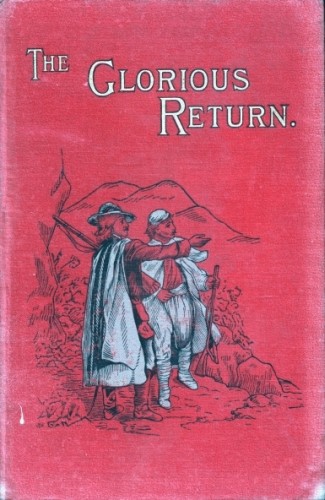
He lifted the ivy trails and stood a moment, peering into the dimness. These mountain caves held strange creatures now and then.
From out of the darkness came a sudden cry.
‘O Gaspard, O Gaspard! is it thou?’
He staggered. He was worn and faint, and just at that moment the hope was dim of finding those he sought. His brain whirled round; he put his hand to his eyes, bewildered.
Then a woman’s arms reached out to him, and confused words, and little cries of joy, and short sobs came in broken gusts and silences.
‘Gaspard! Oh, thanks be to God! Thou art living then, Gaspard! Mother, mother, awake! here is he, our Gaspard.’ And Rénée clung to him and hid her face against his breast.
They were safe then, as yet! And his voice came back to him as he knelt to kiss his mother’s hand and cheek. Ah, the swords of the duke were sharp, the desolation of the valleys was drear, the house-father was an exile, and Emile lay in his gory grave; but an offering of heartfelt praise went up to God’s throne as the re-united ones held each other’s hands and thanked the Lord that day.
There was much to hear on either side, and the women’s faces grew very grave when Gaspard told them what had happened in the valleys of Luserna and Angrogna. Cannon and cavalry had been too much for the mountaineers in the villages and on the roads, and treachery had beguiled them from the entrenchments on the heights to which they had fled. The Savoy general had offered, in the duke’s name, safe and honourable treatment for themselves, their wives, and children, if they would throw themselves on their conquerer’s clemency. The words were fair, the terms all they dared expect. They trusted the promise and laid down their arms.
How their trust was betrayed is a long and shameful tale. Some were led in chains to the fortresses of the plains, some were executed then and there, many were destroyed by the brutal soldiers, and two thousand little children were handed over to Roman Catholic families to be trained in that religion.
Thus it was that Victor Amadeus conquered—for the same thing had occurred in all the valleys, although Gaspard only knew what had happened near at home. Perosa and San Martino had been treated with like barbarity and deceit. The scenes at the rocks of Vadolin were to the full as heart-rending as what Gaspard could describe.
‘And thy father?’ Madeleine’s eyes asked the question which her lips could scarcely frame. ‘Thy father, what of him?’
Gaspard rose to his feet and leant against the rock where the dark cave-shadow almost hid his countenance.
‘Ah,’ he said, ‘I have been well-nigh torn in twain betwixt my desire to find you, to know that thou and Rénée were out of the clutches of yon——’
‘Name them not, my son,’ said Madeleine; ‘hard words hurt only the heart from which they come.’
‘Words? Aye, it is not with words I would meet them!’ the young man said between his teeth.
‘And thy father?’
‘He is wounded. He was thrust at with a lance when trying to defend Marie Rozel. You remember old Marie? the widow who gave us goat’s milk when we were lost in the hill-mist long ago, Emile and I, and Rénée—thou wert a tiny child then, Rénée. They—well, they killed her at last, in spite of all that my father could do.’
‘Where is he?’ Madeleine Botta had come close to her son and was holding his arm. ‘Oh, Gaspard, ill, wounded as he is, surely he is not alone? Let us go to him.’
‘Mother, to cross the valley, to go down by the river in broad daylight—it is death, certain death, or worse. Nay, I will creep back to him, and bring him word how you fare. He will revive when once he knows that you and Rénée are safe. It was to get news for him that I am come. But how have you lived here? Have you food? fire?’
So they showed him their store, the bag of rye-bread Rénée had stolen down to Rora to fetch from a secret hiding-place; the dried grapes, the chestnuts, the flour—which last was useless, since they dared not light a fire; and then, stepping forward, the girl called softly once and again. Presently two or three goats came pushing their way through the ivy, rustling beneath the glossy leaves, and nodding their sage sharp heads as they came.
‘The others have been killed, I suppose,’ said Rénée sadly; ‘but these give us milk enough and to spare.’
Gaspard watched her as she stroked the creatures that were pressing against her knees. All dumb things seemed ready to love Rénée, and it was no wonder.
Madeleine sat silently. Her heart was full; her lips were quivering; the iron was entering her very soul. God had required much from her—her happy home, the quiet contentment of her failing years; then the life of Emile, her eldest born; and now Henri, the husband of her youth, her strong Henri, was stricken. Was his life to be taken too?
This woman had come of a race of martyrs: she had been cradled in terror, and reared amongst dangers and blood-spilling. She knew, none better, what it meant to take up Christ’s cross and follow Him along the path that leads to where the shadow lies across the shining Threshold. Her nature was brave, as befitted a child of the hills; her soul was filled with a high and sacred faith that had been lighted by God’s Gospel and nourished by His grace.
But now, there, in the cavern, the grief, the pity, the despair of it well-nigh overcame her.
‘O Lord, how long, how long? Must Thy people be outcasts for ever? for ever down-trodden and slain? Canst Thou not hear in heaven Thy dwelling-place, and when Thou hearest wilt Thou not aid?’
Just now, in her hour of agony and sore dismay, she was too near to pain to see its glorious crown, too close to the shadow of death to behold the shining gate. Not only for her and hers that crown and shining should be, but for ever unto the uttermost ages the Church of Christ is fairer for what then the Vaudois bore! Not a tear nor drop of martyr blood fell then unmarked, for not only on earth but in heaven is the death of God’s saints held ‘right dear.’
CHAPTER IV.
RENEE, if God gives me life, I will return; I will return here to thee.’
So said Gaspard Botta as he parted from his promised wife in the cavern on the cliff.
He had stayed long enough to gather them a store of wood and firing. He had even crept down in the darkness to the ruined home, and, with the silent hunter-craft of his nation, had managed to evade the Savoy soldiers while he loaded himself with things which he knew his mother and Rénée must need.
A dangerous service—yes, but existence was just one long course of danger in those months to the Vaudois.
Madeleine had urged him to go back to his father. She herself would have chosen to dare all things, and go also. To stay in that cliff-cage, hiding in silence, with no knowledge of how it fared with her nearest and dearest, would be a terrible strain and trial; the risks of crossing the Luserna valley and the heights of Roussina and Mount Vandalin, watched as they were by the duke’s troops, would be as nothing compared with the waiting and the longing for news there in the cave.
But Gaspard, who had threaded the passes and forded the torrents swelled with melting snows, who had doubled and dived and scrambled like the hunted thing that he was, implored her to stay in the comparative safety of their hiding-place.
‘It is far to where I left him,’ he said; ‘out there below La Vachère. And if thou didst reach him, mother, they would but tear thee from his side. The men were driven off in gangs to Luserna, and the women——’ He paused, and the dark look came again into his face. ‘The women were taken too, some of them, and the little ones—— Oh, mother, be satisfied! rest here, thou and Rénée, and if God pleases to hear my prayer I will come again, and bring my father, should I carry him on my shoulders.’
And so he left them; and for days, and yet again for days, they watched and waited for his coming back across the torrent, and round by the huge rocks that rose sharp and sheer from the water to the fringes of the pines. But they waited in vain.
And as the time wore on they saw from their point of vantage that the soldiers had left Rora, or only scoured the land at intervals; and Rénée ventured down from time to time to the desolated village, filling her basket with such fruits and food that the ruthless robbers had chanced to spare. Seeking, too, if there might be other fugitives perhaps more helpless and terror-stricken than themselves—to whom Madeleine and she could give a word of cheer or hand of help.
And so the spring deepened into summer, and the skies were stainless blue above them; and the sunlight of many blossoms shone over the grass; the pines shook their yellow dust in clouds into the scented air; and the brooms opened their dry seed-pods with sharp reports, as of fairy artillery.
It was hard to believe that only so few weeks ago human lives had been sobbed out in agony—there in that beautiful world—and that rage and cruelty had wrought their worst wickedness in the sacred name of Christ.
So quiet was it, that at last the two women went back to Rora, finding shelter amongst the ruins of what had once been their home. One or two other hunted and bereaved ones crept back also, like them waiting for news, hoping still in their faithful hearts that better times would come, and those so dear to them would be delivered from the jaws of death.
Rénée would look wistfully northward and westward, where the great violet peaks rose into the summer sky. Would Gaspard come that day? the next? Deferred hope that maketh the heart sick was heavy upon her; she longed to find her way down the valley to the outer world, and learn for herself what had befallen. Inaction and waiting were the hardest of trials to this girl, child of the mountain as she was.
Patience, Rénée! The time for doing will come. The blood of heroes does not flow uselessly in your young veins; ‘to do’ comes by nature to hearts like yours; ‘to wait’ is a lesson taught by care Divine.
Some stray reports penetrated even to the far recesses of this valley, the most southern of all the Vaudois dwelling-places. Some wandering folk would come from Vigne or Villaro, outcasts like themselves, whom they might question. Any well-to-do traveller, any body of men, any strangers who looked happy and well-fed, must be avoided and hidden from, for they would certainly prove to be enemies, who considered all the Vaudois to be under the ban of the Church, and therefore to be driven to a Luserna prison, or hunted down and slain.
But from one and another the story was brokenly gathered—the story of what had chanced beyond the hills, and what sort of measure the duke had dealt to his conquered people.
Exile. That had been the final decree.
The Vaudois were to be driven out; their hills should harbour heretics no more. Once and for all Savoy should be cleared from them and their doctrine. As Louis had purified the soil of France, so Victor Amadeus would purge Piedmont.
The prisons were to be emptied. The twelve thousand men, women, and children shut up in the several fortresses must go. To Switzerland, since the Swiss would receive them—but across the Alps, and out of the valleys at any cost, and any whither.
Twelve thousand? Could there really be so many? Henri Botta and his son Gustave were amongst that great and dreary company.
The sentence fell on the hearts of those two women like a leaden weight.
They, too, must go to Switzerland.
That was the resolve that grew strong in each before they dared to say the words one to the other. They were silently counting the miles, the mountains, the dangers that lay between them and the country where their dear ones had been driven. And each dreaded the objections which the other might urge.
‘But, Rénée,’ Madeleine Botta held out her withered hands imploringly, and her sunken eyes were moist as she spoke—‘Rénée, we must go to them, since it may not be that they can come to us.’
The girl’s face shone with the swift up-leaping of the hope that was strong in her.
‘Yes, mother, we will go; and God will lead us safely through!’ was her answer, spoken with the fervent simple faith that had sprung strongly up in Vaudois hearts under that red-rain of martyr blood.
But not yet was the ‘leading’ to come.
CHAPTER V.
THEY set out, their bundles on their shoulders, walking openly in the daylight without attempt at disguise; seeking, it is true, the less frequented paths, and avoiding observation as much as possible. They were so inoffensive, so insignificant, this woman and her foster-child; surely few would notice them or hinder them—now that the bitterness of the persecution had died down.
Sorrowfully were they mistaken.
They had not lost sight of the white ridge of Mount Friolent, nor crested the pass leading toward Villaro, before they were stopped and questioned by a band of preaching friars who were busy establishing their churches and schools in the country whence ‘the heretics’ had been driven.
Madeleine’s courage rose with the first hint of danger. She had no idea of softening or disguising anything, and answered back so dauntlessly that Rénée’s cheeks grew white as she listened; though the girl herself had no lack of truth nor of courage. Words are in these nineteenth-century days little else than easily stirred air; to those defenceless ones just then they meant all the difference betwixt life and death.
The friars consulted together and shook their cowled heads, looking not unlike birds of prey gloating over some poor trapped wild thing. They said that the women were firebrands, and far too dangerous to be allowed to go through the land—that the duke allowed none of the so-called Reformed religion to dwell or pass in Piedmont; and that Mistress Botta and the girl must travel in their company to Luserna, ‘where further decisions would be arrived at.’
That night the two women found means of escape. They gained the open air, the hills, the steep and intricate ways known only to the people of the valleys; and presently, after some days of wandering, they found themselves once more in their cavern. The tears rolled down Rénée’s cheeks as she entered—it was present safety, indeed, but must they still wait there, and watch for the footsteps that might never come—for the news which seemed further from them than ever?
Then Madeleine fell sick. Some slow fever consumed her; and for days and nights she lay so ill that Rénée could find no place in her thoughts for aught but ‘mother.’ And when at last she seemed to revive somewhat, and her wandering reason returned to her, she was so exceeding weak and frail that the girl feared she would die from very weariness.
It was hard to get necessaries, harder still to obtain the food fitted for a sick woman’s needs, but Rénée never flagged nor faltered all through that terrible time.
She drove the straying goats from the mountain, that her mother might have draughts of their milk; she managed to make charcoal of her store of dry wood, and that so carefully that no volume of smoke or flame could betray their hiding-place. She ran down to the valley for the few bunches of grapes which might yet be left on the broken and neglected vines; and once, but only once, she dared to enter the village of Rumero, where she bartered her own long silver chain for a warm coverlet for Madeleine.
And the autumn came, and the winter. And the icicles had been hung across their cave, and the raging winds had careered there, while the avalanches thundered amongst the higher Alps, and the sunsets lay crimson on the bosom of the snows. Then came the creeping warmth and the blessing of the spring, and the sick woman revived, as did the flowers where the sunshine made glory on the springing grass.
Madeleine Botta rose from her rock bed almost as hale as ever, and her voice had scarcely lost anything of its fulness when she sang that evening hymn, the ‘Psalm of Strong Confidence.’
But Rénée, as the light grew longer and the sweet benediction of the year stole over the frost-held earth, as the swollen streams leapt laughing down amongst the flowers, and the song-birds called in music one to the other, Rénée grew silent and sad.
Life would be easier now. Her mother was in no danger of death or suffering. There would be little to do up there in their cliff cave. Little to do but to wait.
Ah, and the waiting time is the hardest time to such hearts as that of Rénée Janavel.
CHAPTER VI.
GASPARD BOTTA was not one to be easily baffled or beaten; he was young, with muscles of iron and thews as of steel, and he had, moreover, the caution and resource of a hunter, the endurance and the keen eyesight of a mountaineer.
His faith was the faith of his fathers, and for it he would die, readily, unshrinkingly, as his fathers died in the terrible days of the past, and as he had himself seen his countrymen die here, in every hamlet, and by every hearth and home.
But of the actual love of God he knew but very little.
He had meant to do his duty. He had prayed a soldier’s prayers, and he had trusted that help Divine would come to him, as it had done to others; to such men as Janavel, and Laurene, and Jayer, men who had gloriously fought in defence of the valleys, and whose names would live while Vaudois hearts yet beat.
But some glimpse of a faith better than this came to him as he left his mother and Rénée in the cave that day.
He could not have put the feeling into words; he scarcely knew when or why, but as he took his lonely way towards the mountains of Angrogna, a sense of God’s presence came over him—a searching, demanding presence—a power and a gentleness that asked, not only for his life, but also for his love.
There was the hoarse note of pain ringing through the valleys, the boundless pain of desolation and distress. Why, then, should such thoughts come to him, one of those smitten ones who had suffered, and who yet must suffer? Gentleness—love? surely here on the south slopes of the Alps there was in those terrible years more evidence of the outpouring of God’s wrath!
But into the young man’s soul there stole some glimpse of the Light that shineth in darkness, of the Love that is behind all wrath, of the Joy that is greater than pain. Not suddenly, but softly and sweetly, even as the spring-time comes upon the coldness and dumbness of the winter-world. He was only a herdsman’s son, and his carpentering trade had left him little leisure even for such poor scholarly lore as penetrated to the valleys, but he had heard of One who had also been an outcast, hunted, and done to death; of One whose days were days of suffering, and whose nights were spent in lonely watchings beneath the stars.
And the remembrance of that One came to him now in his own lonely vigil. The Master who had wandered on the Syrian hills, who had stood silent before murderous men; and in heaven, from the great white height of His glorious throne, He yet feels for His brethren who, through great tribulation, are pressing to His feet.
Gaspard understood things better now. There was love, and there was gentleness, in spite of the sharpness of that cry of human pain. And Gaspard knelt mute upon the hill-side, with a look upon his face that had never before rested there, a look too full of love for fear, and yet which was too near to awe to take the semblance of gladness.
It seemed to him as though he knelt with his whole soul bare before the glance of God.
The days that followed were full of excitement, anxiety, and trouble. His father had been taken to Luserna, together with all the rest of the valley folk, and there Gaspard followed. It was rather like a lamb searching the den of a wolf, this going into the very stronghold of the Papists; but Gaspard had no thought of evading the duke’s troops now. His first duty was to find his father, to tend him, if so it might be; and to carry to him the news of the safety of those two women—news which would go far, so Gaspard guessed, to calm the fever left by that Savoyard lance-thrust.
It was easy to find a way to the interior of the prison, for Gaspard had only to declare that he too was a Vaudois when he was seized and flung into the fortress already full to overflowing with his wretched countrymen; and amongst that pitiful host was his father.
The horrors of that imprisonment will never be fully known now. An old writer says that the Vaudois perished by hundreds of hunger, thirst, and the festering of neglected wounds. Their bread was rough and filled with rubbish, their water was impure and insufficient. The places of the dead—numbers dying every day—were filled with fresh prisoners; the intense heat of summer, the throng of sick and suffering ones, and the crowded state of every corner of the dungeons, made a mass of evil too horrible for recital.
Was not this harder to be borne than were the savage swords of the soldiery, than the fighting at the barricades, than even the brutal insults of victorious foes? For in the past there had at least been the clear air of heaven, and the heart-stirring of struggle; now there seemed only the blankness of noisome despair.
What was it that Henri Botta’s parched lips were murmuring as he lay in uneasy sleep across Gaspard’s knees? The young man bent to listen, and the broken words he caught were of peace and of beauty, of rest for the weary ones, of the waters of comfort, and the loving-kindness of God.
The old herdsman’s rugged nature had also found some trace of gentleness and love amid all this chaos of dismay.
‘It must be that the Lord Himself is pitiful,’ thought Gaspard, ‘and He Himself sends comfort to such as are sore stricken.’
Over and over again did that thought return as he watched frail women rise triumphant above the power of pain, and men—just the rude and untaught peasants of the hills—meeting insult with dignity, and outrage with a smile.
‘Be of good cheer, my children,’ said one, an aged pastor from Angrogna, ‘our Master bore shame and death for our sakes, and shall we shrink from sharing the glory of His cross? Rather thank Him that such as we, the simple valley-folk, are reckoned worthy to follow where He trod!’
They counted twelve thousand captives that were held in the vile durance of the gaols; if it were so, death had opened the prison gates to hundreds upon hundreds of the suffering souls, for it was but three or four thousand men, women, and children whom the Duke of Savoy at last set free. Did he call it ‘freedom’?
They were free to leave Piedmont, to take their wretched lives and their precious faith to other lands, but they were not free to return to the valleys. Homeless exiles, ruined wanderers, they might go north or south, east or west; but their homes on the hill-sides should know them no more.
CHAPTER VII.
THE autumn had come, the snow already whitened the Alpine passes; soon the glittering mantle would lie thick on all the hills, and the whirling winds would form deep drifts, and the avalanches come thundering down, and the passage of the Alps would be dangerous exceedingly.
But the order came, imperious, unevadable—the Vaudois were to go.
They would rather trust themselves to their own mountains, to the ice and snow, than stay in those fated prisons; but disease had enfeebled them, imprisonment and bad air had poisoned those whom death had spared. It was a woeful company that set out upon that long and dangerous road.
One of their own historians[A] writes thus of that terrible journey:—
[A] Monastier. Translated from the French.
‘The Vaudois travelled in companies, escorted by the soldiers of the duke. They had been promised clothing, but only a small number of jackets and socks were served out to them. It was five o’clock
in the afternoon, at Christmas-tide, when their liberation was announced, with the addition that if they did not set out forthwith it would be out of their power to leave at all, for the order was to be revoked next day. Fearful of losing the chance of liberty, these unfortunate persons, wasted by sickness, set out on their march that very night. There were old men amongst them, worn down by sufferings as well as by years, besides women and children of the tenderest age. That night they marched three or four leagues through the snow, in the most intense frost.’
This first march cost the lives of a hundred and fifty of them. Was it wonderful that these died?
A few days later on at Novalèse, at the foot of Mount Cenis, a troop of the prisoners noticed that a storm was rising on the mountain; they knew well what mountain snow-storms were, and they begged the officer who was in charge to let them stay at Novalèse for a while, out of pity for the weak that were to be found in their ranks. If their request caused delay, they said, they would not ask for food; there was less danger in going without food than in travelling in the face of the storm. The officer refused. The company was forced to proceed on its march, and eighty-six sank in the drifted snow; they were the aged, the worn out, women, and some little children. The bands that followed days after saw the bodies lying frozen on the snow, the mothers still pressing their children in their arms.
Henri Botta would never have survived that journey of toil and horror, had his son Gaspard’s arm been less strong and his heart less brave.
Gaspard devoted himself to his father with the whole force of his silent nature; it seemed as though his love for Rénée, pent up and baffled as it was, sought an outlet in this older, less selfish love, and touched it with an enthusiasm which was glorious to behold.
No fatigue seemed to weary the young elastic frame, no privation had power to damp the calm courage which was always ready to cheer and brighten the dark hours of trial.
He had made friends with one of the guards, a soldier whose people he had known in Turin, and from him he managed to get now and then an extra bit of bread, a blanket, and some handfuls of roasted chestnuts—poor and pitiful provision for such a weary way, but to Henri Botta it made, perhaps, the difference between life and death.
Down the steep hill-passes the Vaudois came, troops of gaunt and toil-worn men, large-eyed, weary women, and children who had already learnt the lesson, so strange for childhood—to suffer and be silent. Down on the shores of the Geneva lake, where the winter sun was shining on the ripples until they flashed again like liquid diamonds. Along the ancient roads where many an army had passed before them, but never one so disconsolate and poor; and up to the gates of the town, whence the citizens came hurrying with eager welcome.
They were generous in their kindness, these people of Geneva. Not only welcoming words, but help, food, rest, comfort were freely given to the outcast children of the Alps. Company after company came winding down the mountain sides, but instead of being frightened at such claims upon their charity, the Swiss contended among themselves for the honour of aiding these, their persecuted brethren.
Once more we translate from the Vaudois historian, for the simple statement is more eloquent than modern words can be:—
‘Two thousand six hundred Vaudois were received within the walls of Geneva, the feeble remnant of a population of from fourteen to sixteen thousand. Moreover, they were either sick or worn out with fatigue and anxiety, and but ill protected from the rigours of winter by the old garments they had worn in prison. Some there were whose lives ended the very moment their liberty began; these expired between the two gates of the city, too weak to bear the strange sense of joy. But in proportion as the wounds to be dressed were deep, the loving-kindness of the Genevese rose high. They contended with one another who should take home the most destitute; if the invalids and sufferers had any difficulty in walking, men carried them in their arms into their houses. The heavy charge to the state and the people was cheerfully accepted. From the time they had heard of the cruelty of Louis XIV., and of the edicts of the Duke of Savoy, the Swiss had been preparing to offer aid; and when they knew that the Vaudois were to be exiled, and coming to Switzerland, these preparations were redoubled. Five thousand ells of linen were made into garments, and an equal quantity of the woollen stuffs of Oberland. Hundreds of pairs of shoes were laid up in depots. The different cantons distributed the refugees amongst them in a fixed proportion, and the liberality and compassion knew no bounds.’
There was a letter written in July, 1688, signed in the name of the Vaudois by Daniel Forneron and Jean Jalla, a letter yet existing in the archives of Berne. ‘We have no language strong enough,’ it runs, ‘to express our gratitude for your favours; our hearts, penetrated with all your acts of kindness, will publish in distant parts the unbounded charity with which you have refreshed us and supplied all our need. We shall take care to inform our children and our children’s children, that all our posterity may know, that, next to God, whose tender mercies have preserved us from being entirely consumed, we are indebted to you alone for life and liberty.’
. . . . . . . .
In Geneva, in the early days of 1688, there were aching hearts as well as those that were joyous and thankful. It was delightful to be at rest, to see the sun rise and set, to feel the pure air, and to wander free beneath God’s sky. It was strangely sweet to meet together in the churches to sing the praises of the God who had helped and delivered, to hear His Word read in the tongue the people could understand, and know that at last they might worship Him without fear or hindrance.
But the pain that mingled with the gladness was very sharp.
Husbands searched through each arriving company for the wives they had been parted from in the days of the fighting in the valleys. Mothers sought for their sons with hopes that grew fainter with each day that brought refugees, indeed, but not the familiar faces they longed to see. Parents sorrowed for their little ones who had been torn from them and handed over to the Romish convents and schools—the children would grow up to despise them and their religion, and in the coming time, these, who were flesh of their flesh, would be ranked with their enemies.
And how many lay dead, away there beyond the white peaks rising like a giant’s rampart against the eastern sky! Dead, in the nameless prison-graves or beneath the winding-sheet of the Alpine snows.
CHAPTER VIII.
IN a Geneva street, where the steep red roofs almost met across the way, in a tall house with a silversmith’s sign swinging above the door, lived a Vaudois who had been exiled years ago—the hero of Rora, Joshua Janavel.
The coming of his countrymen stirred him as a trumpet-note might stir an old war-horse. He could only see the glory of their trial, the martyr’s crown given to so many, the noble endurance, the faithfulness and steadfastness of heart which they had shown. For him to rejoice at tribulation was no new thing, and he now stood so near to the kingdom of God that he realised more than ever how small are the ‘sufferings of this present time’ when compared with the glory that shall be revealed.
His aged eyes flashed as he heard of weak women standing firm in face of death and danger; and something of his old ardour awoke again as they reckoned up the names of those who had fallen in a cause so holy, in defending rights so sacred. Once only did his head droop and his voice sink tremulous with feeling, and that was when Henri Botta came to tell him of his grand-daughter Rénée.
He had never seen her, this child of his best-beloved son; he had been driven from the valleys when she was an infant. But he was strangely moved when they told him of her sweetness, her womanly ways and words, of the help she had been to Madeleine, and of how she had faced the trial-storm along with the best and bravest.
‘Our God has demanded much from me,’ he said in his thin, quavering tones. ‘And He knows I have reckoned it as honour to spend and be spent in His cause. I am glad, aye, doubly glad, that the girl, the last of my race, has been ready to take up the standard of Christ, since my weak hands can grasp it no more.’
Henri Botta stood in the doorway, looking down on the old man’s face, and he silently thought that neither age nor death would quite rob the Vaudois of Joshua Janavel; such names and memories as his linger long in the hearts of men, and being dead, yet speak in those voices which have far echoings.
The time passed slowly on, the spring, the hot summer, and the scented autumn. There was a great deal stirring in the courts of Europe, but the people of the Cantons were busy with their own affairs, and troubled themselves but little with the rebellion in England, or the war which the Emperor Leopold was bent on waging with France. The fate of the Vaudois concerned them far more nearly.
It was only kindness, and the most active Christian charity, that moved them to make plans for the welfare of the exiles; but the proposals brought forward filled the Vaudois with dismay.
It was suggested that some should be settled in Brandenburg, the dominions of the Great Elector, on the banks of the Elbe; a country which seemed far and foreign to the simple mountaineers. But Brandenburg, distant as it was, was as nothing to the journeys which others urged. The Cape of Good Hope, the unexplored lands of America, these were mentioned as possible homes for the children of the valleys: and the Swiss were inclined to be impatient when they saw how very unwelcome such suggestions were.
The plain fact was that the Vaudois were breaking their hearts with longings for home. Every time they looked to the eastward they saw the Alps gleaming white against the sky; the rushing of the Rhone River was always in their ears, the water which had melted from those upper snows—the snows of the hills.
Here in the west there might indeed be freedom, friends, and no shadow of fear nor pressure of want—but over there, beyond those great white barriers, lay the land they loved, the ruined hearths for which they had shed their blood, the fields their ancestors had tilled, the chestnuts, and the vines, and the mulberries that their grandsires had planted, the graves of their dear ones, the sacred spots made holy by their tears.
The Jews of old sighed by the waters of Babylon over their silent harps: and these poor exiles turned their yearning eyes eastward, unable to forget their Jerusalem, the land of their inheritance.
To Gaspard Botta in these days the hope of return was the very mainspring of life. He worked for his living, as did all the Vaudois; he indeed worked doubly hard, doing his father’s share as well as his own, for the old man’s strength had never recovered that wound given on the slope of La Vachère, and it was as much as Gaspard could do to keep him from fretting over his uncompleted tasks.
But all the work, hard and anxious as it was, could not entirely blunt the pain which lay for him behind all other things, as shadows lie about the clouds. He could not forget that Rénée was still in danger; that whilst he had shelter, food, comfort, liberty, she and his mother were probably yet hiding among the mountains with but little more shelter and sustenance than God gives to the ravens.
There had been just a chance that they too had been driven off to exile with the rest, and Gaspard had searched with mingled hope and dread through every group of forlorn ones arriving in Geneva. But those he loved were not there. There was no news of them either; they had not been amongst those who had died in prison, nor amongst those who had perished on the journey.
If they were still in life they were near Rora, waiting and watching, as Gaspard knew, with weary hearts and sinking hopes for his coming back to them. His white teeth ground themselves together as he thought of it, and his eyes were dim with a mist of tears as he turned them towards the hills. Was it right to stay quietly here in Switzerland, to let his hands peaceably handle saws and planes? Was it right to let the long days pass in peacefulness when his nearest and dearest needed help so sorely?
He could scarcely hold himself back as he looked at the hills. Surely, his faithful heart kept saying, surely he could reach them, surely he could die with them, if the worst must come.
Not Gaspard only, but the whole company of the banished felt bitter longings and heart-sick yearnings drawing them towards Piedmont, as the magnet draws the steel. Their devotedness, strengthened as it had been by centuries of persecution, nourished their patriotism; they had suffered much for the love of God—they reckoned it now but a small thing to suffer for love of their country.
As the days crept on the longing grew. It was not that they were ungrateful; it was not that they did not prize the calm that had succeeded the struggle, the liberty that had come after the bitter oppression—but their simple hearts just drooped and pined for the valleys.
They had watered that land with their tears and with their blood. No other country could be ‘home’ to them. They must return, and lift again—if such were God’s good will—the voice of praise and prayer from the glens and the hills which now lay desolate.
Men with the same anxiety in their hearts as Gaspard had might be reckoned by the score. There was scarcely a Vaudois who would not have willingly died rather than have surrendered the hope of getting home to the valleys, somehow, some day.
In the silversmith’s house in the dark Geneva street, groups gathered evening after evening to talk with Janavel. He was, as was natural, a sort of rallying-point for his countrymen. His elbow-chair was the centre of elaborate plannings, fluctuating hopes and fears, and audacious ideas. Here differing ways and means were discussed endlessly; here all men spoke their minds.
And Janavel, who himself could never again strike a blow for country or for faith, was the most eager and hopeful of all.
‘Our land is the Lord’s,’ he would say; ‘and in the Lord’s good time it shall be restored to our trust.’
. . . . . . . .
It was in July, 1687, that the first attempt at return was made. Two or three hundred impatient ones gathered at Ouchy, on the shores of the lake, full of ardour and hope. But that enterprise was promptly nipped in the bud. The Swiss had pledged their honour to the Duke of Savoy, and considered themselves responsible for the good behaviour of the Vaudois. They could not allow the exiles to cross the frontier with the avowed intention of regaining their country by force of arms, so the expedition was stopped at its very outsetting, and the two or three hundred men sent back to the places from whence they had gathered themselves. So the first effort, small and ill-advised as it was, came to an untimely end.
On the next occasion things were altered. Events marched quickly in those troublous times. In July, 1687, James II. was on the English throne, a bigoted Papist, whose sympathies were all with the extermination of what he called heresy. And in 1687 Louis of France had ample leisure to listen to all priestly plans for crushing the ‘new religion.’
In 1689 William of Orange was King of England, a prince wholly devoted to the cause of Protestantism, and King Louis had his hands full to overflowing with wars against the Germans and the Dutch.
And—a fact more important to them than affairs of foreign kings and potentates—the exiles had found what they had hitherto so sorely lacked—a leader. He was one Henri Arnaud, a simple pastor of the valleys, a man trained in the school of hardship, just one of themselves. But he was, in spite of this, a really great man, one not only like Joshua Janavel, but like that other and far greater Joshua, the Hebrew captain of old; for in his heart burnt the holy fire of God’s faith and fear, and on his lips was the old battle-cry of the Hebrews, ‘Be strong and of a good courage; be not afraid, neither be thou dismayed, for the Lord thy God is with thee whithersoever thou goest.’
It is said that events shape the characters of men rather than men shape the events. If ever this be true, it was the case with Henri Arnaud. His character was the outcome of that hard struggle for existence that had made the Vaudois what they were. Past years of oppression and blood-shedding had nerved his heart and armed his hand; and the purity of the truth for which he and his had suffered had sunk into his soul as the sun’s warmth penetrates the surface of the earth.
The Vaudois were as sheep having no shepherd. That very need was a spur to Arnaud. He stood forth, and with one voice they hailed him as their captain. Reverently, and in God’s strength, he accepted the trust.