
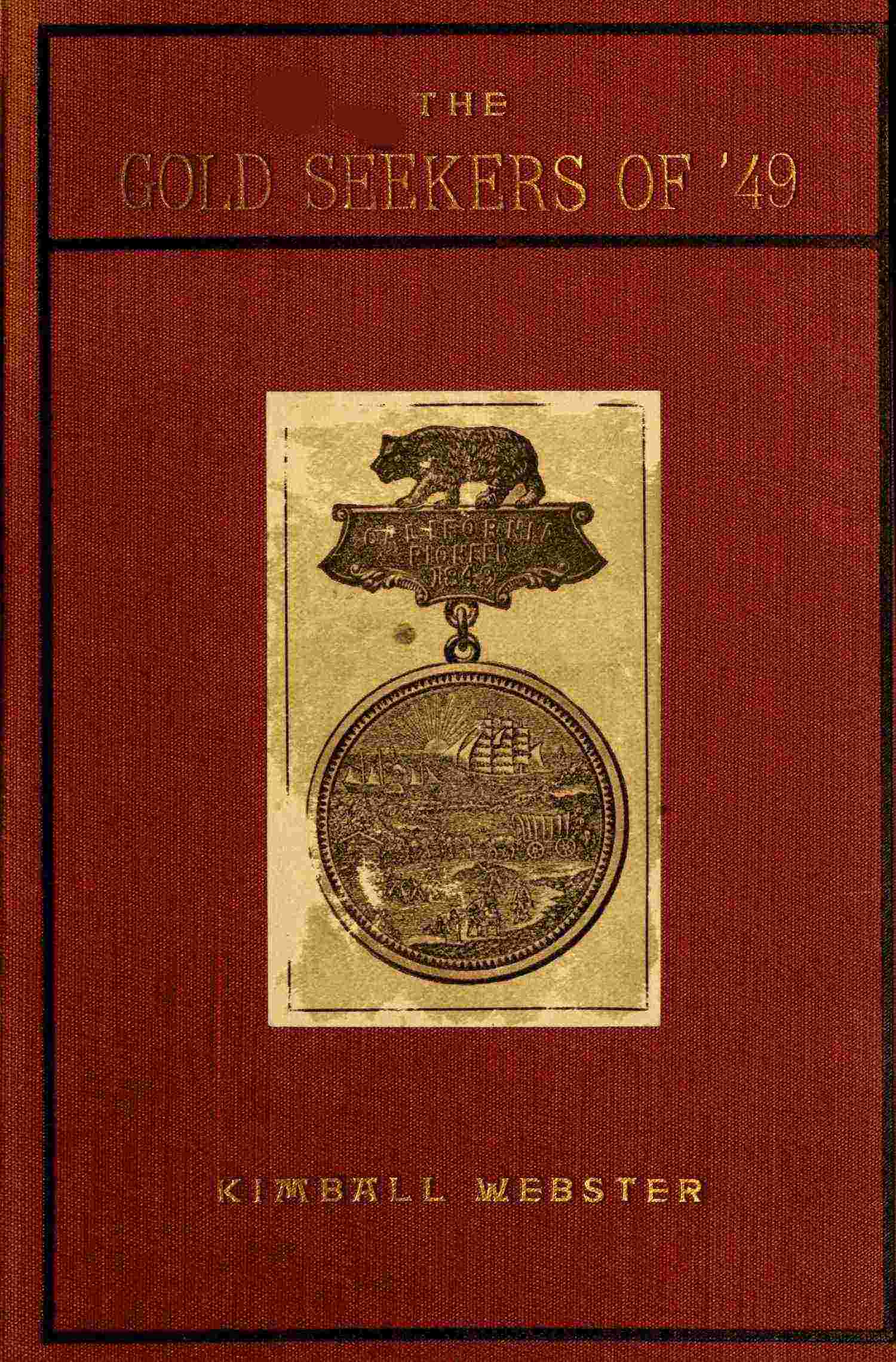
The Project Gutenberg eBook of The gold seekers of '49
Title: The gold seekers of '49
a personal narrative of the overland trail and adventures in California and Oregon from 1849 to 1854
Author: Kimball Webster
Contributor: George Waldo Browne
Illustrator: Frank Holland
Release date: September 5, 2023 [eBook #71572]
Language: English
Original publication: Manchester: Standard Book Company, 1917
Credits: Chuck Greif and the Online Distributed Proofreading Team at https://www.pgdp.net (This file was produced from images generously made available by The Internet Archive)
CONTENTS
ERRATA
ILLUSTRATIONS
TRANSCRIBER'S NOTE
The Gold Seekers of ’49
A Personal Narrative of the Overland Trail and Adventures in California and Oregon from 1849 to 1854.
BY KIMBALL WEBSTER A New England Forty-Niner
With an Introduction and Biographical Sketch
By George Waldo Browne
Illustrated By Frank Holland and Others
Manchester, N. H.
STANDARD BOOK COMPANY
1917
Copyrighted 1917
George W. Browne
DEDICATION.
To My Five Daughters, Mrs. Lizzie Jane Martin, Mrs. Eliza Ball Leslie, Mrs. Julia Anna Robinson, Mrs. Mary Newton Abbott, all of Hudson, N. H., and Mrs. Ella Frances Walch, of Nashua; and to the sweet memory of that loved Deceased Daughter, Latina Ray Webster, who quietly passed to the other side of the “Great Divide,” November 12, 1887, this narrative is most respectfully dedicated by the
Author
KIMBALL WEBSTER
HON. KIMBALL WEBSTER.
It is with keen regret and sorrow that we are called upon to record the going out of the life of the author of the following pages, who has died since work was begun upon the book. Mr. Webster was born in Pelham, N. H., November 2, 1828, the seventh child and third son of John and Hannah (Cummings) Webster. His education was acquired in the schools of his native town and Hudson, N. H. He grew up inured to the hard work upon a New England farm, besides working in granite quarries in his 19th and 20th years. In April, 1849, a little over six months before he was twenty-one, with others scattered all over the country, he caught the gold fever. Characteristic of his methodical ways, he kept a journal of his journey across the country and of his experiences as a miner in California and land surveyor in Oregon. His experiences in the Land of Gold are told in his own vivid language in the following pages, and form one of the most interesting narratives of the days of the gold-seekers of the Pacific Slope.
In 1855, after leaving Oregon, he was employed as a surveyor and land examiner by the Hannibal and St. Joseph Railroad Company in the western part of Missouri. In 1858 he lived in Vinal Haven, Me., working in a granite quarry, but the following year took up his permanent residence in Hudson, N. H., where he lived the remainder of his long and useful life. Following his leading occupation as surveyor and engineer, always active and capable in his duties as a citizen, Mr. Webster became a valuable and respected leader in public affairs, at one time or another holding all of the offices in the gift of his townsmen, while there were few important committees in which he did not figure prominently. Possessing an observing mind, a good memory and a logical discernment and summing up of local and general matters, he early began to compile a history of his town, and after fifty years of painstaking work he had collected the data for one of the most comprehensive town histories ever written. He was then past eighty, and it was the pleasure of the undersigned to be associated with him in the preparation of the manuscript for the printer and its publication. During work upon that, his “journal” of the days of ’49 were examined, and finally he consented to have it published.
He was a Justice of the Peace and had an extensive probate practice for nearly sixty years. He was a Mason and active in the order of Patrons of Husbandry. Mr. Webster retained his mental and physical powers, owing largely no doubt to a perfectly abstemious life, until within a short time of his decease, which occurred June 29, 1916, being 87 years, 7 months and 27 days of age. Noted for his sterling qualities, and having a wide acquaintance, he was mourned by a large circle of friends.
Mr. Webster married, January 29, 1857, Abiah, daughter of Seth and Deborah (Gage) Butler Cutter, of Pelham, N. H., who survives him, as well as five of their ten children, who have married and lived in Hudson.
CONTENTS.
ILLUSTRATIONS.
ERRATA
| Line | 16, | insert George W. Houston, Joseph B. Gage, and Calvin S. Fifield | 20 |
| 9, | read Moore, not moon | 39 | |
| 9, | read formed, not found | 45 | |
| 19, | erase of, and insert on, after mountains | 63 | |
| 19, | erase s at end of line, and insert r (Fort Bridger) | 65 | |
| 10, | read service berries, not summer berries | 74 | |
| Top, | Chapter IV | 83 | |
| 18, | spell Winnemucca | 83 | |
| 19, | correct spelling of principal | 96 | |
| 15, | read miners, not winers | 101 | |
| 18, | read weighed, not wished | 102 | |
| 17, | After promised, insert “to release to” | 127 | |
| Top, | also line 8, spell protractor | 151 | |
| 27 and 28, read the Pelham camp | 166 | ||
| 2, | after “The” erase following, and after morning insert before starting | 167 | |
| 3, | erase leaving and insert learning | 177 | |
| 8, | at end of line add ship, “Columbia” | 189 | |
| Top, | erase “the” between “to” and “commence” | 190 | |
| 4 and 7, | erase measured and insert meandered | 207 | |
| 7, | erase compassman and insert campman | 207 | |
| 22 and 23, name of river, “Callapooya” | 210 | ||
| 16, | erase “have” and insert “had” | 216 | |
THE PIONEERS OF CALIFORNIA.
The story of the pioneers of all times and all countries is one of great interest. In it is embodied the combined elements of adventure and patriotism; the certain forerunner of the coming greatness of the land quickened by the inspiring efforts of the newcomers, usually men of sterling qualities and unswerving purpose. The history of none of these adventurers is fraught with keener interest or more momentous results than that of the “Gold Seekers of ’49.”
The story of the men who dared and did so much in the early days of the discovery of GOLD on the Pacific Slope has never been fully told. In the pages of this remarkable book we are given in plain straightforward language without any attempt at embellishment, by one who participated in them, the trying experiences that comprised the adventures and achievements of the hardy volunteers forming the little army of gold seekers who crossed the plains immediately following the cry that awoke the land from ocean to ocean as no other word could have done.
With no Jason to lead them, no seer to prophesy success, no wizard to avert danger, these brave Argonauts pushed resolutely forward across a continent, traversing thousands of miles where the Greek heroes traveled hundreds, passing over long, weary stretches of pathless plains, under beetling crags, along frowning chasms and over alkaline deserts, where the barest sustenance of life was denied them, constantly menaced by the Arabs of prairie and mountain flitting hither and thither across their way, enduring sickness and privations sufficient to have discouraged a less determined body, comrade after comrade falling from the ranks, the ever-decreasing band still resolutely marching onward into the Land of Gold, to become the creators of a mighty commonwealth, the builders of states. Through the flood of circulating coin that their pickaxes unloosened was advanced the prosperity of a nation whose progress since has been the wonder of the world.
In the midst of all of this, and much more that a glance at the scenes cannot even suggest, Mr. Webster bore a prominent part as pioneer, miner, prospector, and surveyor of the new country. With over half a century intervening since that far-away day his vivid narrative comes to the few now living who participated in the scenes like a voice in a dream, while imparting to others the inner story of an era in our country’s history that forms one of its most important chapters.
With nearly two-thirds of a century intervening since the days when the “gold fever” swept over the country, awakening steady-going New England as nothing else could have done, it is not strange we seldom meet now one of the veterans who answered the call and crossed a continent in a march as beset with dangers as many of a more warlike purpose, or rounded a world to pursue the phantom of fortune in a strange land. Very few of the Gold Seekers of ’49 are living to enjoy the halcyon days of a long and useful life.
G. W. B.
THE GOLD SEEKERS OF ’49
CHAPTER I.
TIDINGS OF A NEW ELDORADO
Late in the autumn of 1848 some reports began to be received from the new Territory of California, which had then lately been acquired by the United States from Mexico, that large deposits of gold had been discovered there, and that the small resident population had almost forsaken their former avocation and had repaired to the rich mines where they were reaping a golden harvest, in many instances making large fortunes in a brief period.
These reports were at first almost entirely discredited by the people of the United States. Many believed it to be some cunning device of interested persons to decoy thither immigrants and thereby stimulate the growth of that sparsely populated territory.
During the early part of the winter of 1848-49 these reports were in a great measure corroborated and confirmed by official statements from government officers, who were stationed on the Pacific coast; and as early as January, 1849, vessels were fitting up in Boston, New York and other Atlantic ports, in a manner suited to convey passengers around Cape Horn to the New Eldorado, as it was then called.
The Pacific Mail Co. had at the time a line of steamers plying between New York and San Francisco, by the way of the Isthmus of Panama. These steamers made but one trip each way a month.
As soon as information of a reliable character was received in the Atlantic states regarding the mineral wealth of California, a large portion of the population became more or less excited, and many of an adventurous nature were at once determined to leave their homes and seek their fortunes on the western slope of the snowy mountains.
The query then arose, which was the cheapest, best and most expeditious route to reach San Francisco?
The long and tedious voyage of five or six months “around Cape Horn,” though perhaps the cheapest, was viewed by many as being almost beyond endurance.
The route by the Isthmus of Panama was attended by difficulties and dangers in crossing the Isthmus from Chagres to Panama, a distance of about fifty miles. This journey was performed in boats up the Chagres river, and thence by mules to Panama.
The journey by the latter route from New York to San Francisco had usually been performed in about thirty days and had usually been considered the better route.
So great was the rush to California by the way of the Isthmus in a short time, or as early as January, the tickets by that route were largely sold in advance for several trips, and thousands of passengers who had taken passage to Chagres were unable to get any conveyance from there to California, and were compelled either to remain at Panama for weeks, and in many instances for months, or to return to New York or Boston.
This congested state of affairs rendered the Mail route extremely objectionable. While thousands were waiting for a passage at Panama, a large percentage of those waiting passengers were sick with the Panama fever or other tropical diseases, and many died from such diseases.
Numerous companies were organized during the winter with the intention of pursuing the land route across the extensive western plains and the Rocky Mountains, which was thought could be accomplished in from sixty to eighty days.
It will be remembered that all the country between the Missouri river and the Sacramento valley, which was called “The Great American Desert,” was almost an unbroken wilderness. No white people were then allowed to settle in that vast territory.
As soon as I had sufficient reasons for believing California to be what it had been represented to be as a gold bearing country, I was determined to go myself; and after taking a prospective view of the difficulties and dangers incident to a protracted detention on the Isthmus and the tediousness of a long, monotonous journey via Cape Horn, I finally concluded to cross the country by land; believing it would be an interesting and romantic journey and one not entirely free from difficulties and hardships.
The Granite State and California Mining and Trading Company was organized in Boston in March, 1849, as a joint stock company, with a constitution and by-laws extremely strict and precise.
The above company numbered twenty-nine members, principally hale, hearty, strong men, who were then about to leave their homes and friends to seek their fortunes in the newly discovered gold mines of California. The names of these twenty-nine men were as follows:
Charles Hodgdon, Grovensor Allen, Dr. A. Haynes, John Lyon, Lafayette Allen, Samuel W. Gage, Joseph D. Gage, Thomas J. True, Alfred Williams, Cuthbert C. Barkley, Kimball Webster, Erastus Woodbury, James M. Butler, Alden B. Nutting, Benjamin Ellenwood, James W. Stewart, Jonathan Haynes, Charles W. Childs, Robert Thom, Jacob Morris, Austin W. Pinney, J. P. Hoyt, George Carlton, J. P. Lewis, Dr. Amos Batchelder and Edward Moore.
Ten of these men were from the town of Pelham, N. H., as follows: Capt. Joseph B. Gage, Samuel W. Gage, Joseph D. Gage, Dr. Amos Batchelder, George Carlton, James M. Butler, Austin W. Pinney, Robert Thom, Benjamin Ellenwood and Jacob Morris.
The majority of them were natives of Pelham and had always resided there as neighbors. Several of the others were from Boston, and a few from other towns of New Hampshire and Massachusetts.
Each member of the company was required to pay into the treasury the sum of three hundred dollars which, it was estimated, would be sufficient to furnish the necessary outfit and cover all traveling expenses.
It was the boast of the officers and many of the members that the Granite State Company would carry with them and introduce into California New England principles. Pelham was my native town and although my home at that time was in Hudson I was acquainted with the larger number of the members from Pelham previous to the organization of the company. With the exception of the Pelham members they were all strangers to me. I was twenty years of age on November 2, 1848, five months before we started.
The officers at the time of starting were: George W. Houston, President; Joseph B. Gage, Vice President; Edward Moore, Secretary; Calvin S. Fifield, Treasurer; besides a Board of Directors. Another company similar to our own had been organized in Boston and numbered about forty members and was called the Mount Washington Company. These two companies mutually agreed to travel in company until they should reach California.
The president of the last mentioned company, Captain Thing, having several years previous traveled across the country from Independence, Missouri, to Fort Hall and Oregon, in company with some of the men of the American Fur Company, agreed to pilot the Granite State Company through to California for five dollars each.
Some two or three weeks previous to the time of the starting of the two companies, Captain Thing and Lafayette F. Allen of Boston were selected to go to Independence, Mo., in advance of the two companies, with sufficient funds to purchase mules and cattle in numbers adequate to supply the needs of the two companies in their embarkation on the broad plains at such time as they should arrive at the above mentioned place.
The necessary arrangements having all been matured and the members having provided themselves with guns, pistols or revolvers, bowie-knives, and a plenty of powder, lead, caps, together with such other articles as they thought they might need on their long journey and after they should arrive at the “New Eldorado,” we started on our long journey.
CHAPTER II.
ACROSS THE CONTINENT.
Tuesday, April 17, 1849.
We left Boston this morning at about 8 o’clock for Albany, by way of the Western Railroad.
After shaking hands and bidding such of our friends as had gathered at the station a good-bye, we seated ourselves in the cars, and as they began to move, the spectators that had gathered in and around the station sent up three most hearty cheers for the California adventurers; and they were very readily and heartily returned by us, while we were started on our way with railroad speed toward the land of gold.
We had a special car into which no intruder was allowed to trespass, and I believe a more jolly company of men has seldom been found. We arrived at Springfield, Mass., at about noon where we were fortunate in procuring a fine dinner, to which all did ample justice. After we had eaten we were soon on our way again.
We arrived at Greenbush, N. Y., before night, where we had some little trouble with the baggage master about procuring our trunks, which had been checked at Boston, as we had failed to procure the corresponding checks. However, after some little dispute he gave them up and we took the ferry boat for Albany on the opposite side of the Hudson.
It will be remembered that at that time no railroad bridge spanned the Hudson River. Everything had to be ferried over. At Albany we took our quarters at the Mansion House.
I will here mention that on the road today we fell in with George W. Houston, our president, who had started in advance of the company for the purpose, as it was said, of evading some officers who were in pursuit of him for the object of detaining him until such time as he should be able to liquidate some obligations.
Wednesday, April 18.
We left Albany at 12:30 P.M. in an immigrant train for Buffalo. At Schenectady, about twenty miles from Albany, we were detained two or three hours, waiting for the passenger train to pass us. The fare by the immigrant train was considerably less but we soon discovered that it was a slow and tedious experience of travel, it being very slow. It was nearly night when we left Schenectady and proceeded slowly on our way. The night was cold and stormy—disagreeable in the extreme.
Some five or six inches of snow fell during the night, and there being no fires in the cars, or no place to lie down and nothing to eat, it was a very long, tedious night.
The night passed slowly away, and we arrived safely at Rochester at about 10 o’clock on the 19th; when, after refreshing ourselves with a good dinner, we crossed the Genesee River and took a view of the falls bearing the same name.
Near the middle of the channel is a high projecting point of rocks, where the celebrated Sam Patch is said to have taken his last jump in presence of a large multitude of spectators; and it was said that he was never afterward seen. His motto was: “Some things may be done as well as others.”
Rochester has very excellent water power, and can boast of some of the best flouring mills in the world.
Left Rochester at one o’clock, by the express train, for Buffalo, at which place we arrived at five o’clock P.M., and put up at Bennett’s Temperance Hotel, where we found a very fine hotel and good accommodations.
Friday, April 20.
There being no steamers going west from Buffalo today, we were compelled to await another day for a passage.
A railroad had been built and opened from Buffalo to Niagara Falls, a distance of twenty-two miles. The larger number of the company took this trip and went to the celebrated Falls, as a pleasant manner of passing the few hours that we were compelled to wait. We left Buffalo at two o’clock and rode twenty-two miles over a very rough and uneven railroad, and arrived at the Falls at about three o’clock.
On my arrival at the cataract, I descended the lofty flight of stone steps numbering 290—crossed the river in a yawl boat to the Canada side—a short distance below the Falls; went under the sheet of water at Table Rock, where I found a very damp atmosphere caused by the rising spray—so very damp that I soon became completely saturated.
I then went to the Suspension Bridge about two miles below the Falls, and there recrossed the river.
This bridge had been built the year previous, and was largely an experiment. It was a foot bridge suspended by wire cables and stood 230 feet above the water. It was about eight feet wide.
It seems useless for me to attempt a description of Niagara Falls. To be fully appreciated it must be seen. It is certainly one of Nature’s wonderful curiosities.
Saturday, April 21.
We left Buffalo at 11 o’clock, A.M., in the elegant, first-class steamer Canada, for Detroit, Michigan, with pleasant weather and a smooth lake.
The weather continued fine until about five o’clock, when it commenced raining, and the lake became somewhat rough.
Sunday, April 22.
The weather today has been very fine.
At 7 o’clock we landed at Amherstbury, Canada, near the mouth of the Detroit River; and at nine, landed at the wharf at Detroit.
Detroit is situated on the west bank of the river bearing the same name, about twenty miles above Lake Erie. It rises gradually from the river and is a very pleasantly situated city. In the forenoon I attended the Congregational Church, where we heard an eloquent sermon by an able divine.
In the afternoon I visited Windsor, Canada, situated on the east side of Detroit River. This place contains an old Jesuit church said to be more than one hundred and fifty years old, and built by early French settlers.
In the evening a few of the Pelham boys visited Gen. Lewis W. Cass at his elegant residence. We found Mr. Cass at home, to whom we introduced ourselves. He was a native of New Hampshire, and formerly had his home there. He received us with the greatest cordiality and respect, wishing us the greatest success in our enterprise, and expressing a desire to accompany us himself.
We remain aboard the Canada tonight.
Monday, April 23.
We left Detroit at 7:30 this morning by the Michigan Central Railroad for New Buffalo, a small village on the eastern shore of Lake Michigan, near the line between the states of Michigan and Indiana. The country bordering on this road is principally very heavily timbered with oak, elm, hickory, ash, sycamore and other species. The houses are mostly small “log cabins.”
The soil is fertile but somewhat low and moist, and is said to be well adapted to the propagation of the “shakes.”
We arrived at New Buffalo at 7:30 in the evening, and we intended to have taken the steamer for Chicago immediately, but the harbor being so much exposed and the lake so very rough, it was impossible for the boat to make a landing at the wharf with safety. Consequently, we were compelled to await such time as the waters should become more calm. At that time the railroad had not been constructed around the south side of Lake Michigan into Chicago.
This was a newly constructed place and but a small village at that; and as passengers usually embarked for Chicago almost immediately on their arrival here, the people had made no preparation to accommodate people over night. They had no accommodations to furnish lodgings or meals in so large numbers, and we were unable to obtain either. We were obliged to content ourselves in the cars during the night.
The night seemed long, cold and disagreeable, but at length it passed away.
Tuesday, April 24.
The weather this morning was very cold and windy. The steamer from Chicago landed at the wharf at about 9 o’clock this morning, but, owing to the rough state of the lake, she had not lain at the wharf over two or three minutes before she parted her large hawser, and immediately left for Chicago, without her passengers.
At about ten o’clock in the evening, the lake having become comparatively smooth, the steamer Detroit came in. We soon after got aboard and were on our way for Chicago.
This was an old vessel and had a very ungentlemanly list of officers.
It was not until after a long parley with the steward and captain, that we were successful in obtaining any refreshments. Immediately after supper, I lay down and soon fell asleep, and, on awaking the next morning, I found our boat moored at the wharf in Chicago. The past two days had been our first really bitter experience. Much of the same as bad or worse was in store for us.
Wednesday, April 25.
Chicago at that time was a comparatively small city of about 25,000 inhabitants.
The Michigan and Illinois Canal from Lake Michigan at Chicago to the Illinois River at La Salle, which had been under construction for twelve years or more, had been finished the year previous, and was open for traffic.
We left Chicago at ten o’clock in the morning on a packet by the above mentioned canal for La Salle, a point situated at the head of navigation on the Illinois River.
The weather was fine and we found this to be a delightful mode of travel, but not very expeditious. The packet was drawn by mules or horses traveling on the tow-path.
The passengers had a good view of the broad Illinois prairies, as they passed leisurely through the country. A large percentage of those prairies were then unbroken and were the native home of the prairie hen. From Chicago westward the country is so nearly level that there are no locks in the canal for twenty-five miles.
At night we had the pleasure of seeing a burning prairie for the first time.
Thursday, April 26.
Owing to a leakage in the canal the packet ran aground about two o’clock this morning, where we were detained four hours—until six. We arrived at La Salle about two o’clock in the afternoon.
The canal passes along down a valley one mile or more broad, with bluffs on each side. This valley has the appearance of having been, at some remote period of the past, the bed of a large river, and is thought by many to have once been the outlet and drainage of the Great Lakes, whose waters now form the great cataract of Niagara. I went out with my gun about one mile west of the city, where I found prairie chickens to be very numerous on the prairie. They are as large or larger than our New England partridge, which they very much resemble.
We left La Salle at 9 o’clock in the evening by the steamer Princeton for St. Louis, by way of the Illinois and Mississippi Rivers.
Friday, April 27.
The weather is fine today. The Illinois River is a stream about one-half mile wide, with low, timbered bottom lands on each side, which at this time are considerably inundated, the river being quite high.
The scenery along the river presents a very dreary appearance at this time. It is neither beautiful nor grand. We saw a few wild turkeys along near the shore, which to us was something new.
Saturday, April 28.
At ten o’clock we entered the Mississippi River, and at eleven, passed the junction of the Missouri with the Mississippi.
The river at this point is nearly two miles in width, and has a current of about four miles an hour.
The upper Mississippi is a deep, clear stream, while the Missouri has many shoals and sand bars, and whose waters are always muddy, so very muddy that they color the Mississippi, from the junction to the Gulf of Mexico.
At one o’clock we arrived at St. Louis.
This flourishing city is situated on the west bank of the Mississippi, and, owing to its commanding position, will probably ever maintain a leading position among the great cities of the West.
The streets, at this time, are quite muddy and filthy, but they are of good width.
The population appears to be made up—as seems to us New Englanders—of a heterogeneous collection of almost every nation and tongue.
Tonight we engage passage to Independence, Missouri, and go aboard the steamer Bay State, which is to leave here tomorrow morning for St. Joseph, Mo.
Sunday, April 29.
We left St. Louis at ten o’clock and proceeded up the river. At twelve we entered the turbid waters of the Missouri.
The Bay State is a good vessel, but is very much crowded with Californians.
On her last voyage up the river she is said to have lost quite a large number of her passengers by cholera, which at present is quite prevalent on the western rivers.
At 4 o’clock we pass the beautiful city of St. Charles, situated on the north bank of the river.
The bottom lands along the river are low and subject to overflow; consequently the settlements in sight of the river are not very numerous, a few log cabins being seen on the banks.
The channel of the river is very much obstructed by snags and sand bars and is constantly changing, which renders the navigation of the Missouri extremely difficult and dangerous.
Monday, April 30.
We made about ninety miles during the day yesterday, but moved slowly during the night.
Early this morning we passed the village of Hermon, noted for its extensive wine distilleries. A little later we passed Portland, situated on the north side of the river. At three we touched at Jefferson City, situated on the right bank of the Missouri River, 160 miles from St. Louis. This is the capital of Missouri, and is very pleasantly located on a high bank.
Tuesday, May 1.
At 12 o’clock we passed Glasgow; at 5, Brunswick; and at 7, Miami, all of which are apparently pleasant and thriving little villages.
The banks of the river are much higher than they are lower down, and consequently, we see more settlements.
Wednesday, May 2.
We saw a few small villages on the banks of the river.
At six o’clock P.M. we passed Lexington City, some forty or fifty miles below Independence, our destination.
Thursday, May 3.
At two o’clock this morning we arrived at Independence Landing, four miles from Independence.