
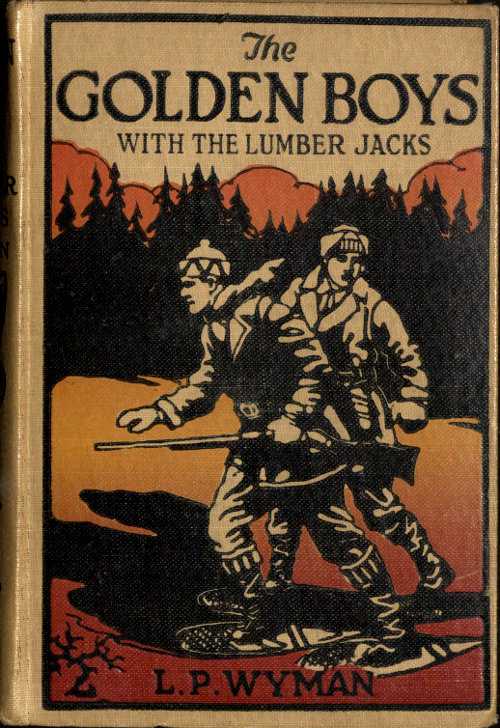
The Project Gutenberg eBook of The Golden Boys With the Lumber Jacks
Title: The Golden Boys With the Lumber Jacks
Author: L. P. Wyman
Illustrator: Mead Schaeffer
Release date: December 18, 2018 [eBook #58491]
Language: English
Credits: Produced by Stephen Hutcheson and the Online Distributed
Proofreading Team at http://www.pgdp.net
It seemed as though the wind increased with every minute as they hurried through the thick woods. Page 69
THE GOLDEN BOYS
WITH THE LUMBER JACKS
By L. P. WYMAN, Ph.D.
Dean of Pennsylvania Military College
Author of
“The Golden Boys and Their New Electric Cell,” “The Golden Boys at the Fortress,” “The Golden Boys in the Maine Woods,” “The Golden Boys on the River Drive.”
A. L. BURT COMPANY
Publishers New York
THE
GOLDEN BOYS SERIES
A Series of Stories for Boys 12 to 16 Years of Age
By L. P. WYMAN, Ph.D.
Dean of the Pennsylvania Military College
- The Golden Boys and Their New Electric Cell
- The Golden Boys at the Fortress
- The Golden Boys in the Maine Woods
- The Golden Boys with the Lumber Jacks
- The Golden Boys on the River Drive
- The Golden Boys Rescued by Radio
- The Golden Boys Along the River Allagash
Copyright, 1923
By A. L. BURT COMPANY
Made in “U. S. A.”
CONTENTS
- I. Snowbound 3
- II. The Lost Deed 14
- III. The Ghost 30
- IV. The Ghost Has Its Picture Taken 42
- V. Tom Lays the Ghost 57
- VI. Coals of Fire 76
- VII. Big Ben Makes a Call 92
- VIII. On the Trail 109
- IX. Jack Goes Fishing 130
- X. Jacques Lamont 154
- XI. Big Ben Falls Down Again 174
- XII. Big Ben Decides That He Had Better Not 196
- XIII. Jack Takes a Forced Walk 213
- XIV. Jacques’ Secret. What is it? 231
THE GOLDEN BOYS WITH THE LUMBER JACKS.
CHAPTER I.
SNOWBOUND.
The car, after hesitating several times as though undecided what to do next, finally came to an unmistakable stop. The rear wheels, although equipped with heavy chains, spun around for a moment and then they also stopped.
“Looks as though we’re stuck, Mike.”
The words came from a boy in the front seat, but they were lost to the driver in the roar of the wind as it drove the blinding snow against the windows of the sedan.
The speaker tried again.
“Looks as though we’re stuck, Mike.”
This time he shouted at the top of his voice and the driver turned his head.
“Stuck is right, begorra,” he shouted back. “Sure and it’s meself that’s been expecting it fer the last half hour, an’ how could ye expect inything on wheels to git through sich drifts, I dunno.”
“How about a shovel, Mike?”
The question came from a second boy in the back seat and it also was shouted with all the strength of a sound pair of lungs.
“Sure and I’ve got a shovel, do yez expect to dig all the way to Skowhegan?”
The two boys, Bob and Jack Golden, were on their way home from college for the Christmas holidays. Unfortunately they had missed the train which they should have taken at Boston, and the only other one for the day would take them as far as Waterville, nineteen miles from their home in Skowhegan. Rather than wait over a day, they had telegraphed to their father and he had sent his man, Mike, to meet them.
The snow had begun to fall soon after they left Portland and the storm had increased rapidly in violence until, when they reached Waterville, at ten o’clock, two hours late, it had reached the proportions of a blizzard. Mike had been dubious about starting, declaring that they would never make it, but the boys had laughed at his fears and, against his better judgment, he had yielded to them.
During the first hour they made seven miles, plowing through snow up to wheel hubs. And this brings us to the point where our story opens.
“I hope it won’t be so bad as that,” Bob said with a laugh, as he opened the door and stepped out into the storm. “Where’s the shovel, Mike?”
“Sure and it’s under the back sate,” Mike shouted, as he too got out of the car.
“Let’s have it quick, Jack,” Bob called, as he stuck his head in at the rear door. “It’s colder than Greenland out here.”
Jack quickly pulled the shovel from beneath the seat and handed it to his brother, who at once started making the snow fly.
“There,” he shouted to Mike, who had gotten back in the car, “Back up and hit her hard and I guess she’ll go through. Don’t think I ever saw the snow come down so fast,” he added, as he threw the shovel back in and climbed in beside Mike.
“I told you so,” he shouted joyfully, a moment later, as the big car plowed its way through the drift. “All it needs is a little elbow grease.”
But his joy was short lived for in less than a hundred rods they struck another drift and again the car came to a standstill.
“My turn this time,” Jack shouted, and was out almost as soon as the car stopped.
This drift was deeper than the first one and it took the boy all of fifteen minutes before he felt that there was a chance for the car to win through.
“We’ll strike Skowhegan some time next summer at this rate,” he laughed, as he stamped his feet on the running board.
As before, the car went through, but in less than a hundred feet they came to a halt for a third time.
“It’s no use,” Bob shouted, as the car came to a stop. “We’ll never get through to-night, that’s sure. Suppose you turn around, Mike?”
“What’s the use of trying?” Jack asked, before Mike had time to reply.
“We’d probably get stuck just as quick if we tried to go back. I move we stay here.”
“How about it, Mike? Got plenty of gas?” Bob asked.
“Filled her up in Waterville.”
“Then I think Jack’s suggestion is a good one. By running the engine once in a while we can keep plenty warm and they’ll probably break out the road early in the morning. What do you say Mike?”
“Sure an I gess yer right. If we can’t go ayther forninst nor behind I guess we’d better stand still.”
“That’s good logic anyhow,” Bob laughed, as he climbed over the back of the seat and joined his brother. “We’ll be as snug as a bug in a rug and there’s no danger of getting run into,” he added, as he curled up on the roomy seat and pulled a heavy robe over himself.
“Not much need of traffic cops on this road tonight,” Jack shouted from the other corner of the car.
Bob was just drifting off to sleep when, above the shriek of the wind he heard a cry which brought him sitting upright in an instant.
“Did you hear that, Jack?” he shouted. “Listen: there it is again.”
“Help!”
Again came the cry in piercing tones now plainly audible.
“Sounds like a girl,” Bob cried, as he pushed open the door and leaped out, closely followed by his brother.
Breathlessly they listened for the call to be repeated, but no sound save the howling of the wind came to them.
“Which way was it?” Jack asked, straining his ears.
“Haven’t the least idea,” Bob replied, as he waded around to the front of the car.
By this time Mike had joined them and, after listening a moment longer, Bob said:
“She must have given out. Mike, you hunt around to the right, and Jack you go back a bit and I’ll see what I can find up ahead here. It isn’t likely that she’s down by the river. If you find her yell,” he shouted as they started off.
The wind was still blowing a gale and the sharp particles of snow stung like so many needles as Bob faced into the storm. It was so dark that he could hardly see his hand before his face and the headlights were of little use as the car had stopped at an angle to the road. The snow came nearly to his waist as he plowed his way through.
“She can’t be very far off,” he thought, as he bent his head to the force of the wind. “I don’t believe you could hear a steam whistle a hundred feet away in this gale.”
He had not gone more than thirty feet from the car when his knee struck something and the next second he was bending over a form, which was nearly buried in the snow. Quickly he straightened up and, putting his hands to his mouth trumpet fashion, he gave a yell that would have done credit to a Comanche Indian.
As he again stooped and lifted the girl in his arms she gave a low moan which he barely caught.
“She’s not dead at any rate,” he muttered, as he endeavored to start toward the car. But, although the wind was now at his back, the snow was too deep and he was unable to take a step. But help was close at hand, as both Jack and Mike had heard his cry.
“Give her to me,” ordered the big Irishman, as he reached Bob’s side. “Now break trail an’ it’s meself that’ll take her back,” and he took the girl in his strong arms as though she were but a feather.
The boys kicked their way back, making a fairly decent path through the snow, and in a few minutes they had her in the car. Mike at once started the engine, as it was far from warm, while Bob wrapped her in a heavy robe and began to chafe her hands. The girl was not unconscious, as he could tell by the appearance of her eyes, but she seemed numbed with the cold.
Quickly the heat from the exhaust made itself felt and soon the rich color of health began to steal back into the pale cheeks. The chattering of her teeth gradually grew less and finally a faint smile lighted up her face.
“I hope—I won’t—shake—the car—to pieces,” she said, evidently trying hard to make her voice heard above the howling of the wind.
“I guess she’ll hold together: she’s had a lots bigger shaking up than this and came through all right,” Bob assured her with a laugh.
“My, but this—robe—feels good,” she declared. “It was so—cold out there—in the—snow, and—and I thought I was—a goner.”
In a short time she was recovered sufficiently to tell them her story. It seemed that she had spent the evening at a neighbor’s only a few rods from her home. She had started for home soon after eleven o’clock, never for a moment doubting her ability to find her way. But she had entirely underestimated the fury of the storm and bewildered by the blinding snow had lost the path. For nearly two hours she had stumbled about in the deep snow before Bob had found her.
She told them that her name was Mary Scott and that she was sure that she had not gone far from her home. She also informed them that she was twenty years old and was a school teacher. The boys in turn introduced themselves and Bob asked:
“Won’t your folks be out looking for you?”
“Not likely. You see,” she explained, “my father is a farmer and he goes to bed early and no doubt they were all fast asleep before ten o’clock, so you see they won’t miss me till morning.”
It was now nearly two o’clock and after some further talk they, one by one, capitulated to the sand man, all except Mike, who forced himself to keep awake in order to “kape up steam,” as he afterward told them.
Day had come when Bob, the first of the three to awake, opened his eyes. The storm had passed, although a high wind was still blowing, sending the light snow swirling in clouds about the car. But it had lost much of its savage force and no longer howled as it had during the night. His watch told him that it was just past seven o’clock.
“Some storm,” he said in a low voice to Mike who just then started the engine.
“I’ll say that same, begorra,” Mike declared. “Sure an’ it’s meself that niver seed a worser one except a few that were bigger.”
“That’s playing it safe all right,” Bob laughed, as he climbed over to the front seat. “Here comes some one,” he announced an instant later, as he saw the form of a man plowing his way through the snow toward the car.
He threw open the door as the man came up.
“Ain’t seed nothin’ of a gal, have ye?” he asked, and it was evident that he was much worried.
“Sure have,” Bob replied quickly. “Dug her out of the snow last night,” he added, and just then the girl spoke for herself.
“I’m all right Daddy, thanks to these folks.”
“Thank God for that,” the man breathed as he stepped into the car and hugged the girl to his breast. “You see when I got up this mornin’ an’ seed that you aren’t home I sposed that you had stayed all night at Lucy’s but ter make sartain, I ’phoned over an when Lucy said as how you had set out fer home last night I jest thought as how you’d be frizzed fer sartain. Yer mother’s nigh crazy, an’ I must hustle back an’ let her know that yer’re all right.”
He thanked them for what they had done, but the boys cut him short telling him how glad they were they had found her in time.
“My place’s the second one on the left, and you won’t have ter wait morn a few minutes afore Jeb Taylor comes along with the snow plow. He was jest gittin hitched up as I come by,” Mr. Scott explained, as he stood with one foot on the running board. “Gess ye’ll have ter move your car though so’es he can git by. Yer see Jeb he breaks out’s fur as the Waterville line an’ Josh Howland he goes up tother way’s fur as Hinkley. Josh he allays gits started afore Jeb an’ I low as how he’s half way up that by now. But I must hump back an’ let the missus know as how Mary’s all right. If ye’ll jest drop her off as yer go by it’ll save her gettin’ all over snow again.”
The boys assured him that they would be glad to do as he asked and after thanking them again he started back.
By great good luck the car had stopped at a place where, after a half hour’s work with the shovel, they were able to back the car out of the road.
“Here they come,” Jack shouted a moment later, and looking up the road they saw the snow plow, characteristic of Maine.
It was made of two huge logs fastened together in the shape of a V and drawn by eight yoke of oxen. A half dozen men and twice as many boys accompanied it, and the boys at least evidently considered it a great lark as their shouts of laughter attested.
After the plow had passed came the task of shoveling through the huge pile of snow heaped up by the roadside. But finally this was accomplished and they were off.
Mr. Scott was waiting for them as they reached the farm house, and insisted that they stop for breakfast, although to tell the truth, they did not need a great deal of urging.
“Mother’s got a big batch o’ buckwheat cakes and sassage all ready an I reckon as how ye’ll have an appetite as’ll about fit ’em,” he declared, as he led the way to the house.
They found Mrs. Scott a motherly woman who showered them with thanks, and the breakfast was all and more than the farmer had promised.
“I guess we’ll get home in time for Santa Claus at any rate,” said Bob.
It was several hours after they had said goodbye to their new friends, and they were still several miles from home. Three or four miles an hour was about the best they had been able to make, for they had been obliged to follow behind the slowly moving plow nearly all the way.
“We ought to make it by three o’clock,” Bob replied to Jack’s guess. But it was nearer four when finally they drove into the yard.
“We were about to send out a relief expedition for you,” Mr. Golden laughed, as he welcomed them home.
CHAPTER II.
THE LOST DEED.
“Yes, it is a serious matter.”
It was two days after Christmas and Mr. Golden was talking to his two boys in the library.
“You see,” he continued, “there’s over four hundred acres of the finest timber in the state in that tract. I bought it of Amos Town just ten years ago, and he died about a year after. I had made all arrangements to cut on it this winter and you can imagine my surprise when, about a week ago, Ben Donahue came into my office and told me that he owned the tract. Said he had bought it of Town about a month before he died.”
“But how about your deed?” Bob interrupted.
“That’s the strange part of it,” Mr. Golden said. “Of course I went at once to the bank to get my deed from my deposit box but to my great surprise it was not there. Ben was with me when I opened the box, and from the expression on his face when I failed to find it, I was certain that he knew all the time that it was not there, but of course I couldn’t prove anything.”
“How about the records in the Register of Deeds’ office?” Bob asked.
“That’s another mystery. Of course that was my next move, but when we looked it up, no record of it could be found.”
“But you know that it was recorded don’t you?”
“Certainly; but unfortunately that doesn’t prove it. You see, while the pages in the deed books are numbered, they are of the loose leaf type; and my theory is that someone has substituted a leaf for the one on which that deed was recorded. Of course Ben’s deed is a forgery, but to prove it is another matter. I’ve gotten out an injunction to prevent his cutting on the tract this winter and he has done the same thing.”
“But how do you suppose the deed got out of your deposit box?” Jack asked.
“Haven’t the faintest idea,” Mr. Golden replied, pacing slowly up and down the room. “Well,” he added a moment later, “there’s no use worrying about it. Al is taking up a load of supplies tomorrow and I suppose you’re planning to go with him.”
“Sure thing,” both boys replied.
Ben Donahue, or Big Ben as he was known through the state, had for many years been one of the big lumber men of Somerset County. But, although he had operated on a large scale, it was a well known fact that he had never made much money, and several times he had narrowly escaped financial ruin. Physically a giant and a terrific driver of men, his lack of education, together with an inherent carelessness in the handling of his accounts, was undoubtedly the cause of his financial condition. Unscrupulous and hated by those who worked for him, nevertheless his tremendous vitality and dominant personality made him a powerful factor in the lumber interests of the county.
The stars were still shining when, the following morning, the two boys climbed aboard the big sled drawn by four horses and driven by Al Higgins. Al was a teamster of the old school. Seventy-five years old, he looked and acted as though not a day more than fifty. It was his proud boast that he had never been sick a day in his life and had never had a doctor.
“I reckon it be the Maine air,” was his uniform reply when asked for his secret of youthfulness.
It was a long two days’ trip to the lumber camp on Moosehead Lake, hence the early start. The mercury in the thermometer on the porch of the Golden home registered twenty-two degrees below zero as Al cracked his long whip over the ears of the leaders.
“Hurrah! We’re off at last,” Jack shouted, waving his hand to his father who stood on the porch. “I believe that thermometer’s got dropsy,” he laughed a few minutes later, as they drove across the bridge which spans the Kennebec in the center of the town. “Why, it was colder than this in Pennsylvania before we left and it never got below ten above.”
“It’s because the air is so dry here and so damp there,” Bob explained, as he pulled his cap down over his ears. “But you want to look out for your nose. Remember it hasn’t got any antifreeze in it.”
“Pooh, who’s afraid,” Jack jeered. “But this air sure is wonderful, isn’t it Al?”
“You sure said a mouthful: it’s the greatest air in the world,” the old driver said, as he turned off onto the lake road.
They had covered about three miles when the first streaks of the coming dawn tinged the east. Al had stopped the horses for a brief rest after a hard pull up a steep hill when Jack, who, leaning comfortably back against a bag of flour had fallen into a doze, was rudely awakened by a handful of snow dashed in his face followed by a vigorous rubbing of his nose.
“Hey there, what’s the idea?” he sputtered, as he tried to push the offending hand away.
“Sorry to disturb you old man, but your radiator was congealed,” Bob laughed as he continued the rubbing.
“I deny the allegation and can lick the alligator,” Jack gasped as he finally succeeded in freeing himself, but after he had carefully felt of the tip of his nose, he agreed that ‘the alligator’ had acted well within his rights.
Night was close at hand when they reached Kingsbury, the half way station where they were to stop at the little wayside hotel. It had been a long day and soon after supper was over the boys were in bed.
“Don’t believe I’ll have to be rocked to sleep tonight,” Jack declared, as he pulled the blankets up close under his chin.
Some time later Bob, who was a light sleeper, was awakened by the sound of voices in the next room. Two men were talking in low tones, but as only a thin partition separated the two rooms and the head of his bed as well as that in the other room was close up against it, he could hear them sufficiently well to be able to catch a word now and then. At first he paid but slight attention beyond wishing that they would keep still and let him go to sleep. But suddenly he became keenly alert as he heard one of them say in a tone louder than he had used before:
“I tell ye it’s risky.” And the other replied impatiently:
“Risky nothing. There ain’t a man round here that’d dare serve that injunction on me.”
“That’s Big Ben,” thought Bob, as he strained his ears, but now the two men were talking only in whispers and he was unable to catch any more of the conversation. “Guess Big Ben intends to cut on that tract, injunction or no injunction,” he thought as he drifted off to sleep again.
At four o’clock Al called the boys and they were soon on their journey again.
Daylight found them several miles nearer the lake and just as the town clock was striking twelve they pulled into Greenville, a small town at the foot of the lake. The camp was twenty miles up the lake, a little to the north of Lilly Bay.
Bob had told Jack what he had heard in the night and they both agreed that their father should know of it. So they went at once into the general store and soon had him on the long distance wire.
“Tell Tom to keep his eyes open and let me know if they start to cut,” Mr. Golden said, after Bob had told him what he had heard.
Tom Bean was the foreman of the camp and a great favorite with the boys, as indeed he was with nearly all who knew him. An Irishman, quick of temper but generous to a fault, and with a heart, as Jack often said, “as big as an ox,” he possessed the rare knack of getting the maximum amount of work from his men with the minimum amount of trouble. As one man put it, “one worked for Tom because he liked him!”
Dinner over, they started up the lake on the ice. A good road had been broken up the lake and they made excellent time, reaching their destination fully an hour before dark.
The camp comprised five buildings, all built of unpeeled logs. In the center of the clearing was the bunk house, a long low structure where the men slept. It was heated by two immense wood-burning stoves, while along both sides were the beds or bunks built up in tiers three high. Back of the bunk house was the cook and mess house, another structure of about the same size but divided into two sections. Two rough tables ran the entire length of the larger section, while the smaller was a kitchen or cook house as it was called. A little to the right of the bunk house was a small building which served as the office and sleeping quarters for the boss or any other visitors. Six men could be accommodated here very comfortably. The fourth building, just behind the office, was the tool house, and back of that a large shed for the horses. About sixty men were at work at the camp.
“Sure an’ yer a sight fer sore eyes so ye be,” was Tom Bean’s greeting as they jumped from the sled.
“And it’s mighty glad we are to see you again Tom,” and his words were echoed by Jack as they nearly shook his arms off. “And how’s things going?” Bob asked as they began to pull their dunnage from the sled.
“Sure an’ ’twas niver better. We’re bound ter make a record cut this winter if the luck holds out,” Tom declared. “But where do you want ter slape?” he asked, picking up one of their bags.
“In the bunk house of course,” both replied in the same breath.
“It’s meself that thought so.” The foreman grinned as he led the way.
As soon as Tom had assigned their bunks to them, the boys started out on a tour of inspection of the camp as they laughingly told Tom. Dusk was falling and the men by twos and threes were coming in from the forest. They were mostly French Canadians, or Kanucks, as they were commonly called. Big men, most of them, they looked as Jack declared “as hard as nails.”
The boys knew only two or three of the crew, as they were mostly new men that winter. They were dressed in much the same garb as were the workmen—a rough mackinaw coat, heavy khaki breeches, thick woolen stockings rolled just below the knees, and moccasins. It was characteristic of them that, “when in Rome they lived as did the Romans.”
They were back of the cook house and were about to return to the front of the camp, when two men came toward them from the deep woods. The men were talking earnestly together and paid no attention to the boys as they passed them. At that moment a small hunch-backed man came hurriedly out of the back door of the cook house carrying in his hands a pan of hot ashes. Accidentally he bumped into one of the men, spilling some of the ashes on his legs. With an oath the man gave him a cuff on the side of the head which sent him sprawling in the snow, the hot ashes flying over him.
“The big brute,” Bob cried loudly enough for the man to hear, as he sprang to the hunchback’s aid and pulled him to his feet.
“What that you say?” the man who had struck the blow demanded, as he came close to Bob who was brushing the ashes from the hunchback.
“I said you were a brute,” Bob replied, looking the man full in the eyes.
“You dare call me name, I mak’ you eet them word ver’ queek,” and before Bob had time to defend himself the Canadian swung an open handed blow which caught him on the side of the face and he too was sent reeling into a snowdrift.
Both of the men were laughing uproariously as he picked himself up.
“Suppose you try that again,” he said, as he stood once more in front of the man.
Surprise showed in the Canadian’s face. “You want more is et?” he asked, as he drew back his hand, this time closed into a knotty fist. “All right, I give you plenty dis time,” and he struck with his entire one hundred and eighty pounds behind the blow.
But this time Bob was on his guard and as the fist whizzed past his face he hit the man a stinging blow just beneath the ear, which jerked his head sideways but did not upset him. But it made him mad and he came for Bob, as Jack afterward declared, “like a bull for a red rag.”
“I keel you for dat,” he shouted, and from the look on his face Bob did not doubt but that he would do it if he was able.
“You’ll have to spell able first,” he said as he dodged a vicious swing and succeeded in landing again this time on the Canadian’s nose. The blow started the blood to flowing and as Bob had hoped, rendered him insane with fury. If he knew anything of the science of boxing, he threw his knowledge to the winds as he again rushed, his fists beating the air like flails.
The Canadian was several inches taller than Bob and at least thirty pounds heavier and the boy well knew that he was no match for him so far as mere strength went, and that a blow from one of those fists, delivered in the right place, would put an end to the struggle in short order. But through long practice he was a splendid boxer and he did not intend to allow that blow to land. By this time a number of the men, attracted by the cries of the Canadian, had come up and were watching the seemingly unequal contest with great interest.
As his antagonist rushed forward, Bob slowly gave way, protecting himself from the hammering blows as well as he was able. To be sure some of them hit him, but they were only glancing blows, thanks to his agility, and did no great amount of damage. He knew that at the rate he was going the man would soon wear himself out and he was watching for the first indication of weakening. But swinging an axe day after day, makes muscles which do not easily tire and there seemed no limit to the man’s endurance.
“You no stan’ up and fight like man,” he panted as he missed a particularly vicious swing.
“This suits me all right,” Bob grinned. “You started this you know.”
At this moment Tom Bean came running up.
“Cut it out there, you Jean,” he shouted, as soon as he was near enough to see who it was with whom he was fighting. As he spoke he sprang forward but Jack caught hold of his arm and dragged him back.
“Let them alone,” he begged.
“But that’s Jean Larue,” Tom gasped. “He’s the bully of the camp and as strong as an ox. He’ll kill the bye.”
“Don’t you believe it,” Jack returned. “Look there!”
Tom looked and could hardly believe his eyes when he saw the bully of the camp, as he had named him, stretched out at full length in the snow.
Bob had at last gotten his chance and had landed full on his opponent’s chin. But the blow, although delivered with all his strength, lacked something of the force which he was able to put behind his right hand punch, owing to the insecure footing offered by the snow, and the bully, although down, was far from being out. He sprang quickly to his feet but to Bob’s disappointment did not rush at him again. He had learned the futility of that kind of fighting in the present instance and now he circled warily around Bob seeking an opening.
It was growing dark rapidly now and becoming more and more difficult to follow each other’s movements. Suddenly the Canadian sprang forward and aimed a blow at Bob’s head which he barely dodged. But the force of the blow carried the man slightly off his balance and before he had time to recover Bob had again landed on the point of the chin. Again the bully went down and all the men shouted encouragement to Bob. It was evident that the Canadian was not popular among his fellows.
This time he did not get to his feet so quickly as before and when he did it was evident that he was somewhat dazed. And now Bob decided that the time had come for him to force the fighting. So, as the man got to his feet, he sprang forward and aimed another blow for the chin. But he slipped just as he struck and before he could recover himself the Canadian had him around the waist. Bob realized that there could be but one outcome to this kind of fighting unless he finished it in short order. To his joy he quickly discovered that the man knew nothing of scientific wrestling, and in a moment he had a half nelson about his neck and exerting all his strength he threw him completely over his head. The man gave vent to a heavy grunt as he struck the snow and undoubtedly he was at that moment the most surprised man in seven counties. Once more anger got the best of him and, springing to his feet, he came at Bob with much the same tactics with which he had started the fight. This was what Bob had hoped for and after defending himself for a moment the right chance came. This time he happened to have an excellent foothold and the blow was not lacking in full power. Square on the man’s chin it landed and he dropped like a log, and this time he did not get up.
“Sure an’ yer’er one broth of a bye,” Tom Bean shouted, as he rushed forward and grabbed the panting boy in his arms. “Are yez sure ye’re not hurt?” he asked anxiously.
“I guess I’ll need a piece of beef steak on this eye, but I think that’s about all the damage. But he’s sure got an ugly punch when it lands. The only thing that saved me is that it didn’t land often,” and Bob grinned as he took Tom’s arm.
As the bully went down for the last time a loud cheer went up from the crowd, which now included practically the entire camp. No one went to his assistance until Tom said:
“Hey you, Jim and Pete, rub some snow on his face and git him into the bunk house. Sure an’ he’ll be all right in a jiffy.”
“Sure an’ he had it coming to him all right,” Tom declared, after Jack had told him how the fight started. “It’s hisself as is a mean one an’ he’s bullied the hull camp, but begorra, his bullying days are over, for onest a bully is licked an’ he’s done. But don’t fergit lad, ye’ve made an inemy and ye want ter kape yer eyes peeled mighty sharp so ye does.”
But if he had made an enemy of Jean Larue he had also made a friend of Jakie Semper, the hunchback. Jakie was what is known as “cook’s helper.” He washed dishes, kept the cook house clean, waited on the table, and did a thousand and one other things about the place. His unfailing good nature and readiness to grant favors made him a general favorite about the camp. After the fight he regarded Bob almost with reverence and would have become his willing slave had he permitted it. Although his body was deformed, the boys soon learned that his mind was, as Jack put it, “as bright as a new dollar.”
As the two boys entered the mess house a half hour later, they were greeted with a ringing cheer, and many hearty slaps on the back proved to Bob that his victory was most popular with the crew. The boys had asked Tom not to tell anyone that their father owned the camp, as they wished to associate with the men on as nearly an equal footing as possible. To be sure two or three of the crew knew them, as they had been in their father’s employ for some years, but at the boys’ request Tom had “put them wise.”
After supper the boys accompanied Tom to the office where they told him about the disputed tract and what Bob had heard in the hotel the night before.
“Just where is that tract, Tom?” Bob asked when he had finished.
“’Tis jest below us, an’ ’tis sure the crame of the pickings up here.”
“And where is Big Ben’s camp?”
“Jest forninst the big tract, aboot three miles down the lake.”
“How big a camp is it?” was Bob’s next question.
“About the same as this,” Tom replied, as he filled his pipe.
“You said everything was going fine, didn’t you?” Bob asked, after a short pause during which Tom got his pipe drawing to his satisfaction.
“Sure I said thot same, an’ so it is up to the presint, but I dunno,” and the foreman had a worried look about his eyes which Bob was quick to notice.
“What do you mean, Tom?” he asked anxiously, for he knew that Tom did not worry about trifles.
Tom Bean did not reply for some time and then, as Bob repeated his question, he told them a strange tale.
CHAPTER III.
THE GHOST.
“’Tis this way,” the foreman began, as he shifted his pipe to the other side of his mouth. “Yer father has a contract to deliver four million fate of spruce to The Great Northern Star Company in Waterville, on or before the twentieth of nixt May. We got a good crew here an’ kin do the job all right if things go well; but ’tis a man’s size job let me tell ye and if the logs ain’t thar on the dot the contract’s busted.”
“But that’s not what’s worrying you,” Bob declared as Tom paused. “Come out with it. Where’s the fly in the ointment?”
“Sure an’ it’s no fly at all at all: it’s a ghost, that’s what it is,” and Bob’s laugh died on his lips as he noted the serious look on the foreman’s face.
“What do you mean, ghost?” Jack broke in as Tom paused. “There ain’t no such animal,” he laughed.
“Mebbe not: I dunno, but I saw it meself.”
“When was it you saw it?” Bob asked.