
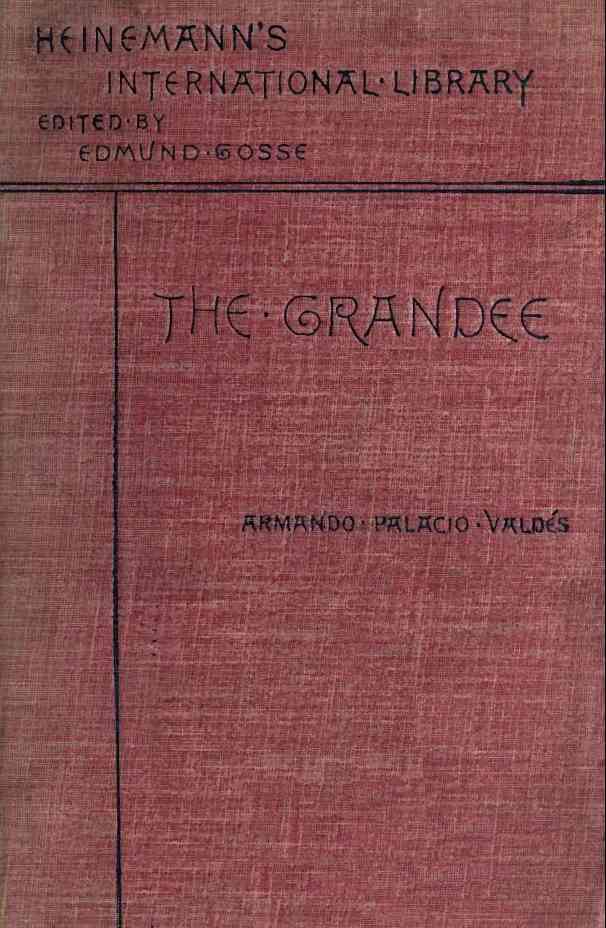
The Project Gutenberg eBook of The Grandee
Title: The Grandee
Author: Armando Palacio Valdés
Translator: Rachel Challice
Release date: January 23, 2010 [eBook #31056]
Language: English
Credits: E-text prepared by Chuck Greif and the Project Gutenberg Online Distributed Proofreading Team (http://www.pgdp.net) from page images generously made available by Internet Archive (http://www.archive.org)
E-text prepared by Chuck Greif
and the Project Gutenberg Online Distributed Proofreading Team
(http://www.pgdp.net)
from page images generously made available by Internet Archive
(http://www.archive.org)
| Note: | Images of the original pages are available through Internet Archive. See http://www.archive.org/details/grandeenovel00palaiala |
HEINEMANN'S
INTERNATIONAL LIBRARY
EDITED BY
EDMUND GOSSE
THE GRANDEE
ARMANDO PALACIO VALDÉS
Heinemann's International Library.
Edited by EDMUND GOSSE.
Crown 8vo, in paper covers, 2s. 6d., or cloth limp, 3s. 6d.
| 1. | IN GOD'S WAY. From the Norwegian of Björnstjerne Björnson. |
| 2. | PIERRE AND JEAN. From the French of Guy de Maupassant. |
| 3. | THE CHIEF JUSTICE. From the German of Karl Emil Franzos. |
| 4. | WORK WHILE YE HAVE THE LIGHT. From the Russian of Count Lyof Tolstoi. |
| 5. | FANTASY. From the Italian of Matilde Serao. |
| 6. | FROTH. From the Spanish of Don Armando Palacio Valdés. |
| 7. | FOOTSTEPS OF FATE. From the Dutch of Louis Couperus. |
| 8. | PEPITA JIMÉNEZ. From the Spanish of Juan Valera. |
| 9. | THE COMMODORE'S DAUGHTERS. From the Norwegian of Jonas Lie. |
| 10. | THE HERITAGE OF THE KURTS. From the Norwegian of Björnstjerne Björnson. |
| 11. | LOU. From the German of Baron von Roberts. |
| 12. | DONA LUZ. From the Spanish of Juan Valera. |
| 13. | THE JEW. From the Polish of Joseph I. Kraszewski. |
| 14. | UNDER THE YOKE. From the Bulgarian of Ivan Vazoff. |
| 15. | FAREWELL LOVE! From the Italian of Matilde Serao. |
| 16. | THE GRANDEE. From the Spanish of Don Armando Palacio Valdés. |
In preparation.
A COMMON STORY. From the Russian of
Goncharof.
NIOBE. From the Norwegian of Jonas Lie.
Each Volume contains a specially written Introduction by the Editor.
London: W. HEINEMANN, 21 Bedford St., W.C.
THE GRANDEE
A NOVEL
BY
ARMANDO PALACIO VALDÉS
TRANSLATED FROM THE SPANISH
BY
RACHEL CHALLICE
LONDON
WILLIAM HEINEMANN
1894
[All rights reserved]
|
CONTENTS FOOTNOTES |
INTRODUCTION
According to the Spanish critics, the novel has flourished in Spain during only two epochs—the golden age of Cervantes and the period in which we are still living. That unbroken line of romance-writing which has existed for so long a time in France and in England, is not to be looked for in the Peninsula. The novel in Spain is a re-creation of our own days; but it has made, since the middle of the nineteenth century, two or three fresh starts. The first modern Spanish novelists were what are called the walter-scottistas, although they were inspired as much by George Sand as by the author of Waverley. These writers were of a romantic order, and Fernan Caballero, whose earliest novel dates from 1849, was at their head. The Revolution of September, 1868, marked an advance in Spanish fiction, and Valera came forward as the leader of a more national and more healthily vitalised species of imaginative work. The pure and exquisite style of Valera is, doubtless, only to be appreciated by a Castilian. Something of its charm may be divined, however, even in the English translation of his masterpiece, Pepita Jiménez. The mystical and aristocratic genius of Valera appealed to a small audience; he has confided to the world that when all were praising but few were buying his books.
Far greater fecundity and a more directly successful appeal to the public, were, somewhat later, the characteristics of Perez y Galdos, whose vigorous novels, spoiled a little for a foreign reader by their didactic diffuseness, are well-known in this country. In the hands of Galdos, a further step was taken by Spanish fiction towards the rejection of romantic optimism and the adoption of a modified realism. In Pereda, so the Spanish critics tell us, a still more valiant champion of naturalism was found, whose studies of local manners in the province of Santander recall to mind the paintings of Teniers. About 1875 was the date when the struggle commenced in good earnest between the schools of romanticism and realism. In 1881 Galdos definitely joined the ranks of the realists with his La Desheredada. An eminent Spanish writer, Emilio Pardo Bazan, thus described the position some six years ago: "It is true that the battle is not a noisy one, and excites no great warlike ardour. The question is not taken up amongst us with the same heat as in France, and this from several causes. In the first place, the idealists with us do not walk in the clouds so much as they do in France, nor do the realists load their palette so heavily. Neither school exaggerates in order to distinguish itself from the other. Perhaps our public is indifferent to literature, especially to printed literature, for what is represented on the stage produces more impression."
This indifference of the Spanish reading public, which has led a living novelist to declare that a person of good position in Madrid would rather spend his money on fireworks or on oranges than on a book, has at length been in a measure dissipated by a writer who is not merely admired and distinguished, but positively popular, and who, without sacrificing style, has conquered the unwilling Spanish public. This is Armando Palacio Valdés, who was born on the 4th of October 1853, in a hamlet in the mountains of Asturias, called Entralgo, where his family possessed a country-house. The family spent only the summer there; the remainder of the year they passed in Avilés, the maritime town which Valdés describes under the name of Nieva in his novel Marta y Maria. He began his education at Oviedo, the capital of Asturias. From this city he went, in 1870, up to Madrid to study the law as a profession. But even in the lawyer's office, his dream was to become a man of letters. His ambition took the form of obtaining at some university a chair of political economy, to which science he had, or fancied himself to have, at that time a great proclivity.
Before terminating his legal studies, the young man published several articles in the Revista Europea on philosophical and religious questions. These articles attracted the attention of the proprietor of that review, and Valdés presently joined the staff. In 1874 he became editor. He was at the head of the Revista Europea, at that time the most important periodical in Spain from a scientific point of view, for several years. During that time he published the main part of those articles of literary criticism, particularly on contemporary poets and novelists, which have since been collected in several volumes—Los Oradores del Ateneo, ("The Orators of the Athenæum"); Los Novelistas Españoles ("The Spanish Novelists"); Un Nuevo Viaje al Parnaso ("A New Journey to Parnassus"), sketches of the living poets of Spain; and, in particular, a very bright collection of review articles published in conjunction with Leopoldo Alas, La Literatura en 1881 ("Spanish Literature in 1881"). These gave Valdés a foremost rank among the critics of the day. He wrote no more criticism, or very little; he determined to place himself amongst those whose creative work demands the careful consideration of the best judges.
Soon after he took the direction of the Revista, Valdés wrote his first novel, El Señorito Octavio, which was not published until 1881. In 1883 he brought out his Marta y Maria, a book which, I know not why, is called "The Marquis of Peñalta" in its English version. This novel enjoyed an extraordinary success, and had more of the graphic and sprightly manner by which Valdés has since been distinguished, than the books which immediately followed it. Spanish critics, indeed, remembering the wonderful freshness of Marta y Maria, still often speak of it as the best of Valdés' stories. In this same year, 1883, he married, at the seaside town of Gijon, in Asturias, on the day when he completed his thirty years, a young lady of sixteen. His marriage was a honeymoon of a year and a half, of which El Idilio de un Enfermo ("The Idyll of an Invalid"), a short novel of 1884, portrays the earlier portion. His wife died early in 1885, leaving him with an infant son to be, as he says, "my allusion and my fascination." His subsequent career has been laborious and systematic. He has published one novel almost every year. In 1885 it was José, a shorter tale of sea-faring life on the stormy coast of the author's native province. About the same time appeared a collection of short stories, called Aguas Fuertes ("Strong Waters").
It was not until 1886, however, that Valdés began to rank among the foremost novelists of Europe. In that year he published his great story, Riverita, one of the characters in which, a charming child, became the heroine of his next book, Maximina, 1887. Of this character he writes to me: "My Maximina in these two books is but a pale reflection of that being from whom Providence parted me before she was eighteen years of age. In these novels I have painted a great part of my life." A Sevillian novice, who has helped to care for Maximina in Madrid, reigns supreme in a succeeding novel, La Hermana San Sulpicio ("Sister San Sulpicio"), 1889. But between these two last there comes a massive novel, describing the adventures of a journalist who founds a newspaper in the provincial town of Sarrió, by which Gijon seems to be intended. This book is called El Cuarto Poder ("The Fourth Power"), and was published in 1888. To these, in 1891, was added La Espuma ("Froth"), of which a translation has already appeared in the "International Library." In 1892 Valdés published La Fé ("Faith").
In La Espuma, his best-known novel, Valdés reverted from those country scenes and those streets of provincial cities which he had hitherto loved best to paint, and gave us a sternly satiric picture of the frothy surface of fashionable life in Madrid. From the illusions of the poor, pathetic and often beautiful, he turned to the ugly cynicism of the wealthy. With his passion for honesty and simplicity, his heart burned within him at the parade and hollowness which he detected in aristocratic and bureaucratic Madrid. One conceives that, like his own Raimundo, he was invited to enter it, took his fill of its pleasures, and found his mouth filled with ashes. His talent for portraiture was never better employed. If he was occasionally tempted to commit the peculiarly Spanish fault of exaggeration—scarcely a fault there, where the shadows are so black and the colours so flaring—he resisted it in his more important characters. The brutality of the Duke de Requena, the sagacity and urbanity of Father Ortega, the saintly sweetness of the Duchess, the naïveté of Raimundo, the sphinx-like charm of Clementina de Osorio, with her mysterious sweetness and duplicity, these are among the salient points of characterisation which stand out in this powerful book. La Espuma was a cry from the desert to those who wear soft raiment in king's palaces. It was the ruthless tearing aside of the conventions by a Knox or a Savonarola. It was stringent satire, yet tempered with an artist's moderation, with a naturalist's self-suppression.
The latest novel which Valdés has published is that which we here present under the title of The Grandee ("El Maestrante"). Here, as it will be seen, the author is no longer engaged in the jarring notes of satire, but, with more lightness and a greater effusion of humour, he dissects the quaint elements which make up old-fashioned society in a provincial city of Spain. This is one of those books which peculiarly appeal to the foreign reader who desires to enter into a phase of life from which his own experience absolutely excludes him. We may suppose that a limited number of Englishmen can penetrate to the palaces and the club-rooms of Madrid, and see something, however superficially, of the life described in Froth. But the grim and ancient mansions which look down through ancient mullioned windows on the narrow streets of such a town as is brought before us in The Grandee—what can the most privileged Englishman possibly know of the manners and customs of their stately inhabitants?
In the second half of the book, the gaiety and grotesqueness of the pictures of life sink before the solemnity of the terrible and tragic corruption of Amalia, and the martyrdom of Josefina. The last pages of The Grandee are, indeed, tinged with almost intolerable gloom, and in a society comparatively so civilised as our own, the revenge of the unnatural mother may seem almost overdrawn. The author contends, however, that in the cryptic and cloistered provincial life which he describes, where the light of censure can hardly reach a powerful criminal, such wickedness as is perpetrated upon Josefina is neither improbable nor unprecedented. Nor do the reports of Mr. Benjamin Waugh permit us to question that such horrors are daily committed at our own doors. Whether these maladies of the soul are or are not fit subjects for the art of the novelist is a question which every reader must answer for himself.
In the pages of The Grandee we have a singular transcript of Spanish pride and picturesqueness, of a narrow society absolutely fortified against public opinion by its ancient prejudices, a society, nevertheless, in which the primitive passions of humanity stir and interact with as much dangerous vivacity as in freer and more democratic conditions. I may perhaps mention, on the authority of the author, that by Lancia Valdés intends us to understand Oviedo, the capital of the province of Asturias, where he spent many years of his childhood and early youth. The story opens between thirty and forty years ago, and represents Oviedo and its social customs at an epoch a little earlier than the time when the novelist was forming his freshest and most vivid impressions of life.
Of the author of so many interesting books but little has yet been told to the public. In a private letter to myself, the eminent novelist gives a brief sketch of his mode of life, so interesting that I have secured his permission to translate and print it here:—"Since my wife died," Señor Valdés writes, "my life has continued to be tranquil and melancholy, dedicated to work and to my son. During the winters, I live in Asturias, and during the summers, in Madrid. I like the company of men of the world better than that of literary folks, because the former teach me more. I am given up to the study of metaphysics. I have a passion for physical exercises, for gymnastics, for fencing, and I try to live in an evenly-balanced temper, nothing being so repugnant to me as affectation and emphasis. I find a good deal of pleasure in going to bull-fights (although I do not take my son to the Plaza dressed up like a miniature torero, as an American writer declares I do), and I cultivate the theatre, because to see life from the stage point of view helps me in the composition of my stories."
EDMUND GOSSE.
CONTENTS
| CHAP. | PAGE | |
| I. | THE GRANDEE'S HOUSE | 1 |
| II. | THE DISCOVERY | 25 |
| III. | THE TOWN | 55 |
| IV. | THE HISTORY OF THEIR LOVE | 75 |
| V. | THE JOKES OF PACO GOMEZ | 100 |
| VI. | THE SEÑORITAS DE MERÉ | 113 |
| VII. | THE INCREASE OF THE CONTINGENT | 138 |
| VIII. | FERNANDA AND THE WINE | 153 |
| IX. | THE MASQUERADE | 172 |
| X. | FIVE YEARS AFTER | 188 |
| XI. | AMALIA'S RAGE | 206 |
| XII. | THE BARON'S JUSTICE | 226 |
| XIII. | THE MARTYRDOM | 239 |
| XIV. | THE CAPITULATION | 258 |
| XV. | JOSEFINA SLEEPS | 276 |
THE GRANDEE
CHAPTER I
THE GRANDEE'S HOUSE
It was ten o'clock at night, an hour when the number of those who frequented the streets of the noble city of Lancia was always of the scantiest, but in the depth of winter, when our story opens, with a bitter north-east wind and drenching rain, one would find it difficult to stumble upon a living soul. Not that all had surrendered themselves into the arms of Morpheus, for Lancia as capital of a province, albeit not one of the most important, had learnt to sit up late. But the people used to resort at an early hour to parties, whence they only sallied forth to supper and to bed at eleven o'clock. At that hour many noisy groups could be seen passing along under the shelter of umbrellas, the ladies enveloped in warm woollen cloaks, holding up their petticoats, and the gentlemen all wrapped in their cloaks, or montecristos, with their trousers well turned up, breaking the silence of the night by the loud clack of their wooden shoes. For at the time of which we speak there were few that despised this comfortable shoe of the country, unless it were some new-fledged medical student from Valladolid, who considered himself above such old-fashioned things, or some fanciful young lady, who pretended that she could not walk in them. But these were the exceptions. There were no carriages in the town, for only three existed in the place, belonging respectively to the Quiñones, the Countess of Onis, and to Estrada-Rosa; the last-mentioned being the only one that did not date from the middle of the last century. When either of these conveyances appeared in the street, it was followed by a crowd of little urchins, whose enthusiasm at the sight knew no bounds. The neighbours inside their houses could tell by the sound of the wheels, and the clink of the horseshoes to which of the above-mentioned magnates the carriage belonged. They were in fact three venerated institutions which the natives of the city had learnt to love and respect. So umbrellas and wooden shoes were the only protections against the rain that falls more than three parts of the year. India-rubber shoes came in later, as well as hooded waterproofs, which at certain times transform Lancia into a vast community of Carthusian friars.
The wind blew stronger at the crossing of Santa Barbara than in any other part of the town. This uncovered passage, between the bishop's palace and the walls of a courtyard of the cathedral, just by the chain which regulates the lightning conductor, leads finally under an archway, a murky corner where the blast, confined within a narrow space, howls and moans on such infernal nights as this.
A man, muffled up to the eyes, crossed with rapid steps the little square in front of the archbishop's house, and entered this recess. The force of the hurricane stopped him, and the rain penetrating between the collar of his coat and the brim of his hat, almost blinded him. He made a few seconds' stand against the violence of the whirlwind, and then, instead of uttering any exclamation of impatience, which would have been more than excusable under the circumstances, he merely gave vent to a long-drawn sigh of distress:
He cowered up against the wall, and when the wind had somewhat abated, he resumed his course. Passing under the archway that connects the palace with the cathedral, he entered the widest and best-lighted part of the passage. An oil-lamp fixed in the corner served as its only light. The wretched thing, seconded by a tinfoil reflector placed at the back, made ineffectual attempts to pierce the gloom of the farthest corners.
Ten yards off nobody would have thought it was there, and yet to our muffled traveller it must have seemed an Edison lamp of ten thousand candle-power, from the way he drew his coat-collar higher about his face, and from the haste in which he avoided the pavement, and crept along by the wall where the shadows were deepest. In this way he arrived at the Calle de Santa Lucia, cast a rapid glance around him, and renewed his course on the darkest side of the way. Although one of the most central streets, the Calle de Santa Lucia is solitary to an extreme. It is closed at one end by the base of the tower of the cathedral, a graceful, elegant structure like few to be found in Spain, and so it is only used as a thoroughfare by canons going to the choir, or devotees on their way to early Mass. In this short, straight, narrow street, the palace of Quiñones de Leon was situated—a large, dreary, uninteresting-looking building with projecting iron balconies. It was two storeys high, and over the central balcony there was an enormous roughly carved shield, supported by two griffins in high relief, as rudely carved as the quarterings.
One side of the house looked on to a little, damp, melancholy, neglected garden, enclosed by a wall of regular elevation; and the other on to a dull, even damper, narrow street which ran between the house and the black, discoloured wall of the church of San Rafael. To pass from the palace to the church, where the Quiñones had a private pew, was a little gallery, or covered way, smaller, but similar to that of the archbishop, over the passage of Santa Barbara.
By the bright light shining from the crevice of a half-opened window on the balcony, it was evident that the people of the house had not yet retired to rest. And if the light were not sufficient proof, the fact was confirmed by the strains of a piano heard occasionally above the roar of the storm.
Our muffled friend, with a rapid step, keeping as much in shadow as possible, arrived at the door of the palace. There he stopped again, cast a furtive glance down both sides of the street, and entered the portico. It was large, and paved with stones like the street; the bare, discoloured, whitewashed walls were dimly illumined by an oil-lamp hung from the centre. The man quickly crossed it, and before pulling the bell-cord, placed his ear to the door, and listened long and attentively. Convinced that nobody was descending the staircase, he gave one more look down the street. At last he decided to undo his cloak, and drew from under its folds a bundle, which he placed with a trembling hand near the door. It was a basket, covered with a woman's mantle, which hid the contents from view, although they could be pretty well guessed, for from the time of Moses, mysterious baskets seem destined for the consignment of infants.
The man, being now free of his burthen, pulled the bell-cord three times, and the door was immediately opened from above by means of another cord. The three pulls of the bell showed that the visitor to the aristocratic mansion of the Quiñones was a nobleman on a par with the Señores. This was an old-established custom of unknown origin. A menial, a servant, an inferior in any degree, only rang once, ordinary visitors rang twice, and the half dozen, or more, persons that the important Señor of Quiñones considered his equals in Lancia, rang three times. If those in the town, who had never been admitted to the sacred precincts of the mansion, joked with the habitués of the place on the subject, their witticisms fell flat; but even if the shafts did go home, the feudal custom was so universally respected, that none but the privileged few dared to give the three signals pertaining to the highest rank. Paco Gomez once ventured to break the rule for a joke, but he was received so coldly when he entered the drawing-room that he never cared to repeat the experiment.
So the man of the basket entered quickly, shut the door, crossed the hall, and ascended the wide stone staircase, where holes, worn by long use, retained the damp.
When he reached the first floor, a servant approached to take his hat and cloak; so without further delay, and as if avoiding pursuit, he darted with hasty stride towards the drawing-room door, and opened it. The light of the chandelier and candelabra dazzled him for a moment. He was a tall powerful man, between thirty and thirty-two years of age, with a pleasant expression of countenance and regular features, short hair, and a long, silky beard of reddish hue. His face was pale, and betrayed extreme anxiety. On raising his eyes, which the excessive brightness of the room at first obliged him to lower, he turned them on the lady of the house, who was seated in an armchair. She, on her side, cast an inquiring anxious look at him, and the glance caused him a shock which gave instantaneous repose to his face like the neutralisation of two equal forces.
The gentleman remained at the door waiting for five or six couples, who were pirouetting to the strains of a waltz, to pass him, whilst his pale lips wreathed into a smile as sweet as it was sad.
"What an evening! We did not think you would be here so soon," exclaimed the lady as she gave him her delicate nervous hand, which contracted three or four times with intense emotion as it came in contact with his.
She was a woman of about twenty-eight or thirty years of age, diminutive in stature, with a pale, expressive face, very black eyes and hair, small mouth, and delicate aquiline nose.
"How are you, Amalia?" said the gentleman, without replying to her remark, and trying to hide under a smile the anxiety which, in spite of himself, the trembling of his voice betrayed.
"I am better, thank you."
"Is not this noise bad for you?"
"No; I was bored to death in bed. Besides, I did not wish to deprive the young people of the one enjoyment they can get occasionally at Lancia."
"Thank you, Amalia," exclaimed a young lady who was dancing and overheard the last remark, and Amalia responded by a kind smile.
Another couple from behind then knocked against the gentleman, who was still standing.
"Always devoted, Luis!"
"To no one more than yourself, Maria," replied the young man, affecting to hide his embarrassment under a laugh.
"Are you sure that I am the only one?" she asked with a mischievous glance at the partner who held her in his arms.
Maria Josefa Hevia was at least forty, and she had been almost as ugly at fifteen. As her means were not equal to her weight, no one had dared redeem her from the purgatory of solitude. Until quite lately she still entertained hopes that one of the elderly Indian bachelors, who came to pass their declining years in Lancia, would ask her hand in marriage; and these hopes were founded on the fact that these gentlemen frequently contracted alliances with the daughters of distinguished people in the place, portionless as they generally were.
On her father's side, Maria Josefa was connected with one of the oldest families, being related to the Señor of Quiñones, in whose house we now are.
But her father was dead, and she lived with her mother, a woman of low degree, who had been a cook before marrying her master. Either for this reason, or on account of the indisputable ugliness of her face, the Indians fought shy of her; although her exaggerated idea of her position exacted a certain respect in society. Her face was hideous, with irregular features, marked with erysipelas, and disfigured by red patches about the nostrils. She only retained one feminine taste, and that was for dancing, which was a real passion with her; and she felt it dreadfully when she was left a wallflower by the careless young men of Lancia. But, possessing a sharp tongue, she revenged herself so cleverly on both sexes when thus neglected, that the majority of the youths willingly sacrificed one dance on the programme to her at all the balls; and when they failed to do so, the girls would remind them of their duty, so great was their fear of the spiteful old maid. Thus, by dint of the wholesome terror she inspired, she danced as much as the greatest beauty in Lancia.
She was conscious of the reason of her success, and however humiliated she might be in the depths of her heart, she did not fail to make use of the power, as she considered it the lesser evil of the two.
Witty and malicious, she was particularly alive to a sense of the ridiculous in things, and whilst not lacking in the power of narration, she was, moreover, endowed with the peculiar knack of wounding everybody to the quick when she had a mind to.
"Has the count come yet?" asked a sharp voice from the next room, which made itself heard above the sounds of the piano, and the feet of the dancers.
"Yes, here I am, Don Pedro; I am coming."
Whereupon the count made a step towards the door, without removing his eye from the pallid-looking lady; and she riveted another steady gaze upon him, which conveyed the impression of a question. He just closed his eyes in affirmatory reply, and passed on to the next apartment, which, like the drawing-room, was furnished without any regard for luxury.
The highest nobility of Lancia despised all the refinements of decoration so usual nowadays. They scorned every innovation both within and without their dwellings; and this not from feelings of avarice, but from the inborn conviction that their superiority consisted less in the richness and splendour of their houses, than in the seal of ancient respectability.
The furniture was old and shabby, and the carpets and curtains were faded; but the master paid little heed to such matters. Indeed, Don Pedro Quiñones showed an indifference, bordering upon eccentricity, on the point. Neither the entreaties of his wife, nor the remarks which some bolder spirit, like Paco Gomez, who was always ready to be facetious, dared to make, ever induced him to call in the painters and upholsterers.
With regard to size, the drawing-room was superb, being both lofty and spacious, and including all the windows of the Calle de Santa Lucia, with the exception of that of the library. The chairs were antique, not a mere imitation of those of bygone ages, as is now the mode, but made in times past, according to the fashion of the period, and covered with green velvet, worn old by time. In many places the floor was visible through the holes in the carpet. The walls were covered with magnificent tapestries, which constituted the one adornment of the house, for Don Pedro had a very valuable collection; but he only exhibited it once a year, when the balconies were draped on the day of Corpus Christi. It was said that an Englishman once offered a million pesetas[A] for their possession.
The count had also several very valuable pictures, but they were so discoloured by time that, if not restored before long by some skilful hand, they seemed likely to disappear altogether. The only new thing in the drawing-room was the piano, bought three years ago, soon after the second marriage of Don Pedro.
The library, also of large dimensions, with a window looking on to the Calle de Santa Lucia, and two on to the garden, was furnished still worse. It had heavy damask curtains, two mahogany presses without mirrors, a sofa upholstered with silk, a few leather chairs, a round table in the centre, and some seats to match the sofa, all old and shabby.
Seated round the table, lighted by an enormous oil-lamp, were three gentlemen playing at tresillo.[B]
The master of the house was one of them. He was between forty-six and forty-eight years of age. For the last three years he had been quite unable to move from the effects of an apoplectic stroke, which left him with both legs paralysed. He was stout, with a red face, and strong well-marked features; his thick curly hair and beard were streaked with grey, and he had keen, piercing black eyes. His face was remarkable for an expression of pride and fierceness, which the kind smile with which he received the Conde de Onis could not entirely hide. He was sitting, or rather reclining, in an armchair constructed especially for facilitating the movement of his body and arms; and it was placed sideways at the table, so that he could play, and keep his legs raised up meanwhile. Although there were logs burning on the hearth, he had a grey cloak round his shoulders, fastened at the throat with a gold clasp. Embroidered on the left-hand side was the large red cross of the order of Calatrava.[C] The Señor of Quiñones was rarely seen without this cloak, which afforded him a fantastic, somewhat theatrical, appearance. He had always been eccentric in his dress. His pride impelled him to try and distinguish himself from the vulgar in every way. On ordinary occasions he wore a buttoned-up frock-coat, a high-crowned, wide-brimmed hat, and his hair was long, like that of a cavalier of the seventeenth century, whilst his clothes were generally of velvet or velveteen, with riding-boots of a fashion beyond all recollection, and his wide shirt-collars were turned back over his waistcoat in imitation of the Walloon style. There never was a man prouder of his high degree, nor more retentive of the privileges enjoyed by those of his rank in times gone by. People grumbled at his eccentricities, and many turned them to ridicule, for Lancia is a place not wanting in a sense of humour. But, as usual, unbending pride had ended by making an impression. Those who were the first to joke at Don Pedro's peculiarities, were those who were the most punctiliously respectful in doffing their hats when he appeared almost half a mile off. He had lived some years at Court, but he did not strike root there. He was one of the gentlemen in office, and curiously jealous of every prerogative and distinction due to his fortune and birth. But there was no satisfying a heart so corroded with arrogance, and he bitterly resented the amalgamation of people of birth with those of money. The respect afforded to politicians, which he in his position also had to accede to, perfectly enraged him. Was a son of a nobody, a common fellow, to take precedence of him, and merely give an indifferent or disdainful glance at him?—at him, the descendant of the proud Counts of Castille! Not being able to put up with such a state of things, he resigned his appointment, and took up his abode again in the old-world palace in which we now are. His pride, or maybe his eccentric character, made the rich bachelor at this time of his life do a thousand odd and ridiculous things, to the great astonishment of the town until it became accustomed to him. Don Pedro never went out in the street without being accompanied by a servant, or majordomo, a rough sort of man who wore the costume of the peasants of the country, which consisted of short breeches, woollen stockings, a green cloth jacket, and a wide-brimmed hat. And he not only went out with Manin (he was universally known by this name), but he also took him to the theatre with him. It was a sight to see these two in one of the best boxes: the master stiff and decorous, with his eyes roaming carelessly round; whilst the servant sat with his bearded chin resting on his hands, which clasped the balustrade, staring fixedly at the stage, occasionally giving vent to loud guffaws of laughter, scratching his head, or yawning loudly in the middle of a silence.
Manin soon became a regular institution.
Don Pedro, who scarcely deigned to converse with the wealthiest people of Lancia, talked familiarly with this servant, and allowed him to contradict him in the rude rough way peculiarly his own.
"Manin, man, be careful not to give these ladies too much trouble," he would say to the majordomo when they entered some shop together.
"All right," returned the rough fellow in a loud voice, "if they want to be at their ease, let them bring a mattress from home and recline upon it."
Don Pedro would then bite his lips to keep from laughing, for such coarse and brutal remarks were just to his taste.
When they repaired to a café, Manin drank quarts of red wine, whilst his master only sipped a glass of muscat. But although he left it almost full, he always asked and paid for a whole bottle.
An apothecary of the place, with whom the count sometimes condescended to have a chat, once evinced some surprise at this extravagance, but he returned with chilly arrogance:
"I pay for a whole bottle because I think it would be unseemly for Don Pedro Quiñones de Leon to ask for a glass like some ink-stained clerk in a government office."
The whole town was impressed with his manners, for when he met any clerics in the streets, he kissed their hands in accordance with the custom of noblemen of bygone centuries. But, like all the rest of his ways, this respect was nothing but a wish to appear different to other people, and to show that he belonged to the old régime; because, although he kissed the hand of his own chaplain in public, he treated him like a servant in private, and, in fact, accorded him far less consideration than he did Manin.
But what most astonished the place, and gave rise to no end of remarks and jokes, was what Don Pedro did with a certain religious solemnity soon after his arrival from Madrid. He appeared at church in the white uniform trimmed with twisted cords pertaining to the office of Maestrante de Ronda.
Just before the elevation of the Host at the Mass, he advanced with a solemn step to the empty space in the centre of the edifice, unsheathed his sword, and made sharp, firm passes in the air, in the direction of the four cardinal points. The women were frightened, the children ran away, and the majority of the congregation thought he had suddenly gone out of his mind. But those who were better informed, and more intellectual, understood that it was meant to be a symbolical ceremony, and that those thrusts in the air signified Don Pedro's resolution, as a noble member of a military Order, to fight all the enemies of the faith from every quarter of the globe. The one little periodical published at that time in Lancia (now there are eleven—six dailies, and five weeklies) devoted a whole page to a humorous account of this event.
But in spite of the eccentricities of his public and private life, the prestige enjoyed by the illustrious nobleman in the town was by no means affected.
He, who in perfect good faith considers himself superior to those about him, is in no danger of humiliation. In spite of his affectations, Don Pedro was a man of culture, fond of literature, and endowed with a taste for poetry. He had been known occasionally to celebrate events pertaining to the kingdom, or the royal family in several stanzas of a classic, somewhat pompous, style. But although people had tried to persuade him to publish them, he never would consent to do so.
Periodicals were one of his particular aversions, for he considered them a sign of the democracy of the times. So he preferred to keep his poems in manuscript, known only to a select circle of friends.
He also had a reputation as a man of valour. He had fought a few duels in Madrid, and in Lancia he had one with a certain political chief, sent by the progressionists to the province through the intervention of the archbishop and Chapter of the cathedral. When he was about forty years of age, our friend married a lady of position who lived in Sarrió. But his wife died within the year, just when he had hopes of an heir to his name and estates. Three years after, he contracted another marriage—this time with Amalia, a Valencian lady, who was a connection of his. They scarcely knew each other, for Don Pedro had not seen her since she was fourteen. The alliance formed ten years later was arranged by letters, and an interchange of photographs. There was no doubt that the bride's will was coerced in the matter, and it was said that for many months she had a separate room to her husband. And the story was told in Lancia, with no lack of detail, how Don Pedro, in pursuance of a canon's advice, managed to overcome these scruples. But in spite of the success of the suggestion of the church dignitary, and the subsequent concession of conjugal rights, Heaven did not see fit to bless the union.
Not long after, Don Pedro was seized with the dreadful apoplectic attack which paralysed the whole of the lower part of his body, and the poor man was much tempted to curse his affliction, although no doubt it was ordered for the best.
"We are in want of a fourth," he said, warmly shaking hands with the count.
"Yes, yes, and we will see if the luck will change, for Moro is winning all our money," said a little old man with a strong Galician accent. He had a fresh, clean-shaven, round face, white hair, and clear, kind eyes. His name was Saleta, and he was a magistrate of the Court of Justice, and a constant visitor at the Quiñones' house.
"Not so much as that, Señor Saleta, not so much! I have only two hundred counters, and I want three hundred to make up for what I lost yesterday," returned the man referred to, who was a youth with a genial frank expression of countenance.
"And why did you not call upon Manin?" asked the count with a smile as he glanced at the celebrated majordomo, who in his short breeches, woollen stockings, and green cloth jacket, was sleeping in an armchair.
The other three turned and looked at the man.
"Because Manin is a brute who can play at nothing but brisca,"[A] said Don Pedro, smiling.
"And at tute,"[A] returned the fellow, opening his mouth and yawning loudly.
"All right, and at tute."[A]
"And at monte."[A]
"Very well, man, and at monte, too."
And the friends went on with their cards without paying further attention to Manin, but presently he began again by saying:
"And at parar." [A]
"And at parar, too?" asked the count in a joking tone.
"Yes, señor, and at los siete y media."[D]
"Get along!" said the other, absently, as he opened his hand of cards and examined it attentively.
Then they went on playing with much interest, absorbed and silent. But the majordomo interrupted them again by saying:
"And at julepe."
"All right, Manin, be quiet and don't be a fool," said Don Pedro, crossly.
"Fool, fool," muttered the peasant, surlily; "there are a good many fools about, but as they have money there is no one to call them so."
He then re-settled his broad shoulders in the seat, stretched out his legs, closed his eyes, and began to snore.
The players turned their eyes on Don Pedro in surprise, and some anxiety.
The master looked wrathfully at his majordomo; but seeing him in such a comfortable position he changed his mind, and, shrugging his shoulders, he turned his attention to his cards, merely remarking with a pleasant smile:
"What a barbarian! He is a regular Sueve."
"But, Señor Quiñones," said Saleta, "the Suevi only settled in Galicia. You are nothing but Cantabrians, and I have reason to know it."
"What! you have reason to know it!" said a gentleman who was not very old, for he would have passed for fifty, who came in at that moment.
It was Don Enrique Valero, also a magistrate of the Court, a man of an agreeable presence, with a fine expressive face, albeit somewhat marked by the fast life he had lived. As shown by his strong accent, which was mincing and lisping, he was Andalusian, of the province of Malaga.
"I don't quite know that," returned Saleta, calmly, "but I perfectly well know the history of my country, and the particulars regarding my family."
"And why do you mention your family in connection with the Suevi, my friend?"
"Because, according to various documents preserved in my ancestral archives, my family is descended from one of those brave commanders, who penetrated Pontevedra at the time of the invasion."
The players exchanged an amused smile of intelligence with Valero.
"Ah!" exclaimed the latter between amusement and irritation, "so my friend is a Sueve like a cathedral! Who would have thought it to see him so dwarfish and so small!"
"Yes, señor," said the other, speaking with firmness and deliberation as if he had not heard the last remark. "The captain to whom our family owes its origin was named Rechila. He was a man of ferocious and bloodthirsty presence, a great conqueror, who extended his dominions immensely, and, from what I understand, his expeditions took him as far as Estremadura. One day, when I was a child, a crown was found buried in the foundations of the old chapel of our house."
"Really, my man, really!" exclaimed Valero, looking at him with such comic indignation that all the others burst out laughing.
But Saleta, quite unperturbed, went on to describe the treasure-trove, its form, weight, and all its embellishments, without omitting a single detail.
And Valero, without taking his eyes off him, continued shaking his head with increasing irritation.
The same thing went on every night. His colleague's unblushing lying propensity aroused in the magistrate an indignation that was sometimes real, and sometimes feigned. It was so seldom that a Galician dared to boast and exaggerate before an Andalusian, that he, wounded in his amour propre and respect for his country, sometimes wondered whether Saleta was a fool, or whether he considered his audience as such.
Really the magistrate of Pontevedra lied with so much ease, and in such a serious way, that it became a question whether he was an artful rogue, who delighted to upset his friends.
"Did you say that this ancestor of yours got to Estremadura?" asked Valero at last in a decided tone.
"Yes, Señor."
"Then it seems to me you make a mistake, for this Señor Renchila——"
"Rechila."
"Well, this Rechila got farther still, for he got as far as the province of Malaga; but there a company of Vandals went out to meet him: the leader was one of my ancestors. His name is difficult to recollect—wait a bit, he was called Matalaoza. Well, then, this Matalaoza, who was a rough, brave sort of fellow, completely routed him, took him prisoner, and kept him drawing water from a well till his death. And a piece of the machine is still to be seen in the cellar of our house."
Don Pedro, Jaime Moro, and the Conde de Onis stopped playing, and roared with laughter.
"It cannot be so. Rechila never went farther than Merida, which he took after a short siege," said Saleta, not one whit put out.
"Excuse me, friend, in the archives of my house there are documents which show that this Señor Renchila took a company of soldiers through the province of Malaga, and that the Señor Matalaoza, my grandfather on my mother's side, prevented his advancing any farther."
"Excuse me, friend Valero, but it seems to me you are in error. This Rechila must be another one; there were many Rechilas among the Suevi."
"No, sir, no, the Rechila that my ancestor conquered was an ancestor of yours; I am certain of it. He came from the province of Pontevedra; that was clear from his accent."
These remarks were made with great gravity, and the players were more and more amused. As Saleta was accustomed to his companion's chaff, he was not the least put out, neither would he modify any of his boasting assertions. The man was perfectly shameless in the way he invented lies and then stuck to them.
When he saw it was useless to discuss the matter farther, he turned his attention to the game, and the others did the same, although they could not repress an occasional chuckle of amusement.
Jaime Moro went on winning, and he was cheerful and talkative, making tedious remarks at every turn of the game. He was a good-looking young fellow, with a short black beard, regular features, large expressionless eyes, and a delicate pink complexion. His father, who had been parochial administrator of the province, had died the previous year, leaving him an income, according to report, of between 70,000 and 80,000 reales,[E] and this money gave him a certain position in the place. Needless to say, he was considered a prize in the matrimonial market, and he was the golden dream, and the ideal of the girls, who contemplated marriage; but unfortunately Moro was little attracted by the opposite sex. He liked Mercury much better than Venus; and indeed he was so fond of every kind of game, that one might almost say he was born to play, for his whole life was devoted to it.
He lived alone with his housekeeper, man-servant, and cook. He got up between ten and eleven in the morning, and after making his toilette he repaired to the confectioner's shop of Doña Romana, where he found congenial spirits, who told him all the current gossip of the place, and when this was exhausted, he withdrew to the dark, greasy-looking little room, pervaded by an overpowering smell of pastry, at the back of the shop, and there seating himself at a table, which matched its surroundings in dinginess, he indulged in a glass of sherry, and a game of dominoes with Don Baltasar Reinoso, who was one of the many who lived in Lancia on an income of four or five thousand pesetas. At three o'clock he repaired to the Mercantile Club, where, with three of the Indians, who formed the nucleus of that social gathering, he indulged in the classic game of chapo[F] until five o'clock, when, if we went to the house of the dean of the cathedral, we should come across this gentleman enjoying his daily game of tresillo with the dignitary of the church, and the rector of San Rafael. When the chapo went on longer than usual, an acolyte appeared at the club to tell him that his friends were waiting. Then Moro hastened to give the three or four final strokes, the boy, between them, helping him on with his coat to save time; then, after paying or receiving the balance of his account with trembling hands, he ran in breathless haste to the house of the dean. There the tresillo lasted till eight o'clock. Then home to supper. At nine he repaired to Don Pedro Quiñone's house to spend an hour or two in the same sort of way, and if he did not go there, he went to Don Juan Estrada-Rosa's for the same thing; and at twelve to the Casino, where a few night-birds met for a game of monte, or lottery. Finally Jaime Moro retired to rest at two or three in the morning, quite tired out with such a hard day's work, to wake to another exactly the same.
It must not be thought that he was a covetous young man, for the whole town knew, and lauded his liberality. He was not incited to play by a passion for gain, but by a devotion to the pastime, which extinguished all better feelings.
His was an excessively active temperament, without the intelligence or the wish for any serious aim in life. In his short moments of idleness he looked like a quiet, careless, lymphatic man, but directly he had the cards, billiard-cue, or dominoes in his hand, he evinced an interest which utterly changed his expression, as his eyes brightened and his hands showed more power.
He was a universal favourite, and there never was a man more suave and gentle in manner. He was never heard to speak ill of anybody, and those who see only the dark side of things and the weak point of people's characters, said that he never grumbled because he did not know how to, and that he was as good as he was, because he could not be otherwise. But there must always be some perverse fools!
However, Moro had one fault, begotten of his playing propensity, he considered he was invincible in every game. It could not be denied that he was a great expert at them, but there is a great difference between that, and being utterly unrivalled, which was the case with Moro. This gave rise to those tedious, eternal commentaries, which seasoned every game, until they became quite a byword in Lancia.
When, after making a stroke on the billiard-table, the balls did not go as he wanted, he struck his head in despair:
"A little less ball and mine would have gone into the pocket! But I was obliged to strike well on the ball so that the red ball should go down, because if the ball does not go down, you know how it would be."
If things went according to his ideas, he did not mind how much he lost; the money was nothing to him as long as he saved his professional honour. He talked unceasingly, making a running commentary upon every stroke he made; and he went on just the same at cards. However, he never blamed his companions, or lost his temper when his plan of action was defeated. He certainly talked incessantly, but it was always to explain or to palliate some point in the game, and the eternal repetitions, delivered in the same eloquent and persuasive tone, provoked a smile from the onlookers.
"If I had only had a king then! If I had but had another trump! I did not dare give the lead because I thought that Don Pedro—Why could not this three of hearts have been three of diamonds? With the deuce of spades this trick was once got."
He was a noisy fellow, but very polite and kind.
"I say, it is your play now, is it not?" said Valero to our friend as he looked over the players' shoulders and had a glance at their cards.
"Do you think that can be done?" said Moro, vacillating.
"Yes, I think so."
"There is too little of this and not enough of that," returned Moro, discreetly pointing at the cards with his finger.
"Nevertheless, nevertheless, I think——"
"Well, well, let us play," replied Moro, with his usual politeness.
That game was lost. Moro gave a look at his companions, and shrugged his shoulders; then as Valero turned away, he said in a low tone:
"I did not want to vex Don Enrique, but I knew that that play could not win."
And having thus vindicated his reputation, he was as pleased as if he had won the game.
The Conde de Onis seemed absent when he came in, and as time went on, he became more and more thoughtful and gloomy; and he played so carelessly that his friends called him to book several times.
"But, Conde, what has come to you?" said Don Pedro, at last, "you seem so very preoccupied."
"Yes, you have actually trumped my trick," added Valero, in distress.
Seeing himself thus taken to task, the count looked as confused as if his companions had read his thoughts.
"Nothing particular is the matter with me," he replied; and taking refuge in an innocent excuse, he added, "I am only suffering from toothache."
"So the poor fellow is ill!" said Valero.
Whereupon they all began pitying him, and asking him particulars about his complaint.
The count being now at his wit's end, answered the questions at random.
"Well, for that pain, Señor Conde," said Saleta, "there is no finer remedy than iron. You will find that it is so. When I was a student I suffered dreadfully from my teeth. I never dared have one drawn, but the landlord I had in Santiago told me the best thing to do was to take a thread, and tie one end to the tooth, and the other to the back of the chair, so that it was gradually drawn out without any pain. I sat myself in a chair, and when the tooth was well tied I got up from the chair and left it hanging behind me. You see I had nothing to do but jump up."
Valero shook his head in despair, and the others looked at him and smiled. But Saleta did not notice, or pretended not to notice it, and continued his story in the quiet matter-of-fact way and the strong Galician accent peculiar to him.
"Afterwards I quite overcame my fear of tooth-drawing. The dentist of Corunna extracted five, one after the other; and when I was judge at Allariz I was in dreadful pain, and as there was no dentist the Promotor[G] pulled out three for me with his wife's curling tongs; but do you know this gave me inflammation of the mouth? I was then at Madrid, and Ludovisi, the queen's dentist, burnt my gums with a red-hot iron, and then extracted seven good teeth."
"There went fifteen!" murmured Valero.
"Yes, and I had no further trouble until four years ago, when, whilst I was staying with a friend in a little place in the province of Burgos, the pain came on again. There was no doctor, no surgeon, nobody. But a charlatan happened to come along who extracted teeth whilst on horseback; and I was in such distress that I was obliged to have recourse to him, and he took out two with the tail end of a spoon."
"Oh! my man, what humbug!" exclaimed Valero in utter indignation, "and may I ask if you have a tooth left in your head?"
Manin at this moment, with his usual want of manners, opened his mouth wide with a loud guffaw, to the astonishment of the party. Then the great giant turned round in his chair and composed himself to sleep.
"You have never suffered from your teeth, have you, Manin?" asked the Grandee, who could not be a quarter of an hour without appealing to his majordomo.
"What?" asked the fellow without opening his eyes.
"He is like a rock!" said the nobleman with real enthusiasm.
Then Manin sat up a little, and rubbing his eyes with his fists, he said:
"I never had anything worse than a stomach-ache: It came on as I was loading a cart with hay, and it lasted more than a month. I could not touch a morsel of food, and it was just as if I had a fox continually gnawing at my inside. My ribs felt as if they would break in agony, and I leant against the wall, bowed down with pain, and showed my teeth like a serpent. I became as yellow as corn in harvest time. One day the señor priest said to me: 'Manin, you have no heart.' 'I have no heart, señor curé!' said I. 'You don't know me well if you say that, for it is beating here for its very life. I have more heart than what you would think!' 'Then there is nothing to be done, Manin, but to send for the doctor,' said he. 'No, indeed, señor curé; I want none of their drugs and plaisters.' 'Well, if you don't send for him, I shall,' was his answer. At last there was no help for it, and although I was still against it, Don Rafael, the doctor of the mines, arrived. He made me undress as far as my shirt, and then forced me by the shoulders on to a trough. Then he set to giving me blows on the chest with his knuckles, as if he were knocking at a door. He thumped me here, and he thumped me there, and listened with his ear pressed against my body. 'Nay,' I cried. 'Gently! gently my good fellow! Find the truant!' And he went on for half an hour longer, knocking with his knuckles and listening with his ear. At last he got tired of hearing nothing. 'Ah! friend of my soul!' he said, making the sign of the cross, 'you have a liquid heart. I never saw anything like it in my life!' 'Yes, I knew that before, Don Rafael,' said I."
Having got so far in his relation, Manin stopped suddenly, turned an angry glance on the audience, and muttered under his breath: "And what do these asses find to laugh at?"
Then, throwing his shaggy head back in the armchair, he closed his eyes in great disgust.
The Grandee's guests resumed their game, laughing all the while, but the count became more and more thoughtful and absent.
At last no longer able to control his upset state of nerves, he rose from his seat saying:
"I say, Don Enrique, will you kindly take my place; this pain is so tiresome that I must move about?"