
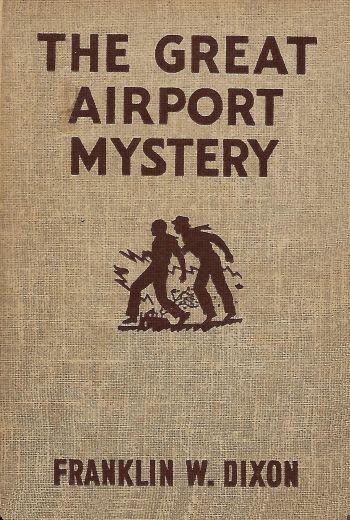
The Project Gutenberg eBook of The great airport mystery
Title: The great airport mystery
Author: Franklin W. Dixon
Release date: January 1, 2026 [eBook #77595]
Language: English
Original publication: New York: Grosset & Dunlap, 1930
Credits: Al Haines, Cindy Beyer & the online Distributed Proofreaders Canada team at https://www.pgdpcanada.net
The Great Airport Mystery
“IT’S ROBBERY, BUT I’LL SELL THE PLANE,” THE HARDY BOYS HEARD OLLIE JACOBS SAY.
HARDY BOYS MYSTERY STORIES
THE GREAT AIRPORT
MYSTERY
By
FRANKLIN W. DIXON
NEW YORK
GROSSET & DUNLAP
PUBLISHERS
Made in the United States of America
Copyright, 1930, by
GROSSET & DUNLAP, Inc.
——
All Rights Reserved
The Hardy Boys: The Great Airport Mystery
Printed in the United States of America
| CONTENTS | ||
| CHAPTER | PAGE | |
| I | Peril from the Sky | 1 |
| II | The Crash | 8 |
| III | A Promise of Trouble | 17 |
| IV | An Attack | 25 |
| V | Anxious Days | 34 |
| VI | The Cabin in the Woods | 42 |
| VII | A Mysterious Conversation | 51 |
| VIII | Puzzled | 59 |
| IX | Missing Mail | 67 |
| X | Looking for Clues | 77 |
| XI | News from the City | 87 |
| XII | Under Arrest | 96 |
| XIII | Circumstantial Evidence | 106 |
| XIV | Held for Trial | 115 |
| XV | On the Trail of Ollie Jacobs | 125 |
| XVI | Mysterious Plans | 136 |
| XVII | Dangerous Business | 144 |
| XVIII | The Warning Message | 153 |
| XIX | The Twenty-Eighth | 162 |
| XX | That Night | 172 |
| XXI | West of Bacon Hill | 181 |
| XXII | Captured | 189 |
| XXIII | Back in Bayport | 197 |
| XXIV | Vindicated | 207 |
CHAPTER I
Peril from the Sky
“It’s certainly great to have an airport so close to Barmet Bay,” said Frank Hardy.
“I wish we could go up in an airplane some time,” returned Joe, his brother.
“Wouldn’t you be scared?”
“Me? Would you?”
“No.”
“Then I wouldn’t be scared either. Look at the record holders! Where would they be now if they’d been afraid to go up in an airplane?”
“That’s right,” said Frank. “Airplanes are pretty safe nowadays. Almost as safe as this car of ours.”
The two Hardy brothers were driving on the Shore Road, leading out of Bayport and skirting Barmet Bay, in their new roadster. It was springtime. Snow had disappeared from the hillsides and the blue waters of the bay sparkled in the sunlight. Their destination this afternoon was the new airport, a few miles out of the city.
“I’m glad winter is over, even if we did have a lot of fun on Cabin Island,” said Joe. “It won’t be long now before we’re through school.”
“If we pass our exams,” Frank reminded him, calmly.
“You’ll pass all right. I’m not so sure about myself. I had to work mighty hard to catch up to you.”
“Yes, but I lost a term that year I was sick. Anyway, our marks have been good this year. We should get through. Isn’t it funny—when we’re going to high school we wish we were out of it and now that we are in our last term I’m rather sorry to leave.”
“Me, too,” said Joe. “Wonder where we’ll be next fall?”
“College, I guess.”
“Mother has her mind set on a college course for both of us. So far as I’m concerned I’d rather go into detective work with dad.”
“It would certainly be more exciting. Still, we’d have a good time at college, I imagine,” observed Frank.
He turned the car into a road that branched off the main highway. This road led toward the airport that had been constructed back of Bayport the previous summer.
“Wonder why they built the airport so far out,” Joe said.
“They have to have plenty of ground. It was the only place available. Then, there’s a railway siding near by and a train always meets the mail planes,” Frank explained. “Dad was telling me all about it the other evening. They use the port for commercial flying too, and I hear they do a lot of business and hope to do more.”
“An airmail pilot must have lots of nerve. It’s marvelous that they nearly always bring the mail through on time. And lots faster than trains. I wish we knew one of the pilots. He might take us up for a flight.”
“Chet Morton and the rest of the fellows would be green with envy,” rejoined Frank.
The roadster bounced along the rutted road toward the airport. A signpost near by conveyed the information that the flying field was three miles away. A little later, as the car came over the brow of a hill the Hardy boys could see the great flat field lying in the valley below. In front of a hangar they could see a plane with silver wings.
“Chances are we’ll both have a plane of our own in about ten years,” Joe said. “Everybody will be flying then, and think nothing of it.”
Frank applied the brakes as the roadster descended the steep grade. In a few minutes they had reached the foot of the hill. The car raced along the level road toward the airport.
The boys had often seen the airplanes flying over the city, but they had never been in close proximity to one of the machines and now they were excited over the prospect.
“Perhaps,” said Frank, “we’ll even meet one of the pilots and have a chance to talk to him and hear about some of his adventures.”
Joe turned in his seat and looked back.
“Why, there’s a plane now!” he exclaimed. “We’ll be able to see it land.”
Above the roar of the car the boys could hear the hum of an approaching airplane. It came swooping down out of the sky beyond the hill.
“Seems to be flying mighty queerly,” commented Frank. “Usually they go along as smoothly as a bird.”
“Nothing smooth about that one. Maybe the pilot’s in trouble.”
The flight of the plane was indeed erratic. It was going from side to side in a jerky fashion and it seemed to be flying much closer to the ground than safety warranted.
“He’ll never reach the airport at that rate,” said Frank, looking back again. “He should be higher up than that. Look! He’s coming straight down, and the airport is a couple of miles away!”
“I hope he doesn’t land on the road. He might hit us.”
“If he lands on the road he’s in for a nasty crash. A plane has to have plenty of room to move around in.”
Between steering the roadster and eying the plane, Frank Hardy was well occupied. Joe kept looking back and staring at the descending machine.
“I believe that fellow is in trouble,” he said. “He’s coming down right this way.”
They could see the airplane quite clearly now. They could even see the figure of the pilot in the cockpit. The machine was descending at terrific speed in a long glide that made it seem inevitable that the plane would fall far short of the airport.
Frank stepped on the accelerator. The car leaped forward, raising a cloud of dust. But the speed of the car was as nothing compared with the speed of the plane. The distance between them diminished, and the plane was steadily nearing the ground.
“Great Caesar! That fellow is coming down on top of us!” shouted Joe, in alarm.
“Not if I can help it,” returned Frank grimly.
Joe looked up. He could even distinguish details of the understructure of the airplane now. The roar of its engine was deafening. Lower and lower it came.
For a moment the plane flew level. Its nose raised and it gained altitude. Joe breathed a sigh of relief. Then the big machine dipped again. He could see the propeller blades flashing in the sun.
The roadster was traveling at sixty miles an hour. Frank did not dare raise his eyes from the road. He crouched over the wheel.
“Where is he now?” he snapped.
“Right behind us! And coming down every minute!”
Joe was really frightened. There was no hope that the plane would ever reach the airport, for it was flying too close to the ground. He wondered if the pilot was merely trying to scare them. But the plane was diving toward them in such headlong fashion that he quickly abandoned this explanation.
Powerful though the roadster was, the speed of the plane was much greater. It was scarcely two hundred feet from the ground now and its nose was pointing down at a dangerous angle. In a few more seconds there would be a crash, and, from the angle of flight, it seemed almost certain that the heavy machine would crash directly on top of the roadster!
The car roared ahead, the noise of its engine drowned in the gigantic throbbing of the airplane’s motor. The plane came nearer and nearer, diving at almost incredible speed.
“We’re done for!” groaned Joe.
Unless a miracle intervened the plane would crash directly on top of the Hardy boys’ car!
CHAPTER II
The Crash
Frank Hardy could scarcely keep the car on the road. He glanced at the speedometer. They were traveling at seventy miles an hour.
It was certain that the airplane would crash on the highway.
Suddenly Joe leaned forward.
“Look! The side road!” he shouted. “Take the side road!”
A short distance ahead Frank saw a rough dirt road leading off the highway to the airport. If he could only reach it in time! The roar of the descending airplane was deafening now. They could even hear the wind screaming in the struts. Joe saw the pilot, in helmet and goggles, waving his arm wildly.
Frank slackened speed slightly as he neared the dirt road, bore down on the wheel, and made the turn. The rear wheels skidded wildly, there was a screech of brakes, the car teetered perilously, then righted itself, and shot down the rough lane.
At the same moment the airplane roared past. It was so close that the wing tip came within a few feet of the rear of the car.
Then it crashed.
Frank was having his own troubles and he did not see the crack-up. On the bumpy dirt road the car skidded, throwing up a cloud of sand and dust, then shot across a ditch, thumped and lurched over some rocks, and finally came to a stop at a rail fence.
Joe came close to going through the windshield and then hit the door with a thud.
“Wow!” he burst out. “Some wild ride, I’ll tell the universe!”
Frank had been thrown tightly against the wheel, otherwise he, too, might have gone into the glass. As it was, he hurt his ribs a little.
“Well, I’m glad we didn’t overturn,” he remarked, as soon as he could catch his breath.
“Or take down the fence.”
“Wonder who that crazy fellow was?”
“Maybe something went wrong with his air bus.”
“Well, I’m glad we managed to get from under. It was a mighty close call.”
Joe, looking back, saw the airplane as it crashed.
Nose-down, it came, then flattened out just before it reached the ground. Its understructure crashed into the earth. The plane seemed to bound high in the air, then came down again with a snapping and crackling of wood, and buried its nose in the dust of the road. Then its tail canted up and the plane turned a somersault over on its back.
It was a wreck!
While the Hardy boys are scrambling out of their roadster and hastening back to the scene of the airplane crash that had so nearly cost them their own lives, the opportunity will be taken to introduce them more definitely.
Frank and Joe Hardy were the sons of Fenton Hardy, an internationally famous detective, late of the New York police force. Mr. Hardy had made such a name for himself as a detective with the New York force that he had resigned to go into business for himself as a private detective and his services were frequently sought in important cases. His sons, Frank and Joe, were eager to follow in his footsteps.
The Hardys lived in Bayport, a thriving city on Barmet Bay, on the Atlantic coast. Here Frank and Joe attended the Bayport high school, where they were in their final year. Although Frank, a tall, dark, handsome lad, was a year older than his curly-headed brother Joe, both boys were in the same grade because of an illness that had caused Frank to lose time. Mr. and Mrs. Hardy were anxious that their sons should go to college after finishing high school, Mrs. Hardy wishing them to study law and medicine. But the boys were of different mind. Their father’s profession appealed to them. They wanted to be detectives.
As a matter of fact, the lads had a natural bent toward detective work and they had already proved their ability so thoroughly that Fenton Hardy was disposed to believe that they would be successful if they followed in his footsteps. The Hardy boys had solved a number of mysteries that had puzzled the police of Bayport and vicinity, and already the people of the city knew of them as boys possessing more than the usual share of initiative, resourcefulness, and deductive ability.
Frank and Joe were introduced in the first volume of this series, entitled: “The Hardy Boys: The Tower Treasure,” in which they solved the mystery of the disappearance of a treasure from Tower Mansion, on the outskirts of Bayport. In succeeding volumes of the series their adventures while seeking to unravel other mysterious cases in which they became involved have been described at length. During the winter previous to the time this present story opens, Frank and Joe Hardy had spent a vacation on Cabin Island, in Barmet Bay, where they had cleared up the mystery of a stolen stamp collection of great value, discovering the precious stamps after many thrilling events. These adventures have been related in “The Mystery of Cabin Island,” the volume immediately previous to this story.
As the Hardy boys ran back down the dirt road toward the wreckage of the airplane they had little hope that they would find the pilot alive.
“He’ll be smashed to pieces!” gasped Joe.
“The plane isn’t burning, anyway,” said Frank. “There may be a chance for him yet.”
Just then they heard a cry for help.
It came from beneath the jumbled wreckage of the plane. In a few moments the Hardy boys reached the scene.
Although the crash had been witnessed from the airport and people were already proceeding toward the spot, the Hardy boys were the first to arrive. They could hear groans and shouts from beneath the plane.
“We’ll have to lift up some of that wreckage to get the poor fellow out,” said Frank quickly. He looked around. It was futile to attempt raising the wreckage by hand. He saw a heavy rail lying at the base of the near-by fence. “Here we are. This will do as a lever.”
The boys seized the rail and carried it over to the wreckage. They inserted one end of the rail beneath the body of the plane, rolling a big rock forward as a support.
The groans and shouts continued.
“All right there!” called Frank. “We’re going to pry some of this wreckage away from you. Are you badly hurt?”
“I’m nearly killed,” groaned the pilot. “Hurry up and lift this plane off me.”
“Try to crawl out when we raise it,” advised Frank.
The boys bore down on their improvised lever. There was a clattering and crackling of the wreckage; then the mass began to move. The body of the upturned plane rose slightly. Joe caught a glimpse of the pilot scrambling out of the cockpit. The man’s face was scratched and bleeding, but he seemed to be crawling out of his precarious position quickly, so evidently no bones were broken.
The boys managed to hold up the plane by means of the strong rail until the pilot crawled out.
“Anyone with you?” demanded Frank.
The pilot, struggling to his feet, shook his head. The boys released their grasp on the rail and the wreckage subsided again with a crash.
The pilot came forward. The boys noticed that he lurched slightly as he walked and that he staggered as he came up to them. His uniform was torn and he had a few scratches across his face, but otherwise he did not appear to be badly hurt.
“How are you feeling?” Joe asked him.
Swaying from side to side, the pilot confronted them in silence. His face was flushed.
“Narrow escape,” he muttered. “Mighty narrow escape.” He turned and looked at the wrecked plane, and hiccuped.
“What happened?” asked Frank. “Engine trouble? Or did you run out of gas?”
“I dunno,” answered the pilot thickly. “I dunno what happened. It wasn’t my fault. All the fault of them fellows in the car.”
“Fellows in a car?”
“Yes. Couple of fools in a car ahead of me. I wanted ’em to stop and they wouldn’t. They rushed right ahead and got in my way. Thought I’d scare ’em and make ’em stop, but they kept on going. Then I found I couldn’t get back in the air again—flying too low—it was all the fault of those fools in the car.”
Frank and Joe glanced at one another significantly. Clearly, the man was referring to them. And it was just as clear that the pilot had been drinking.
“We were in a car,” said Frank. “If you think we’re to blame for your accident you’re badly mistaken. You mighty near cost us our lives. We had to get off the road or you would have crashed on top of our car.”
The pilot turned and looked at the boys, an ugly expression in his bloodshot eyes.
“You were in the car, eh?” he shouted. “You’re the fellows that are to blame for this crack-up!”
“It was your own fault.”
“Wasn’t my fault. You fellows wouldn’t stop. I was afraid I was going to hit you. That’s why I lost control of the plane.” The pilot was working himself up into a temper. “You’ll pay for this, let me tell you. My plane is wrecked and I was mighty near killed just because a couple of fool boys didn’t know enough to stop.”
Frank and Joe Hardy stared at the man in amazement. The injustice of the charge passed belief. They were just about to reply angrily when they heard voices and saw men hurrying down the road toward them. A number of farmers in the adjacent fields had witnessed the accident and had lost no time in hastening to the scene.
“What happened? Anybody killed?” demanded one man, as they came up.
“The plane is wrecked. The pilot escaped,” explained Frank.
“No thanks to you young fools,” snarled the pilot. He turned to the farmers. “I’m lucky to be alive. I was trying to make a landing on the road and these young idiots in their car kept racing ahead of me so I couldn’t come down. I lost control of my machine and it’s wrecked.”
The farmers looked gravely at the Hardy boys. Frank laughed.
“I think you’d better wait until you sober up,” he told the pilot, “before you make any charges like that. You haven’t any business being in an airplane when you’re drunk.”
“Who says I’m drunk?” demanded the pilot belligerently. He clenched his fists and stepped forward. “My airplane is wrecked and I’m going to hold you young fools responsible.”
CHAPTER III
A Promise of Trouble
“You can’t blame us for this smash-up!” exclaimed Frank Hardy. “Why, that’s absurd! We were on the road, where we belonged. If you wanted to land, you should have landed in a field. There’s plenty of room.”
“I’ll land my plane wherever I please,” raged the pilot.
“Why pick on us?” asked Joe. “We did our best to get out of your way. I think you deliberately tried to run us down.”
“Never mind. You’ll hear more about this affair. I’m going to report this to the air mail service and they’ll come on you for damages.”
“Try to get ’em,” returned Frank.
A lanky farmer stepped forward.
“I saw the whole thing from the top of the hill,” he said slowly. “If I was you, Mr. Airplane Man, I wouldn’t try to collect no damages from these lads.”
“Why not?”
“Because they wasn’t to blame for the accident. The whole thing was your own fault. And, by jing, if you do try to blame them they can count on me for a witness to prove that they did their best to get out of your way. They was ridin’ peacefully along the road, and then you come swoopin’ and bouncin’ out of the sky and come slap down on the road where you shouldn’t be. You airplane fellows give me a pain. You’ve got the whole sky to move around in, and yet you think you have a right to chase people off the earth too.”
“Is that so?” sneered the pilot. “Well, you’ll have a chance to give your evidence, seeing you know so much.”
“I’m glad of that, Giles Ducroy,” said the farmer. “I’m glad I’ll have a chance to give evidence, for then I can tell ’em how drunk you were when you crawled out from under the plane.”
This shot told.
“I’m not drunk,” stormed Ducroy. “I’m nervous.”
“You must have a pretty bad case of nerves to make your breath smell so strong,” rejoined the farmer calmly. “I’ll bet the air mail service won’t keep you on very long after this, when they hear what I’ve got to say.”
The pilot turned his back.
“I haven’t got time to bother with you. It’s these boys I’m dealing with. I warn you,” he said, glaring at the Hardy boys, “you haven’t heard the last of this. There’s going to be plenty of trouble for you.”
Just then there was a roaring and clattering as a huge truck lumbered down the road, bound from the airport. The driver stared at the scene in amazement. Some of the farmers moved the wreckage of the plane out of the road to enable the truck to pass. Giles Ducroy strode forward arrogantly.
“Driver!”
“Yeah?”
“There are some bags of air mail in my plane. I want you to bring them to Bayport.”
“Who says so?” asked the driver calmly.
“I do. I’m pilot of this plane.”
The driver regarded the wreckage.
“Looks like you made a pretty good job of the crack-up,” he said finally.
Some of the bystanders grinned. Giles Ducroy flushed angrily.
“No nonsense about this,” he snapped. “It’s my duty to see that the mail bags reach the city.”
The truck driver sighed.
“Why didn’t you bring ’em to the airport in your plane?” he inquired.
“Can’t you see? I’ve had an accident.”
“You picked a nice day for it,” observed the driver, glancing up at the sky.
Giles Ducroy lost patience. He went over to the wreckage of the plane and burrowed among the débris until he found the mail bags. These he hauled forth and tossed into the truck.
“There!” he said. “Get them to Bayport as quick as you can.”
“Yes, Commander!” said the truck driver, with an elaborate salute. “The air mail must arrive on time. If I run out of gas I’ll come down in a parachute.” And the big truck lumbered off.
This exchange of witticisms, in which Giles Ducroy had come out second best, judging by the snickers of the farmers who were now crowding about, did not leave the pilot in a very good temper. He stormed into the middle of a group of men who were examining the wreckage, ordered them to stand back, and promised all sorts of dire penalties if anyone touched the airplane until he returned from the airport.
“As for you,” he said, turning to Frank and Joe Hardy before he stalked away, “you’ll hear more about this. You’re to blame for the whole business and I’m going to see that you suffer for it.”
He went away, walking rather unsteadily down the road.
The lanky farmer who had befriended the boys came over to them.
“A man like that oughtn’t to be allowed in charge of a plane,” he said gravely. “I’ll bet if the air service people knew about him being drunk he wouldn’t hold his job two seconds.”
“Do you think he can make trouble for us?” asked Frank. “It wasn’t our fault that he crashed. We did our best to get out of his road, and it was just by luck that he didn’t smash right on top of us. I nearly wrecked our roadster getting out of the way.”
“I saw it,” said the man. “I saw it all from the top of the hill. And it’s just like I told Ducroy. I’ll be a witness for you if there’s any trouble. My name is Jim Perrin and people around here know my word is as good as my bond. You lads were no more to blame for that smash-up than I was, and I’ll tell ’em so.”
“It’s mighty good of you, Mr. Perrin,” said Frank gratefully. “If we have any trouble about this matter we’ll certainly call on you.”
“Be sure you do. I’ll help you all I can.”
The farmer went back toward the wreckage. Frank and Joe decided that their trip to the airport might as well be called off for the time being, as they had no desire for a further encounter with Giles Ducroy. So they went back to the roadster and extricated it from its position among the rocks, backed it out into the highway and headed toward Bayport again.
In spite of Jim Perrin’s reassuring words, the lads were disturbed.
They had no idea how far Giles Ducroy might go and they realized that the man would certainly stretch the truth in order to clear himself with the airport officials. Like most boys, they believed that a man in uniform was vested with powers beyond that of the average citizen and they reflected that the officials might be more inclined to believe Giles Ducroy’s word than theirs.
“I think we’d better tell dad about this,” said Frank. “We know we aren’t to blame, but this thing might be serious if Ducroy makes any charge against us.”
“Good idea,” replied Joe.
When they reached home they ran the roadster into the garage, then went into the house. Fenton Hardy was working in his study, but he put aside his papers when the boys came in and looked up at them with an inquiring smile.
“What’s the matter?” he asked. “You both look as if you have something on your minds.”
“We have,” said Frank.
“Been in an accident with the car?”
“There was an accident, but we weren’t in it. We saw an airplane crash and we’re blamed for it.”
Mr. Hardy looked serious.
“How on earth could you be blamed for an airplane smash when you were in your roadster?”
Frank then explained the circumstances and told how they had been obliged to take refuge in a lane in order to avoid the descending plane.
“It certainly wasn’t our fault,” he concluded. “We might have been killed if we hadn’t reached the lane in time.”
“You say Ducroy was drunk?”
“He had been drinking. We could smell liquor on his breath.”
“I don’t think he’ll get very far if he tries to lay any charges against you,” said the great detective. “The post office authorities won’t be very easy on him if they discover he had been drinking. And, then, you have this witness, Mr. Perrin. I’m inclined to think they’ll accept his word about how it happened.”
“I suppose we’ll just have to wait and see what Ducroy does,” said Joe.
“Perhaps I can fix things up,” said Mr. Hardy. “I happen to have a good many friends in the postal department. I cleared up a big mail robbery here a few years ago and they appreciated it. I’ll go down right away and have a talk with some of the officials and I’ll try to explain things to them. Don’t worry too much about it.”
“That’s mighty good of you, Dad,” said Frank.
“I’ll say it is!” chimed in Joe.
“Well, I certainly can’t see my sons accused of wrecking an airplane when they didn’t have anything to do with it,” said Mr. Hardy warmly. He got up and reached for his hat. “I’ll go and see what can be done about it right away.”
CHAPTER IV
An Attack
The airplane crash was a front-page feature in the newspapers of Bayport for several days thereafter, and the Hardy boys learned that the post office department was conducting an investigation into the cause of the affair.
Several reporters called on Frank and Joe Hardy to learn their version of the accident, and although the boys told exactly how the crash occurred, they were disturbed to find that considerable space was given to Giles Ducroy’s account. Ducroy was not backward in laying the blame upon the Hardy boys.
“My plane cracked up simply because I was trying to avoid hitting the car,” he said, in an interview. “The boys deliberately drove their roadster ahead so that I was unable to find a landing place until it was too late. They confused me so much that the accident was the result.”
All this looked very bad in cold print, and one of the newspapers hinted that the post office department might take action against the boys if Ducroy’s story was upheld.
“Don’t worry about it,” Fenton Hardy advised. “Don’t let it be on your minds while you are writing examination papers.”
This counsel was sound. The lads were busy writing their final examinations and upon the result would depend their graduation from the high school that year. If they failed, it would mean another term, and a year’s work wasted.
Both Frank and Joe had studied hard and were well up in their work. Under ordinary circumstances they would have had little doubt of the outcome, but with the Ducroy affair on their minds they could not concentrate on their studies as well as they might have done otherwise. Frank shook his head mournfully when the boys left school the afternoon of the geometry examination.
“How do you think you made out?” he asked Joe.
“Not so good.”
“I’m sure I failed.”
“It was a tough exam. Everybody says so.”
“I know it was tough, but I couldn’t help thinking of the trouble we’ll be in if the post office people decide we’re to blame for that accident.”
“It was in my mind too,” Joe admitted, “Still we know it wasn’t our fault.”
“Of course it wasn’t. But the chances are that they’ll believe Ducroy, seeing he’s one of their own pilots.”
“If they blame us, we’ll fight it. We’ll tell them Ducroy was drunk.”
“Perhaps they won’t even listen to us,” said Frank.
The boys went on down the street toward the downtown section. Joe caught sight of a familiar name in a newspaper headline.
“This looks interesting,” he remarked. When he bought the paper, the two stood on the corner to read it.