
“For that in many and most places of this Realm, commonly little Horses and Nags of small stature and value be suffered to depasture, and also to cover Mares and Felys of very small stature, by reason whereof the Breed of good and strong Horses of this Realm is now lately diminished, altered, and decayed, and further is like to decay if speedy Remedy be not sooner provided in that Behalf.”
“It is provided that all Owners or Fermers of parks and enclosed grounds of the extent of one mile in compass, shall keep two Mares, being not spayed, apt and able to bear foals of the altitude or height of thirteen handfuls at least, upon pain of 40/.”
“A penalty of 40/ is imposed on the Lords, Owners, and Fermers of all parks and grounds enclosed as is above rehearsed, who shall willingly suffer any of the said Mares to be covered or kept with any Stoned Horse under the stature of fourteen handfuls.”
The year 1541 saw another statute (32 Hy. VIII.) This enacted that—
“No person shall put in any forest, chase, moor, heath, common, or waste (where mares and fillies are used to be kept), any Stoned Horse above the age of two years, not being 15 hands high, within the SHIRES and territories of Norfolk, Suffolk, Cambridge, Buckingham, Huntingdon, Essex, Kent, South Hampshire, North Wiltshire, Oxford, Berkshire, Worcester, Gloucester, Somerset, South Wales, Bedford, Warwick, Northampton, Yorkshire, Cheshire, Staffordshire, Lancashire, Salop, Leicester, Hereford, and Lincoln.”
“And furthermore be it enacted, that if in any of the said drifts, there shall be found, any mare, filly foal or gelding that then shall be thought not to be able nor like to grow to be able to bear foals of reasonable stature, or not able nor like to grow to be able to do profitable labours, by the discretions of the drivers aforesaid or of the more number of them, then the same driver or drivers shall cause the same unprofitable beasts, and every of them to be killed, and the bodies of them to be buried in the ground or otherwise bestowed, as no annoyance thereby shall come or grow to the people, there near inhabiting or thither resorting.”
By another Act the exportation of horses beyond the seas is strictly forbidden; and this Act is extended to Scotland; selling a horse in England to a Scotchman without a Royal permission, is declared to be felony in both buyer and seller (32 of Henry VIII. cap. 6). This statute is entitled, “An acte for the tryall of felonies upon conveiynge of horses into Scotland.”
The use of the word “Shire” will be noted in the foregoing extract. It is of interest in view of the diversity of opinion expressed when the Shire Horse Society was formed, concerning the propriety of using this term. In this statute of Henry VIII. for the first time we find the word “Shire” used in connection with horses.
Ralph Holinshed, in his Chronicles (Ed. London, 1807, vol. vi., p. 3), has an entry which indicates that this monarch set his subjects a good example in this particular respect:—
King Henry VIII. erected a noble studderie for breeding horses, especially the greatest sorte, and for a time had verie good success with them. The officers however seemed wearie: and procured a mixed breed of baser races, whereby his good purpose came to little effect.”
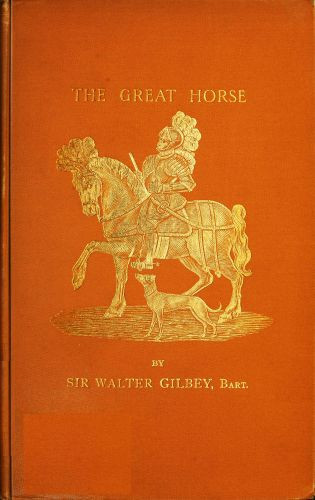
That horses of “the greatest sorte” were absolutely essential at this time the immense weight of iron worn by both rider and horse proves to us. The engraving represents a knight clad in a suit of tilting armour, which is now to be seen in the Tower of London. This armour was described in 1660 as having belonged to Charles Brandon, Duke of Suffolk, Henry VIII.’s brother-in-law. The Tower officials give the weight as follows:—Man’s armour, 99lbs. 9oz.; horse’s armour, 80lbs. 15oz. The mail would fit only a big and powerful man (none other could profitably wear it) whose weight must have been at least 16 stone. Thus we have:—
| Lbs. | oz. | |
| Weight of rider | 224 | 0 |
| Rider’s armour | 99 | 9 |
| ” spear | 20 | 0 |
| Horse’s armour | 80 | 15 |
| Total | 424 | 8 |
or 30 stone 4lbs. 8oz. As we must allow for the knight’s clothing and the horse’s gear, bridle, &c., the total weight would not fall short of the four hundredweight mentioned by the old chronicler quoted on the next pages as the burden the Great Horse will “carrie commonlie.”
QUEEN ELIZABETH’S TIME.
Holinshed gives a valuable account of the heavy horses of Queen Elizabeth’s time (1558-1603). From his record we gather that at this period the Great Horse was no longer reserved exclusively for military purposes, but was in general use for farm and draught work. Holinshed’s reference to the transport required by the Queen’s retinue when she made her frequent progresses through the kingdom is testimony to her inordinate love of pageantry and display. Coaches, according to Stowe, had been introduced into England by FitzAlan, Earl of Arundel, 1580 (though Queen Mary had had one built for herself in 1556), but this mode of conveyance does not appear to have commended itself to Queen Elizabeth. She was, as history tells us, an admirable horsewoman, and we know that she rode behind her Master of Horse when she went in state to St. Paul’s. The following passage from Ralph Holinshed’s Chronicle will be found in book ii., chapter i. of the folio edition printed in London, 1587:—
“Our horses, moreover, are high, and, although not commonlie of such huge greatnesse as in other places of the maine, yet, if you respect the easinesse of their pase, it is hard to saie where their like are to be had. Our cart or plough horses (for we use them indifferently), are commonlie so strong that five or six of them (at most), will draw three thousand weight of the greatest tale with ease for a long journeie—although it be not a load of common usage—which consisted onlie of two thousand, or fiftie foot of timber, fortie bushels of white salt, or six and thirtie of baie, or five quarters of wheat—experience dailie teacheth, and [as] I have elsewhere remembered. Such as are kept for burden, will carie four hundred weight commonlie, without any hurt or hinderance. This furthermore is to be noted, that our princes and nobilitie have their carriage commonlie made by carts; whereby it commeth to passe, that when the queenes majestie dooth remove from anie one place to another, there are vsuallie 400 carewares, which amount to the summe of 2,400 horses, appointed out of the countries adioining, whereby her cariage is conveied vnto the appointed place. Hereby, also, the ancient vse of somers and sumpter horsses is in a maner vtterlie relinquished; which causes the traines of our princes in their progresses to shew far lesse than those of the kings of other nations.”
The loads so respectfully described by Holinshed do not at first sight appear to indicate any very remarkable draught power on the part of a team of five or six horses; rather the contrary. In regard to this, however, we must bear in mind that three hundred years ago the roads were so bad and rutty that an empty waggon would be harder to draw in those days than a heavily loaded wain on a modern road.
The accompanying portrait of Sir Walter Hungerford, Knight, of Farley Castle, Heytesbury, is engraved from a picture in the possession of Sir R. Hungerford Pollen, Bart., at Rodbourne, Malmesbury. Sir Walter was the eldest son of Baron Hungerford, who was beheaded July 28th, 1541. Upon the accession of Queen Mary, Walter Hungerford obtained a reversal of the attainder imposed on his father, and recovered the family estates; but the peerage was not revived. Sir Walter retired from political life and court intrigue, and, choosing for his motto, Amicis Amicissimus, devoted himself entirely to country pursuits. He became widely known for the excellence of his stud; and the picture here engraved bears the following inscription, “Sir Walter Hungerford, Knight, had in Queene Elizabeth’s tyme, the Second of her Raine, for foure yere together, a baye horse, a blacke greyhounde, a lanerett.[A] This offer was for foure yere together, to all Eynglande, not above his betters, he that shoulde showe the best horse for a man of armes, a greyhounde for a hare, a haucke for the reyver, to wine III hundred poundes, that was a hundery the poundes apese. Also he had a gerfalcon for the herne in Her Majesty’s tyme, that he kept XVIII. yere; and offered the lyke to flye for a hundred pounde, and were refused for all.”
This offer of Sir Walter’s gives us the right to assume that the type here represented was the one acknowledged at the date to be that most approved in the English Great Horse; whilst the special function of that horse was, still, to carry “a man of armes.” It can be seen that—though the hair, both of the mane and legs, has been manipulated to suit the fashion—the tail still shows the characteristic abundance. Sir Walter Hungerford’s horse is certainly of the type of Albert Dürer’s Great White Horse, though it shows more evidence of spirit and high action.
Instructive particulars concerning the horses of this period are to be found in a curious little black letter volume, entitled, The Art of Ryding and Breaking Greate Horses, written by Thomas Blundeville of Newton Flotman in Norfolk, and published in 1566; a second edition of which, “newlie corrected and amended of manie faults escaped in the first printing” was issued in 1580; the latter including chapters on breeding
horses. We may quote from Blundeville’s pages a few passages which throw light upon our subject:—
“Some men have a breed of Great Horses, meete for warre and to serve in the field. Others have ambling horses of a meane stature for to journey and travel by the waie. Some again have a race of swift runners to run for wagers or to gallop the bucke. But plane country men have a breed only for draftes or burden.”
From the foregoing it would appear that the lesser breed of agricultural horses (stots and affers) was still in existence, though the extract on page 34 appears to show that mares of the Great Horse breed were used for draught purposes. It will be remembered that at an earlier age churchmen were enjoined to use mares that the horses might be at the service of soldiers. Thomas Blundeville mentions as the “most worthy” breeds:—
“The Turke, the Barbarian, the Sardinian, Napolitan [commonly called the courser of Naples], the Jennet of Spain, the Hungarian, the high Almaine, the Frizeland horse, the Flanders horse, and the Irish hobbie.”
He describes these in turn: those that come within our purview are the Napolitan, high Almaine and Flanders: the first of these is:—
“a trim horse being both comelie and stronglie made and of so much goodness, of so gentle a nature and so high a courage as anie horse is. Known from other horses by his no lesse cleane than stronge makinge.”
The high Almaine (modern Allemagne, German: King John’s importations from the banks of the Elbe at once recur to mind) is:
“commonlie a great horse, and though not finelie yet verie stronglie made and therefore more meete for the shocke [of battle] than to passe a cariere or to make a swift manege because they be verie grosse and heavie, yet by industrie they are made lighter behind than before, for their rider do use in their maneging to make them to turne alwaies with their hinder parts and not with their fore parts like jackanapes on a chaine, whereby they keep their horses heads alwaies upon the enimie.”
The Flanders horse differed little from the “high Almaine” or North German breed save that it was for the most part of greater stature; the disposition of these two heavy horses was “not evill;” on the contrary the animals are stated to be “verie tractable.”
Thomas Blundeville’s suggestions for breeding, based as they undoubtedly were on experience, throw light upon the ancestry of our heavy horses:—
“I would wish him that seeketh to have a race of good horses, meet to serve in the field to get a Napolitan stallion if it be possible, if not let him take the high Almaine, the Hungarian, the Flanders, or the Frizeland Horse, so that he be of convenient stature well proportioned and meete for the purpose. The mares should be of an high stature, stronglie made, large and fair, and have a trotting pace as the mares of Flanders and some of our own mares be. For it is not meete for divers respects that horses of service should amble.”
The “Napolitan stallion,” coming from a greater distance and being more costly, was comparatively seldom imported; whence the author’s reservation “if it be possible.” There is no doubt but that the English Great Horse owed far more to importations from more northern countries than to those from Italy.
A “horse of service,” we are informed, should be able to
“trot cleane and loftilie, to stop lightlie, to turn on both hands readilie, to gallop stronglie, to manege with single turne surelie and last of all to passe a cariere [i.e., “do a smart spin”] swiftlie; and in all his doings from the beginning to the ending to reine well and to bear his head steddilie.”
The “cariere” was to be of specified length; for a “mightie puissant horse great of stature” a shorter one was recommended.
In the chapter headed “How to ride a Horse to the best shewe before a Prince”—how to show him off to the best advantage, as we should say—there is a very suggestive remark which proves how necessary were the endeavours of horse-loving sovereigns to improve the breed:—
“Maneging and doubling after a cariere belongeth to a horse of greate force, which indeed should represent in his doings the verie order of fight observed in the field which is but little used now a daies because of the general weaknes of our horses.”
In the earlier edition the writer speaks with admiration of the Great Horse,
“not finelie yet stronglie made he is of great stature. The mares also be of a great stature; strong, long, large, fayre and fruitful; and besides that, will endure great labour in their wagons, in which I have seene two or three mares to go lightly away with such a burthen as is almost uncredible.”
“But now to content the countryman his desire, which seeketh to breede horses for draught or burthen, where should I wysh him to provyde hymselfe of Mares and Stallions better than here in Englande.”
“I have knowne some carriars that go with carts, to be so exquisit in their choyse of horses, as onlesse been as commely to the eye as good in their worke they would not buye them; insomuch as I have seen somtyme drawing in their carts better proportioned horses than I have knowne to be fynely kept in stables, as jewels for the saddle. The horse that is meete for the cart, may serve also for the burthen, bycause he is strong and able to beare much.”
In the second edition, however, we find the recommendation to the countryman to provide himself with stock of English raising qualified by a remark which confirms the author’s reference to the general weakness of the war horses of the time, and indicates that the “misfits” of the Great Horse breed, as we might suppose, were relegated to the waggon and the plough. The passage “But now to content ... better than here in Englande,” continues:—
“whereas he maie easilie find a number of strong jades more meet for that purpose than for the saddle, and all for lack of good order of breeding which if it might be once observed in this realme I believe there would be so good and so faire horses bred here as in anie place in Christendome.”
The need of more legislation on the subject, or better administration of the existing laws, is here very plainly indicated.
When discussing the advantages of gelding horses for use on the road, Blundeville incidentally bears out what we already know, viz., that the animals used by heavily armoured cavalry were entires. “Our light horsemen here in England,” he says, “do in like manner serve upon geldings in the warres ... partly for servants to ride on and to carie their males [mail] and cloke bagges.”
The invention of gunpowder and its application to hand firearms produced the inevitable effect upon heavy armour in the last quarter of the sixteenth century. Sir John Smythe writing in 1589, the year after the famous Spanish Armada fiasco, says contemptuously of the cavalry of Spain: “Their horsemen also serving on horseback with launces or any other weapon they think very well armed with some kind of headpiece, a collar, and a deformed light bellied beast.” The introduction of coaches at this time, and the encouragement of racing at a somewhat later period also tended to encourage the breeding of lighter horses in England.
JAMES I.
We now take leave of our Elizabethan instructors and come to records relating to a generation later. In the Herbert MS., published as vol. xx. of the Montgomeryshire collection, we find on page 148 an estimate of the cost of horsing an expedition which was being fitted out to enforce the claims of the Prince Palatine, son-in-law to James I., to the Crown of Bohemia. This estimate was laid before the Privy Council on January 13th, 1620. Ten thousand men were to be despatched from England; it was calculated that the baggage of this army would weigh 1,150 tons, to transport which as many carts each carrying one ton, would be needed, and for each waggon eight cart horses. It was further estimated that for the conveyance of the officers, the sick and the wounded, 380 waggons would be wanted, and that three horses must be provided for each of these vehicles. The scheme laid before the Privy Council proposed that part, at least, of the 10,412 cart horses thus required should be taken up where they could be hired by the day “in the Low Countries or where they may best be hadde. They with the carters to drive and keep them.” The hire was estimated at 2s. per diem, while the cost of the horses, if bought outright, “with harness and furniture,” would, it was anticipated, be £9 apiece. The framers of this estimate appended thereto a note or recommendation which reflects the comparative merits of English and foreign cart horses at the time. “We think it necessary that, besides, 200 strong cart horses such as cannot be hired should be bought or continually kept for the use of the ordnance and munition.” The cost of these Strong or Great Horses was put down at £15 per head—the modern equivalent of that seemingly modest sum being perhaps £100—and the lieutenants and deputy-lieutenants of counties throughout England were to be required to certify what proportion of horses fit for this service “each sheire canne affourd upon all occasions on enterprise.”
Among the leaders of this expedition was the Duke of Arenberg, whose portrait, painted by Vandyke, is in the collection of the Earl of Leicester, at Holkham Hall, and from which the accompanying engraving is taken. In Smith’s Catalogue of Painters, vol. iii., p. 148, this is described as one of the great artist’s most successful equestrian portraits. Vandyke is believed to have visited this country in 1620 and to have executed commissions for James I. who conferred upon him a pension and a safe conduct which enabled him to travel without hindrance through all continental countries whose sovereigns were friendly to England. The picture affords interesting proof of the close resemblance of the English war horse in the first quarter of the seventeenth century to that portrayed by Albert Dürer more than one hundred years earlier. The colour is different; but in all material points it is practically identical with the white Great Horse of the German painter. The similarity of character is not confined to the horse on which the Duke is mounted; in the background a body of cavalry is represented, and an engraving on large scale of this portion of
the picture shows the stamp of animal to be the same.
CHARLES I.
Coming now to the reign of Charles I. (1625-1649) we find that the popularity of racing and its results on the breed of strong horses were disturbing the minds of thoughtful men. Sir Edward Harwood presented to the King a memorial which represented that there was a great deficiency of good and stout horses for the defence of the Kingdom, insomuch that it was a question whether it could have furnished 2,000 that would have been equal to 2,000 French. The cause being, the memorialist stated, the strong proclivity of the nation for racing and hunting, which required horses to be lighter and weaker for the sake of swiftness. Sir Edward proposed as remedy that nobles and gentlemen should keep stronger horses and train them and their riders in military exercises instead of making races for Bells. This sound advice might have produced results but it was offered at the time when troubles were gathering about the throne and the King had no leisure to attend to it. Charles was fond of the manège and was a good horseman; his care for the art of riding the Great Horse was shown by a proclamation issued in the third year of his reign. In this he commanded that, as he had found by experience, such horses as are employed in the service are “more apt and fit to be managed by such as shall ride them, being accustomed to the Bitt, than the Snaffle ... no person shall in riding use any snaffles but Bitts only.” This was qualified by exception in favour of “times of Disport,” which doubtless referred to racing, hunting, and hawking.
It is quite in accord with King Charles’ love of the manège and military horsemanship that the Great Horse should figure on the Great Seals of the unfortunate King. By permission of Mr. Allan Wyon we reproduce from his beautiful work, The Great Seals of England, engravings of Charles’ Counter Seal and Second Counter Seal with the descriptions therein given. The engraver has rendered the breed of his horses unmistakeable; and nothing need be added to Mr. Wyon’s descriptions:—
COUNTERSEAL.
Period of use 1625 to 1627.
“The King on horseback, galloping to the left, holding in the right hand a sword which passes behind the King’s head, the left hand holding the
reins. The helmet is ensigned with the Royal Crown. Three very long and three short feathers fly backwards from the King’s helmet. The horse’s neck is protected at the back by plates, and on its head is a plume of feathers. The horse wears a stiff caparison as in the seal of James I., but more limited in dimensions. On the caparison covering the hind quarter are the Royal arms encircled with an inscribed Garter, and ensigned with a Crown. In the lower border of the caparison thistles and roses are placed alternately at a small distance apart, above a short fringe. The reins are very wide and much ornamented; the part which is seen in front is escalloped, having four pendants, each pendant being made to represent a rose with a tassel hanging from it. The tail is in three distinct waves. In base is a greyhound collared and current to the left. The field is diapered with interlacing ovals, in which appear roses and thistles alternately. The legend begins with a rose, which is repeated between the words and is also placed after the last word. Between the first and last rose is a fleur-de-lis.” Legend:—
Carolus . Dei . Gratia . Magnæ . Britanniæ .
Franciæ et Hiberniæ . Rex Fidei . Defensor, &c.
SECOND COUNTERSEAL.
Period of use 1627 to 1640.
“The King on horseback, galloping to the left, in complete armour, the helmet open showing the features very characteristically rendered, holding in the right hand a sword which passes above the helmet, and the point of which touches the outer border; the left hand holds the reins; on the left is a small shield covering the elbow and the lower part of the body. Two very large feathers sweep backwards from the helmet and two smaller ones rise to the outer border above. The right hand, the sword, and part of the helmet, break across the inner border and divide the commencement from the end of the legend. The horse is entirely devoid of armour. The saddle cloth is very small, and square. In base is a greyhound collared and current to the left, and underneath the horse is a view of London from the South, showing the river Thames and London Bridge. Shipping on the river below London Bridge is seen between the hind legs of the horse. The hills to the North of London are represented as of mountainous height. The hind hoof breaks into the legend.”
Carolus . Dei . Gratia . Angliæ . Scotiæ .
Franciæ . et . Hiberniæ . Rex . Fidei . Defensor.
“The style of the King, which in the First Seal of his reign was ‘Rex Magna Brittanniæ’ is now ‘Rex Angliæ Scotiæ,’ &c.”
From the year 1200 downwards very many seals have borne the device of a horse, and invariably one of the Great Horse type.
FROM THE COMMONWEALTH TO WILLIAM III.’s TIME.
During the Commonwealth (1649-1659) three seals were in use, each of which shows on the reverse side a Great Horse of well defined character. To prove the use of the breed at this period we may, however, take evidence from Vandyke, whose equestrian portrait of Oliver Cromwell, in the heroic attitude orthodox for so many generations, is here reproduced. The charger upon which the Protector, partially clad in armour, is
represented, has all the Great Horse character. Stress must be laid on the fact that from about this period the term Black Horse is used as synonymous with Great Horse. The following brief note from Cromwell to Auditor Squire, which we take from Carlyle’s Letters and Speeches of Oliver Cromwell, has value in this connection, as also in showing the cost of troop horses at the time:
“Stilton, Jan. 31, 1643.
“Dear Sir,—
“Buy those horses, but do not give more than 18 or 20 pieces each for them, that is enough for Dragooners. I will give you 60 pieces for that Black you won [in battle] at Horncastle, for my son has a mind to him.
“Your friend,
“Oliver Cromwell.”
It is altogether improbable that the “dragooners” referred to were animals boasting the power and substance of the charger on which Vandyke has painted the Protector. Cromwell’s “Ironsides” were not clad in plate armour but in leathern jerkins, and for men so accoutred a much lighter stamp of horse would suffice.
In another letter written six months after, appears the following phrase:—“I will give you all that you ask for that black you won last fight.” Use of this term still survives in a negative form among the breeders of Cleveland Bays; whose favourite boast of their strain is that it contains “neither blood nor black.”
The actual value of the “piece” mentioned is not quite certain. Mr. Warwick Wroth of the British Museum (Department of Coins) to whom I referred the point writes: “I think that ‘piece’ must mean ‘broad piece,’ i.e., the gold sovereign (20s.) of the time called ‘Unite,’ ‘Broad’ or ‘Carolus’ (or if of James I. the ‘Laurel,’ ‘Jacobus,’ &c.). The only other coin that could be meant would be the silver crown piece (5s.) of Charles I., or possibly the ‘piece of eight,’ i.e., the Spanish dollar current in England about 1643, for rather more than 4s.” My informant kindly sends me a quotation from Rogers’ History of Agriculture and Prices, which confirms his cautious opinion that the “piece” was the gold piece, i.e., the sovereign. The quotation referred to possesses an interest germane to the subject under consideration apart from this special point; it runs:—
“There is very little change in the price of horses ... during the first thirty years of my period [1582-1702]. Then the price begins to rise for the next thirty years and, though the dear decade 1643-1652 does not represent the highest average of the whole, the exaltation over the thirty years that precede it is very marked. For the period 1673-1682 horses are decidedly dear. Thus in 1673 a horse is bought by All Souls College at £30 5s., and two others at Cambridge at £20 each. In 1674 Winchester gives £15 8s. 6d. for a saddle horse.”
Cromwell’s letter was written at the beginning of the “dear decade;” and as the prices quoted for individual purchases thirty years later appear “decidedly dear” in a general review of the period, it is highly probable that £18 or £20 was the amount Cromwell thought “quite enough for dragooners.” His offer of three times as much, £60, for “that Black you won” shows the superiority of the Great Horse.
Despite the prowess of Cromwell’s lighter cavalry, the day of the true Great Horse was not yet at an end. In the year 1658 the Duke of Newcastle published his classic volume—The Manner of Feeding, Dressing and Training of Horses for the Great Saddle and Fitting them for the Service of the Field in the Time of War. This very curious and instructive volume, which was originally published in French at Antwerp contains numerous elaborate copper-plate engravings, most of which represent horses of the one massive type with large limbs, heavy crest, silky haired fetlocks and flowing mane and tail. The Duke writes of the Northern Horses, using the term to distinguish the North German, Flanders and similar breeds from the lighter Oriental and Spanish horses:—“I have seen some, beautiful in their kind, genteel in all sorts of paces, and which have excelled all others in leaping. Moreover they have a peculiar excellence in the motion of their forelegs which is the principal grace in the action of a horse.” Thomas Blundeville in his book gives instructions for improving the action of a horse; he was to be taken into a ploughed field or soft ground and encouraged with voice and spur to trot; by which exercise he would learn to lift his feet.
The engraving of a dappled grey horse here given is from one of the latest works of Paul Potter; the original picture bears date 1652, and was therefore painted only six years before the Duke of Newcastle’s book appeared. Potter, who died at Amsterdam in 1654, made his great reputation by the infinite pains he bestowed on the study of cattle and sheep, and the success with which he gave the result of his observations on canvas; and it is only reasonable to suppose that he exercised equal
care in painting horses. The strain of North German and Flanders blood was at this period so strongly represented in our English Great Horses of the best stamp that we need not enquire whether this horse was of German, Flemish or English origin; the character of all being practically the same. The abundance of the plaited mane will be remarked in this picture.
The reflection that the Duke of Newcastle’s careful work came somewhat late to fulfil its direct purpose crosses the mind of the student. During the latter half of the seventeenth century armour fell into disuse, and the interests of Great Horse breeding appear to have been neglected. Charles II. was a racing monarch, and James II. during his brief reign seems to have done nothing. William III. established a riding academy and brought over a French riding master, one Major Foubert, to direct it. The Great Horse, no longer required for military service, was no longer a saddle horse, and took its place as a beast of draught. From this time forward, therefore, we shall give it the name which associates it with agriculture and commerce, and speak of the Shire Horse.
QUEEN ANNE’S REIGN.
In the reign of Queen Anne (1702-1713), the roads throughout England were still of the worst description, and the ponderous carriages of the nobility demanded great strength and weight in the animals which drew them; and thus we now find the Shire Horse in demand as a carriage horse. The Queen’s state coach was drawn by long-tailed Shire mares; and the stage coaches which since 1670 had opened regular communication between London and the most important towns in the kingdom were we need not doubt, drawn by horses of a heavy, massive type; for until the end of the century, when McAdam introduced the system of road making known by his name, no team of lighter horses would have been equal to the work. The value and importance of the Shire horse therefore in no wise decreased when the abolition of armour enabled our ancestors to employ a lighter stamp of cavalry trooper.
The London Evening Post, of September 24th to 27th, 1737, contains notice of a race which shows that endeavours were made to encourage the breeding of active cart horses. It runs as follows:—
“To be run for on Finchley Common, in the county of Middlesex, on Tuesday the 4th of October next, a Set of Lating Bells and Whip, for five Horses, by Carthorses that constantly go in a Team, and to be rid by the Carter that did constantly drive the Team; to ride bareback’d, with the Bit-Halter and his own Cart-Whip; to run two miles at a Heat, the best of three Heats, and to pay three shillings entrance, and no less than five to start, and enter the day of running between the Hours of Eight and Two, at the place above-mentioned; the first Horse to have the Bells, and the second the Whip.”
Here is the advertisement of another race of somewhat similar character which, in spite of the element of jocularity in the conditions, would help to stimulate the interest taken by carters in their charges. This is taken from the London Evening Post, of September 4th to 6th, 1739:—
“On the Wash, near Newbury, in Berkshire, on Friday, the 22nd of September, 1739, will be run for, a set of Cart Harness with Bells, for five Horses (given by the Most Honourable the Marquess of Carnarvon), by any Horse, Mare, or Gelding that shall be 15 hands high at the least, and has been train’d to the Cart only, and in that way continued to be used. None but Carters to ride, and to ride with Bell Halters, long Cart Whips, in Straw Boots and Carter’s Frocks, and without saddles; and all Riders to change their Horses, &c. (mares or geldings), before starting at the Starting-Post, and no Man to ride his own Horse (mare or gelding), &c., the Horse (mare or gelding) &c., that comes in last to win the Prize. And if any Dispute shall arise about the Change of Horses, starting, running, &c., the same to be determined by the said Marquis, his deputy, or deputies, and 2s. 6d. will be given by the said Marquiss to each Rider.”
Marshall in his Rural Economy of Norfolk, published 1795, describes the road races in which “the lead was the goal contended for:” in his time this dangerous amusement, as he justly considered it, had been “a good deal laid aside though not entirely left off.” The gist of Marshall’s account has been given in a former little work.[B]
From Heavy Horses (No. 3 of Messrs. Vinton’s Live Stock Handbooks Series), we take the following interesting passage which shows the value set upon good Shires, by their owners in the middle of the eighteenth century:
“Only within the last year or so there went over to the great majority ... an old stud groom, whose grandfather in his day was at the head of a famous stud owned by people of the name of Gallemore, who for generations had a celebrated Shire stud within two miles of Calwich Abbey. At the time when Prince Charlie marched on Derby in the famous ’45 this old retainer was forced to take refuge from the invaders and place the stallions of this stud in a place of safety. This he successfully did.”
The fear lest these animals should be appropriated by the invader reminds us of the similar state of affairs three hundred years previously, when the Wars of the Roses created a demand for horses which private owners took extreme measures to avoid satisfying at their own expense (pages 19-20).
This excerpt also furnishes us with a link between past and present; for volume i. of the Shire Horse Stud Book contains mention of several of the original Derbyshire stallions named Gallemore, which were no doubt called after their owners. The stud referred to was stabled at Croxden Abbey—“and from its courtyard the horses went forth into hiding. Though it cannot be stated as an absolute fact, all the evidence points to the famous Packington Blind Horse having been begotten at this same place” (Ibid., p. 16).
The direct descendants of the Packington Blind Horse (believed to have been in his full vigour from 1755 to 1770) are traced down to the year 1832.
It is certain that this breed, for which War Horse, Great Horse, Old English Black Horse or Shire Horse are terms used at different periods has been distributed for centuries through the district between the Humber and the Cam, occupying the rich fen lands of Lincolnshire and Cambridgeshire, and extending westward through the counties of Huntingdon, Northampton, Leicester, Nottingham, Derby, Norwich and Stafford, on to the Severn. It has also been extensively bred in the low-lying pasture lands of England, in the counties both north and south of those named, everywhere retaining its typical character subject to slight variations produced by differences of climate, soil and food.
When Arthur Young, in the latter part of the last century, was describing his tours through the counties of England and Scotland, he mentions only two varieties of Cart Horse as deserving attention, namely, the Large Black Old English Horse, “the produce principally of the Shire counties in the heart of England and the Sorrel-coloured Suffolk Punch for which the sandy tract of country near Woodbridge is famous.”
The writer’s use of the word “Shire” will be remarked; we cannot doubt but that a breed of horses whose home was in these counties would have been known in other localities as “Shire Horses,” like the “Norfolk Trotter” and “Suffolk Punch,” and at a later date the “Clydesdale;” the only difference being that the Shire was
distributed over a larger breeding area, which therefore furnished him with a less strictly local name. Arthur Young, it will also be observed, describes the breed as the “Large Black Old English Horse,” a name which, as we have seen, had been in current use since at least the time of Oliver Cromwell. The Eastern counties breed was known and described as the Black Lincolnshire Horse. Black and grey, as Mr. Reynolds points out, were held to indicate purity of breeding.
We have now reached a period when painters of animal pictures were sometimes commissioned to execute portraits of fine examples of horses, cattle and sheep. The engraving which faces this page is from a picture by Mr. Woodward of a Norfolk Cart Horse called Dodman (East Anglian for “Snail”), of whose pedigree unfortunately no particulars exist, but which was foaled in the year 1780. This horse was the property of an ancestor of Anthony Hamond, Esq., and the portrait is preserved at his family seat in the parish of Westacre near Brandon. The long hair-lock hanging from the knee arrests the eye; this appendage, like a moustache on the upper lip and a hair lock projecting from the back of the hock, is regarded as the distinguishing mark of a strain or variety of the Shire. Dodman seems to have been used as a stallion in the district whence was obtained, nearly a century later, Honest Tom (1105), whose portrait faces page 60.
Our next engraving is from a picture by George Morland, which was probably painted at about the same date as that of Dodman. That artist, between 1790 and 1795, went into hiding in Leicestershire to escape from his creditors; he took up his abode in the neighbourhood of Mr. Bakewell’s famous Dishley Farm; and the horse portrayed resembles in no small degree pictures of some of Mr. Bakewell’s stud, which at that period had attained its highest repute. It is therefore exceedingly likely that this represents a typical Leicestershire Cart Horse of the time. It belongs to a type differing in some respects from Dodman, being longer in the body, finer about the head and lacking the hair-lock in front of the knee, while the mane, tail, and feathering on the legs are less profuse. These two portraits afford opportunity of comparing two varieties of the Shire, the Fenland and the Leicestershire.
The Sporting Magazine of 1796 contains an article headed “Operations on British