
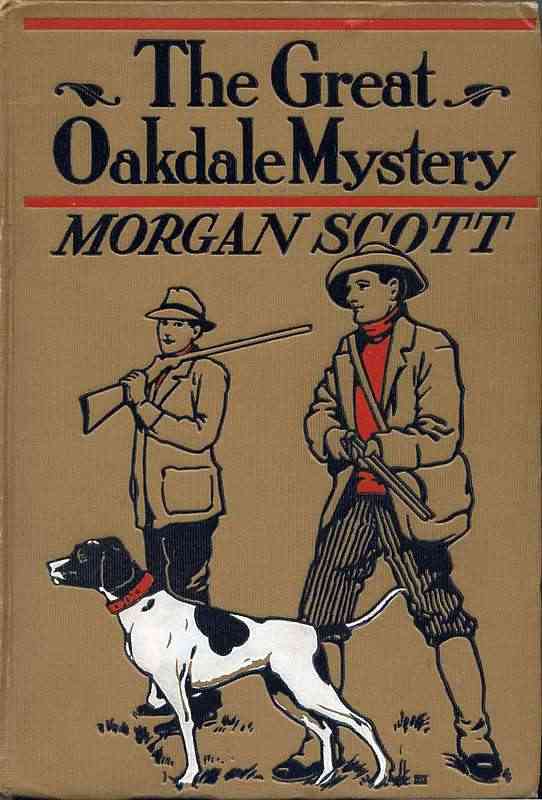
The Project Gutenberg eBook of The Great Oakdale Mystery
Title: The Great Oakdale Mystery
Author: Morgan Scott
Illustrator: Charles L. Wrenn
Release date: December 30, 2015 [eBook #50792]
Most recently updated: October 22, 2024
Language: English
Credits: E-text prepared by Stephen Hutcheson, Rick Morris, Rod Crawford, Dave Morgan, and the Online Distributed Proofreading Team (http://www.pgdp.net)
The Project Gutenberg eBook, The Great Oakdale Mystery, by Morgan Scott, Illustrated by Charles L. Wrenn
“POINT, ROY—POINT!” CALLED SAGE, SOFTLY. —Page 11.
THE GREAT
OAKDALE MYSTERY
| CHAPTER | PAGE | |
| I. | The Hunters | 5 |
| II. | The Mysterious Stranger | 17 |
| III. | The Home of the Sages | 28 |
| IV. | A Man “Wanted” | 40 |
| V. | By the Light from the Window | 54 |
| VI. | Captain Quinn’s Monkey | 68 |
| VII. | Annoying Attentions | 79 |
| VIII. | Hooker has a Plan | 89 |
| IX. | The Camp in the Woods | 99 |
| X. | A Perplexing Question | 109 |
| XI. | The Hidden Sportsmen | 118 |
| XII. | Disappointed Duck Hunters | 132 |
| XIII. | The Tardy Quarterback | 141 |
| XIV. | The First Quarter | 151 |
| XV. | The Player Who Blundered | 159 |
| XVI. | Remarkable Behavior of Sage | 169 |
| XVII. | Work of the Young Detective | 176 |
| XVIII. | Sleuth’s Astonishing Theory | 187 |
| XIX. | The Night Alarm | 197 |
| XX. | In the Bank | 204 |
| XXI. | What Sleuth Learned | 213 |
| XXII. | Following the Trail | 222 |
| XXIII. | The Capture | 235 |
| XXIV. | Suspicion | 245 |
| XXV. | The Boy Who Acted Guilty | 255 |
| XXVI. | Another Capture | 265 |
| XXVII. | The Two Prisoners | 271 |
| XXVIII. | The Shreds of Hope | 279 |
| XXIX. | A Concession from Sleuth | 291 |
| XXX. | The Truth at Last | 301 |
CHAPTER I.
THE HUNTERS.
Two boys, each carrying a gun, came out of a strip of woods and paused. They were followed by a short-haired pointer dog. One of the boys, whose gun was a single-barreled repeater, bore a game-bag suspended from his shoulder by a strap, and he spoke to the dog with an air of authority that proclaimed him the animal’s master. He was a pleasant-faced, blue-eyed chap, and his name was Fred Sage.
The gun of the other boy was a double-barreled hammerless. The boy had a slightly undershot jaw, and his eyes were a trifle too small. This was Roy Hooker. During the months of the past summer these two fellows had become exceedingly friendly.
“There are the Hopkins woodcock covers down yonder, Fred,” said Roy, pointing across the open strip of pasture land. “Old Hopkins doesn’t like to have anyone gun there, but I’m for giving those covers a try, as long as he will probably never know it.”
“Has he posted ‘No Trespass’ signs?” asked Sage.
“Guess not; I haven’t seen any. He doesn’t do any shooting himself, but being a cranky old bear, he doesn’t like to have anyone else gun on his property.”
“Well, as long as there are no warnings posted and he hasn’t personally notified us to keep off, we’ll see if we can find any birds there. The covers look attractive to me. Here, Spot; heel, sir.”
With the first indication that the boys intended to proceed, the eager dog had started forward, but he turned at the command of his master and once more fell in behind.
The forenoon of this clear, sunny autumn day was not far advanced, the young hunters having set forth shortly after breakfast. Although the air was clear and almost warm, there was a certain suggestion of crispness in it, which, together with the flaming leaves of the deciduous trees, plainly betokened that the early autumn frosts had been at work. The stubble of the open pasture land was brown and dry. Behind the boys, in the woods they had just left, squirrels were chattering and bluejays screaming, but Fred and Roy were after bigger and more legitimate game. Thus far their hunt had proved disappointing.
“If we don’t find anything down yonder,” said Hooker, “I’ll get mad and shoot the next squirrel that barks at me. I was tempted to pop over one big gray fellow that leered at me from a limb.”
“You don’t eat squirrels, do you?”
“Oh, no.”
“What would you do with them if you should shoot ’em?”
“Nothing; just throw them away.”
“Then don’t shoot them, Roy. It’s not good sport to kill practically harmless creatures simply for the sake of killing something. I’d rather never shoot anything at all than do that.”
“Oh, you’re deucedly finicky about some things, old fellow. You won’t have many chances to gun this fall, for football is going to keep you busy. When I proposed it last night I hardly thought I’d get you out to-day.”
“And I came out with the understanding that we are to get back in time for practice this afternoon. Next Saturday, a week from to-day, the team plays its first game.”
“And will be beautifully beaten,” prophesied Hooker.
“What makes you think so?”
“Why shouldn’t I think so? The eleven is going to be weak this year. With Roger Eliot for captain, it made an unexpected success last fall; but Eliot is gone, and Stone, who was chosen to follow him as captain, never can be such a crafty, far-sighted general. The team was weakened fifty per cent by the loss of Eliot.”
“Perhaps you’re right,” admitted Sage; “but you seem to forget that we ought to receive some strength from the development of new players. For instance, there’s that fellow from Texas, Rodney Grant——”
“Oh, yes,” nodded Roy quickly, “I suppose he’ll help some, but it takes time to make a football player, and Grant has had little experience at the game. Stone realizes he’s going to be shy of material, and he’s coaxing everybody to come out for practice. He’s been at me.”
“You’re going to come out, aren’t you?”
“I don’t know. Never did care a great deal about football. You know it’s my ambition to be a baseball pitcher, and a fellow can’t do everything.”
“Baseball is over now, and there’ll be no more until next spring. For the good of the team you ought to take hold and do your best to become a player and fill one of the weak spots.”
“And maybe get a broken leg or arm or collar-bone to set me back. A baseball player is taking chances when he goes in for football.”
“But if none of our ball players went in for football,” reminded Sage, “we’d have no eleven. Our school isn’t big enough for the two teams to be made up of distinct and independent bodies of players. You’re quick, active and strong, Roy, and, if you choose to take hold and work hard, it seems to me you might become one of the valuable members of the eleven.”
“Oh, possibly,” admitted Hooker, attempting to conceal the fact that he was somewhat flattered. “I fancy I could do as well as some other fellows, Piper, Cooper or Tuttle, for instance. In a way they are mere makeshifts; none of them is a bang-up good football man.”
By this time they had crossed the pasture land and reached the edge of the covers, the dog betraying a restless desire to get to work. Sage permitted the animal to go forward, directing his movements now and then by a word of command, and, with the guns held ready for quick use, the young hunters advanced slowly, keeping their eyes on the pointer the most of the time. They separated somewhat and went forward with the dog at the apex of an imaginary triangle. Nearly all the time the boys could see each other through the scrub growth, which made it unlikely that either would place his friend in danger by careless shooting.
Moving hither and thither, sniffing, pausing, advancing, every hunting instinct alert, the dog did his work beautifully. Suddenly, with one foot uplifted, tail horizontal and rigid and muzzle thrust forward, the pointer became a statue of stone. Directly ahead of him, a few feet away, was a thick cluster of low bushes.
“Point, Roy—point!” called Sage softly, his repeater held in both hands and half lifted, ready for a quick shot.
Immediately Hooker swerved toward the dog and advanced as swiftly and noiselessly as possible, in order to obtain a position for a shot when the bird should flush. Reaching a favorable spot, he placed himself in position to shoot and waited for the rise.
The seconds passed slowly—so slowly that to the anxious boys they seemed more like minutes. A chickadee flitted through the bushes, lighted on a branch within five feet of Roy, performed some surprising horizontal bar evolutions and applauded himself in a ludicrously hoarse voice. Something rustled at a distance, like a creature running swiftly along the ground. Far away, so far that it was but faintly heard, the gun of some other hunter spoke.
With a sudden whirr of wings a woodcock rose straight up from the further side of the cluster of bushes. The butt of Sage’s gun came to his shoulder, his eye caught the sights, and he fired.
Hooker was a trifle slower, but ere Sage, realizing that he had shot too quickly and therefore made a miss, could fire again, Roy’s weapon spoke.
Down came the bird into the midst of the thicket.
“Good work, old man,” cried Fred approvingly. “You got him. I shot under; didn’t wait for him to make his full rise. Go fetch, Spot.”
The dog, released from the spell that had chained him motionless, plunged forward, sniffing around in search of the bird. In a few moments he brought the dead woodcock and placed it at his master’s feet.
“A plump fellow,” laughed Sage, holding the kill up for the other lad to see. “That’s the first blood for you, Roy. Shall I put it in my bag?”
“Sure; I haven’t any. There’s likely more of them near by.”
There were more, and Sage evened things up by bringing down the next one. After this both boys missed a shot, and, though they had tried to “mark” their birds when they lighted, they beat back and forth for more than half an hour without getting another flush.
“Come on,” said Roy at last; “I’m tired of this. There’s some good partridge timber near by, and I’d rather shoot one partridge than half a dozen woodcock.”
“Every fellow to his taste,” laughed Sage. “I prefer the sport of woodcock shooting, and I certainly hate to leave without getting either of those two birds up again.”
He yielded, however, to Hooker’s urging, and they left the low covers for the adjacent timber, in which partridges might be found.
The partridges were there, too. Roy put one up almost beneath his feet, but the timber was so thick at that point that he could not get even a chance shot with the slightest hope of success. While he was grumbling over this, Spot made a point and the partridge rose with a booming of wings before Sage could give his companion warning.
Fred fired.
“Did you get her?” called Hooker.
“I think I hit her,” was the answer. “I saw her go down. Come, Spot, we must dig that bird out.”
Hooker started to follow, but had not advanced thirty feet before still another partridge rose and went sailing away in another direction. This time Roy fired, but he did so under such a disadvantage and with so much haste that he had little hope of bringing down the game.
“Confound it!” he muttered. “Are all these birds going to get away?”
For a full minute he stood still in his tracks, peering into the woods on all sides and listening keenly. Then he removed the empty shell from his gun and slipped a loaded one into place.
“I’m going to follow that old bird I banged at,” he decided. “I don’t believe she went beyond the road that runs through these woods. If I can get her without the assistance of the dog, it will be a trick worth turning.”
Having hurried after the partridge until he fancied he had reached a point where the bird might have alighted, he began creeping forward with the utmost caution, pausing every few yards to listen and use his eyes. Once an acorn, clipping down through the leaves and striking the ground, gave him a start, but it seemed that the partridge had flown farther than he thought, for presently, without again sighting the game, he approached the road. A short distance from the highway he stopped in his tracks and flung the gun to his shoulder, the barrel levelled toward some roadside bushes, near which he had heard a slight noise.
Beyond the bushes a man rose into view from a stone on which he had been seated, and found himself looking straight into the muzzle of Hooker’s gun.