
CHAPTER IV
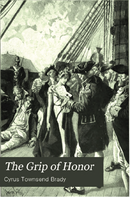
Three days later the Ranger, under all plain sail, in a gentle breeze, was slowly ploughing along through the Irish Sea, off the English coast, near the mouth of the Mersey. The whaleboat, manned by six of the smartest seamen, armed with cutlass and pistol, and dressed in their best clothes, old Price being coxswain again, was just being made ready. The ship was presently hove to, and a side ladder was dropped overboard at the gangway where Miss Elizabeth Howard and her maid were standing waiting for the lowering of the whaleboat, and around which the officers of the deck speedily congregated.
They were a sorrowful lot of men, these impressionable sailors, for O'Neill was not alone in his captivity. True to his promise, Captain Jones had shifted his course, and was about to land his fair passenger. He had chosen to put her ashore upon a rocky beach four or five miles away from a fort at Birkenhead, which guarded the mouth of the river which gave entrance to the harbor, not caring to venture his ship in any closer proximity to the fortifications and the war-vessels probably in the river. It was a risky performance at best, but he trusted to the known speed of the Ranger and his own seamanship to effect his escape in case the ship should be discovered and pursued in force.
Once on shore, it would not be a difficult matter for the lady and her maid to procure a conveyance to take them to the city a little farther inland. The melancholy duty of landing the two women, by special request, had been allotted to the first lieutenant, much to the disgust of the various midshipmen who conceived that the matter of taking charge of boats appertained more properly to one of their number.
The farewells were soon spoken by the grateful girl to the officers, who had done their very best in making the days pass pleasantly and lightening the tedium of the voyage, and to the captain, who had been kindness and consideration itself. The young lieutenant, still somewhat pale from his adventure, had clothed himself in a handsome full-dress uniform, and, with a splendidly jewelled sword swinging by his side, came on deck from his cabin, the envy of all the others.
The ship had been hove to, the accommodation ladder shipped, the whaleboat was lying at the gangway now, and the three passengers at once took their places in the stern.
"See Miss Howard safely landed, Mr. O'Neill," said the solicitous captain, leaning over the rail, "and assure yourself, as far as possible, of her ability to reach the town without harm, and then return at once; in any event, do not leave the beach. We will watch you, sir."
"Ay, ay, sir," answered O'Neill. "Shove off--out oars--give way!" and the little boat at once shot away from the side, and, under the impetus given by the watchful men, dashed toward the not distant shore.
Miss Howard should have been radiantly happy at leaving the Ranger, and in her proximity to Liverpool, where she was about to meet not only friends and family connections, but one who was destined to be something more. This person was Major Edward Coventry, a gallant and distinguished young officer, the son and heir of her guardian, Lord Westbrooke, and to whom for many years--from infancy, in fact--she had been betrothed. But an unaccountable tinge of sadness hovered over her lovely face, though she strove to conceal it under an affectation of lightness and gayety.
As for O'Neill, he made no effort whatever to hide his misery. The impressionable young Irishman had fallen deeply in love with Elizabeth Howard. He had fallen in love a thousand times before, but not in this way; and the heart which had withstood the successful assaults of the brilliant beauties of the gay court of France had literally succumbed at the first sight of this beautiful English girl whom benignant fortune had thrown across his path.
She, and she only, was his fate, then and thereafter. A new and hitherto unknown feeling had been excited in his heart at the sight of her. In that hour in the boat when he lay with his head upon her knee, when he had looked up at her, heaven had opened before his gaze, and to his disordered fancy she had seemed an angel. Each passing moment discovered in her a new charm, and he loved her with the impetuosity of a boy, the doting passion of an old man, and the consecration of a devotee.
With the daring of his race, he had not hesitated to acquaint the girl with his passion, either, though it was stale news to her; there is nothing a woman discovers more quickly and more certainly than the feelings of a man who loves her. That she had laughed at his ardor had not in the least deterred him from persisting in his attentions, which she had not found unwelcome, for he thoroughly understood the value of determined pursuit. She had told him that they were like two ships sailing the great sea, whose paths happened to cross for a moment. They meet, nod to each other, and pass on; the deep swallows them up, and they see each other no more forever.
He had vowed and protested that it would not be so; that England was a little country and Admiral Westbrooke a great man; that she could not be anywhere without attracting the attention of the world,--she could by no means hide her light; that he would withdraw from the American service, which he could honorably do at the expiration of the present cruise, and search the whole island until he found her,--all of which was pleasant for her to hear, of course, though it elicited no more favorable reply. She was attracted to the young man: his handsome person, his cultured mind, his charming manners were such that no one--no woman, that is--could be indifferent to them; but she did not love him, at least not yet.
Elizabeth Howard was a woman to make a man fall desperately in love with her, and many men had done so. She was tall and graceful, golden-haired, blue-eyed, and of noble presence. She was proud, she was wise, she was witty, she was tender, she was contemplative, she was gay, she was sad, she was joyous, in different moods. Days, years even, could not exhaust the charms of her infinite variety, though far down beneath the surface of her nature were the quiet deeps of constancy and devotion,--what plummet could sound them, who should discover them? There was about her that indefinable air of one born for homage and command which speaks of generations to whom have been accorded honor and place unquestioned.
It was not a long row to the land; and as they approached the rugged coast, the young lieutenant eagerly scanned the shore for a landing-place. Steering around a little promontory which hid them from the Ranger, he discovered a stretch of sandy beach under its lee, and the boat was sent in its direction until the keel grated on the soft sand. It was a lonely spot, a little stretch of sand ending inland, and on one side in precipitous rocks over which a wandering pathway straggled unevenly to the heights above. The other end of the beach gave entrance, through a little opening, or pass in the rocks, upon a country road which wandered about inland, losing itself under some trees a mile or so away.
On the rocky promontory back of, and at one end of the beach, there was a small lighthouse; and several miles from the beach in the other direction, at the end of the road probably, was a castle or fort, the flag floating lazily from the staff indicating that it was garrisoned. Springing lightly from the boat, O'Neill stepped recklessly into the water alongside. Miss Howard rose to her feet and looked anxiously about her.
"Allow me," said O'Neill; and then, without waiting for permission, he lifted her gently in his arms and carried her to the shore. "Would that all the earth were water, and that I might carry you forever," he said, as he put her down upon the sand.
"You would not like heaven, then?" she replied, jesting.
"I find my present experience of it delightful, madam; but why do you say that?" he asked anxiously.
"Because there, we are told, there will be no more sea!" she answered with well-simulated gayety.
"'Tis a poor place for a sailor, then," he replied gravely, in no mood for badinage, "and I fear few of them will get there."
Price, who had followed his officer's example with the maid, now stepped up to him for his orders, necessarily interrupting the conversation.
"Price," he said to that intrepid old sailor, "you may go back to the boat and shove off, and keep her under the lee of that little point until I call you. Keep a sharp lookout, too."
"Ay, ay, sir," said the old sailor, turning to fulfil the command.
"Now I suppose the time has come for me to say good-bye to Lieutenant O'Neill," said Elizabeth.
"Oh, not yet, Miss Howard; I cannot leave you here alone until I know that you are safe."
"But your duty, sir?"
"A gentleman's, a sailor's, first duty is always toward a helpless woman, especially if she is--
"His prisoner, you would say, I suppose?" she said, interrupting hastily. That was not at all what he had intended to say, but he let it pass.
"You know who is prisoner, now and forever, Miss Howard."
"If you refer to Lieutenant O'Neill, I will release him now and forever as well, at once, sir," she said archly.
"You cannot."
"As you will, sir," she replied; "but as I happen to see several horsemen coming down the road yonder, I imagine you will not be detained from your ship a very long time. Let us go forward to meet them; perhaps they can give us some information."
The horsemen, evidently an officer and two orderlies who were galloping toward the beach, at this moment noticed the boat party and probably the Ranger itself. They reined in their horses at once, and the officer apparently gave some directions to one of the others, for he saluted, turned his horse about in the road, and galloped rapidly back in the direction of the castle. The officer then trotted hastily forward, followed by the remaining man, and looking intently ahead of him until he reached the vicinity of the little group, he dismounted, and handing the bridle to the soldier, bade him wait where he was. He came forward fearlessly, with one hand on his sword, the other holding a pistol which he had taken from the holster. He was a young and handsome man in a new and brilliant scarlet uniform.
CHAPTER V
Swords are Crossed on the Sand
"Lady Elizabeth, you here?" he exclaimed, stopping short in great surprise, when he was near enough to recognize them. "What is the meaning of this?" He stood a moment as if petrified, and then came nearer. "Who is this person?" he demanded imperiously. Elizabeth started violently.
"Major Coventry! Edward!" she cried.
"Are you a 'Lady,' madam?" said O'Neill, in equal surprise, addressing the astonished girl and paying no attention to the officer.
"For what else do you take her, sir?" interrupted the officer, bristling with indignation.
"Faith, sir, I would take her 'for better or worse,' an I could," replied the Irishman, smiling.
"Unfortunately for you, that is a privilege I propose to exercise myself," said the Englishman, sternly.
"The world will doubtless share my regret, sir," said the Irishman, audaciously, a bitter pang in his breast at this unlooked for news.
"Now I wish to know who you are and how you come here and what you are doing,--an explanation, sir!" asked the officer.
"I am not accustomed to give explanations save to those who have the right to demand them," replied O'Neill.
"I have two rights, sir."
"They are?"
"First, I am betrothed to this young lady," said the officer. "Second, this," laying his hand upon his sword.
"Either of these may be sufficient from your point of view, neither of them from mine. As to the first, I refer you to the young lady herself: I will have it from her own lips, or not at all; as to the second, you will see I have a similar right of my own."
"Will you, Lady Elizabeth," said the young officer, addressing her formally, "have the goodness to inform me how you came here and who this person is, or shall I force the knowledge from him?"
"If you wish him to have the information, Miss Howard, you would, I think, better give it him. Otherwise I do not see how he is to get it," said O'Neill, grimly, his dark face flushing with anger.
"This gentleman," said the girl, faintly, pointing to the officer, "is Major Edward Coventry, the son of my guardian, Admiral Westbrooke."
"And your betrothed, Elizabeth; you forget that," added Coventry.
"I almost wish I could," she replied sharply, gathering courage. "You remind me of it too constantly for it to be pleasant, and at no time so inopportunely as at the present."
The Englishman, in great astonishment and perturbation, opened his mouth to speak, but he was interrupted by the quicker Irishman.
"Why so, Mistress Howard?"
"Lady Elizabeth, if you please, sir," said Coventry.
"Lady Elizabeth, then. I thank you, sir, for the reminder," answered O'Neill, suavely. "Your friends on the Ranger are all interested in your welfare, and I am sure they are glad in my person to meet with and congratulate the fortunate gentleman who aspires to your hand." He smiled bitterly at her as he spoke.
"Will you tell me or not, Lady Elizabeth, who this person is and how you came here?" said Coventry, impatiently, with mounting choler at all this by-play.
"This is a lieutenant of the American Continental ship Ranger, Captain John Paul Jones--
"The d----d, murdering pirate!" exclaimed Coventry, hotly.
"Stop!" cried O'Neill, stepping forward with his hand upon his sword. "You shall neither swear before a lady, nor shall you in this scandalous manner disparage the ship of which I have the honor to be the first lieutenant, nor asperse the character of her captain. Withdraw your words, or you shall answer to me with that which hangs by your side."
"I fight only with gentlemen," said Coventry, coldly.
"My custom," replied O'Neill, promptly, "is in the main the same as your own; but I sometimes make exceptions, which I am willing to do in this instance. I require you immediately, instantly, to apologize to me for your remarks."
"And if I refuse?"
"I shall strike them down your throat with my hand."
"'S death, sir! How dare you, a beggarly adventurer, talk thus to me, an officer, a major in the army of his Gracious Majesty King George, a Coventry, a Westbrooke!"
"If you were an angel from heaven 'twould make no difference to me, for I would have you know, sir, that I am of as good a house as--ay, a better than--your own, a descendant of kings--
"An Irishman, I infer?" said Coventry, sneering.
"You are correct, sir, and my people have been chieftains for thirty generations."
"Ah, in Ireland?" The manner of the question made it another insult, but O'Neill restrained himself under the great provocation and answered coldly:
"Where else, sir, and where better? As for me, I am temporarily an officer of yonder ship, the Ranger, flying the flag of the American Republic, but I am a lieutenant in the navy of his Majesty Louis XVI. My father is a marshal of France. Will you draw now?" he cried, stepping forward impetuously.
"A brilliant array of titles surely; pity it lacks other confirmation than your word. I scarcely comprehend the catalogue," replied Coventry, coldly.
"I shall endeavor to enlighten you as to my credibility with this," said O'Neill, drawing his sword. "Now will you fight or not?"
"And if I persist in my refusal?" asked Coventry, who was playing for time.
"At this juncture I shall be under the painful necessity of killing you in the presence of your betrothed, so draw, my dear sir, if not for honor, for--
"What?"
"Life!"
"On guard!" cried the Englishman, whipping out his sword.
"Stop!" cried Elizabeth, springing between their swords. "He saved my life at the risk of his own."
"D--n him!" said the Englishman, grinding his teeth.
"Your condemnation comes too late, sir," said O'Neill, with bitter emphasis, with an expressive glance at Elizabeth, who continued impetuously:
"This gentleman treated me with the most distinguished courtesy."
"I wish that he had exhibited some of it here," interrupted Coventry again.
"I have but followed your own example," retorted O'Neill, calmly.
"Will you hear me in silence, Edward? They are not pirates--"
"I call them so," said Coventry, stubbornly.
"Enough, Lady Elizabeth," said O'Neill, taking his share in the conversation again. "Two lovers are sometimes an embarrassment of riches. This seems to be one of the times. If you will stand aside, I trust that a few moments will rid you of one or the other of them."
"I will not go!" said the girl, defiantly. "You shall not fight; you have nothing to quarrel about."
"We have you, or rather he has," responded the Irishman.
"Withdraw, I beg of you, Elizabeth. This matter must be settled," said Coventry, in his turn.
"I will not, I tell you!" persisted the girl, determinedly. "If you fight, you will fight through me."
"We are doing that now," said O'Neill, savagely. "Will you withdraw, madam?"
"I repeat it, I will not, and I wish to remind you that I do not like your tone. You are not on the deck of your ship now, sir."
"Oh, am I not? Boat ahoy, there! Price," cried O'Neill, waving his hand. A few strokes brought the whaleboat to the shore again. The crew were eager to take a hand in the fray. "Coxswain, come here," said the officer.
"Ay, ay, sir," replied the sailor; and while the other two stood wondering, the veteran seaman rolled up to them and saluted his lieutenant with a sea scrape. "Want us to take a hand in this yere little scrimmage, yer Honor?"
"No. Take this lady and her maid to that clump of rocks yonder."
"That's easy; 'tain't no fightin' at all, that. Come along, yer Leddyship," said the old man, in great disappointment, as the boat shoved off again.
"You monster!" cried Elizabeth, stamping her foot on the sand. "You are a pirate, after all!"
"As you say, madam. Stop, sir!" said O'Neill to Coventry, who made a move to approach the sailor. "My man will do no harm to her Ladyship, and you have other matters to attend to, unless you wish to shelter yourself behind a woman's petticoats."
Coventry had been playing for more time, but this was more than he could stand. "I think you have said enough, sir, and if you are ready," he said, "we will talk in another fashion."
"At your service," said the Irishman, composedly. Two swords flashed in the air simultaneously, and rang against each other with deadly purpose a moment after. Both men were masters of the weapon. Coventry had been thoroughly trained in the more direct English school; while O'Neill was a master of all the graceful tricks of the subtle fence of France and Italy. It was as pretty a play--parry and thrust--as one could hope to see, and for a time the advantage was with neither one of them. Elizabeth stood with clasped hands, her face pale with emotion, her lips parted, eagerly watching. The maid as usual was furnishing a comic side to the scene by her screams of "murder--help!" while the sailors were deeply interested in the two combatants.
Finally, after one especially vicious thrust on the part of Coventry, whose foot slipped a little, a clever parry, followed by a dashing riposte en quarte, which was met and returned with less skill than usual, O'Neill, with a graceful turn of the wrist, whirled the Englishman's sword from his hand. It flew up into the air and fell clanging on the rocks some distance away.
Coventry was unarmed and helpless before a bitter enemy. He was the stronger of the two, and it flashed into his mind to spring upon his antagonist suddenly, catch him in his arms, and overcome him by brute force; but the glittering point of his enemy's sword, shivering in the sunlight like a serpent's tongue, effectively barred the way. He had played the game and lost. If he must die in the presence of his love, he would do it like a gentleman, on the sword's point.
"Strike, sir!" he said hoarsely, with one quick glance toward Lady Elizabeth, who stood perfectly motionless, looking on in terror. She would have run forward had it not been for old Price.
"Oh, he will be killed, he will be killed!" wailed the maid.
"Sir Englishman, pick up your sword," said O'Neill, lowering his point.
"Sir Irishman," said the other, bowing, "men may call you pirate--"
"Not with impunity, sir," interrupted the touchy O'Neill.
"That I grant you. I was about to add that, whatever they call you, you fight like a gentleman; and it will give me great pleasure to testify to your personal worth at every convenient season. Will you permit me, though I do not know your name, to call you my friend?"
There is a great educational value in the point of a naked sword, and it may account for the sudden change which came over Coventry.
"I shall esteem myself honored, sir. My name is O'Neill, Barry O'Neill, at your service."
"I shall remember it. You have not only saved the life of Lady Elizabeth Howard, but now you have given me my own."
"Thus am I the prince of match-makers," said O'Neill, bitterly. "I would that I had lost mine in one of the savings!"
"Now, sir," continued Coventry, disregarding this last remark, "if you would be advised by me, withdraw while you may yet do so in safety."
CHAPTER VI
The Master Player takes a Hand
At this moment, a number of red-coated soldiers clambered down the path in the rocks, while a squad of cavalry came galloping upon the beach by the road at the other end, and, at once dismounting, advanced up the strand. The seamen in the boat, in obedience to a wave of O'Neill's hand, swept her in toward the shore, jumped out, and moved toward him, drawing their cutlasses and handling their pistols threateningly; though they were greatly outnumbered, they would not give up without a struggle. It was Coventry's opportunity now.
"I shall not be able to indulge your desire for the loss of your life," he said, stepping back and picking up his sword, "but I fear that duty imposes upon me the necessity of depriving you of your liberty--I regret the necessity, believe me, 'tis a poor return for your generosity, but I have no option."
"What mean you?"
"You are, by your own statements, a rebel against his Majesty. It is my duty as commander of this post and a loyal servant of the king to apprehend you. Indeed, I have been especially charged to look out for you. I will promise you and your men the best of treatment, however, and you liberty of action, if you will give me your parole."
"I am twice captured then, it seems," said the lieutenant, looking at Elizabeth, who had come forward as soon as old Price, who had left her, had sprung to his officer's side. As the girl drew near to him, and Major Coventry turned away his head a moment to give an order, the Irishman said to her:
"Why did you not call out to save your lover a moment since?"
"It was not necessary," she said, looking at him with eyes filled with tears. "I knew what you would do." Delay was dangerous to him,--Coventry was posting his men; he hesitated a moment, however, and taking her hand bowed low over it.
"Thank you," he whispered gratefully. "This word, and you, I shall remember."
"And I," said the girl, her eyes filling with tears, "will never forget--"
"Come, sir," said Coventry, dryly, turning at this moment, having finished his dispositions. "I think you overstep the privileges of a parole; and if you will have your men lay down their arms, we will go up to the castle. I have sent for a carriage for you, Elizabeth, which will be here shortly."
"Do you know," said O'Neill, "that I have a mind to say to you that I might as well die right here as at any place else, and I do not think I shall go to that castle, after all. There are seven of us here--"
"Close in there!" sharply shouted Coventry to his soldiers, who obeyed him promptly. "Make ready!"
"Handle your pistols, men," cried the other, whipping out his own; but again Elizabeth interfered in the fray. She ran between the American seamen and the English soldiers with outstretched hands.
"Stop!" she cried. "There must be no further fighting here. This gentleman came to this spot to do me a favor, to set me free. My life is his--"
"I give it back to you," cried O'Neill.
"And yours, Major Coventry, was his also," she added reproachfully.
"I give it to him as well; and if any more lives are wanted, anybody can have mine for the taking," interrupted the sailor again.
"This must go no further," continued the girl.
"And it shall not, madam," cried a deep, clear voice, as one of the cutters of the Ranger, filled to the gunwales with heavily armed men, and with a swivel in the bow and a man standing over it with a lighted match in his hand, came sweeping around the headland and dashing in toward the shore. It was under the command of Jones himself, who had grown impatient at the delay.
"I am sorry to interrupt a tête-à-tête, gentlemen," he cried.
"You are beaten again, Major Coventry," said O'Neill, calmly. "The odds are in our favor now. Throw down your arms instantly, you dogs," he shouted to the English soldiers. "Back! Out of the way, Miss Howard."
He sprang to her side, and clasping her around the waist as if she had been a child, lifted her out of the line of fire. The jealous Coventry noticed two things,--he did not release her, nor did she struggle to get away. The sullen soldiers rallied about Coventry and presented their arms threateningly; they had no mind either to yield without a fight.
"Stand by!" shouted Jones to the marines in his boat and to the gunners forward.
"Stop, for God's sake stop, Captain Jones! You have been good to me," cried Elizabeth, now struggling faintly to escape from the grasp of O'Neill. "I know that you are a gentleman. That officer is my betrothed. Withhold your fire. They will retire. There must be no blood shed. You promised to set me free and in safety ashore and leave me there. Go, I entreat you!"
"Steady, lads, steady!" cried Jones, stepping out of the boat. "And you, sir," to the English officer, "will you withdraw quietly, taking your lady with you, of course, if we engage to do the same? You are outnumbered, and we can cut you to pieces. Take the word of an older fighter, your honor will be safe, sir."
"You are right, sir, 'tis best. I must needs submit, I suppose," said Coventry, resigning himself the more gracefully to the inevitable as he could then receive his love again. "Come, Lady Elizabeth."
"Now, why didn't you protest when I was captured?" said O'Neill, releasing her waist, but still holding her hand.
"Could it be because I wanted you to be with me?" she whispered, caught off her guard in spite of herself, with a blush covering her face.
"God bless you for that, and good-bye," he said, bowing over her hand. "A year, give me a year--" he turned and walked away.
"Sir," said Coventry, sheathing his sword, and walking down to where Jones stood upon the sand, "we have been misinformed concerning you. I have had a little interview with your first lieutenant which has convinced me that I was wrong, and this talk has added to my knowledge. As an officer of the king, I offer you my hand. Whatever your political or personal affiliations may be, I am glad to recognize in you gentlemen of merit and distinction. I trust to be able to repay the obligation you have laid upon me and my betrothed on some future occasion. We are friends?"
"Sir," replied Jones, "I love a gallant foe. I shall remember you. I thank you for your courtesy."
"And I as well," added O'Neill.
"It is not the practice of the American Navy," continued Jones, "to force ships of war and bloody battles between loving hearts. Mistress Howard, fare you well; the Ranger, her officers and crew, are yours if you wish. If we should be met by another ship with you in command, we strike to you without a blow."
"Elizabeth," said Coventry, magnanimously, "can you not bid your friends good-bye?"
"I shall ever remember Captain John Paul Jones," said Lady Elizabeth, stepping forward and giving the little captain her hand to kiss, "and I shall never forget Lieutenant O'Neill."
"Will you wait one year for him?" he whispered as he bowed low over her hand.
"Come and see," she answered, and turned away.
BOOK II
THEY MEET AGAIN
CHAPTER VII
"There are only two men-of-war in the whole lot."
"Right, yer Honor. That 'un near the shore there-away looks like a big frigate. That'll be the Serapis, I'm thinkin'."
"Yes, and that one further out, the Scarborough."
"Ay, ay, sir, an' all the rest on 'em is merchantmen. There ain't a gun on board any on 'em. Nice pickin's them'll be fer us poor sailormen arter we dispose of them war-vessels. Dash my wig! jist think of them fat traders, an' we a-rummagin' among 'em--"
"That will do, Price. Just moderate your transports a little," said the officer, stepping forward to the brow of the hill and taking another long look at the harbor.
"I ain't no transport," muttered the garrulous old man under his breath. "I won't carry no soldiers nowhere. I'm a man-o'-war, I am;" but he took good care that his superior should not hear these somewhat insubordinate remarks.
"Well," said the other, finally turning about after his close scrutiny, "I think we have ascertained about all we have come for. They are the Baltic convoy, without doubt, and you would better make a straight course for the ship at once and report."
"An' you, sir?" asked the old man, respectfully, "won't you come along, sir? I hate to cut cable an' leave you here adrift, alone, yer Honor."
"No," answered the officer, after a reflective pause, "I think I shall go up to that castle on the bluff beyond and find out a little more definitely as to the situation, if possible. Meanwhile, do you get on your horse and ride back to Bridlington Bay. Go aboard the Alert and tell Mr. Lunt, from me, to join the Richard to the southward at once, and notify Captain Jones of what we have seen. Tell him I think it will be perfectly safe for him to come on: there is a great fleet of merchant ships here with only two ships-of-war; he will rejoice at the chance of a fair fight. I will find means to join him at the rendezvous before the rest of the ships can assemble and they can get under way. Now bear a hand; don't let the grass grow under your keel."
"Oh, Lord, yer Honor, have I got to git on board that 'ere four-legged craft agin?" said old Price, ruefully.
"That's what you have to do, my lad," remarked the officer, cheerfully.
"Seems like somethin's wrong with him," said the old sailor. "A animal wot steers by the head is contrary like to natur. Now if I could only git him to go about on t'other tack, or wear him, by shiftin' his tail, I'd understand him perfectly; but this yere tiller rope riggin' over his bows is wot gits me. An', sir, I can't make out with them 'ere stirrups nuther; it's like hangin' onto the yard-arm in a tossin' sea without no foot ropes. Howsomever, if I must, I must, I guess."
"Oh, you won't mind it," replied the officer, laughing at the old man's rueful face. "Besides, the wind's fair, and you'll be going free most of the way. Just give him a touch of your weather heel once in a while, and you'll soon make the harbor."
"I never thought about the wind," said the veteran gunner, thoughtfully, his face brightening as he turned and listened for it. "Yer Honor's right. 'Twill be plain sailin'. Well, sir, anchor's aweigh, an' here goes!"
The old seaman, giving great evidence of his disinclination in spite of the favoring breeze, at last climbed upon the back of his staid old horse, and, resisting the temptation to give him his direction by a pull of the tail, got under way and lurched rapidly down the road. Left to himself, the lieutenant mounted his own horse--surprising to state, for a sailor he was an excellent horseman--and rode down toward the sleeping town nestled around Scarborough harbor, which was filled with a large fleet of merchant ships convoyed by two men-of-war, all riding quietly at their anchors.
Opposite the acclivity on which the two men had stood, and to the north of the town, rose a bold, splendid headland, or scar, almost an island, to the height of about three hundred feet. The rugged crest was crowned by a picturesque old castle. The headland jutted boldly out into the sea, and the wild waters dashed upon its walls from every side. Access to the castle from the town was by means of a causeway and bridge springing over a rocky and otherwise impassable connection between the cliff and the mainland, which was sometimes flooded at high-tide.
Portions of the castle were in bad repair, or had been dismantled in the several wars in which it had played a memorable part since its erection nearly seven hundred years before by a follower of William the Conqueror; but a large part of it was still inhabitable, and had been provided with a sufficient garrison. A heavy water battery, which had been placed in position during the rebellion in 1745, had been recently strengthened and reinforced.
Captain Jones, in the Bon Homme Richard, had been cruising around the coasts of the British Islands for some time. He had heard of the expected arrival of the Baltic fleet in these waters, and had presumed that they would make Scarborough harbor. Word had been received from a small trader he had overhauled, that a large number of ships had assembled in that harbor; and in order to ascertain whether he might safely attack them with his small nondescript squadron, he had accepted the voluntary services of Lieutenant O'Neill, seconded by gunner Price of the Bon Homme Richard.
They had gone on ahead of the squadron in the cutter Alert, and had landed below Scarborough headland, and ridden on to Scarborough to ascertain the facts. The Alert was to carry the news back to Jones, on the Richard, farther down the coast, and the vessels of his squadron were all to assemble a day or two later at Bridlington Bay, a small and unimportant town with a good harbor within easy reaching distance of the expected prey. Should the report of the scouts be favorable, they would proceed at once to attack the convoy.
On their journey to Scarborough, O'Neill had ascertained from a passing countryman that Lord Westbrooke was still governor of the castle, and he at once surmised that Lady Elizabeth Howard would probably be there with her guardian. Six months more than the year he had asked for from her had elapsed, and many untoward circumstances had prevented him from carrying out his plan of seeking her, but she had ever been in his heart, and time and separation had but intensified his passion. The mercurial Irishman had been deeply smitten by the proud English beauty, and the constancy of his devotion evidenced the depth of the impression she had made upon him.
When Jones had returned with the Ranger from his first successful cruise, he and his officers had been fêted and made much of by the French court. The gallant adventures in which he had participated lent a new charm to the fascinating personality of the son of the old marshal, whose entrée was already everything that could be desired; and his heart, accordingly, had been a target for repeated attacks upon the part of the bright-eyed and fascinating dames of France--but to no avail had they attempted its capture.
Something of the story of his devotion had been allowed to leak out, however, to account for his obduracy, and they finally understood why he was so unusually insensible to their charms. This romance naturally only added a piquancy to the feminine pursuit of which he was the object, although the ladies' sportive love chase proved, in the end, unavailing. He had resolved, O'Neill said, to show the world that unusual spectacle, a constant Irishman! This was to attempt the impossible, had been the quick reply, but, nevertheless, he had accomplished it.
Our Celtic mariner did not resign from the American service, however, not because he cared particularly for America, for democratic doctrines could never be acceptable to a follower of the young Stuart, the intimate associate of the young nobles of France; but, primarily, because he saw in it renewed opportunities to annoy and humiliate the stout Hanoverian whom he and his people hated, and from whom they had received much harm, and, secondly, because he was so much attracted by the strong personality of Paul Jones. So great had become his regard for this wonderful man that he had even waived considerations of rank in favor of an American, the gallant Richard Dale, and had consented to serve as second lieutenant instead of first, on the Richard, when that famous ship and her ill-assorted consorts started forth upon the memorable cruise.
The tacticians of the French Navy unfortunately were not given to consider downright hard fighting as the end and aim of naval enterprise. Their manœuvres were calculated to annoy and harass the enemy, but their first thought was not to destroy his ships, but to protect their own,--a fatal mistake in policy from which they have ever suffered.
This was not John Paul Jones' way. Whatever else he was, he was a fighter from the beginning to the end, and O'Neill found in him a congenial spirit. The love-lorn Irishman had tried several times to communicate with Lady Elizabeth by letter and messenger, but without success, for he received no reply to his letters, and his messengers had never returned. Therefore, when he found himself in such close proximity to her as on this, the evening of Tuesday, the 21st of September, 1779, he was utterly unable to resist the temptation at least to attempt to see her again.
Jones and the ships were not due at the rendezvous until the day after the next day, that would be Thursday morning. There would be ample time to rejoin them on the next day, Wednesday. O'Neill imagined himself perfectly safe; he had used no disguise except to wear the uniform of a French naval officer, and as France and England were nominally at peace, he persuaded himself that he was in no danger. It was a breach of military propriety, he admitted, of course, but nothing more,--this failure to return promptly to his ship,--and for that he was willing to suffer.
With the delightful casuistry of lovers he persuaded himself against his better judgment and failed to see his action in its true military significance. Trusting to audacity, mother wit, and Dan Cupid for protection, he went bravely on. In fact, he was taking his life in his hand. His love blinded him,--it is the chief function of the cherubic god; without that power most matches he attempts would fail. Meanwhile, with a beating heart--beating not from fear, but with anticipation--he rode slowly down the hill and into the town, where he left his horse at an inn, and made his way on foot, and supperless, such his eagerness, toward the castle.
He had no definite plan. There did not seem to be room for any. He had one consuming desire: to see, to speak to, to come in touch again with the beautiful girl who had been the object of his every thought, the end of his every desire, the spirit of every dream in which he had indulged since they had met. He had a thought--a hope--that she was still Elizabeth Howard. There was that in her promise, in her look, in her word, when she had said, "Come and see" on the strand, which gave him the hope that she would wait until he did come, be it one year or two; and with the sanguine spirit of his race he could not prepare himself for a disappointment.
The moon had risen as he walked quietly through the town and began to mount the hill. He did not know how to gain admittance to the castle when he approached it; and as ill luck would have it, as he was standing on the causeway looking toward the gate, he was approached by a squad of soldiers under the command of a sergeant, who were returning from an errand in the town. His meditations, as he stood gazing at the lights shining from the different windows, wondering behind which wall was ensconced the idol of his heart, were rudely interrupted by the grasp of a rough hand upon his shoulder and a harsh voice in his ear saying,--
"Well, sir, wot are you a-doin' 'ere at this hour o' the night? Entrance to the castle is forbid to every one except members of the garrison, or them wich has passes. No one is allowed on the causeway after sunset even. There's so many tales of raidin's an' hell's own doin's on the coast by that bloody ravagin' pirate Jones an' his bleedin' gang, that we're a'most in a state of siege. Give an account of yourself."
"My friend," said O'Neill, calmly, glancing rapidly about him, and giving up at once any idea of resistance, for he was surrounded by at least a dozen men, one or two of whom had laid violent hands upon him,--"my friend," he said, speaking in broken English, with a well-simulated French accent, "I am an officer of the King of France, travelling for pleasure through your great country. I hear of the old castle--I wish to see it--hence I come here. I have done nothing--you will let me go free?"
"A Frenchman?"
"Yes, monsieur, I have that honor."
"Well, that settles it. You've got to come along with us now. A frog-eatin' Frenchman's our natural-born enemy."
"But, monsieur, there is no war between my master and your king?"
"Don't monshur me. I don't take no palaverin', an' I don't know nothin' about whether there is war or not," said the sergeant, brusquely; "but we always did hate the bloody Frenchies, an' we always will, an' whenever we ketch one of 'em around here, he's got to give an account of hisself. Now if you come along peaceable like, all right--we won't hurt you. If you don't, we'll just pick you up and carry you. You can take your choice," he added indifferently.
A horseman galloping in from the town at this moment drew rein in front of the little group.
"Ah, sergeant, what is it? Whom have you there?" he queried sharply.
"'Tis a Frenchman, sir. We found him a-prowlin' round here. He's a spy, I takes it," answered the sergeant, saluting but still retaining his grasp.
"Pardon me, monsieur," said O'Neill; "I am no spy. I am a gentleman of France, as I explain to this man. I travel--come here to see the castle--"
"Well, sir, I can assist you to attain your end," interrupted the lieutenant on the horse; "and since you desire to see the castle, perhaps you would not object to taking a look at it from the inside."
"As a prisoner, monsieur?"
"Well, I am sorry you put it that way, but I shall be compelled to turn you over to the governor."
"But I protest, monsieur!"
"You can protest to the admiral if you wish, the governor, I mean, for you will have to come along now, under the circumstances. We hear that d----d Scots buccaneer Paul Jones is on the coast, and we don't know when he might strike or whom he might send on shore. We can't be too careful, you know."
"Very well, monsieur, I come," said O'Neill, shrugging his shoulders and resigning himself gracefully to the inevitable.
"That's good," answered the young officer. "Bring him along, sergeant."
"Yes, leftenant. Now, you Johnnie, right about face, march!"
It was in this unexpected and undignified manner that O'Neill gained entrance to the castle. As they walked beneath the great gates of the gloomy fortress, his heart, in spite of the serious nature of his position, gave a bound of elation. This reckless young man had as yet no other thought than that by every step he had been brought a little nearer to his divinity; if other thoughts had come, it is doubtful if he would have allowed them to stop him now. As the party halted in the courtyard, while the lieutenant dismounted and hastened to apprise the governor of the capture, he even ventured most imprudently to ask the sergeant if Lady Elizabeth Howard was in the castle.
"She is," replied the astonished functionary. "Wot's that to you, I'd like to know?"