
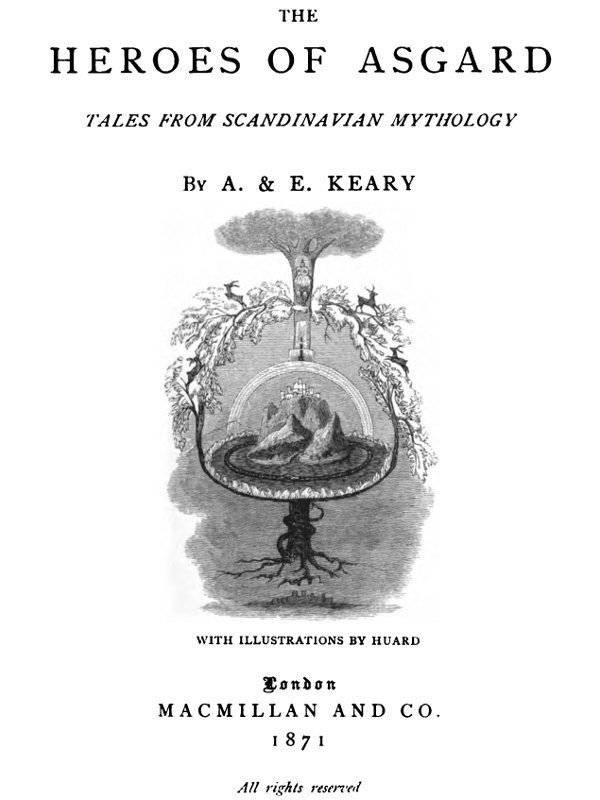
The Project Gutenberg eBook of The Heroes of Asgard: Tales from Scandinavian Mythology
Title: The Heroes of Asgard: Tales from Scandinavian Mythology
Author: Annie Keary
Eliza Keary
Illustrator: L. Huard
Release date: November 3, 2012 [eBook #41283]
Most recently updated: October 23, 2024
Language: English
Credits: Produced by Bryan Ness and the Online Distributed
Proofreading Team at http://www.pgdp.net (This file was
produced from images generously made available by The
Internet Archive/American Libraries.)
THE HEROES OF ASGARD
Transcriber's note
This book uses œ (oe ligature) and ū (u with macron).
Obvious punctuation errors have been repaired silently. Word errors have been corrected, and a list of corrections can be found after the book.
THE
HEROES OF ASGARD
TALES FROM SCANDINAVIAN MYTHOLOGY
BY A. & E. KEARY
WITH ILLUSTRATIONS BY HUARD
New York
THE MACMILLAN COMPANY
LONDON: MACMILLAN & CO., LTD.
1909
All rights reserved
New edition September, 1906. Reprinted July, 1909.
Norwood Press:
Berwick & Smith Co., Norwood, Mass., U.S.A.
PREFACE.
In preparing the Second Edition of this little volume of tales from the Northern Mythology for the press, the Authors have thought it advisable to omit the conversations at the beginning and end of the chapters, which had been objected to as breaking the course of the narrative. They have carefully revised the whole, corrected many inaccuracies and added fresh information drawn from sources they had not had an opportunity of consulting when the volume first appeared. The writers to whose works the Authors have been most indebted, are Simrock, Mallet, Laing, Thorpe, Howitt and Dasent.
CONTENTS.
List of Illustrations.
PAGE
- GIANT SUTTUNG AND THE DWARFS, 86
- GIANT SKRYMIR AND THOR, 115
- FREYJA IN THE DWARFS' CAVE, 172
- IDUNA GIVING THE MAGIC APPLES, 195
- SKADI CHOOSING HER HUSBAND, 227
- TYR FEEDING FENRIR, 265
- THE PUNISHMENT OF LOKI, 292
THE HEROES OF ASGARD.
INTRODUCTION.
If we would understand the religion of the ancient Scandinavians, we ought to study at the same time the myths of all Teutonic nations. A drawing together of these, and a comparison of one with another, has been most beautifully effected by Simrock, in his Handbuch der Deutschen Mythologie, where he tells us that whilst the Scandinavian records are richer and more definite, they are also younger than those of Germany, which latter may be compared to ancient half choked-up streams from which the fuller river flows, but which, it is to be remarked, that river has mingled in its flowing. Grimm says that both religions—the German and the Northern—were in the main identical, though in details they varied; and as heathenism lingered longer in Scandinavia than in any other part of Europe, it is not surprising that there, rather than anywhere else, we should find the old world wants and hopes and fears, dark guesses, crude imaginings, childlike poetic expressions, crystallised into a pretty definite system of belief and worship. Yes, we can walk through the glittering ice halls of the old frozen faith, and count its gems and wonder at its fearful images; but the warm heart-reachings from which they alike once flowed, we can only darkly feel, at best but narrowly pry into here and there. Ah! if we could but break up the poem again into the syllables of the far off years.
The little tales which follow, drawn from the most striking and picturesque of the Northern myths, are put together in the simplest possible form, and were written only with a design to make the subject interesting to children. By-and-bye, however, as we through their means become in a slight degree acquainted with the characters belonging to, and the parts played by, the various deities of this mythology, it will not be uninteresting to consider what their meaning may be, and to try if we can trace the connection of one with another. At present it seems best, as an introduction to them—and without it they would be scarcely intelligible—to give a very slight sketch of the Northern mythology, as it is gathered from the earliest Scandinavian sources, as well as a short account of the sources from which it is gathered.
Laing, in the introduction to his Translation of the Heimskringla Saga, says,—"A nation's literature is its breath of life, without which a nation has no existence, is but a congregation of individuals. During the five centuries in which the Northmen were riding over the seas, and conquering wheresoever they landed, the literature of the people they overcame was locked up in a dead language, and within the walls of monasteries. But the Northmen had a literature of their own, rude as it was." Songs and sagas, mythical and heroic, were the staple of this literature of the north; and these appear to have been handed down by word of mouth from skald to skald until about the beginning of the twelfth century. Then Sæmund the Learned, and others, began to commit them to writing. Sæmund the Learned was born in Iceland about the year 1057, fifty years after Christianity had been positively established in that island. He passed his youth in Germany, France, and Italy, studying at one time with a famous master, "by whom he was instructed in every kind of lore." So full, indeed, did Sæmund's head become of all that he had learnt, that he frequently "forgot the commonest things," even his own name and identity, so that when asked who he was, he would give the name of any one he had been reading about. He was also said to be an astrologer, and a charming little anecdote is related of him in this capacity, which, however, would be out of place here. When he went back to Iceland, he became priest of Oddi, instructed the people about him, studied the old religion, and, besides writing a history of Norway and Iceland, which has been lost, transcribed several of the mythic and heroic songs of the North, which together form a collection known by the name of the Poetic, Elder, or Sæmund's Edda. The songs themselves are supposed to date from about the eighth century; Sæmund wrote them down in the twelfth. The oldest copy of his original MS. is of the fourteenth century, and this copy is now in the Royal Library of Copenhagen. A few years ago they were translated into English by B. Thorpe. So much for the history of the Elder Edda—great-grandmother the name is said to mean, but after all she scarcely seems old enough to be called a great-grandmother. We have traced her growing up, and seen how she has dressed herself, and we begin to think of her almost as a modern young lady. When we listen to the odd jumble of tales she tells us, too, we are more than half inclined to quarrel with her, though without exactly knowing whether it is with her youth or her age that we find fault. You are too young to know what you are talking about, great-grandmother, we complain; but, oh dear! you mumble so and make use of such odd old-fashioned words we can scarcely understand you. Sæmund was not the only man who wrote down songs and sagas; he had some contemporaries, many successors; and, about fifty years after his death, we hear of Snorro Sturleson, a rich man, twice Supreme Magistrate of the Icelandic Republic, who also lived for some time at Oddi, and who has left many valuable additions to the stock of Icelandic written lore. Laing says of him—"Snorro Sturleson has done for the history of the Northmen, what Livy did for the history of the Romans." Amongst other things, he wrote a sort of commentary or enlargement of Sæmund's Edda, probably drawn from MSS. of Sæmund and of others, which were preserved at Oddi. This is called the Prose, Younger, or Snorro's Edda, and was translated many years ago by M. Mallet into French. Added to these two sources of information respecting the Scandinavian mythology, there are many allusions to the myths scattered through the heroic lays with which Northern literature abounds.
The Poetic Edda consists of two parts—the mythological and the heroic. The mythological songs contain an account of the formation and destruction of the world, of the origin, genealogies, adventures, journeys, conversations of the gods, magic incantations, and one lay which may be called ethical. This portion of the Edda concludes with a song called "The Song of the Sun," of which it is supposed Sæmund himself was the author. Thorpe, the English translator, says, "It exhibits a strange mixture of Christianity and heathenism, whence it would seem that the poet's own religion was in a transition state. We may as well remark here that the only allusion to Christianity in the Elder Edda, with the exception of this last song, which stands quite alone, is a single strophe in an incantation:—
If night overtake thee,
When out on the misty way,
That the dead Christian woman
No power may have to do thee harm."
Which savours curiously of the horror which these heathens then evidently felt of the new faith.
The Younger Edda is a very queer old lady indeed. She begins by telling a sort of story. She says "there was once a King called Gylfi, renowned for his wisdom and skill in magic;" he being seized with a desire to know all about the gods, and wishing also to get his information first-hand, sets off on a journey to Asgard itself, the gods' own abode. When he gets there he finds a mysterious Three seated upon three thrones—the High, the Equally High, and the Third. The story-teller is supposed to have taken this picture from a temple at Upsal, where the thrones of Odin, Thor, and Frey were placed in the same manner, one above another. Gylfi introduces himself as Gangler, a name for traveller (connected with the present Scotch word gang), and proceeded to question the Three upon the origin of the world, the nature and adventures of the gods, &c., &c. Gangler's questions, and the answers which he receives, will, with reference to the Elder Edda tales, help us to get just the short summary we want of the Scandinavian mythology—the mythology grown up and old, and frozen tight, as we find it in the Eddas.
"What was the beginning of things?" asks Gangler; and Har (the highest of the Three), replying in the words of an ancient poem, says,—
When all was not—
No sand, nor sea,
No salt waves,
No earth was found,
Nor over-skies,
But yawning precipice
And nowhere grass."
This nothingness was called Ginnungagap, the gap of gaps, the gaping of the chasms: and Har goes on to relate what took place in it. On the north side of Ginnungagap, he says, lay Niflheim, the shadowy nebulous home of freezing cold and gathering gloom; but on the south lay the glowing region of Muspellheim. There was besides a roaring cauldron called Hvergelmir, which seethed in the middle of Niflheim, and sent forth twelve rivers called the strange waves; these flowed into the gap and froze there, and so filled the gap with ice: but sparks and flakes of fire from Muspellheim fell upon the ice. Ginnungagap on the north side was now filled with ice and vapour and fleeting mists and whirlwinds, but southwards with glowing radiancy, with calm and light and wind—still air; and so, continues Har, the heat met the frost, the frost melted into drops, the drops quickened into life, and there was a human form called Ymir, a giant. "Was he a god?" asks Gangler. "Oh! dear no," answers Har; "we are very far indeed from believing him to have been a god; he was wicked and the father of all the Frost Giants." "I wonder what he ate?" said Gangler. "There was a cow," Har went on to explain; "she was made out of the drops, too, and the giant fed upon her milk." "Good," answered Gangler; "but what fed the cow?" "She licked the stones of Ginnungagap, which were covered with salt hoar frost;" and then Har goes on to relate how by degrees a man, Bur, grew up out of the stones as the cow licked them, good, not like Ymir, but the father of the gods; and here we may remark that the giant and the god equally were the sole progenitors of their immediate descendants. Ymir was the father of the first giant, Bur had a son called Bör. But after that the races mix to a certain extent, for Bör married a giantess and became the father of three sons, Odin, Vili and Ve.
"Was there any degree of good understanding between these two races?" asks Gangler. "Far from it," replies Har; and then he tells how the sons of the god slew all the frost giants but one, dragged the body of old Ymir into the middle of Ginnungagap, made the earth out of it,—"from his blood the seas, from his flesh the land, from his bones the mountains, of his hair the trees, of his skull the heavens and of his brains the clouds. Then they took wandering flakes from Muspellheim, and placed them in the heavens." Until this time, says the Völuspá.
Where she a dwelling had,
The moon knew not
What power he possessed,
The stars knew not
Where they had a station."
About this time it happened that the sons of the god took a walk along the sea-beach, and there found two stems of wood which they fashioned into the first man and woman:—
Sense gave Hœnir
Blood gave Lodin (Loki)
And goodly colour."
After this it is said that the all-holy gods, the Æsir, the Lords, went to their judgment seats, held council, and gave names to the "night and to the waning moon, morn, midday, afternoon, and eve whereby to reckon years." Then they built a city called Asgard in the middle of the earth, altars and temples, "made furnaces, forged tongs and fabricated tools and precious things;" after which they stayed at home and played joyously with tables. This was the golden age of the gods; they were happy. "To them," says the old song, "was naught the want of gold, until there came three maids all powerful from the giants."
In some mysterious way it appears that a desire for gold seized upon the gods in the midst of their innocent golden play. Then they formed the dwarfs, in order that these might get gold for them out of the earth. The dwarfs till then had been just like maggots in Ymir's dead flesh, but now received human likeness. A shadow begins to creep over the earth, the golden age is past. At the same time three things happen. The gods discover the use or want of gold; the first war breaks out, as it is said, "Odin hurled his spear amid the people, and then was the first war;" and the three all-powerful giant maids appear. "Gold," says the old song (and calls her by a name as if she were a person), "they pierced with lances,—
Burnt her once,
Burnt her thrice,
Oft not seldom,
Yet she still lives.
Wolves she tamed,
Magic arts she knew, she practised,
Ever was she the joy
Of evil people."
The three giant maidens are the three Fates—the sisters,—Past, Present and Future. They came from giant land, which in this place typifies the first mixed cause of all things; they came at the moment when the golden age was disappearing; they stand upon the very edge of its existence, at once the bringers and the avengers of evil. "The golden age ceased when gold was invented," is an old saying. "After the golden age, time begins," is another, or, in the words of a German proverb, "To the happy no hour strikes." And now let us see what sort of looking world these giants, gods, men, dwarfs and fateful maids whom Har has been talking about were living in.
"Round without," Har says so; but a flat round. The outmost circle a frozen region full of frost giants; inside that circle, the sea; in the middle of the sea, the earth in which men live, called Midgard, and made out of Ymir's eyebrows; in the midst of the earth Asgard, the city of the gods. It seems to be rather a disputed point whether or not Asgard was on the top of a hill. Heavenly mountains are mentioned in the Edda, but they are placed at the edge of heaven under one end of the rainbow, not at all near Asgard, if Asgard was in the middle of the earth. However, to make the city more conspicuous we have placed it on the summit of a hill in the picture of the Scandinavian World which stands at the beginning of this chapter, and here remark that this picture must not be looked at exactly in a geographical light even from a Scandinavian point of view. It is rather an expression of ideas than of places, for we have tried to figure by it what is said about the great World Tree Yggdrassil and its three roots. "That ash," says Har, which was indeed the earth-bearer, "is the greatest and best of all trees." Its branches spread over the whole world and even reach above heaven. It has three roots, very wide asunder. One of them goes down to Ginnungagap. The frost giants live over it, and over this root is a deep well which we shall hear more of by-and-bye. In the picture this root could not be shown, but the branches which encircle the ice region are supposed to spring from it. Another root extends to Niflheim, the old roaring cauldron lies under it, a great snake called Nidhögg gnaws it night and day as the old lay says. "Yggdrasil's ash suffers greater hardship than men know of. Nidhögg tears it." Under this root also lies Helheim, a home of the dead. The third root is in heaven: gods and men live under it, in Asgard and Midgard; the giant fate-sisters also live under it, at the top of the Rainbow's arch in their palace very beauteous, which stands by the Holy Urda Fount. They water the tree every day with the holy water, so that ever "it stands green over Urda's Fount."
These maidens are called Norns;—they fix the destinies of men, Har says; "but besides them," he adds, "there are a great many other norns—indeed, for each man that is born there is a norn to decide his fate."
"Methinks, then," says Gangler, "that these Norns were born far asunder; they are not of the same race." "Some belong to the Æsir, some come from the Elves, and some are dwarfs' daughters." Besides these wonders, we are told that an eagle perched amongst the highest branches of Yggdrasil with a hawk between his eyes, four harts ran amongst the branches and bit off the buds, and a squirrel called Ratatösk or branch borer ran up and down, carrying messages between the Eagle and Nidhögg, as one account says, causing strife between them—a kind of typical busybody, in fact.
Such is the myth of Yggdrasil, of which Jacob Grimm remarks "it bears the stamp of a very high antiquity, but does not appear to be fully unfolded." Of course, it was only the symbol of a thought, the Scandinavians could not have believed that there was such a tree. But of what thought was it the symbol? The editor of Mallet's Northern Antiquities says, "We are inclined to regard this mythic Tree as the symbol of ever-enduring time, or rather of universal nature, ever varying in its aspects but subsisting throughout eternity." It is called somewhere "Time's hoary nurse," and we see the principles of destruction and of renovation acting upon it. One root in the formless elemental abyss, one in the formed ice-frozen-over giant land, its branches spreading over the whole world; one reaching up to the unseen. Its name means "Ygg"—terror, horror, fear—"drasil"—horse or bearer—and the first syllable is one of the names of Odin the chief god. We must not omit to mention that our Maypoles and the German Christmas trees are offshoots of Yggdrasil, "that ash, the greatest and best of trees."
"But who is the first and eldest of the gods?" Gangler asks. "We call him Allfather," says Har, "but besides this he has twelve names."
Allfather, Odin or Woden, the eldest son of Bör by a giantess, is the chief god of the Eddas, and it is quite true, as Har says, that he has many names. He was called Allfather—the father of gods and men, and Valfather or the chooser, because he chose which of the slain in battle should come and live with him in heaven; he called himself by many names when he travelled, he was known as Ygg, but generally, chiefly, he was Odin. The meaning of the first syllable of this last name is terror (like Ygg), or violent emotion. Simrock says that air in calm or storm lies at the root of Odin's being; from this he grew up to be a god of the spirit, a king of gods, "as in the simple ideas of the people," he says, "nature and spirit are inseparable; he became as much a commander of the spirits of men as of the forces of nature." Air, widespread and most spiritual of the elements, how naturally akin it seems to that wind, blowing where it listeth, which moves in hidden ways the spirits of men. Inspiration, madness, poetry, warrior-rage, the storm of wind, the storm of mind—we find Odin in them all. Thor the thunder-god stood next in importance to Odin. Odin was his father, and he had a giantess mother, Jörd (the earth). Besides these Har enumerates Baldur, Tyr, Vidar, Vali, Hödur, Bragi, all called sons of Odin;—we shall hear the stories that belong to them by-and-bye.
All these were of the race of the Æsir or Asgard gods; there were other deities counted amongst them, and yet kept a little distinct—the Vanir gods and goddesses. These were of a different race, and it is not clear how and when they became mixed with the Æsir. What the Eddas say about it is simply this, that the Æsir made peace with the Vanir and exchanged hostages with them. Amongst these we find Niörd a kind of sea-coast god, the original of Nipen still known in Norway, his son and daughter Frey and Freyja, "beauteous and mighty,"—Frey presiding over rain, sunshine, and the fruits of the earth; Freyja goddess of the beautiful year and of love, and Heimdall, a god who lived upon the heavenly hills at one end of the rainbow. A sea-king called Ægir, whose nature is not quite defined whether he belonged to the god or the giant is occasionally mentioned in the Edda tales, and also a wise giant Mimer. But there is besides a mysterious being whom we name last because he requires a little explanation. This is Loki. He was one of the Æsir; we read of his being with Odin when that god took his fateful walk along the seashore and made man, he helped Odin in the work; we come upon him frequently travelling with the gods, sometimes at least as a friend, and yet it is evident that Loki was looked upon as an evil being. "Some call him the calumniator of the gods," says Har, "the contriver of all fraud and mischief, the disgrace of gods and men. Loki is handsome," he adds, "and well made, but of a very fickle mood and most evil disposition. He surpasses all beings in those arts called cunning and perfidy." Simrock says that fire lies at the root of Loki's being as air lies in that of Odin,—fire which has good and evil in it, but most outwardly destructive power; hence the beginning of the idea of his evil-heartedness. From simple nature myths, it is quite easy to conceive that the moral principle, as it grew up in a people, would develop spiritual ones, and the character of the gods would materially alter with the growth of the religion. Good and evil are scarcely conceptions which the wars of the elements give birth to. By the law is the knowledge of sin. The name of Loki, it is said, may mean the bright element.
Amongst the goddesses who were called Asyniur, Frigga stands out chief in the Eddas as Odin's wife, but several others are named, and also the Valkyrior, swayers of the battle and heavenly serving maidens. The peace between the Æsir and the Vanir, and the perceptible difference between these races of gods, points to an amalgamation of the religions of two tribes of Teutons in very early times: their faiths would be similar, drawn indeed from one source, but would have been modified by the circumstances and requirements of the divergent tribes. Simrock supposes that the Vanir worshippers may have been dwellers by the sea, and have had a special reverence for wind and water deities—mild, wide, beneficent airs. Their gods are a little milder in nature than those of Asgard, they are also more purely nature deities, with less of the moral element in their characters, which looks as if the two faiths had joined at different stages of development, at different levels one may say, so that the line between them is still discernible. We have seen how Har explains to Gangler the formation of the universe in Ginnungagap out of the strange ice waves; primeval giant; beneficent might of the gods; its endurance, rooted in the mighty Tree, that reached from depth to height,—
Gnawed by more serpents
Than any one would think
Of witless mortals."
He had also something to say concerning the future of the world. "What hast thou to tell me about it?" said Gangler; and Har replied,—"In the first place there will come a winter;" and then he described the destruction of the world—flood and storm, and ice and fire, and warfare, a supreme conflict; all the powers of evil, the chaotic powers—primeval chaos surging again out of Niflheim and Muspellheim—on one side, the gods, the forming orderly principle of the course of the universe, on the other—all rage within, and through the mighty ash, which itself trembles, "Groans that aged tree." Monsters and gods alike fall, killing each other, and one cannot say with whom the victory lies; for though the sun, moon, and stars are made away with, and the earth sinks into the flood, it soon emerges again, "beauteously green," destined, as it would seem, to run a second course. Brighter, purer? The account is so mixed that one cannot say, and why should we puzzle over it; perhaps they knew as little what they thought and hoped as we know about them—those old song-singers and myth-spinners of days gone by, as one of them says,—
Further forth
Than when Odin
Meets the wolf."
Notwithstanding, we cannot help feeling, as we contemplate this myth, that there was something noble, very grimly courageous in its fatalism. Simrock says, "the course of Northern mythology is like a drama." The world's beginning, the golden years, the first shadow of evil, evil that came with times, evil fated to come, the troubles of various kinds, all death shadows which fell upon the gods (we shall trace them in the following tales); and above all, hanging over all, crowning all, the twilight, the struggle, the end, the renewing; for it is not, be it observed, the end of the world, of time, of succession of events that is recorded in this myth (called the Ragnarök Myth), but rather of the struggling powers that had been brought by these, that had formed these. Looking through this drama two things chiefly strike us, fatalism and combat. The two do not contradict one another. The gods fight the giants from the earliest times; they go on fighting them in a thousand ways, even though they know that their own final defeat and destruction are fixed—they ward off the evil day as far as possible, hoping through its shadow again and again, dauntless to the end. It is impossible to help admiring the impulses which led to the building up, and dictated the worship of this idea,—the worship of the gods who were to die, who were, in spite of most courageous defiance of it, after all but the servants of the inevitable. Of course it was perfectly simple and natural that this conception of unceasing strife, of the alternate victory and defeat of light and darkness, cold and heat, should arise in the minds of any worshippers of the natural world, but it must, one would think, have acquired some moral significance to these heathen Northmen by the time that Odin had come to be Allfather, even Valfather, and Frigga, through the nourishing earth, the lady of married love and of the hearth. A good deal of this courageous spirit of conflict and self-surrender comes into the Scandinavian myths and heroic tales. We read of one of the gods' messengers, who, when implored to desist from an undertaking because danger threatened, replied, "For one day was my age decreed and my whole life determined." In a lay of Odin, it says, "We ourselves die, but the fair fame never dies of him who has earned it;" and this reminds us of the Scandinavian custom of engraving the records of their warlike deeds upon their shields. "When a young warrior was at first enlisted," it is said, "they gave him a white and smooth buckler, which was called the 'shield of expectation,' which he carried until he had earned its record." It is related of one of the celebrated Jomsburg sea-rovers called Bui, that finding himself defeated in an engagement, and seeing that all further resistance was fruitless, he took his treasure—two chests full of gold—and, calling out "Overboard all Bui's men," plunged into the sea and perished. But better far is the following:—"A warrior having been thrown upon his back in wrestling with his enemy, and the latter finding himself without arms, the vanquished person promised to wait without changing his posture while the other fetched a sword to kill him, and he faithfully kept his word."
Such traits as these lie on the light side of the Northern character, pity that the other side is such a dark one. Craft, avarice, cruelty—we cannot shut our eyes to them—cropping up everywhere, in the stories of the gods, and still more frequently in the sagas whose details are sometimes most revolting. Amongst other stories, we have one of a young sea-rover, called Sigurd, by-the-bye, a son of that very Bui mentioned above. Sigurd and his companions had been taken prisoners, and were condemned to be beheaded. They were all seated on a log of wood, and one after another had his head struck off, whilst king Hakon their capturer looked on; the account says, that he came out after breakfast to watch the execution. The sea-rovers all met their fate with unflinching courage, and as the executioner asked each one, before he struck the blow, what he thought of death, each gave some fierce mocking answer; but when it came to Sigurd's turn, and he was asked what he thought of death, he answered, "I fear not death, since I have fulfilled the greatest duty of life, but I must pray thee not to let my hair be touched by a slave, or stained with my blood." The story tells us he had long fair hair, as fine as silk, flowing in ringlets over his shoulders. One of the cruel king Hakon's followers, being moved, it seems, either with pity for Sigurd's hair or admiration of his courage, stept forward and held the ringlets whilst the executioner struck, upon which Sigurd twitched his head forward so strongly that the warrior who was holding his hair had both his hands cut off, "and this practical joke so pleased the king's son," continues the tale, "that he gave Sigurd his life."
"Thou tellest me many wonderful things," said Gangler; "what are the names of the Homesteads in heaven?" In answer, Har tells him about Odin's halls, and Thor's, and Baldur's, and Frigga's, and many another bounteous, wide-spreading, golden-roofed mansion; amongst them of Valhalla, which Odin had prepared especially for warriors who fell in battle and who were thenceforth to be his sons, called Einherjar, heroes, champions. "Methinks," said Gangler, "there must be a great crowd in Valhalla, and often a great press at the door among such a number of people constantly thronging in and out." "Why not ask," says Har, "how many doors there are?—
And forty eke
I think are in Valhall.
"But what does Odin give the warriors to eat?" asked Gangler. "The flesh of the good boar Sæhrimnir, and this is more than enough (though few know how much is required for heroes), for in spite of its being eaten every day it becomes whole again every night; truly it is the best of flesh." "And what have the heroes to drink?" asked Gangler "for they must require a plentiful supply; do they drink only water?" "A silly question that," replied Har; "dost thou imagine that Allfather would invite kings and jarls and other great men and give them nothing to drink but water? In that case the heroes would think they had paid dearly to get to Valhall, enduring great hardships and receiving deadly wounds; they would find they had paid too great a price for water drink. No, no, the case is quite otherwise, in Valhall there is a famous goat that supplies mead enough for all the heroes and to spare." "Mighty things these," said Gangler; "but how do the heroes amuse themselves when they are not drinking?" "Every day they ride into the court and fight till they cut each other in pieces, this is their pastime; but when meal-tide approaches they return to drink in Valhall." "Odin is great and mighty," answered Gangler, "as it is said in one of the Æsir's own poems,—
Is the first of Trees,
As Skidbladnir of ships,
Odin of Æsir
Sleipnir of steeds,
Bifrost of bridges,
Bragi of Bards,
Habrok of hawks
And Garm of hounds is."
"But do all the dead go to Valhalla?" No; down below in Niflheim there was another home of the dead which was ruled over by the underworld goddess Hela, and called after her Helheim. Coldness and discomfort, according to one account, were rather its characteristics than actual suffering; and as all the dead were said to go there who died of sickness or old age, it was probably at one time regarded more as a place of misfortune than of punishment. The cold, hidden-away condition of the dead, separated from the bright, warm life of the upper world, would naturally suggest their being consigned to the keeping of some under-world deity, unless, indeed, they could lay claim to a second higher life by virtue of any great warlike deed done up here. By degrees misfortune must have deepened into suffering; and, as the moral sense quickened, the idea would arise of there being a retribution for misdeeds done on earth as well as an emptiness of its missed glories. There is a description given of some place of punishment—it is not quite clear what place it refers to—in these words,—
Far from the sun
In Nastrond,
Its doors turn northward,
Venom drops fall
Through its apertures;
The Hall is twined
With serpents' backs.
Through sluggish streams,
Bloodthirsty men
And perjurers;
There Nidhög sucks
The corpse of the dead
The wolf tears men—
Understand ye yet, or what?"
"Now," says Har; that was when he had finished his description of Ragnarök, "If thou, Gangler, hast any more questions to ask, I know not who can answer thee, for I never heard tell of any one who could relate what will happen in the other ages of the world." "Upon which," the story says, "Gangler heard a terrible noise all round him; he looked everywhere, but could see neither palace, nor city, nor any thing save a vast plain. He therefore set out on his return home." And so disappears king Gylfi.
But we, who are not so presumptuous as to enquire into the future of the ages, and are neither learned nor over inquisitive like king Gylfi, will go on listening to the great-grandmothers' stories, giant stories and god stories—a little bit that one remembers, and a little bit that another remembers, and so on; and all the time we will try to make the story tellers clear to one another and to ourselves as they go on, translating their old fashioned words into our own common every day words and modes of speech, so that we may have at least a chance of understanding them.
CHAPTER I.
THE ÆSIR.
PART I. A GIANT—A COW—AND A HERO.
In the beginning of ages there lived a cow, whose breath was sweet, and whose milk was bitter. This cow was called Audhumla, and she lived all by herself on a frosty, misty plain, where there was nothing to be seen but heaps of snow and ice piled strangely over one another. Far away to the north it was night, far away to the south it was day; but all around where Audhumla lay a cold, grey twilight reigned. By-and-by a giant came out of the dark north, and lay down upon the ice near Audhumla. "You must let me drink of your milk," said the giant to the cow; and though her milk was bitter, he liked it well, and for him it was certainly good enough.
After a little while the cow looked all round her for something to eat, and she saw a very few grains of salt sprinkled over the ice; so she licked the salt, and breathed with her sweet breath, and then long golden locks rose out of the ice, and the southern day shone upon them, which made them look bright and glittering.
The giant frowned when he saw the glitter of the golden hair; but Audhumla licked the pure salt again, and a head of a man rose out of the ice. The head was more handsome than could be described, and a wonderful light beamed out of its clear blue eyes. The giant frowned still more when he saw the head; but Audhumla licked the salt a third time, and then an entire man arose—a hero majestic in strength and marvellous in beauty.
Now, it happened that when the giant looked full in the face of that beautiful man, he hated him with his whole heart, and, what was still worse, he took a terrible oath, by all the snows of Ginnungagap, that he would never cease fighting until either he or Bur, the hero, should lie dead upon the ground. And he kept his vow; he did not cease fighting until Bur had fallen beneath his cruel blows. I cannot tell how it could be that one so wicked should be able to conquer one so majestic and so beautiful; but so it was, and afterwards, when the sons of the hero began to grow up, the giant and his sons fought against them, too, and were very near conquering them many times.
But there was of the sons of the heroes one of very great strength and wisdom, called Odin, who, after many combats, did at last slay the great old giant, and pierced his body through with his keen spear, so that the blood swelled forth in a mighty torrent, broad and deep, and all the hideous giant brood were drowned in it excepting one, who ran away panting and afraid.
After this Odin called round him his sons, brothers, and cousins, and spoke to them thus: "Heroes, we have won a great victory; our enemies are dead, or have run away from us. We cannot stay any longer here, where there is nothing evil for us to fight against."
The heroes looked round them at the words of Odin. North, south, east, and west there was no one to fight against them anywhere, and they called out with one voice, "It is well spoken, Odin; we follow you."
"Southward," answered Odin, "heat lies, and northward night. From the dim east the sun begins his journey westward home."
"Westward home!" shouted they all; and westward they went.
Odin rode in the midst of them, and they all paid to him reverence and homage as to a king and father. On his right hand rode Thor, Odin's strong, warlike, eldest son. On his left hand rode Baldur, the most beautiful and exalted of his children; for the very light of the sun itself shone forth from his pure and noble brow. After him came Tyr the Brave; the Silent Vidar; Hödur, who, alas! was born blind; Hermod, the Flying Word; Bragi, Hœnir, and many more mighty lords and heroes; and then came a shell chariot, in which sat Frigga, the wife of Odin, with all her daughters, friends, and tirewomen.
Eleven months they journeyed westward, enlivening the way with cheerful songs and conversation, and at the twelfth new moon they pitched their tents upon a range of hills which stood near the borders of an inland sea. The greater part of one night they were disturbed by mysterious whisperings, which appeared to proceed from the sea-coast, and creep up the mountain side; but as Tyr, who got up half a dozen times, and ran furiously about among the gorse and bushes, always returned saying that he could see no one, Frigga and her maidens at length resigned themselves to sleep, though they certainly trembled and started a good deal at intervals. Odin lay awake all night, however; for he felt certain that something unusual was going to happen. And such proved to be the case; for in the morning, before the tents were struck, a most terrific hurricane levelled the poles, and tore in pieces the damask coverings, swept from over the water furiously up the mountain gorges, round the base of the hills, and up again all along their steep sides right in the faces of the heroes.
Thor swung himself backwards and forwards, and threw stones in every possible direction. Tyr sat down on the top of a precipice, and defied the winds to displace him; whilst Baldur vainly endeavoured to comfort his poor mother, Frigga. But Odin stepped forth calm and unruffled, spread his arms towards the sky, and called out to the spirits of the wind, "Cease, strange Vanir (for that was the name by which they were called), cease your rough play, and tell us in what manner we have offended you that you serve us thus."
The winds laughed in a whispered chorus at the words of the brave king, and, after a few low titterings, sank into silence. But each sound in dying grew into a shape: one by one the strange, loose-limbed, uncertain forms stepped forth from caves, from gorges, dropped from the tree tops, or rose out of the grass—each wind-gust a separate Van.
Then Niörd, their leader, stood forward from the rest of them, and said, "We know, O mighty Odin how you and your company are truly the Æsir—that is to say, the lords of the whole earth—since you slew the huge, wicked giant. We, too, are lords, not of the earth, but of the sea and air, and we thought to have had glorious sport in fighting one against another; but if such be not your pleasure, let us, instead of that, shake hands." And, as he spoke, Niörd held out his long, cold hand, which was like a windbag to the touch. Odin grasped it heartily, as did all the Æsir; for they liked the appearance of the good-natured, gusty chief, whom they begged to become one of their company, and live henceforth with them.
To this Niörd consented, whistled good-bye to his kinsfolk, and strode cheerfully along amongst his new friends. After this they journeyed on and on steadily westward until they reached the summit of a lofty mountain, called the Meeting Hill. There they all sat round in a circle, and took a general survey of the surrounding neighbourhood.
As they sat talking together Baldur looked up suddenly, and said, "Is it not strange, Father Odin, that we do not find any traces of that giant who fled from us, and who escaped drowning in his father's blood?"
"Perhaps he has fallen into Niflheim, and so perished," remarked Thor.
But Niörd pointed northward, where the troubled ocean rolled, and said, "Yonder, beyond that sea, lies the snowy region of Jötunheim. It is there the giant lives, and builds cities and castles, and brings up his children—a more hideous brood even than the old one."
"How do you know that, Niörd?" asked Odin.
"I have seen him many times," answered Niörd, "both before I came to live with you, and also since then, at night, when I have not been able to sleep, and have made little journeys to Jötunheim, to pass the time away."
"This is indeed terrible news," said Frigga; "for the giants will come again out of Jötunheim and devastate the earth."
"Not so," answered Odin, "not so, my dear Frigga; for here, upon this very hill, we will build for ourselves a city, from which we will keep guard over the poor earth, with its weak men and women, and from whence we will go forth to make war upon Jötunheim."
"That is remarkably well said, Father Odin," observed Thor, laughing amidst his red beard.
Tyr shouted, and Vidar smiled, but said nothing; and then all the Æsir set to work with their whole strength and industry to build for themselves a glorious city on the summit of the mountain. For days, and weeks, and months, and years they worked, and never wearied; so strong a purpose was in them, so determined and powerful were they to fulfil it. Even Frigga and her ladies did not disdain to fetch stones in their marble wheelbarrows, or to draw water from the well in golden buckets, and then, with delicate hands, to mix the mortar upon silver plates. And so that city rose by beautiful degrees, stone above stone, tower above tower, height above height, until it crowned the hill.
Then all the Æsir stood at a little distance, and looked at it, and sighed from their great happiness. Towering at a giddy height in the centre of the city rose Odin's seat, called Air Throne, from whence he could see over the whole earth. On one side of Air Throne stood the Palace of Friends, where Frigga was to live; on the other rose the glittering Gladsheim, a palace roofed entirely with golden shields, and whose great hall, Valhalla, had a ceiling covered with spears, benches spread with coats of mail, and five hundred and forty entrance-gates, through each of which eight hundred men might ride abreast. There was also a large iron smithy, situated on the eastern side of the city, where the Æsir might forge their arms and shape their armour. That night they all supped in Valhalla, and drank to the health of their strong, new home, "The City of Asgard," as Bragi, their chief orator, said it ought to be called.
PART II. AIR THRONE, THE DWARFS, AND THE LIGHT ELVES.
In the morning Odin mounted Air Throne, and looked over the whole earth, whilst the Æsir stood all round waiting to hear what he thought about it.
"The earth is very beautiful," said Odin, from the top of his throne, "very beautiful in every part, even to the shores of the dark North Sea; but, alas! the men of the earth are puny and fearful. At this moment I see a three-headed giant striding out of Jötunheim. He throws a shepherd-boy into the sea, and puts the whole of the flock into his pocket. Now he takes them out again one by one, and cracks their bones as if they were hazel-nuts, whilst, all the time, men look on, and do nothing."
"Father," cried Thor in a rage, "last night I forged for myself a belt, a glove, and a hammer, with which three things I will go forth alone to Jötunheim."
Thor went, and Odin looked again.
"The men of the earth are idle and stupid," said Odin. "There are dwarfs and elves, who live amongst them, and play tricks which they cannot understand, and do not know how to prevent. At this moment I see a husbandman sowing grains of wheat in the furrows, whilst a dwarf runs after him, and changes them into stones. Again, I see two hideous little beings, who are holding under water the head of one, the wisest of men, until he dies; they mix his blood with honey; they have put it into three stone jars, and hidden it away."
Then Odin was very angry with the dwarfs, for he saw that they were bent on mischief; so he called to him Hermod, his Flying Word, and despatched him with a message to the dwarfs and light elves, to say that Odin sent his compliments, and would be glad to speak with them, in his palace of Gladsheim, upon a matter of some importance.
When they received Hermod's summons the dwarfs and light elves were very much surprised, not quite knowing whether to feel honoured or afraid. However, they put on their pertest manners, and went clustering after Hermod like a swarm of ladybirds.
When they were arrived in the great city they found Odin descended from his throne, and sitting with the rest of the Æsir in the Judgment Hall of Gladsheim. Hermod flew in, saluted his master, and pointed to the dwarfs and elves hanging like a cloud in the doorway to show that he had fulfilled his mission. Then Odin beckoned the little people to come forward. Cowering and whispering they peeped over one another's shoulders; now running on a little way into the hall, now back again, half curious, half afraid; and it was not until Odin had beckoned three times that they finally reached his footstool. Then Odin spoke to them in calm, low, serious tones about the wickedness of their mischievous propensities. Some, the very worst of them, only laughed in a forward, hardened manner; but a great many looked up surprised and a little pleased at the novelty of serious words; whilst the light elves all wept, for they were tender-hearted little things. At length Odin spoke to the two dwarfs by name whom he had seen drowning the wise man. "Whose blood was it," he asked, "that you mixed with honey and put into jars?"
"Oh," said the dwarfs, jumping up into the air, and clapping their hands, "that was Kvasir's blood. Don't you know who Kvasir was? He sprang up out of the peace made between the Vanir and yourselves, and has been wandering about these seven years or more; so wise he was that men thought he must be a god. Well, just now we found him lying in a meadow drowned in his own wisdom; so we mixed his blood with honey, and put it into three great jars to keep. Was not that well done, Odin?"
"Well done!" answered Odin. "Well done! You cruel, cowardly, lying dwarfs! I myself saw you kill him. For shame! for shame!" and then Odin proceeded to pass sentence upon them all. Those who had been the most wicked, he said, were to live, henceforth, a long way underground, and were to spend their time in throwing fuel upon the great earth's central fire; whilst those who had only been mischievous were to work in the gold and diamond mines, fashioning precious stones and metals. They might all come up at night, Odin said; but must vanish at the dawn. Then he waved his hand, and the dwarfs turned round, shrilly chattering, scampered down the palace-steps, out of the city, over the green fields, to their unknown, deep-buried earth-homes. But the light elves still lingered, with upturned, tearful, smiling faces, like sunshiny morning dew.
"And you," said Odin, looking them through and through with his serious eyes, "and you——"
"Oh! indeed, Odin," interrupted they, speaking all together in quick, uncertain tones; "Oh! indeed, Odin, we are not so very wicked. We have never done anybody any harm."
"Have you ever done anybody any good?" asked Odin.
"Oh! no, indeed," answered the light elves, "we have never done anything at all."
"You may go, then," said Odin, "to live amongst the flowers, and play with the wild bees and summer insects. You must, however, find something to do, or you will get to be mischievous like the dwarfs."
"If only we had any one to teach us," said the light elves, "for we are such foolish little people."
Odin looked round inquiringly upon the Æsir; but amongst them there was no teacher found for the silly little elves. Then he turned to Niörd, who nodded his head good-naturedly, and said, "Yes, yes, I will see about it;" and then he strode out of the Judgment Hall, right away through the city gates, and sat down upon the mountain's edge.
After awhile he began to whistle in a most alarming manner, louder and louder, in strong wild gusts, now advancing, now retreating; then he dropped his voice a little, lower and lower, until it became a bird-like whistle—low, soft, enticing music, like a spirit's call; and far away from the south a little fluttering answer came, sweet as the invitation itself, nearer and nearer until the two sounds dropped into one another. Then through the clear sky two forms came floating, wonderfully fair—a brother and sister—their beautiful arms twined round one another, their golden hair bathed in sunlight, and supported by the wind.
"My son and daughter," said Niörd, proudly, to the surrounding Æsir, "Frey and Freyja, Summer and Beauty, hand in hand."
When Frey and Freyja dropped upon the hill Niörd took his son by the hand, led him gracefully to the foot of the throne, and said, "Look here, dear brother Lord, what a fair young instructor I have brought for your pretty little elves."
Odin was very much pleased with the appearance of Frey; but, before constituting him king and schoolmaster of the light elves, he desired to know what his accomplishments were, and what he considered himself competent to teach.
"I am the genius of clouds and sunshine," answered Frey; and as he spoke, the essences of a hundred perfumes were exhaled from his breath. "I am the genius of clouds and sunshine, and if the light elves will have me for their king I can teach them how to burst the folded buds, to set the blossoms, to pour sweetness into the swelling fruit, to lead the bees through the honey-passages of the flowers, to make the single ear a stalk of wheat, to hatch birds' eggs, and teach the little ones to sing—all this, and much more," said Frey, "I know, and will teach them."
Then answered Odin, "It is well;" and Frey took his scholars away with him to Alfheim, which is in every beautiful place under the sun.
PART III. NIFLHEIM.
Now, in the city of Asgard dwelt one called Loki, who, though amongst the Æsir, was not of the Æsir, but utterly unlike to them; for to do the wrong, and leave the right undone, was, night and day, this wicked Loki's one unwearied aim. How he came amongst the Æsir no one knew, nor even whence he came. Once, when Odin questioned him on the subject, Loki stoutly declared that there had been a time when he was innocent and noble-purposed like the Æsir themselves; but that, after many wanderings up and down the earth, it had been his misfortune, Loki said, to discover the half-burnt heart of a woman; "since when," continued he, "I became what you now see me, Odin." As this was too fearful a story for any one to wish to hear twice over Odin never questioned him again.
Whilst the Æsir were building their city, Loki, instead of helping them, had been continually running over to Jötunheim to make friends amongst the giants and wicked witches of the place. Now, amongst the witches there was one so fearful to behold in her sin and her cruelty, that one would have thought it impossible even for such an one as Loki to find any pleasure in her companionship: nevertheless, so it was that he married her, and they lived together a long time, making each other worse and worse out of the abundance of their own wicked hearts, and bringing up their three children to be the plague, dread, and misery of mankind. These three children were just what they might have been expected to be from their parentage and education. The eldest was Jörmungand, a monstrous serpent; the second Fenrir, most ferocious of wolves; the third was Hela, half corpse, half queen. When Loki and his witch-wife looked at their fearful progeny they thought within themselves, "What would the Æsir say if they could see?" "But they cannot see," said Loki; "and, lest they should suspect Witch-wife, I will go back to Asgard for a little while, and salute old Father Odin bravely, as if I had no secret here." So saying, Loki wished his wife good-morning, bade her hide the children securely in-doors, and set forth on the road to Asgard.
But all the time he was travelling Loki's children went on growing, and long before he had reached the lofty city Jörmungand had become so large, that his mother was obliged to open the door to let his tail out. At first it hung only a little way across the road; but he grew, Oh, how fearfully Jörmungand grew! Whether it was from sudden exposure to the air, I do not know; but, in a single day he grew from one end of Jötunheim to the other, and early next morning began to shoot out in the direction of Asgard. Luckily, however, just at that moment Odin caught sight of him, when, from the top of Air Throne, the eyes of this vigilant ruler were taking their morning walk. "Now," said Odin, "it is quite clear, Frigga, that I must remain in idleness no longer at Asgard, for monsters are bred up in Jötunheim, and the earth has need of me." So saying, descending instantly from Air Throne, Odin went forth of Asgard's golden gates to tread the earth of common men, fighting to pierce through Jötunheim, and slay its monstrous sins.
In his journeyings Odin mixed freely with the people of the countries through which he passed; shared with them toil and pleasure, war and grief; taught them out of his own large experience, inspired them with his noble thoughts, and exalted them by his example. Even to the oldest he could teach much; and in the evening, when the labours of the day were ended, and the sun cast slanting rays upon the village green, it was pleasant to see the sturdy village youths grouped round that noble chief, hanging open mouthed upon his words, as he told them of his great fight with the giant of long ago, and then pointing towards Jötunheim, explained to them how that fight was not yet over, for that giants and monsters grew round them on every side, and they, too, might do battle bravely, and be heroes and Æsir of the earth.
One evening, after thus drinking in his burning words they all trooped together to the village smithy, and Odin forged for them all night arms and armour, instructing them, at the same time, in their use. In the morning he said, "Farewell, children; I have further to go than you can come; but do not forget me when I am gone, nor how to fight as I have taught you. Never cease to be true and brave; never turn your arms against one another; and never turn them away from the giant and the oppressor."
Then the villagers returned to their homes and their field-labour, and Odin pressed on, through trackless uninhabited woods, up silent mountains, over the lonely ocean, until he reached that strange, mysterious meeting-place of sea and sky. There, brooding over the waters like a grey sea fog, sat Mimer, guardian of the well where wit and wisdom lie hidden.
"Mimer," said Odin, going up to him boldly, "let me drink of the waters of wisdom."
"Truly, Odin," answered Mimer, "it is a great treasure that you seek, and one which many have sought before, but who, when they knew the price of it, turned back."
Then replied Odin, "I would give my right hand for wisdom willingly."
"Nay," rejoined the remorseless Mimer, "it is not your right hand, but your right eye you must give."
Odin was very sorry when he heard the words of Mimer, and yet he did not deem the price too great; for plucking out his right eye, and casting it from him, he received in return a draught of the fathomless deep. As Odin gave back the horn into Mimer's hand he felt as if there were a fountain of wisdom springing up within him—an inward light; for which you may be sure he never grudged having given his perishable eye. Now, also, he knew what it was necessary for him to do in order to become a really noble Asa,[1] and that was to push on to the extreme edge of the earth itself, and peep over into Niflheim. Odin knew it was precisely that he must do; and precisely that he did. Onward and northward he went over ice-bound seas, through twilight, fog, and snow, right onward in the face of winds that were like swords until he came into the unknown land, where sobs, and sighs, and sad, unfinished shapes were drifting up and down. "Then," said Odin, thoughtfully, "I have come to the end of all creation, and a little further on Niflheim must lie."