
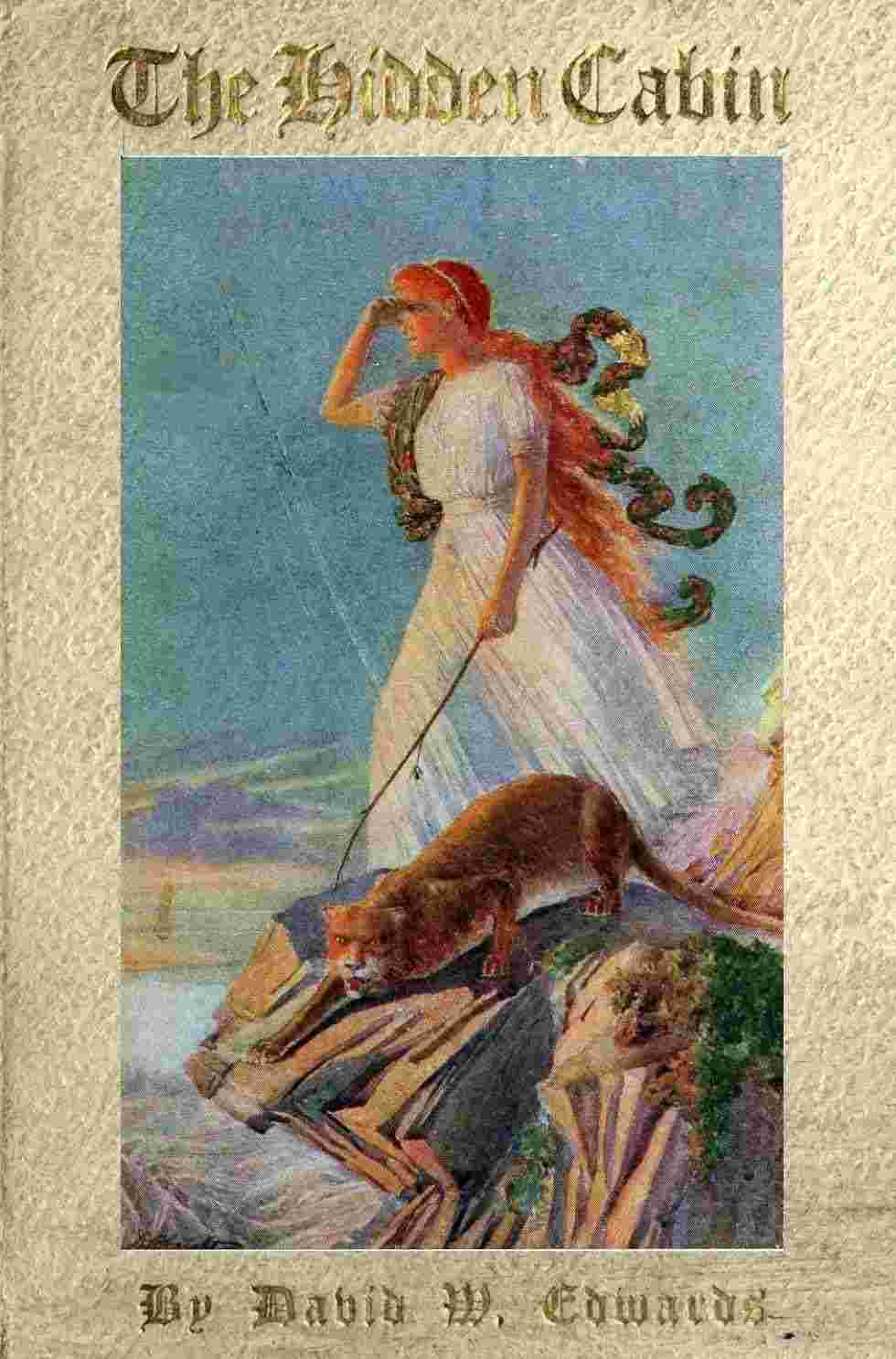
The Project Gutenberg eBook of The Hidden Cabin: a pathetic story in condensed form
Title: The Hidden Cabin: a pathetic story in condensed form
Author: David W. Edwards
Release date: August 8, 2021 [eBook #66008]
Most recently updated: October 18, 2024
Language: English
Credits: Charlene Taylor, Chuck Greif and the Online Distributed Proofreading Team at https://www.pgdp.net (This file was produced from images generously made available by The Internet Archive/American Libraries.)
THE HIDDEN CABIN
THE
Hidden Cabin
A PATHETIC STORY
IN CONDENSED
FORM
BY
DAVID W. EDWARDS
AUTHOR OF “BILLY BIRDSALL,”
“UP THE GRADE,” ETC.
COVER DESIGN, ZOLA AND ZIMBO
BY DRURY VICTOR HAIGHT
LOS ANGELES
COMMERCIAL PRINTING HOUSE
PUBLISHERS
1909
Copyright, 1909
by
David W. Edwards
ALL RIGHTS
RESERVED
THE STORY.
AUTHOR’S NOTE
Palomar Mountain is one of the grandest natural attractions of Southern California. It is more than a mile in height. From its lofty “look-outs” the beautiful bay of San Diego may be descried, and also the distant islands of Santa Catalina and San Clemente. It abounds with gushing springs, richly timbered table-lands, deep, rocky canyons, and rugged peaks. It is one of the favorite resorts of the writer, who has spent many pleasant hours in camp near the mysterious hidden cabin above the “snow white clouds,” in company with his friend, the Rev. John L. Pitner, D. D., to whom these lines are inscribed.
D. W. E.
BIMINI SPRINGS LOS ANGELES, CAL.
PALOMAR.
Tow’rs Palomar, the monarch of the range.
Along its western base are frostless hills
With verdure crowned, and valleys green, where bloom
And fruitage fill the air with sweet perfume.
Green pastures, rich with herbage and bright flowers,
Bedeck the eastern slopes which fall away
A lone and weary desert land to meet;
To meet a lone and weary desert land—
A rich and rocky land where mines of wealth
Have slumbered long beneath its arid wastes.
So stands in majesty this mountain grand
Between the desert and the western sea.
From ocean’s heaving breast, she upward sent
A humid vapor, in the skies to meet
And woo the softer breezes that ascend
From off the heated earth at eventide.
A gentle zephyr was at play among
The cacti beds and yuccas tall, that lift
Their spiny leaves and tufted fronds above
The burning sands; she softly breathed a sigh,
And floating upward in the milky way
She met and wed the vapor from the sea;
For each had found a true affinity.
The moon withdrew and hid her face behind
The distant isles; and from the blushing east
A ray of sunlight came and kissed the bride.
A mantle, soft as down, of spotless white;
And often as the evening twilight falls,
Or dewy morning sheds her purple tints,
They come and spread it over Palomar.
Thus runs the legend which has oft been told;
And which the Indian maiden whispers low
When snow white clouds hang over Palomar.
THE HIDDEN CABIN.
With canyons cleft, where raging floods have made
Their downward path and held their course unchained.
Beyond the eagle’s nest and rocky crag,
Where giant arborvitaes throw their plumes
Athwart the sky; and crystal waters cold
And pure, come sparkling from a mountain spring;
By bending boughs and tangled vines shut out
From view, the hidden cabin stood; and there
Today it stands, and there has stood unkept,
In mystery wrapped, a hundred years or more
Since its last tenant left it there alone.
It stands where it was builded long ago;
Yet not the same as in the days of old,
For long disuse and winters’ storms and rain
Have left their mark; but still enough remains
To show that in the hands of him who built
No joiner’s tools were held; divested of
All metals with sharp edge save only axe
And auger, which he plied with master hand
To hew the timbers smooth, and cut and fit
The doors and frames; and fitting, through these sent
The auger’s teeth to clear the way for pins
Of wood with which he made all fast and strong.
CEDRIC VAUGHN.
Cedric from the southland came, and in his
Veins there flowed—tho’ mixed with Anglo-Saxon—
A trace of Montezuma blood, the same
As that of those who met with sharpened steel
The hosts of Cortez on the bloody plains
Of Otumba. In the lightsome morning
Of his happy youth, he saw that twain who
Gave him life and love, with all his kindred,
By savage hands struck down! struck down and flung
Amid the blazing ruins of their home.
With superhuman strength he stood beside
His father ’till he fell; and then fought on
Like wounded tiger, grimly courting death.
Robber chief—when he saw brave Cedric’s blade
Cleave skull and flesh, and break like slender reeds
The spears of those who came upon him three
To one—thought him protected by the gods
And made immune to blows of mortal hands;
Stricken with fear lest in revengeful wrath
They turn on him, fell on his spear and died.
Then the others fled and Cedric’s life was
Spared. He, wand’ring aimless o’er the waste
Scarce knowing where his footsteps led, came where
Terraced hills sloped to a narrow harbor.
He knew the place and knew his father had
Been well known there and much respected for
Fair dealing, when in trade he bought and sold;
Not many days before, they together
Had come down this dusty trail and returned
With family stores. Sadly he walked on, his
Poor heart bleeding at remembrance of those
Happy hours now gone, when suddenly he
Came upon the spot where they had rested
By a spring and led their horses down;
Here lay the branch his father’s hand had used
To urge the horses on; and half trodden
In the mold, and scattered round, the paper
Which he had seen his mother’s loving hands
Wrap ’round the food prepared by her for them.
Now, for the first, he realized his loss.
He laid his head and wept—alone! Beneath
The bending skies and sighing boughs; no loving
Hand upon his brow; no ear to hear the
Groans that shook his iron frame; nor knew he
How near in that dark hour the heart of Him
Who suffered in the garden all alone
Was bending down to his. The soul may weep
And still the flesh demand its own: Too proud
To eat the bread of charity, he sought
And found employment in the mines. He worked
With heavy heart, crushed for a time by dark
Despair; and giving way to hunger for
Revenge, he well-nigh fell; but when at last
A kindly light broke thro’ the gloom of his
Black night of grief, and he could say, “Thy will
Be done”; in him awoke new life and hope
And high resolve to make of his own life
A memorial to them; and to strive
To reach the measure of their highest hope.
To this end he hoarded all his earnings,
And with the salvage from the wreck of their
Estate, went bravely forth, determined to
Fulfill their wish so oft expres’d that he
Might go away to school—they named the school—
The greatest in the northland, whence they hoped
To see him come one day with cultured mind.
HOMER LEE.
Sacred ground where beacon lights were kindl’d
On the hills, before the war that broke the
Chains of monarchy and set this nation
Free. His father owned ships and lands and
Merchandise; and the son—the eldest born—
Had never known a wish ungratified.
Albeit, he was not puffed up, or vain,
Or churlish by over-much indulgence,
For he was nurtured in the Quaker faith,
And early taught to draw the line ’twixt
Right and wrong; and measure men by what
They are and not by what they have or say.
Unlike in all respects were Cedric Vaughn
And Homer Lee, save in those noble traits
Of character which make men strong and brave
And true. Homer, lighter built and younger,
But noted for his prowess—when he met
The tall, dark, princely stranger from the south,
As by the power of some magnetic chain
Was strangely drawn to him. Touched by the kind
Demeanor of this fair-haired, happy youth,
Cedric’s heart went out to him. So, as the
Years went by, between them grew a friendship
Strong as that of Pythias and his friend.
DORA LEE.
Their success, or wept when disappointment
Crossed their path. Likewise, she shared in all their
Happy leisure hours, when sailing on the
Bay, or riding horseback o’er the hills. And
When their united strength their pennant saved,
The campus rang with shouts of victory
And plaudits for the heroes of the day,
She wept for joy. Dora Lee loved Cedric,
But he knew it not nor dreamed that she whose
Faithful heart could never love but one,
Had consecrated that one love to him.
And nearer came the day when these two friends
Must each go out to meet the sterner life—
The one to fill the place prepared for him;
The other, empty handed and alone.
Their intercourse—to each a priceless boon—
Had ne’er been marred by shadow of distrust.
A diamond careless thrown upon the sand,
May change the gentle current of a stream.
And so it chanced the even current of
Their fellowship was broken.
LOLA VAIL.
Her father, a rich planter, owned a vast
Estate upon the banks of that great stream
Which gathers up the waters of the land
And sweeps them onward to the gulf. Half way
To that strange southern land whence Cedric came
Was Lola born—a schoolmate, friend and guest
Of Dora Lee, and much like her; or as she
Would appear with three more years of summers’
Sun to paint with ruddier glow the bloom of
Health upon her cheek, and tint with deeper
Gold her ample braids; in purity of
Thought and loyalty, they also were alike.
Her father, bringing home a Creole wife,
Unwittingly neglected her; and thought
His duty done when he provided for
The child a nurse—an aged Octoroon—
A pious soul, who gave to Lola all
The love she knew in her sweet childhood life;
And filled the tender mind with holy thoughts
And pure. And Lola daily gathered flowers
And, weeping, laid them on her mother’s grave.
When she was older grown, her father took
Her to the north, she and her faithful nurse,
To bide until she grew to womanhood.
Her education finished, her father
Called her home, but she begged to tarry, yet
A few more days and visit with her friend.
Vaughn and Homer Lee met sweet Lola Vail
And loved her, each in his own way—Cedric,
With all the fervor of his sincere soul—
And Homer worship’d her, forgetting for
The time his own betrothed. Cedric told her
All, she sitting by his side in shady
Bower, upon a wooded isle, their boat drawn
Up below upon the pebbly beach. He
Told the story of his life, as one a
Painful duty would perform. “She must know
The truth.” And keeping nothing back, he told
Her of his birth and lineage—which was
Equal to her own—his loss of home and
Wealth; his lofty aspirations; high hopes
Now partly realized, though penniless;
But he was going back to that same land
Where he had delved; and there would he employ
The knowledge gained of placer, drift and ledge,
And engineering, to locate and bring
Forth rich treasure from the earth, and in a
Few short years would he return with wealth and
Build a costly home for her in some great
City,—she might name the place. “Could she love
Him? Would she wait for him?” She answered not
By spoken word, but when she lifted her
Fond eyes to his, he read the sweet response.
Her head upon his breast, she wept for joy;
And speaking through her tears: “Oh, leave me not,
But let me share your lot whate’er it be—
A palace or a cot—I would leave all
The world, my Cedric, dear, and go with thee.”
But Cedric kindly told her of the place,
Its roughness, the peons there; and frankly,
But perhaps unwise, he spoke of dangers
From the wild bandits. It was no place for
One so sweet and gentle as his own dear
Lola; it were better she obey her
Father’s call. That day, a week, the ship that
He expected her to take, would leave that
Port. It would not be long; he would stop there
On his way and see her father, speak to
Him, as man to man should speak, all fair and
honorable. The wisdom of his speech
She saw and cheerful yielded to his will.
With fervid kiss their pledges sealed, they sat
In sweet converse till lengthening shadows called;
Then spread their sail and shoreward set the prow
Of their light craft. With rosy finger tips
She swept the strings of her guitar and sang:
Entrancing the senses with calm melody?
’Tis the voice of the mermaid as she floats o’er the main,
And mingles her notes with the gondolier’s strain.”
Mooring, by their merry laughter and love
Glances, half concealed, each read their secret;
And reading, saw the fading shadows of
Their hope. Each concealed the pang; and laughing,
Teased the truants for their tardiness. Then
Timidly the lovers made confession.
“And we will pray,” said Homer, “that to you
Be given the fullness of all earthly
Joy, and then the sweetest bliss of heaven.”
Watched her waving from the deck; and saw the
Good ship fading in the offing vanish,
Where bending skies come down to meet the sea;
Then sadly turned away—each heart, wounded
By a shaft from Cupid’s bow; arrows from
His quiver, unaimed, ofttimes fly amiss.
And Homer to harbor in their minds dark
Jealousies, or thoughts unkind; but Homer
Was disconsolate; and Dora, cheering,
Said: “You surely will forget your grief; and
Going back to your first love will marry
Her and love her evermore; for no true
Heart can ever love but one.” So it was
Her prophecy came true. Dora loved with
Woman’s constancy; and womanlike found
Comfort in the secret hope (while wishing
Naught but good for Lola Vail), the idle hope
That she one day would marry Cedric Vaughn.
Can see with joy a loved one plodding on,
And faithful to the end, achieve at last
The worthy object sought, then there was joy
Above when Cedric led the class and gained
The highest meed of praise for work well done.
Way to competence than any of the
Kindly offers of a place which, without
His asking, came to him; a great law firm
Wanted him; a professorship in that
Same college he could have; in the counting
House and busy marts of commerce there were
Many op’nings for one as he so well
Endowed and popular. He declined them
All; and yet so gracefully, with thanks, that
They were urged upon him all the more; but
He had fixed his mind on going back, see
Lola on his way, then hasten on to
Carry out his plans; for each hour improved
Would bring them nearer to their wedding day.
Of gay young friends came, bearing tokens of
Their friendship, souvenirs of college days,
And bidding him God-speed upon his way.
He keenly felt the sting of parting with
His friends; but when he came to say good-bye
To Homer, that was hardest of it all.
When Dora gave the parting hand, and in
Her large blue eyes he saw the gathering
Tears, that tell-tale look of love she fain would
Hide; that yearning look of hopeless love
Like arrow pierced his soul with deep regret,
And haunted him thro’ all the coming years.
THE VOYAGE.
Summer sea. At times translucent clouds were
Flung across its way like twilight mists, and
Then anon the sun burst forth. With lowering
Winds and listless sail they drifted dreamily
Beneath the turquoise skies. When at night the
Mellow moonlight made its path across the
Waves, Cedric paced the deck impatiently;
And in his restless dreams he saw the face
And form of Lola; felt her soft breath on
His cheek, her arms entwined about his neck
In heavenly bliss.
Freightage, the ship would often linger for
A day, and those on board would wander thro’
The town. Once they saw a vessel that plied
Between that southern coast and Africa
Unload its cargo—human souls, who had
Been stolen from their home and brought to this
Free country to be sold to servitude.
The buyers, richly dressed and bedecked with
Diamonds, stood like drovers waiting at the
Cattle pens to buy. One gentleman with
Pistol at his belt, true type of southern
Cavalier, took a mother from her child;
Cedric pled with him to buy the baby
Too. He was answered by an insult, and
Derided for his pity for “the brat.”
Unmindful of the insult to himself,
He persevered and gained consent to buy
The child and place it in its mother’s arms.
The magic isle of Bimini, where the
Indian sages told De Leon he
Would find the fountain of eternal youth.
Thence onward thro’ the gulf, and near that quaint
Old Crescent City, he found his darling
Lola. Near the city in a lovely
Urban villa on the rich plantation
Of her father, where the oleanders
Bloom, and palmettos wave their fronded plumes,
They met once more. Her father, Colonel Vail,
Was absent; would return in one week more.
Six days, six blissful days, from early morn
Till eve, the lovers wandered ’mid the scenes
To her, so rich in hallowed memories.
How unlike the days of old she found her
Home. Her father, with advancing age and
Growing wealth, had changed; become more like the
One who filled her mother’s place, purse-proud and
Haughty. He had hinted at a union
That he desired for her, and she feared he
Would not look with favor on her Cedric.
And clings the stronger when the north wind blows,
So she, as moved by some foreboding, clung
To him, and begged that she might go with him
To that far land; and coaxingly she said:
“Who will spread the table for my Cedric?
Or smooth his pillow? Or if mishap befall,
Nurse him back to health? If he goes alone,
I ne’er shall look upon his face again.”
Made light of her misgiving; yet he was
Sorely tempted, and well-nigh gave way to
His desire; but that high sense of honor,
And solicitude for her, gave him the
Mastery over self. And from that hour
He never knew a thought of selfishness.
He soothed her fears; and by words of wisdom,
(As before) soon brought her judgment into
Sweet accord with his. But it was agreed
That if her father answered his request
With scorn, or treated him unkindly, there
Would be no angry words. That he would go
And never ask again. When he returned,
Would take her as his rightful own; and then
He held her to his breast, and laid upon
Her lips what they both well knew might be his
Farewell kiss. For even then they saw her
Father’s carriage coming up the drive. When
They met and she presented her betrothed,
Cedric recognized the man who bought the
Slave and would have torn the infant from its
Mother’s breast. Yet, speaking calmly, told him
Who he was, whence and why he came; told all
Manfully; and the Colonel heard him thro’.
For his presumption: “A pauper, begging
For a queen! Nay, nay! The one who gains my
Daughter’s hand must have a bank account or
Property in land or slaves.” The hot blood
Rushing to his brow, he boldly answered:
“I go, accepting these conditions, but
Surely will return.” Then, taking Lola’s
Hand, said cheerfully: “’Till then, good-bye.” With
Tearless eyes she proudly looked upon her
Cedric, and stood as strong and brave as he.
THE MINES.
Metals and bright gems, by nature’s cunning
Hand are tucked away and hidden in the
Rocks or scattered in the sands, he found a
Dusky peon—Jose Morales—whom he
Had known and trusted, and took him with his
Train of donkeys packed with stores; with miner’s
Pick and spade and crucible, he bravely
Plunged into the wilderness. For many
Long and weary days he sought among the
Dry Lomitas, sought in vain beneath a
Tropic sun, lured on by prospects that proved
Valueless. And when at last he found a
Vein of quartz that sparkled with the golden
Grains, he was compelled to leave it there, to
Wait thro’ long decades for other hands to
Come with stamp and chemicals to crush the
Rock and bear away the millions he had
Found. He working, saw the months pass by, but
Labored on with Lola ever in his
Mind. Anon there crept before his sight
A vision of that peaceful shore where first
They met,—a cottage home—his Lola with
A blue-eyed baby kneeling by her side,
White robed, with golden curls, in attitude
Of prayer—that evening prayer by mother taught;
Then he saw the blessings of the simpler,
Holy life; saw that wealth is least of all.
Sent, returned in great excitement, crying
“Oro grande, señor! Oro grande!”
In a deep arroyo in the sands for
Ages washed by floods from mountain storm,
Jose had discovered as he said, “much
Gold.” In cup-like hollows of the rocks by
Falling waters worn away—in yellow
Nuggets buried in the sand—he found the
Glittering fortune they so long had sought.
This he changed for currency of lighter
Weight and coin, in that old city where his
Forbears died; then to the seaport sped, there
Impatient waited for the ship to come
And carry him in triumph to his bride.
BEN RUBIDEAUX.
Had sent a messenger in search of him
With letters, and gave him one from Lola,
Requesting that the messenger be sent.
Cedric sent Morales to intercept
The messenger and bring the letters back.
This the faithful fellow did, and Cedric
Read them with dismay. Morales saw the
Troubled look on Cedric’s face and begged to
Go with him. With his tamales, and his
Mascal, and being Cedric’s servant, he
Was satisfied. He cared not for his share;
Would leave it all with him. Cedric, with real
Affection, grateful for his faithfulness,
Told him he might go and evermore abide
With him.
O’er with sinking heart, read Lola’s letters.
Beginning at the first, he read how proud
Of him she was when he “so grandly stood
Before her father, with the bearing of
A king, and faced him in his wrath;” then of
Her sad and lonely days when he was gone;
How her father sought by gentleness to
Mould her to his will and bring her to forget
The one she loved. Of the attention paid
By Simon Blake, her father’s friend and boon
Companion, the man he wanted her to
Wed,—a vile, besotted wretch who knew no
God but gold; she hated gold and wished that
He might come back poor in all but love and
Purity of soul, with which no other
Riches can compare.
Suit until she had exhausted all the
Harmless arts of womanhood to evade
His coarse advances, praying daily that
Her Cedric would return; when he boldly
Claimed her hand, she told him, “No;” he bro’t her
Father who commanded that she wed him;
She, helpless in their hands, had pled for time—
One more year; then, if Cedric had not come,
Her answer they should have. One day she, in
An arbor half hidden in the trellis,
Had heard her father’s overseer, Ben
Rubideaux, and Simon Blake make bargain
That for a sum the overseer would watch
For Cedric and murder him if he should
Come. She knew he did not fear them all, but
For her sake, she begged him not to venture
There. She gave a number in the city
Where he would find a friend, a lady friend,
Of hers. It was arranged that she should come
For her. Then, as his lawful wife, he could
Defend her and himself, if needs must be.
’Twere best that he should come with pistols, armed;
Ben Rubideaux and Blake were desperate
And wicked men. She wrote, fearing lest her
Letters would not be received; since he left,
She had received no word from him; she knew
That he would write, but they had come between.
THE WEDDING.
He would fain have gone openly and claimed
His bride, but for her sake he acquiesced,
And in his servant’s name he took a house,
A lovely house, in quiet place apart.
There Lola came, and as the light of slow
Descending sun proclaimed the dying day,
And zephyrs laden with the breath of bloom
And tuneful with the song of mocking bird,
Were wafted from the sea, then from the mission
Came the parish priest, and in soft accents
Of the Spanish tongue, pronounced the holy
Words that made them one. No other witness
Than his servant and her friend. And there thro’
Long and dreamy, blissful days, they passed their
Honeymoon.
Instinct, saw that danger hovered over
Cedric; and, unknown to him, he shadowed
All his steps. One night a messenger in
Haste came to the door, told Cedric that his
Servant was in trouble, needed him; he
Went, not knowing that his faithful Jose
Shadowed them. When near the water front the
Stranger fled; and from the cotton bales and
Freightage piled upon the dock, two ruffians
Sprang on Cedric. When the light of morning
Dawned, the lifeless forms of Simon Blake, Ben
Rubideaux and poor Morales were found
Lying on the bloody dock.
Paced the floor in anguish, list’ning for the
Footsteps that came not. Nor knew she of the
Tragedy until she read: “Murdered! In the
Night! Two citizens of high repute shot down!
But not until one of the murderers
(A bearded foreigner) was killed by them.
The other has escaped, but the mob is
On his track and he will soon be taken.”
The paper gave a good description of
Her husband, which she doubted not, was given
By the man who called for him. If she should
Speak, it would bring harm to Cedric; he might
Escape and come to her; so, taking hope,
With one trusty servant she in hiding
Waited there. Her friend had gone and no one
Knew of her abiding place.
Weeks and months rolled by; she pined, and passing
Near the gates of death, awoke to find a
Blue-eyed baby by her side—the child of
Cedric’s dreams. The months passed by and still
No word from Cedric came. She, yielding to
Her grief and drooping, faded as a flower
That withering in decadence fades away.
The rosy seraph sent—so kindly sent—
From heaven to be the precious idol of
Her solitude, and his, grew strong and more
Angelic as the passing days went by.
Cedric, with ready shot, the foremost fell;
But the bludgeon of the other laid him
Low; then, as the fatal blow was falling,
Morales coming, threw himself between;
And in deadly combat grappled with Ben
Rubideaux. With bowie knives they struggled,
Each receiving fatal thrusts, nor yielded
Until weak from loss of blood, they parting
Fell; Morales’ bowie buried in the
Heart of Rubideaux. Cedric lay for hours,
Unconscious; then, his strength returning, he
Rose, and dazed, bewildered, groped along the
Frontage, stag’ring like a drunken man; the
Stevedores thought him one returning from a
Night’s debauch. He in the early morning,
Came where a boat was loosening its cables
From the wharf; and unnoticed, stumbled on
And fell among the luggage in a swoon.