
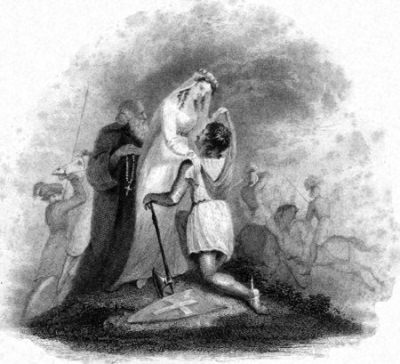
Military exercises were mingled with the anxieties of love. He practised every mode by which strength and activity could be given to the body. He learnt to endure hunger and thirst; to disregard the seasons’ changes, and like the Roman youths in the Campus Martius, when covered with dust, he plunged into the stream that watered the domains of his lord. He accustomed himself to wield the sword, to thrust the lance, to strike with the axe, and to wear armour. The most favourite exercise was that which was called the Quintain: for it was particularly calculated to practise the eye and hand in giving a right direction to the lance. A half figure of a man, armed with sword and buckler, was placed on a post, and turned on a pivot, so that if the assailant with his lance hit him not on the middle of the breast but on the extremities, he made the figure turn round, and strike him an ill-aimed blow, much to the merriment of the spectators. The game of the Quintain was sometimes played by hanging a shield upon a staff fixed in the ground, and the skilful squire riding apace struck the shield in such a manner as to detach it from its ligatures.[66]
But of all the exercises of chivalry, none was thought so important as horsemanship.
“Wel could he sit on horse and fair ride,”
is Chaucer’s praise of his young squire. Horsemanship was considered the peculiar science of men of gentle blood. That Braggadochio had not been trained in chivalry was apparent from his bad riding. Even his valiant courser chafed and foamed, for he disdained to bear any base burthen.[67]
Notions of religion were blended with those of arms in the mind of the squire, for his sword was blessed by the priest, and delivered to him at the altar. As he advanced to manhood he left to younger squires most of the domestic duties of his station. Without losing his title of squire he became also called a bachelor, a word also used to designate a young unmarried knight. He went on military expeditions. The squire in Chaucer, though but twenty years old, had
“Sometime been in chevauchee,
In Flanders, in Artois, and in Picardy.”
Love was the inspirer of his chivalry: for he
“Bore him well, as of so little space,
In hope to stonden in his lady’s grace.”[68]
Particularly at the battle of Bovines.
For the squire, instead of being merely the servant of the knight, often periled himself in his defence. When the knight was impetuous beyond the well-tempered bravery of chivalry, the admirer of his might followed him so close, and adventured himself so jeopardously, as to cover him with his shield.[69] A valiant knight, Ernalton of Saint Colombe, was on the point of being discomfited by a squire called Guillonet, of Salynges; but when the squire of Sir Ernalton saw his master almost at utterance, he went to him, and took his axe out of his hands, and said, “Ernalton, go your way, and rest you; ye can no longer fight;” and then with the axe he went to the hostile squire, says Froissart, and gave him such a stroke on the head that he was astonied, and had nigh fallen to the earth. He recovered himself, and aimed a blow at his antagonist, which would have been fatal, but that the squire slipped under it, and, throwing his arms round Guillonet, wrestled, and finally threw him. The victor exclaimed that he would slay his prostrate foe, unless he would yield himself to his master. The name of his master was asked: “Ernalton of Saint Colombe,” returned the squire, “with whom thou hast fought all this season.” Guillonet seeing the dagger raised to strike him, yielded him to render his body prisoner at Lourde within fifteen days after, rescue or no rescue.[70] The squires were brought into the mêlée of knights, at the famous battle of Bovines, on the 27th of July, 1214. The force of Philip Augustus was far inferior in number to that of the united Germans and Flemish; and, in order to prevent them from surrounding him, he lengthened his line by placing the squires at the two extremities of the knights. The mail-clad chivalry of the emperor Otho were indignant at such soldiers daring to front them; but the young warriors were not dismayed by haughty looks and contumelious speeches, and their active daring mainly contributed to the gaining of the victory, the most considerable one that France had ever obtained.[71]
Seldom before the age of twenty-one was a squire admitted to the full dignity of chivalry. Chaucer’s squire was twenty, and had achieved feats of arms. St. Louis particularly commanded that the honour of knighthood should not be conferred upon any man under the age of twenty-one. As the time approached for the completing and crowning of his character, his religious duties became more strictly enforced. Knighthood was assimilated, as much as possible, to the clerical state, and prayer, confession, and fasting were necessary for the candidate for both. The squire had his sponsors, the emblems of spiritual regeneration were applied to him, and the ceremonies of inauguration commenced by considering him a new man. He went into a bath, and then was placed in a bed. They were symbolical, the bath of purity of soul, and the bed of the rest which he was hereafter to enjoy in paradise. In the middle ages people generally reposed naked[72], and it was not till after he had slept that the neophyte was clad with a shirt. This white dress was considered symbolical of the purity of his new character. A red garment was thrown over him to mark his resolution to shed his blood in the cause of Heaven. The vigil of arms was a necessary preliminary to knighthood. The night before his inauguration he passed in a church, armed from head to foot[73], and engaged in prayer and religious meditation. One of the last acts of preparation was the shaving of his head to make its appearance resemble that of the ecclesiastical tonsure. To part with hair was always regarded in the church as a symbol of servitude to God.[74]
The ceremony of inauguration was generally performed in a church, or hall of a castle, on the occasion of some great religious or civic festival. The candidate advanced to the altar, and, taking his sword from the scarf to which it was appended, he presented it to the priest, who laid it upon the altar, praying that Heaven would bless it, and that it might serve for a protection of the church, of widows, and orphans, and of all the servants of God against the tyrannies of pagans and other deceivers, in whose eyes he mercifully hoped that it would appear as an instrument of terror. The young soldier took his oaths of chivalry; he solemnly swore to defend the church, to attack the wicked, to respect the priesthood, to protect women and the poor, to preserve the country in tranquillity, and to shed his blood, even to its last drop, in behalf of his brethren. The priest then re-delivered the sword to him with the assurance that, as it had received God’s blessing, he who wielded it would prevail against all enemies and the adversaries of the church. He then exhorted him to gird his sword upon his strong thigh, that with it he might exercise the power of equity to destroy the hopes of the profane, to fight for God’s church, and defend his faithful people, and to repel and destroy the hosts of the wicked, whether they were heretics or pagans. Finally, the soldier in chivalry was exhorted to defend widows and orphans, and to restore and preserve the desolate, to revenge the wronged, to confirm the virtuous; and he was assured that by performing these high duties he would attain heavenly joys.[75]
The young warrior afterwards advanced to the supreme lord in the assembly, and knelt before him with clasped hands;—an attitude copied from feudal manners, and the only circumstance of feudality in the whole ceremony. The lord then questioned him whether his vows had any objects distinct from the wish to maintain religion and chivalry. The soldier having answered in the negative, the ceremony was permitted to advance. He was invested with all the exterior marks of chivalry. The knights and ladies of the court attended on him, and delivered to him the various pieces of his harness.[76] The armour varied with the military customs of different periods and of different countries, but some matters were of permanent usage. The spurs were always put on first, and the sword was belted on last. The concluding sign of being dubbed or adopted into the order of knighthood was a slight blow[77] given by the lord to the cavalier, and called the accolade, from the part of the body, the neck, whereon it was struck. The lord then proclaimed him a knight in the name of God and the saints, and such cavaliers as were present embraced their newly-made brother. The priest exhorted him to go forth like a man, and observe the ordinances of heaven. Impressed with the solemnity of the scene, all the other knights renewed in a few brief and energetic sentences their vows of chivalry; and while the hall was gleaming with drawn swords, the man of God again took up the word, blessing him who had newly undertaken, and those who had been long engaged in holy warfare, and praying that all the hosts of the enemies of heaven might be destroyed by Christian chivalry. The assembly then dispersed. The new knight, on leaving the hall, vaulted on his steed, and showed his skill in the management of the lance, that the admiring people might know that a cavalier had been elected for their protection. He distributed largesses among the servants and minstrels of the castle, for whoso received so great a gift as the order of chivalry honoured not his order if he gave not after his ability. The remainder of the day was passed in congratulation and festivity.[78]
Many of the most virtuous affections of the heart wound themselves round that important circumstance in a man’s life, his admission into knighthood. He always regarded with filial piety the cavalier who invested him with the order. He never would take him prisoner if they were ranged on opposite sides, and he would have forfeited all title to chivalric honours if he had couched his lance against him.
A noble aspirant to chivalry would only receive the accolade from a warrior, whose fame had excited his emulation, or sometimes the feelings of feudal attachment prevailed over the higher and sterner sense of chivalry. In expectation of a battle, the Earl of Buckingham called forth a gentle squire of Savoy, and said, “Sir, if God be pleased, I think we shall this day have a battle; therefore I wish that you would become a knight.” The squire excused himself by saying, “Sir, God thank you for the nobleness that ye would put me unto; but, Sir, I will never be knight without I am made by the hands of my natural lord, the Earl of Savoy.”[79]
A very singular tribute was paid to bravery during the famous battle of Homildon Hill. When the cloth-yard arrows of the English yeomen were piercing the opposite line through and through, Sir John Swinton exhorted the Scotsmen not to stand like deer to be shot at, but to indulge their ancient courage and meet their enemy hand to hand. His wish, however, was echoed only by one man, Adam Gordon, and between their families a mortal feud existed. Generously forgetting the hatred which each house bore to the other, Gordon knelt before Swinton, and solicited to be knighted by so brave a man. The accolade was given, and the two friends, like companions in arms, gallantly charged the English. If a kindred spirit had animated the whole of the Scottish line the fate of the day might have been reversed; but the two noble knights were only supported by about an hundred men-at-arms devoted to all their enterprises; and they all perished.[80]
Inconvenience of this.
The ceremonies of inauguration which have been described were gone through when knighthood was conferred on great and public occasions of festivity, but they often gave place to the power of rank and circumstances. Princes were exempted from the laborious offices of page and squire. Men were often adopted into chivalry on the eve of a battle, as it was considered that a sense of their new honours would inspire their gallantry. Once during the war of our Black Prince in Spain, more than three hundred soldiers raised their pennons; many of them had been squires, but in one case the distinction was entirely complimentary, for Peter the Cruel, who could boast neither chivalric qualities nor chivalric services, was dubbed. There was scarcely a battle in the middle ages which was not preceded or followed by a large promotion of men to the honour of knighthood. Sometimes, indeed, they were regularly educated squires, but more frequently the mere contingency of the moment was regarded, and soldiers distinguished only for their bravery and ungraced by the gentle virtues of chivalry were knighted. We often read of certain squires being made cavaliers and raising their pennons, but very often no pennons were raised, that is to say, the men who were knighted were not able to summon round their lances a single man-at-arms; hence it ocurred that the world was overspread with poor knights, some of whom brought chivalry into disgrace by depredations and violence; others wandered about the world in quest of adventures, and let out their swords to their richer brethren. In the romance of Partenopex of Blois, there is a picture of a knight of this last class.
“So riding, they o’ertake an errant knight,
Well hors’d, and large of limb, Sir Gaudwin hight,
He nor of castle nor of land was lord,
Houseless he reap’d the harvest of the sword;
And now, not more on fame than profit bent,
Rode with blithe heart unto the tournament;
For cowardice he held it deadly sin,
And sure his mind and bearing were akin,
The face an index to the soul within;
It seem’d that he, such pomp his train bewray’d,
Had shap’d a goodly fortune by his blade;
His knaves were point device, in livery dight,
With sumpter nags, and tents for shelter in the night.”
Cavaliers sometimes took their title from the place where they were knighted: a very distinguished honor was to be called a Knight of the Mines, which was to be obtained by achieving feats of arms in the subterranean process of a siege. The mines were the scenes of knightly valour; they were lighted up by torches; trumpets and other war instruments resounded, and the general affair of the siege was suspended, while the knights tried their prowess; the singularity of the mode of combat giving a zest to the encounters. No prisoners could be taken, as a board, breast high, placed in the passage by mutual consent, divided the warriors. Swords or short battle-axes were the only weapons used.
In the year 1388, the castle of Vertueill, in Poictou, then held by the English, was besieged by the Duke of Bourbon. Its walls raised on a lofty rock were not within the play of the battering ram, and therefore the tedious operation of the mine was resorted to: both parties frequently met and fought in the excavated chambers, and a battle of swords was one day carried on between Regnaud de Montferrand, the squire of the castle, and the Duke of Bourbon, each being ignorant of the name and quality of the other. At length the cry “Bourbon, Bourbon! Our Lady!” shouted by the attendants of the Duke, in their eager joy at the fray, struck the ears of the squire, and arrested his hand. He withdrew some paces, and enquired whether the duke were present: when they assured him of the fact, he requested to receive the honour of knighthood in the mine, from the hands of the duke, and offering to deliver up the castle to him in return for the distinction, and from respect for the honour and valour he found in him. Never was a castle in the pride of its strength and power gained by easier means. The keys were delivered to the Duke of Bourbon by Regnaud de Montferrand, and the honor of knighthood, with a goodly courser and a large golden girdle, were bestowed on the squire in return.[81]
Such were the various ceremonies of chivalric inauguration. Those of degradation should be noticed. What the offences were which were punishable by degradation it is impossible to specify. If a knight offended against the rules of the order of chivalry he was degraded, inasmuch as he was despised by his brother knights; and as honour was the life-blood of chivalry, he dreaded contempt more than the sword. Still, however, there were occasions when a knight might be formally deprived of his distinctions. The ceremony of degradation generally took place after sentence, and previous to the execution of a legal judgment against him.[82] Sometimes his sword was broken over his head, and his spurs were chopped off; and, to make the bitterness of insult a part of the punishment, these actions were performed by a person of low condition; but at other times the forms of degradation were very elaborate. The knight who was to be degraded was in the first instance armed by his brother knights from head to foot, as if he had been going to the battle-field; they then conducted him to a high stage, raised in a church, where the king and his court, the clergy, and the people, were assembled; thirty priests sung such psalms as were used at burials; at the end of every psalm they took from him a piece of armour. First, they removed his helmet, the defence of disloyal eyes, then his cuirass on the right side, as the protector of a corrupt heart; then his cuirass on the left side, as from a member consenting, and thus with the rest; and when any piece of armour was cast upon the ground, the king of arms and heralds cried, “Behold the harness of a disloyal and miscreant knight!” A basin of gold or silver full of warm water was then brought upon the stage, and a herald holding it up, demanded the knight’s name. The pursuivants answered that which in truth was his designation. Then the chief king of arms said, “That is not true, for he is a miscreant and false traitor, and hath transgressed the ordinances of knighthood.” The chaplains answered, “Let us give him his right name.” The trumpets sounded a few notes, supposed to express the demand, “what shall be done with him?” The king, or his chief officer, who was present replied, “Let him with dishonour and shame be banished from my kingdom as a vile and infamous man, that hath offended against the honour of knighthood.” The heralds immediately cast the warm water upon the face of the disgraced knight, as though he were newly baptized, saying, “Henceforth thou shalt be called by thy right name, Traitor.” Then the king, with twelve other knights, put upon them mourning garments, declaring sorrow, and thrust the degraded knight from the stage: by the buffettings of the people he was driven to the altar, where he was put into a coffin, and the burial-service of the church was solemnly read over him.[83]
The English customs regarding degradation are minutely stated by Stowe in the case of an English knight, Sir Andrew Harcley, Earl of Carlisle who (in the time of Edward II.) was deprived of his knighthood, previously to his suffering the penalties of the law for a treasonable correspondence with Robert Bruce. “He was led to the bar as an earl, worthily apparelled, with his sword girt about him, horsed, booted, and spurred, and unto him Sir Anthony Lucy (his judge) spoke in this manner: ‘Sir Andrew,’ quoth he, ‘the king for thy valiant service hath done thee great honour, and made thee Earl of Carlisle, since which time thou as a traitor to thy lord, the king, led his people, that should have helped him at the battle of Heighland, away by the county of Copland, and through the earldom of Lancaster, by which means our lord the king was discomfited there of the Scots, through thy treason and falseness; whereas, if thou haddest come betimes, he hadde had the victory, and this treason thou committed for the great sum of gold and silver that thou received of James Douglas, a Scot, the king’s enemy. Our lord the king wills, therefore, that the order of knighthood, by the which thou received all the honour and worship upon thy body, be brought to nought, and thy state undone, that other knights of lower degree may after thee beware, and take example truly to serve.’ Then commanded he to hew his spurs from his heels, then to break his sword over his head, which the king had given him to keep and defend his land therewith, when he made him earl. After this, he let unclothe him of his furred tabard, and of his hood, of his coat of arms, and also of his girdle; and when this was done, Sir Anthony said unto him, ‘Andrew,’ quoth he, ‘now art thou no knight, but a knave; and for thy treason the king wills that thou shalt be hanged and drawn, and thy head smitten off from thy body, and burned before thee, and thy body quartered, and thy head being smitten off, afterwards to be set upon London bridge, and thy four quarters shall be sent into four good towns of England, that all others may beware by thee;’ and as Sir Anthony Lucy had said, so was it done in all things, on the last day of October.”[84]
CHAP. III.
THE EQUIPMENT.
Beauty of the chivalric Equipment ... The Lance ... The Pennon ... The Axe, Maule, and Martel ... The Sword ... Fondness of the Knight for it ... Swords in Romances ... The Shield ... Various sorts of Mail ... Mail ... Mail and Plate ... Plate Harness ... The Scarf ... Surcoats ... Armorial Bearings ... Surcoats of the Military Orders ... The Dagger of Mercy ... Story of its Use ... Value of Enquiries into ancient Armour ... A precise Knowledge unattainable ... Its general Features interesting ... The broad Lines of the Subject ... Excellence of Italian Armour ... Armour of the Squire, &c. ... Allegories made on Armour ... The Horse of the Knight.
The fierce equipage of war deserves a fuller consideration than was given to it in the last chapter. The horse whereon the knight dashed to the perilous encounter should be described, the weapons by which he established the honour of his fame and the nobleness of his mistress’s beauty deserve something more than a general notice. Never was military costume more splendid and graceful than in the days which are emphatically called “the days of the shield and the lance.” What can modern warfare present in comparison with the bright and glittering scene of a goodly company of gentle knights pricking on the plain with nodding plumes, emblazoned shields, silken pennons streaming in the wind, and the scarf, that beautiful token of lady-love, crossing the strong and polished steel cuirass.
The lance was the chief offensive weapon of the knight: its staff was commonly formed from the ash-tree.
Its length was fitted to the vigour and address of him who bore it, and its iron and sharpened head was fashioned agreeably to his taste.[85] To the top of the wooden part of the lance was generally fixed an ensign, or piece of silk, linen, or stuff. On this ensign was marked the cross, if the expedition of the soldier had for its object the Holy Land, or it bore some part of his heraldry; and in the latter case, when the lance was fixed in the ground near the entrance of the owner’s tent, it served to designate the bearer. Originally this ensign was called a gonfanon, the combination of two Teutonic words, signifying war and a standard. Subsequently, when the ensign was formed of rich stuffs and silks, it was called a pennon, from the Latin word pannus.[86] The pennon cannot be described from its exact breadth, for that quality of it varied with the different fancies of knights, and it had sometimes one, but more often two indentations at the end.
When the pennon was cut square on occasion of a simple knight becoming a knight banneret it received the title of a banner, the ancient German word for the standard of a leader, or prince.[87]
The maule and martel.
To transfix his foe with a lance was the ordinary endeavour of a knight; but some cavaliers of peculiar hardihood preferred to come to the closest quarters, where the lance could not be used. The battle-axe, which they therefore often wielded, needs no particular description. But the most favourite weapons were certain ponderous steel or iron hammers, carrying death either by the weight of their fall or the sharpness of the edge. They were called the martel and the maule, words applied indifferently in old times; for writers of days of chivalry cared little about extreme accuracy of diction, not foreseeing the fierce disputes which their want of minuteness in description would give rise to. This was the weapon which ecclesiastics used when they buckled harness over rochet and hood, and holy ardour impelled them into the field; for the canons of the church forbad them from wielding swords, and they always obeyed the letter of the law. Some cavaliers, in addition to their other weapons, carried the mallet, or maule, hanging it at their saddle bow, till the happy moment for ‘breaking open skulls’ arrived. When it was used alone, this description of offensive armour was rather Gothic than chivalric; yet the rudeness of earlier ages had its admirers in all times of chivalry, the affected love of simplicity not being peculiar to the present day. A lance could not execute half the sanguinary purposes of Richard Cœur de Lion, and it was with a battle-axe[88], as often as with a sword, that he dashed into the ranks of the Saracens. Bertrand du Guesclin had a partiality for a martel, and so late as the year 1481 the battle-axe was used.
Among the hosts of the Duke of Burgundy was a knight named Sir John Vilain. He was a nobleman from Flanders, very tall, and of great bodily strength: he was mounted on a good horse, and held a battle-axe in both hands. He pressed his way into the thickest part of the battle, and, throwing his bridle on the neck of his steed, he gave such mighty blows on all sides with his battle-axe that whoever was struck was instantly unhorsed, and wounded past recovery.[89] Generally speaking, however, the polite and courteous knights of chivalry thought it an ungentle practice to use a weapon which was associated with ideas of trade; and the romance-writers, who reflect the style of thinking of their times, commonly give the lance to the knight, and the axe or mallet to some rude and ferocious giant.[90]
Fondness of the knight for it.
The usual weapon for the press and mêlée was the sword, and there were a great many interesting associations attached to it. The knight threw round it all his affections. In that weapon he particularly trusted. It was his good sword, and with still more confidence and kindness he called it his own good sword. He gave it a name, and engraved on it some moral sentence, or a word referring to a great event of his life. Not indeed that these sentences were confined to the sword; they were sometimes engraven on the frontlet of the helmet, or even on the spurs[91], but the hilt or blade of the sword were their usual and proper places. The sword rather than the lance was the weapon which represented the chivalry of a family, and descended as the heir loom of its knighthood. When no one inherited his name, there was as much generous contention among his friends to possess his good sword, as in the days of Greece poetry has ascribed to the warriors who wished for the armour of Achilles.[92] The sword was the weapon which connected the religious and military parts of the chivalrique character. The knight swore by his sword, for its cross hilt was emblematical of his Saviour’s cross.
David in his daies dubbed knights,
And did hem swere on her sword to serve truth ever.
P. Ploughman.
The word Jesus was sometimes engraven on the hilt to remind the wearer of his religious duties. The sword was his only crucifix, when mass was said in the awful pause between the forming of the military array and the laying of lances in their rests. It was moreover his consolation in the moment of death. When that doughty knight of Spain, Don Rodrigo Frojaz was lying upon his shield, with his helmet for a pillow, he kissed the cross of his sword in remembrance of that on which the incarnate son of God had died for him, and in that act of devotion rendered up his soul into the hands of his Creator.[93]
The handle of the sword was also remarkable for another matter. The knight, in order not to lose the advantage of having his seal by him, caused it to be cut in the head of his sword, and thus by impressing his seal upon any wax attached to a legal document, he exhibited his determination to maintain his obligation by the three-fold figure of his seal, the upholden naked sword, and the cross.[94]
The sword of the knight was held in such high estimation, that the name of its maker was thought worthy of record. Thus when Geoffery of Plantagenet received the honor of knighthood, a sword was brought out of the royal treasury, the work of Galan, the best of all sword smiths.[95] Spain was always famous for the temper and brilliancy of its swords. Martial speaks in several places of the Spanish swords which, when hot from the forge, were plunged in the river Salo near Bilbilis in Celtiberia. The armourers at Saragossa were as renowned in days of chivalry as those of Toledo in rather later times, for it was not only the sword of Toledo that became a proverbial phrase for the perfection of the art. Sometimes the armourers had establishments in both towns. The excellence, however, of the swords of Julian del Rey, who lived both at Saragossa and Toledo, is referred to by the keeper of the lions in Don Quixote. The weapons of this artist had their peculiar marks. El perillo, a little dog; el morillo, a Moor’s head, and la loba, a wolf.[96]
But perhaps it may be thought I am passing the bounds of my subject. To return then to earlier days. The girdle round the waist, or the bauldrick descending from the shoulder across the body was simple tanned leather only, or sometimes its splendour rivalled that of prince Arthur in the Fairy Queen.
Athwart his breast a bauldrick brave he ware
That shind like twinkling stars, with stones most precious rare;
******
And in the midst thereof, one precious stone
Of wond’rous worth, and eke of wondrous mights,
Shapt like a lady’s head, exceeding shone,
Like Hesperus among the lesser lights,
And strove for to amaze the weaker sights:
Thereby his mortal blade full comely hung
In ivory sheath, ycarv’d with curious slights,
Whose hilt was burnish’d gold, and handle strong
Of mother perle, and buckled with a golden tong.
Book 1. c. 7. st. 29, 30.
Many of the historical circumstances just now related regarding the sword of the knight are pleasingly exaggerated in the beautiful extravagancies of romantic fabling. The most famous sword in the imagination of our ancestors was that of king Arthur; it was called Escalibert (corrupted into Caliburn). The romance of Merlin thus explains the name. Escalibert est un nom Ebricu qui vault autant à dire en Français, comme tres cher fer et acier, et aussi dissoyent il vrai. The history of this sword enters largely into the romances of Arthur, and the knights of the round table, and the subject was fondly cherished by those who detailed the exploits of other heroes. The fame of Caliburn was remembered when Richard the first went to the East. The romances affirm that he wore the terrible and trusty sword of Arthur. But, instead of mowing down ranks of Saracens with it, he presented it to Tancred, king of Sicily.
And Richard at that time gaf him a faire juelle.
The good sword Caliburne, which Arthur luffed so well.[97]
The romancers followed the practices of the northern scalds[98], of naming the swords of knights: that of Sir Bevis of Hampton was called Morglay; and that of the Emperor Charlemagne himself Fusberta joyosa.[99] The poets were also as faithful delineators of manners as their predecessors the romance writers had been, and therefore we find in Ariosto that the sword of the courteous Rogero was called Balisarda, and that of Orlando, Durindana.
In the romance of Sir Otuel, the address of the same Orlando to his sword is perfectly in the spirit of chivalry.
Then he began to make his moan
And fast looked thereupon,
As he held it in his hond.
“O sword of great might,
Better bare never no knight,
To win with no lond!
Thou hasty—be in many batayle,
That never Sarrazin, sans fayle
Ne might thy stroke withstond.
Go! let never no paynim
Into battle bear him,
After the death of Roland!
O sword of great powere,
In this world n’is nought thy peer,
Of no metal y—wrought;
All Spain and Galice,
Through grace of God and thee y—wis,
To Christendom ben brought.
Thou art good withouten blame;
In thee is graven the holy name
That all things made of nought.”[100]
Regarding inscriptions on swords mentioned in the concluding lines, there is a very interesting passage in the romance of Giron the courteous. On one occasion where the chaste virtue of that gentle knight and noble companion of Arthur was in danger, his spear, which he had rested against a tree, fell upon his sword, and impelled it into a fountain. Giron immediately left the lady with whom he was conversing, and ran to the water. He snatched the weapon from the fountain, and, throwing away the scabbard, began to wipe the blade. Then his eyes lighted on the words that were written on the sword, and these were the words that were thus written:—Loyaulte passe tout, et faulsete si honneit tout, et deceit tous hommes dedans quals elle se herberge. This sentence acted with talismanic power upon the heart of that noble knight Giron the courteous, and so his virtue was saved.
Impresses.
Leaving those pictures of manners which the old romances have painted, I come to the defensive harness of the knight, a subject which has many claims to attention. The shield was held in equal esteem in chivalric as in classic times; for
“To lose the badge that should his deeds display,”
was considered the greatest shame and foulest scorn that could happen to a knight. The shape of the shield was oblong or triangular, wide at the top for the protection of the body, and tapering to the bottom.[101] Other shapes were given to it agreeably to the fancy of the knight, and it was plain or adorned with emblazonry of arms and other ornaments of gold and silver, according to his estate, and the simplicity or comparative refinement of his age. Some knights, as gentle as brave, adorned their shields with a portrait of their lady-love[102], or stamped on them impresses quaint, with a device emblematical of their passion. Knights formed of sterner stuff retained their heraldic insignia, and their mottoes breathed war and homicide; but gallant cavaliers shewed the gentleness of their minds, and their impressed sentences were sometimes plain of meaning, but oftener dark to all, except the knight himself, and the damsel whose playful wit had invented them. We can readily imagine that those amorous devices and impresses were not so frequently used in the battle field as in the tournament, and that they were sometimes worn together with gentilitial distinctions.
The casing of the body is a very curious subject of enquiry. The simplicity of ancient times, in using the skins of beasts, is marked in the word loricum, from the word lorum, a thong, and the word cuirasse is traceable to cuir, leather. Body harness has three general divisions; mail; plate and mail mixed; plate mail entirely. Rows of iron rings, sown on the dress, were the first defences, and then, for additional defence, a row of larger rings was laid over the first. These rings gave way to small iron plates which lapped over each other, and this variety of mail is interesting, for armour now resembled the lorica squammata of the Romans, and hence ancient mail of this description has generally been called scale-mail, while the ordinary appearance of armour being like the meshes of a net, gained it the title of mail from the macula of the Latins, and the maglia of the Italians. Sometimes the plates were square, and sometimes of a lozenge form: but it would be considering the matter much too curiously to divide armour into as many species as the shapes and forms which a small piece of iron or steel was capable of being divided into.[103]
All this variety of mail harness was sown on an under garment of leather or cloth, or a more considerable wadding of various sorts of materials, and called a gambeson. If the garment were a simple tunic or frock the whole was called a hauberk. The lower members were defended by chausses, which may be intelligible to modern understandings by the words breeches or pantaloons. When the mailed frock and chausses were joined, the union was called the haubergeon. In each case, the back and crown of the head were saved harmless by a hood of mail, which sometimes formed part of the hauberk or haubergeon, and sometimes was detached. In Spain, the hood and the other parts of the dress were united, if the case of the Cid be held as evidence of the general state of manners; for after his battles, he is always represented as slowly quitting the field with his gory hood thrown back. The mail covered also the chin, and sometimes the mouth; in the latter case the office of breathing being entirely committed to the care of the nose. Finally, the sleeves of the jacket were carried over the fingers, and a continuation of the chausses protected the toes.
“A goodly knight all armed in harness meet
That from his head no place appeared to his feete.”
It is curious that foppery in armour began at the toe. It was the fashion for the knight to have the toe of the mail several inches in length and inclining downwards. To fight on foot with such incumbrances was impossible, and, therefore the enemies of the crusaders (for foppery prevailed even in religious wars) shot rather at the horses than at the men. The fashion I am speaking of crossed the Pyrenees, for in the pictorial representation of a tournament at Grenada, between Moorish and Christian knights, the former are drawn with the broad shovel shoes of their country, while the latter have long pointed shoes, like the cavaliers of the North.
Such were the various descriptions of mail armour from the earliest æra of chivalry to the thirteenth century. They were worn at different times in different countries, and often in the same country at the same time by different individuals: but at length so excellent an improvement was made in chain mail, that military fashion could have no longer any pretence for variety. The different descriptions of mail armour show the skill of the iron-smiths among our ancestors, and that they were capable of inventing the next and last great change. But as it was made at a time when the Asiatic mode of warfare was known in Europe, and as the improvement I am about to mention was the general mode of the Saracenian soldiers, it is as probable that it was borrowed, as that it was invented. The rings of mail were now no longer sewn on the dress, but they were interlaced, each ring having four others inserted into it, and consequently the rings formed a garment of themselves. The best coats of mail were made of double rings.[104] The admirable convenience of this twisted or reticulated mail secured its general reception. A knight was no longer encumbered by his armour in travelling. His squire might be the bearer of his mail, for it was both flexible and compact, or it could be rolled upon the hinder part of a saddle.