
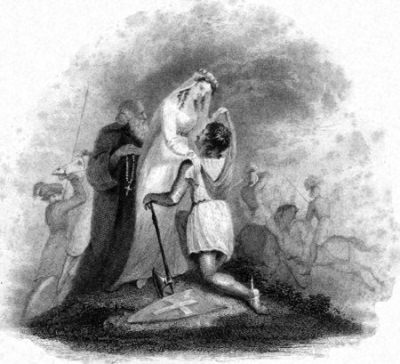
More full in its circumstances, and equally romantic in its character, is the following tale. About the year 1388, Sir Peter Courtenay, an English knight of approved valiancy, went to France in order to joust with the renowned Sir Guy of Tremouille. They ran one course with spears, and the king then stopped the martial game, saying that each had done enough. He made the stranger-knight fair presents, and set him on his way to Calais, under the care of the Lord of Clary, who is characterised by our old chivalric chronicler as a lusty and frisky knight. They rode together till they reached Lucen, where resided the Countess of St. Poule, sister of the King of England, and whose first husband had been a Lord of Courtenay. During the noble entertainment with which she greeted her guests, the Countess enquired of Sir Peter his opinion of France. He complimented the country in most of its forms, and praised the demeanour of the French chivalry, except in one thing, for he complained that none of their knights would do any deed of arms with him, although he had with great trouble and cost left England to encounter them. The Lord of Clary heard with pain the knights of his country reviled, in the presence of the sister of the King of England; but he restrained his feelings, because Sir Peter was then under his protection.
The next day they took their leave of the Countess, who, like a noble lady, threw a chain of gold round the neck of each. They proceeded to Calais, and when they reached the frontier, and Sir Peter stepped on the English territory, the Lord of Clary reminded him of the language he had used at the board of the Countess St. Poule, regarding the French chivalry, and added, that such an opinion was not courteous nor honorable, and that simple knight as he was he would do his devoir to answer him, saying, however, that he was influenced not by any hatred to his person, but the desire of maintaining the honor of French knighthood.
Accordingly they jousted in the marshes of Calais, in the presence of noble cavaliers and squires of the two nations. In the second course the lance of Lord Clary pierced the shoulder of Sir Peter, and the wounded knight was led to the neighbouring town. The Lord of Clary returned to Paris, proud that he had vindicated the chivalric honor of his country, and expecting praise. But when it was reported that a strange knight, travelling under the royal safeguard, had been required to do a deed of arms, the king and his council felt alarmed, lest the honor of their nation had received a stain. It was also thought that the joust had been intentionally a mortal one, a matter which aggravated the offence. The Lord of Clary was summoned before them, and interrogated how he had presumed to be so outrageous, as to hold a joust to the utterance with a knight-stranger that had come to the king’s court for good love and to exalt his honor, to do feats of arms, and had departed thence with good love and joy, and to the intent that he should not be troubled in his return, he had been delivered to his charge.
The Lord of Clary, in reply, simply related his tale, and instead of deprecating the anger of his liege lord, he claimed reward for his vindication of the French chivalry. He said he would abide the judgment of the constable and the high marshal of France, the knights and squires of honor in every land; and so highly did he esteem the chivalry of that noble knight himself, Sir Peter Courtenay, that he would appeal to his voice and discretion.
Notwithstanding this defence, the Lord of Clary was committed to prison, nor was he delivered thence till after a long time, when the entreaties of the Countess of St. Poule, the Lord of Bourbon, the Lord of Coucy, and other nobles, prevailed with the king. He was dismissed with this reproof and exhortation: “Sir of Clary, you supposed that you had done right well, howbeit you acted shamefully, when you offered to do arms with Sir Peter Courtenay, who was under the king’s safeguard, and delivered to you to conduct to Calais. You did a great outrage when you renewed the words, which were spoken only in sport before the Countess of St. Poule. Before you had so renewed them, you ought to have returned to the king, and then what counsel the king had given, you should have followed; because you did not this, you have suffered pain. Beware better another time, and thank the Lord of Bourbon and the Lord of Coucy for your deliverance, for they earnestly solicited for you, and also thank the Lady of St. Poule.”[175]
The virtue of liberality seems to have been a striking feature of the chivalric character. It proceeded from that loftiness of spirit which felt that avarice would have debased a heroism that should contend for crowns and kingdoms. The minstrels of the times, who kept alive the flame of chivalry, encouraged this virtue above all others, for upon it depended their own subsistence. But it often sprang from better motives than pride or vanity. The good Lord de Foix gave every day five florins, in small money, at his gate, to poor folks, for the love of God; and he was liberal and courteous in his gifts to others; for he had certain coffers in his chambers, out of which he would oft-times take money to give to lords, knights, and squires, such as came to him, and none departed from him without a gift.[176] A knight, indeed, was taught to consider nothing his own, save his horse and arms, which he ought to keep as his means of acquiring honour, by using them in the defence of his religion and country, and of those who were unable to defend themselves.[177]
The valiancy of chivalry was beautifully chastened by humility;
“And of his port as meek as is a maid.”
Every hero, as well as Chaucer’s knight, demeaned himself in all things as if he had been in the hands of God, and in his name used his arms, without vaunting or praising himself; for praise was regarded as blame in the mouth of him who commended his own actions. It was thought that if the squire had vain-glory of his arms, he was not worthy to be a knight, for vain-glory was a vice which destroyed the merits and the claims of chivalry.
The heroes of the Round Table were the mirror of all Christian knights; and the generous modesty of Sir Lancelot was reflected in the conduct of many a true soldier of chivalry. In the lofty fancies of romantic Europe that valiant friend of Arthur was the prowest of all the heroes of Britain; yet he always gave place to Sir Tristram, and often retired from the field of tournament when that noble son of arms was performing his devoir. Even when he was entitled to the prize, Sir Lancelot would not receive it, maugre the offering of king, queen, and knights; but when the cry was great through the field, “Sir Lancelot, Sir Lancelot hath won the field, this day!” that noble subject of praise cried, on the contrary, “Sir Tristram hath won the field; for he began first, and endured last, and so hath he done the first day, the second, and the third day.”[178]
The catalogue of knightly virtues is not yet complete; and nothing can be more beautiful to the moral eye than some of the characteristics of the ancient chivalry. Kindness and gentleness of manner, which, when adopted by kings from knightly customs, were called courtesy, were peculiar to the soldier of the middle ages, and pleasingly distinguished him from the savage sternness of other warriors, whether Roman or barbarian. Courtesy was the appearance, in the ordinary circumstances of life, of that principle of protection which, in weightier matters, made the sword leap from its scabbard; and, like every other blessing of modern times, it had its origin in the Christian religion. The world thought that courtesy and chivalry accorded together, and that villainous and foul words were contrary to an order which was founded on piety.[179] Whether historians or fabulists speak of a true knight, he is always called gentle and courteous. To be debonnaire was as necessary as to be bold;
“Preux chevalier n’en doutez pas,
Doit ferir hault et parler bas.”[180]
The following anecdote curiously marks the manners of chivalric ages with relation to the quality of courtesy:—The wife and sister of Du Guesclin were once living in a castle which was attacked and taken by a force of Normans and Englishmen. The success was great and important; but public indignation was excited against the invaders, because they had transgressed the licence of war, and been guilty of the uncourteous action of surprizing and disturbing ladies while they were asleep.[181]
Falconry.
These military and moral qualities of knighthood were sustained and nourished by all the circumstances of chivalric life, even those of a peaceful nature. Hunting and falconry, the amusements of the cavalier, were images of war, and he threw over them a grace beyond the power of mere baronial rank. Dames and maidens accompanied him to the sport of hawking, when the merry bugles sounded to field; and it was the pleasing care of every gallant knight to attend on his damsel, and on her bird which was so gallantly bedight; to let the falcon loose at the proper moment, to animate it by his cries, to take from its talons the prey it had seized, to return with it triumphantly to his lady, and, placing the hood on its eyes, to set it again on her hand. Every true knight could say, like the cavalier in Spenser,
“Ne is there hawk which mantleth her on perch,
Whether high towering or accosting low,
But I the measure of her flight do search,
And all her prey and all her diet know.”
These amusements of every-day life were always mingling themselves with the humanities of war. Edward III., when in France, in the year 1359, was attended by sixty couple of dogs, and by thirty falconers, on horseback, carrying birds. Various barons in the army had their dogs and birds with them, like the king. During the reign of Richard II., when the Duke of Lancaster was in France and Spain, many ladies accompanied the army, for the objects of the expedition were not altogether military; pleasure was as much the occupation as affairs of moment, and for the space of a month or more the Duke lay at Cologne, and removed not, except it were hunting or hawking; for the Duke and other lords of England had brought with them hawks and hounds for their own sport, and sparrow-hawks for the ladies.[182]
To play the game of chess, to hear the minstrel’s lays, and read romances, were the principal amusements of the knight when the season and the weather did not permit hawking and hunting. A true knight was a chess-player, and the game was played in every country of chivalry; for as the chivalric states of midland Europe obtained a knowledge of it from the Scandinavians, so the southern states acquired it from the Arabs.
“When they had dined, as I you say,
Lords and ladies went to play;
Some to tables, and some to chess,
With other games more and less.”[183]
The fondness of our ancestors for the game of chess appears by the frequent mention of the amusement in the ancient romances. Sometimes a lover procured admittance to the place where his mistress was confined, by permitting the jailor to win from him a game at chess. Again, the minstrels in the baronial hall, spread over their subject all the riches of their imagination. They were wont to fancy the enchanted castle of a beautiful fairy, who challenged a noble knight to play with her at chess. Flags of white and black marble formed the chequer, and the pieces consisted of massive statues of gold and silver, which moved at the touch of a magic wand held by the player. Such fables show the state of manners: but a curious story remains on historical record, which displays the practical consequences of chess-playing. During part of the reign of our Edward III. the town and castle of Evreux were French. A noble knight of the neighbourhood, named Sir William Graville, who was secretly attached to the English side, thought he could win the place, and he formed his scheme on his knowledge of the governor’s character. He first gained some friends among the burgesses, who were not very strongly attached to the French cause. As he had not declared himself the friend of either party, he was permitted to walk in whatever quarters of the city he chose, and one day he loitered before the gate of the castle till he attracted the attention of the governor. They saluted each other, and conversed awhile on the topics of the season. Sir William found his auditor credulous to every tale, till, when he had told one of wondrous improbability, the governor demanded his authority. “Sir,” replied the knight of Graville, “a cavalier of Flanders wrote this to me on the pledge of his honour, and sent with the letter the goodliest chess-men I ever saw.”
The governor dropped all care for the story at the mention of chess-men, and he anxiously desired to see them.
“I will send for them,” said Sir William, “on condition that you will play a game with me for the wine.”
The governor assented, and Sir William desired his squire to fetch the chess-men and bring them to the gate.
The two knights then passed through two wickets into the castle yard; and while the stranger was viewing the edifice, his faithful squire ran at speed to the burgesses’ houses, and summoned them to arms. They soon donned their harness and repaired with him to the castle gate, where, agreeably to a concerted scheme, he sounded a horn.
When Sir William heard it, he said to the governor, “Let us go out of the second gate, for the chess-men are arrived.” Sir William passed the wicket, and remained without. In following him the governor stooped and put out his head. Sir William drew a small battle-axe from under his cloak, and therewith smote to death his defenceless foe. He then opened the first gate, the burgesses entered in numerous and gallant array, and incontinently the castle was taken.[184]
The minstrel’s lay, the poetry of the troubadour, the romance of the learned clerk, all spoke of war and love, of the duties and sports of chivalry. Every baronial knight had his gay troop of minstrels that accompanied him to the field, and afterwards chaunted in his hall, whether in their own or another’s verse, the martial deeds which had renowned his house. A branch of the minstrelsy art consisted of reciting tales; and such persons as practised it were called jesters.
“I warn you first at the beginning,
That I will make no vain carping
Of deeds of arms nor of amours
As do minstrelles and jestours,
That make carping in many a place
Of Octoviane and Isembrase,
And of many other jestes,
And namely when they come to festes;
Nor of the life of Bevis of Hampton,
That was a knight of great renown;
Nor of Sir Guy of Warwick,
All if it might some men like.”[185]
Minstrels played on various musical instruments during dinner, and chaunted or recited their verses and tales afterwards both in the hall, and in the chamber to which the barons and knights retired for amusement.
“Before the king he set him down,
And took his harp of merry soun,
And, as he full well can,
Many merry notes he began.
The king beheld, and sat full still,
To hear his harping he had good will.
When he left off his harping,
To him said that rich king,
Minstrel, me liketh well thy glee,
What thing that thou ask of me
Largely I will thee pay;
Therefore ask now and asay.”[186]
A minstrel’s lay generally accompanied the wine and spices which concluded the entertainment.[187] Kings and queens had their trains of songsters, and partly from humour and partly from contempt, the head of the band was called king of the minstrels.[188] But men of the first quality, particularly the younger sons and brothers of great houses, followed the profession of minstrelsy, and no wonder, if it be true that they gained the guerdon without having encountered the dangers of war; for many a doughty knight complained that the smiles for which he had perilled himself in the battle field were bestowed upon some idle son of peace at home. The person of a minstrel was sacred, and base and barbarian the man would have been accounted, who did not venerate him that sang the heroic and the tender lay, the magic strains of chivalry, and could shed a romantic lustre over fierce wars and faithful loves.
“In days of yore how fortunately fared
The minstrel! wandering on from hall to hall,
Baronial court or royal; cheered with gifts
Munificent, and love, and ladies’ praise:
Now meeting on his road an armed knight,
Now resting with a pilgrim by the side
Of a clear brook: beneath an abbey’s roof
One evening sumptuously lodg’d; the next
Humbly, in a religious hospital;
Or with some merry outlaws of the wood;
Or haply shrouded in a hermit’s cell.
Him, sleeping or awake, the robber spared;
He walk’d—protected from the sword of war
By virtue of that sacred instrument
His harp, suspended at the traveller’s side;
His dear companion wheresoe’er he went,
Opening from land to land an easy way
By melody, and by the charm of verse.”[189]
Every page of early European history attests the sacred consideration of the minstrel, and the romances are full of stories, which at least our imagination can credit, of many a knight telling his soft tale in the dress of a love-singing poet. That dress had another claim to respect, for it was fashioned like a sacerdotal robe, as we learn from the story of two itinerant priests gaining admittance to a monastery, on the supposition of their being minstrels; but as soon as the fraud was discovered the poor ecclesiastics were beaten and driven from the monastery by their happier brethren.[190] The minstrel also was often arrayed in a dress of splendour, given to him by a baron in a moment of joyous generosity. The Earl of Foix, after a great festival, gave to heralds and minstrels the sum of five hundred franks; and he gave to the minstrels of his guest, the Duke of Tourrain, gowns of cloth of gold, furred with ermine, valued at two hundred franks.[191]
There were other classes of poets in days of chivalry, who, under the names of troubadours, trouveurs, and minnesingers, were spread over all chivalric countries, and sang the qualities by which a knight could render himself agreeable to his mistress. The board of a baron was sometimes enlivened by a tenson, or dialogue in verse, on the comparative merits of love and war; and the argument was often supported by warmer feelings than those which could influence a hireling rhymer, for the harp of the troubadour was borne by kings, and lords, and knights. The romances, or poems longer than the minstrels’ or troubadour lay, were also faithful ministers of chivalry. All their heroes were advocates of the church, and enemies of the Saracens and pagans. The perilous adventures of the Gothic knights, their high honor, tender gallantry, and solemn superstition were all recorded in romances[192], and there was not a bay window in a baronial hall without its chivalric volume, with which knights and squires drove away the lazy hours of peace.
The fictitious tales of Arthur and Charlemagne were the study and amusement of the warrior in his moments of ease, and even the few relics of classical literature, which, after the Gothic storm, were cast on the shores of modern Europe, were fashioned anew by chivalry. The heroes of Troy were converted into knights, and Troilus and Cressida moved like a warrior and damsel of chivalric times. Indeed, as the tale of Troy Divine was occasioned by a lady, it blended very readily with the established fictions of the times. And the romancers, like the minstrels and troubadours, were highly favoured by the great, who knew that their actions, unless recorded by clerc, could have no duration, and therefore they often made handsome presents to authors in order to have their names recorded in never-dying histories.[193]
The conversation of knights, like their lives and literature, related only to love and war.
“Then were the tables taken all away,
And every knight, and every gentle squire,
Gan choose his dame with basciomani[194] gay,
With whom he meant to make his sport and play,
******
Some fell to dance; some fell to hazardry;
Some to make love; some to make merriment.”
Every knight was welcome at another knight’s castle, if it were only for the intelligence he could communicate regarding the deeds of arms that had been done in the countries which he had visited; and the great charm of the castle of the Earl of Foix, to the imagination of Froissart, was the goodly company of knights and squires of honor, pages and damsels, that he met in the hall, chamber, and court, going up and down, and talking of arms and amours.[195]
“After meat they went to play,
All the people, as I you say;
Some to chamber, and some to bower,
And some to the high tower,
And some in the hall stode,
And spake what them thought gode;
Men that were of that cytè,
Enquired of men of other contrè.”[196]
Knights were wont, at these entertainments, to repose on couches, or sit on benches. The guests were placed two by two, and only one plate was allotted to each pair; for to eat on the same trencher or plate with any one was considered the strongest mark of friendship or love.[197] Peacocks and pheasants were the peculiar food of knights on great and festival occasions; they were said to be the nutriment of lovers, and the viand of worthies. The peacock was as much esteemed in chivalric as in classic times; and as Jupiter clothed himself with a robe made of that bird’s feathers, so Pope Paul, sending to King Pepin a sword, in sign of true regard, accompanied it with a mantle ornamented with a peacock’s plumes. The highest honours were conferred on these birds; for knights associated them with all their ideas of fame, and vowed by the peacock, as well as by the ladies, to perform their highest enterprises. A graceful splendour often characterised the circumstances in which the vow of the pheasant or peacock was made.
On a day of public festival, and between the courses of the repast, a troop of ladies brought into the assembly a peacock, or a pheasant, roasted in its feathers, in a golden or silver dish.[198] The hall was adorned with scenes, and wooden or other semblances of men, animals, or nature, all being expressive of the object for which the vow of the peacock was to be taken. If the promotion of religious wars was in view, a matron, clad in habiliments of woe, entered the room, and, approaching the dais, or lofty seat, which the chief lords and knights surrounded, she recited a long complaint, in verse, on the evils she suffered under the yoke of infidels, and complained of the tardiness of Europe in attempting her deliverance. Some knights then advanced, to the sound of solemn minstrelsy, to the lord of the castle, and presented two ladies, who bore between them the noble bird, in its splendid dish. In a brief speech the ladies recommended themselves to his protection. The lord promised to make war upon the infidels, and sanctioned his resolution by appealing to God and the Virgin Mary, the ladies and the peacock. All the knights who were in the hall drew their swords and repeated the vow; and, while bright falchions and ladies’ eyes illumined the scene, each knight, inflamed by thoughts of war and love, added some new difficulty to the enterprise, or bound himself, by grievous penalties, to achieve it. Sometimes a knight vowed that he would be the first to enter the enemy’s territory. Others vowed that they would not sleep in beds, nor eat off a cloth, nor drink wine, till they had been delivered of their emprise. The dish was then placed upon the table, and the lord of the festival deputed some renowned knight to carve it in such a manner that every guest might taste the bird. While he was exercising his talents of carving and subdivision, a lady, dressed in white, came to thank the assembly, presenting twelve damsels, each conducted by a cavalier. These twelve represented, by emblematical dresses, Faith, Charity, Justice, Reason, Prudence, Temperance, Strength, Generosity, Mercy, Diligence, Hope, and Courage. This bevy of bright damsels trooped round the hall, amidst the applauses of the assembly, and then the repast proceeded.[199]
These were the military, the religious, and the social qualities of a preux chevalier. The gentler feelings of his heart will be best delineated in the next chapter; and, as we have seen him adventurous and imaginative, so we shall find him amorous and true.[200]
CHAP. V.
DAMES AND DAMSELS, AND LADY-LOVE.
Courtesy ... Education ... Music ... Graver Sciences ... Dress ... Knowledge of Medicine ... Every-day Life of the Maiden ... Chivalric Love ... The Idolatry of the Knight’s Passion ... Bravery inspired by Love ... Character of Woman in the Eyes of a Knight ... Peculiar Nature of his Love ... Qualities of Knights admired by Women ... A Tale of chivalric Love ... Constancy ... Absence of Jealousy ... Knights asserted by Arms their Mistress’s Beauty ... Penitents of Love ... Other Peculiarities of chivalric Love ... The Passion universal ... Story of Aristotle ... Chivalric Love the Foe to feudal Distinctions ... But preserved Religion ... When Attachments were formed ... Societies of Knights for the Defence of Ladies ... Knights of the Lady in the Green Field ... Customs in England ... Unchivalric to take Women Prisoners ... Morals of chivalric Times ... Heroines of Chivalry ... Queen Philippa ... The Countess of March ... Tales of Jane of Mountfort and of Marzia degl’ Ubaldini ... Nobleness of the chivalric Female Character.
If we fancy the knight of chivalry as valiant, noble-minded, and gentle, our imagination pictures to our minds the lady of his love in colours equally fair and pleasing. But we must not lose her individuality in general expressions of admiration, for she had a distinct and peculiar character, which from the circumstances of her life can be accurately traced. The maiden of gentle birth was, like her brother, educated in the castle of some knight or baron, her father’s friend, and many of her duties were those of personal attendance. As the young candidate for chivalric honours carved at table, handed the wines, and made the beds of his lord, so his sister’s care was to dress her lady, to contribute by music and conversation to her amusement, and to form a part of her state retinue[201]: and while there was no loss of dignity in this description of service, the practice being universal and of immemorial antiquity, feelings of humility insensibly entered the mind, and a kind consideration for those of harder fortunes softened the severity of feudal pride. Thus a condescending deportment to inferiors was a duty which their moral instructors enforced. It was represented to them by the pleasing image of the sparrow-hawk, which, when called in gentle accents, would come and settle on her hand, but if, instead of being courteous, she were rude and cruel, he would remain on the rock’s pinnacle heedless of her calls. Courtesy from persons of superior consideration was the fair right of people of gentle birth though of small estate, for gentility was always to be respected, and to the poor man or woman it ought to be shown, because it gives pleasure to them, and reflects honour on those who bestowed it. A lady once in company of knights and ladies took off her hood and humbled herself courteously unto a mechanic. One of her friends exclaimed in astonishment, “Why, noble dame, you have taken off your hood to a tailor.”—“Yes,” she replied, “and I would rather have doffed it to him than to a gentleman:” and her courteous friends reputed that she had done right well.[202]
Music.
The mental education of women of those days was not of a very high polish. To repeat the prayers of the church, to sing the brief piece of poetry called the lai, or the longer romaunt were the only tasks on the intellect.
“The king had a daughter dear,
That maiden Ysonde hight;
That glee was lef to hear
And romance to read aright.”[203]
The ladies also played upon the harp.
“They were wont to harp and syng,
And be the merriest in chamber comyng.”[204]
The same particular of ancient manners is recorded by another poet:
“The lady that was so fair and bright,
Upon the bed she sat down right,
The harpers notes sweet and fine,
Her maids filled a price of wine.
And Sir Degore sat him down,
For to hear the harper’s sown.”[205]
But sometimes the graver sciences were introduced into female education, and Felice, the daughter of Rohand, Earl of Warwick, was not without parallels.
“Gentle she was, and as demure
As ger-fauk, or falcon to lure,
That out of mew were y-drawe.
So fair was none, in sooth sawe.
She was thereto courteous, and free and wise,
And in the seven arts learned withouten miss.
Her masters were thither come
Out of Thoulouse all and some,
White and hoar all they were;
Busy they were that maiden to lere;
And they her lered of astronomy,
Of armsmetrick, and of geometry;
Of sophistry she was also witty,
Of rhetorick, and of other clergy:
Learned she was in musick;
Of clergy was her none like.”[206]
Maidens were taught that a mild dignity of demeanour beseemed them, and moralising their duty into a thousand similies, their teachers declared that they ought not to resemble the tortoise or the crane, which turn the visage and the head above their shoulders, and winde their head like a vane; but their regard and manner ought to be steadfast, in imitation of the beautiful hare, which always looks right on. If an occasion required a damsel to look aside, she ought to turn the visage and body together, and so her estate would be more firm and sure; for it was unmaidenly lightly to cast about her sight and head, and turn her face here and there.[207]
Simplicity of dress was another part of instruction: but there was to be no lack of jewels of price and other splendid ornaments on festive occasions, and, consistently with the general magnificence of religious worship of the age, maidens were commanded to wear their gorgeous robes at church, and not merely at courtly festivals. There was a gravity about chivalry which accorded well with the recommendation for women not quickly to adopt new dresses introduced from strange countries. Modesty of attire was the theme of many a wise discourse, and every castle had its story of the daughter of a knight who lost her marriage by displaying too conspicuously the graces of her figure, and that the cavalier who was her intended suitor preferred her sister who had modesty, though not beauty, for her dower.[208]
All the domestic œconomy of the baronial mansion was arranged by these young maidens: and the consideration which this power gave them was not a little heightened by their sharing with the monks in the knowledge which the age possessed of vulnerary medicaments. This attribute of skill over the powers of nature was a clear deduction from that sublime, prophetic, and mysterious character of women in the ages which preceded the times both of feudalism and chivalry. The healing art was not reduced to an elaborate system of principles and rules, for memory to store and talent to apply, but it was thought that the professors of medicine enjoyed a holy intercourse with worlds unknown to common minds. The possession of more than mortal knowledge was readily ascribed to a pure, unearthly being like woman, and the knight who felt to his heart of hearts the charm of her beauty was not slow in believing that she could fascinate the very elements of nature to aid him. There are innumerable passages in the various works which reflect the manners of chivalric times on the medicinal practice of dames and damsels. A pleasing passage of Spenser illustrates their affectionate tendance of the sick.
“Where many grooms and squires ready were
To take him from his steed full tenderly;
And eke the fairest Alma met him there
With balm and wine and costly spicery,
To comfort him in his infirmity.
Eftesoones she caus’d him up to be conveyed,
And of his arms despoiled easily:
In sumptuous bed she made him to be laid,
And, all the while his wounds were dressing, by him stay’d.”[209]
Chirurgical knowledge was also a necessary feminine accomplishment, and we will accept the reason of the cavalier with “high thoughts, seated in a heart of courtesy,” for such a remarkable feature in their character. “The art of surgery,” says Sir Philip Sidney, “was much esteemed, because it served to virtuous courage, which even ladies would, even with the contempt of cowards, seem to cherish.”[210] A fair maiden could perform as many wonderful cures as the most renowned and skilful leech. The gentle Nicolette successfully treated an accident which her knight Aucassin met with.
“So prosper’d the sweet lass, her strength alone
Thrust deftly back the dislocated bone;
Then, culling curious herbs of virtue tried,
While her white smock the needful bands supplied:
With many a coil the limb she swath’d around,
And nature’s strength return’d, nor knew its former wound.”
Spenser favours us with the ladies’ method of treating a wound.
“Mekely she bowed down, to weete if life
Yet in his frozen members did remain;
And, feeling by his pulses beating rife
That the weak soul her seat did yet retain,
She cast to comfort him with busy pain:
His double-folded neck she reared upright,
And rubb’d his temples and each trembling vein;
His mailed haberieon she did undight,
And from his head his heavy burganet did light.
Into the woods thenceforth in haste she went,
To seek for herbs that mote him remedy;
For she of herbes had great intendiment,
Taught of the nymph from whom her infancy
Her nourced had in true nobility.
******
The soveraine weede betwixt two marbles plain,
She powder’d small, and in pieces bruize;
And then atweene her lily handes twain
Into his wound ye juice thereof did scruze;
And round about, as she could well it use,
The flesh therewith she suppled and did steepe
T’abate all spasm and soke the swelling bruise;
And, after having search’t the intuse deep,
She with her scarf did bind the wound, from cold to keep.”[211]
The every-day life of a young maiden in chivalric times is described with a great deal of spirit in the fine old English tale, of the Squire of Low Degree. I am not acquainted with any other passage of the metrical romances which contains so vivid a picture of the usages of our ancestors. To dissipate his daughter’s melancholy for the loss of her lover, the King of Hungary says,
“To-morrow ye shall on hunting fare,
And ride, my daughter, in a chair,[212]
It shall be covered with velvet red,
And cloths of fine gold all about your head;
With damask white and azure blue
Well diapered with lilies new.
Your pomelles shall be ended with gold,
Your chains enameled many a fold;
Your mantle of rich degree,
Purple pall and ermine fre.
Jennets of Spain that be so white
Trapped to the ground with velvet bright.
Ye shall have harp, sawtry, and song,
And other myrthes you among;
Ye shall have Rumney and Malmesyne,
Both ypocrass and vernage wine,
Mount rose and wine of Greek,
Both algrade and despice eke;
Antioch and bastard,
Piment also and gamarde;
Wine of Greek and muscadell,
Both clare piment and rochell,[213]
The red your stomach to defy,
And pots of osey set you by.
You shall have venison ybake,[214]
The best wild fowl that may be take.
A lese of greyhounds with you to strike,
And hart and hind and other lyke,
Ye shall be set at such a tryst[215]
That hart and hind shall come to your fist.
Your disease to drive you fro,
To hear the bugles there yblowe.
Homeward thus shall ye ride,
On hawking by the river’s side,
With goss hawk and with gentle falcon,
With egle-horn, and merlyon.[216]
When you come home your men among,
Ye shall have revel dance and song,
Little children great and small
Shall sing as doth the nightingale.
Then shall ye go to your even song,
With tenors and trebles among,
Threescore of ropes of damask bright
Full of pearls they shall be pight,[217]
Your censers shall be of gold
Indent with azure many a fold:
Your choir nor organ song shall want
With counter note and discant.
The other half on organs playing,
With young children full fair singing.
Then shall ye go to your supper,
And sit in tents in green arbour,
With cloth of arras pight to the ground,
With saphires set and diamond.
The nightingale sitting on a thorn
Shall sing you notes both even and morn.
An hundred knights truly told,
Shall play with bowls in alleys cold,
Your disease to drive away,
To see the fishes in pools play.
And then walk in arbour up and down,
To see the flowers of great renown.
To a draw-bridge then shall ye,
The one half of stone, the other of tree;
A barge shall meet you, full right,
With twenty-four oars full bright,
With trumpets and with clarion,
The fresh water to row up and down.
*****
Into your chamber they shall you bring
With much mirth and more liking.
Your blankets shall be of fustain,
Your sheets shall be of cloths of Rayne;[218]
Your head sheet shall be of pery pyght,[219]
With diamonds set and ruby bright.
When you are laid in bed so soft,
A cage of gold shall hang aloft,
With long pepper fair burning,
And cloves that be sweet smelling,
Frankinsence and olibanum,[220]
That when you sleep the taste may come,
And if ye no rest can make,
All night minstrels for you shall wake.”