
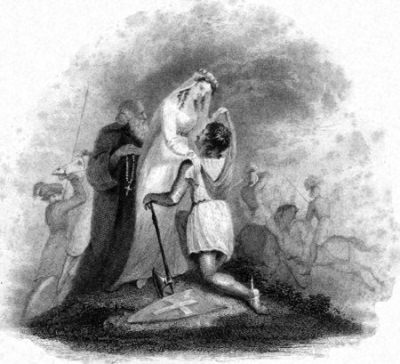
Perhaps the most interesting joust in the middle ages was that which was held between Lord Scales, brother of the Queen of Edward the Fourth, and the Bastard of Burgundy. Many of the circumstances which attended it are truly chivalric.[339]
On the 17th of April, 1465, the Queen and some ladies of her court, in a mood of harmless merriment, attached a collar of gold, enamelled with the rich floure of souvenance[340], to the thigh of that right worshipful and amorous knight, Anthony Woodville, Lord Scales, for an emprise of arms on horseback and on foot.[341] The most renowned cavalier at that time was the Bastard of Burgundy, and accordingly Lord Scales addressed him in courteous wise, praising his prowess, and vowing before God and the ladies that his own great desire was to rival his fame. In order, then, that there might exist that love and fraternity between them which became knights of worship, he related the goodly adventure at the court of England, and requiring the Bastard, in all affection for the honour of chivalry, to do him so much favour as to discharge him of his bond. The Earl of Worcester, Lord High Constable of England, certified the fact of the delivery of the floure of souvenance to the Lord Scales, and the King’s permission for his herald to cross the seas to Burgundy.
The Bastard received the letter on the last day of April, and with permission of his father, the Duke of Burgundy, he consented to assist the Lord Scales in accomplishing his emprise. Lord Scales and the court of England were right joyous and grateful at the news, and Edward granted a safe-conduct to the adventurous Burgundian, the Earl of Roche, and a thousand persons in his company, to come into England, to perform certain feats of arms with his dearly beloved brother Anthony Woodville, Lord Scales, and Nucelles.[342]
The Bastard accordingly set sail for England, nobly accompanied by four hundred of his father’s prowest chivalry. By Edward’s command, Garter king-at-arms met him at Gravesend. The gallant squadron sailed towards London, and at Blackwall it was joined by the Earl of Worcester, attended by a noble troop of lords, knights, and squires, and also by many of the aldermen and rich citizens of London. The Lord of Burgundy landed at Billingsgate, and was welcomed by another party of the nobility and trades of England, (so general was the interest of the expected joust,) who conducted him on horseback through Cornhill and Cheap to the palace of the Bishop of Salisbury in Fleet Street, which royal courtesy had appointed for his abode. Lord Scales soon afterwards came to London, attended by the nobility and chivalry of his house, and the King assigned him the palace of the Bishop of Ely in Holborn for his residence. The noble stranger was introduced to Edward on his coming to London from Kingston, in order to open the parliament.
The ceremonies of the joust were then arranged by well experienced knights, and strong lists were erected in Smithfield, one hundred and twenty yards and ten feet long, eighty yards and ten feet broad, with fair and costly galleries around. On the morning appointed for the gallant show, the King and Queen with all the chivalry and beauty of the land, repaired to Smithfield. The King sat under a richly canopied throne, at one end of the lists; on each side were lords and ladies, and underneath him were ranged the knights, the squires, and the archers of his train. The city magistrates then appeared; the lord mayor bowing, and the mace-bearer lowering his sign of authority, as they passed the King in their procession to the other end of the lists, where scaffolds of similar form, but inferior magnificence to the royal chambers, were erected for them. The eight guards of the lists entered on horseback, and received their charge from the Earl Marshal and Lord High Constable of England, who gently paced their horses to and fro beneath the throne.
When every thing was fairly arranged, Lord Scales appeared at the gate of the lists. At the sound of his trumpet the Constable advanced and demanded his purpose. The young lord, with the grace and modesty of chivalry, replied, that he solicited the honor of presenting himself before his sovereign liege the King, in order to accomplish his arms against the Bastard of Burgundy. The gate was then thrown open by command of the Constable, and the Lord Scales entered the lists, followed by nine noblemen on horseback, bearing parts of his harness and arms, and nine pages riding on gaily caparisoned steeds. They advanced to the King, and after having made their obeisances, they retired to a pavilion at one end of the lists.
With similar forms the Lord of Burgundy, attended by the chosen chivalry of his country, approached the King, and then repaired to his tent.
The heralds commanded silence, and forbad any one, by the severest penalties, from intermeddling with the jousters. Two lances and two swords were taken to the King, who, being satisfied of their fitness, commanded the lords who bore them to take them to the combatants. The stranger-knight made his election, and dressed his lance to its rest. Lord Scales prepared himself with equal gallantry, and they dashed to the encounter. Their spears were sharp; but so perfect was their knowledge of chivalry, that no wounds were inflicted. The nicest judges could mark no difference of skill, and the noble knights jousted their courses, when the King dropped his warder, and the amusements ended.
The next day the court and city repaired to Smithfield, with their accustomed pomp, and the spectacle was varied by the jousters contending with swords. The sports were, however, untimely closed by the steed of Lord Scales with the spike of his chaffron overthrowing the Bastard of Burgundy and his horse; and the King would not allow the tourney to proceed, though the bruised knight gallantly asserted his wish not to fail his encounter companion.
Not wearied by two days’ amusement, the chivalry and beauty of England assembled in the lists of Smithfield on the third morning. The noblemen now fought on foot with pole-axes. At last the point of Lord Scales’s weapon entered the sight of the Burgundian’s helmet, and there was a feeling of fear through the galleries that a joust of peace would have a fatal termination. But before it could be seen whether Lord Scales meant to press his advantage, the King dropped his warder, and the Marshals separated them. The Bastard of Burgundy prayed for leave to continue his enterprise; and the Lord Scales consented. But the matter was debated by the assembled chivalry; and it was declared by the Earl of Worcester, then Constable of England, and the Duke of Norfolk the Marshal, that if the affair were to proceed, the knight of Burgundy must, by the law of arms, be delivered to his adversary in the same state and condition as he was in when they were separated. This sentence was a virtual prohibition of the continuance of the joust, and the Bastard therefore relinquished his challenge. The herald’s trumpet then sounded the well known point of chivalry that the sports were over; but as the times were joyous as well as martial, the knights and ladies before they parted held a noble festival at Mercer’s Hall.[343]
The feats of arms at St. Ingilbertes displayed the martial character of the joust; and the emprise of Lord Scales shows how beautifully love could blend itself with images of war, and the interest which a whole nation could take in the circumstance of certain fair ladies of a court binding round the thigh of a gallant knight a collar of gold, enamelled with a floure of souvenance.
But the high romantic feeling of chivalric times is, perhaps, still more strikingly displayed in the following tale. In the beginning of the year 1400, an esquire of Spain, named Michel d’Orris, being full of valour and love, attached a piece of iron to his leg, and vowed that he would endure the pain till he had won renown by deeds of chivalry. The prowess of the English knights most keenly excited his emulation; and, as his first measure to cope with it, he journeyed from Arragon to Paris. He then issued his defiance to the English chivalry at Calais, to perform exercises on foot with the battle-axe, the sword, and the dagger, and to run certain courses on horseback with the lance.
A noble soldier, hight Sir John Prendergast, a companion of Lord Somerset, governor of Calais, being equally desirous to gain honour and amusement, like a gentleman, to the utmost of his power, accepted the challenge in the name of God, of the blessed Virgin Mary, and of his lords Saint George and Saint Anthony. Like a true brother in chivalry, he expressed his wish to relieve the Arragonian esquire from the pain he was suffering; and, agreeably to the nobleness and modesty of his profession, he avowed his joy at the occasion of making acquaintance with some of the French nobility[344], and learning from them the honourable exercise of arms; and then, in a fine strain of gallantry, he concludes his acceptance of the challenge by praying that the Author of all good would grant the gentle esquire joy, honour, and pleasure, and every description of happiness to the lady of his affection, to whom Sir John Prendergast entreated that those letters might recommend him.
Political affairs recalled Orris to Arragon, and the English knight, not knowing that circumstance, wrote to him at Paris, pressing the performance of the emprise, reminding him how much his honour was concerned in the matter, and entreating Cupid, the god of love, as Orris might desire the affections of his lady, to urge him to hasten his journey.[345] No answer was returned to this heart-stirring epistle; and, after waiting several months, Prendergast again addressed Orris, expressing his astonishment that the challenge had not been prosecuted, and no reason rendered for the neglect by the valiant esquire. He was ignorant if the god of love, who had inspired him with courage to undertake the emprise, had since been displeased, and changed his ancient pleasures, which formerly consisted in urging on deeds of arms, and in promoting the delights of chivalry. He was wont to keep the nobles of his court under such good government, that, to add to their honor, after having undertaken any deeds of arms, they could not absent themselves from the country where such enterprise was to be performed, until it was perfectly accomplished. Anxious to preserve the favour of the god of love, and from respect to the ladies, Sir John Prendergast was still ready, with the aid of God, of Saint George, and Saint Anthony, to deliver him whom he still hoped was the servant of Cupid; and unless within a short time the emprise was accomplished, he intended to return to England, where he hoped that knights and esquires would bear witness that he had not misbehaved towards the god of love, to whom he recommended his own lady and the lady of Orris.[346]
The esquire returned to Paris, after he had finished his military duties in Arragon, still wearing the painful badge of iron. He found at Paris all the letters of Prendergast. His chivalric pride was wounded at the thought that the god of love had banished him from his court, and made him change his mind; and he informed his noble foe that assuredly, without any dissembling, he should never, in regard to the present emprise, change his mind, so long as God might preserve his life; nor had there ever been any of his family who had not always acted in such wise as became honest men and gentlemen.
Notwithstanding the appeal of Orris to the chivalry of Prendergast no deeds of arms were achieved. The delay of answers to his letters had offended the English knight, and some misunderstanding regarding the petty arrangements of the joust abruptly terminated the affair.[347]
A very favourite description of joust was that which was called a passage of arms. A knight and his companions proclaimed that they would on a certain day guard a particular road or bridge from all persons of cavaleresque rank, who attempted to pass.[348] Those who undertook such an emprise had their arms attached to pillars at the end of the lists with some plain shields of different colours, in which were marked the nature of the adventure, and the description of arms that were to be employed, so that he, who repaired to the passage, with the design of trying his skill, chose his mode of combat by touching one of the shields whereon it was specified. Officers at arms were in waiting to collect and register the names of such as touched the different shields, that they might be called out in the rotation of their first appearance.
In the spring of the year 1443, the Lord of Chargny, a noble knight of the court of Burgundy, made known to all princes, barons, cavaliers, and esquires without reproach, that, for the augmentation and extension of the most noble profession and exercise of arms, it was his will and intention, in conjunction with twelve knights, squires, and gentlemen, of four quarterings, whose names he mentioned, to guard and defend a pass d’armes, situated on the great road leading from Dijon toward Exonne, at the end of the causeway from the said town of Dijon, at a great tree called the Hermit’s Tree, or the Tree of Charlemagne. He proposed to suspend on the tree two shields, (one black, besprinkled with tears of gold, the other violet, having tears of sable,) and all those who by a king at arms or pursuivant should touch the first shield should be bounden to perform twelve courses on horseback, with him the Lord of Chargny, or one of his knights and squires, with blunted lances; and if either of the champions, during their twelve courses, should be unhorsed by a direct blow with the lance on his armour, such person so unhorsed should present to his adversary a diamond of whatever value he pleased. Those princes, barons, knights, and esquires, who should rather take their pleasure in performing feats of arms on foot, were to touch the violet shield, and should perform fifteen courses with battle-axes or swords, as might be most agreeable to them, and if during those courses any champion should touch the ground with his hand or knees he should be obliged to present to his adversary a ruby of whatever value he pleased.
The Lord of Chargny was a right modest as well as a valiant knight, for he besought all princes, barons, knights, and esquires, not to construe his intention as the result of pride and presumption, for he assured them that his sole motive was to exalt the noble profession of arms, and also to make acquaintance by chivalric deeds with such renowned and valiant princes and nobles as might be pleased to honor him with their presence.
For the forty days that followed the first of July, the passage of arms lasted, and right nobly did the Burgundian chivalry comport themselves. Their most skilful opponent was a valiant knight of Spain, hight Messire Pierre Vasque de Suavedra, with whom the Lord of Chargny jousted on horseback and on foot, and the nicest eye of criticism could not determine which was the doughtiest knight. At the conclusion of the jousts the cavaliers repaired to the church of our Lady at Dijon, and on their knees offered the shields to the Virgin.[349]
Such were the martial amusements and exercises of preux chevaliers. All the noble and graceful virtues of chivalry were reflected in the tournament and joust, and the warrior who had displayed them in the lists could not but feel their mild and beneficent influence even in the battle-field. He pricked on the plain with knightly grace as if his lady-mistress had been beholding him: skill and address insensibly softened the ferocity of the mere soldier, and he soon came to consider war itself only as a great tournament. Thus the tourneying lists were schools of chivalric virtue as well as of chivalric prowess, while the splendour and joyousness of the show brought all classes of society into kind and merry intercourse.
Through the long period of the middle ages tournaments were the elegant pastimes of Europe, and not of Europe only, but of Greece; and knighthood had its triumph over classical institutions when the games of chivalry were played in the circus of Constantinople. The Byzantines learnt them from the early Crusaders; and when the French and Venetians in the twelfth century became masters of the East, chivalric amusements were the common pastimes of the people, and continued so even when the Greeks recovered the throne of their ancestors; nor were they abolished until the Mussulmans captured Constantinople, and swept away every Christian and chivalric feature.[350]
In the West the tournament and joust survived chivalry itself, whose image they had reflected and brightened, for changes in the military art did not immediately affect manners; and the world long clung with fondness to those splendid and graceful shows which had thrown light and elegance over the warriors and dames of yore.
CHAP. VII.
THE RELIGIOUS AND MILITARY ORDERS OF KNIGHTHOOD.
General Principles of the Religious Orders ... Qualifications for them ... Use of these Orders to Palestine ... Modern History of the Knights Templars ... Their present Existence and State ... Religious Orders in Spain ... That of St. James ... Its Objects ... Change of its Objects ... Order of Calatrava ... Fine Chivalry of a Monk ... Fame of this Order ... Order of Alcantara ... Knights of the Lady of Mercy ... Knights of St. Michael ... Military Orders ... Imitations of the Religious Orders ... Instanced in the Order of the Garter ... Few of the present Orders are of Chivalric Origin ... Order of the Bath ... Dormant Orders ... Order of the Band ... Its singular Rules ... Its noble Enforcement of Chivalric Duties towards Woman ... Order of Bourbon ... Strange Titles of Orders ... Fabulous Orders ... The Round Table ... Sir Launcelot ... Sir Gawain ... Order of the Stocking ... Origin of the Phrase Blue Stocking.
Such were the institutions by which the character of the true knight was formed; and we might now resume our historical course did not a matter of considerable interest detain us, which, as it belongs to chivalry in general, and not entirely to any state in particular, can no where be treated with so much propriety as in this place.
It has been shown that from the union of religion and arms chivalry arose, and that the defence of the church and the promoting of its interests were among the chief objects of the new system of principles and manners. But knighthood had various duties to discharge, and the cavalier, who was sometimes distracted by their number, consecrated his life to the single purpose of upholding the cross of Christ. Thus orders called the Religious Orders of Knighthood were founded, and in imitation of them, fraternities, called Military Orders, appeared, all being ranged within the general pale of chivalry.
The religious orders, as might be expected, were sanctioned by papal authority. They were both martial and monastic in their general principles, but their internal conduct was entirely regulated by the discipline of the cloister; and, like the establishments of monks, they took some existing rule of a favourite saint as their guide. Theirs was a singular compound of the chivalric and the cloisteral characters,
“The fine vocation of the sword and lance
With the gross aims and body-bending toil
Of a poor brotherhood who walk the earth
Pitied.”[351]
Like the monks they were bound by the three great monastic vows of chastity, poverty, and obedience. The first of these matters needs no explanation[352]; the second meant a total oblivion of individuality, the community and not a peculiar possession of property; and by the third, the members were confined to obey the head of their order, to the exclusion of all other authority. These general principles of the religious societies of knighthood gave way, however, and fitted themselves to the occasions and demands of society, for like the chain-mail, which was flexible to all the motions of the body, the orders of chivalry have varied with every change of European life. Ascetic privations gave place to chivalric gallantry, the vow of chastity was mitigated into a vow of connubial fidelity; and when men of noble birth and high fortune became knights of the holy and valiant societies of Saint John, the Temple, or Saint James, the vow of poverty was dispensed with, or explained away to the satisfaction of conscientious scruples. In the fraternity of the Temple a knight was permitted to hold estates, so that at his death he bequeathed some portion of them to his order.[353]
In another very important respect the religious brotherhoods were moulded to the general frame of political society. Their independence of civil authority was given up, as the papal power declined, and kings refused admittance of the bulls of Rome into their states without their previous license. The knights of the religious fraternities became connected with the state by professing that their duties to God and their country were prior and paramount to the rules and statutes of the brotherhood; and they adopted this form of phrase rather to prevent the suggestions of malice than from any existing necessity, for they contended that the obligations of chivalry, instead of contravening the duty of a citizen, gave it strength, and dignity, and grace.[354]
In their origin all the military orders and most of the religious ones were entirely aristocratic; proofs of gentility of birth were scrupulously examined; and no soldier by the mere force of his valiancy could attain the honours of an order, though such a claim was allowed for his admission into the general fraternity of knighthood. These requisites for nobleness of birth kept pace with the political state of different countries, for the sovereigns of Europe and chivalry did not accord upon any particular form. Thus a French candidate for the knighthood of Saint John of Jerusalem must have shown four quarters of gentility on his coat-armour, but in the severer aristocracies of Spain and Germany no less than eight heraldic emblasonings were requisite. In Italy, however, where commerce checked the haughtiness of nobility, it was not expected that the pedigree should be so proud and full, and at length the old families conceded, and the new families were satisfied with the concession, that the sons of merchants should be at liberty to enter into the religious orders.
It would be tedious and unprofitable to detail the history of all these chivalric societies; and were I to repeat or abridge the usual books on the topic I should in many cases be only assisting to give currency to fraud, for the title, a religious order of knighthood, was often improperly bestowed on an establishment, while in truth it was only a fraternity of monks who maintained some soldiers in their pay: other associations obtained a papal sanction, but they were small and insignificant, and their history did not affect the general state of any country.
Not so, however, the noble fraternities of Saint John and the Temple[355], and next, though the intervening space of dignity was considerable, the Teutonic knights. These religious orders of chivalry by their principles and conduct are strongly marked in the political history of the world, for they formed the firm and unceasing bulwark of the Christian kingdom in Palestine during the middle ages. They were its regular militia, and maintained the Holy Land in the interval between the departure of one fleet of crusaders and the arrival of another. Generous emulation sometimes degenerated into envy, and the heats and feuds of the knights of Saint John and the Temple violated the peace of the country; but these dissensions were usually hushed when danger approached their charge, and the atabal of the Muselmans was seldom sounded in defiance on the frontier of the kingdom without the trumpets of the military orders in every preceptory and commandery receiving and echoing the challenge.
The valiancy of the Templars was particularly conspicuous in the moments of the kingdom’s final fate; for when the Christians of the Holy Land were reduced to the possession of Acre, and two hundred thousand Mameluke Tartars from Egypt were encamped round its walls, the defence of the city was entrusted to Peter de Beaujeau, Grand Master of the Templars. And well and chivalrously did he sustain his high and sacred charge. Acre fell, indeed, but not until this heroic representative of Christian chivalry and most of the noble followers of his standard had been slain. The memory of the Templars is embalmed in all our recollections of the beautiful romance of the middle ages, for the red cross knights were the last band of Europe’s host that contended for the possession of Palestine. A few survived the fall of Acre and retired to Sis in Armenia. They were driven to the island of Tortosa, whence they escaped to Cyprus, and the southern shore of the Mediterranean no longer rang with the cry of religious war.
The origin and peculiar nature of these three great religious orders have been detailed by me in another work, and also their history as far as it was connected with the crusades; but on one subject our present deductions may be carried further: for though the annals of the cavaliers of Saint John and also of the Teutonic knights are mixed with general European history, yet those of the Templars stand isolated. In the History of the Crusades, I described the circumstances of the iniquitous and sanguinary persecution of the brotherhood of the Temple, the consequent suspension of their functions[356], and the spoliation of all those possessions with which the respect of the world had enriched them.
But the persecution of the Templars in the fourteenth century does not close the history of the order, for though the knights were spoliated the order was not annihilated. In truth, the cavaliers were not guilty, the brotherhood was not suppressed, and, startling as is the assertion, there has been a succession of Knights Templars from the twelfth century down even to these days; the chain of transmission is perfect in all its links. Jacques de Molai, the Grand Master at the time of the persecution, anticipating his own martyrdom, appointed as his successor, in power and dignity, Johannes Marcus Larmenius of Jerusalem, and from that time to the present there has been a regular and uninterrupted line of grand masters. The charter by which the supreme authority has been transmitted is judicial and conclusive evidence of the order’s continued existence. This charter of transmission, with the signatures of the various chiefs of the Temple, is preserved at Paris, with the ancient statutes of the order, the rituals, the records, the seals, the standards, and other memorials of the early Templars. The brotherhood has been headed by the bravest cavaliers of France, by men who, jealous of the dignity of knighthood, would admit no corruption, no base copies of the orders of chivalry, and who thought that the shield of their nobility was enriched by the impress of the Templars’ red cross. Bertrand du Guesclin was the grand master from 1357 till his death in 1380, and he was the only French commander who prevailed over the chivalry of our Edward III. From 1478 to 1497, we may mark Robert Lenoncourt, a cavalier of one of the most ancient and valiant families of Lorraine. Philippe Chabot, a renowned captain in the reign of Francis I., wielded the staff of power from 1516 to To 1543. The illustrious family of Montmorency appear as Knights Templars, and Henry, the first duke, was the chief of the order from 1574 to 1614. At the close of the seventeenth century the grand master was James Henry de Duras, a marshal of France, the nephew of Turenne, and one of the most skilful soldiers of Louis XIV. The grand masters from 1734 to 1776 were three princes of the royal Bourbon family. The names and years of power of these royal personages who acknowledged the dignity of the order of the Temple were Louis Augustus Bourbon, Duke of Maine, 1724-1737; Louis Henry Bourbon Condé 1737-1741; and Louis Francis Bourbon Conty 1741-1746. The successor of these princes in the grand-mastership of the Temple was Louis Hercules Timoleon, Duke de Cossé Brissac, the descendant of an ancient family long celebrated in French history for its loyalty and gallant bearing. He accepted the office in 1776, and sustained it till he died in the cause of royalty at the beginning of the French Revolution. The order has now its grand master, Bernardus Raymundus Fabré Palaprat, and there are colleges in England and in many of the chief cities in Europe.
Thus the very ancient and sovereign order of the Temple is now in full and chivalric existence, like those orders of knighthood which were either formed in imitation of it, or had their origin in the same noble principles of chivalry. It has mourned as well as flourished; but there is in its nature and constitution a principle of vitality which has carried it through all the storms of fate. Its continuance, by representatives as well as by title, is as indisputable a fact as the existence of any other chivalric fraternity. The Templars of these days claim no titular rank, yet their station is so far identified with that of the other orders of knighthood, that they assert equal purity of descent from the same bright source of chivalry. Nor is it possible to impugn the legitimate claims to honorable estimation, which the modern brethren of the Temple derive from the antiquity and pristine lustre of their order, without at the same time shaking to its centre the whole venerable fabric of knightly honor.[357]
The Holy Land was not the only country which gave birth to the religious orders of knighthood. Several arose in Spain, and their arms were mainly instrumental in effecting the triumph of the Christian cause over that of the Moors. War with the usurpers was the pristine object of some of these societies, and in other cases it was based and pillared upon a foundation of charity. Perpetual enmity to the Arabian infidels was the motto of all. Unlike the Christian kings of Spain, the orders never relaxed in their hostility; they never mingled with the Moors in the delights of peace, and their character was formed by their own rules and principles, unaffected by the graceful softenings of oriental luxury and taste.
The most considerable of these Spanish religious orders of knighthood was that of Saint James, of Compostella, which sprang from the association of some knights and monks in the middle of the twelfth century, for the protection of the pilgrims who flocked from all countries to bow before the relics of the tutelar saint of Spain.[358] The monks were of the society of St. Eloy, a holy person of great fame among our English ancestors; for Chaucer’s demure prioress was wont to verify her assertions by appealing to his authority.
“Her greatest oath n’as but by St. Eloy.”
The monks and knights lived in friendly communion, the prior of the convent regulating the spiritual concerns, and a grand master, chosen by the cavaliers, leading the soldiers. They were taken under the protection of the papal see, on their professing the vows of chastity, poverty, and obedience; but afterwards Pope Alexander the Third sank the ascendancy of the monastic portion of their character, for he permitted an oath of connubial fidelity to be substituted for that of chastity. A descent of two degrees of gentle birth was required for admission into the order of Saint James, and the Christian blood must have been uncontaminated with any Jewish or Moorish mixture.
The guarding of the passages to the shrine of Saint James from the incursions of the Moors became extended into a general defence of the kingdom against the hostilities of those enemies of the Christian name; and in time their active military operations far exceeded their defensive wars in consequence and splendour. The simple object of their association being forgotten, their glories became associated with the earliest struggles of the Christians for the repossession of their inheritance; and they pretended to trace their line up to the ninth century, when Saint James himself, riding on a white horse, and bearing a banner marked with a red cross in his hand, assisted them to discomfit the Moors. A cross, finished like the blade of a sword, and the hilt crossleted, became the ensign of the order, and the order was then appropriately called La Orden de Santiago de la Espada. The centre of the crosslet was ornamented with an escalop-shell, the badge of Saint James; and nothing can more strongly mark the popularity of his shrine in the middle ages than the fact of the escalop-shell being the usual designation of an European palmer. The cross was worn on a white cross mantle, and was painted red, agreeably, as it might seem, to that on the banner already alluded to. But Don Rodrigo Ximines, an archbishop of Toledo, who dealt in allegories, observed the reason to be that the sword was red with the blood of the Arabs, and that the faith of the knights was burning with charity.
The grand master of the order of Saint James had precedence over the grand masters of other Spanish orders; but the internal government of the fraternity was in the hands of a council, whose decrees were obligatory, even on the grand master himself. The order of Saint James had two great commanderies, one in Leon and the other in Castile; and to them all other establishments were subordinate. There were perpetual disputes for precedency between these commanderies, and the kings of Castile and Leon fomented them, thus preventing an union which might be dangerous to the state itself, and obtaining military aid in return for occasional interference. The gratitude of sovereigns enriched the order with various possessions; but it was its own good swords that won for it the best part of its territories.
Notwithstanding that, like all other religious orders of knighthood, the order of Saint James had originally enjoyed independence of royal authority, yet in the course of time the kings of Castile acquired the right of delivering to every newly-elected grand master the standard of the order. The obedience was only titular till the beginning of the sixteenth century, when the Emperor Charles V. obtained from Popes Leo X. and Adrian VI. the supreme direction of all the affairs of the order, and, consequently, the dignity of grand master became attached to the crown. But the power of the king was not suffered to be absolute; for the popes compelled him to consent that the affairs of the order should be managed by a council, with a right of appeal to the pope himself. The power of the Spanish kings then became a species of influence, rather than of direct prerogative.
The object of the association, the expulsion of the Moors from Spain, being accomplished, this religious order became an order of merit,—a feather in the plume of Spanish dignity. It could be gained only by the nobility; for it then behoved every knight to prove the gentility of his descent, maternal and paternal, for four degrees. The old vows of poverty, obedience, and conjugal chastity were preserved, with a mental reservation regarding the two former.
In the year 1652, the knights of St. James as well as the knights of Calatrava and Alcantara, in the fervour of their zeal for what they called religion, added a vow to defend and maintain the doctrine of the immaculate conception of the Virgin Mary. The people of Madrid were invited to three churches to witness the taking of the vows by the knights. After the celebration of the mass a cavalier in the name of all his brothers pronounced the vow[359], and every one repeated it, placing his hand on the cross and the Gospels. And thus an order, which in its origin was charitable, in its progress patriotic, had the bright glories of its days of honor sullied by superstition.[360]
The next station in the dignity of rank was occupied by the knights of Calatrava, who, considering the circumstances of their origin, may be regarded as a more honourable fraternity than the brotherhood of St. James. About the year 1147, Alfonso King of Spain recovered from the Moors the fortress of Calatrava, which was the key of Toledo. The king committed it to the charge of the Knights Templars. That noble order of Christian soldiers was then in the very infancy of its career of honour, and so few were the red crosses in Spain, that they could not drive back the swelling tide of Muselman power. After retaining it for only eight years, the Templars resigned it into the hands of Don Sancho, successor of Alfonso, who endeavoured to secure for it defenders, by proposing to accord Calatrava and its lands in perpetual possession to such knights as would undertake the guarding of the fortress. The chivalry of Spain, remembering that the brave militia of the Temple had quailed before the Moors, hung back in caution and dismay; and Sancho already saw the fate of Calatrava sealed in Arabian subjection, when the cloisters of a convent rang with a cry of war which was unheard in the baronial hall.
The monastery of Santa Maria de Fetero in Navarre contained a monk named Diego Velasquez, who had spent the morning of his life in arms, but afterwards had changed the mailed frock for a monastic mantle, for in days of chivalry, when religion was the master spring of action, such conversions were easy and natural. The gloom of a convent was calculated only to repress the martial spirit; but yet the surrounding memorials of military greatness, the armed warrior in stone, the overhanging banner and gauntlet, while they proved the frail nature of earthly happiness, showed what were the subjects wherein men wished for fame beyond the grave. The pomp of the choir-service, the swelling note of exultation in which the victories of the Jews over the enemies of Heaven were sung, could not but excite the heart to admiration of chivalric renown, and in moments of enthusiasm many a monk cast his cowl aside, and changed his rosary for the belt of a knight.
And thus it was with Velasquez. His chivalric spirit was roused by the call of his king, and he lighted a flame of military ardor among his brethren. They implored the superior of the convent to accept the royal proffer; and the king, who was at first astonished at the apparent audacity of the wish, soon recollected that the defence of the fortress of Calatrava could not be achieved by the ordinary exertions of courage, and he then granted it to the Cistertian order, and principally to its station at Santa Maria de Fetero, in Navarre. And the fortress was wisely betowed; for not only did the bold spirits of the convents keep the Moors at bay in that quarter, but the valour of the friars caused many heroic knights of Spain to join them. To these banded monks and cavaliers the king gave the title of the Religious Fraternity of Calatrava, and Pope Alexander III. accepted their vows of poverty, obedience, and chastity. The new religious order of knighthood, like that of Saint James of Compostella, was a noble bulwark of the Christian kingdom.
Fame of this order.
Nothing could be more perfect than the simplicity of the knights of Calatrava. Their dress was formed from the coarsest woollen, and the edges were not like those of many a monk of the time, purfiled or ornamented with vair or gris, or other sorts of rich fur. Their diet, too, reproached the usual luxury of the monastery, for the fruits of the earth sustained them. They were silent in the oratory, and the refectory, one voice only reciting the prayers, or reading a legend of battle; but when the first note of the Moorish atabal was heard by the warder on the tower, the convent became a scene of universal uproar. The caparisoning of steeds, and the clashing of armour, broke the repose of the cloister, while the humble figure of the monk was raised into a bold and expanded form of dignity and power. Through all the mighty efforts of the Christians for the recovery of their throne, the firm and dense array of the knights of Calatrava never was tardy in appearing on the field; but the kingdom, as its power and splendour increased, overshadowed the soldiers of every religious order of chivalry. The grand mastership of the Calatrava fraternity became annexed to the thrones of Castile and Leon by the decree of Pope Innocent VIII., and the Kings of Spain kept alive the chivalry of their nation by using the crosses and other emblems of the ancient knighthood as signs of military merit.[361]