
The Project Gutenberg eBook of The History of the Devils of Loudun, Volumes I-III
Title: The History of the Devils of Loudun, Volumes I-III
Author: Des Niau
Translator: Edmund Goldsmid
Release date: March 31, 2014 [eBook #45282]
Most recently updated: October 24, 2024
Language: English
Credits: Produced by Chris Curnow, Eleni Christofaki and the Online
Distributed Proofreading Team at http://www.pgdp.net (This
file was produced from images generously made available
by The Internet Archive)
Transcriber's Note.
A list of the changes made can be found at the end of the book. In the text, the corrections are underlined by a red dotted line "like this". Hover the cursor over the underlined text and an explanation of the error should appear.
THE DEVILS OF LOUDUN.
[COLLECTANEA ADAMANTÆA.—XXI.]
THE HISTORY OF THE
Devils of Loudun,
The Alleged Possession of the Ursuline Nuns, and the Trial and Execution of Urbain Grandier,
TOLD BY AN EYE-WITNESS.
TRANSLATED FROM THE ORIGINAL FRENCH,
AND
Edited by
EDMUND GOLDSMID, F.R.H.S.,
F.S.A. (Scot.)
VOL. I.
PRIVATELY PRINTED.
EDINBURGH.
1887.
This Edition is limited to 275 small-paper and 75 large-paper copies.
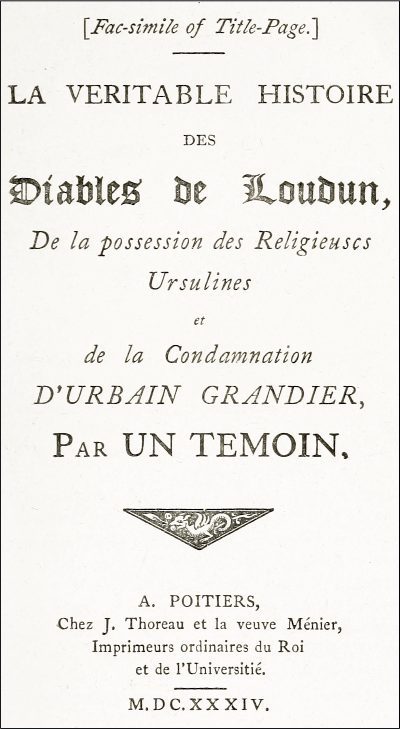
[Fac-simile of Title-Page.]
LA VERITABLE HISTOIRE
DES
Díables de Loudun,
De la possession des Religieuses Ursulines
et
de la Condamnation
D'URBAIN GRANDIER,
Par UN TEMOIN.
A. POITIERS,
Chez J. Thoreau et la veuve Ménier,
Imprimeurs ordinaires du Roi
et de l'Universitié.
M.DC.XXXIV.
Introduction.
THE following extraordinary account of the "Cause Célèbre" of Urbain Grandier, the Curé of Loudun, accused of Magic and of having caused the Nuns of the Convent of Saint Ursula to be possessed of devils, is written by an eye-witness, and not only an eye-witness but an actor in the scenes he describes. It is printed at "Poitiers, chez J. Thoreau et la veuve Ménier, Imprimeurs du Roi et de l'Université, 1634." I believe two copies only are known: my own, and the one in the National Library, Paris. The writer is Monsieur des Niau, Counsellor at la Flèche, evidently a firm believer in the absurd charges brought against Grandier.
Magic appears to have had its origin on the plains of Assyria, and the worship of the stars was the creed of those pastoral tribes who, pouring down from the mountains of Kurdistan into the wide level where Babylon afterwards raised its thousand towers, founded the sacerdotal race of the Chasdim or Chaldeans. To these men were soon alloted peculiar privileges and ascribed peculiar attributes, until, under the name of Magi, they acquired a vast and permanent influence. Their temples were astronomical observatories as well as holy places; and the legendary tower of Babel, in the Book of Genesis, is probably but the mythical equivalent of a vast edifice consecrated to the study of the seven planets, or perhaps, as the Bab (court or palace) of Bel, to the brilliant star of good fortune alone. Availing themselves of the general adoration of the stars, they appear to have invented a system of astrology—the apotelesmatic science—by which they professed to decide upon the nature of coming events and the complexion of individual fortunes, with especial reference to the planetary aspects.
In Persia magic assumed a yet more definite development. The Chaldeans had attributed the origin of all things to a great central everlasting fire. The foundation of the Persian system, usually ascribed to Zerdusht or Zoroaster, was the existence of two antagonistic principles—Ormuzd, the principle of good, and Ahriman, the principle of evil. In Persia everything associated with science or religion was included under the denomination "magic." The Persian priests were named the Magnise or Magi, but they did not arrogate to themselves the entire credit of intercourse with the gods. Zoroaster, who was King of Bactria, made some reservations for the sake of exalting the regal power, and taught that the kings were illuminated by a celestial fire which emanated from Ormuzd. Hence the sacred fire always preceded the monarch as a symbol of his illustrious rank; and Plato says the Persian kings studied magic, which is a worship of their gods.
It was, however, in Egypt, that magic received its development as an art. The most famous temples in Egypt were those of Isis, at Memphis and Busiris; of Serapis, at Canopus, Alexandria, and Thebes; of Osiris, of Apis, and Phtha. Isis, the wife of Osiris, derives her name from the Coptic word isi, or plenty, and would seem to typify the earth; but she is usually represented as the goddess of the moon (Gr. kerasphôros, the horn-bearing). Isis was also employed as a personification of wisdom, and to a certain extent she may be regarded as a symbol of the eternal will, her shrines bearing the enigmatic inscription—"I am the all that was, that is, that will be; no mortal can raise my veil." Horus was the son of Isis, and was instructed by his mother in the art of healing. Horus, synonymous with light, is the king or spirit of the sun. Astrological science and magic were earnestly and eagerly studied by the Egyptian priests. It was their belief that the different stars exercised a powerful influence on the human body. Their funeral ceremonies may be quoted as an illustration, for they agree in sharing among the divinities the entire body of the dead. To Ra, or the Sun, they assigned the head; to Anubis, the nose and lips; to Hathor, the eyes; to Selk, the teeth; and so on. To ascertain the nativity the astrologer had only to combine the theory of the influences thus exercised by these star-related gods with the aspect of the heavens at the moment of an individual's birth. It was an element of the Egyptian as well as of the Persian astrological doctrine that a particular star controlled the natal hour of everyone.[1]
Through the instrumentality of Orpheus, Musæus, Pythagoras, and others, who had travelled in Egypt, and been initiated by the priests into their mysteries, magic found its way into Greece, and there assumed various novel developments. The Greek sorcery was chiefly manifested in the peculiar rites of the Orpheotelesta, the invocation of the dead, the cave of Trophônios, the oracles of the gods, and the worship of Hekatê. The latter mysterious deity, the moon-goddess, was the patron divinity of the sorcerers. From her, as from one of the powers of the nether world, proceeded phantoms that taught witchcraft, hovered among the tombs, and haunted crossways and places accursed by the blood of the murdered or the suicide. "The Mormô, the Cereops, the Empusa, were among the goblin crew that did her bidding."
Rome borrowed her magic, no less than her art and literature, from poetic Hellas. The occult science does not appear to have been known to the Romans until about 200 years before the Christian era. But they had previously cultivated a modification of the Etruscan sorcery, comprising the divination of the future, the worship of the dead, the evocation of their lemures or phantoms, and the mystic ceremonies of the Mana-Genita, a nocturnal goddess of awful character. Numa was the great teacher of the ancient Roman magic, which probably partook both of a religious and medical character.
The Christian church, at the outset of its history, forbade the practice of pagan magic, but taught what may be described as a magic of its own. Both Origen and Tertullian held that mania and epilepsy were produced by the action of demons or evil spirits confined within the bodies of the sufferers, and that these were to be exorcised by certain forms of words. The church formally recognized the efficacy of exorcism in 367, when the Council of Laodicea ordained that only those should practise it who were duly authorized by the bishops. Connected with magic and magical rites were the supposed curative properties of the relics of saints, and the divine origin popularly ascribed to visions and ecstatic trances.
In the middle ages magic asserted its supremacy over the whole of Christian Europe; but it had entirely lost the religious character communicated to it by the Chaldeans. It had degenerated into the "black art." It dealt only with the night-side of nature, with the Evil One and his imps, with the loathsome practises of witchcraft and the enchantments of the necromancer. The scholar rose superior to this low kind of theurgy, but he, too, no longer sought communion with the heavenly powers; he devoted all his energies to the discovery of the philosopher's stone and the elixir of eternal youth, to the sources of illimitable wealth and endless life. [Encyc. Nat. ix. p. 52].
Born at Rouvère, near Sablé, at the very end of the sixteenth century, Urbain Grandier was curate and Canon of Loudun. On obtaining this living, he became so popular a preacher that the envy of the monks was excited against him. He was first accused of incontinency; but, being acquitted, his enemies instigated some nuns to play the part of persons possessed, and in their convulsions to charge Grandier with being the cause of their visitation. This horrible, though absurd, charge was countenanced by Cardinal Richelieu, who had been persuaded that Grandier had satirized him. It is this celebrated case which our credulous author here endeavours to prove.
The reader will, no doubt, be interested in the wonderful effects said to have been produced by exorcism. This word is a term applied to the act of driving an evil spirit out of one possessed, by a command in the name of some divine power. The ability to effect this by such means has been accepted as a belief by pagans, Jews, and Christians, and ceremonials with this object are still in use among the Roman Catholics and the closer followers of the teachings of Luther, who continued to keep his opinions in this respect after the Reformation. One of the minor orders of the Roman Catholic clergy exercise the function, and it is only used in cases of supposed demoniacal possession, in the administration of baptism, and in the blessing of the holy oil or chrism, and of holy water. [Nat. Encyc. v., p. 389].
"Is not my word like as a fire? saith the Lord; and like a hammer that breaketh the rock in pieces?" (Jer. xxiii. 29).
"Healing by words, that is by the direct expression of the mental power," says Van Helmont, "was common in the early ages, particularly in the church, and not only used against the devil and magic arts, but also against all diseases. As it commenced in Christ, so will it continue for ever." (Operatio sanandi a primordio fuit in ecclesia per verba, ritus, exorcismos, aquam, panem, salem, herbas, idque nedum contra diabolos et effectus magicos, sed et morbos omnes. Opera omnia, de virtute magna verborum et rerum, p. 753). Not only did the early Christians heal by words, but the old magicians performed their wonders by magic formulas. "Many cures," says the Zendavesta, "are performed by herbs and trees, others by water, and again others by words: for it is by means of the divine word that the sick are the most surely healed." The Egyptians also believed in the magic power of words. Plotin cured Porphyrius, who lay dangerously ill in Sicily, by wonder-working words; and the latter healed the sick by words, and cast out the devil by exorcism. The Greeks were also well acquainted with the power of words, and give frequent testimony of this knowledge in their poems; in the oracles, exhortation and prayer were universal. Orpheus calmed the storm by his song; and Ulysses stopped the bleeding of wounds by the use of certain words. Among the Greeks, healing by words was so common that in Athens it was strictly forbidden. A woman was even stoned for using them, as they said that the gods had given healing virtues to stones, plants, and animals, but not to words (Leonard. Varius de fascino, Paris, 1587, lib. ii. p. 147). Cato is said to have cured sprains by certain words. According to Pliny, he did not alone use the barbaric words "motas, daries, dardaries, astaries," but also a green branch, four or five feet long, which he split in two, and caused to be held over the injured limb by two men. Marcus Varro, it is said, cured tumours by words. Servilius Novianus cured affections of the eyes by causing an inscription to be worn suspended round the neck, consisting of the letters A and Z; but the greatest celebrity was gained by Serenus Sammonicus by his wonder-working hieroglyphics. They were supposed to be a certain cure for fever, and were in the subjoined form:—
A B R A C A D A B R A
B R A C A D A B R
R A C A D A B
A C A D A
C A D
A
Talismans were inscribed with various signs; and many customs still in use in the East originate from them. Angerius Fererius, in his "Vera medendi methodus, lib. ii. c. ii. de homerica medicatione," speaks very plainly on this subject: "Songs and characters have not alone this power: it exists also in a believing mind, which is produced in the unlearned by the help of visible signs, and in the learned by an acknowledged and peculiar influence." (Non sunt carmina, non characteres, qui talia possunt, sed vis animi confidentis, et cum patiente concordis, ut doctissime a poeta dictum sit:
Doctis et rerum intelligentiam habentibus, nihil opus est externis, sed cognita vi animi, per eam miracula edere possunt. Indoctus ergo animus, hoc est, suæ potestatis et naturæ inscius, per externa illa confirmatus, morbos curare poterit. Doctus vero et sibi constans, solo verbo sanabit; aut ut simul intactum animum afficiat, externa quoque assumet.)
The living Word, which illuminated mankind through Christ, showed its divine power over disease; and the true followers of Christ can perform wonders by the power of his word. "Etenim sanatio in Christo Domino incœpit," says Helmont, "per apostolos continuavit et modo est, atque perennis permanet."—Our Lord said to the sick man, Arise and walk; and he arose and went his way: open thine eyes; and he saw: take up thy bed and walk; and he stood up; Lazarus, come forth! and he that was dead came forth, bound hand and foot with grave-clothes, and his face was bound about with a napkin, &c. But what is this word, which is sharper than a two-edged sword? It is the Divine spirit, which is ever present, ever active; it is the Divine breath which inspires man. In all ages, and in every nation, there have been men who possessed miraculous powers; but they were inspired by religion—turned towards God in prayer and unity. The Almighty sees the heart of the supplicant, and not alone their words; he sees the belief and intention, and not the rank or education.
Even the pious heathens prayed to God; and their peculiar worship maintained the connection, and brought about a still closer union, between individuals and God, and enabled them, in some measure, to pierce the veil of ignorance and darkness. And the pious heathen endeavoured with all his energies to raise himself to a more intimate relation with God, and, therefore, a peculiar force lay in the means employed; and what could be more powerful than prayer? and God, in his comprehensive love and affection, would not leave these supplicants unanswered.
It would be superfluous to enumerate many instances of the efficacy of prayer, as exemplified in pious and believing men, which we might meet with in all ages, and among all nations. In later times many are well known. I shall, however, mention one, which appears to me the clearest and least doubtful. Kiersen relates as follows: "I knew a seer who gained a power of foretelling the future by prayer during the night on a mountain, where he was accustomed to lie on his face; and he used this power for the assistance of the sick in the most unpretending manner. His visions are partly prosaic, partly poetical, and have reference not only to sickness, but also to other important, and even political, events, so that he has much resemblance to the prophets of the Old Testament."
For those to whom the universe is a piece of clockwork, or a perpetual motion, which continues moving for ever of its own accord—to whom the everlasting power and wisdom and love in eternity and nature is as nothing, prayer and supplication must seem objectless and insipid; but they will never be able to perform the works of the soul. To these, the magical effects are just as inexplicable (and, therefore, untrue) as the magical phenomena are unknown. But, with all their knowledge and wisdom of the world, nature will ever remain to them a mystery.
This is not the place to enter more fully into this subject; but it may not be superfluous to remember that in every word there is a magical influence, and that each word is in itself the breath of the internal and moving spirit. A word of love, of comfort, of promise, is able to strengthen the timid, the weak, or the physically ill; but words of hatred, censure, enmity, or menace, lower our confidence and self-reliance. How easily the worldling, who rejoices under good fortune, is cast down under adversity, and despair only enters where religion is not—where the mind has no inward and divine comforter. But there is, probably, no one who is proof against curse or blessing. [Ennemoser, Hist. of Magic, I., p. 120.]
FOOTNOTES:
[1] To those interested in the study of occult science, the publications and reprints issued by Mr. R. Fryar, of Bath, must prove most interesting. As regards Egyptian magic, especially the artistic reproduction of the celebrated Isiac Tablet, with the learned essay thereon, by Mr. W. Wynn Westcott, is invaluable. Happy is the collector who has secured a copy, however, as the edition, like all Mr. Fryar's, is very limited, only 100 copies being printed.
The Devils of Loudun.
AT the beginning of the 17th century, the curate of Loudun was Urbain Grandier. To those talents which lead to success in this world, this man united a corruption of morals which dishonoured his character. His conduct had made him many enemies. These were not merely rivals, but husbands and fathers, some of high position, who were outraged at the dishonour he brought on their family. He was, nevertheless, a wonderfully proud man, and the bitterness of his tongue and the harshness with which he pursued his advantages only excited them the more. And these advantages were numerous, for he had a marvelous faculty for pettifogging. His iniquities had rendered him the scourge of the town, whose principal curate and greatest scandal he was at one and the same moment. This is proved by the dispensations obtained by many fathers of families to assist at the divine service in some other parish, and by the permissions granted them to receive the sacrament from some other hand.[2]
But what was still more serious is, that while setting so many people against him, he had been able to form as formidable a party of his own. These were almost all Huguenots,[3] of which Loudun was then full. He had gained their good graces so much that they upheld him to the utmost of their power. This gave rise to the suspicion that he was merely a disguised Calvinist; a by no means unusual occurrence. Thus Grandier, believing himself safe, put no bounds to his audacity. He treated those from whom he differed with contempt, and in his preachings even dared to question the privileges of the Carmelites. He publicly ridiculed their sermons. He even encroached on episcopal jurisdiction, by granting dispensations from the publication of marriage banns. This last act caused a sensation, and was reported to Louis de la Rocheposay, Bishop of Poitiers, to whom, at the same time, were addressed numerous complaints of the irregular conduct of the curate and of the scandal he caused. The prelate had him arrested, and imprisoned till his trial, which took place on the 2nd June 1630, when he was condemned to fast on bread and water every Friday for three months, forbidden to officiate in the diocese for five years, and interdicted for all time from performing divine service in the town of Loudun. Grandier appealed against this sentence to the Metropolitan, M. d'Escoubleau de Sourdis, Archbishop of Bordeaux, and since then created Cardinal; and the prosecution appealed to the parliament of Paris against this attempt to evade the jurisdiction of the Bishop. But as many witnesses had to be heard, most of whom lived in the diocese, the parliament remitted the case to the Courts of Poitiers. Grandier was thus enabled to face his adversaries, thanks to the friends he had in the district. The following fact proves this.
Amongst other witnesses, two priests, Gervais Méchin, and Louis Boulieau deposed that they had found Grandier lying with women and girls flat on the ground in his Church, the gates leading to the street being shut; that several times, at extraordinary hours, both during the day and during the night they had seen women and girls come to his room; that some remained there from one o'clock in the afternoon, till past midnight, and had their suppers brought there by their maidservants; who used to withdraw at once; that they had also seen him in his Church, with the doors wide open, and, that some women having entered, they were at once closed.
Such evidence was absolute ruin to Grandier; consequently his friends moved heaven and earth. They used bribery and threats against these priests, and obtained from them a retractation of their evidence. René Grandier, brother of the accused, wrote it with his own hand, as was afterwards proved, and the two priests signed it. This evidence destroyed, the cabal had little trouble in turning the legal proceedings to the advantage of Grandier. The Court of Poitiers pronounced his acquittal of the charges brought against him. He was so triumphant, that he insulted his enemies and treated them with public contempt, as if he were entirely 'out of the wood.' He had yet to appear before the tribunal of the Archbishop of Bordeaux, to whom he had appealed. But here again his friends stood by him, and he obtained a second acquittal and an order reinstating him in all his functions (22nd Nov. 1631). The verdict contained a warning to him "to behave well and decently, according to the Holy Decretals and Canonical Constitutions."
At the same time, the Archbishop, in view of the animosity of his adversaries, thought it would be better and safer for him to exchange livings; and he advised him to leave a town where he was looked upon with such disfavour.
Grandier did not think proper to follow the advice or obey the order: far from showing the modesty which was enjoined him, he looked upon his acquittal as a triumph, and returned to Loudun with a laurel branch in his hand, for the mere purpose of insulting his opponents.
Neutral persons were shocked at so little modesty of conduct, his enemies were irritated, and even his friends blamed him. Without pausing an instant he set to work to obtain every advantage over his adversaries. He was not satisfied with having obtained the full mead he was entitled to; he resolved to carry his vengeance as far as law would allow him; and prepared to prosecute before the Courts all those who had taken steps against him, and to claim damages of various amounts, and the restitution of the revenues of his cure, the sentence of the Archbishop of Bordeaux entitling him thereto. In vain did his best friends use every means to turn him from so imprudent a design: God, who intended to cut off this gangrenous member from the body of His Church, and to make of him an example memorable to all ages, abandoned him to his own wilful blindness. Nevertheless, amidst all these proceedings, nothing had been as yet heard of Magic, and up to this time no one had even thought of suspecting him of that crime.
Six years previously, a convent of nuns of the order of St. Ursula had established itself at Loudun. This community, like every new institution, was in somewhat straitened circumstances; though the social position of its members was good. Most of them were daughters of the nobility, while the remainder belonged to the best "Bourgeoisie" of the country. The good reputation of the new order (it was not quite fifty years old), and the high character it bore in Loudun, had also attracted to it a great number of pupils. The nuns were therefore enabled, with economy, to make ends meet, and could look forward to the future with confidence.
The Mother Superior, Madame de Belfiel, daughter of the Marquis de Cose, was related to M. de Laubardemont, Counsellor of State and afterwards Intendent of the provinces of Touraine, Anjou, and Maine. Madame de Sazilli was a connection of the Cardinal de Richelieu. The two ladies de Barbesiers, sisters, belonged to the house of Nogeret. Madame de la Mothe was daughter of the Marquis de la Motte Baracé in Anjou. There was also a Madame d'Escoubleau, of the same name and family as the Archbishop of Bordeaux. Thus they could flatter themselves with dreams of future successes, when they happened to lose their Prior Moussaut, who had charge of their spiritual welfare.
A successor had now to be sought. Grandier, who had never had any connection with the convent, offered himself nevertheless as a candidate. The proposal was scornfully rejected; and the Superior, Madame de Belfiel, had a great quarrel with one of her friends, who urged her to appoint this priest. The choice of the convent fell on Canon Mignon, a man of considerable merit, and in whom spiritual gifts were only equalled by intellectual ones. Grandier, already irritated at his own want of success, was still more annoyed at Mignon's appointment. The contrast in all points between his character and that of the Canon was too great for any other result to have been looked for. Every honest man takes a pride in the blamelessness of his profession, and cannot look favourably on a colleague who dishonours it, nor speak favourably of him. The curate, then, had nothing to expect from the Canon, who was very intimate with the Bishop,[4] and he had already been made aware of the opinions Mignon had expressed at the time of the first trial. These circumstances were not likely to induce Grandier to look with a kindly eye on his successful competitor, and he consequently determined to give plenty of work to the confessor and to his penitents.
Of the various functions the priest is called upon to perform, none requires such delicacy of treatment as the ministry of the tribunal of Penitence.[5] It becomes still more delicate where the consciences of nuns are concerned. But the burden is intolerable, and few could bear it, if extraordinary agencies are employed to increase the difficulty. The anxiety of a newly-appointed confessor in such a situation would be easily understood by Grandier, and would tend to console him for his failure in obtaining the coveted position.
However this may be, extraordinary symptoms began to declare themselves within the convent, but they were hushed up as far as possible, and not allowed to be known outside the walls. To do otherwise would have been to give the new institution a severe blow, and to risk ruining it at its birth. This the nuns and their confessor understood. It was therefore decided to work in the greatest secrecy, and to cure, or at least mitigate, the evil.
It was hoped that God, touched by the patience with which the chastisement was borne, would Himself, in His mercy, send a remedy.
This was all that prudence could devise, but human prudence, always infinitely limited in its views; Divine prudence is quite another thing. God had resolved that the mystery of iniquity should no longer lie buried. As the church, at its birth, gained great credit through similar events,[6] so again, in this case, did they serve to revive the faith of true believers, and so it will be again in future times.
Loudun was fated to behold events of this nature, and they were to produce their ordinary effect, viz., to enlighten those whose consciences, though distorted, had preserved some remnants of original good, and to blind souls darkened with pride, and hearts full of perversity.
As usually happens, the extraordinary phenonomena displayed in the persons of the nuns were taken for the effects of sexual disease. But soon suspicions arose that they proceeded from supernatural causes; and at last they perceived what God intended every one to see.
Thus the nuns, after having employed the physicians of the body, apothecaries and medical men, were obliged to have recourse to the physicians of the soul, and to call in both lay and clerical doctors, their confessor no longer being equal to the immensity of the labour. For they were seventeen in number; and everyone was found to be either fully possessed, or partially under the influence of the Evil One.
All this could not take place without some rumours spreading abroad; vague suspicions floated through the city; had the secret even been kept by the nuns, their small means would soon have been exhausted by the extraordinary expenses they were put to in trying to hide their affliction, and this, together with the number of people employed in relieving them, must have made the matter more or less public. But their trials were soon increased when the public was at last made acquainted with their state. The fact that they were possessed of devils drove everyone from their convent as from a diabolical residence, or as if their misfortune involved their abandonment by God and man. Even those who acted thus were their best friends. Others looked upon these women as mad, and upon those who tended them as visionaries. For, in the beginning, people being still calm, had not come to accuse them of being imposters.
Their pupils were first taken from them; most of their relations discarded them; and they found themselves in the deepest poverty. Amidst the most horrible vexations of the invisible spirit, they were forced to labour with their hands, to earn their bread. What was most admirable was that the rule of the community was never broken. Never were they known to discontinue their religious observances, nor was divine service ever interrupted. Ever united, they retained unbroken the bonds of charity which bound them together. Their courage never failed, and when the seizure was past, they used to return to their work or attend the services of the Church with the same modesty and calmness as in the happy days of yore. I know that malice will not be pleased at such a pleasing portraiture. But this base feeling, too natural in the human heart, should be banished thence by all men of honour, who know its injustice and only require that history should be truthful. Probability itself is in favour of our statements. For when God permits us to be attacked so violently by our common enemy, it is as a trial to ourselves, to sanctify us and raise us to a high degree of perfection, and simultaneously He prepares us for victory, and grants us extraordinary grace, which we have only to assimilate and profit by.
It became necessary to have recourse to exorcisms. This word alone is for some people a subject of ridicule, as if it had been clearly proved that religion is mere folly and the faith of the church a fable. True Christians must despise these grinning impostors. Exorcisms, then, were employed. The demon, forced to manifest himself, yielded his name. He began by giving these girls the most horrible convulsions; he went so far as to raise from the earth the body of the Superior who was being exorcised, and to reply to secret thoughts, which were manifested neither in words nor by any exterior signs. Questioned according to the form prescribed by the ritual, as to why he had entered the body of the nun, he replied, it was from hatred. But when, being questioned as to the name of the magician, he answered that it was Urbain Grandier, profound astonishment seized Canon Mignon and his assistants. They had indeed looked upon Grandier as a scandalous priest; but never had they imagined that he was guilty of Magic. They were therefore not satisfied with one single questioning: they repeated the interrogatory several times, and always received the same reply.
FOOTNOTES:
[2] Our author takes care not to mention that the Bishop of the Diocese was Grandier's greatest enemy.
[3] Huguenots, the name given to the early adherents of the Reformation in France. The origin of the word has been variously accounted for, but it was most probably introduced from Germany as a corruption of the German-Swiss Eidgenossen, confederates, or those bound together by an oath. Like many other names it was first given by opponents as a badge of reproach, and subsequently became honourable from its associations. The movement of the Reformation made its appearance in France at the beginning of the sixteenth century; and at the period when Luther was defending its principles before the Diet of Worms, Briconnet, bishop of Meaux, Lefevre, and Farel were labouring zealously for the same cause in France. At first the new doctrines, which seemed to be chiefly directed against the more open sins and derelictions of the clergy, enjoyed the toleration of the king, Francis I. and his sister Margaret of Valois, the queen of Navarre, was an active supporter of the cause. As it progressed however, the alarm and anger of the clergy became fully aroused, and as some of its manifestations had given offence to the king, a determined effort was made to extirpate it by means of fire and sword. In 1535 a solemn procession in vindication of the faith was made at Paris, in which the king walked bareheaded and bearing a taper; as part of the proceedings six Lutherans were burned, having their tongues cut out and being affixed to a movable gallows, which alternately rose and fell over a fire kindled beneath. This was followed by many executions of a similar kind, and by the more wholesale slaughters which exterminated the Vaudois of Provence; but in spite of these persecutions the number of those who adopted the principles of the Reformation continually increased. Under the influence of Calvin, who took very great interest in the work of the Reformation in France, the French Protestants about the middle of the sixteenth century began to organize themselves into churches, and to unite these churches into groups or districts for the purposes of mutual aid and counsel. The first French Protestant church was established at Paris in 1555, and very soon afterwards others were established in most of the large towns where the principles of the Reformation had obtained followers. These churches were established according to the Presbyterian form, a pastor being appointed as the leader, with elders and deacons to assist in the government and worship, each church being independent of the rest, though several churches might combine in any movement for their mutual benefit or for the promotion of their common cause. The first synod of the reformed churches was held at Paris in 1559. At this assembly, to which eleven churches sent deputies, a confession of faith and a series of articles of discipline were drawn up and issued, and these, with a few alterations, became subsequently the doctrinal and ecclesiastical standards of the Protestants of France. It is not easy to estimate the number of the Huguenots at this period, but according to Beza they were not less than 400,000, and the party included about one-third of the nobility of France. The persecutions of the Roman Catholic party, however, had become more fierce and intolerable as the number of the Protestants increased, and at last, driven to desperation, the Huguenots took up arms in their own defence and sought to change the government in order that they might gain liberty of worship. In February, 1560, at a meeting at Nantes, they resolved to petition the king, Francis II., for liberty of worship and for the removal of the two brothers, Francis duke of Guise, and Charles of Lorraine, cardinal and archbishop of Rheims, who were the real rulers of the kingdom and the foremost in the persecution. In the event of a refusal they conspired to seize the person of the king and appoint their own leader, Louis I., prince of Bourbon Condé, as governor-general of the kingdom. The conspiracy failed completely, and a terrible vengeance was exacted: some 1200 of the Huguenots were slaughtered without investigation or trial, their bodies being flung into the Loire until the stream was almost choked by the number. In January, 1562, owing to political changes in France, Catherine de Médicis being obliged to rely upon the aid of the Protestant party in defence of her son Charles IX., who was under age, an edict was issued which gave the Huguenot noblemen the right to the free exercise of their religion on their own estates. A few months only after this a party of Huguenot worshippers in the little town of Vassy, in the province of Champagne, were attacked by the Duke of Guise and his followers, sixty being slain upon the spot, and 200 more severely, some mortally, wounded. For this butchery he was received with acclamation by the people of Paris, and emboldened by his reception he seized upon the persons of the young king and the queen-mother, and proclaimed the Protestants rebels against the royal authority. The latter rallied round the standard raised by Condé at Orleans, and the civil war was commenced which was to devastate France for nearly thirty years. At the outset the Huguenots were defeated at Rouen, 11th September, 1562, and again at Dreux, 19th December, the same year. In 1563 the treaty of Amboise was concluded, but its stipulations were observed by neither party, and the war was soon recommenced, the Huguenots being again defeated 10th November, 1567, at St. Denis. Reinforced by aid from Germany, they were able to threaten Paris, but their leader Condé allowed himself to be again duped by Catherine de Médicis, and signed the peace of Longjumeau, "leaving his party at the mercy of their enemies, with no other security than the word of an Italian woman." The queen-mother, as soon as the pressure of danger was removed, promptly recommenced the persecution, and within a few months several thousands of the Huguenots were either assassinated or publicly executed. Condé and Coligny fled to La Rochelle, where they were joined by the Queen of Navarre and her son Henry, afterwards Henry IV. of France, at the head of 4000 men. Assistance was also received from Germany and England, and the third war of religion was begun. The Huguenots were defeated 13th March, 1569, at Jarnac, and again at Moncontour, 3rd October, 1569, but they managed to take Nîmes, relieve La Rochelle, and gain the victory of Luçon. Their successes led again to the proposal of terms of peace; and a treaty, in which an amnesty and the free exercise of their religion everywhere except at Paris was granted to the Protestants, was signed at St. Germain-en-Laye, 8th August, 1570.
As with the treaties previously signed, the queen-mother and the leaders of the Roman Catholic party had no intention of observing its conditions, but on the contrary they sought to obtain by treachery that which they had failed to procure by force of arms. In two years their plans were ripe for execution, and the leaders of the Huguenot party having been enticed to Paris, a general massacre of the Protestants was commenced on St. Bartholomew's Day, 24th August, 1572. In the ghastly slaughter that followed, according to the lowest computation, 30,000 of the Protestants of France were destroyed, but many historians place the number killed at a much higher figure. Most of the leaders of the Huguenot party were destroyed in the massacre, but the remainder rallied their scattered forces, and a fresh war was commenced which continued with but few intermissions until the accession of Henry of Navarre in 1589. His reign marks a tranquil period in the history of the French Protestants, and in 1598 they obtained the celebrated Edict of Nantes, which though it granted them less than they had anticipated, was yet for a long period the foundation of their liberty. The period succeeding the reign of Henry IV. was marked by numerous outbreaks on the part of the Huguenots, who were distrustful of the plans and purposes of the French court, and ultimately Cardinal Richelieu determined to finally break their power by the capture of their chief stronghold, La Rochelle. This he effected in 1628, and with its fall and the subsequent surrender of the remaining Protestant towns the religious wars of France came finally to an end. Still the Huguenots were left in the enjoyment of freedom of religion, and being excluded from the court and service of the state, they devoted themselves to manufacture and commerce until they became the industrial leaders of the nation. They followed agriculture in the rural districts, and their farms were among the finest in France. The wine trade of Guienne, the cloths of Caen, the maritime trade on the sea-board of Normandy, the manufactures in the north-western provinces, the silk trade of Lyons, with many other branches of commerce, were almost entirely carried on by the Huguenots, who bore a high reputation for industry and integrity even among their enemies. The consolidation of the power of the king was, however, fraught with danger to the liberties of the Protestants, and as Louis XIV. in his declining years became morbidly superstitious, he sought, under the direction of Madame de Maintenon and his confessor Lachaise, to atone for his own crimes by the suppression of heresy. At first bribery was tried, and a regular fund of secret-service money was set apart for procuring conversions. Then persecution was recommenced, and many thousands were terrified into abjuring their religion by the means of the Dragonnades.
Finally, in 1685 Louis revoked the Edict of Nantes, and followed up the revocation with laws of terrific severity against Protestantism. All Protestant worship was forbidden under penalty of arrest and confiscation of property. Ministers were to leave the kingdom within fourteen days unless they became converted. All Protestant schools were closed, and all children born after the passing of the law were to be baptized and brought up as Roman Catholics; all marriages, unless celebrated by the Roman Catholic clergy, were declared null, and the Protestant laity were strictly prohibited from leaving the kingdom.
The provisions of the edict were carried out with relentless rigour, and a desperate flight of the Huguenots ensued. Many thousands had been forced to emigrate by the dragonnades, but now the flight became wholesale, though every effort to check it was made by the authorities. Vauban, who wrote a year after the revocation, estimated the loss of France at 100,000 inhabitants, 60,000,000 francs in specie, 9,000 sailors, 12,000 veterans, 600 officers, and her most flourishing branches of manufacture and trade. Sismondi considers the loss to have exceeded 300,000 men, while some modern estimates put the number lost during the whole period of the persecution at not less than 1,000,000. A large number abjured their religion, but a remnant remained who neither fled nor abjured, and whose endurance and determination during the long years of persecution that followed form one of the most remarkable of the records of religious history. The loss of France was the enrichment of other lands, and England, America, Germany, Switzerland, Denmark, Sweden, and Holland all profited by the advent of the emigrants. It is estimated that during the ten years that followed the revocation nearly 80,000 of the Huguenots established themselves in England, and their influence upon the trade and manufactures of the country was both widespread and lasting. The long windows of the silk-weavers' houses still mark the quarter of Spitalfields, London, where not so very long since a considerable French colony, with English assistants, drove a thriving trade, though not a weaver is now to be found there.
The majority of the Huguenots, however, became merged in the general population of England, and their descendants heartily accepted the change of nationality. Many of the latter have since attained to eminence in their adopted country, and are to be found among the leaders of the nation in all branches of its activity. Similar results may be traced in other nations where the refugees took up their abode, and it is said that when the Emperor of Germany rode into Paris at the head of his victorious troops at the close of the war in 1871, not less than eighty members of his personal staff were descendants of the Huguenots who had been driven by persecution from France.
During the early part of the eighteenth century the rigour of the persecution was maintained, but gradually the spirit of the age began to be averse to such methods of maintaining the power of the priesthood, and the interference of Voltaire, after the judicial murder of John Calas, did much towards bringing the persecution to an end. In 1787 an edict of Louis XVI. restored civil rights to the Huguenots, and the Revolution of 1789 and the passing later of the Code Napoleon gave them equal rights with Roman Catholics. At the present time the Protestants of France number about 500,000, and many of their pastors receive a small salary from the state. They nevertheless enjoy a considerable amount of self-government, and they have an excellent reputation as industrious and orderly citizens. In the Protestant churches of France, as in those of other countries, there is a tendency to divide over the questions arising from the progress of scriptural and historical criticism. Some of the leaders are well known for the liberalism of their ideas, and for the work they have done in connection with the advancement of the science of theology, while others, fearing the Rationalizing tendencies of modern studies, cling more closely to the Calvinistic standards of their forefathers. [See "History of the Rise of the Huguenots," by Prof. M. Baird, 1880.]
[4] The friendship of the Bishop would account for Mignon's envy towards Grandier.
[5] When and under what circumstances confession, either public or private, was first deemed absolutely necessary for the remission of sins is a subject of controversy. Innocent III., in the fourth Lateran Council, A.D. 1215 (Canon 21), made confession (meaning auricular or private) obligatory upon every adult person once a year; and that continues to be one of the rules of the Roman Catholic church to the present day. The Council of Trent, in its Catechism, defines it to be "a declaration by the penitent of his sins made to a priest in order to receive the penance and absolution." Penitence, therefore, consists of four parts—confession, contrition, penance, and absolution; and it is a positive doctrine of the same church, that without the concurrence of all these parts or conditions the sacrament is null and void. The penance which the priest imposes consists generally of satisfaction to be given if the penitent has injured any one in his property, honour, &c., in a manner that can admit of reparation, and also of prayers, abstinence, or other religious practices to be performed. The secrecy imposed on confessors is strict and unconditional; whatever be the crime of which a penitent may accuse himself, they are solemnly bound to keep it secret, under the most severe denunciations and penalties, both here and hereafter, that of excommunication included. The box in which the priest sits in the church to hear the penitent is called a confessional. But the act of confession may be performed out of church, in private houses, or in any place, in short, of which the bishop approves, provided it be not within hearing of any person except the priest and the penitent. The Greek Church retains the practice of auricular confession, but differs from that of Rome in the form of the absolution. The reformed churches do not as a rule encourage the practice, and in Scotland it is not even recognized. In the Church of England, although admitted by the Prayer Book, private confession has long been viewed with extreme suspicion, but of late years attempts have been made by a certain section to revive it.
[6] The reference is evidently to Mark XVI., p. 17 and 18.
End of Vol. I.