
JOHN PAUL JONES,
WITH THE FIRST U. S. FLAG, ESTABLISHING THE FREEDOM OF THE SEAS.
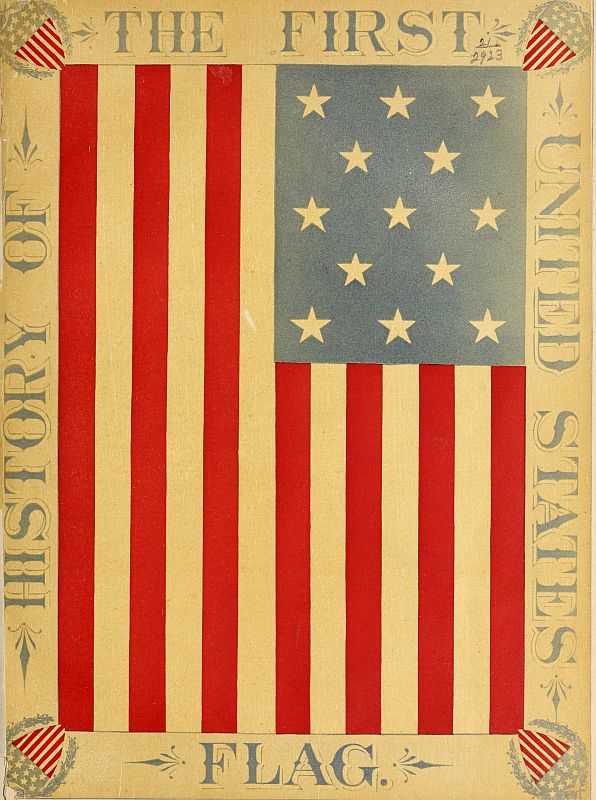
PAUL JONES, the bravest of Naval Commanders, was born at Selkirk, Scotland, 1730, and came to America about 1770, to fight the battles of Liberty and Independence. He was styled “The Washington of the Seas,” “The deadliest foe of Cowards.” Lieutenant Paul Jones and Mrs. Elizabeth Ross, of Philadelphia, became intimate friends and neighbors, well known as the most zealous patriots in the cause of Independence, doing battle against tyrants and oppressors, and Thomas Jefferson, Dr. Franklin, John Adams, Dr. Rittenhouse and Robert Morris were their truest and most steadfast friends and patrons. Mrs. Ross designed and made the Flag that Lieutenant Jones hoisted upon the Flagship of War, in the Delaware bay. During the month of December, 1775, by the request and explicit orders of Dr. Franklin, Col. George Ross and Robert Morris, the three members of a Secret Committee of Congress, Lieutenant Jones was supplied with one of Mrs. Ross’ first and best Flags, the red white and blue emblem of Liberty, for which Congress paid. Afterward, for Jones’ brave honoring of that Flag, Congress awarded him $25,000 and a golden medal, and he was further complimented by an invitation to Paris, where the cross of military merit and a sword of honor were presented to him by the King of France, at the written request of our Congress, for his dauntless courage and his triumphant victory as the Captain of the “Richard,” with the first Flag of the Union, over the British Flag of the “Serapis.”
In January 1776, the following vessels were fitted out.
The “Alfred,” of thirty guns and three hundred men, Dudley Saltonstall, Captain, bearing the Pine Tree Flag, presented by the colony of Connecticut.
The “Columbus,” of twenty-eight guns and three hundred men, Abraham Whipple, Captain, bearing the Flag of the Red Cross of Saint George, presented by the Colony of Vermont.
The “Andrew Doria,” of eighteen guns and two hundred men, Nicholas Biddle, Captain, bearing the Flag of the White Cross of Saint Andrew, presented by the Philadelphians.
The “Cabot,” of fourteen guns and two hundred men, John W. Hopkins, Captain, bearing the Pine Tree white silk Flag from Connecticut.
The “Providence,” of twelve guns, bearing the Flag with the Cross of Saint Andrew, presented by Rhode Island.
The “Hornet,” of fourteen guns, bearing the yellow silk Flag of Virginia, with Rattlesnake.
The “Wasp,” eight guns, bearing the yellow silk Flag of South Carolina, with a Crescent, a Beaver and a Rattlesnake, with the motto, “Don’t tread on me.”
The Dispatch vessel “Fly,” bearing a blue Flag with Red Cross of Saint George.
E. Hopkins, was Commander-in-chief of the fleet, and John Paul Jones first lieutenant. Jones was offered the command of the sloop “Providence,” which he declined, declaring that he preferred to be “Chevalier Bannaret,” to hoist and carry the bald eagle, with glittering stars and stripes, on the flagship “Alfred,” and when the Commander-in-chief, E. Hopkins, came on board of her, January 1, 1776, Jones hoisted the American Union Flag, with his own hands, which was the first time it was ever displayed on a man-of-war, and waving his navy cap swiftly overhead, shouted “Three Cheers for the Red, White and Blue! The Haughtiest of Monarchs shall bow before that Flag!!!” “Again, Three cheers for our Commander-in-Chief and the American Navy!!!” And thus he boldly evinced his lofty and chivalrous character, bravely assuming the responsibility, and his achievement of glorious deeds aided in the recognition of our Independence.
On the 14th day of February, 1778, the United States Flag was, for the first time, recognized in the fullest and completest manner by the Flag of France. Lieutenant Paul Jones, on board the brig “Independence,” at the entrance of Quiberon bay, sailed through the French fleet, commanded by Admiral La Motte Piquet, (who was keeping the coast of France clear of British cruisers,) and our National Emblem was most courteously complimented and saluted by nine guns. The American Flag was first carried around the world in 1789, by the “Columbia,” Captain Gray, of Boston, AND SALUTED IN EVERY PORT.