
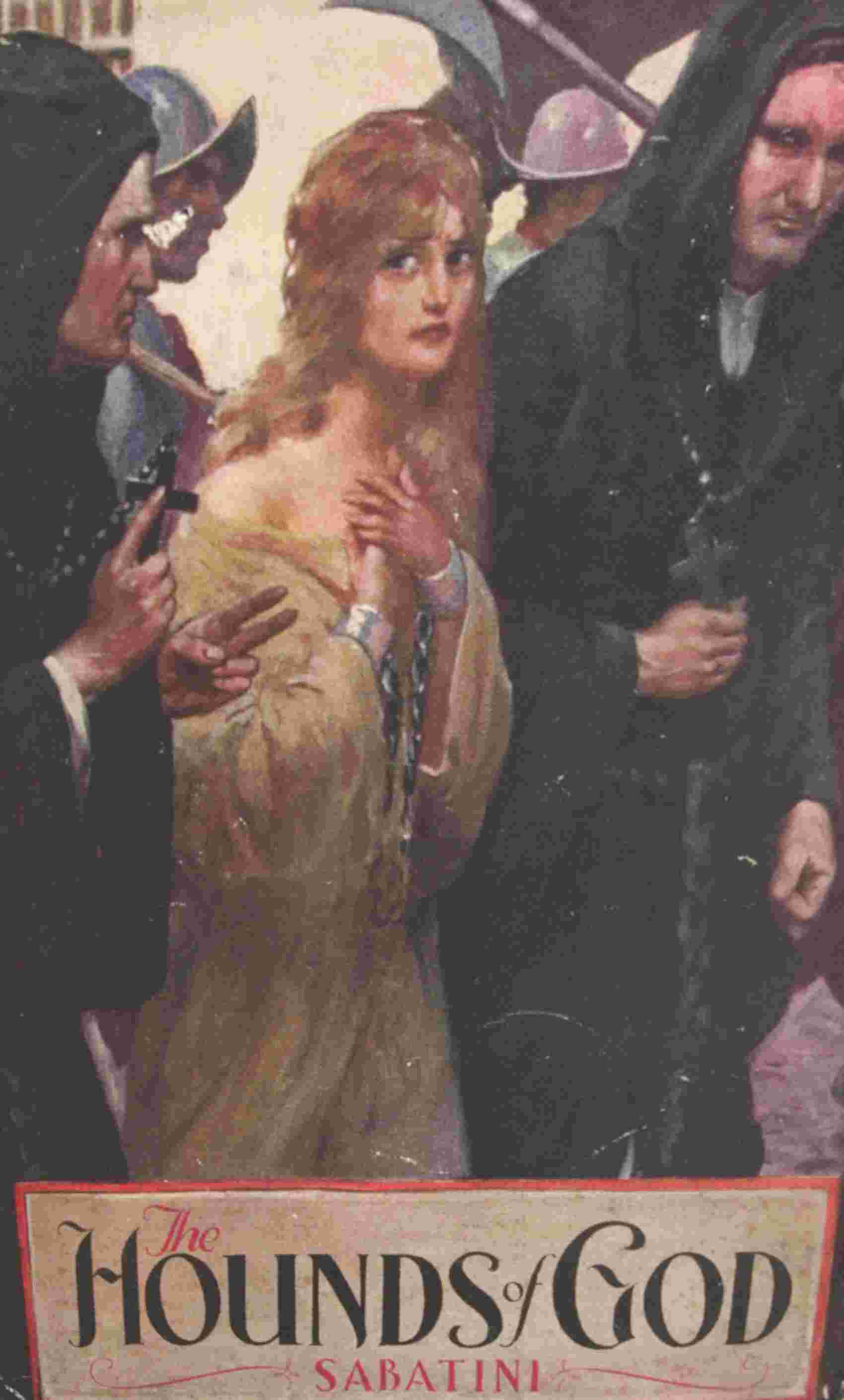
He paused, his melancholy love-lorn glance upon her in humble supplication. But neither the glance nor his words had produced any visible impression. The eyes with which she returned his glance were hard, and there was only scorn in the little smile that tightened her red lips.
‘I have thought you whilst you spoke sometimes a knave, sometimes a fool. I perceive you now to be a sorry mixture of both.’
He shrugged and even smiled, an infinite weariness in his eyes. ‘That is not argument.’
‘Argument? Does it need argument to prick the empty bubble you have laboured so to blow? By the same arguments there is no vileness in the world that cannot be justified. The facts are here, Don Pedro: you have returned evil for good; you have used me with violence and indignity hoping to constrain me to your will; you have left anxiety and sorrow behind, in a house which sheltered you in time of stress. These facts no arguments in the world can ever dispel. The attempt upon me I tell you now is idle. I’ll be no man’s countess against my will, and I have no will to be yours and never shall have. If you would earn a forgiveness you may yet come to need, I ask you again to give orders to go about and restore me to my home.’
He lowered his eyes and sighed. ‘Let us eat,’ he said, and spoke rapidly in Spanish to the waiting and wondering Pablillos, who at once grew busy with the dishes prepared upon a buffet.
In a spirit of admirable philosophic detachment, Don Pedro found himself admiring the courage which permitted her to answer him so firmly, to sit before him so upright, and to meet his eye so steadily. How differently would any other woman he had ever known have borne herself in this situation! What tears and outcries would not have deafened and nauseated him! But Margaret was tempered finely as steel. Not in all the world could he find such another mother for his sons. What men would she not bear to add lustre and honour to the house of Mendoza y Luna?
Of her ultimate surrender he was confident. The arguments he had used were sincere enough; they expressed his utter faith; and in that faith he could practise patience, a virtue impossible only where there is doubt.
She ate sparingly; but that she could eat at all was a further proof of her spirit. She drank, too, a little wine; but was careful to drink only from the same jug as that which supplied Don Pedro. Observing this caution, he rated her wit as highly as her spirit. Thus her very defiances and mistrusts but served to magnify her in his adoring eyes.
The single cabin on the starboard side had been prepared for Don Pedro, and prepared luxuriously. Informed of it by Pablillos, he yielded it to her ladyship, and she withdrew to it with the cold resignation which had marked her every surrender to the force of circumstances.
Alone there, her demeanour may have altered. In secret she may have yielded to fear and grief and indignation. Certain it is that when early on the following morning she sought the deck, where she might conceive herself less prisoned than in the coach, there was a haggardness which her countenance had never worn before and a redness about her eyes which may have been the result of weeping or of sleeplessness, both new experiences in the life of the Lady Margaret Trevanion. Apart from those, however, she flew no signals of distress. She had dressed herself with pains, repairing the disorder which her garments had suffered and she had tired her hair with care. Her step was as firm as the canting deck permitted, her manner one of chill dignity and assurance.
Thus she emerged from the gangway to the waist, which, beheld now in the morning sunlight, seemed less spacious than yesternight. Her glance strayed from the square main hatch with its shot-rack to the boats on the booms amidships and lingered a moment on a sturdy lad, who, engaged in polishing the brass hoops of a scuttle butt, eyed her with furtive interest. The wind had freshened with the sunrise, and there were men aloft taking in sail. Save for the youth at the scuttle butt, she seemed singularly alone. But as she moved forward along the weather quarter away from the break of the poop, she saw that there were men on the quarter-deck above. Duclerc, the sturdy, bearded French master, leaned on the carved rail, observing her. As she turned, he doffed his bonnet in salutation. Behind him two sailors were gazing up into the shrouds, following the operations there of those aloft.
She crossed the canted deck to the quarter on which she supposed that land—her England—would last have been. There was no land now in sight. She had a sense almost that the ship was in the centre of a vast aqueous globe, for the pellucid morning sky seemed one with the ocean. A nausea of dismay swept over her, and she steadied herself against the bulwarks, to become suddenly aware that she was less alone than she had believed. Against one of the forecastle bulkheads leaned a tall figure as immoveable as if it had been a caryatid carved to bear the burden of that forward deck.
It was the friar. His cowl was now thrown back from his tonsured head, and his face, thus fully revealed in the light of day, announced him younger than she had supposed him, a man in the middle thirties. Despite its hungry, almost wolfish look, it was a not unhandsome face, and one that must anywhere arrest attention. The nose was prominent, almost Semitic; the cheek-bones thrust forward boldly, seeming to drag the sallow skin with them and leaving gaunt hollows in the cheeks. His mouth was wide, but thin of lips and firm, whilst under a jutting brow two great dark eyes glowed sombrely.
He stood within but a few yards from where she had come to lean, his finger closed upon his breviary, a string of beads intertwining his fingers and hanging from his hand; they formed—although she could not know or guess it—a chaplet brought from the Holy Land, each grain of which was wrought of camel bone.
Perceiving her regard upon him, he slightly inclined his head in greeting, but his face remained as impassive as if carved of wood. He advanced towards her, his great stern eyes upon her, and she grew conscious of a faint, uneasy quickening of her pulses, such as besets us at the approach of some creature of a species not known or understood. To her surprise he greeted her in English. He uttered commonplaces, but his deep, grave voice and sibilant Spanish accent seemed to lend them consequence. He expressed a hope that she had found a ship’s quarters not too uncomfortable, that sleep had been possible to her in surroundings that must be unaccustomed so that waking refreshed she had commended herself to the Holy Mother of God, the natural protectress of all virgins.
She realized that the apparently courteous hope was in reality a question, although perhaps she scarcely understood the depth to which it was meant to probe. Indeed, her active wits were already engaged on other matters. This man was a priest, and although his might be a creed superficially different from her own, yet in fundamentals it was essentially the same. Good and Evil wore the same aspect in Roman as in Lutheran eyes, and he was by his office and his habit a servant of the Good, an upholder of virtue, a champion of the oppressed. Had he known no English, he could not have availed her. He must have drawn his own conclusions touching her presence on that ship, or accept whatever tale Don Pedro told him. But the fact that she could appeal to him, tell her own story and be understood, seemed all at once to dispel her every qualm and open a clear way for her out of her present difficulties. Let him but know of the violence done her, of how she was placed, and his assistance must be won; he must stand her friend and protector, and he a man in authority who could enforce, even upon so great a gentleman as Don Pedro de Mendoza y Luna, the need to right this wrong.
Don Diego had blundered worse than he knew, or Don Pedro yet suspected, in bringing this Dominican as the ship’s spiritual guide. The man’s knowledge of English, which was the very ground upon which Don Diego had chosen him for a voyage to England, was the very ground upon which, had there been no others, he should have been left in Spain. But this was all outside her ladyship’s knowledge. All that mattered was that he spoke her tongue and that he was here beside her to hear what she had to tell.
The colour flooded to her cheeks, a sparkle came to eyes that a moment since had been dull with dejection. Her first words were such as must commend her to him, and almost quiet the doubts concerning her that were stirring in his mind, doubts which his questioning greeting had desired to test.
‘God must have sent you to me; God and that Holy Mother whom you pronounce the protectress of all maids in need. Be you her deputy by me. For I am sorely in need of protection.’
She saw the stern eyes soften. Compassionate tenderness invested that ascetic countenance.
‘I am an unworthy servant of the Lord and of those who call upon the Lord. What is your need, my sister?’
Briefly, with feverish speed, she told him that she had been ravished from her home and brought by violence aboard this ship in which she was being carried to Spain in the power and at the mercy of Don Pedro de Mendoza.
He inclined his head. ‘I know,’ he said quietly.
‘You know? You know?’ There was almost horror in her voice. Was it possible that this priest was in the plot? Were the hopes vain to which his presence had but given birth? He knew, and yet bore himself with such indifference!
‘I also know, if man’s words are to be believed, that Don Pedro means you honourably.’
‘What is that to the matter?’ she cried out.
‘Something. Something surely that his intentions concerning you are not villainous or sinful.’
‘Not villainous? Not sinful? To bear me off against my will! To coerce me!’
‘It is a wrong, a grave and wicked wrong,’ Frey Luis admitted quietly. ‘Yet not so grave or so wicked as it might be, and as first I feared it was. I feared a mortal sin to imperil the salvation of his soul. And who voyages in ships should more than another preserve that state of grace in which to meet his Maker, since at any moment the perils of sea may summon him to that Dread Presence. But a wrong there is, as I perceive. You desire me to prevail upon Don Pedro to repair it. Content you, my sister. In my protection, under God’s, whose servant I am, rest you assured that no evil shall befall you. Don Pedro either returns you to your home at once, or you shall be delivered from this coercion so soon as you touch Spanish soil.’
She could have laughed in her exultation, so easy had it been to secure the frustration of all Don Pedro’s measures. The voyage no longer had any peril to daunt her. The mantle of Saint Dominic protected her, and although she knew little if anything about that ardent zealous saint who had preached the love of Christ with fire and sword and warred relentlessly upon all who did not think as he did, she felt that she would hold his name ever hereafter in reverence and love.
Frey Luis had passed his beads and breviary into his left hand. He raised now his right, with three fingers extended, and made the sign of the cross in the air over her golden head, a murmur of Latin on his lips.
To the Lady Margaret this was almost as the ritual of some incantation. Her wide-set generous eyes dilated a little as she looked at him. Frey Luis read the question of that uncomprehending stare, observed that golden head held rigid, unbowed, and unresponsive to his benediction, and his own eyes reflected a sudden doubt which mounted swiftly to conviction. Dismay overspread the austere face. This thing which Don Pedro had done went deeper than he could have dishonoured him by suspecting. It suddenly assumed proportions of wickedness and evil far exceeding any which he attached to the abduction in itself, indeed the last wickedness he would have believed of a nobleman of a family so renowned for piety as Don Pedro’s, a family which had given Spain a Primate. This abducted woman, whom Don Pedro intended for his wife and the mother of his children, was a heretic!
Before that horrible discovery Frey Luis recoiled in body as in spirit. His lips tightened; his expression became mask-like. He folded his hands within the sleeves of his white woollen habit, and without another word turned on his sandalled heel and moved slowly away to excogitate this horror.
CHAPTER XV.
SCYLLA
So deeply perturbed by his discovery was Frey Luis that he required time to recover from the shock and to rehearse the measures by which he was to combat Satan for the imperilled soul of Don Pedro de Mendoza y Luna. The holy man prayed long and fervently for guidance and for strength. As one who sincerely regarded the world and its honours as trivial evanescences to be crossed on the path to eternity, he stood in no awe of the great, acknowledged no superiority in any nobility that was not rooted in zeal for the Faith. He would serve no king who was not himself a servant of God; acknowledge no king who did not acknowledge himself that. Worldly power, which himself he had spurned when he assumed the habit of Saint Dominic, became a contemptible mockery in his eyes, a thing of scorn, from the moment that it ceased to be employed first and foremost in the service of the Faith. It follows from all this, which was not without its unperceived leaven of arrogance and the deadly sin of pride, that Frey Luis was no respecter of persons or of rank. Yet, whilst despising worldly rank, he must acknowledge it. It was necessary to reckon with it. Evil could be wrought by it. Because self-seeking men were sycophantic to it, great strength was often necessary to stand against it and thwart it where it addressed itself to unholy ends.
For this strength prayed Frey Luis, and it was not until the following afternoon that he felt himself sufficiently equipped and inspired for his struggle with the Devil.
Don Pedro took the air—crisp and sharp despite the sunlight—upon the poop. He was distressed and moody, when Frey Luis approached him, but because it was some time before the Dominican’s words showed whither he was travelling, Don Pedro offered no interruptions, betrayed no impatience.
Frey Luis went a long way round, so as completely to disguise his approaches; so as to say all that mattered, all that should germinate in the soul of Don Pedro, before Don Pedro, discerning the friar’s real aim, should be tempted to set a term to his discourse. It amounted to little less than a sermon.
He began by speaking of Spain, of her glory first and then of her difficulties. Her glories he described as the mark of divine favour upon her. God made it manifest that the Spaniards were to-day his chosen people, and woe unto Spain should she ever grow negligent of the stupendous grace vouchsafed her.
Don Pedro permitted himself to wonder was the scattering of the Armada by the hosts of Heaven a manifestation of this grace.
The doubt inflamed Frey Luis. Not the hosts of Heaven, but the powers of darkness had been responsible for that. God had permitted it as a warning to a people against the deadly sin of pride—one of Satan’s most artful snares—which might betray them into supposing that their glories were the result of their own puny endeavours. It was necessary to remind men, lest they perished, that without the favour of Heaven nothing was to be achieved on earth.
There were a dozen answers which suggested themselves to the logical mind of Don Pedro, who had first known doubt on that morning when he awakened in the cove below Trevanion Chase. But he offered none of them, knowing already how they would be met.
Frey Luis passed on to speak of his country’s difficulties: the jealous enemies without, and the insidious enemies within; the latter inspired and sustained by the former. Because Spain, under God’s favour and protection, was unconquerable in direct and honourable warfare, Satan sought to undermine the religious unity which rendered her invulnerable by insinuating sectarian disorders into her bosom. To wound her in her faith was to bleed her of her strength. The Jews, those enemies of the Cross, those armies of the powers of darkness, had been driven out. But the New Christians remained with their frequent Judaizings. Gone were those other legionaries of hell, the followers of Mahomet. But the Moriscos remained and their frequent lapses into the abominations of Islam continued a defilement. And, after all, the taint of Jew and Moor was in many a man of lineage. Not every nobleman of Spain was as clean of blood as Don Pedro de Mendoza y Luna. But not even clean blood was nowadays a sufficient safeguard, since it assured no immunity from the poison of heresy, a poison which once introduced into the body laboured there until it had destroyed it utterly. And there were signs of it, more than signs of it in Spain already. Frey Luis became lugubrious. Valladolid was a hotbed of Lutheranism. Salamanca was little better than a heretical seminary. The disciples of Luther and Erasmus became daily bolder. Even a Primate of Spain, Carranza, the Archbishop of Toledo, had been guilty of Lutheranizing in his catechism.
Upon this climax of exaggeration, Don Pedro interrupted him. ‘The Archbishop was acquitted of the charge.’
The Dominican’s eyes flashed with holy wrath. ‘That acquittal shall be atoned for in hell by those who betrayed their God in pronouncing it. For seventeen years Carranza lay in the prisons of the Holy Office, defending himself with sophistries which the Devil inspired in him for his self-preservation. He should have left them for the fire. In such matters there is no room for arguments or casuistries; whilst men talk, the evil grows; it grows even from their disputations. What is needed is that we extirpate these buboes of heretical pestilence, that we cauterize them once for all with the purifying flame. To the fire with all these putrescences! And so Amen!’ He flung up one of his long arms in a gesture of denunciation almost terrifying in its remorseless vehemence.
‘Amen, indeed!’ Don Pedro echoed.
The Dominican’s lean, feverish hand clawed the nobleman’s arm in its black velvet sleeve. His eyes glowed with eagerness and saintly zeal.
‘That is the response I expected from you, the response worthy of your nobility, of your clean blood and of the representative of the great House of Mendoza, which has laboured ever to the glory of God and of Spain.’
‘What other response could have been possible? I am, I hope, a faithful son of Mother Church.’
‘Not merely faithful, but active; a member of the Militia Christi. Are you not in some sort my brother, my spiritual brother, in the great fraternity of Saint Dominic? Are you not a lay tertiary of the order, and so consecrated to uphold the purity of the Faith and to expunge heresy wherever you shall find it?’
Don Pedro began to frown at so much vehemence. ‘Why do you question me, Frey Luis?’
‘To test you, whom I find upon the brink of a precipice. To assure myself that your faith is strong enough to keep you from the vertigo that may hurl you down into the depths.’
‘I am on the brink of a precipice? I? You give me news, brother.’ And Don Pedro laughed with a flash of white teeth behind his black beard.
‘You stand in danger of defiling the purity of your blood which hitherto has been without taint. You have announced to me that you will give your children a heretic for their mother.’
Don Pedro understood, though truth to tell the thing took him by surprise. The fact was, although he dared not admit it to this zealot, that swept headlong by the stream of passion he had given no thought to this side of the matter.
For an instant he stood appalled. He was a devout and faithful son of the Church, as he had announced; and he was dismayed to discover how reckless he had been of matters which should have claimed his first attention. But the dismay was momentary. The same high confidence that he would win the Lady Margaret to be a willing bride assured him that he would have no difficulty in bringing her within the fold of the True Faith. He said so, and by the confident assurance entirely changed the current of the friar’s thoughts. Frey Luis was uplifted like a man who suddenly perceives the light where all before him had been darkness.
‘Blessed be God!’ he exclaimed piously. ‘Woe me for the weakness of my own faith! I failed to see, my brother, that you were chosen to be the instrument of her salvation.’
He enlarged upon this theme. In his view it justified all that Don Pedro had done, the very violence he had used in abducting this lady. Here was no question of any yielding to carnal lusts such as the friar had shuddered to his soul in contemplating. Don Pedro was snatching a brand from the burning, carrying off not so much a fair smooth body cast in the Satanic mould of loveliness for man’s corruption, but rather a soul that was in peril of damnation. The friar would be his ally now in this worthy work. He would bear the light of the True Faith to this damsel for whom such high temporal destinies were reserved. He would labour in the holy work of delivering her from the heretical abominations absorbed in the abominably heretical country of her birth, and by converting her to the True Faith render her a fit bride for the Count of Marcos, a fit mother for future Mendozas.
Even if Don Pedro had possessed the inclination, he would not have dared to oppose Frey Luis in this. But it was what he himself desired; what, now that he came to consider it, he perceived must happen before he could dare take Margaret to wife.
And so Frey Luis was granted charter to preach conversion to the Lady Margaret.
He went about it with an infinite caution, patience, and zeal, labouring assiduously for three days to break down the earthworks which he clearly perceived to have been thrown up about her by Satan. But the more he laboured, the more did those Satanic ramparts grow to frustrate the gallant zeal of his attacks.
At first the Lady Margaret had been interested in his expositions. Perhaps even because of her interest, she had come to interrupt him with questions. How did he know this? What was his authority for that? And when he answered her, behold her presenting him with embarrassing rejoinders straight from Scripture, begging him to reconcile this or that of his statements with these passages from Holy Writ.
To her it was an engrossing game, a Heaven-sent pastime to beguile the tedium of those days upon that ship, to take her mind from distracting activities upon the past and the future. But to him it was an appalling torment. There was a simplicity about her which was devastating, a directness of question and a lucidity of statement that at moments reduced him to despair.
Frey Luis had never met her equal. This need not surprise us. His inquisitorial dealings had chiefly been concerned with Judaizers and relapsed Moriscos. His knowledge of English had brought him into touch with some English and other mariners consigned for heresy to the prisons of the Holy Office. But they had been ignorant men, even when shipmasters, in religious matters. They had clung stubbornly to certain fundamental tenets of the heretical creed in which they had been reared; but they had attempted no argument or answers to the arguments which in the performance of his holy duty he had placed before them.
The Lady Margaret Trevanion’s was a very different case. Here was a woman who had read and reread the Scriptures, largely for lack of other reading matter, until she knew—whilst scarcely aware of it—a deal of them by heart. Add to this that she was gifted with a clear intelligence, a ready wit, and a high courage and that she had been reared in the habit of expressing herself with the utmost frankness. These matters which Frey Luis came so assiduously to expound had never greatly exercised her mind in the past. Her father was not a religious man, and sentimentally his leanings had been rather to the old Romish Faith. He had been careless of his daughter’s religious training, and had left her to pursue it for herself. But if she had never yet exercised herself upon it in the past, she was ready enough to exercise herself upon it now when in a sense she found herself challenged to do so. The ease with which she found herself embarked in polemical argument, the readiness with which quotations came to her hand as required, surprised her very self.
It more than surprised Frey Luis. It brought him to a raging despair. It proved to him how right were the fathers of the Church to forbid the translation and diffusion of the Sacred Writings, and what a lure of Satan’s it was to place those books in the hands of those who, because they could not understand them, must of necessity pervert their meaning. Thus by the wiles of the Devil the very means of salvation were transformed into instruments of corruption.
When he said so in furious denunciation, she laughed at him, laughed like a Delilah or a Jezebel, flaunting her white beauty as it seemed to him before his eyes as if to take him in the lure of it, as she had taken Don Pedro. He covered his face with his hands.
‘Vade retro, Sathanas!’ he cried aloud, whereat she but laughed the more.
‘So, sir friar,’ she rallied him, ‘I am become Satan now, and I am to get behind you! You’re ungallant, which is no doubt very proper in a priest, however distressing in a man. But behind you I will not get. I’ll face you out, sir, until one of us goes down in defeat.’
He uncovered his face to stare at her with eyes of horror. He took that rallying phrase in its literal sense. ‘Until one of us goes down in defeat?’ he echoed. Then his voice soared passionately. ‘Until Satan triumphs, you mean! Woe me!’ And on that he fled from the great cabin where the atmosphere had grown stifling, to seek breath and sanity on the open deck with the salt tang of the sea in his nostrils.
That happened on the third day of his efforts of conversion, and it was fateful. Her words pursued him. ‘I’ll face you out until one of us goes down in defeat.’ It was a threat; a threat of Satan’s spoken through those fair false lips. He perceived it now. Out here under God’s sky, it came to him that he had stood in direst peril. He, the hunter, had begun to be the hunted. There were moments, as he now perceived, when his own faith had momentarily faltered under the specious arguments, the glib answers with which she had counter-assailed him, moments when he had stood in doubt of what actually was the teaching of the Church, bewildered by a sudden confrontation with some text of Scripture which seemed to give the lie to what he had last said. And this had happened to him, a man learned in these matters, at the hands of a woman, a girl, an untutored child! It was unthinkable, preposterous, that she should be able to do this of her own wit. Whence had she the power? Whence? It must be that she was possessed, a subject of unholy inspiration.
The conviction grew, and something beside the thought of her polemics came to strengthen it. The image of her was solid before his eyes. He beheld her concrete, almost palpable before him even now: the lissom form on the cushions of the sea-chest with the glowing horn panes of the stern windows behind her, her head thrown back in laughter and lending her an air of wantonness; the red-gold hair that seemed at moments to flame in the sunlight, the blue eyes so full of a false alluring candour, the white throat, so fully revealed by the wanton cut of her corsage and the swelling curve of breast below, along which his eyes had unduly lingered. They lingered now upon the image of it all, even though he pressed his palms against his eyeballs as if to crush them, revolted, terrified, to find that image evoking an unholy thrill in his starved virility.
‘Vade retro, Sathanas!’ he muttered again, and piteously from the depths of his soul cried out for help against the terrible lure of the flesh, so long and fiercely repressed and now rising up to destroy him. ‘Vade retro, Sathanas!’
A hand touched his shoulder. He started as if a red-hot iron had been pressed against him. Beside him as he sat there on the hatch coaming to which he had sunk, stood the slight, elegant figure of Don Pedro observing him with a half-smile.
‘With what devil do you wrestle, Frey Luis?’
Frey Luis looked up at him with haunted eyes. ‘That is what I desire to know,’ he answered. ‘Sit here beside me,’ he invited, and the great gentleman obeyed.
There was a silence, at the end of which the Dominican began to discourse. He spoke of witchcraft and demonology in a fevered manner and with a leaning to impure things—not necessarily in itself impure. He expounded the origin and nature of the Devil; alluded to many weapons and snares of which the Devil avails himself, and the dangers created by the illusions in which these are veiled. Antichrist, he asserted, was to be fathered by an incubus, even as the accursed heresiarch Luther had been fathered.
The discourse dragged on. It was obscure, and Don Pedro wearied of it.
‘What have I to do with all this?’ he ventured.
The friar swung to him, and laid a hand heavily upon his shoulder. Solemnly he put a question.
‘Would you prefer a crumb of ephemeral and poisoned pleasure to the banquet of infinite and everlasting bliss which is offered to you in heaven?’
‘God help me! Of course not.’
‘Then be warned in time, my brother.’
‘Of what?’
Frey Luis answered obliquely. ‘God hath set woman in the world to put man to the proof. Woe unto him that fails!’
‘If you said it in Greek, I might understand you better,’ was the impatient answer.
‘This woman…’ the friar was beginning.
‘If you mean the Lady Margaret Trevanion, you’ll speak of her differently or not at all.’
Don Pedro got up stiffly, breathing noisily through his nostrils. But Frey Luis was not to be abashed.
‘Words are naught. It is the fact they express that signifies. This lady, my lord, is beyond conversion.’
Don Pedro looked at him, and fingered his beard. ‘Beyond such arts of it as yours, you mean.’
‘Beyond all arts. She is possessed.’
‘Possessed?’
‘Of a devil. She has recourse to witchcraft. She…’
Leaning over him, Don Pedro hissed an interruption. ‘Silence, madman! Is your vanity so monstrous, your pride so egregious, that because you have not the wit to persuade her, you must assume the Devil speaks with her tongue? Why, what a paltry tale, and how often has it not served an incompetent man of God?’
The friar, however, untouched by offence, slowly shook his head. ‘There’s more to it than that. God’s grace has revealed to me that which I should have had the wit to perceive before with my earthly senses. For I hold the proof of it. The proof, do you hear? As you might hold it if she had not caught you in her spells, trammelled you in her evil web.’
‘No more!’ Don Pedro stood stern and fierce. ‘You push presumption to amazing lengths, sir friar. Do not push it so far that in my just resentment I should forget the habit that you wear.’
The friar rose, too, and stood close beside him, half a head taller, stern, indomitable in his holy zeal. ‘No threats will silence one who knows himself within his rights to speak, as I am.’
‘Are you so?’ Don Pedro had dropped all outward signs of anger. He was his habitual mocking self, mocking and something sinister. ‘Remember that I too have rights here on this ship, and these include the right to have you flung overboard if you become importunate.’
Frey Luis recoiled, not in fear of the threat, but in horror of the spirit that prompted it.
‘You say this to me? You threaten sacrilege, no less? You are so lost already that you would raise your hand against an anointed priest?’
‘Begone!’ Don Pedro bade him. ‘Go preach of hell to those poor devils in the forecastle.’
Frey Luis folded his hands under his scapulary, assuming an outward impassivity. ‘I have sought to warn you. But you will not be warned. Sodom and Gomorrah would not be warned. Beware their fate!’
‘I am neither Sodom nor Gomorrah,’ was the biting answer. ‘I am Don Pedro de Mendoza y Luna, Count of Marcos and Grande of Spain, and my word is paramount aboard this ship; my wish the only law upon these decks. Remember it unless you are prepared to take your chance of travelling home like Jonah.’
For a moment Frey Luis stood considering him with inscrutable, hypnotic eyes. Then he raised his hands and drew the cowl over his head. There was almost a symbolism in the act, as if he intended to express the completeness of his withdrawal.
Yet he went without malice of any kind in his piteous heart; for piteous he was to the core and marrow of him. He went to pray that the divine grace might descend upon Don Pedro de Mendoza y Luna to deliver him from the snares of an enchantress inspired by Satan to destroy his soul. That fact was now crystal-clear to Frey Luis Salcedo. As he had said, he held the proof of it.
CHAPTER XVI.
CHARYBDIS
They cast anchor at evening two days later in the spacious Bay of Santander, lying sheltered in its green amphitheatre of hills with Mount Valera in the background thrusting up its detached mass from the range of the Sierras de Isar.
Those last two days aboard the Demoiselle had been days of profound uneasiness under a sullen, superficial calm. Frey Luis had made no further attempt to approach the Lady Margaret, and there was something ominous and menacing in his very abstention, and in its implication that he had abandoned the hope of her conversion. Twice he attempted to reopen the subject with Don Pedro, and well might it have been for Don Pedro had he listened and so learned the precise peril in which he stood. But Don Pedro was at the end of his patience in several ways. The fundamental pride and haughtiness of his nature reminded him that he had tolerated from this conventual zealot more insolence already than self-respect permitted. Piety demanded in him a certain measure of submission; but there were limits to the strain to be imposed upon it, and those limits had been overpassed by the presumptuous friar. Realizing it, Don Pedro became curt and rude with him, asserted his rank and nobility, and dismissed Frey Luis with threats of violence, which but served to confirm the Dominican in the terrible conclusions he had already drawn.
With the Lady Margaret, Don Pedro was almost sullen now. Uneasiness began to stir in him. He began to fear the ultimate frustration of his hopes from her calm obduracy, from the firm manner in which she repelled his every advance with the constant reminder that he had by the ingratitude of his conduct made her regret the hospitality her house had afforded him. He would have reasoned her away from this. But she would not suffer him to do so. However he might twist and turn, she brought him ever back to the source.
‘We have,’ she insisted, ‘a fact, a thing done, which nothing in the world could possibly excuse. Why labour, then, to seek what does not exist?’
Her firmness, the more formidable because of her unbroken outward calm, began to sow in his heart the seed of despair. He thought of what he was, of what he offered her. Enough surely to have contented any woman. Her obduracy was exasperating. He brooded over it. It festered in him, and began to warp and transmute his nature, which fundamentally was chivalrous.
The explosion came after those two days of sullen silences and sullen glances. It came when the anchor was being cast on that calm evening of October in the Bay of Santander.
She sat in the great cabin, her anxieties sharpened by the knowledge that the voyage was at an end and that she must gird herself for battle now upon some new ground which she did not yet perceive and for which she was unable to discover any weapons.
‘We have arrived,’ he announced to her. He was pale, angry, his dark eyes aflash.
She weighed her words before she uttered them. ‘You mean that you have arrived, sir. For me this is not an arrival. It is a stage in the tiresome journey you have forced upon me.’
He agreed, deliberately affecting to misunderstand her. ‘True. To-morrow we continue on land. We have yet some leagues to go. But it is not far. In a few days now we shall be within my own walls at Oviedo.’
‘I trust not,’ said she with her outward imperturbability. Her confidence was in Frey Luis. Although for two days he had not approached her; although his latter visits had all been concerned with her conversion to the True Faith, yet she trusted to his promise to protect her and to the fundamental virtue and goodness discernible in the man.
‘You trust not?’ Don Pedro was sneering. He approached her where she sat, on the cushioned sea-chest under the tall stern windows. Seated thus her face was little more than a white blur in the shadows. But what little daylight lingered was confronted by him, revealing his countenance and the wicked mockery that writhed on it.
This persistent cold opposition to his imperious will, this utter unresponsiveness to the love which might have made a saint of him, was converting him swiftly into a devil. He realized in that moment that the change had been steadily growing in those days on board the Demoiselle. Standing over her now he perceived that his love was all but transmuted into hate.
For her he would have made the last sacrifice. He would have laid down his life, he assured himself. And all the return he could awaken in her was this glacial scorn, this unchanging attitude of repulsion. His present impulse was to punish this obstinacy and this folly; to render her brutally aware of him; to possess her, merely so that she might learn his dominance; to break her in body and in soul.
‘You trust not?’ he repeated. ‘Upon what do you found this trust of yours?’
‘Upon God,’ she answered him.
‘God! The God of heretics? Will he move in your defence?’
‘He moved in my people’s,’ she reminded him, ‘when the invincible might of Spain was arrayed against them. Spain thought of England as you think of me. A dream from which there was a rude awakening. Your awakening, Don Pedro, may be as rude.’
He swung away from her, wringing his hands, beating fist into palm in a gesture of exasperation. Then he was back again, his mood soft once more, his tone a lover’s.
‘We are uttering words that should never pass between us. If you will but be reasonable! It is naught but unreason blocks the way. Your obstinacy it is which denies you to me. You will not listen, however humbly I sue, because you have taken an obdurate resolve against it.’
‘You are modest, sir. You are assuming that you can win any woman who will listen to you.’
‘That is to corrupt my meaning. It is to forget all that I said to you when first you came on board…’
‘When first you dragged me here, you mean.’
He went on without heeding the correction. ‘I told you then of a force outside ourselves, of my persuasion that as it drove me so must it drive you if you would suffer yourself to be driven. Listen, Margaret!’ He was down on one knee beside the sea-chest.
‘I love you, and you may trust my love to render your life glorious. There is no return for you. Even if I allowed you to go free, it is too late. You have been with me here a week on board this ship, under my hand. You see what must be assumed, what already can be repaired in no way save by marrying me. Let it be done now. There is a priest here who will…’
She interrupted him. ‘You speak of assumptions! I tell you, man, in England there is no one will assume anything against me when I shall have told my tale.’
He rose, inflamed again with anger, casting all courtliness aside. ‘The assumption might be justified,’ he threatened. ‘Only the strength and quality of my love have made me hold my hand.’
She came to her feet in a bound, breathing hard. ‘God! You dare say that to me! You knave! You gentleman!’
‘Gentleman?’ She heard his tinkling laugh. ‘Where have you lived not yet to have discovered that gentility is just a garment worn by a man? You may have me in that garment or without it. The choice is yours, madam. Nay! Listen! There is no need for further words. Very soon now you’ll lie in my house at Oviedo. How you lie there is a matter for your own determining. But if you are wise you will lie there as my wife; you will marry me before we leave this ship.’
On that he departed abruptly, slamming the cabin door so that the bulkheads trembled.
Shaking, outraged, mortified, she sank down again to the seat from which she had risen; and there for the first time she loosed her grip of her self-control, and gave way to tears of anger and of panic.
In that hour of her overwhelming need a figure rose before her, the figure of Gervase, stalwart, laughing, clean-limbed, clean-souled, mirror to her now of all that a gentleman should be. And she had hurt him that she might trifle with this Spanish satyr, by foolish imprudences which gave this man the right to think that he had power to whistle her down the wind when he so chose. She had played with fire, and, by Heaven, the fire had licked out, not merely to scorch her, but to consume and destroy her. Little fool that she had been, vain, empty-headed little fool to have found satisfaction in the attentions of one whom she conceived of consequence because he had seen the world and quaffed at many of life’s cups. Heavy was the punishment of her heedlessness.
‘Gervase! Gervase!’ she called in a whisper to the surrounding gloom.
If only he were there, she would cast herself upon her knees before him, purge herself by confession to him of her wilful folly, and acknowledge the love for him which was the only love her life had ever known or would ever know.
Then her mind turned to Frey Luis, and she recovered her shaken courage in the confidence of his protection. Aboard the ship he had been powerless despite the authority of his sacerdotal office. But now that land was reached, he could summon others to enforce that authority if Don Pedro should still attempt to withstand it.
Of this she had confirmation later, when, locked in her own cabin, she heard through the thin door Don Pedro talking to Duclerc whilst Pablillos was serving supper. She had excused herself when Don Pedro had come to summon her to table, and he had accepted her excuses without argument.
He spoke French with Duclerc, for all that the master was fluent enough in Spanish. But it was characteristic of the cultured Don Pedro that he must be addressing each man in his own language. He asked what kept Frey Luis and why he was not at table.
‘Frey Luis went ashore an hour ago, monseigneur,’ was the answer.
‘Did he so?’ grumbled the Spaniard. ‘And without farewells? Why, then a good riddance to the croaking raven.’
The Lady Margaret’s heart leapt within her. She guessed the errand upon which the friar was gone, and she was glad that Don Pedro should have no suspicion of it.
Her guess was correct enough in that Frey Luis had gone ashore on matters concerned with her salvation. But there was this difference, that it was not salvation in the sense in which she understood it.
The manner of it was made manifest early on the following morning. Her ladyship had risen betimes after a sleepless night of alternating hope and anxiety; she had dressed and gone on deck long before Don Pedro was astir, so that she might be ready for Frey Luis however early he should come.
That he would come early she was assured; and again her assurance was justified, for early he came; and with him a boatload of gentlemen in black with swords at their sides, and some of them carrying partizans as well.
The Spanish sailors on the Demoiselle came crowding to the bulwarks to watch the approach of that barge, and a murmur of dread and wonder ran through their ranks, for they were under no misapprehension as to the character of the escort with which Frey Luis returned. These were alguaziles of the Inquisition, the pursuivants of the Holy Office, whose approach was not to be regarded with equanimity by any man, no matter how tranquil his conscience.
Duclerc the master, hearing that murmur, beholding the excitement among his seamen, despatched a boy to the cabin, to inform Don Pedro. The information brought that gentleman swiftly on deck. He came profoundly intrigued, but without anxiety. No doubt this was some formality of the port where foreign vessels were concerned, the result of some new inquisitorial enactment.
He emerged into the open, in the ship’s waist, just as Frey Luis, having climbed the entrance ladder, lowered in obedience to his command, was setting foot on deck. At his heels came some six of the black-arrayed pursuivants.
Her ladyship who had eagerly watched that approach from the heights of the poop, was in the act of descending the companion when Don Pedro came forth. He heard her blithe greeting of the friar, called across the deck; he turned in time to see her smile of welcome and the hand-wave of friendliness and understanding. His brows met; a doubt entered his mind. Was there treachery here at work? Was the priest in alliance with this girl to frustrate his ends concerning her? Was this presumptuous Dominican venturing to interfere in the affairs of the Count of Marcos?
Of the nature of this interference Don Pedro’s doubts were brief. The priest’s answer to her ladyship’s welcome was also an answer to the question in Don Pedro’s mind.
In response to that friendly hand-wave, Frey Luis raised an arm to point her out to those who had followed him aboard. The rigidity of the movement and the sternness of his countenance lent the gesture a denunciatory character. He said some words to his followers rapidly, in Spanish; words which made Don Pedro catch his breath; words of command in response to which they moved forward promptly. Frey Luis stepped aside to observe. The seamen, having backed to the other quarter, stood ranged against the bulwarks and some in the ratlines, looking on with round eyes of awe.
Her ladyship faltered, paused in her advance, and, sensing in all this something ominous and very different from what she had expected, frowned her perplexity. And then abruptly Don Pedro stepped between her and those advancing men in black, and by his challenge halted them.
‘What’s this?’ he demanded. ‘What have you to do with this lady?’
Respect for his high rank gave them pause. One or two of them turned their heads to look for instruction to Frey Luis. It came, addressed to the nobleman.
‘Stand aside, Lord Count!’ The friar was stern and peremptory. ‘Do not presume to resist the Holy Office, or you will bring yourself, together with this woman, under its displeasure. At present there is no charge against you, who are but the victim of this woman’s enchantments. See to it that you do not, yourself, provide one.’
Don Pedro stared at him livid with passion. ‘Lord God!’ he ejaculated as the full measure of the peril to the Lady Margaret was suddenly unrolled before him. That mention of enchantments revealed it all to him, as if in a sudden flash of light. He remembered how the friar had spoken of witchcraft and demonology. He perceived now the application of that discourse, saw almost in detail the course that would be taken. Whether his rage was fed by this intent to rob him of a cherished possession, or whether it sprang from a sudden anguished realization of the horror to which his rashness had committed Margaret, it may be difficult at this point to determine. But his immediate action and all his subsequent conduct through the affair point to the nobler motive, to a belated forgetfulness of self in his concern for the woman whom I believe that he sincerely loved. His real offence against her was that he loved her too arrogantly; took too much for granted; but this was simply a natural expression of the inherent arrogance of this great gentleman of Spain, this spoilt darling of Fortune.
Certain it is that he was blinded now by fury, driven headlong to a rashness that must imperil his life and even—by his own lights—the salvation of his soul. And I prefer to think that he was so driven by his sudden and terrible concern for Margaret.
He advanced a step, very stiff and haughty, his bare head thrown back, his left hand resting heavily upon the pommel of his sword, so that the weapon was thrust horizontally behind him. He had completed his preparations for going ashore, and he was booted and armed for the journey to come, which may be in the circumstances fortunate or unfortunate, according to how you regard the sequel.
His blazing eyes met the calm, almost melancholy glance of Frey Luis. ‘You will depart this ship,’ said Don Pedro through his teeth, ‘and take your inquisitorial rabble with you before I have you all flung into the water.’
Quietly Frey Luis admonished him. ‘You speak in anger, sir. I will forget your words. Once again I warn you against implicating yourself by resistance with this heretical witch whom it is our business to arrest. Be warned, Don Pedro!’
‘Warned! You insolent friar, be you warned that there are presumptions from the consequences of which not even your sweat-reeking habit can protect you.’ Harshly, peremptorily, he raised his voice. ‘Don Diego!’
His intendant appeared from the other side of the companion. The man started forward at the call, livid and trembling visibly. Don Pedro’s orders were brisk. There were muskets in the mainmast rack. There were men to handle them in plenty. Let this rabble be swept overboard at once.
Don Diego hesitated. Great was his awe of the Count his master. But greater still his awe of the Church Militant which could ride roughshod over nobility, over royalty itself. The seamen, too, were horror-stricken. Not one of them would move foot or hand to obey such a command if spoken by any below the rank of the King himself.
Lest they should be tempted to do so, Frey Luis spoke a word of warning sharply, and almost in the same breath commanded the pursuivants to take the woman in despite of any opposition that might be offered.
They advanced again. Don Pedro swept her into the gangway behind him, whilst himself he blocked the entrance to it. The Lady Margaret suffered this because, although she had not understood the altercation, she had perceived clearly enough in the friar’s face and manner that whatever his intention it was not friendly to herself. She was bewildered, not knowing here who was her friend, or who her foe; and she found no confidence inspiring her in these men in black with the white cross embroidered on their doublets who moved in obedience to the friar’s commands.
Out flashed Don Pedro’s sword, whilst his left hand plucked the heavy dagger from his hip.
‘Sacrilege!’ she heard the friar denounce the act, and understood the word.
‘Stand!’ raged Don Pedro to the pursuivants who were standing already, halted by his naked weapons.
But they paused for no more than to draw their swords. This done they advanced again, calling upon him to yield, reminding him of the penalties to which this sacrilegious resistance was exposing him.
He answered them with furious mockery, with wild vituperation. Again he summoned Don Diego and the crew to stand beside him, and because they would not stir, but stood huddled like scared sheep, he called them dogs and cowards and by the foulest epithets that one man may cast upon another. Alone, then, his back protected by the gangway, whence Margaret, white and agitated, looked on in horror, he defied the alguaziles. He invited them to journey on his sword to the paradise of their dreams or to the hell of which Frey Luis had preached. He said blasphemous things which it would seem to those who heard them must doom him irrevocably when they came to be repeated to the Inquisitors of the Faith.
When at last they fell upon him, he stabbed one in the neck with his dagger and sheathed his sword in the bowels of another before they closed with him, bore him to the deck, knelt upon him, and trussed him with leather thongs into a helpless human bundle.
They left him then to give their attention to the woman, to this heretical witch who had been the only original object of their quest.
Stiff and straight she stood as they advanced and laid rough hands upon her. They would have used violence to drag her forward, had she resisted; but so as to be spared this, she made haste to advance of her own free will.
‘What does it mean?’ she demanded of Frey Luis. ‘Is this the protection you afford a lady in distress, a maid who cast herself upon your pity, trusted to your priestly office? What does it mean, sir?’
The compassion of all the ages was in his great sombre eyes.
‘My sister, you have been grievously misled. The heretical godlessness of your native land is answerable. But the poison has entered into you. Come with me, and you shall be made sound and whole. This poison shall be expurgated, so that you may come to be filled with grace, delivered from the abominable practices in which Satan the seducer has prompted you. In the bosom of the Faith you shall find infinite compassion. Have no fear, my sister.’
To her senses all this was fantastic: the tall, lean friar with his gaunt face and smouldering, pitiful eyes; the two black pursuivants, coarse and bearded, who stood on either side of her; the other two between whom stood Don Pedro, gagged and bound, his doublet torn from neck to waist; the black sprawling figure on the deck in a puddle of blood from which a trickle was crawling snakewise towards the scuppers; the other on his knees, tended by Don Diego, who was stanching the blood that flowed from the wound in his neck; the huddle of stricken, staring seamen in the background; the masts and spars and shrouds above; and before her, across the stretch of opalescent, limpid water, a green hillside dotted with white houses set in gardens or amid terraced vineyards, a straggling town dominated by a great castle, all lying in the peaceful sparkle of the morning sun.
This was that fabulous land of Spain, the mistress of the world.
CHAPTER XVII.
THE HOLY OFFICE
It would seem that all had been settled and predetermined by Frey Luis with the representatives of the Holy Office in Santander that morning before he returned to the Demoiselle to make his arrest. For at the mole, when they landed from the barge, the prisoners found horses and a mule-litter waiting in the charge of a small company of javelin-men. Here no time was lost. Under the eyes of a considerable gaping concourse of people of all conditions, attracted thither by the presence of the apparitors of the Inquisition, the Lady Margaret was consigned to the litter; Don Pedro was set on horseback between two mounted alguaziles; the friar tucked up his gown to bestride a mule; the remainder of the company, numbering in all a full score, got to horse; and so they departed.
It had been determined that, because the seat of the Asturian nobleman Don Pedro de Mendoza y Luna was in the neighbourhood of Oviedo, to Oviedo he should be sent, together with the woman who was accused of having practised magic against him. The resources of the country were at the disposal of the Holy Office. Frequent relays of horses, such as no other power in the kingdom, save the royal authority itself, could have commanded, were available to the apparitors. They travelled swiftly along the coast, with the ocean on their right and the mountains on their left. They left Santander in the early morning of Thursday, the 5th of October, setting foot ashore at almost the very hour in which at Greenwich Sir Gervase Crosby and Sir Oliver Tressilian were stepping aboard the Rose of the World to give chase. Such good speed did those horsemen make that by the afternoon of Sunday, dusty, jaded, and saddle-worn, it is true, they brought up at the portals of the Holy House in Oviedo, having covered over a hundred miles in less than three days.
To the Lady Margaret, tossed and jolted in the litter, without knowledge of whither she was being taken or to what purpose, the journey was but a continuation of the nightmare begun upon the deck of the Demoiselle on Thursday morning. She afterwards confessed that for most of the time she was in a state of stupor, her reason numbed, her wits befogged. The only thing that she clearly perceived was that Don Pedro was caught with her in a snare for which his own presumptuous folly was responsible. Whatever her present danger, at least it had removed her from all that Don Pedro had intended.
But in escaping the rock of Scylla she had been sucked into the whirlpool of Charybdis.
She would have questioned Frey Luis during those days of travel. But Frey Luis rigorously and studiously refrained from approaching her, even when they paused for food or rest or change of horses.
Don Pedro, now delivered of his gag and no longer pinioned, rode between his guards with hell in his soul, as may well be imagined. His frame of mind needs no explaining. It could be one thing only; what it was.
Oviedo, however, did not prove the journey’s end, as was supposed. One night only was spent there, and this to the Lady Margaret in conditions of discomfort such as she had never known. Don Pedro de Mendoza y Luna was the first among Asturian noblemen, and in the province of Oviedo, which contained his vast estates, he was accounted second in importance only to the King himself. To proceed against him in the very heart of a province in which he was of such weight and consequence would be a serious step, entailing grave responsibilities and provoking perhaps even graver consequences. It was a responsibility which the inquisitors of Oviedo desired in common prudence to avoid, if to avoid it were not inconsistent with their duty to the Holy Office. Nor was his temporal consequence the only consideration; Don Pedro commanded also spiritual and even inquisitorial influence by the fact that the Inquisitor-General Don Gaspar de Quiroga, the Cardinal-Archbishop of Toledo, was his uncle. This rendered doubly grave the responsibility of dealing with his case. A brief consideration revealed not only the prudent, but actually the proper course to the inquisitors of Oviedo.
Don Pedro and the woman responsible for his implication in the terrible charge which was levelled against her by Frey Luis Salcedo should be sent for trial to Toledo where he would be under the eye of the Inquisitor-General, his uncle. The reason for this decision, duly registered by the notary of tribunal at Oviedo, was to be discovered in his rank and in the particular nature of the offence.
Frey Luis, perceiving their motives and accounting them pusillanimous, sought to combat them, and to insist that, in defiance of all perils and worldly considerations, the matter should be dealt with here. But his arguments were swept aside, and on the morrow he was constrained to set out again with his prisoners upon the long journey south to Toledo.
Upon that journey a week was spent. They quitted the Asturias by the defiles of the Cantabrian Mountains, emerging upon the plains of Old Castile, going by way of Valladolid and Segovia, then crossing the Sierra of Guadarrama and descending to the fertile valley of the Tagus. It was a journey that well might have afforded interest to an English lady had that English lady’s interest not been already unpleasantly preoccupied by the pains and perils of her own situation and the gravest doubts of the future. Yet a hope she nourished based upon her English nationality. At Oviedo she had not been brought before any person of authority with whom she could lodge her claim for protection at the hands of the Ambassador of France in the absence of any ambassador of England just then at the Escurial. But when formal action against her came to be taken, as she supposed to be the intention, of necessity she must be brought before some court, and then would be her opportunity.
This opportunity presented itself at Toledo on the day after her arrival there.
The prisoners were lodged in the Holy House, as the palace-prison of the Holy Office was always styled. A long, low, two-storied building in a narrow street near Santo Domingo el Antiguo, it did not materially differ in appearance from any other palace in Toledo, if we except the splendid Alcazar crowning the granite heights of the great city. It was almost windowless on the side of the street, as a result of the Moorish influence, as dominant in architecture as in every other factor of life in this city, where until less than ten years ago Arabic was as freely spoken in the streets as Spanish, and ceased to be spoken freely then only in obedience to the interdict against the use of the language.
The long, low white building, then, presented to the world a countenance almost as blank and inscrutable as that of the inquisitors who behind its portals laboured so zealously to maintain the purity of the Faith. Admission was gained by a wide Gothic doorway, closed by massive double gates of timber studded with great iron bosses. Above the doorway was hung a shield upon which was figured the green cross of the Holy Office, a cross of two rudely hewn, rudely trimmed boughs, from which some burgeoning twigs still sprouted; under this was to be read the motto, Exsurge Domine et judica causam Tuam. In one of the wings of the great door a smaller door or postern was practised. In the other, at a man’s height, there was a Judas grille with its little shutter. Through this Gothic doorway you entered a vast stone hall, whence on your immediate right a wooden staircase ascended to the floor above; at the inner end on the same side, a stone-flagged corridor, like a tunnel, led away into the unknown; from this, on the left soon after entering it, stone steps led down into cellars, dungeons, and other underground places. From the cool gloom of the great hall there was a view, through farther gates stoutly latticed in their upper halves, of the sunlit quadrangle about which the building stood; of green shrubs, of flowers, of vines carried upon a trellis of black beams that were supported by rough-hewn granite pillars; of a fig tree shading a brick wall, with its windlass above; and beyond all this the fine Moorish tracery of the cloisters where black-and-white Dominicans paced slowly in couples reciting the office of the day. A place of infinite peace and rest it seemed, faintly pervaded by an odour of incense and of wax from the distant chapel.
Many an unfortunate Judaizer, relapsed Morisco, or suspected heretic, coming in terror of the apparitors who haled him thither, must upon entering the palace have felt some of his terror melting from him in the instinctive assurance that in such a place no evil could befall him, an impression to be confirmed presently by the benignity of his examiners.
By this benignity the Lady Margaret was agreeably surprised on the morning after her arrival there, when she was fetched from the wretched cell with its straw pallet, wooden table and chair, where she had spent so miserable a night of sleeplessness and resentment.
Two familiars, lay brothers of Saint Dominic, conducted her to the small room where her examiners awaited her. It was on the right of the long corridor on the ground floor. Its windows opened upon the garden, but they were set so high that, whilst admitting abundant light and air, no outlook was to be obtained from them.
In this austere room with its whitewashed walls sat the ecclesiastical court that was to make inquisition into her ladyship’s case. At an oblong table of square deal, upon which there was a crucifix between two tall candles and a vellum-bound copy of the Gospels, sat three cowled figures: the presiding inquisitor, Frey Juan Arrenzuelo, with the Diocesan Ordinary on his right and the Fiscal Advocate on his left. At right angles with these, at the table’s end, on their left, sat another Dominican, proclaimed, by his quills, his tablets, and the inkstand of orange-root before him, the notary of the tribunal.
Beside the notary, on his left, sat one who did not rightly belong to the court, and whose place in the proceedings would normally have excluded him from open participation in them. This was the delator, Frey Luis Salcedo, admitted here partly because of the peculiar character of the case which would have rendered futile the concealment of his identity, partly because his excellent knowledge of the language of the accused rendered his presence as desirable to her as to the court itself.
A wooden bench ranged against the wall at the back and a stool set before the table completed the furniture of that bleak chamber.
The Lady Margaret introduced by her guarding familiars was a startlingly different figure from the cringing, panic-stricken prisoners whom the tribunal was accustomed to behold. Her demeanour was proud to the point of haughtiness. Her step was firm, she carried her head high, and between her fine brows there was a frown of impatience, of displeasure, almost of menace. Thus might a great lady frown upon impertinent underlings who obstructed her.
Her beauty, too, and the particular quality of it, was in itself a disturbing factor to these austere men. She still wore that gown of dark red velvet in which she had been carried off, with a farthingale so narrow as to be no more than a suggestion of a farthingale, entirely failing to dissemble the supple slimness of her body. The corsage was cut low and square revealing the snowy whiteness of her throat. Her exquisitely featured face was pale, it is true; the delicate tints had faded from it under weariness and stress. But from its pallor she seemed to gather an increased air of purity and virginity. If the lines of her mouth were resolute, they were of a resoluteness in dignity and good; if the glance of her blue eyes was steady, it was a steadiness derived from a clear conscience and a proper pride.
The inquisitors considered her in silence for some seconds as she advanced. Then the cowled heads were lowered. It may be that her stateliness, her calm, her beauty, and the aura of purity and worth in which she seemed to move made them tremble lest the contemplation of these outward and so often deceptive signs should cause them to weaken in the stern duty that lay before them. Only Frey Luis, his cowl thrown back from his tonsured head, continued steadily to regard her, a sombre wonder in his deep-set eyes. He was marvelling anew, no doubt, as he was presently to express it to the tribunal, that Satan should be permitted so admirably and deceptively to empanoply his servants.
The familiars halted her before the table. Frey Juan uttered three words rapidly in Spanish, whereupon one of her guards stooped to thrust forward the stool, and made a sign to her to be seated. She looked questioningly at the inquisitor, who bowed his head, whereupon composedly she sat down, folding her hands in her lap, and waited.
The familiars fell back at a sign from Frey Juan, who then leaned forward a little, and considered her anew. Reflected light from those whitewashed walls dispelled the shadows cast about his face by the cowl. It was a lean, pallid face with solemn eyes and a wistful, sensitive mouth; a gentle, pitiful face; a face to command confidence and even affection. He spoke, and his voice was low and level, gentle and persuasive. It went with his face, and, like it, possessed a rare quality of attractiveness. It was impossible to mistrust or fear a man with such a voice, at moments almost womanly in its tenderness, though always masculine in tone. The Diocesan Ordinary beside him was a shorter man, rubicund of countenance, with twinkling eyes and a humorous mouth. The Fiscal was stern-faced, with deep lines in his cheeks, which sagged below the line of his jaw giving him an almost doglike appearance.
The inquisitor addressed her in English, which he spoke haltingly but without other difficulty. His knowledge of the language had led to his appointment to deal with the case. He began by asking her if she spoke Spanish or French, and, when she had answered in the negative, he sighed.
‘Then I do what I can in your own tongue. Frey Luis Salcedo will help me if it is needful.’
He might have been a physician whom she had come to consult about her health, or a Morisco merchant hoping to persuade her to make some purchases from among his Moorish wares. He proceeded, as the forms prescribed, to inquire her name, her age, and her place of abode. Her replies were swiftly written down by the notary, spelled out to him by Frey Luis.
The inquisitor passed on. ‘The informations we are given are that you have by misfortune been reared in the Lutheran heresy. Do you confess this?’
She smiled a little, which startled them all. It was not usual for an accused to smile in that place, especially when asked an incriminating question.
‘Whether I confess it or not, sir, does not seem to me to be your concern.’
It was a moment before Frey Juan recovered. Very gently then he addressed her:
‘It is our concern to safeguard the purity of the Faith and to suppress all that may imperil it.’
‘In Spain,’ she said. ‘But I am not in Spain from choice or of my own will. I have been brought here by force. I am here because of an outrage committed by a Spanish gentlemen. The only concern with me of Spanish laws, whether civil or ecclesiastical, if administered with any pretence of justice, should be to right the wrong I have suffered, and to enable me to return home with the least delay. I cannot imagine myself before any Spanish court, civil or ecclesiastical, in any quality but that of an accuser and plaintiff suing for justice.’
Frey Juan translated the sum of this to his fellow inquisitors. Amazement overspread their countenances in the moment of silence that followed before Frey Luis broke in:
‘Is more needed to establish my accusation? She stands upon forms of law, arguing with diabolical skill, like an experienced advocate. Heard any ever of a woman with the wit to do that? Observe her calm; her air of insolent contempt. Has any woman ever so confronted you? Can you doubt whence she derives her strength and whence her ready arguments?’
Frey Juan waved him into silence. ‘You are here as a witness, Frey Luis; not as an advocate for or against the accused. You shall speak, if you please, only to those matters upon which you may be questioned, only to the facts within your knowledge. Inferences from those facts, like judgment upon them, are for us.’
Frey Luis bowed his head under the mildly delivered rebuke, and the inquisitor passed on to answer her ladyship.