
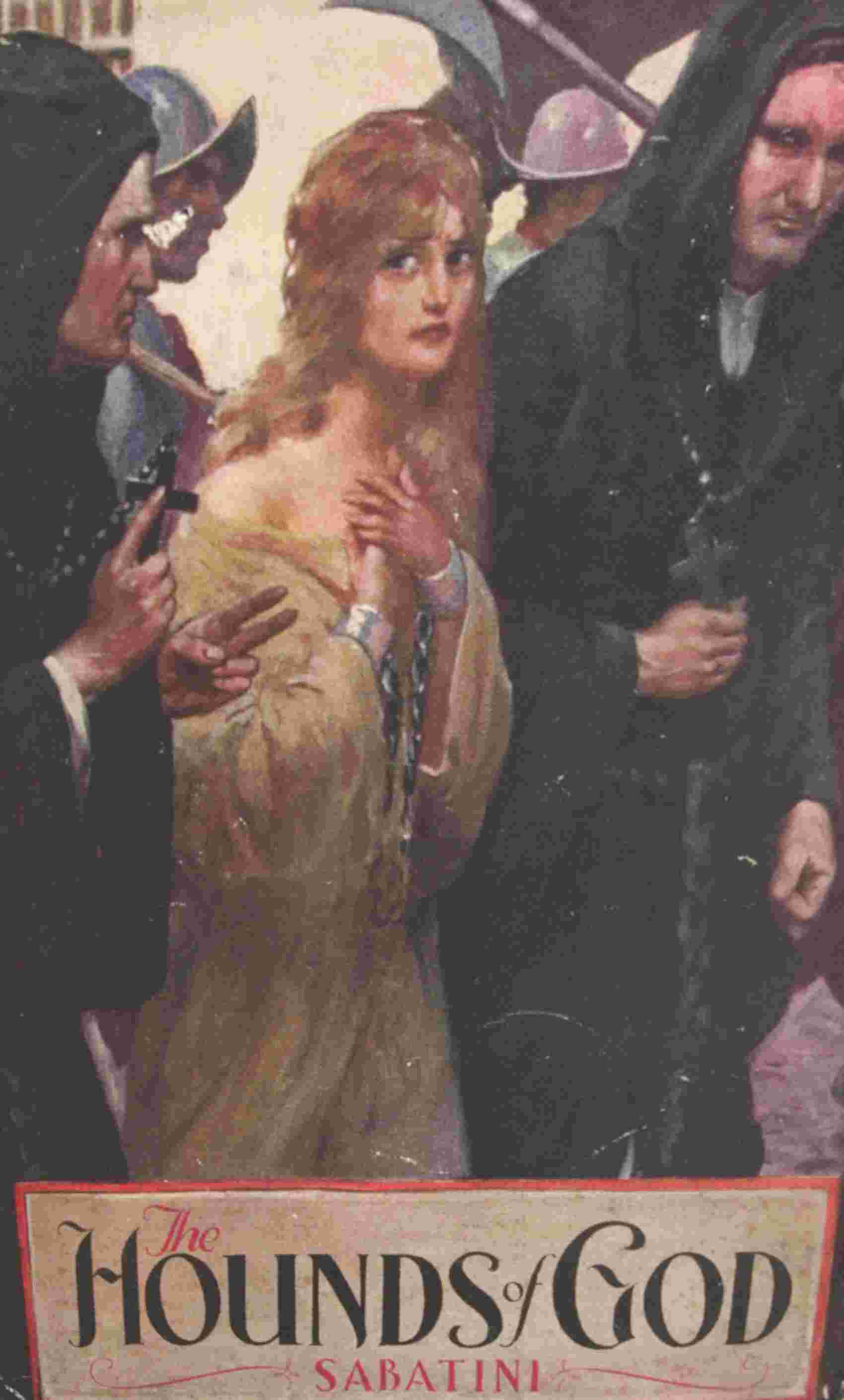
The haggard eyes of Sir Gervase scanned their ranks. Knowing nothing of the distinctions made and indicated by the signs upon the zamarra, he did not realize that these were penitents who, guilty of comparatively light offences, went to be reconciled and pardoned with the imposition of penances of varying severity. Suddenly his eyes alighted upon a countenance he knew: a narrow, handsome face with a peaked black beard and fine eyes which, looking straight before him, reflected now something of the agony within his soul.
Sir Gervase sucked in his breath. The scene before him was momentarily blotted out. In its place he beheld an arbour set above a rose-garden, and seated there a very elegant, mocking gentleman with a lute in his lap, a lute which Sir Gervase dashed to the ground. He heard again the level, mocking voice:
‘You do not like music, eh, Sir Gervase?’
Then the scene melted into another: A sweep of lawn shaded by a quickset hedge, by which a golden-headed girl was standing. This same gentleman bowing to him with a false urbanity, and proffering him the hilt of a sword. Again that same pleasant voice: ‘Enough for to-day. To-morrow I will show you how the estramaçon is to be met and turned.’
He was back again in the Zocodover at Toledo. The figure which had raised these visions was abreast of him. He craned to look, and caught something of the agony in the man’s face, conceived something of what it must cost him to be thus paraded, was taken even with pity for him, imagining that he went to his death.
The penitents passed, and in their wake stalked another posse of soldiers of the Faith.
Then, borne aloft, dangling from long green poles, their limbs jerked hither and thither as in the movements of some idiotic dance, or as if with the spasmodic twitchings of the hanged, came a half-dozen full-sized effigies in grotesque caricature of life. These figures of straw were arrayed in yellow zamarras smeared with tongues of fire and with horrid images of devils and dragons, and they were crowned by the coroza, the yellow mitre of the condemned. On their faces of waxed linen were figured bituminous eyes and scarlet, idiotic lips. Grotesque and horrible they passed. They were the effigies of contumaciously absent offenders which were to be burnt, pending the capture of the originals, and of others who after death had been discovered guilty of heresy: of these followed now the poor earthly remains. Porters came staggering under the exhumed coffins which were to be given to the flames jointly with the effigies.
The baying of the mob, which had died down after the passing of the penitents, now rose again with an increased ferocity. Gervase saw women crossing themselves and men craning forward with an interest grown overwhelming.
‘Los relapsos!’ was the cry, meaningless to him.
On they came, those poor wretches who had relapsed and for whom there was no reconciliation, and those who were in the same case because obstinate in their heresy. There were but six of them; but all six were doomed to the fire. They advanced singly, each one between two Dominicans, who were still exhorting them to repent and win at least the mercy of strangulation before being burnt in fires which otherwise must be but a prelude to eternal flames.
But the crowd, less pitiful, entirely pitiless, indeed, in its perfervid devotion to the most pitiful of all religions, roared foul abuse, demoniac mockery, ordures of insult at those anguished unfortunates who were passing to the flames.
The first of them was a stalwart aged Jew; a misguided fellow, who perhaps for the sake of temporal profit, so as to overcome the barriers so calculatedly erected against the worldly advancement of the Israelite, so as to earn the right to continue in the land in which his forefathers had been established for centuries before the crucifixion, had accepted baptism and embraced Christianity. Later, his conscience stirring against this apostasy from the Mosaic Law, he had secretly relapsed into Judaism, to be discovered, haled before the dread tribunal of the Faith, tortured into confession, and then condemned. He dragged himself painfully along in his hideous livery of infamy, his yellow zamarra and coroza bedaubed with flames and devils. A band of iron passed about his neck held a wooden apple in his mouth to gag him. But his eyes remained eloquent of his scorn as he flashed them upon the howling bestial Christian mob.
He was followed by one even more pitiful. A young Morisco girl of ravishing beauty stepped along with light and tripping movements of her graceful limbs; she seemed almost to be treading a measure as she came. Her long black hair, escaped from her yellow mitre, hung about her shoulders like a mantle. And as she went, she paused ever and anon, and, leaning a hand upon the shoulder of the gaunt Dominican beside her, she would throw back her body and laugh with the wild abandoned joy of a drunken woman. Her mind had given way.
Next came a terror-stricken youth who was half-carried along by his guards, a dazed woman half-swooning, and two men in middle life so broken by torture that they could hardly crawl.
After these followed another double file of monks, and after them again a military rearguard akin to that which had headed the procession. But the details now entirely escaped Gervase. He had suddenly realized that Margaret was not among the condemned. Relief at this and renewed anxiety, springing from his ignorance of her real condition, shut out the scene around him.
Anon he remembered a glimpse of the great scaffold, the Inquisitor-General in the tribune; the condemned ranged on the tiers to the right, the effigies dangling above the topmost places; the nobles and clergy on the benches opposite; a Dominican preaching from the pulpit facing the condemned.
The remainder of the Auto was afterwards a confused dream-memory: the ritual of the Mass, the chanting of choristers, and the clouds of incense rising above the altar surmounted by its great green cross; then the figure of the notary standing to read from a long scroll, his voice inaudible at the distance at which Gervase was placed; the movement of the apparitors, bringing the condemned from their benches and surrendering them to the Corregidor and his men—the representatives of the secular arm—who waited at the foot of the great scaffold to mount them on donkeys, and so hurry them away under guard, each with a Dominican in attendance; the howls of execration from the mob; and lastly, the stately return of that procession by the way it had come.
As it passed, the human torrent broke the dam that had so long confined it; the barricades, no longer guarded, yielding to pressure, were broken down and swept away, and the crowd swirled in on both sides and filled the street.
The alguazil touched Sir Gervase on the arm. ‘Come,’ he said.
CHAPTER XXIV.
RECOGNITION
The Auto de Fé was over. The reconciled had been reconducted to the Holy House, where upon the morrow measures would be taken for the enforcement of the penances to which they were sentenced. The condemned had been hurried away to the meadows by the river, beyond the walls. There at La Dehesa, beside the swirling Tagus, in view of the smiling countryside beyond the river, that lovely peaceful amphitheatre enclosed by hills, a great white cross had been reared as the symbol of mercy. About it were the stakes, the faggots piled, and there, Christi nomine invocato, the work of the Faith was brought to an end in smoke and ashes. The crowd had followed to attend the closing scene of that great show, and was again kept within bounds by a stout barricade guarded by men-at-arms. But the majority of those who had taken active part in the Auto had returned with the reconciled to the Holy House.
The Cardinal-Archbishop was back in his palace, disrobing, his mind at peace at last so far as his nephew was concerned. The course which he had advocated to Frey Juan Arrenzuelo had in the end been adopted. Don Pedro had been sentenced upon the depositions of Frey Luis. He was condemned to pay a fine of a thousand ducats into the treasury of the Holy Office and to attend Mass barefoot, clad only in his shirt and with a rope about his neck, every day for a month in the Cathedral of Toledo, at the end of which his offence would be accounted purged, and absolution and reinstatement would follow.
The case against the woman might now proceed strictly in accordance with inquisitorial duty and inquisitorial practice, and, whether as a witch or merely as a heretic, she would undoubtedly be burnt when they came to hold the next Auto de Fé. That, thought the Cardinal, was no longer a matter of sufficient importance to cause him any preoccupation.
But in this conclusion he was proven hasty. Within half an hour of his return to the palace, Frey Juan Arrenzuelo came in agitation to seek him.
He brought news that already Frey Luis Salcedo was protesting openly against the order observed, which he denounced for an illegality. The sentence upon Don Pedro, Frey Luis was asserting, had been based upon matters which must remain presumptuous until established by the condemnation of the woman as a witch. He desired to know—demanded to know—what course would be adopted if torture should fail to wring from the woman the necessary admission of her necromantic practices.
Arrenzuelo had sought to pacify him with the reminder that he might well wait until the situation which he feared arose; at present all his protests were in the realm of speculation.
‘The realm of speculation!’ Frey Luis had laughed. ‘Was it not in the realm of speculation that sentence was passed upon Don Pedro, so as to enable him to escape the graver punishment which may yet be his due?’
He had said this in the presence of a considerable audience in the Holy House, and it was impossible not to perceive the threat which he implied, and also the fact that his zeal and vehemence had impressed many of those who overheard him into sympathy with his views.
The Cardinal was deeply annoyed. But he was of a wisdom which bade him put aside annoyance which could not serve him in dealing with one who was supported by right. He considered deeply for some moments, saying no word to betray his real chagrin.
At last he permitted himself a smile of much gentleness and some craft.
‘Word comes to me from Segovia that the Inquisitor of the Faith there is so ill that a successor must be appointed. I shall confer the appointment on Frey Luis Salcedo to-day. His zeal and rigid honesty would seem eminently to qualify him. He shall leave for Segovia at once.’
But the suggestion in which the Cardinal conceived that he had found the solution of his difficulty had the effect of visibly terrifying Frey Juan.
‘He will see in that an attempt to remove an awkward testifier to the truth, an attempt to bribe him into silence. He will become a devastating flame of righteous anger which nothing afterwards will quench.’
The Cardinal perceived the truth of this, and stared blankly. All, then, was to be rendered vain by this impetuous friar unless torture could wring the requisite confession from the woman. That was now his only hope.
A secretary entered unbidden at that moment. Irritably the Cardinal waved him away.
‘Not now! Not now! You interrupt us.’
‘On the King’s business, Eminence.’ And in answer to the Cardinal’s change of countenance, the secretary informed him that alguaziles of the Holy Office had brought in a man who excused himself for bearing arms in such a place at such a time on the ground that he was a messenger from the King with a letter for the Inquisitor-General, which he was to deliver in person.
Still travel-stained, haggard, and unshaven, Sir Gervase was introduced, a man worn almost to the last strand of endurance. His eyes, blood-injected from sleeplessness, seemed to have receded into his head; they shone with an unnatural glassy brightness amid the dark shadows that surrounded them. He lurched in his step as he now advanced.
The Cardinal, a humane man, observed these signs. ‘You have ridden hard, sir,’ he said between question and assertion.
Sir Gervase bowed, and presented his letter. The Cardinal took it.
‘Give him a seat, Pablo. He is in no case to stand.’
Gratefully the Englishman slid into the chair to which the Cardinal waved him and which the secretary advanced invitingly.
His Eminence broke the royal seal. As he read, the cloud of care lifted from his brow. The eyes which he raised to look across the top of the royal parchment at Frey Juan were alight with relief, almost with laughter.
‘Heaven, I think, has intervened,’ he said, and passed the sheet to the Dominican. ‘The woman is abstracted from the care of the Holy Office by royal command. She need preoccupy us no further.’
But Frey Juan Arrenzuelo frowned as he read. The woman might not be a witch, but she was still a heretic, a soul to be saved, and he resented this royal intervention in what he accounted the affairs of God. At another time the Inquisitor-General would have shared that just resentment, and would not have relinquished this heretic without a struggle and a stern reminder to His Majesty that he intervened at his peril in matters of the Faith. But at present the command came so opportunely to solve all difficulties, to rescue the Inquisitor-General even from a possible accusation of nepotism, that, as he pondered it, His Eminence smiled. Before that smile, so placid and beatific, Frey Juan bowed his head, and stifled the protests which were rising to his lips.
‘If you will confirm this, Eminence, in your quality as Inquisitor-General of the Faith, the prisoner shall be surrendered.’
Subtly thus he reminded Cardinal Quiroga that the King transcended his royal and strictly secular authority. Cardinal Quiroga, very grateful for that royal presumption, dictated at once his confirmation to the secretary, signed it, and delivered it to the inquisitor that he might attach it to the royal letter.
Then he turned his glance again upon Sir Gervase. ‘Who are you, sir, into whose charge the prisoner is to be consigned?’
Sir Gervase got to his feet, and answered him. He gave his name and announced that he had followed from England with a letter from the Queen.
‘An Englishman?’ said His Eminence, raising his brows. Here, no doubt, was another heretic, he thought. But he shrugged. After all, the matter was out of his hands, and he was very glad to be rid of it. He had no reason for anything but thankfulness towards this hard-worn messenger.
He offered him refreshment, of which he appeared to stand so sorely in need, whilst the prisoner was being brought to the palace from the Holy House. When inquisitorial duty permitted it, there was no more humane gentleman in Spain than this Cardinal-Archbishop of Toledo. Gervase accepted gratefully, having heard Frey Juan dismissed with instructions to send the prisoner at once to the palace, and Frey Juan’s reply that it should be done within the hour, so soon as the necessary formalities were satisfied and record made of the royal command concerning her.
Two familiars of the Holy Office conducted her from her cell. She imagined that she was being led to another of those exasperating audiences that made a mockery of justice. Instead, she found herself conducted across the great hall to the great double doors that opened upon the street. The postern was set wide for her by one of the familiars, and she was waved out by the other, who followed.
Before the door stood a mule-litter, which they motioned her to enter. She looked about her, hesitating a moment. People were streaming through this as through other streets in numbers, dispersing after the consummation of the Auto. She desired to know what was intended by her. The novelty of the proceedings filled her with a fresh uneasiness. But having no Spanish it was impossible to ask questions. Being a woman, single-handed, weak, and helpless, it was even more idle to attempt resistance. She must wait to ascertain, and meanwhile command such patience as still remained in her.
She entered the litter, the leather curtains were closely drawn, and the mules went off briskly, guided by the man who rode the foremost, and escorted by some others which she had seen drawn up alongside and whose hooves she now heard clattering beside her.
At last the little cavalcade came to a standstill, the curtains parted again, and she was desired to alight. She found herself before an imposing building in the great square, across which fell now the shadow of the vast Cathedral cast there by the sinking sun.
In that shadow the air was chill, and she shivered as she stood there. Then the same familiars ushered her through double gates of wrought iron bearing great gilded escutcheons each surmounted by a cardinal’s hat with its array of tassels. Under a deep archway they came into a quadrangle where the ground was inlaid with mosaics and in the middle of which a fountain played. Across this at another door, guarded by two splendid men-at-arms in steel and scarlet, the familiars consigned her to a waiting chamberlain in black who bore a wand and about whose neck a chain was hung.
The mystery of it deepened. Had she fallen asleep in her cell, and was she dreaming?
This sleek black gentleman signed to her to follow him, and the familiars were left behind. They ascended a wide marble staircase flanked by a massive balustrade, rising from a hall that was hung with costly tapestries which Spain had no doubt filched from Flanders. They passed between another two men-at-arms, standing like statues at the stair-head, and along a corridor until the chamberlain halted at a door. He opened it, signed to her to enter, bowed as she passed him, and closed the door upon her when she had crossed the threshold.
Understanding nothing, she found herself in a small plain room. Its windows looked out across the courtyard through which she had passed to the opposite wall whose white surface was aglow in the last rays of the setting sun. A tall-backed chair was standing by a table that was topped with red velvet. Out of this chair a man rose now to startle her.
He turned to face her and the incredible became the impossible; even when he spoke her name, spoke it on a sob, and came lurching towards her with outheld hands, her brain refused to be seduced by this illusion. And then she was in his arms, she felt them coiled about her, and this ghost—this untidy, grimy, unshaven ghost—was kissing her hair, her eyes, her very lips. He was no ghost, then. He was real. The thought brought her a new terror. She thrust back from him as far as his embrace allowed.
‘Gervase! What are you doing here, Gervase?’
‘I’ve come for you,’ he answered simply.
‘You’ve come for me?’ She repeated the words as if they had no meaning.
A smile crossed the man’s weary face. His fingers fumbled at the breast of his doublet. ‘I had your note,’ he said.
‘My note?’
‘The note you sent me to Arwenack, asking me to come to you. See. Here it is.’ He drew it forth, a very soiled and crumpled scrap. ‘When I got to Trevanion Chase, you’d gone. So… so I followed; and I’m here to take you home.’
‘To take me home? Home?’ She could almost inhale the perfume of the moors.
‘Yes. All is arranged. This Cardinal is very good.… The escort waits. We go… Santander, and there Tressilian stays for us with his ship.… All arranged.’
His senses were swimming, he staggered as he held her, might indeed have fallen but for his hold of her. And then she said words which revived and renewed his strength as not even the Cardinal’s wine had been able to do.
‘Gervase! You wonderful, wonderful Gervase!’ Her arms tightened about his neck as if she would have choked him.
‘I knew you would find it out one day,’ he said weakly.
THE END
TRANSCRIBER’S NOTES
Minor spelling inconsistencies (e.g. lovelorn/love-lorn, trumpet call/trumpet-call, unmistakeable/unmistakable, etc.) have been preserved.
Alterations to the text:
Abandon the use of drop-caps.
Punctuation: fix a few quotation mark pairings/nestings.
[Chapter VII]
Change “increased the fresh young comeliness of his apppearance” to appearance.
[Chapter XVII]
“the fact that the Inquisitor, General Don Gaspar de Quiroga” to Inquisitor-General.
[Chapter XVIII]
“Neverthless, he waved back the familiars who had already” to Nevertheless.
[Chapter XIX]
“held the sheet tremble vioiently as if suddenly palsied” to violently.
[Chapter XX]
“The Concepcion which Don Pedro de Mendoza had commanded” to Concepción.
[Chapter XXIII]
“spoke with an accent that rendered him almost imcomprehensible” incomprehensible.
[End of text]