
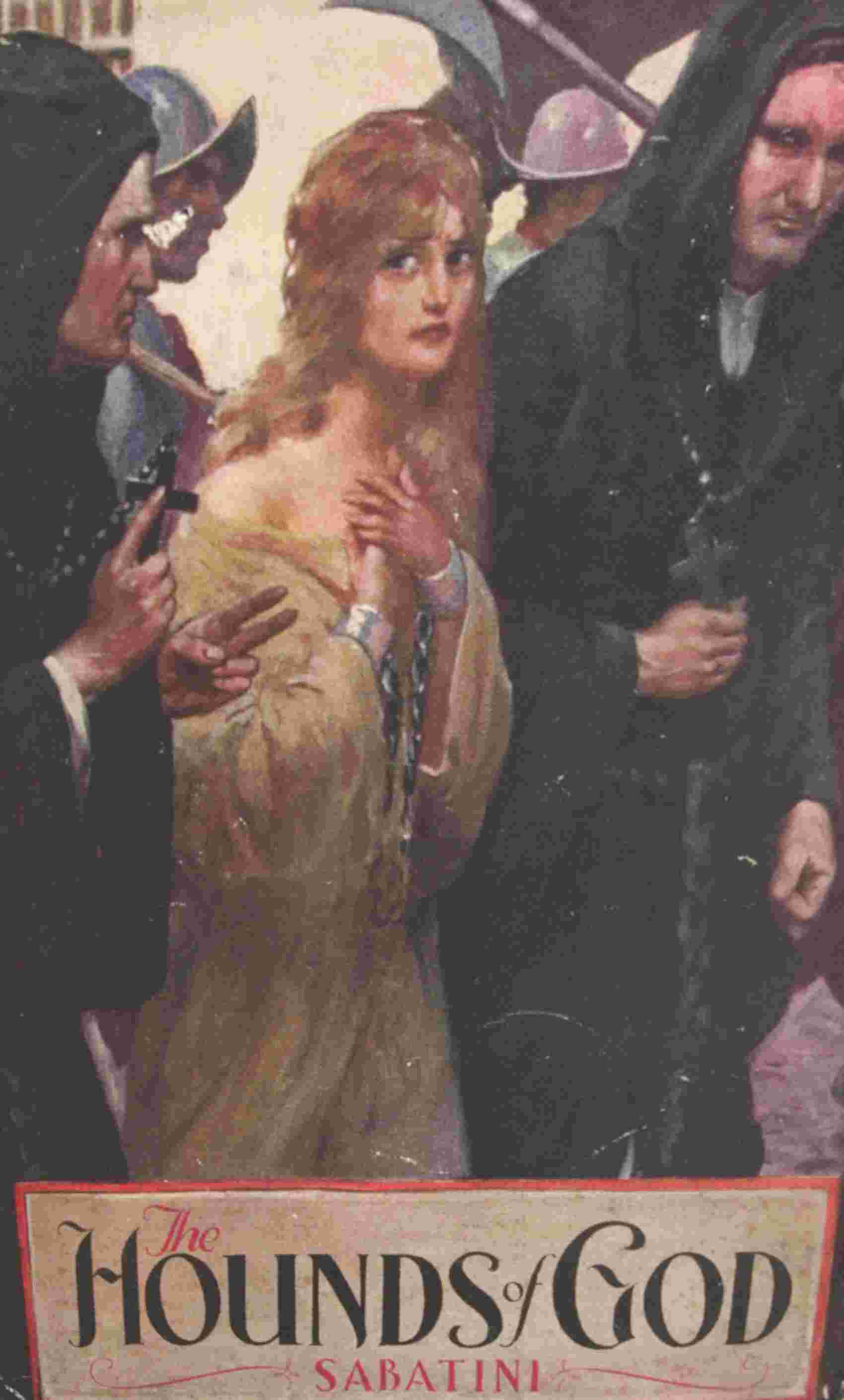
The Project Gutenberg eBook of The hounds of God
Title: The hounds of God
A romance
Author: Rafael Sabatini
Release date: December 15, 2025 [eBook #77465]
Language: English
Original publication: Boston: Houghton Mifflin Company, 1928
Credits: an anonymous Project Gutenberg volunteer
THE HOUNDS OF GOD
A Romance
BY
RAFAEL SABATINI
BOSTON AND NEW YORK
HOUGHTON MIFFLIN COMPANY
The Riverside Press Cambridge
[COPYRIGHT]
COPYRIGHT, 1928, BY RAFAEL SABATINI
ALL RIGHTS RESERVED, INCLUDING THE RIGHT TO REPRODUCE
THIS BOOK OR PARTS THEREOF IN ANY FORM
CONTENTS
XXI. The Cardinal’s Conscience
THE HOUNDS OF GOD
CHAPTER I.
THE MISANTHROPE
It was Walsingham who said of Roger Trevanion, Earl of Garth, that he preferred the company of the dead to that of the living.
This was a sneering allusion to the recluse, studious habits of his lordship. His lordship, no doubt, would have regarded the sneer as a thunderbolt of lath; that is, if he regarded it as a thunderbolt at all. It is much more likely that he would have accepted the statement in its literal sense, admitted the preference and justified it by answering that the only good men were dead men. This because, being dead, they could no longer work any evil.
You conceive that the experience of life which brings a man to such a conclusion cannot have been pleasant. His misanthropy dated from his adolescence, arose out of his close friendship for the gallant Thomas Seymour, who was brother to one queen and husband to another, and who, under the spur of ambition and perhaps indeed of love, would, upon the death of Katherine Parr, have married the Princess Elizabeth. As Seymour’s devoted and admiring friend, he had seen at close quarters the slimy web of intrigue in which the Lord Admiral was taken, and he had narrowly escaped being taken with him and with him sent to the block. He had witnessed the evil working of the envious ambition of the Protector Somerset, who, fearful lest fruition of the affair between the Lord Admiral and the Princess should lead to his own ultimate supersession, had not scrupled to bring his own brother to the scaffold upon a fabricated charge of high-treason.
It was pretended that the Admiral was already the lover of the Princess and that he conspired with her to overthrow the established regency and to seize the reins of power with his own hands. Indeed, the full pretence was that his courtship of the Princess was no more than a step in the promotion of his schemes. The two offences were made so interdependent that either might be established upon evidence of the other.
Young Trevanion suffered arrest, together with all the principal persons in the household of the Princess Elizabeth, and all who were in close relations with the Admiral, whether as servants or as friends. Because he was at once a member of the household of the Princess and probably more in Seymour’s confidence than any other man, he became the subject of assiduous attention on the part of the Council of Regency. He was brought repeatedly before that council, examined and reëxamined, questioned and probed ad nauseam, with the object of tricking him into incriminating his friend by admissions of what he had seen at Hatfield whilst living there and of what confidences his friend might have reposed in him.
Although years later, when the admission could do no harm to any, his lordship is known to have confessed that the Admiral’s passion for the young Princess was very real and deep with roots in other than ambition, and that once at Hatfield he had surprised her in the Admiral’s arms—from which it may reasonably be concluded that she was not indifferent to his passion, yet before the Council, young Trevanion could remember nothing that might hurt his friend. Not only did he stubbornly and stoutly deny knowledge, direct or indirect, of any plot in which Seymour was engaged; but, on the contrary, he had much to say that was calculated to prove that there was no substance whatever behind this shadow of treason cast upon the Admiral. By his demeanour he put the members of the Council in a rage with him on more occasions than one. It was an education to him of the lengths to which human spite can go. The Protector, himself, went so far once as to warn him savagely that his own head was none so safe on his shoulders that by pertness of words and conduct he should himself unsettle it further. Their malevolence, begotten as he perceived of jealous fear, made these men, whom he had accounted among the noblest in England, appear despicable, mean, and paltry.
Under the shadow of that malevolence, Trevanion was sent to the Tower, and kept there until the day of Seymour’s execution. On that blustering March morning, he was granted a favour which he had not ventured to solicit; he was conducted to the chamber in which his doomed friend was imprisoned and left alone with him to take his leave.
He was one-and-twenty at the time, an age in which life is so strong in a man and death so abhorrent that it is almost terrifying to look upon another who is about to die. He found the Admiral in a state of composure which he could not understand, for the Admiral too was still young, scarcely more than thirty, tall, vigorous, well-made, and handsome. He sprang up to greet Trevanion almost gladly. He talked volubly for the few moments they were together, scarcely allowing the younger man to interject a word. He touched almost tenderly upon their friendship, and, whilst moved by Garth’s sorrow, desired him to be less glum, assured him that death was no great matter once you had brought yourself to look it in the face. He had taken a full leave, he announced, of the Lady Elizabeth, in a letter which he had spent most of the night in writing to her; for although denied pen and ink by the Lords of the Council, he had plucked an aglet from his hose and contrived to write with that, and with the ink supplied by his own veins. This letter, he told Trevanion, speaking boldly and loudly, was concealed within the sole of his shoes, and a person of trust would see to its safe delivery after he was gone. There was an odd smile on his lips as he made the announcement, a singular slyness in his fine eyes, which puzzled Trevanion at the time.
They embraced and parted, and Trevanion returned to his own prison to pray for his friend and to resolve the riddle of that unnecessary and indeed incautious confidence touching the letter in his shoes. Later he understood.
With the knowledge of men which the Admiral possessed, he had been quick to conclude that it was out of no kindly feelings Trevanion had been permitted to pay him this last visit. It was the hope of the Lords of the Council that Seymour might seize the opportunity to send some message to the Princess which would be incriminating in character, and their spies were posted to overhear and report. But Seymour, guessing this, had taken full advantage of it to inform them of the existence of letters which he desired them to find, letters which had been written so that they might be found, couched in such terms that their publication must completely vindicate the Princess.
That was the last act of Seymour’s devotion. Although the letters were never published, they may have done their work by limiting the persecution to which the Lady Elizabeth was thereafter subject. But the jealous spite which had spilled Seymour’s blood left the honour of the Princess besmirched by the foul tales that were current of her relations with the Admiral.
It was Trevanion, himself, some months later, after his release and when about to withdraw from the scene of events which had killed his faith in men, who, in going to take his leave of the Princess Elizabeth, informed her of the letter. And that slim girl of sixteen, with a sigh and a sad smile that would have been old on a woman twice her years, had repeated, perhaps in a different tone, the cautious words she had used of the Admiral on an earlier occasion.
‘He was a man of much wit but very little judgment. God rest him!’
It was perhaps because he accounted this requiem so inadequate that, when she would have had him resume his place in her household, he was glad to be able to answer her that this the Lords of the Council had already expressly denied him. Besides, his one desire was to remove himself from the neighbourhood of the Court. He had been through the valley of the shadow, and he had been permitted to perceive the vile realities, the unscrupulous ambitions, the evil greed, the unworthy passions festering under the fair surface of Court life. It had filled him with loathing and disgust, and had put a definite end to all courtly aspirations in himself.
He withdrew to his remote Cornish estates, there to devote himself to husbandry and to the care of his people, matters which his father and grandfather had entrusted to their stewards. Nor was he to be lured thence by an invitation from the Princess Elizabeth when she became queen and desired to reward those who had served her in her time of tribulation.
He married, some ten years later, one of the Godolphins, a lady of whom repute says that she was so beautiful that to behold her was to love her. If that is true of her, it would appear to be the only commendation she possessed. She was destined to carry the disillusioning of the Earl of Garth yet a stage farther. A foolish, empty, petulant creature, she made him realize once again that the fairest skin may cover the sourest fruit, whereafter she departed this life of a puerperal fever within a fortnight of the birth of their only child, some five years after their ill-matched union.
Just as his one glimpse below the surface of Court life had sufficed him, so his one experience of matrimony surfeited him. And although only thirty-six at the time of her ladyship’s death, he undertook no further adventures in wedlock, nor indeed adventures of any kind. He was soul-weary, a distemper that not infrequently attacks the thoughtful and introspective. He took to books, by which he had always been attracted; he amassed at Trevanion Chase a prodigious library, and as the years slipped by, he became more and more interested in the things that had been and the things which philosophy taught him might be, and less in those that actually were. He sought by study to probe the meaning, purpose, and ultimate object of life, than which there is no pursuit likelier to alienate a man from the business of living. He became more and more aloof, took less and ever less heed of events about him. The religious dissensions by which England was riven left him unmoved. Not even when the menace of Spain hung like a black cloud over the land, and everywhere men were arming and drilling against the day of invasion, did the Earl of Garth, now well-advanced in years, awaken to interest in the world in which he lived.
His daughter, who had been left more or less to bring herself up as she chose, and who by a miracle had accomplished the task very creditably, was the only living person who really understood him, certainly the only one who loved him, for you conceive that he did not invite affection. She had inherited a considerable portion of her mother’s good looks, and most of the good sense and good feeling that had distinguished her father in his youth, with just enough of her mother’s perversity to give a spice to the mixture. If she reached—as she eventually did—the age of twenty-five unmarried the fault was entirely her own. There had been suitors to spare at any time after her seventeenth year, and their comings and goings at times had driven his lordship to the verge of exasperation. She was credited with having broken several hearts. Or, to put it more happily, since that untruly implies an undesirable activity on her part, several hearts had been broken by her rejection of their infatuated owners. She had remained as impassive as one of the rocks of that Cornish coast against which ships might break themselves if hard-driven by weather or ill-handled.
She loved her liberty too well to relinquish it. Thus she informed her suitors. Like the Queen, she was so well satisfied with her maiden estate that she accounted it the best estate in the world and was of no mind to change it for any other.
This was no mere pretext upon which mercifully to dismiss those wooers who did not commend themselves. It was, there is every reason to believe, the actual truth. The Lady Margaret Trevanion had been reared, as a result of her father’s idiosyncrasies, in masculine freedom. Hers from the age of fifteen or sixteen to come and go unquestioned; horses and dogs and hawks had engrossed her days; she was as one of the lads of her own age with whom she associated; her frank boyishness kept her relations with them on exactly the same plane as that which marked the association of those boys with one another. If the advent of her first suitor when she had reached the age of seventeen produced the result of setting a check upon her hoydenishness, arousing her to certain realities and imposing upon her thereafter a certain circumspection, she did not on that account abandon her earlier pursuits or the love of personal liberty which their free indulgence had engendered in her. The odd thing is that she was nowise coarsened by the masculinity with which her unusual rearing had invested her. Just as the free and constant exercises of her tall, supple body appeared but to have enriched it in feminine grace, so the freedom of mental outlook upon which she had insisted had given her a breadth and poise of mind from which she gathered a dignity entirely feminine, as well as command over herself and others. She afforded perhaps a remarkable instance of the persistence of inbred traits and how they will assert themselves and dominate a character in despite of environment and experience.
At the time at which I present her to you she had reached her twenty-third year firmly entrenched in her maidenhood; and, with the plainly asserted intention of remaining in that estate, she had so far successfully discouraged all suitors but one. This one was an amiable lad named Gervase Crosby, of a considerable Devon family, a kinsman to Lord Garth’s neighbour, Sir John Killigrew of Arwenack, and a persistent fellow who could not take ‘no’ for an answer. He was a younger son with his way to make in the world, and Killigrew, a bachelor, with no children of his own, had taken an interest in him and desired to promote his fortunes. As a result of this the boy had been much at Arwenack, that stately castellated house above the estuary of the Fal. Killigrew was closely connected with the Godolphins, and therefore looked upon the Earl of Garth as a kinsman by marriage and upon Margaret as a still closer kinswoman on the maternal side. He was one of the few among the surrounding gentry who ventured freely to break through the seclusion in which the old earl hedged himself about, and who was not to be discouraged by the indifference of his welcome at his lordship’s hands. It was under his ægis that young Crosby was first brought to Trevanion Chase, when a well-grown, handsome lad of sixteen. Margaret liked him and used him with a frank, boyish friendliness which encouraged him to come there often. They were much of an age, and they discovered a similarity in tastes and an interest in the same pursuits which made them fast friends.
Killigrew, after much deliberation, had resolved that his young kinsman should study law, with a view to a political career. He argued that if young Crosby’s brains were any match for his long, comely body there should be a brilliant future for him at the Court of a queen who was ever ready to promote the fortunes of a handsome man. Therefore he brought tutors to Arwenack and set about the lad’s education. But, as often happens, the views of young and old did not here coincide. Crosby was of a romantic temperament, and he could perceive no romance in the law, however much Killigrew might labour to demonstrate it for him. He desired a life of adventure; to live dangerously was in his view the only way to be really alive.
The world was still ringing with the echoes of the epic of Drake’s voyage round the globe. The sea and the sailor’s opportunity to probe the mysteries of the earth, penetrating uncharted oceans, discovering fabulous lands, called him; and finally Killigrew yielded, being wise enough to perceive that no man will make a success of a career in which his heart is not engaged.
Sir John took the boy to London. That was in 1584, just after his twentieth birthday. Before setting out upon that voyage of adventure, Gervase had desired to establish moorings at home against his return, and he had offered himself, heart and hand and the fortune which he was to make, to the Lady Margaret.
If the offer did not dazzle her ladyship, it certainly startled her. From their fairly constant association she had come to regard him almost as a brother, had come to permit him those familiarities which a sister may permit, had even upon occasion allowed a kiss or two to pass between them with no more than sisterly enthusiasm. That, unsuspected by her, there should have been anything more than brotherliness on his part seemed ludicrous. She said so, and brought down upon herself a storm of reproaches, pleadings, and protestations which soared in moments to heights of terrifying vehemence.
The Lady Margaret was not terrified. She remained calm. The self-reliance which her rearing had imposed upon her had taught her self-control. She took refuge in that phrase of hers about her preference for a maiden estate. What was good enough for the Queen, she announced, was good enough for her, as if making of virginity a point of loyalty.
Shocked and dejected, Gervase went to take his leave of her father. His lordship, who had just discovered Plato and was absorbed in that philosopher’s conception of the cosmos, desired to cut these valedictions short. But Gervase deemed it incumbent upon him to enlighten the Earl on the subject of his daughter’s unnatural views of life. No doubt he hoped, with the irrepressible optimism of the young, to enlist his lordship’s aid in bringing her ladyship to a proper frame of mind. But his lordship, irritated perhaps by the interruption, had stared at him from under shaggy eyebrows.
‘If she chooses to lead apes in hell, what affair is that of yours?’
If Master Crosby had been shocked already by the daughter’s attitude towards what he accounted the most important thing in life, he was far more deeply shocked by her sire’s. This, he thought, was a nettle to be grasped. So he grasped it.
‘It is my affair because I want to marry her.’
The Earl maintained his disconcerting level stare. He did not even blink.
‘And what does Margaret want?’ he asked.
‘I have told your lordship what she says she wants.’
‘Since she says what you say she says, I wonder that you think it worth while to trouble me.’
This would have discouraged any young man but Gervase Crosby. He drew a swift, shrewd inference favourable to himself. I suspect that Killigrew had good reasons besides the lad’s looks and inches for intending him for the law, just as I suspect that a good lawyer was lost in him when he took to the sea.
‘Your lordship means that I deserve your approval, and that if I can bring Margaret to a change of views…’
‘I mean,’ his lordship interrupted him, ‘that if you bring Margaret to a change of views, I will then consider the situation. It is not my habit to deal with more than I find before me, or to plague myself over possibilities which may never become realities. It is a habit which I commend to you now that you are about to go forth into the world. Too much good human energy is wasted in providing for contingencies that never arise. I make you in these words, if you will trouble to bear them in your memory, a parting gift of more value than you may at present discern. I shall hope to hear of your good fortune, sir.’
Thus the misanthrope dismissed the lover.
CHAPTER II.
THE LOVER
Mr. Crosby’s bearing was marked upon his departure from Arwenack by none of that exultation proper to the setting out of a young man who regards the world as his oyster. Too much that he valued was being left behind unsecured; and the Earl, he could not help admitting to himself, had not been encouraging. But what youth desires, it believes that it will ultimately possess. His confidence in himself and in his star was restored and his natural buoyancy reëstablished long before the journey was accomplished.
Travelling by roads which were obstacles to, rather than means of progress, Sir John Killigrew and his young cousin reached London exactly a week after setting out. There no time was lost. Sir John was a person of considerable consequence, wielding great influence in the West and therefore to be well received at Court. Moreover, some personal friendship existed between himself and the Lord Admiral Howard of Effingham. To the Admiral he took his young cousin. The Admiral was disposed to be friendly. Recruits for the navy at such a time, especially if they happened to be gentlemen of family, were more than welcome. The difficulty was to find immediate employment for Mr. Crosby. The Admiral took the young man to Deptford and presented him to the manager of Her Majesty’s dockyards, that old-time slaver and hardy seaman Sir John Hawkins. Sir John talked to the lad, liked him, admired his clean length of limb and read promise in his resolute young countenance and frank, steady blue eyes. If he was in haste for adventure, Sir John thought he could put him in the way of it. He gave him a letter to his young kinsman, Sir Francis Drake, who was about to put to sea from Plymouth, though on the object of that seagoing Sir John seemed singularly—perhaps wilfully—ignorant.
Back to the West went Gervase, once more in the charge of Killigrew. At Plymouth they sought and duly found Sir Francis. He paid heed to the strong recommendation of Hawkins’s letter, still greater heed to the personality of the tall lad who stood before him, some heed also, no doubt, to the fact that the lad was a kinsman of Sir John Killigrew, who was a considerable power in Cornwall. Young Crosby was obviously eager and intelligent, knew already at least enough of the sea to be able to sail a fore-and-aft rig, and was fired by a proper righteous indignation at the evil deeds of Spain.
Drake offered him employment, the scope of which he could not disclose. A fleet of twenty-five privateers was about to sail. They had no royal warrant, and in what they went to do they might afterwards be disowned. It was dangerous work, but it was righteous. Gervase accepted the offer without seeking to know more, took leave of his kinsman, and went on board Drake’s own ship. That was on the 10th September. Four mornings later, Drake’s maintop was flying the signal ‘up anchor and away.’
If none knew, perhaps not even Drake himself, exactly what he went to do, at the least all England, simmering just then with indignation, knew why he went to do it, whatever it might prove to be. There was a bitter wrong to be avenged, and private hands must do the work, since the hands of authority were bound by too many political considerations.
In the North of Spain that year the harvest had failed and there was famine. Despite the hostile undercurrent between Spain and England, which at any moment might blaze into open war, despite Spanish intrigues in which Philip II was spurred on by the Pope to exert the secular arm against the excommunicate bastard heretic who occupied the English throne, yet officially at least, on the surface, there was peace between the two nations. England had more corn than she required for her own consumption and was willing to trade it to the famine-stricken Galician districts. But because of certain recent barbarous activities of the Holy Office upon English seamen seized in Spanish ports, no merchant ships would venture into Spanish waters without guarantees. These guarantees had ultimately been forthcoming in the shape of a special undertaking from King Philip that the crews of the grain ships should suffer no molestation.
Into the northern harbours of Corunna, Bilbao, and Santander sailed the ships of the English corn-fleet, there to be seized, in despite of the royal safe-conduct, their cargoes confiscated, their crews imprisoned. The pretext was that England was lending aid to the Netherlands, then in rebellion against Spain.
Diplomatic representations were of no avail. King Philip disclaimed responsibility. The English seamen, he said, were no longer in his hands. As heretics they had been claimed by the Holy Office. To purge them of their heresy, some were left to languish in prison, some sent as slaves to the galleys, and some were burnt in fools’ coats at the autos-da-fé.
To rescue even those who survived from the talons of the Holy Office was beyond hope. It remained only to avenge them, to read Spain a punitive lesson which she should remember, a lesson which, it was hoped, would teach her to curb in future her zeal of salvation where English heretics were concerned.
The Queen could not act in her own name. For all her high stomach and for all the indignation which it is not to be doubted now consumed her, prudence still dictated that she should avoid with mighty Spain an open war for which England could not account herself prepared. But she was willing enough to give a free hand to adventurers, whom at need she could afterwards disown.
That was the reason of Drake’s setting forth with his twenty-five privateer ships. That was the voyage on which Gervase Crosby went to win his spurs in this new order of chivalry whose tilting-yard was the wide ocean. It was a voyage that lasted ten months; but so eventful, adventurous, and instructive did it prove that not in as many years of ordinary sailing could it have offered a man a more generous schooling in fighting seamanship.
They sailed first of all into the beautiful Galician port of Vigo at a time when the grapes were being gathered for the vintage, labours which their sudden appearance interrupted. And here Drake published, as it were, his cartel; he made known, inferentially at least, the aim and purpose of that imposing fleet of his. Of the Governor, who sent in alarm to know who and what they were who came thus in force and what they sought at Vigo, Drake asked to be informed whether the King of Spain was at war with the Queen of England. When he was fearfully assured that this was not the case, he asked further to be informed how it happened, then, that English ships which had sailed into Spanish harbour under the safe-conduct of King Philip’s word had been seized and their owners, officers, and crews imprisoned, maltreated, and slain. To this he received no proper answer. He did not press for one unduly; he contented himself with inviting the Governor to consider that English seamen could not suffer that such things should happen to their brethren. After that he demanded water and fresh provisions. There was also a little plundering, a mere ensample this of what might be done. Whereafter, with refurnished ships, Sir Francis sailed away, leaving Spain to conjecture in dismay and rage whither he was going and to concert measures for forestalling and destroying so endemonized an Englishman—inglez tan endemoniado.
November saw him at Cape Verde, where he missed the plate fleet upon which no doubt he had intentions. Its capture would have indemnified England for the loss of the confiscated corn. He turned his attentions, instead, to the handsome town of Santiago, possessed it, sacked it, and might have been content with that but for the barbarous murder and mutilation of a poor ship-boy, which revived memories of some Plymouth sailors lately murdered there. The town was fired, and Sir Francis sailed away leaving behind him a heap of ashes to show King Philip that barbarity was not the prerogative of Spain and that talion law existed upon earth and always would exist as long as there were men to enforce it. Let His Most Catholic Majesty learn that Christianity, whose particular champion he accounted himself, had for corner-stone the precept that men should do unto their neighbours as they would have their neighbours do unto them and, conversely, not do unto their neighbours what was detestable when suffered by themselves. Lest this King, who was so passionately concerned in the eternal salvation of others, should himself miss salvation through an inadequate appreciation of that great principle, Sir Francis meant to bring it strongly to his notice by further illustration.
The fleet spent Christmas at St. Kitts, and, having there refreshed itself, went to pay its respects to San Domingo, that magnificent city of Hispaniola, where as a monument to the greatness of Spain the grandeurs of the Old World were reproduced in palaces, castles, and cathedrals. Here things, without being difficult, were not quite so easy as at Santiago. The Spaniards turned out horse and foot to resist the landing of the English. There was some fighting, some cannonading, in the course of which the Spaniards killed the officer commanding the particular landing-party of which Gervase Crosby was a member. Gervase, eager and audacious, acting upon impulse and without any sort of authority, took his place, and skilfully brought up his men to join the vanguard under Christopher Carlile which carried the gate and cut its way into the town.
For his part in this, Gervase was afterwards commended by Carlile to Drake, and by Drake confirmed in the command which he had so opportunely usurped.
The castle meanwhile had surrendered, and the English put the city to ransom. Its treasure had already been removed out of it, and all that Drake could extract from the Governor was twenty-five thousand ducats, nor did he succeed in extracting this until he had reduced nearly all its marble splendours to ruins.
After San Domingo came Cartagena, where a tougher resistance was encountered, but subdued, and where again young Gervase Crosby showed his mettle when he led the men of his recent command to scale the parapets and engage the Spanish infantry at point of pike. The captured city saved itself from the fate of Santiago and San Domingo by a promptly forthcoming ransom of thirty thousand ducats.
That was enough for the purpose; enough to show King Philip that the activities of the Holy Office were not meekly to be suffered by English seamen. Destroying in passing a Spanish fort in Florida, Drake’s fleet set sail for home and was back in Plymouth by the end of July, having proved to all humanity that the mightiest empire of the world was by no means invulnerable, and having apparently made war inevitable by throwing down a gauntlet which the hesitating King of Spain could hardly ignore.
The Gervase Crosby who came back to Arwenack was a very different person from the Gervase Crosby who had gone forth a year ago. Adventure and experience had ripened him, dangers faced and conquered, and an increase of general knowledge, which included a fair command of Spanish, had given him a calmer self-assurance. Also he was bronzed and bearded. He came in confidence to Trevanion Chase, conceiving that the capture of the Lady Margaret would prove now a trifling matter to one who had been at the capturing of Spanish cities. But the Lady Margaret manifested no enthusiasm for his deeds, when, for her benefit and in her presence, he recounted them to the Earl, who had no wish to hear them. When his lordship had heard them despite himself, he curtly pronounced Drake a shameless pirate, and, in the matter of the hanging of some monks at San Domingo, a murderer. His daughter agreeing with him, Master Gervase departed in a dudgeon too deep for expression that his glorious deeds upon the Spanish Main should be so contemptuously dismissed.
The explanation lies in the fact that the Earl of Garth had been brought up in the Catholic Faith. He had long since ceased to practise the Christian religion in any of its forms. The narrow intolerance of priestcraft of whatever denomination had revolted him, and study and brooding, and Plato in particular, had brought him to demand a nobler and wider conception of God than he could discover in any creed alleged to have been revealed. But underneath his philosophic outlook there lingered ineradicably an affection for the faith of his youth and of his fathers. It was purely sentimental, but it vitiated his judgment on those rare occasions when he permitted himself at all to turn his attention to the problems that were afflicting England. Unconsciously, imperceptibly, this had created at Trevanion Chase, the atmosphere in which Margaret had been reared. In addition to this, and probably in common with the majority of the gentry of her day—certainly so if we are to believe those who kept King Philip informed of the state of public opinion in England—she could not exclude from her heart a certain sympathy with the Queen of Scots, now languishing in an English prison and in peril of her life. The Lady Margaret might be imbued with some of the widespread English antipathy to Spain and resentment of its operations against men of her own English blood; she might shudder at the tales of the activities of the Holy Office; but all this was tempered in her by a disposition to regard King Philip as a Spanish Perseus intent upon the deliverance of the Scottish Andromeda.
Gervase’s angrily silent departure she observed with a smile. Afterwards she grew thoughtful. Could the wound be so deep that he would not come again? she wondered. She confessed frankly to herself that she would be sorry if that were so. They had been good friends, Gervase and she; and it was far from her wish that their friendship should end like this. Apparently it was also far from Gervase’s wish. He was back again in two days’ time, his indignation having cooled, and when she hailed his appearance with a ‘Give you welcome, Master Pirate!’ he had enough good sense to laugh, realizing that she no more than rallied him. He would have kissed her according to the fraternal custom which had grown up between them, but this she denied him on the score of his beard. She could not suffer to be kissed by a hairy man; she would as soon be hugged by a bear.
As a consequence of this assertion, he appeared before her on the morrow shaved like a Puritan, which sent her into such an ecstasy of mirth that he lost his temper, laid rough hands upon her and kissed her forcibly and repeatedly in pure anger and just to show her that he was master, and man enough to take what he lacked.
At last he let her go, and was prepared to be merry in his turn. Not so the lady. She stood tense and quivering, breathing hard, her face white, save for a red spot on each cheek-bone, her red-gold hair in disorder, and flames in her vivid blue eyes. For a long moment those eyes pondered him in silent fury. This and the outraged dignity which he read in every line of her tall supple figure abashed him a little, rendered him conscious that he had behaved like an oaf.
‘Faith!’ she said at last with ominous composure of voice, ‘you must think yourself still in San Domingo.’
‘In San Domingo?’ quoth he, labouring to discover the inference.
‘Where you no doubt learnt to mishandle women in this fashion.’
‘I?’ He was scandalized. ‘Margaret, I vow to God…’
She, however, cared nothing for his vows and interrupted them. ‘But this is Trevanion Chase, not a city conquered by pirates; and I am the Lady Margaret Trevanion, not some unfortunate Spanish victim of your raid.’
He was wounded and indignant. ‘Margaret, how can you suppose that I… that I…’ He became inarticulate. Indeed, there were no words for it that a lady could tolerate. And she, perceiving that she had found the heel of her Achilles, turned the arrow in the wound to avenge herself.
‘Such ready expertness argues abundant practice, sir. I am glad to know, even at the cost of the indignity, the quality of those adventures which were left out of your brave narrative to my father. As you boasted, sir, you’ve learnt a deal on the Spanish Main. But in your place I shouldn’t practise in England what you learnt there.’
He read in her tone, as she intended that he should, a depth of conviction against which he felt that protestations and arguments would be idle. It would need evidence to dispel it, and where should he find evidence? Moreover, she was no longer there to listen to arguments. She had departed whilst he was still deep in his dumb, bewildered mortification. Useless to go after her in her present mood, he assured himself. And so he went home to Arwenack, trusting dejectedly that time would efface the bad impression he had made and modify the terrible assumptions to which he had given rise.
Time, however, was denied him. Before the month was out there came a summons from Sir Francis recalling him to Plymouth. If he was a clumsy lover, there is no doubt that he was a very promising seaman, as Drake had observed, and Drake had urgent need of all such men. War was coming. That was now beyond all doubt. A great fleet was building in the Spanish dockyards, and in Flanders the Prince of Parma was assembling a mighty army of the finest troops in Europe for the invasion of England so soon as the fleet should be ready to cover his passage.
Gervase went to take his leave of Margaret and her father. Lord Garth he found as usual in his library, his gaunt, spare frame wrapped in a bedgown, his head covered by a black velvet cap with ear-flaps, his mind fathoms deep in scholarly speculation. The fiddling of Nero during the burning of Rome seemed to Gervase a reasonably pardonable trifle of conduct, compared with the Earl of Garth’s absorption at such a time in the works of men who had been dead a thousand years and more. To startle him out of this unpatriotic lethargy, Master Crosby talked of the Spanish invasion as if it were already taking place. His lordship was not startled. A man who is obsessed by the Platonic theory that the earth, the sun, the moon, and all the visible heavenly bodies are so much sediment in the ether, with a more or less clear perception of all that this connotes, cannot be expected to concern himself deeply with the fortunes of such ephemeral things as empires.
The traditions and duties of gentility imposed it upon him to dissemble his impatience at the unwelcome interruption of his studies and to utter a courteous Godspeed which should straightly put an end to it.
From his lordship, Gervase went in quest of her ladyship. It was a fine autumn day, and he found her taking the air in the garden with a company of gallants. There was that handsome fribble Lionel Tressilian who was too much at Trevanion Chase these days for Gervase’s peace of mind. There was young Peter Godolphin, a kinsman of Margaret’s, it is true, but not of such near kinship that he might not aspire to make it nearer. And there were a half-dozen other beribboned lute-tinklers, stiffly corseted in modish narrow-waisted doublets, their trunks puffed out with Spanish bombast. He descended upon them with his news, hoping to dismay them out of their airy complacency as he had hoped to dismay the Earl.
Ignoring them, he flung his bombshell at the feet of Margaret.
‘I come to take my leave. I am summoned by the Admiral. The Prince of Parma is about to invade England.’
It made some little stir, and might have made more but for the flippancy of young Godolphin.
‘The Prince of Parma cannot have heard that Mr. Crosby is with the Admiral.’
It raised a general laugh, in which, however, Margaret did not join. It may have been this little fact that lent Gervase the wit to answer.
‘But he shall, sir. If you have messages for him, you gentlemen who stay at home, I will do my best to bear them.’
He would gladly have quarrelled with any or all of them. But they would not indulge him. They were smooth and sleek, whilst Margaret’s presence made him set limits on his display of the scorn they aroused in him.
When presently he departed, Margaret went with him through the house. In the cool grey hall she paused, and he stood to take his final leave of her. Her eyes were very grave and solemn as she raised them to his face.
‘Is it war, indeed, Gervase?’
‘That is what I gather from the letters I have had and the urgency of this summons. I am to leave at once, the Admiral bids me. All hands are needed.’
She laid a hand upon his arm, a beautiful tapering hand it was, looking oddly white on the dark crimson velvet of his sleeve. ‘God keep you, Gervase, and bring you safely back,’ she said.
It was a commonplace enough thing to say in the circumstances. But the tone she used was a tone he had never heard in her voice before. It should have heartened him, who normally was bold enough, and upon occasion, as we have seen, almost overbold. He might have kissed her then and had no reproach for it. But he couldn’t guess it, any more than he could guess that not to take the advantages a woman offers is an even worse offence than to take advantages which she does not offer. So while his heart beat fast with hope at that gentle tone and liquid gaze, it beat also with trepidation.
He gulped and stammered: ‘You… You’ll wait, Margaret?’
‘What else? Would you have me follow after you?’
‘I mean… You’ll wait for me; for my return?’
She smiled up at him. ‘I think it’s very likely, sir.’
‘Likely? Not certain, Margaret?’
‘Oh, certain enough.’ She had not the heart to rally him. He was going on a business from which he might never return, and the thought made her very tender, gave her almost a foretaste of the sorrow that would be hers if he should be counted among the fallen. So she took pity on his halting, and generously gave him the answer he lacked the courage to demand. ‘It is not likely that I shall marry anyone else, Gervase.’
His heart bounded. ‘Margaret!’ he cried.
And then Peter Godolphin came mincing into the hall to inquire what it was that kept her ladyship from her guests.
Gervase, wishing him in hell, was forced to cut short his leave-taking. But he was content enough. He took the slim hand that lay upon his sleeve and kissed it reverently.
‘Those words, Margaret, shall be as a cuirass to me.’ Upon which poetical assertion, almost as if ashamed of it, he abruptly departed.
CHAPTER III.
IN CALAIS ROADS
War was not so immediate as Gervase had supposed. Indeed, there were good reasons why neither Spain nor England should desire irrevocably to engage in it.
King Philip, however urged by the Pope to do his duty as the secular arm of the Faith and dethrone his excommunicated sister-in-law, was, after all, anything but a fool and not unreasonably self-seeking. He must therefore pause to ask himself what profit would accrue to himself from such an enterprise. God and Time and he—King Philip liked to contemplate that conjunction—made up a slow-moving trinity. It was not as if there were any prospect of making England a Spanish province like the Netherlands. The only temporal result would be to place Mary Stuart upon the English throne, and the political consequences of this would be to strengthen the French influence which Mary Stuart represented by virtue of her French alliances. The only way to avoid this and to profit Spain would be for Philip to marry Mary and share her English throne. But Philip had no wish to do anything of the kind. He may have observed that the lady’s husbands were not lucky. He did not, therefore, see why Spanish blood and Spanish gold should be poured out for the profit of France. From the temporal point of view, the business was much more the concern of the French King than it was Philip’s. There remained the spiritual point of view: the importance of restoring the unadulterated Catholic Faith to England and bringing her spiritually once more under the subjection of Rome. Now this was Rome’s business, and if the Pope wanted Philip to do Rome’s business for him, it was fitting that the Pope should bear the expenses of the enterprise. But when Philip laid this reasonable argument before the Pope, His Holiness—the great Sixtus V—fell into such a rage that he flung his dinner plates about the room.
That was the situation in Spain through the autumn and winter of 1586.
In England nothing could be farther from the intention or wish than to declare war. Spain was, after all, the mightiest empire of the day. Her possessions were vast, her wealth fabulous, her strength colossal. The inexhaustible riches of the Indies were at her command, the finest troops in the world served under her banners. Clearly this was not an empire to be challenged. But since danger threatened from it, preparations must be made to meet that danger, if only in obedience to the old Roman maxim that who desires peace should prepare for war.
Hence those naval activities to which Gervase Crosby was summoned; the shipbuilding, the drilling, the storing of arms, the manufacture of gunpowder, and all the rest. The conflicting orders from Court reflected the uncertainty of the outlook. On Monday came instructions to mobilize the fleet, on Wednesday to disband it, on Saturday to mobilize it again, and so on interminably. But the adventurers, the privateers, took no heed of these ever-fluctuating orders. They went steadily ahead with their preparations. It may have been in the mind of Sir Francis that if war did not come there would still be work for his hands in plucking some more feathers from Spain’s rich Indian plumage. He was, there can be no doubt of it, a pirate at heart. Let England not reproach him with it, but be thankful.
In the early part of the year, the whole aspect of the situation was changed by the execution of the Queen of Scots. It was deemed that her removal, so long advocated by far-sighted statesmen, by putting an end to plots and intrigues which aimed at enthroning her, and the Catholic religion with her, in England, must remove the menace of a war which was to be waged for this very purpose.
The effect, however, was the exact opposite. King Philip took the view that, if he were now to exert himself as the secular arm of the Church, the fruits of his endeavours would no longer fall into the lap of France. There being no longer a Queen of Scots to be placed upon the throne of England, King Philip might occupy it himself, converting England into a Spanish province so soon as he should have done his duty by executing the bull of excommunication and deposition which had been launched against his heretical sister-in-law. Now that a direct profit was perceived from the affair, the arming for a crusade against heretical pravity went forward amain, the brothers of Saint Dominic were sent up and down the land to preach the sanctity of the cause, Catholic adventurers from every country flocked in to offer their swords. The hounds of God were straining at the leash. At last King Philip was to loose them at the throat of heretical England.
It occurred to Sir Francis Drake that common-sense demanded that something should be done to mar these preparations. To sit back in patience while your avowed enemy arms himself at all points to destroy you is the attitude of the insane.
So Sir Francis went off to London and the Queen. His proposals made her nervous. She was still negotiating a treaty of peace with King Philip through the Spanish Ambassador. King Philip, she was assured, wanted peace, on the strong advice of the Prince of Parma, who was finding more than enough to do in the Netherlands.
‘So do we want peace, Madam,’ the blunt Sir Francis answered. ‘I might do something to ensure it.’
She questioned him as to his intentions. He had none. He didn’t know what he should do until he got there—he did not quite know where—and saw for himself what might be possible. In any treaty of peace she would get the best terms by showing her strength, and so removing all suspicion that she treated because of weakness.
‘We’ll put on a brag, Your Grace,’ the sailor laughed.
He was a difficult man to resist when his long, steady grey eyes were upon you. A sturdy fellow of middle height, now in his fortieth year, too powerfully built for grace, but of an engaging countenance with his crisp brown hair and the pointed beard which dissembled the inflexibility of his mouth. The Queen yielded, if reluctantly.
Because he perceived the reluctance, he lost no time in fitting out, and he was away in the Buonaventura with a fleet of thirty sail at his heels on a fine April morning, not more than a few hours before the arrival of a courier to detain him. Perhaps he had word that these countermandings were on the way.
Six days later, he was in Cadiz Roads discovering for himself what there was to be done, and seeing it clearly there before him in the shipping that crowded the harbour. Here lay the elements of that great expedition against England: the transports, the provision vessels, even some of the mighty ships of war that were now fitting.
What was to be done was as clear to him as how to do it. He went in on a flood tide. He took them unawares. Such an act as this was the last audacity Spain could have expected even from one so audacious and endemonized as El Draque. They ran the gauntlet of the hail of shot from the Spanish batteries, sank the guardship with a broadside, scattered a fleet of galleys that ventured momentarily to oppose them, and swooped down upon their prey.
Twelve days they stayed in Cadiz harbour, during which at his leisure Drake stripped the ships of all that could be useful to him, then set them on fire and so destroyed a million ducats’ worth of shipping. When he sailed out again, having in his own words thus singed the beard of the King of Spain, he did so in the assurance that the Armada would not sail that year. Not that year would the troops of the Prince of Parma be landed on English soil.
He was correct enough in his estimate, for it was not until May of the year following that the Invincible Armada of a hundred and thirty vessels sailed out of the Tagus in the wake of the San Martín, the stately flagship of the Admiral, the Duke of Medina Sidonia. The fleet sailed in a state of grace. Every man of the thirty thousand distributed through the ships had confessed himself, received absolution of his sins, and had communicated. Every ship had been especially blessed by the Primate of Spain; every main masthead carried a crucifix; on the great banner flown by the Admiral, the red-and-gold standard of Spain, the figures of the Virgin and her Son had been embroidered and the motto, ‘Exsurge Deus et vindica causam tuam’; there was great provision for the care of the souls of those crusaders—greater than the provision for the care of their bodies; for whilst the ships carried two hundred priests they carried fewer than a hundred surgeons. Majestically this mighty fleet, as formidable in spiritual as in temporal armament, advanced on the blue water.
There were delays and difficulties; enough of them to have suggested that the Deity was none so eager to vindicate His cause at the bidding of Spain or through the arm of Spain.
But at last, at the end of July the invincible fleet was in the Channel and the season of English waiting was at an end. It had not been wasted so far as Drake and the privateers were concerned. Most of them had been at their stations ever since the return from Cadiz, and they had found abundant work for their hands.
They slipped out of Plymouth without any kind of ostentation, and some fifty of them, low-hulled ships, gave the towering Spaniards an exhibition of close-hauled sailing which made them rub their eyes. Reaching easily to windward, their low hulls offering comparatively little target, they crossed the Spanish rear, and whilst themselves out of range of the Spanish cannon, they poured from their own more powerful guns broadside after broadside with deadly effect into those great floating castles. The Spanish ships suffered the greater mortality from being overcrowded; this because they counted upon time-honoured boarding tactics. But the English, outsailing them, and refusing to grapple or to be grappled, showed them a new and disconcerting method of sea-fighting. In vain the Spaniards cursed them for cowardly dogs who would not come to hand-grips. The English answered them with broadsides and slipped away through the water to go about and empty into them the guns on the other quarter.
To Medina Sidonia this was all very exasperating in its difference from all that he had expected. The good Duke was not a sailor, nor indeed a fighting man of any kind. He had pleaded his incompetence when the King had placed this responsibility upon his shoulders. He had been abominably seasick when first they put to sea, and now he and the mightiest fleet the waters of the world had ever seen were being chased up the Channel, like a herd of bullocks before a pack of wolves. The Andalusian flagship, with her commander Don Pedro Valdez, the ablest, as he was the most gallant admiral in that fleet, had come to grief and had been constrained to surrender; other vessels had suffered dreadfully from the damnable tactics of these endemonized heretics. Thus closed the first day of action, which was Sunday.
On Monday both fleets were becalmed, and the Spaniards licked their wounds. On Tuesday the wind had veered and the Spaniards had the weather gauge. Now was their chance to sail the English down and grapple them. At last, in the wind He sent them from the east, God lent a hand to the vindication of His cause. But the Devil, it became clear to them, fought on the side of the English. Sunday’s history was repeated in spite of the wind from the east. English broadsides continued to crash through Spanish bulwarks from ships that were either out of range or else so low in the hull that they offered no target at all, and by vespers the noble San Martín was leaking like a sieve through her fractured timbers, six feet of solid oak though they were.
On Wednesday there was another pause. On Thursday a further hammering, and on Friday at last the Duke saw nothing for it but to endeavour to establish communications with the Prince of Parma, from whom he would require supplies and what other assistance the Prince could bring him. With this intent he brought his battered fleet to anchor on Saturday in Calais Roads, neutral waters into which the English would not dare to follow him.
But that the English did not mean to lose sight of him he understood when he perceived them at anchor a couple of miles astern.
The Spaniards were licking their wounds again; cleaning up the ships, effecting repairs where possible, tending the wounded, putting the dead overboard.
The English, half a league away, were considering the position. In the main cabin of the Ark Royal, the flagship of the Lord Admiral, Howard of Effingham, his lordship sat in council with the principal officers of the fleet. They were under no delusion as to the Spaniard’s reason for anchoring in Calais Roads, or the danger to themselves and to England in allowing him to remain there. The Armada after all was not yet sensibly impaired. She had lost but three ships, and could easily spare them. What she could spare less easily was the confidence which had been shaken by those first knocks exchanged, or indeed the lives that had been lost; but men could be replaced by Parma; courage and confidence could be restored by rest; damages could be repaired; the ships could be revictualled, and Parma could renew also their ammunition, which must be running low. Here was one set of reasons why the Duke of Medina Sidonia must not be left in peace where he now lay. Another was in the fact that the English supplies were becoming exhausted, and they could not wait here indefinitely for the Spaniards to come out of neutral waters. Something must be done.
Drake was for burning them out. A strong flood tide was due that night setting towards the Spanish anchorage. This could be used to float a fleet of fire-ships down upon them. Seymour, Sir John Hawkins, Frobisher, and the Lord Admiral himself were heartily in accord. But it would be blindfolded work unless first by daylight they took some more accurate observation of the Spanish position than was possible at their present distance. Therein lay the difficulty. Hawkins offered a suggestion. The Lord Admiral weighed it, and slowly shook his head.
‘Too desperate a chance,’ said he. ‘The odds are a hundred to one, a thousand to one against his return.’
‘It depends upon whom you send,’ said Drake. ‘Odds of that kind are to be reduced by skill and courage.’
But Howard would not yet hear of it. They discussed other means, and dismissed them one by one, returning at last to that first suggestion.
‘I think it’s that or nothing,’ Hawkins submitted. ‘Either that or we go to work blindfolded.’
‘We may have to go to work blindfolded after that,’ Lord Howard reminded him, ‘and we shall have sacrificed some gallant lives.’
But Drake had an answer to this. ‘Every man of us makes a gamble of his life. We should not be here else, or being here we should never engage in action. I am of Sir John’s opinion.’
Lord Howard’s fine eyes considered him. ‘Do you know of a man for such an enterprise?’
‘I have him under my hand here. He came aboard with me, and is waiting now on deck. A strong lad of his hands, with brains to act quickly in an emergency. He hasn’t yet learnt to be afraid of anything, and he can handle a boat with any man. I first proved his mettle at San Domingo. He’s been with me ever since.’
‘Almost too good a man to lose in this affair,’ Lord Howard deprecated.
‘Nay. He’s the sort of man that won’t be lost. I’ll send for him if your lordship says so, and we’ll put the matter to him.’
And that is how Mr. Crosby comes into this famous council of war and, as it were, into history. His youth, his inches, and his gallant bearing when he presented himself won him the sympathy of those hard-bitten seamen. His seemed too fair a life to offer up on the ruthless altar of Bellona. But when Drake had expounded to him the task ahead, the laugh with which he took it for a jest, an escapade, won him the love of those hard-bitten men, and most of all of Drake because the lad so nobly justified his captain’s boast of him. Aglow with eagerness, young Crosby listened to a recapitulation of what was required and how he was to obtain it. Himself he suggested that as the afternoon was waning no time should be lost. He had best start at once.
Lord Howard shook him by the hand at parting. The Admiral’s lips smiled, but his eyes were wistful as they surveyed this smiling, audacious lad whom he might never see again. He strove to say something for a moment.
‘When you return,’ he said—and keen ears might have noted that he stressed the ‘when’ as men do when a word is changed between thought and utterance—‘When you return, sir, I shall be glad if you will seek me.’
Gervase bowed to the company, flashed them a last smile, and was gone, the sturdy Sir Francis labouring after him up the companion ladder. They went back to Drake’s ship the Revenge. The boatswain piped all hands on deck. Sir Francis told them what was needed: a dozen volunteers to go with Mr. Crosby and ascertain the exact position of the Spanish ships. There was not a man would have refused to follow Gervase; for many of them had followed him before and knew him for a leader who never flinched.
That afternoon the Duke of Medina Sidonia, moodily pacing the poop of the San Martín with a group of officers, beheld to his amazement a sailing pinnace detach herself from the English lines to bear down upon the Spanish anchorage. He and those with him stood at gaze. So did others on the Spanish ships, in the utter inactivity of men who can but observe the unfolding of a marvel they do not understand. Straight towards them came the little craft, rippling through the light waves, straight for the Spanish flagship.
It must be, opined the Duke, that she bore him a message from the English. Perhaps his guns had mauled them more than he suspected. Perhaps the loss of life had been such that they would be willing to make terms. Fatuous imaginings possible only to a landlubber. Politely his mistake was pointed out to him; also that this pinnace bore no flag of truce as she must have done if she sought a parley. Whilst they were still conjecturing, she was under their counter.
Gervase Crosby stood in the stern sheets, himself handling the tiller. With him sat a youth with a writing-tablet and a pen. In the bows a gun had been mounted and a gunner stood with lighted match beside it. The little craft sped on, circled the San Martín completely, and as she circled fired a shot at her. Drake would have described this as putting on a brag. The object of that piece of swagger was to deceive the Spaniards as to the real purpose of the visit. Meanwhile Gervase’s eyes were measuring the distance from the shore, and taking in the position of the other ships relatively to the flagship, and his details were rapidly being written down by the improvised secretary.
It was done, and he was already leaving the Spaniards astern before one of their officers recovered from his surprise at this impudence to ask himself if something else did not lie behind it. Whether impudence or not, something was due here. He commanded it, and a gun executed the command. But trained too hastily, its shot, which could easily have sunk the frail boat, tore harmlessly through her mainsail. Other ships roused themselves, and there was a cannonade. But it was loosed too late by at least five minutes. The pinnace was already beyond the short range of the Spanish guns.
Drake was in the waist of the Revenge awaiting him, when Gervase climbed aboard.
‘I ask myself,’ said Sir Francis, ‘what particular kind of luck protects you. By all the laws of war and of chance and of common-sense you should have been sunk before ever you got within a cable’s length of them. What’s this?’
Gervase had proffered the sheet of notes which he had dictated.
‘Lord!’ he said. ‘You bring the methods of the counting-house with you. Come away to the Admiral.’
That night eight vessels thickly coated with pitch drifted down in the dark upon the tide, controlled by long sweeps in the wake of their leader, which was steered by Gervase Crosby. This, a trivial task from the point of view of danger compared with his earlier one, he had almost insisted upon undertaking as being the logical corollary to his inspection of the positions. At comparatively close quarters, slow matches were lighted aboard each vessel. The crews slipped silently overboard to the waiting pinnace, and the ships were left to drift down the short remainder of the way upon the Spaniards.
When as they got amongst them they suddenly broke into flame one after the other, they scattered panic through the invincible fleet. These English, it seemed, had every resource and artifice of hell at their command. It was conceived, reasonably enough, that the fire-ships were full of gunpowder—as indeed they would have been if the English had possessed powder to spare—and knowing the fearful havoc they would work upon exploding, the Spaniards, without waiting to weigh anchor, cut their cables and stood out to sea.
At dawn, Medina Sidonia found the English bearing resolutely down upon him, and on that day was fought the most terrific action that the seas had ever known. When evening fell, the power of the Armada was definitely broken. Thereafter, in the days that followed, it but remained to drive into the high latitudes of the North Sea, where they could do no harm, the seventy surviving ships of the hundred and thirty that had sailed so proudly from the Tagus as the instrument by which God should vindicate His cause.
Medina Sidonia asked nothing better than to be allowed to go. He had endured all the sea-fighting to which his stomach was equal, and was glad enough to drive before the wind away from any further risk of action. Like sheep-dogs herding a flock, the English ships hung on their heels until they were past the Forth; then left them to the winds and the God in whose name they had sailed forth on their crusade.