
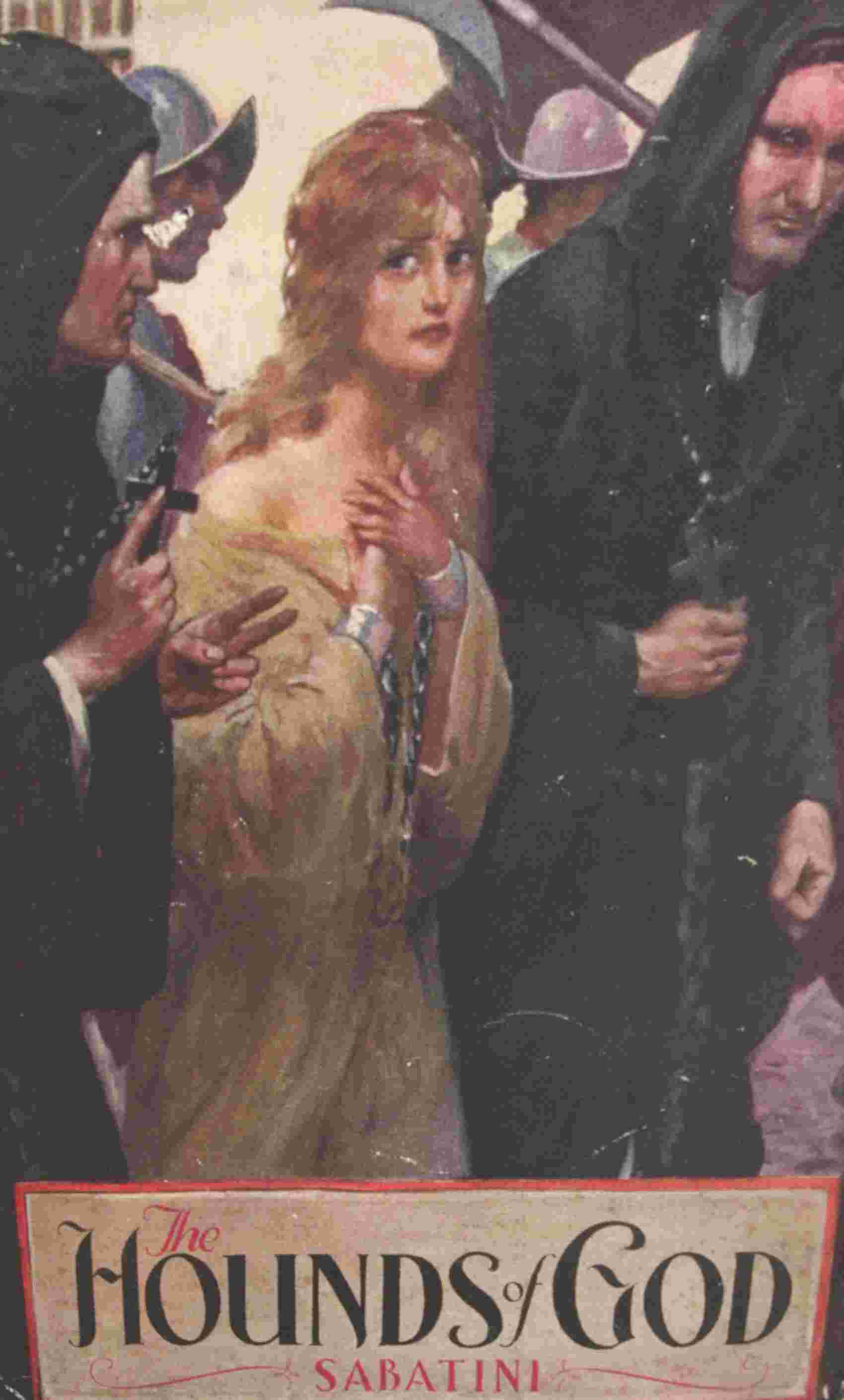
CHAPTER IV.
SIR GERVASE
On a fair August day, Mr. Crosby made one of a numerous company assembled in a spacious panelled chamber of the Palace of Whitehall.
It was a day of calm, and of blue skies, delusive interlude in the fury of the weather which had lately turned stormy, with frequent tempests that shook the earth and the heavens and made seamen thankful that they had turned back when they did from the pursuit of the Spaniards, and so had brought their ships in safety to the Thames before the change set in.
The sun shone radiantly through the leaded panes of the tall windows overlooking the river and the palace steps, where the barges were now moored which had brought the Admiral and his numerous company to answer the summons of the Queen of England.
Mr. Crosby, in mingled pride and awe to find himself in so considerable and distinguished an assembly, looked about him with interest. The room was hung with pictures, all of which were veiled; there was an Eastern carpet of brilliant variegated colouring on a square table by which he was standing in the room’s middle; against the panelling were ranged some chairs, tall-backed and carved, each bearing upon its scarlet velvet an escutcheon whereon the leopards of England, or on gules, were quartered with the lilies of France, or on azure.
These chairs were empty, all save one, which was taller and ampler than the rest and equipped with arms which ended in carved and gilded leonine heads.
In this chair, placed between two of the windows with its back to the light, sat a woman whom at first glance you might have supposed an Eastern idol, so bejewelled and bedizened was she. Her leanness was dissembled by a bulging farthingale. Her red-raddled face was lean and sharp, with a thin, aquiline nose and a very pointed, ill-tempered chin. The darkness of her eyebrows had been supplied by a pencil, and her lips were of a startling scarlet, in which Nature had no hand. Above the brow, which was almost masculine in its loftiness and breadth, towered a monstrous head-tire of false yellow hair in which a bushel of strung pearls were interwoven. Rows upon rows of pearls covered her neck and breast as if to supply again the pearly beauty long since faded from her skin. From the summit of her gown a collar of lace of the proportions of an enormous fan spread itself upright behind her head. Pearls were slung from it; jewels blazed in it; more jewels smouldered in her gown, a cloth-of-gold wrought with an uncanny embroidery of green lizards. She made some play with a handkerchief that was edged with gold lace, and this served two purposes: to display a hand which, spared as yet by time, was extremely beautiful, and to conceal her teeth whose ageing darkness no art could yet dissemble for her.
Behind her and to right and left of her chair were ranged in line her ladies-in-waiting, a dozen women of the noblest and loveliest in England.
Mr. Crosby had heard the Queen described more than once by Lord Garth. In painting the portrait of the lady whom his ill-fated friend had loved, Roger Trevanion yielded to one of his few remaining enthusiasms, and out of this it may be that he coloured the picture overgenerously. Hence, and forgetting that forty years were sped since the Earl of Garth had last beheld her, Mr. Crosby had entered the august presence in expectation of a radiant vision of feminine beauty. What he beheld dismayed him by its disparity with his mental portrait.
Her immediate supporters, too, added to the incongruity of the picture. The one upon her left was a tall, lean gentleman all in black. His sharp-featured countenance ended in a long white beard which entirely failed to lend that crafty face a patriarchal air. This was Sir Francis Walsingham. In ludicrous contrast with him stood the Earl of Leicester on her right. Once reputed the handsomest man in England, he was now corpulent and ungainly of body, inflamed and blotchy of countenance. His gorgeous raiment and the arrogance with which he carried his head served only to heighten the absurdity of his aspect.
That the Queen did not find him absurd was instanced by the place he occupied, and still more by the fact that the land forces of England which were to have resisted Parma’s landing had been placed under the Earl of Leicester’s supreme command. As a deviser and leader of pageants, it is probable that he had not his equal in England, if, indeed, in Europe. But it was fortunate for England and for Leicester that English seamen had made it unnecessary for him to exercise those talents in attempting to withstand the Prince of Parma.
With these same valiant English seamen was this assembly now concerned. Lord Howard of Effingham, the Lord Admiral towering straight and tall before the Queen, was rendering her a first-hand account of those actions in the Channel which had delivered England from the awful menace of Spain. His lordship was brisk and succinct in his narrative. At moments too succinct to please Her Grace, who now and again would arrest him to crave more details of this or a closer explanation of that. This occurred when the Lord Admiral spoke of the difficulty in which they found themselves when Medina Sidonia was at anchor in French waters, and related that having made a close survey of his position they sent in fire-ships to burn him out. He would have swept on, with no more than that, to relate the morrow’s action, but the Queen checked him in terms of his own trade.
‘God’s death, man! Haul down some of your sail. You drive so fast before the wind that we cannot follow. This survey at close quarters, how was it made? You have not told us that.’
He supplied the details in a silence of intense attention which may have inspired him to a certain liveliness of phrase. The Queen laughed. So did others, thrilled by the narrative of personal valour.
‘Faith,’ she told him, ‘you’re better as a sailor than a story-teller; you leave out the choicest morsels.’ Then came a question that sent a quiver through Mr. Crosby. ‘What was the name of the man who sailed that pinnace?’
Gervase heard his own name. It terrified him. It seemed to his straining ears that Lord Howard rolled it out in tones of thunder upon the silence. He blushed like a girl, shifting uncomfortably on his feet, and saw as if through a mist the faces of some of those of his acquaintance who stood about him, as they now turned their heads to give him a smile of friendly satisfaction. Then his thoughts flew to Margaret. If only she could have been there to hear him named, she must have accounted herself justified of her faith in him and her promise to become his wife.
The Lord Admiral’s narrative drew to a close. The Queen pronounced it, in a voice made sonorous by the depth of her emotion, as brave a tale as the world had ever heard, and alluded to her thankfulness to God for this good and prosperous success to those who had fought this battle against the enemies of His Gospel. Not Spain alone, but England too—and, from the results, with better justification—might account herself the instrument of divine justice.
Followed the presentation by the Lord Admiral of the captains of the fleet under his command and other officers who had distinguished themselves in that great battle in the Channel. To each the Queen spoke some words of commendation, whilst upon three of them she bestowed the accolade with a sword supplied by the Earl of Leicester.
After that, Lord Howard’s place was taken by the Vice-Admiral Sir Francis Drake upon whom devolved the duty of presenting the captains and some other officers of the privateers, nearly all of them West-Country gentlemen of family, many of whom had fitted ships at their own charges. The sturdy seaman rolled forward on his short thick legs as if a heaving poop were under his feet. He was resplendent in a suit of white satin which gave his bulk the appearance of having been suddenly increased. His beard was newly trimmed, his crisp brown hair sedulously combed and oiled, and there were rings of pure gold in the lobes of his close-set ears.
He bowed low, announced his purpose in a voice that was like a trumpet-call, and began his presentations.
The first was a neighbour of Mr. Crosby’s, Oliver Tressilian of Penarrow. He was half-brother to that Lionel Tressilian who came too much to Trevanion Chase for Mr. Crosby’s peace of mind. But you would have looked at the men in vain for evidence of relationship. Where Lionel was fair and mincing, elegant, soft, and sleek as a woman, this Oliver, tall, resolute, and swarthy, was of an almost overwhelming maleness. His mien was commanding, his bearing proud to the point of arrogance. To behold him as he made now his leisurely advance was to recognize him for one born to mastership. And although still young, his deeds already bore out the promise of his person. He had been schooled in seamanship at the hands of Frobisher; he had come to the support of Drake with a strong ship of his own, and to his audacity and resource as much as to any other cause had been due the capture of the Andalusian flagship, an event which early in the fight had put such heart into the English seamen.
The Queen’s dark, short-sighted eyes conned him with unmistakable admiration as he knelt at her footstool.
The sword flashed up and descended smartly upon his shoulder. ‘Such men as you, Sir Oliver, are to be considered as persons born for the preservation of the country.’ Those were the terms in which she dubbed him knight.
None grudged him the honour. He was one for whom a great future was predicted, and it was not to be foreseen that, by the wickedness of men, the apparent inconstancy of his mistress, and finally the operations of the Holy Office, the fame for which he was reserved was to be won under the banner of Islam. As a Moslem corsair he was destined to become one of the scourges of Christianity. It was a destiny none could have prophesied as he rose proudly from his knees that day, honoured and commended.
After him, one by one, came the other privateers. First the captains, and then those lesser officers who had served with more than ordinary distinction. And the first of these whom Sir Francis named was Gervase Crosby.
He stood forth, tall and supple. He had dressed himself—or rather, Killigrew had seen to it that he was dressed—in a brave suit of murrey velvet, with slashed canions to his trunks and rosettes to his shoes. He wore a short cloak in the Italian fashion, and a narrow white ruff sharpened the outline of his face. Excessively young for a man of his deeds he looked in his shaven beardlessness; for never since Margaret’s condemnation of beards nearly a year ago had he suffered the hair to grow upon his face.
The Queen’s dark eyes seemed to soften a little as they watched his approach, and they were not the only feminine eyes that pondered him with admiration. More than one of her maids-of-honour considered him with interest.
He went down on his knees to kiss her hand, and she frowned almost in perplexity as she surveyed the top of his head with its rippling auburn hair worn close. Having kissed her beautiful hand, he would have got to his feet again.
‘Here’s haste!’ said she in her gruff voice. ‘Kneel, child, kneel! Who bade thee rise?’
Realizing his fault, he blushed to the nape of his neck and continued kneeling. She turned to Sir Francis.
‘Is this he who went sailing in the pinnace among the Spanish ships in Calais Roads?’
‘The same, Your Grace.’
She looked at Gervase again. ‘God’s death! Why, it’s a child!’
‘His age is older than his looks; and his deeds are older than his age.’
‘They are so,’ she agreed. ‘By God, they are!’
Mr. Crosby was increasingly ill-at-ease and wished from his heart that she would make an end of this. But she was not minded to make an end just yet. His young comeliness gave his exploit a special heroism in her feminine eyes, stirred a little enthusiasm in her intensely feminine soul.
‘That was a brave thing you did,’ she told him gently, to be gruff with him the next moment. ‘God’s death, child, look at me when I speak to you.’ I suspect that she desired to see the colour of his eyes. ‘It was as brave a thing as I’ve heard this day, and God knows a feast of valour has been spread before me. Don’t you agree, Sir Francis?’
Sir Francis drew himself up a little from his deferentially bending attitude.
‘He was schooled by me in seamanship, Madam,’ he replied, as who would say: ‘What else do you expect from a pupil of that academy?’
‘It deserves, I think, some special mark of favour, both to reward it and to encourage others to the like.’
And then, a bolt from the blue to him who had been very far from expecting any guerdon, the flat of the sword smote him on the shoulder, and the command to arise, so long delayed to his discomfort, came in terms which made him realize that a man may be in too great haste to rise from kneeling to a sovereign.
Standing, he marvelled that he had not earlier observed her singular beauty; that upon his first glimpse of her he had wanted to laugh. What, he wondered, could have ailed him?
‘God bless Your Majesty,’ he blurted out in his intoxication.
She smiled at him, and there was something wistful in the lines of her ageing mouth and reddened lips. She was unusually gracious that day.
‘He has blessed me richly already, lad, in giving me subjects such as these.’
He effaced himself after that, and went to join Oliver Tressilian, who offered to carry him back to the Fal in his ship. Gervase was in haste to return, to carry to the lady, whom he pictured waiting there, this dazzling, bewildering news of his advancement. Drake permitting it, and excusing him from the great thanksgiving service that was to be held in Saint Paul’s, he departed on the morrow with Tressilian. Sir John Killigrew, who had been in London during the past ten days, went with them. Of the bitter feud that was later to mar the good relations between Killigrew and Tressilian there was as yet no sign. Sir John, moreover, was elated by the achievement of his young kinsman.
‘You shall have a ship of your own, boy, if I have to sell a farm to fit it,’ he had promised him. ‘All I ask,’ he added, for with all his generosity there was a practical mercenary streak in him, ‘is a quarter share in the ventures you will undertake.’
That ventures were to be undertaken was readily assumed, as also that they would be more than usually profitable now that the might of Spain upon the seas had been so signally impaired. And this was the subject of most of their talk during that voyage to the Fal on Sir Oliver’s ship, the Rose of the World. He had named her so, it is to be supposed, in honour of Rosamund Godolphin, whom he loved, and upon the assumption—erroneous, I believe—that her name was a contraction of Rosa Mundi.
On the last day of August, the Rose of the World rounded Zoze Point and came to anchor in Carrick Roads.
Sir John and his kinsman took their leave of Tressilian and went ashore at Smithwick to climb the heights to stately Arwenack, whence on a clear day the view extended to the Lizard, fifteen miles away.
No sooner did they reach it than Gervase was away again. He would not even stay to dine, although it was already past the hour of dinner. Now that Tressilian was home, the news of events in London might reach Trevanion Chase at any moment, and this was dangerous to the satisfaction which Gervase hoped to derive from being the first to announce to Margaret those details which concerned himself. Killigrew, perceiving the reason of his haste, rallied him upon it, but let him go, and sat down to dine alone.
Although the distance from door to door was less than two miles, the properties adjoining, yet such was Gervase’s haste that he must call for a horse, and ride it at the gallop.
In the avenue approaching the big red house with its tall, twisted chimneys he found a groom in the blue livery of the Godolphins waiting with three horses, and learned that Peter Godolphin and his sister Rosamund, together with Lionel Tressilian, were at the Chase having stayed to dine there. As it was already close upon three o’clock, they would soon be leaving. Gervase was relieved. The sight of the waiting horses had led him almost to fear that despite the haste he had made he might have been forestalled.
He found them in the garden, even as on that day, two years ago, when he had gone to the Chase to take his leave of Margaret. Then, however, he had been an aspirant for fame. To-day he returned in the effulgence of achievement. Success had crowned him, the Queen had knighted him. His name would be repeated among Englishmen; it would be inscribed upon the scroll of history. The memory of that accolade at Whitehall invested Sir Gervase with a new assurance. The dignity of knighthood had entered into his blood, was reflected in his bearing.
He sent ahead the servant who received him, to announce him.
‘Sir Gervase Crosby, may it please your ladyship.’
Thus did he break his news to them as he came briskly, in his brave murrey suit, his head high, in the servant’s wake.
For a moment Margaret was breathless. The colour ebbed from her face to come surging back on a flood tide. Amazement smote similarly her three companions, those two gallants and the sister of one of them, the gentle, fair-headed, saintly-looking Rosamund Godolphin, still a child of not more than sixteen years, but already woman enough to have fired the heart of the masterful elder Tressilian.
Gervase and Margaret looked at each other, and for a heartbeat may have seen naught but each other. Had he found her alone, there can be no doubt he would have taken her in his arms, as he accounted his right by virtue of her last words to him at parting two years ago. The unwelcome presence of those others compelled some measure of circumspection. He must confine himself to taking her hand and, bending low, content his lips with that as an earnest of more to come anon when he should have driven out those intruders.
To this task he addressed himself from the outset.
‘I landed less than an hour ago on Pendennis Point,’ he announced, that Margaret might judge for herself with what eager speed he had sought her. He turned to the younger Tressilian. ‘Your brother brought us back from London in his ship.’
Rosamund broke in with startled eagerness.
‘Oliver is home?’ It was the tall, slim girl’s turn to go pale and breathless, whereat her handsome brother frowned. Although prudence and expediency made him maintain a pretence of friendliness with the Tressilians, there was no real love lost between him and them. He found them in rivalry with him on every hand. His interests were beginning to clash with theirs in the countryside, and he viewed with anything but favour the affection which had sprung up between his sister and the elder of them. There was an unpleasant surprise in store for him from Gervase.
‘The Rose of the World,’ he said, answering the lady, ‘is anchored in Carrick Roads, and Sir Oliver will be home by now.’
‘Sir Oliver!’ both men echoed in a breath. And Lionel repeated the questioning exclamation: ‘Sir Oliver?’
Gervase smiled, almost with condescension, and hung upon his answer an account of how he had received his own honours.
‘He was knighted by the Queen in the same hour as myself at Whitehall on Monday last.’
Margaret stood with her arm about the waist of the willowy Rosamund. Her own eyes sparkled, whilst Rosamund’s looked oddly moist. Lionel frankly laughed his pleasure at his brother’s advancement. Peter Godolphin alone saw here no cause for satisfaction. This thing would make these Tressilians more insufferable than ever; it gave them an unquestionable advantage over him in local influence. He sneered. He was very ready always with his sneers.
‘Faith! Honours must have fallen thick as hail.’
Sir Gervase caught the sneer, but kept his temper. He met it by assuming a still loftier condescension. He looked down his nose at Mr. Godolphin.
‘Not quite so thickly, sir, and only where the Queen’s discernment perceived them to be deserved.’ He might have let the matter lie upon that reminder that to sneer at honours is to sneer at who bestows them. But he pursued the matter a little farther. Pride in the advancement which had come upon him so unexpectedly may have intoxicated him a little, considering his youth. ‘I quote, I think, Her Majesty, or if not Her Majesty at least Sir Francis Walsingham. I will not swear which of them it was who said—but I know that it was one of them—that England’s best made up the twenty thousand that sailed out to meet and break the might of Spain. A score of knighthoods, sir, comes to but one for every thousand. None so thick a shower when all is said. Had every man been knighted, it would still have been foolish to sneer at a measure which could but serve to distinguish them hereafter from those who stayed at home and sheltered themselves behind their valour.’
It made an awkward silence, and a little frown of perplexed annoyance descended upon the brow of the Lady Margaret. Then Peter stiffly answered him.
‘You use a deal of words, sir, to say a little, and your meaning is obscured in verbiage.’
‘Will you have the marrow of it?’ wondered Sir Gervase.
‘In Heaven’s name, no!’ It was Margaret who spoke, a determined, resolute Margaret. ‘We’ll have no more of this. My father, Gervase, will be glad to see you. You’ll find him in the library.’
It was a dismissal, and deeming it unjust it made him angry. But still he veiled his annoyance. He smiled quite pleasantly. ‘I’ll stay until you are free to take me to him.’
Upon that, in secret resentment, and with the curtest of nods to Gervase, the men took their leave, and Godolphin carried off his sister with him.
When they had gone, the Lady Margaret looked at her lover with gloom in her eyes and a wry little smile on her lips. Slowly she shook her head at him. ‘It was ill done, Gervase.’
‘Ill done? God lack!’ To remind her of the cause, he mimicked Peter Godolphin with an exaggerated simper. ‘ “Faith! Honours must have fallen thick as hail!” Was that well done? Am I to be rallied by any popinjay for what my merits have earned me? Am I to kiss the rod of his providing and turn the other cheek? Is that how you would have your husband behave?’
‘My husband!’ said she, and stared at him. Then she laughed. ‘Remind me, pray, of when it was I married you. I vow that I’ve forgot.’
‘You’ll not have forgot that you promised to marry me?’
‘I remember no such promise,’ said she in the same light tone.
He weighed the words rather than the manner. They set him breathing hard, caused him to pale under his tan. ‘Will you go back on your word, Margaret?’
‘And now you are unmannerly.’
‘I am concerned with more than pretty manners, madam.’ He was growing vehement, overbearing, and she ever calm and cool, disliking vehemence either in herself or others, began to be seriously annoyed. He hectored on. ‘There was a promise you gave me in the hall, there, as I was leaving: a promise that you would marry me.’
She shook her head. ‘As I remember it, my promise was that I would marry no man but you.’
‘Why, what’s the difference?’
‘It lies in that I may keep that promise and yet keep to my intention of following the Queen’s example and continuing all my days in my maiden estate if I so choose.’
He turned it over in his mind. ‘And do you so choose?’
‘I must until I am persuaded to choose otherwise.’
‘How may you be persuaded?’ he demanded, almost challengingly, wounded in his tenderest sensibilities and simmering with indignation at what he must account an unworthy quibble. ‘How may you be persuaded?’
She looked him between the eyes, standing straight and tense. ‘Certainly not in any way that you’ve yet chosen to pursue,’ said she, quite calm and cool and mistress of herself.
The elation in which he had come, the pride in his knightly rank so newly attained, the swagger it had lent him, all fell from him now. He had thought to dazzle her—and, indeed, to dazzle all the world—with his honours and the echo of the deeds that had earned them. Realization was so vastly different from his exalted expectations that his heart turned to lead in his breast. The auburn head which he had carried so proudly even at Whitehall was lowered at last. He contemplated the ground. He became humble.
‘I’ll choose any way that you may desire for me,’ he said, ‘for I love you, Margaret. To you I owe my knighthood, for the deeds that won it me were inspired by you. In all I bore myself as if your eyes had been upon me, with no thought save to do that which should give you pride in me could you behold it. The reward I have won and all that may follow upon this are naught to me unless you share them with me.’
He looked up, and saw that he had touched her, melted her a little from the smooth hardness of her mood. She was smiling now with a hint of tenderness. He set himself to follow up the advantage.
‘I vow you use me ill,’ he protested, and thus introduced again contentious matters. ‘You give a chilly welcome to the eager haste in which I seek you.’
‘You chose to be quarrelsome,’ she reminded him.
‘Was I not provoked? Was I not sneered at by that Godolphin whelp?’ Again he became impatient. ‘Is all that I do wrong and all that he does right in your eyes? What is Mr. Godolphin to you that you espouse his quarrels?’
‘He is my kinsman, Gervase.’
‘Which gives him licence to affront me. Is that your meaning?’
‘Shall we forget Mr. Godolphin?’ said she.
‘With all my heart!’ he cried; whereupon she laughed and took his arm.
‘Come and pay your duty to my father. You shall tell him of your fine deeds upon the sea, and I will listen. I may be so beglamoured by the tale as to forgive you everything.’
It did not seem to him in justice that he had need of forgiveness. But he desired no more disputes.
‘And then, Margaret?’ he asked her eagerly.
She laughed again. ‘Lord, what a man it is for outracing time! Can you not await the future in patience without ever seeking to foretell it?’
He looked at her in doubt a moment. Then he thought he read a challenge in her eyes. He took the risk of acting upon it. He caught her in his arms, and kissed her. And since she suffered it this time without resentment, it would seem that he had read aright the challenge.
They went in to disturb the studies of the Earl.
CHAPTER V.
FLOTSAM
Don Pedro de Mendoza y Luna, Count of Marcos and Grande of Spain, opened his eyes and looked up through the pallid dawn at the grey cloud masses overhead. It was some little while before his senses understood what his eyes beheld. Then he grew conscious that, as he lay there supine upon the shore, he was cold and stiff and sick. By this he knew that he was still alive; though how it happened, and where he might be, were matters yet to be investigated.
Painfully, upon joints that seemed almost to creak as they moved, he brought himself to a sitting posture, and gazed out across the heavy ground swell of the opal-tinted sea into the spreading flush of the September dawn. His senses reeled under the effort, sky and sea and land all rocked about him, and he was seized with nausea. He ached from head to foot, ached as if he had been stretched upon the rack; his eyes smarted acutely; there was an unspeakably bitter, briny taste in his mouth, and his mind was in such troubled confusion that it could render him no proper account of himself. He was conscious that he lived and suffered. Beyond that it is to be doubted if he was so much as conscious of his own identity.
His nausea increased, and he became violently sick, whereafter, exhausted, Nature compelled him to lie down again. But as he lay now, the oppressing cloud began to lift from his brain, clearing the outlook for his consciousness. Soon memory resumed her sway. He sat up again, more alertly this time, and at least no longer nauseated. His eyes ranged once more over the sea, more purposefully now, seeking upon the waters some sign of that towering galleon which had suffered shipwreck in the night. The reef upon which she had gone to pieces showed boldly in silhouette against the quickening sky, a black line of jagged rocks upthrusting from a white foam of thundering breakers. But of the galleon, not so much as a mast or spar was to be seen. And the storm, too, had passed, its fury spent, leaving no indication of its passage save that oily ground swell. Overhead the cloud mass was being broken up, dissolving, and patches of blue sky became increasingly revealed.
Don Pedro sat forward, his elbows on his knees, his head in his hands, his fine long fingers thrust into his damp, clammy hair. He remembered now that dreadful swim of his, instinctive and without orientation in the blackness of the night. The unquenchable animal instinct of self-preservation it was that had compelled it. Reason had no part in the effort. For whilst he possessed the clear assurance that land could not be far, he had no means of telling in that impenetrable darkness the direction in which it lay. Therefore, with little hope of reaching it, he supposed himself to be swimming into eternity.
He remembered how, when exhaustion began at last to cramp his limbs and paralyze further effort, he had commended his soul to his Maker, to that God who had proved so extraordinarily insensible of the fact that His were the battles which Don Pedro, and so many other tall Spaniards now stiff and cold, had gone forth to fight. He remembered how, in those last moments of consciousness, a wave had suddenly seemed to seize him in its coils, lift him high and bear him swiftly forward upon its crest, then loose its grip of him and leave him to crash down upon the beach with a force that had driven out what little breath yet lingered in his tortured lungs. He remembered his instant deep thankfulness, quenched the next moment in the realization that he was being sucked back by the undertow.
The horror of it was upon him again. He shuddered now as he thought of the frenzy with which he had clawed that foreign shore, driving his fingers deep into the sand, to grip and save himself from the maw of hungry ocean before the strength to battle should be spent with consciousness. That was the last thing he remembered. Between that point and this there was a blank which his reason now set itself to bridge.
The tide was on the ebb when they had struck the reef. This had permitted his last effort to be availing. Thus had the retreating sea been foiled of her prey. But, in faith, that monster had been fed to a surfeit as it was. The galleon was gone and with her some three hundred fine tall sons of Spain. Don Pedro checked the surge of thankfulness for his own almost miraculous preservation. Was he, after all, more fortunate than those who had perished? He had been dead, and he was alive again. It amounted scarcely to less. The dark, dread portals had been crossed when consciousness was extinguished. For what had he been thrust back into the world of life? His respite in this barbarous heretic excommunicate land could be no more than temporary. Escape must be impossible. Upon discovery it would be demanded of him that he suffer death again, and suffer it probably with indignity and amid torments infinitely worse than those which last night he had undergone. Far indeed from returning thanks for his preservation, let him give rein to his envy of those compatriots of his who would wake no more.
Drearily he looked about him, surveying the rocky little cove of that nook-shotten isle on which the sea had spewed him up. The swiftly growing light showed him a desolate, deserted space walled in by cliffs like some vast prison. No dwelling was visible here or anywhere on the heights above. All about him rose these sheer red cliffs fringed on their summit by the long grass that was waving in the freshening breeze.
He knew that he was somewhere upon the coast of Cornwall. This from what the navigator of the galleon had told him last night just before they were dashed upon the rocks by the fury of that infernal tempest which had swept them leagues out of their course; a tempest which had come down upon them just when they appeared to have weathered all their perils, to have conquered adversity, and to confront a clear run home to Spain. Never again would he behold the white walls of Vigo or Santander upon which two days ago he had so confidently been expecting soon to look.
In imagination a picture of them rose before him, all bathed in sunshine, the vines all laden now with their rich ripe clusters among which the brown-skinned, dark-eyed Galician or Asturian peasants would be moving with their vintage-baskets on their shoulders, to pile from these the grapes into the ponderous wooden bullock-carts identical in every detail with those which the Romans had brought into Iberia nearly two thousand years ago. He could hear them singing at their labours, the wistful, heart-wringing songs of Spain, subtle compounds of joy and melancholy that quicken a man’s blood. So confidently two days ago had he been anticipating the sight of all this to heal the wounds of body and of soul which they had taken in their ill-starred adventure. From the white church on the summit there above Santander, the Angelus of dawn would even now be ringing. As if he heard it with the ears of his flesh, the homesick, storm-battered Don Pedro disengaged his legs from a tangle of seaweed, struggled to his knees, crossed himself, and recited the salutation to the Mother of God.
After that he sat down again dejectedly to consider anew his position.
Suddenly he laughed aloud, a laugh of deep and bitter irony. Laughed at the contrast which he discovered between the manner of his coming ashore in England and that which had so confidently been planned. He had shared the assurance of his master, King Philip, in a triumphal progress which no human power could withstand. He had looked upon England as already beneath the heel of Spain, its bastard and excommunicate Queen driven forth in ignominy, and this Augean stable of heresy cleansed and purified and restored to the True Faith.
What else was to have been expected? Spain had launched upon the seas an armament that was invincible by temporal forces, fortified by spiritual weapons which must render it invulnerable to the Powers of Hell, offering herself as an arm through which God should vindicate His cause. It was incomprehensible, incredible that from the outset the elements should appear to have stood in league with the heretics. He reviewed the whole adventure from the first issuing of the fleet from the Tagus, when at the very outset adverse winds had created confusion, losses, and delays. In the Channel the wind had almost constantly favoured the lighter craft of the endemonized heretical dogs who had harried them. And even when all hope of effecting a landing in England had been abandoned, and the surviving ships of the Armada, driven to circumnavigate this barbarous island, asked no more of Heaven than that they should be permitted to reach home again, the elements had persisted in their incomprehensible hostility.
As far as the Orkneys they had hung together. There in a fog ten of the galleons had gone astray. Sixty ships, including the Concepción commanded by Don Pedro de Mendoza y Luna, had clung to the San Martín, and with her had adventured farther north, running short of food, the water fouling in their casks, and disease breaking out amongst them. Their pressing needs drove them to seek the coast of Ireland, where half of them were wrecked. In a gale off that Irish coast the Concepción was separated from the remnant of the fleet at a time when her crew were by thirst and famine rendered too exhausted to handle her. By a miracle they made Killibeg, and here Don Pedro obtained fresh provisions and fresh water. Thus he had been able to revive his fainting seamen, preserving them only so that they might be drowned upon the coast of Cornwall, from which he had been again preserved, to end perhaps yet more miserably. Was there a curse upon them that the gift of life at the hands of Heaven should be the gift to be most feared?
Of the fate of the other consorts of Medina Sidonia’s flagship, Don Pedro had no knowledge. But judging their case by his own when he had parted from them, he had little cause to suppose that any of them would ever reach Spain again, or if they reached it that they would bear anything but skeletons into Spanish harbours.
In his dejection at this final ruin so far as he himself was concerned, Don Pedro reflected that the ways of the Deity were altogether beyond understanding. One explanation, it was true, existed. The launching of the Armada might be regarded as an ordeal by battle in the old sense: an appeal to God to deliver his judgment between the old established faith and the reformed religion; between the Pope and Luther, Calvin and the rest of the heresiarchs. Was it in answer to this that God had spoken thus through the winds and the waves which He controlled?
Don Pedro shuddered at the thought, which, as he himself perceived, went perilously near to heresy. He dismissed it, and from the past turned his attention more closely to the present and the future.
The sun was breaking through and quickening the dispersal from the heavens of the cloudy remnants of last night’s tempest. Don Pedro rose painfully to his feet and wrung what he could of the sea-water from his doublet. He was a tall, gracefully shaped man of scarcely more than thirty, and not even the sodden state of his garments could extinguish their elegance. His dress alone would have proclaimed his nationality. He was all in black, as became a noble of Spain and a lay tertiary of Saint Dominic. His velvet doublet, peaked and tapering to an almost womanish waist, was faintly wrought with golden arabesques. In its present wet state it had almost the appearance of a damascened cuirass. From a girdle of black leather embossed with gold, a heavy dagger hung upon his right hip above his ballooning trunks; his hose, a little rumpled now, was of black silk; the canions of his boots, of fine Cordovan leather, had slipped down, one to the level of his knee, the other to his very ankle. He sat down again to pull them off, first one and then the other, emptied out the water by which they were logged and drew them on again. He removed from his neck the handsome collar of Dutch point, which hung like a dish-clout now that the sea had washed all the starch from it. He wrung it out, considered it a moment, then cast it from him in disgust.
Giving now in the full daylight a closer attention to his surroundings, he was startled to perceive the real nature of certain dark objects which dotted the little strip of beach. These, carelessly observed when he had first looked about him whilst the light was dim, he had assumed to be rocks or clumps of seaweed.
He made his way towards the nearest of them with dragging feet. He paused to bend over it, recognizing it for the body of Hurtado, one of the officers of the ill-fated galleon, a gallant, stout-hearted fellow who had laughed at perils and discomforts. Hurtado would laugh no more. Don Pedro fetched a sigh that was in itself a requiem, and passed on. A little farther, he came upon a man still bestriding in death the spar upon which he had ridden ashore. Seven other bodies lay, some sprawled, some huddled, upon the sands where the sea had cast them up. These, some timbers, a chest, and few odd furnishings represented all that was left above water of the splendid Concepción.
Don Pedro considered his late comrades with that solemnity which the dead must ever command. He breathed a prayer for them even. But upon his finely chiselled face—of the colour of ivory, its warm pallor stressed perhaps by the small black moustache and stiletto beard—there was no shade of regret for their fate. Don Pedro was equipped with a finely balanced, cold intelligence which could suppress emotion in the weighing of realities. These men were more fortunate than himself in that they had died but once, whereas he was destined, he supposed, to endure another and infinitely more cruel death in this hostile land.
It was a reasoned assumption, and by no means merely the apprehension of illogical panic. He was acquainted with the fierce hatred of Spain and Spaniards that was alive in England. He had seen flashes of it during his sojourn at Elizabeth’s Court, where he had spent two years in the train of his cousin, the Ambassador Mendoza—he who had been compelled to leave England when Throgmorton betrayed his complicity with the adherents of the Queen of Scots in a plot against the life of Elizabeth. If that hatred had been so lively then, what must it be to-day after years of alarms culminating in the dread into which the coming of the Armada had flung this God-abandoned country? He knew his own feelings for a heretic; he knew how he would deal with one at home; how, indeed, he had dealt with some. Was he not a lay tertiary of Saint Dominic? These feelings supplied him with a standard by which to measure the disposition of heretics towards himself, and the fate that must inevitably await him at the hands of heretics.
He paced back slowly to Hurtado’s body. He remembered to have observed that there was a rapier girt to it, and Don Pedro coveted the weapon. This covetousness was entirely of instinct. Reason supervening as he stooped to unbuckle the belt, he paused.
His sombre eyes looked out over the heaving waters as if to question the Infinite of which the ocean must ever seem the symbol. What use to him a sword?
Don Pedro was a cultured and learned gentleman who had studied at the University of Saint James of Compostella, and afterwards applied his learning in the world and the courts he had frequented. Hence he had developed a habit of philosophic reflection. He had learnt that to strive against the ultimately inevitable is a puerile effort, unworthy of an intelligent mind. Where an evil is unavoidable, the wise man goes to meet it and so makes a speedy end. Let him abide, then, here in this deserted spot until he perished of hunger and of thirst; or, if he went forward, let him cover his face like a Roman and receive death from the first hand raised against him.
Thus philosophy. But Don Pedro was still young; the blood flowed strongly in his veins, and the love of life was quick within him. Philosophy, after all, is an arid business, concerned with speculations upon the why and wherefore of things, with theories upon past and future, upon origin and destination outside of absolute human ken. Life, on the other hand, as apprehended by the senses, is concerned with the moment; it is not vague, but definite, real, and self-assertive. Where life flows strongly, the reality of what is must ever conquer speculations of what may be, and life will seize every chance, however slender, of preserving itself.
He stooped again, and, completing this time his task without further hesitation, buckled the dead man’s sword to his own loins. Nor was this the end of the fortification he craved against the immediate future. His men had all received their pay before the fleet sailed from the Tagus, and there had been, alas, no chance of spending any of it. The last precaution of each had been to strap his bag of ducats to his waist. Don Pedro loathed the task, but went about it at the dictates of common-sense, and in the end stuffed a heavy purse into his sodden doublet.
By now the sun was already well above the horizon, and the last of the storm clouds was dissolving in the blue. The sunshine and some exertion which it had been necessary to employ had partly restored Don Pedro’s circulation, had at least delivered him from the earlier ague in which he had shivered. He became conscious that he was hungry and thirsty and that his mouth was bitter as a brine pan.
He stood looking out to sea again, considering. Over the sunlit waters a flock of gulls wheeled and circled ever nearer to the shore, screaming shrilly. Whither should he direct his steps? Was it possible that in this desolate land of England there might be folk so charitable as to take pity on a fallen enemy in extremes? He doubted it. But unless he went to ascertain, the few pains he had already taken to provide for emergencies would be utterly wasted and a certain and painfully slow death would await him here. After all, that was the worst that could await him elsewhere, and it was not quite certain. A chance undoubtedly existed. Thus, you perceive how the instinct of life had come already to effect a change in his outlook, and to irradiate it with a slight measure of hope.
He moved along that strip of Cornish beach, looking for some break in the wall of cliff, for some path that should lead up to those green heights on the level of which no doubt there would be men and dwellings. He climbed a shallow wall of black and jagged rocks which springing from the cliff ran athwart the sands to bury themselves in the water and no doubt continue under it, just such a treacherous reef as that upon which the Concepción had gone to pieces. In the tiny cove beyond, he espied quite suddenly the debouching of a dingle adown which a little brook came hurrying turbulently seaward. The sight of it was blessed in his eyes; the voice of it sang a song of salvation in his ears.
He reached the edge of it above the shore, flung himself prone upon the sparse wet grass where the soil was still sandy, and gratefully lowered his head to drink as drinks the animal. No Andalusian wine, no muscadine, had ever tasted one half so sweet to him as this long draught from that sparkling Cornish brook.
He drank avidly to quench his burning thirst and cleanse his mouth of that bitter briny flavour. Then he washed the salt from his eyes and beard and from the undulating black hair that grew to a peak in the middle of his fine brow.
Refreshed, his spirits rose, and the reaction from the pessimism of his awakening was complete. He was alive, and he was in the full glory of his youth and strength. He had been wrong—impious and insensible to God’s grace—to envy his poor dead comrades. Contritely he fell now upon his knees, and did what it would have become a pious gentleman of Spain to have done earlier: returned thanks to Heaven for his miraculous preservation.
His orisons ended, he turned his back upon the sea and began the ascent of the gently rising ground. The dingle was densely wooded, but a beaten track where the way had been cleared ran along the brook with its little cascades and deep pools, where here and there he beheld the flash of the golden flank of a trout which his shadow startled. Tall blackberry bushes tore at him as he advanced and thereby drew his attention to their fruit. He was thankful for the discovery of this manna, and proceeded to break his fast. It was very jejune fare; the berries were small, none too ripe, and their pulp was scanty. But Don Pedro was not fastidious that morning. Misfortune schools us in the appreciation of small gifts. He ate with relish until a crackling sound in the undergrowth across the stream disturbed him. He stood as still as the trees that sheltered him, lest any movement on his part should betray his presence. His ears were strained to listen and identify the sounds.
Someone was moving yonder. He was not at all alarmed. It was not easy to alarm Don Pedro. But he was alert and watchful, since whoever came must of necessity be an enemy.
Quite suddenly this enemy was revealed, and not quite the enemy that Don Pedro had looked for. Through the alders beyond the stream crashed a great liver-coloured hound, snarling and growling as it came. It stood poised a moment on the farther bank, now barking furiously at this black intruder whom it had sighted. Then with short yelps it ran hither and thither seeking a passage, and at last heaved itself across in a terrific leap.
Don Pedro leaped at the same moment. Nimbly he sprang upon an opportune rock, and out flashed Hurtado’s rapier. This infernal dog should receive a cold, sharp welcome.
But even as the hound bounded forward to the assault, a clear, imperious voice detained it.
‘Down, Brutus! Down! Hither to me! Hither at once!’
The dog checked, hesitating between indulgence and obedience. Then as the command was repeated, and the mistress who uttered it appeared between the trees, it turned, and with a final yelp, perhaps of disappointed anger, went bounding back across the brook.
CHAPTER VI.
SURRENDER
Sword in hand, statuesquely from his rocky plinth, Don Pedro bowed until his trunk was at right angles with his shapely legs. He hoped that he was not ridiculous.
The lady across the brook whom he thus saluted belonged to a type which to a son of Spain must ever seem the most delectable by virtue of that natural law which renders opposites interattractive.
Her cheeks were delicate as apple blossoms; her hair was of the ruddy golden of ripe corn, and tied with great simplicity, without any of those monstrous affectations which Elizabeth had rendered fashionable in England. Her eyes were deeply blue, and the surprise now staring out of them gave them a look of startled innocence. She was tall, he observed with approval, and of those most sweet proportions which ripening womanhood alone can display. Her dress marked her in his eyes for a person of quality. Her peaked stomacher and ridiculous farthingale—though less ridiculous by much than mode prescribed—proclaimed to him clearly that here was no rustic Dian for his Endymion. And not only her dress but her bearing and the self-assured manner in which she now confronted this noble-looking and—in his rumpled, sodden garments—rather fantastic stranger, went further to announce her quality.
‘Sir, would you have killed my dog?’
Now it was not for nothing that Don Pedro de Mendoza y Luna had spent three years in London in the Ambassador’s train and gone about the Court. He spoke English better than many Englishmen, and beyond a slight exaggeration of the vowel sounds there was little in his speech to betray the foreigner.
‘Madam,’ he answered her smoothly, ‘I trust you will not count it a lack of gallantry in me that I am reluctant to be eaten by a lady’s dog.’
His accent and the light humour of his answer set her staring harder.
‘Now, God a’ mercy!’ she ejaculated. ‘You’ll not have sprouted here, like a mushroom, in the night. Whence are you, sir?’
‘Ah! Whence!’ He shrugged. A melancholy smile invested his fine sombre eyes. ‘That is not to be answered in a word.’
He came down from his rock and in three active strides, from boulder to boulder, was across the brook. The crouching hound half-rose and growled at his approach, whereupon the lady bade him down again, and cut him across the body with a hazel switch to quicken his obedience.
Don Pedro stood before her to explain himself. ‘I am no better than a piece of wreckage; some of the flotsam from a Spanish galleon that foundered on the rocks down there in last night’s storm. I am all that has come ashore alive.’
He saw the sudden darkening of that fair face, the recoil before him in which if there was fear there was more repugnance. ‘A Spaniard!’ she exclaimed in the tone we use when we mention evil and detested things.
He sank his head between his shoulders; spread his hands in deprecation. ‘A very sorry one,’ said he, and on that sighed plaintively.
Almost at once he saw racial prejudice cast aside for womanly pity. She observed more closely his condition, his sodden garments and dishevelled head, and saw that it bore out his tale. She pictured to herself the thing he told her, and was stricken at the thought of that sunken galleon and the loss of life.
Upon her face he read the reflection of this uprush of compassion, for he was very skilled in the deciphering of human documents, and being, too, a very subtle gentleman, he perceived his course, and promptly took it.
‘My name,’ he said, and said it with a certain conscious pride that was not to be mistaken, ‘is Don Pedro de Mendoza y Luna. I am Count of Marcos, a Grande of Spain, and your prisoner.’ On that he went down upon his knees, and proffered her the hilt of the sword which he still held naked in his hands.
She fell back a pace or two in sheer surprise. ‘My prisoner?’ Her brows were knit in bewilderment. ‘Nay, now; nay, now.’
‘An it please you,’ he insisted. ‘It has never been imputed to me, and I hope it never may be, that I want for courage. Yet finding myself shipwrecked, alone in a hostile land, I am in no case to offer resistance to my capture. I am like a garrison that is forced to capitulation and merely asks that it may capitulate without hurt to honour. On the beach down there I had a choice of alternatives. One was to walk back into the sea which has rejected me, and drown. But I am young, as you observe, and suicide is the certain gateway to damnation. I fell back, then, upon the other alternative which was to make my way to the haunts of men, and, upon finding one who was of a quality to receive my sword, to make surrender. Here at your feet, lady, my quest is ended almost as soon as it began.’ And again he proffered her the blade, held now across his two hands.
‘But I am not a man, sir.’ She was obviously nonplussed.
‘Let all men thank God with me for that,’ he cried. Then more solemnly continued: ‘In all ages it has been deemed proper that valour should yield to beauty. For my valour I will beg you to accept my word until such time as it may be tested, when the test, I trust, will be in your own service. For the rest your mirror and the eyes of every man will vouch. And as for your quality, I were blind or a clown did I not perceive it.’
That the situation piqued and pleased her from the very outset is as certain as that the astute Don Pedro judged confidently it must. It was so tinctured with romance that its appeal to a lady of any heart and imagination must prove beyond resistance. Only the extraordinary nature of the adventure made her hesitate, aroused a doubt on the score of the practical fulfilment of this Spanish gentleman’s proposal.
‘But I have never heard the like. How can I take you prisoner?’
‘By accepting my sword, madam.’
‘But how can I hold you?’
‘How?’ he smiled. ‘It is easy to hold the captive who desires captivity. Who would desire liberty that may be your prisoner?’
His eyes grew so ardent as to leave no vagueness in his meaning. She flushed under that regard of his, as well she might, for Don Pedro went very fast indeed. ‘I surrender me,’ he said. ‘Yourself shall fix my ransom and make it what you will. Until it comes from Spain I am your prisoner.’
He saw that her hesitation was still far from conquered. Perhaps, indeed, his momentary ardour by its prematureness had increased it. Therefore he had recourse to utter frankness, confident that, by revealing the full extent of his peril and thus arousing her compassion, he would prevail upon her. He showed her that it was upon her mercy that he counted; that it was his faith in her gentleness and her pity for his plight that impelled him to take this course which she accounted extraordinary and which was certainly unusual.
‘Consider,’ he begged her. ‘In the hands of another it might go very ill with me. I intend no insult to your countrymen’s sense of what is in honour due to an unfortunate and helpless enemy, of what is prescribed by all the usages of chivalry. But men are the creatures of their passions, of their feelings; and the feelings to-day of Englishmen for Spaniards…’ He broke off and shrugged. ‘You know them. It may well be that the feelings of the first Englishman I meet will conquer his notions of what is becoming. He may summon others to help him cut me down.’
‘Would so much be needed?’ she flashed at him, touched by his sly imputation that no one Englishman would suffice to take a Spaniard.
But he knew women, and he answered without hesitation, though in accents that sounded humble and self-deprecatory: ‘I think so, lady. And if you deny me now I must resolve your doubts by making proof of it.’
He knew that she would not, and knew that the half-challenge of his answer struck the right note and preserved him a figure of dignity in misfortune, a man who would condescend only within certain definite honourable limits to accept shelter from his peril. If he made it plain that he sought compassion from her, he also made it plain that he sought no more than he might accept without loss of self-respect.
She perceived clearly enough that if she assented to his odd proposal, if she accepted him for her prisoner, it would be hers to shield him. She would be doing a worthy thing; for Spaniard though he might be, he was human and a gentleman. That she had the power to carry this thing through and claim him for her own against any aggressor, reflection made her gradually confident. He had rightly gauged her mettle and her quality. In all that Cornish countryside there was probably none strong enough to stand against her imperious will once she determined to exert it.
The combined appeal of her womanliness and her sense of the romantic carried the day with her. She accepted his surrender, and this in terms of a generosity for which she was sure that there was abundant chivalrous precedent.
‘Be it as you will then, sir,’ she said at last. ‘You shall be my prisoner. Give me your parole of honour that you will attempt no escape, and you may retain your weapons, holding them in trust for me.’
Still on his knees, the sword still proffered, he bowed his head, and solemnly gave the oath required.
‘Before God and Our Lady, by my honour and my faith, I swear to hold myself your captive, and that I shall not leave you until yourself you restore me the liberty which I here surrender.’
Upon that he rose, and sheathed his rapier. ‘Is it a presumption, madam, to ask my captor’s name?’
She smiled, for all that there still abode in her a shade of uneasiness at the eccentricity of this transaction.
‘I am the Lady Margaret Trevanion,’ she replied.
‘Trevanion?’ He manifested a faint quickening of interest. ‘You will be of the family of the Earl of Garth.’
She was justifiably surprised that a Spaniard should be so well-informed upon English family matter.
‘He is my father, sir.’ And she expressed her astonishment in her question: ‘What do you know of the Earl of Garth?’
‘I? Nothing, alas. Though that is a deficiency in me which the fortune of war should now repair. But I have heard my father speak of him and the near escape he had of losing his head in the service of your present Queen when Mary Tudor reigned in England. My father was here in the train of King Philip in those days when he was the Queen of England’s husband, and I think he knew your father well. It is an odd link between us, if you please.’
The link was none so odd as Don Pedro assumed or would have it appear. His father had been one of a cloud of Spanish noblemen who had come and gone about the Court of Queen Mary at a time when the Lord Admiral Seymour and his friends were prominent in the public eye and particularly in the eye of King Philip and his following, whose position in England was menaced by their activities.
‘From the memory of his own misfortunes and the perils in which he all but lost his life, my Lord Garth may not be without sympathy for the misfortunes of another.’ Then, lest he should appear to plead too much, he essayed to diminish it by humour. ‘The first of these misfortunes, my lady, and the peril of life most pressing upon me at the moment comes from hunger.’
She smiled. ‘Come, sir. I will see what may be done to mend it and the rest of your condition.’
‘The rest of my condition? Valga me Dios! There’s naught amiss with the rest of my condition.’
‘Come,’ she commanded, and led the way, the hound bounding forward ahead.
Don Pedro, obediently, as became a prisoner, followed closely, and began at last to be truly thankful for his miraculous preservation.
CHAPTER VII.
MARGARET’S PRISONER
They made their way upwards through the dell by a winding path that was all dappled with the sunlight beating through a ramage still dripping from last night’s storm. The lady and her hound went ahead. Don Pedro followed, partly because to follow became his condition, partly because the pathway was scarcely wide enough to admit of their going abreast.
As they neared the summit, where there was open ground, a lusty male voice carolled suddenly above them. The actual words of his song have been lost, and they do not greatly matter. The burden of it was that life on the rolling sea was a jovial life, a roving life and a rolling life. It fetched a laugh from Don Pedro whose sea-memories at the moment were anything but jovial.
At the sound, the girl looked over her shoulder at him, hanging a moment in her stride, and there was the ghost of a smile on her lips. It might have been supposed, by one whose shrewdness was less satanic than the Spaniard’s, that she smiled in sympathy with his laugh, perceiving the wry humour of it. Don Pedro, however, caught in that smile something different, something mystifying to which he did not hold the clue. He was to hold it presently, when the singer disclosed himself, which was after they had brushed past the last of those wet branches and stood upon the open moorland all gold and purple in the morning sunshine.
Don Pedro beheld a tall young gentleman, tawny of head and care-free of countenance, who hailed her ladyship’s emergence into the open with a glad cry and a light of gladness in his laughing eyes. He advanced upon long legs that were cased in thigh-boots of untanned leather; he rolled a little in his gait—a roll which it is to be feared he exaggerated, so that all might know him at sight for the terrible seaman he accounted himself. He was bareheaded, and his wind-tossed hair, bleached in patches by the same sun which had burnt his skin to its pleasant tan, increased the fresh young comeliness of his appearance. He carried a fowling-piece on his shoulder.
Her ladyship’s dog bounded joyously forward to greet him, and for a moment hampered his own eager advance upon her ladyship, who meanwhile expressed surprise at his being abroad so early. He explained himself briefly. There was a fair at Truro, and a company of mummers who it was said had once played before Her Majesty in London. He had ridden over betimes to offer to escort her thither if it should be her pleasure to attend the play which was to be given after dinner in the yard of the Trevanion Arms. Hearing that she had gone walking, he had followed on foot, and to improve the occasion he had borrowed Matthew’s fowling-piece, hoping to take back a hare or a grouse for his lordship’s supper. From all this, rapidly delivered, he broke off abruptly to inquire in Heaven’s name who might be her companion.
There were several ways in which her ladyship might have presented her prisoner. Of these she mischievously chose the least explanatory and at the same time the most startling.
‘This, Gervase, is Don Pedro de Mendoza y Luna, Count of Marcos.’
The young seaman’s eyes grew round; his brows came together. ‘A Spaniard!’ quoth he, very much as he might have said: ‘A devil!’ And almost instinctively he swung the fowling-piece from his shoulder to the crook of his arm, in readiness for action. He repeated his ejaculation on a higher note: ‘A Spaniard!’
Don Pedro smiled. He commanded upon occasion a smile of melancholy weariness, and this he now employed. ‘A very wet one, sir,’ he said in his precise and careful English.
But Sir Gervase scarcely looked at him. His eyes, question-laden, were chiefly upon her ladyship.
‘How comes a Spaniard here, a God’s name?’
It was Don Pedro who answered him. ‘The sea, in rejecting me, was so benign as to cast me at the feet of her ladyship.’
Quite apart from his being a Spaniard, Gervase disliked him on the spot. It is possible that Don Pedro intended that he should, for such was the dissimilarity mental and physical between these two that in whatever circumstances they might have met no love is conceivable between them. There was no man more skilled than Don Pedro in the art of subtle injury, that injury of tone and glance which is the more to be resented because allied with civil words which give no ground whatever for complaint.
‘You mean that you have been shipwrecked?’ Gervase questioned with a blunt aggressiveness.
Don Pedro’s fine features were illumined by his faint, weary smile. ‘I expressed it more gallantly, I hope. That is the only difference between your words and mine.’
The young man came nearer. ‘Well, well,’ said he, with the least suspicion of swagger. ‘It is fortunate I met you.’
Don Pedro bowed. ‘Sir, your courtesy places me in your debt.’
‘Courtesy?’ quoth Sir Gervase. He uttered a short laugh. ‘You take me amiss, I think.’ And to avoid any possible further misunderstanding, he added curtly: ‘I trust no Spaniard.’
Don Pedro looked at him. ‘What Spaniard asks your trust?’ he wondered.
This Sir Gervase disregarded. He came to business. ‘We will begin,’ he informed her ladyship, ‘by depriving him of his weapons. Come, Sir Spaniard. Hand them over.’
But here at length her ladyship interposed. ‘You’ll go your ways, Gervase,’ she informed him lightly, ‘and meddle in matters that concern you. This is not one of them.’
Momentarily he was rebuffed. ‘What’s that?’ Then he shrugged and laughed. ‘This does concern me. It is a man’s business. Come, sir, your weapons.’
But Don Pedro merely smiled, in that easy, weary way of his. ‘You are too late, sir, by half an hour. These weapons are surrendered already. I hold them merely on parole and in trust for my captor. I am the Lady Margaret Trevanion’s prisoner.’
Sir Gervase first grew solemn in astonishment, then loosed his laughter. In this there was an indiscreet note of contempt which angered her ladyship and summoned a flush to her cheeks by which the young man should have taken warning.
‘Midsummer frenzy!’ he crowed. ‘Who ever heard of a man being a woman’s prisoner?’
‘You have just heard it, sir,’ Don Pedro reminded him.
Her ladyship became disdainful. ‘You are young, Gervase, and the world lies before you for your instruction. Let us on, Don Pedro.’
‘Young!’ was all that his indignation would permit him to ejaculate.
‘Young, ay!’ she answered him. ‘And beset by all the faults that are the marks of callowness. You detain me, I think.’
‘It is my intent, by Heaven!’ He stood squarely and angrily in their way.
Don Pedro might have offered to remove him. But Don Pedro used his wits. He perceived here, both in her ladyship and in Sir Gervase, certain symptoms which he thought he recognized. His own situation bristled with danger; he was very delicately poised; and he must be careful to do nothing that would disturb his precarious balance. So he remained aloof from the contention of which he was the subject.
Sir Gervase meanwhile made haste to put aside his own wrath before the anger in Margaret’s eyes. He perceived betimes his error, though he did not perceive that her indignation sprang chiefly from the very fact that he bore himself so ill.
‘Margaret, this is a thing best…’
She broke in upon his pleading tone. ‘I have said that you detain me.’ She was very haughty and peremptory. There was perhaps in her humour a touch of that perversity inherited from her perverse mother.
‘Margaret!’ His voice quivered with dismay and incredulity; his honest eyes, so blue against the tan of his face were troubled. ‘I desire only to serve you; to…’
‘No service is here required; certainly no service such as you importunately offer.’ And for the third time: ‘Come, Don Pedro,’ she commanded.
Sir Gervase fell back now, too deeply offended to offer another word. She moved on, Don Pedro following obediently, and it was upon him that Sir Gervase vented in his fierce scowl some of his seething anger. The Spaniard met the scowl with a bow than which nothing could have been more courteous and deferential.
To Sir Gervase, as he stood there following them with his brooding eyes, the glory had departed out of that September morning, and the joy in which he had come seeking Margaret was all withered in his heart. He accounted himself monstrously ill used by her, and this not entirely without reason. For a week now he had spent the greater part of each day in her company, either at the Chase itself or else walking or riding with her, and the relations between them had been so close and warm that he was assured his period of probation was at an end and that soon she would consent to become openly betrothed to him.
There was no coxcombry in the lad. If on the one hand he had begun confidently to assure himself that she loved him, on the other her love for him must remain an abiding miracle for which in his own person and endowments he could find no sufficient cause. It was, like the unearned gifts which sometimes fall from Fortune’s lap, something to be accepted in wondering gratitude and without question.
But this morning’s events had destroyed all this again. Clearly she did not love him. She found in his company beguilement of her leisures. Time may have hung heavily upon her hands at Trevanion Chase with that dull bookish father and she was glad to have him ride with her, hawk with her, escort her upon occasion to Penrhyn or Truro, take her sailing or fishing in the estuary. But love, real love, for him, clearly there could be none in her heart, else she would not use him as she did, would never have humbled him in this fashion, and denied him what clearly lay within his rights where this shipwrecked Spaniard was concerned. It was all incredible and exasperating. He was, he found it necessary to assure himself, a man of some account. The Queen had knighted him for his part in the action with the Armada, and he held Her Majesty’s commission, which imposed upon him certain duties here in Cornwall. The apprehension of this Spaniard washed ashore from one of the galleons that had escaped the action in the Channel was clearly within these duties, and Margaret or no Margaret, he would accomplish it and refuse to be put off by any absurd romantic surrender to herself which this Spaniard might have made. And not so absurd, after all, that surrender, reflected Sir Gervase. Far from it. It was an instance of Spanish craft and Spanish cunning to play upon the romanticism of a woman for his own ends and the preservation of his own skin.