
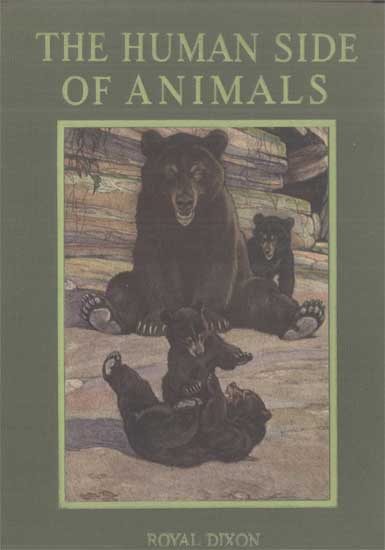
The Project Gutenberg eBook of The Human Side of Animals
Title: The Human Side of Animals
Author: Royal Dixon
Release date: November 17, 2006 [eBook #19850]
Language: English
Credits: Produced by Juliet Sutherland, Janet Blenkinship and the
Online Distributed Proofreading Team at http://www.pgdp.net
RECREATION IS AS COMMON AMONG ANIMALS
AS IT IS AMONG CHILDREN.
THE
HUMAN SIDE
OF ANIMALS
BY
ROYAL DIXON
AUTHOR OF "THE HUMAN SIDE OF PLANTS," "THE HUMAN SIDE OF TREES," "THE HUMAN SIDE OF BIRDS," ETC.
WITH TWO ILLUSTRATIONS IN COLORS AND
THIRTY-TWO IN BLACK-AND-WHITE
NEW YORK
FREDERICK A. STOKES COMPANY
PUBLISHERS
Copyright, 1918, by
Frederick A. Stokes Company
All rights reserved, including that of translation
into foreign languages
MADE IN U. S. A.
TO
MARCELLUS E. FOSTER
WHO BELIEVED
NOTE
The author wishes to acknowledge his indebtedness to his
fellow-naturalist and friend, Mr. Franklyn Everett Fitch, for carefully
reading the entire manuscript and making many scholarly and valuable
criticisms and corrections.
CONTENTS
| CHAPTER | PAGE | |
|---|---|---|
| Foreword | xiii | |
| I | Animals That Practise Camouflage | 1 |
| II | Animal Musicians | 18 |
| III | Animals at Play | 32 |
| IV | Armour-Bearing and Mail-Clad Animals | 46 |
| V | Miners and Excavators | 61 |
| VI | Animal Mathematicians | 88 |
| VII | The Language of Animals | 99 |
| VIII | In Their Boudoirs, Hospitals and Churches | 120 |
| IX | Self-Defence and Home-Government | 130 |
| X | Architects, Engineers, and House-Builders | 150 |
| XI | Food Conservers | 170 |
| XII | Tourists and Sight-Seers | 181 |
| XIII | Animal Scavengers and Criminals | 199 |
| XIV | As the Allies of Man | 210 |
| XV | The Future Life of Animals | 234 |
ILLUSTRATIONS
| Recreation is as common among animals as it is among children (in Colours) | Frontispiece |
| The Indians claim that the mother bison forced her calf to roll often in a puddle of red clay, so that it might be indistinguishable against its clay background | 6 |
| The zebra is one of the cleverest of camouflagers. The black-and-white stripes of his body give the effect of sunlight passing through bushes | 7 |
| Monkeys are the most musical of all animals. When they congregate for "concerts," as some of the tribes do, the air is filled with weird strains of monkey-music | 20 |
| Cats, unlike dogs, are very fond of music. And it has been proved that their music-sense can be developed to a remarkable degree | 21 |
| A happy family of polar bears. The young cubs wrestle and tumble, as playfully as two puppies. This play has much to do with their physical and mental development | 34 |
| Dryptosaurus. The prehistoric animals, too, undoubtedly had their play time, with games and "setting up" exercises | 35 |
| The mother opossum is never happier than when she has her little ones playing hide-and-seek over her back | 38 |
| This young fox came from his home in the woods daily to play with a young fox-terrier. He is now resting after a romp | 39 |
| Naosaurus and Dimetrodon, two extinct armour-bearers who should have been well able to protect themselves | 50 |
| An armour-bearer of prehistoric times whose shield was an effective protection against enemy horns | 51 |
| To the polar bear the ice and snow of the Far North means warmth and protection. The mother bear digs herself into a snowbank, where lives quite comfortably throughout the winter | 84 |
| The sharp claws of the ground squirrel are efficacious tools in digging his cosy underground burrow | 85 |
| The coyote can readily distinguish whether a herd of sheep is guarded by one or more dogs, and will plan his attack accordingly | 94 |
| The zebu, the sacred bull of India, in spite of its domestication, has an agile body and a quick, alert mind | 95 |
| Roosevelt's Colobus. These horse-tailed monkeys chatter together in a language exclusively their own, yet they seem to have no difficulty in making themselves understood by other monkey-tribes | 112 |
| A tamed deer of Texas, whose constant companion and playmate was a rabbit dog. Between the two, there developed, necessarily, a common language | 113 |
| Water-loving animals, like the beavers, seemingly take great pride in their toilets. Their fur is always sleek and clean | 122 |
| Great forest pigs of Central Africa. Like the common domesticated hogs, they will seek a clay bath to heal their wounds | 123 |
| The Rocky Mountain goat has many means of defence, not the least of which is his agility in climbing to inaccessible places | 134 |
| Wild boars are among the most ferocious of animals. By means of their great strength alone they are well able to defend themselves | 135 |
| Brontosaurus. The animals that seemed best equipped to defend themselves are the ones that, thousands of years ago, became extinct | 144 |
| This prehistoric monster was equipped not only with a pair of strong horns but with a shield back of them as well | 145 |
| The beaver is the greatest of all animal architects. His skill is equalled only by his patience (in Colours) | 158 |
| The skunk mother tries to keep on hand a good supply of such delicacies as frogs and toads, so that her young may never go hungry | 172 |
| The porcupine and the hedgehog have a unique method of collecting food for their young. After shaking down berries or grapes, they roll in them, then hurry home with the food attached to their quills | 173 |
| The black bear is not one of the great migrating animals. The thickness of his coat must therefore change with the seasons | 188 |
| Rabbits seem to have a well-devised system in their road-building, running their paths in and out of underbrush in a truly ingenious manner | 189 |
| The mongoose, a scavenger of the worst type, feeding on rats and mice and snakes, and even poultry | 202 |
| Diplodocus. The prehistoric animals, also, undoubtedly had their scavengers and criminals | 203 |
| The Esquimo-dog is man's greatest friend in the Far North | 218 |
| Chipmunks are among the most easily tamed of man's wild friends, and they even seem fond of human companionship | 219 |
| Men cruelly take the lives of these denizens of the wildwood, rejoicing in their slaughter, but the animal soul they cannot kill | 244 |
| Two pals. There is between man and dog a kinship of spirit that cannot be denied | 245 |
FOREWORD
"And in the lion or the frog—
In all the life of moor or fen—
In ass and peacock, stork and dog,
He read similitudes of men."
More and more science is being taught in a new way. More and more men are beginning to discard the lumber of the brain's workshop to get at real facts, real conclusions. Laboratories, experiments, tables, classifications are all very vital and all very necessary but sometimes their net result is only to befog and confuse. Occasionally it becomes important for us to cast aside all dogmatic restraints and approach the wonders of life from a new angle and with the untrammelled spirit of a little child.
In this book I have attempted to bring together many old and new observations which tend to show the human-like qualities of animals. The treatment is neither formal nor scholastic, in fact I do not always remain within the logical confines of the title. My sole purpose is to make the reader self-active, observative, free from hide-bound prejudice, and reborn as a participant in the wonderful experiences of life which fill the universe. I hope to lead him into a new wonderland of truth, beauty and love, a land where his heart as well as his eyes will be opened.
In attempting to understand the animals I have used a method a great deal like that of the village boy, who when questioned as to how he located the stray horse for which a reward of twenty dollars had been offered, replied, "I just thought what I would do if I were a horse and where I would go—and there I went and found him." In some such way I have tried to think why animals do certain things, I have studied them in many places and under all conditions, and those acts of theirs which, if performed by children, would come under the head of wisdom and intelligence, I have classified as such.
Life is one throughout. The love that fills a mother's heart when she sees her first-born babe, is also felt by the mother bear, only in a different way, when she sees her baby cubs playing before her humble cave dwelling. The sorrow that is felt by the human heart when a beloved one dies is experienced in only a little less degree by an African ape when his mate is shot dead by a Christian missionary. The grandmother sheep that watches her numerous little lamb grandchildren on the hillside, while their mothers are away grazing, is just as mindful of their care as any human grandparent could be. One drop of water is like the ocean; and love is love.
The trouble with science is that too often it leaves out love. If you agree that we cannot treat men like machines, why should we put animals in that class? Why should we fall into the colossal ignorance and conceit of cataloging every human-like action of animals under the word "instinct"? Man delights in thinking of himself as only a little lower than the angels. Then why should he not consider the animals as only a little lower than himself? The poet has truly said that "the beast is the mirror of man as man is the mirror of God." Man had to battle with animals for untold ages before he domesticated and made servants of them. He is just beginning to learn that they were not created solely to furnish material for sermons, nor to serve mankind, but that they also have an existence, a life of their own.
Man has long preached this doctrine that he is not an animal, but a kinsman of the gods. For this reason, he has claimed dominion over animal creation and a right to assert that dominion without restraint. This anthropocentric conceit is the same thing that causes one nation to think it should rule the world, that the sun and moon were made only for the laudable purpose of giving light unto a chosen few, and that young lambs playing on a grassy hillside, near a cool spring, are just so much mutton allowed to wander over man's domain until its flavour is improved.
It is time to remove the barriers, once believed impassable, which man's egotism has used as a screen to separate him from his lower brothers. Our physical bodies are very similar to theirs except that ours are almost always much inferior. Merely because we have a superior intellect which enables us to rule and enslave the animals, shall we deny them all intellect and all feeling? In the words of that remarkable naturalist, William J. Long, "To call a thing intelligence in one creature and reflex action in another, or to speak of the same thing as love or kindness in one and blind impulse in the other, is to be blinder ourselves than the impulse which is supposed to govern animals. Until, therefore, we have some new chemistry that will ignore atoms and the atomic law, and some new psychology that ignores animal intelligence altogether, or regards it as under a radically different law from our own, we must apply what we know of ourselves and our own motives to the smaller and weaker lives that are in some distant way akin to our own."
It is possible to explain away all the marvellous things the animals do, but after you have finished, there will still remain something over and above, which quite defies all mechanistic interpretation. An old war horse, for instance, lives over and over his battles in his dreams. He neighs and paws, just as he did in real battle; and cavalrymen tell us that they can sometimes understand from their horses when they are dreaming just what command they are trying to obey. This is only one of the myriads of animal phenomena which man does not understand. If you doubt it, try to explain the striking phenomena of luminescence, hybridization, of eels surviving desiccation for fourteen years, post-matrimonial cannibalism, Nature's vast chain of unities, the suicide of lemmings, why water animals cannot get wet, transparency of animals, why the horned toad shoots a stream of blood from his eye when angry. If you are able to explain these things to humanity, you will be classed second only to Solomon. Yet the average scientist explains them away, with the ignorance and loquaciousness of a fisher hag.
By a thorough application of psychological principles, it is possible to show that man himself is merely a machine to be explained in terms of neurones and nervous impulses, heredity and environment and reactions to outside stimuli. But who is there who does not believe that there is more to a man than that?
Animals have demonstrated long ago that they not only have as many talents as human beings, but that under the influence of the same environment, they form the same kinds of combinations to defend themselves against enemies; to shelter themselves against heat and cold; to build homes; to lay up a supply of food for the hard seasons. In fact, all through the ages man has been imitating the animals in burrowing through the earth, penetrating the waters, and now, at last, flying through the air.
When a skunk bites through the brains of frogs, paralysing but not killing them, in order that he may store them away in his nursery-pantry so that his babes may have fresh food; when a mole decapitates earth-worms for the same reason and stores them near the cold surface of the ground so that the heads will not regrow, as they would under normal conditions, only a deeply prejudiced man can claim that no elements of intelligence have been employed.
There are also numerous signs, sounds and motions by which animals communicate with each other, though to man these symbols of language may not always be understandable. Dogs give barks indicating surprise, pleasure and all other emotions. Cows will bellow for days when mourning for their dead. The mother bear will bury her dead cub and silently guard its grave for weeks to prevent its being desecrated. The mother sheep will bleat most pitifully when her lamb strays away. Foxes utter expressive cries which their children know full well. The chamois, when frightened, whistle; they might be termed the policemen of the animal world. The sentinel will continue a long, drawn-out whistle, as long as he can without taking a breath. He then stops for a brief moment, looks in all directions, and begins blowing again. If the danger comes too near, he scampers away.
In their ability to take care of their wounded bodies, in their reading of the weather and in all forms of woodcraft, animals undoubtedly possess superhuman powers. Even squirrels can prophesy an unusually long and severe winter and thus make adequate preparations. Some animals act as both barometers and thermometers. It is claimed that while frogs remain yellow, only fair weather may be expected, but if their colour changes to brown, ill weather is coming.
There is no limit to the marvellous things animals do. Elephants, for example, carry leafy palms in their trunks to shade themselves from the hot sun. The ape or baboon who puts a stone in the open oyster to prevent it from closing, or lifts stones to crack nuts, or beats his fellows with sticks, or throws heavy cocoanuts from trees upon his enemies, or builds a fire in the forest, shows more than a glimmer of intelligence. In the sly fox that puts out fish heads to bait hawks, or suddenly plunges in the water and immerses himself to escape hunters, or holds a branch of a bush over his head and actually runs with it to hide himself; in the wolverine who catches deer by dropping moss, and suddenly springing upon them and clawing their eyes out; in the bear, who, as told in the account of Cook's third voyage, "rolls down pieces of rock to crush stags; in the rat when he leads his blind brother with a stick" is actual reasoning. Indeed, there is nothing which man makes with all his ingenious use of tools and instruments, of which some suggestion may not be seen in animal creation.
Great thinkers of all ages are not wanting who believe that animals have a portion of that same reason which is the pride of man. Montaigne admitted that they had both thought and reason, and Pope believed that even a cat may consider a man made for his service. Humboldt, Helvitius, Darwin and Smellie claimed that animals act as a definite result of actual reasoning. Lord Brougham pertinently observes, "I know not why so much unwillingness should be shown by some excellent philosophers to allow intelligent faculties and a share of reason to the lower animals, as if our own superiority was not quite sufficiently established to leave all jealousy out of view by the immeasurably higher place which we occupy in the scale of being."
From the facts enumerated in this book I find that animals are possessed of love, hate, joy, grief, courage, revenge, pain, pleasure, want and satisfaction—that all things that go to make up man's life are also found in them. In the attempt to establish this thesis I have been led mentally and physically into some of Nature's most fascinating highways and hedges, where I have had many occasions to wonder and adore. I will be happy if I have at least added something to the depth of love and appreciation with which most men look upon the animal world.
THE HUMAN SIDE OF ANIMALS
I
ANIMALS THAT PRACTISE CAMOUFLAGE
"She was a gordian shape of dazzling line,
Vermilion-spotted, golden, green and blue;
Striped like a zebra, freckled like a pard,
Eyed like a peacock, and all crimson barr'd,
And full of silver moons, that, as she breathed,
Dissolved, or brighter shone, or interwreathed
Their lustres with the glorious tapestries...."
—Keats (on Lamia, the snake).
The art of concealment or camouflage is one of the newest and most highly developed techniques of modern warfare. But the animals have been masters of it for ages. The lives of most of them are passed in constant conflict. Those which have enemies from which they cannot escape by rapidity of motion must be able to hide or disguise themselves. Those which hunt for a living must be able to approach their prey without unnecessary noise or attention to themselves. It is very remarkable how Nature helps the wild creatures to disguise themselves by colouring them with various shades and tints best calculated to enable them to escape enemies or to entrap prey.
The animals of each locality are usually coloured according to their habitat, but good reasons make some exceptions advisable. Many of the most striking examples of this protective resemblance among animals are the result of their very intimate association with the surrounding flora and natural scenery. There is no part of a tree, including flowers, fruits, bark and roots, that is not in some way copied and imitated by these clever creatures. Often this imitation is astonishing in its faithfulness of detail. Bunches of cocoanuts are portrayed by sleeping monkeys, while even the leaves are copied by certain tree-toads, and many flowers are represented by monkeys and lizards. The winding roots of huge trees are copied by snakes that twist themselves together at the foot of the tree.
In the art of camouflage—an art which affects the form, colour, and attitude of animals—Nature has worked along two different roads. One is easy and direct, the other circuitous and difficult. The easy way is that of protective resemblance pure and simple, where the animal's colour, form, or attitude becomes like that of its habitat. In which case the animal becomes one with its environment and thus is enabled to go about unnoticed by its enemies or by its prey. The other way is that of bluff, and it includes all inoffensive animals which are capable of assuming attitudes and colours that terrify and frighten. The colours in some cases are really of warning pattern, yet they cannot be considered mimetic unless they are thought to resemble the patterns of some extinct model of which we know nothing; and since they are not found in present-day animals with unpleasant qualities, they are not, strictly speaking, warning colours.
Desert animals are in most cases desert-coloured. The lion, for example, is almost invisible when crouched among the rocks and streams of the African wastes. Antelopes are tinted like the landscape over which they roam, while the camel seems actually to blend with the desert sands. The kangaroos of Australia at a little distance seem to disappear into the soil of their respective localities, while the cat of the Pampas accurately reflects his surroundings in his fur.
The tiger is made so invisible by his wonderful colour that, when he crouches in the bright sunlight amid the tall brown grass, it is almost impossible to see him. But the zebra and the giraffe are the kings of all camouflagers! So deceptive are the large blotch-spots of the giraffe and his weird head and horns, like scrubby limbs, that his concealment is perfect. Even the cleverest natives often mistake a herd of giraffes for a clump of trees. The camouflage of zebras is equally deceptive. Drummond says that he once found himself in a forest, looking at what he thought to be a lone zebra, when to his astonishment he suddenly realised that he was facing an entire herd which were invisible until they became frightened and moved. Evidently the zebra is well aware that the black-and-white stripes of his coat take away the sense of solid body, and that the two colours blend into a light gray, and thus at close range the effect is that of rays of sunlight passing through bushes.
The arctic animals, with few exceptions, are remarkable for imitating their surroundings; their colour of white blends perfectly with the snow around them. The polar bear is the only white bear, and his home is always among the snow and ice. The arctic fox, alpine hare, and ermine change to white in winter only, because during the other seasons white would be too conspicuous. The American arctic hare is always white because he always lives among the white expanses of the Far North. Both foxes and stoats are carnivorous and feed upon ptarmigan and hares, and they must be protectively coloured that they may catch their prey. On the other hand, Nature aids the prey by providing them with colours that enable them to escape the attention of their enemies.
The young of many of the arctic animals are covered with fluffy white hair, so that while they are too young to swim they may lie with safety upon the ground and escape the attention of polar bears; but in the antarctic regions, where there are few enemies to fear, the young seals, for instance, are exactly the colour of their parents.
The most remarkable exception of mimetic colouring among the animals of the polar regions is the sable. Throughout the long Siberian winter he retains his coat of rich brown fur. His habits, however, are such that he does not need the protection of colour, for he is so active that he can easily catch wild birds, and he can also subsist upon wild berries. The woodchuck of North America retains his coat of dark-brown fur throughout the long, cold winters. The matter of his obtaining food, however, is easy, for he lives in burrows, near streams where he can catch fish and small animals that live in or near the water.
A number of the old-school naturalists believed that when an animal's colouring assumed the snowy-white coat of its arctic surroundings, this was due to the natural tendency on the part of its hair and fur to assume the colourings and tints of their habitat. This, however, is absolutely false; and no better proof of it can be offered than the case of the arctic musk-ox, who is far more polar in his haunts than even the polar bear, and is therefore exposed to the whitening influence of the wintry regions more than the bear. Yet he never turns white, but is always brown. The only enemy of this northern-dweller is the arctic wolf, and against this enemy he is protected by powerful hoofs, thick hair, and immense horns. He does not need to conceal himself, and therefore does not simulate the colour of his surroundings.
American Museum of Natural History, New York
THE INDIANS CLAIM THAT THE MOTHER BISON FORCED HER CALF TO ROLL OFTEN IN A PUDDLE OF RED CLAY, SO THAT IT MIGHT BE INDISTINGUISHABLE AGAINST ITS RED CLAY BACKGROUND.
American Museum of Natural History, New York
THE ZEBRA IS ONE OF THE CLEVEREST OF CAMOUFLAGERS. THE BLACK-AND-WHITE STRIPES OF HIS BODY GIVE THE EFFECT OF SUNLIGHT PASSING THROUGH BUSHES.
Mimetic resemblances are worked out with great difficulty, except in such cases as the nocturnal animals, which simply become one with their surroundings. Mice, rats, moles, and bats wear overcoats that are very inconspicuous, and when suddenly approached they appear almost invisible. Some of the North American Indians claimed that buffaloes made their calves wallow in the red clay to prevent them from being seen when they were lying down in the red soil.
The kinds of protection from these mimetic resemblances are many and varied: the lion, because of his sandy-colouring, is able to conceal himself by merely crouching down upon the desert sands; the striped tiger hides among the tufts of grass and bamboos of the tropics, the stripes of his body so blending with the vertical stems as to prevent even the natives from seeing him in this position. The kudu, one of the handsomest of the antelopes, is a remarkable animal in several ways. His camouflage is so perfect that it gives him magnificent courage. With his spiral horns, white face, and striped coat tinted in pale blue, he is almost invisible when hiding in a thicket. The perfect harmony of his horns with the twisted vines and branches, and the white colourings with blue tints in the reflected sunlight conceal him entirely.
The snow-leopard, which inhabits Central Asia, is stony-grey, with large annular spots to match the rocks among which he lives. This colouration conceals him from the sheep, upon which he preys; while the spotted and blotchy pattern of the so-called clouded tiger, and the peculiarly-barred skin of the ocelot, imitate the rugged bark of trees, upon which these animals live.
One of the most unusual and skilled mimics is the Indian sloth, whose colour pattern and unique eclipsing effects seem almost incredible to those unfamiliar with the real facts. His home is in the trees, and he has a deep, orange-coloured spot on his back, which would make him very conspicuous if seen out of his home surroundings. But he is very clever, and clings to the moss-draped trees, where the effect of the orange-coloured spot is exactly like the scar on the tree, while his hair resembles the withered moss so strikingly that even naturalists are deceived.
Henry Drummond must have known the animal world rather well when he remarked that "Carlisle in his blackest visions of 'shams and humbugs' among humanity never saw anything so finished in hypocrisy as the naturalist now finds in every tropical forest. There are to be seen creatures, not singly, but in tens of thousands, whose every appearance, down to the minutest spot and wrinkle, is an affront to truth, whose every attitude is a pose for a purpose, and whose whole life is a sustained lie. Before these masterpieces of deception the most ingenious of human impositions are vulgar and transparent. Fraud is not only the great rule of life in a tropical forest, but the one condition of it."
Many of the larger cats live in trees, and most of them have spotted or oscillated skins, which aid them in hiding among foliage plants. The puma who wears a brown coat is an exception, but it must be remembered that he does not need the kind of coat his fellow friends wear. He clings so closely to the body of a tree while waiting for his prey as to be almost invisible.
This phenomenon is true throughout the animal world. Everywhere does Nature aid in escape and capture. Only those skilled in the ways of the wild fully realise how conspicuous amidst foliage, for instance, would be a uniform colouration. A parti-coloured pattern is extremely deceptive and thus protective, and for this reason one seldom sees in Nature a background of one colour; and since the large majority of animals need concealment, it is necessary for them to be clothed in patterns that vary.
These variations are especially noticeable in young animals, and furnish them with a mantle that is practically invisible to predatory enemies during the time they are left unprotected by their parents. These protective mantles often differ strikingly in pattern and colouration from those of their parents, and indicate that the young animals present the colouration and pattern of their remote forbears. It might even be said that "the skins of the fathers are thrust upon the children, even unto the third and fourth generation!" In fact, it is quite probable that they give through this varying colouration the "life-history" of their family.
In all hoofed animals—antelope, deer, horses—the protective colouration is also adapted to habitat and environment. Most deer belong to the forest, carefully avoiding the open deserts and staying near water. They live chiefly in the jungle or scrub, and are usually spotted with red and white in such a way as to be almost invisible to a casual observer; some, however, that live in the very shady places are uniformly dark so as to harmonise with their surroundings. The wild horses and asses of Central Asia are dun-coloured—corresponding exactly to their sandy habitat.
The Shakesperian conception of the human world as a stage may be paralleled in the animal world. Animals, like human beings, have all a definite rôle to play in the drama of life. Each is given certain equipment in form, colour, voice, demeanour, ambitions, desires, and natural habitat. Some are given much, others but little. Many have succeeded well in the art of camouflage while endeavouring to make a success in life. This success has brought the desired opportunity of mating, rearing young, bequeathing to them their special gifts and living in ease and comfort.
One of the most successful and striking cases of protective colouration in young animals is found in wild swine. Here there is longitudinal striping which marks them from head to tail in broad white bands, over a background of reddish dark brown. The tapirs have a most unique form of marking. It is similar in the young of the South American and Malayan species. Their bodies are exquisitely marked in snow-white bars. At their extremities these bars are broken up into small dots which tend to overlap each other. During the daytime these young animals seek the shade of the bushes and as the spots of sunlight fall upon the ground they appear so nearly one with their environment as to pass unnoticed by their enemies. The adults, however, vary greatly one from another in colouration. The American species is self-coloured, while the Malayan has the most unique pattern known to the animal world. The fore-quarters, the head, and the hind-legs are black, while the rest of the body from the shoulders backwards is of a dirt-white colour.
It has been observed by all students of Nature that bold and gaudy animals usually have means of defending themselves that make them very disagreeable to their enemies. They either have poisonous fangs, sharp spines, ferocious claws, or disagreeable odours. There are still others that escape destruction because of the bad company with which they are associated by their enemies.
The reptiles offer us many good examples of mimicry. Most arboreal lizards wear the colour of the leaves upon which they feed; the same is true of the whip-snakes and the tiny green tree-frogs. A striking example of successful camouflage is found in the case of a North American frog whose home is on lichen-covered rocks and walls, which he so closely imitates in colour and pattern as to pass unnoticed so long as he remains quiet. I have seen an immense frog, whose home was in a damp cave, with large green and black spots over his body precisely like the spots on the sides of his home.