
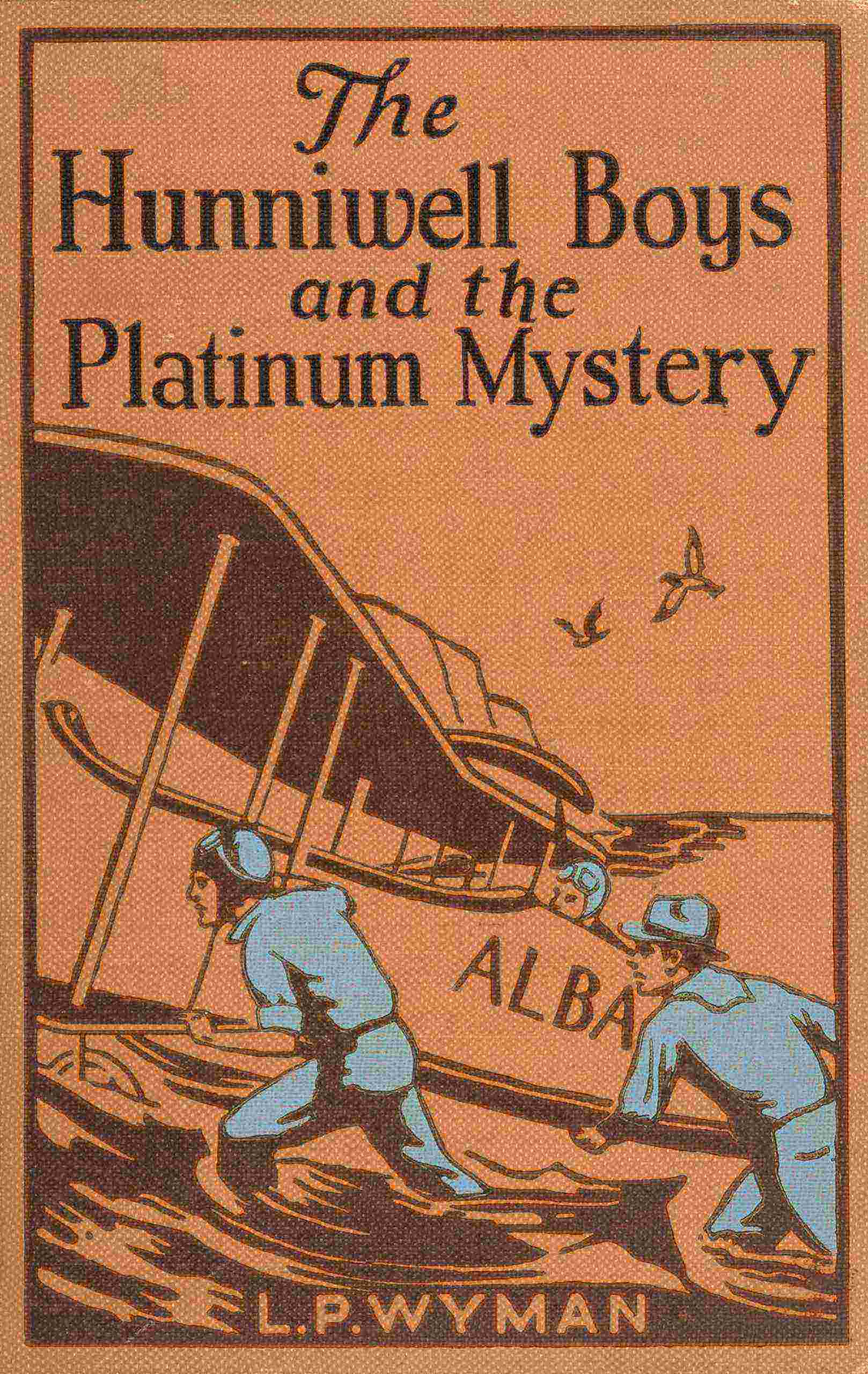
The Project Gutenberg eBook of The Hunniwell boys and the platinum mystery
Title: The Hunniwell boys and the platinum mystery
Author: L. P. Wyman
Illustrator: Howard L. Hastings
Release date: July 17, 2025 [eBook #76521]
Language: English
Original publication: New York: A. L. Burt Company, 1928
Credits: Roger Frank and the Online Distributed Proofreading Team at https://www.pgdp.net (This file was produced from images generously made available by The Internet Archive)
THE HUNNIWELL BOYS AND THE PLATINUM MYSTERY
AND THE PLATINUM MYSTERY
Boys’ Victory,” “The Hunniwell Boys’ Longest
Flight,” “The Hunniwell Boys in the Secret
Service,” “The Lakewood Boys Series,”
“The Golden Boys Series,” etc.
FOR BOYS 12 TO 16 YEARS
The Hunniwell Boys’ Victory
The Hunniwell Boys in the Secret Service
The Hunniwell Boys and the Platinum Mystery
The Hunniwell Boys’ Longest Flight
CHAPTER I
A STRANGE PROPOSAL
“Horned toads and little fishes, but will you look at that baby pull!”
Bill Hunniwell dropped his paddle and grabbed the landing net as he spoke. His brother, Gordon, however, was too busy handling the five ounce rod to make any reply. He had all he could do to keep a taut line on the big square tail as it broke water some sixty feet from the canoe.
But he had handled big fish before and, although he fought it nearly half an hour, he finally succeeded in getting it up within netting distance and in another minute the big fellow lay on the bottom of the canoe too worn out even to flop.
“I’ll bet he’ll go ten pounds,” Bill declared as he looked down at the fish.
“Guess he’s the biggest that has come out of Lost Pond in our time,” Gordon added as he too gazed with pride at his catch.
“We’ll take him home and have him mounted,” Bill declared as he picked up the paddle and turned the canoe toward the cabin.
“The phone’s ringing,” Gordon said when they were almost in. “Make it snappy or they’ll ring off.”
A few strong strokes put the light canoe alongside the wharf and Gordon leaped out and raced for the cabin only a few feet away. Bill pulled the canoe up onto the wharf and began taking the rod and fish out. But he had not finished when Gordon returned.
“It was mother calling,” he announced. “She says that Mr. Rogers is at the house and wants to see us.”
“Rogers? You mean——?”
“Sure, Rogers. R-O-G-E-R-S, our Rogers.”
“What’s he want?”
“She didn’t say, just said he wanted to see us.”
“Of course you said we’d be right down as soon as we could shut up the cabin.”
“Sure I did. We were going down this afternoon anyhow and it’ll save us the trouble of getting dinner. It’s only a few minutes after ten and we can make it by dinner time if we hurry.”
But it was some task to close up the two cabins as the windows were all fitted with heavy shutters and the bedding had to be packed away on account of mice and squirrels which, in spite of all they could do, were bound to get in. So it was nearly half past eleven before they were ready to start.
In a small space on the hillside just beyond the cabin rested an airplane with the name “Albatross” in large letters on both sides. One would have said that it would be impossible for a plane to take off in that small space and, for an ordinary plane it would have been correct. But this was no ordinary plane. It carried no heavy gasoline engine with its heavy load of fuel, but was driven by a light but powerful electric motor which received its power from a new type of storage battery. The latter was very small consisting only of a copper cylinder some eight inches long by an inch and a half or two inches in diameter. The cell was the invention of Bob and Jack Golden and a number of them had been loaned to the Hunniwell boys while the Goldens were abroad.
The extreme lightness of the plane had suggested to them the possibility of lifting it vertically by means of a horizontal propeller driven by a second motor and the idea had proved a complete success. Consequently they were able to land and take off in a space barely large enough to hold the plane.
“You got the fish?” Bill asked as he slipped a cell in place.
“I put it in the box under your seat,” Gordon told him.
“Sure everything’s all right?”
“Sure. I even put out the cat.”
“Well, we want to leave things right because something tells me that we’re going to be busy the rest of the summer and we may not get up here again till next spring.”
“But it’s only the third week in August.”
“I know that, but it’s only a month till college opens and Rogers is wanting to see us.”
“And he wouldn’t be unless he had something he wants us to do.”
“Exactly.”
Steve Rogers was a member of The United States Secret Service and the boys had the previous summer been of great service to him in convicting the leader of the largest dope selling ring in the history of the service. They knew how busy he was and thus Bill had decided that something of more than passing importance had brought him to Maine.
“Let’s go.”
Bill pushed over a switch and the horizontal propeller, which they had dubbed, “the elevator,” began to revolve. Faster and faster the blade whirled as Bill added notch after notch until, with a slight lurch, the plane lifted from the ground. Slowly it rose in the air and started in the direction of the pond as Bill set the forward propeller in motion.
“Better make it snappy so cook’ll have time to put on a couple extra plates,” Gordon told him as the plane skimmed the top of the mountain on the other side of the pond.
“Be there in twenty minutes,” Bill promised.
And he kept his word for the noon whistles were blowing just as the Albatross landed in front of the home hangar. Without waiting to push it inside the boys hurried around to the front of the house where they found their guest on the porch talking with Mr. Hunniwell.
“Talk about pleasant surprises,” Bill said as they shook hands.
“Hope I haven’t disturbed your vacation,” Rogers told him.
“Not a bit of it, we were coming out this afternoon anyhow,” Bill assured him.
“Caught a ten pounder, Dad,” Gordon said with a proud look at his father.
“Tell that to the marines,” Mr. Hunniwell laughed.
“Wait a minute and I’ll show you,” and Gordon darted off to be back in a minute holding the big trout out for their inspection.
“That’s no fish,” Rogers declared, “That’s a whale, and I wouldn’t be a bit surprised if it’s the very one that swallowed Jonah.”
“I didn’t know they grew that large in Lost,” Mr. Hunniwell added.
“Well, I reckon you’ll have to believe it now,” Bill told him.
“Unless you’re like the man who, the first time he saw a giraffe, declared ‘there ain’t no such animal,’” Rogers laughed.
“Well, seeing’s believing,” Mr. Hunniwell assured them. “But there’s the dinner bell and we’d better not keep them waiting.”
An hour later they were again sitting on the porch with the exception of Mr. Hunniwell who had returned to his office.
“Well,” Rogers began as soon as they had sat down, “I suppose you boys are wondering what is up.”
“Something like that,” Gordon grinned.
“Anything is welcome so long as it brought you up here,” Bill added.
“Thanks,” Rogers smiled. “Believe me I’m always glad to come here and see you two boys. Don’t know of a single other place where I’d rather be. But this time I had a very definite object in coming and when I’ve told you the story I think you’ll agree that it’s a queer one.”
“Starts in good,” Gordon declared.
“But it hasn’t started yet,” Rogers told him.
“No, but I mean it sounds as though it was going to be good,” Gordon explained.
“Well, here goes. In the first place you must know that I was born in the city of Gloucester, Massachusetts, and my parents still live there in the same house. You of course know that Gloucester used to be a famous home port for whalers and for many years my ancestors followed that trade. I believe a man named Rogers is more or less famous for having captured the largest whale ever brought in. That was more than a hundred and fifty years ago but it is a matter of record. It’s an old house, the one in which I was born, but they knew how to build in those days and it is still in good shape and the timbers seem as sound as ever.
“I’ve been home a few days with my wife and yesterday morning it was raining and, having nothing to do, I went up into the attic, where there is a great conglomeration of all sorts of things, and began rummaging about as I like to do. Well, stuck away back in one corner and covered with dust I found a small trunk which must have been there no one knows how many years. Strange why no one ever noticed it before but it was way back in a dark corner, as I said, and I guess no one ever saw it, as there was a lot of stuff piled in front of it.
“It was locked but the leather had rotted away so that the lock fell out almost as soon as I touched it. It was almost full of papers yellow with age and most of them were newspapers and didn’t mean a thing to me except that they were pretty old, most of them being dated back before the Civil War. But, to make a long story short, down at the bottom of the heap I found an old pocket-book and in it was a paper and that paper is what brings me here.”
He reached in his pocket and took from it a large and very thin pocket-book which looked to the boys to be very old. From it he drew a sheet of paper which he handled with extreme care and they could see that it was very brittle.
“I’ve read this about a dozen times and as the writing is barely legible I’ll read it aloud to you as it would take you some time to decipher it. It’s dated March 20th, 1816.”
“What year did you say?” Bill asked as he paused.
“1816,” Rogers told him.
“Over one hundred years ago,” Gordon gasped.
“I knew you’d be surprised,” Rogers smiled.
“It’s hardly believable,” Bill added.
“And that isn’t the hardest part to believe either,” Rogers told him as he again bent his gaze on the letter. “Listen.
“‘I burried Jim yesterday. He was sick only a few days and I did all I could for him but ’twasn’t any use. I ain’t feeling none too good myself and perhaps I’m going to get what got him. Well, it’s all right if I do. I’ve had a pretty good life but I would like to see the folks at home once more. I’ve hid the metal we found and there’s about a hundred pounds of it. I don’t know what it is and maybe it’s no good but it’s queer stuff and I never saw any like it before. Looks like silver but ’tain’t because Jim tried it with some aqua fortis he had and——’”
“What’s that stuff?” Gordon interrupted.
“You mean aqua fortis?”
“Sure.”
“That’s what they used to call nitric acid, it means strong water. It’s Latin,” Rogers explained.
“Funny how he happened to have it with him,” Bill declared.
“That’s what I thought,” Rogers agreed.
“‘And it didn’t dissolve it a bit,’” he continued to read. “‘Maybe it’s some new kind of metal, Jim thought it was but I don’t know.’”
“There seems to have been a break here but there’s another line.
“‘I see a ship and it’s coming this way. Maybe I’ll see the folks again after all.’”
“Is that all?” Bill asked as he stopped reading.
“That’s all except for a map on the other side of the paper which shows where they hid the stuff.”
“That stuff was platinum,” Bill declared.
“I think you’re right,” Rogers told him.
“And a hundred pounds,” Gordon gasped. “How much would that be worth?”
“About a hundred and forty thousand dollars,” Rogers told him.
“Is there any name signed to the letter?” Bill asked.
“It’s signed Sol Rogers.”
“Then he must have been one of your ancestors,” Gordon declared.
“He was,” Rogers told them. “He was my grandfather about six times removed. In his day he was a pretty well known whale hunter and, according to the records, he was some man.”
“But how do you suppose that letter ever got in that trunk?” Bill asked.
“You know as much about it as I do. He was lost at sea and I don’t know whether it was on that voyage or not.”
“Probably it wasn’t,” Gordon said. “If it had been I don’t see how that letter ever got ashore.”
“I imagine you’re right. But take a look at the map and tell me what you make of it.”
He spread the paper out on a small table and all three bent over it. It was rather faint but very well drawn and, after a short inspection, Bill said:
“Looks like the Hawaiian Islands to me, and this larger map over on this side seems to be an enlargement of Molokai.”
“I think there’s little doubt about it,” Rogers told them. “The old fellow must have been up on his geography because I’ve compared it with a modern map and it matches almost perfectly.”
“And you think the platinum, or whatever it was, is still there?” Gordon asked.
“That’s hard to say. What would you guess?” Rogers smiled.
“Seems to me he’d have taken it with him if he was rescued,” Bill gave as his opinion.
“At first thought it would seem so,” Rogers said. “But when you come to think of it it doesn’t seem so likely, or at least it doesn’t to me. In the first place he wasn’t sure it was any good and then the ships of that time usually carried a pretty tough crew and he might have been afraid to take it on board. No, I think he left it there hoping to come after it some other time if he found out it was worth it. Probably he took a sample with him.”
“And perhaps he went back and got it,” Gordon suggested.
“I hardly think so or it would have been mentioned in the family history. I looked and there was no word about it. My candid opinion is that he never got back home.”
“Then how did the letter get in that trunk.” Gordon asked.
“Of course I can’t answer that,” Rogers smiled. “But there are several explanations any one of which is possible.”
“Such as what?” Gordon asked.
“Well, for one the letter might have been placed in a tight box of some kind and been washed ashore and someone found it and sent it to his people.”
“Sounds pretty far fetched if you ask me,” Gordon declared, shaking his head.
“Granted,” Rogers smiled. “But it got there some way that’s certain.”
“No doubt about that,” Bill broke in. “But what about it?”
“I’m going to see if I can find it,” Rogers told him slowly.
“You are?”
“Of course I fully realize that it’s more than likely to be a wild goose chase,” Rogers told them, “but I’ve never been out there and I’m going to have a try at it. That is if I can get two boys to go with me. I can get a month’s leave of absence.”
“You mean you want us to go with you?” Gordon asked.
“That was the impression I was hinting at,” Rogers smiled.
“Molokai. Isn’t that where they send lepers?” Bill asked.
“Yes, there’s a leper colony there,” Rogers told him. “But you know leprosy isn’t contagious.”
“Gee, but I’d like to try it,” Gordon declared. “How about you, Bill?”
“I’m on.”
“Fine. How about your parents? Will they want you to go?”
“Oh they won’t object,” Gordon assured him.
“But how’ll we go?” Bill asked. “I think you told us once that you had promised your wife that you’d never fly again and that lets the Albatross out.”
“Ah, but it doesn’t,” Rogers smiled. “You see, my wife is a pretty good sport and when I told her about this find and explained how safe your plane is she consented to let me go.”
“Then we can go in the old bird?”
“You bet. And if we find anything of value we’ll divide it three ways.”
“No, two ways. You half and Gordon and I the other half,” Bill insisted, and neither he nor Gordon would agree to any other plan.
“Oh, well, we probably won’t find anything anyway so we won’t fight about it,” Rogers finally gave up.
CHAPTER II
OFF FOR MOLOKAI
As they had expected it did not take very much urging to gain the consent of their parents although Mr. Hunniwell told them frankly that he had no faith in their hopes. “However,” he continued, “you have never been in that part of the world and if you are careful not to take any chances the trip will undoubtedly be a good one and you will enjoy it. But don’t be disappointed if you find nothing. That paper is too old to have any value in my opinion.”
They had decided to start in a week as it would take them that time to make all their preparations. Or rather Rogers told them it would take him that long as he was obliged to go back to New York and attend to several matters connected with his work. As for Bill and Gordon, they declared that they could be ready to start the next day.
It was arranged that they would pick Rogers up on the flying field on Long Island as he lived not far from there and he left late that afternoon.
“I’ll bet we find it just the same,” Gordon declared as they watched the train pull out from the station.
“Now you don’t want to get your hopes up too high,” Bill advised. “To my way of thinking it’s a mighty long shot. A hundred years is a mighty long time and the chances are that, even if the letter isn’t a fake and he never returned and got the stuff, we’ll never be able to find it.”
“Well, maybe not, but we’ll have a mighty good time hunting for it, let me tell you.”
After they had gone to bed that night they took up the conversation again.
“Say, Bill, you don’t happen to know how big that island is, do you?” Gordon asked.
“Sure do. Two hundred and sixty-one square miles.”
“How do you know?”
“Looked it up, of course.”
“And how far is it from San Francisco?”
“Twenty-one hundred miles.”
“And all the way over water.”
“Sure. There’s no bridge there.”
“Smarty.”
“Well, you asked me.”
“Know anything more about it?”
“Not much. There’s a leper colony there.”
“I knew that.”
“Indeed.”
“Know how many lepers live there?”
“No.”
“Indeed.”
“Well, you can’t expect me to know everything,” Bill laughed.
“I don’t,” Gordon chuckled.
“But I know one thing.”
“Indeed.”
“And that is I’m going to sleep if you’ll let me.”
“Far be it from me to keep your mighty intellect working over time. Good night.”
“Bon nuit.”
Impatient to be off and chafing at the delay the boys put in all the time possible going over the Albatross until Gordon declared that if they did not quit they would wear it all out before they started. “You’ve oiled that motor about a dozen times in the last two days,” he told Bill, “and you know that once in two thousand miles is a plenty.”
“And how many times have you greased that main bearing?” Bill retorted.
“Well, I guess all it needs,” Gordon laughed.
But at last the day came and they bade farewell to their parents and promised to be careful and take no unnecessary chances for the twentieth time. Rogers was awaiting them when about ten o’clock in the morning the plane settled to the ground.
“Been waiting long?” Bill asked as he leaped from the cockpit and grasped his hand.
“Only about fifteen minutes,” Rogers told him. “I’ve got all my stuff here. Think we can find room for it?”
“I reckon,” Gordon assured him. “There’s lots of room back of that back seat. What’s in that box?” he asked pointing to a wooden box about eighteen inches square.
“That’s my laboratory,” Rogers told them. “You see,” he explained, “we don’t want to bring home a hundred pounds of something that’s not worth anything. I happen to know a little about Chemistry and I’m taking along enough equipment to be able to make some tests.”
“You talk as though you really expected to find it,” Bill smiled.
“Of course I do,” Rogers told him. “What do you suppose we’re going for?”
“Platinum,” Gordon answered.
“You said it, son.”
All this time they had been busy packing away Rogers’ stuff and, as soon as the task was accomplished, they were ready for the start.
As there was no particular hurry they had decided not to attempt a non-stop flight but to land as soon as it began to get dark and spend the night at a hotel.
“We ought to get pretty near out to Chicago before dark,” Gordon declared as he got to his seat beside Bill.
“Easy,” Bill told him.
It was a perfect day as they rose in the air. There was a bit of light breeze and even that was in their favor and everything seemed auspicious.
“How quiet it is,” Rogers said as Bill started the forward propeller.
“I suppose you miss the noise of the engine,” Gordon said.
“I sure do, but it’s a happy miss,” Rogers laughed.
Bill climbed rapidly until they reached an altitude of a little over a thousand feet and then leveled the plane and increased the speed until they were making a hundred and fifty miles an hour and for some time kept it there.
“There’s Lake Erie,” Gordon announced about one o’clock, “and I move we eat.”
“Looks to me like a shower coming this way,” Bill said an hour later.
“I’ve been watching that cloud for some time,” Rogers said, “and I think we’re going to hit it.”
“Looks like it,” Bill agreed, “unless we can go over it.”
“How about landing till it passes?” Gordon asked. “I had one experience in a thunder storm and don’t exactly hanker for another.”
“Just as you say,” Bill told him. “But it looks rather low to me and I believe we could go over it without any trouble. What do you say?” he asked turning to Rogers.
“There’s no use in taking chances,” replied the older man. “But if you think there’s no danger, go ahead as far as I’m concerned.”
“I really believe it’s as safe as it would be to land,” Bill declared. “That storm is going to be a pretty good one and it might wreck the plane even on the ground. If you two are willing I’d like to try it.”
“Go to it,” Gordon declared and Rogers nodded his head in agreement.
So Bill gave the stick a sharp pull and the Albatross turned her nose upward. Up crept the needle of the altimeter until it registered ten thousand feet and still the dark clouds seemed just ahead of them. Then suddenly a thick mist enveloped them and they knew they had entered the cloud. For some time they had heard the distant mumbling of thunder and seen flashes which told them that the storm was rushing toward them. And now the wind was rapidly increasing in strength and coming directly against them.
“Think we’ll make it?” Gordon asked, and there was more than a suspicion of anxiety in his voice.
“I think we’re above the center of it,” Bill answered as he glanced over the side of the cockpit.
“Still going up?” Rogers asked.
“Yep, still going up,” Bill told him.
The flashes of lightning were closer now and the rattling of thunder was almost incessant and Bill’s heart sank as he realized he had made a mistake. “I should have landed,” he muttered as he gave the stick another pull.
Then, almost as suddenly as they had entered the cloud, the plane burst into bright sunshine.
“Hurrah, we made it,” Gordon shouted.
“And just in time if you ask me,” Bill returned. “I was beginning to get scared.”
“First time I ever was above a thunder storm,” Rogers told them as he looked over the side of the cockpit. “Just look at those streaks of lightning. Isn’t it a wonderful sight?”
“It sure is,” Gordon told him. “But let me tell you it doesn’t seem half so wonderful when you’re down there in it. And, believe me, I know what I’m talking about because I’ve been there.”
“It seems kind of lonesome up here when you can’t see the ground,” Rogers declared a few minutes later.
“We’ll be going down pretty soon,” Bill told him. “We’ve pretty nearly passed it.”
The sound of the thunder was rapidly decreasing and they could see that the heavy clouds beneath them were thinning out and soon Bill turned the nose of the plane downward.
“Next time I think we’ll land if it’s all the same to you,” Gordon told them as he caught sight of the land. “Terra firma isn’t so bad after all when a storm comes up.”
“I believe you’re right at that,” Bill agreed.
It was about seven o’clock when they decided to land for the night. They were approaching what seemed to be a fair sized town, not too large but large enough to have a hotel and a few minutes past the hour they landed just on the outskirts of the village. About a hundred yards away was a house with a large barn and Bill suggested that it looked as though they could run the plane inside if permission were given. So Gordon went up to the house and at his knock a man appeared who readily granted his request.
“And we can put you up for the night,” he added. “You see we take in tourists and supper is all ready. Matter of fact it’s about over but I guess there’s plenty left.”
“That’ll be fine,” Gordon told him.
Without much trouble they pushed the plane inside the barn, the doors of which happened to be especially wide and, a few minutes later, sat down to a splendid supper.
“What town is this?” Bill asked their host as they started to eat.
“Creston,” he told him.
“Indiana?”
“No, Creston, Iowa.”
“We sure did make good time then,” Gordon declared.
“Funny I didn’t hear your plane,” the man said.
“No, it isn’t,” Gordon told him, “because it doesn’t make hardly any noise.”
“How come?”
“Well, you see, we have an electric motor instead of a gasoline engine,” Gordon explained.
“First time I ever heard of that,” the man declared.
“And I think ours is the first one of its kind,” Gordon told him.
“Think we can make the coast to-morrow?” Gordon asked as they were getting ready for bed.
“If nothing happens and we get away by five o’clock,” Bill told him.
“And we don’t run into any more storms,” Rogers added.
They had arranged for an early breakfast and it was only a few minutes after five o’clock when they again took the air. The sky was overcast with heavy clouds and there was every prospect that it would rain before the day was much older. And the promise was fulfilled, for within an hour it was raining hard. But inside the cockpit all was cozy and, as there was little or no wind, they did not mind the bad weather.
“Better hit her up pretty lively if you expect to make the coast to-day,” Gordon advised.
“We’re doing a hundred and fifty,” Bill told him.
“Do you really mean it?” Rogers asked.
“Hundred and fifty-two to be exact.”
“It doesn’t seem possible we are going that fast,” Rogers declared.
“That’s because the old bird runs with so little fuss,” Gordon told him.
“She doesn’t make much fuss about it and that’s a fact,” Rogers agreed.
“Hark.”
“What is it?” Bill demanded.
“Plane coming,” Gordon told him.
“I hear it now,” Bill agreed.
“And, believe me, it’s doing some hiking,” Rogers added a moment later.
“I see it,” Gordon, who was using the glass, declared. “It’s coming straight for us.”
“Well, thank goodness there’s plenty of room to turn out,” Bill laughed.
“Mail plane,” Gordon announced a moment later.
“Doesn’t look as though he saw us at all,” Bill declared giving the wheel a slight turn.
“He doesn’t hear us, that’s one safe bet,” Rogers said.
A moment later and the big mail plane rushed by them at a distance of only a few rods and they could not help laughing at the expression on the pilot’s face as he caught sight of them, apparently for the first time, when they were directly opposite.
“Bet he goes in with a tale of a ghost plane,” Bill chuckled.
“Wouldn’t wonder,” Rogers laughed.
“He certainly looked as though he was seeing things,” Gordon added.
“I suppose twenty years from now planes will be so thick that we’ll have to have traffic laws same as we do now for automobiles,” Rogers declared as he watched the plane disappearing in the distance.
“But we’ll always have plenty of different levels,” Bill said, “and that will help.”
“It sure will,” Gordon agreed.
“I think I can see the ocean.”
It was a little past six o’clock when Rogers made the statement. Gordon had been driving since shortly after noon and Bill was more than half asleep in his seat. The weather had cleared shortly after twelve o’clock and they had all enjoyed immensely the flight over the lofty peaks of the Rockies. The motor had run perfectly and nothing had happened all day to mar the pleasure of the trip and they were all in high spirits.
“Going to land in the big city?” Gordon asked a few minutes later when they were sure that they were nearly to the coast.
“I think Stockton will be better,” Bill told him. “It’s only a short distance from the coast and it isn’t so large.”
“Then we ought to be sighting it most any minute now.”
“I believe that must be it a bit over to our right,” Rogers declared.
“My idea,” Bill agreed.
Gordon turned the wheel slightly and in a few minutes they had landed. A number of people had seen the plane as it was settling to the ground and they were almost immediately surrounded by a curious crowd.
“What kind of an outfit is that?” one man, a big burly fellow demanded as he rested one hand on one of the wings.
“It’s an aeroplane,” Bill told him.
“But it didn’t make no noise like a plane,” the man objected.
“No,” Bill said quietly. “You see, it’s run by an electric motor instead of a gas engine.”
“Can yer beat that,” the man declared turning from the plane to the crowd. “Where you fellers from?”
“Maine,” Bill told him.
“That’s a good bit of a distance from here, I reckon. When did you start?”
“Yesterday morning.”
“No kiddin’?”
“Honest injun,” Bill smiled.
In spite of the man’s roughness he saw that he, as well as the rest of the crowd, was well disposed toward them and he thoroughly enjoyed his surprise. Inquiry at once gave them the information that there was a good hotel only a couple of blocks distant and willing hands helped them push the plane down the street and into the garage in the rear of the hostelry.
“And so ends the second day,” Gordon declared as they made their way toward the dining-room.
CHAPTER III
OVER THE PACIFIC
“We ought to make it from here in about fifteen hours actual flying time,” Bill said as they were getting ready for bed shortly before ten o’clock.
“Then if we leave here at five we should be there about eight,” Gordon said.
“But that gives us no leeway in case of trouble,” Rogers reminded them.
“And we want to be sure to get there while it is light if we possibly can,” Bill advised.
“Then I move that we pull out of here soon after three o’clock,” Gordon said. “Of course it’ll be dark then but it’ll get light before we get very far and we won’t mind it and we’ll all feel safer.”
“Second the motion,” Bill agreed.
“Third the motion,” Rogers added.
“Which makes it unanimous,” Gordon laughed. “Got your course laid out?” he asked turning to Bill.
“I will have it in about a minute,” Bill replied bending over the map he had been studying for the past few minutes.
“Don’t make any mistakes,” Gordon cautioned him. “If we miss that island we’re likely not to see any land for a long, long time.”
“And the water out there is mighty wet,” Rogers laughed. “By the way, I wonder if the Albatross will float.”
“Of course we’ve never tried it,” Bill told him, “But I don’t think there’s any doubt about it. Back of your seat there’s a pretty good-sized air space which we made water tight and you know she’s very light and we carry no fuel. Yes, I think I can say she’ll float.”
“I’m certain of it, but I sure hope she won’t have to demonstrate it,” Rogers smiled.
He called the office and asked that they be called at half past two. They had already made arrangements with the cook for plenty of food to be packed for them and they were assured that everything would be ready at whatever time they appointed.
“Then I reckon we’d better hit the hay for what sleep we can get which will be only about four hours,” Bill said as he finished charting his course.
Ten minutes later the lights were out and all was quiet.
“Gee, but twenty-one hundred miles seems like a good ways when it’s all over the water,” Gordon declared as he hopped to his seat at a quarter past three the following morning.
“In miles, yes, but in time it isn’t so far,” Bill told him as he started the elevator. “We’ll be there before you know it.”
“Oh, I’m not scared or anything like that,” Gordon hastened to assure him.
“I never thought you were,” Bill smiled.
Dawn was just breaking as they flew over San Francisco and out over The Golden Gate.
“Wish it was lighter so we could see more of it,” Bill said.
“We must plan it so that it will be when we come back, it’s well worth seeing,” Rogers told him.
“And now there’s nothing beneath us but drink,” Gordon sighed.
“And not very good drink at that,” Rogers laughed.
“But there’s plenty of it such as it is,” Bill declared.
“And then some,” Gordon added.
It was a beautiful morning and as the sun came up behind them and threw its rays out over the ocean it was an experience they never forgot. They were flying at an altitude of a little more than a thousand feet and the ocean stretched out beneath them like an immense mirror.
“No wonder they called it the Pacific if it’s always like this,” Gordon declared looking over the side of the cockpit.
“But it isn’t,” Rogers reminded him. “I’ve been on it a couple of times and once in particular it wasn’t so pacific let me tell you.”
“Didn’t you say you had never been where we’re going?” Gordon asked him.
“I never have, but I’ve been on the Pacific. It’s a fairly big pond, you know, and you can go some little distance without banging into those islands.”
“Guess you’re right at that,” Gordon laughed.
An hour later they ate breakfast and found that the cook had put them up a splendid lunch.
“Believe me, that baby knows his vegetables,” Gordon declared as he started on his third sandwich.
“Hope he’s as good on quantity as he is on quality,” Bill sighed.
“That a knock at me?” Gordon demanded.
“Don’t be so quick to put the shoe on,” Bill laughed. “Is that the ninth or tenth sandwich for you?”
“It’s only the third,” Gordon flung back. “How many have you had?”
“Why, er——”
“Don’t be bashful. How many?”
“Four, not counting this one,” Bill acknowledged.
“Then don’t talk to me about quantity. I’m only a piker compared with you.”
“I guess we’ve got enough,” Rogers told them. “I know something about eating myself and I ordered the eats you know. Anyhow if you find we’re going to run short you can throw me overboard.”
“Jonah act, eh?” Gordon laughed.
“Well, if I’m not greatly mistaken there’s the whale all ready for you,” Bill cried pointing ahead.
“Sure’s you’re born,” Gordon shouted.
“And it looks as if it were big enough to do his part all right,” Rogers added.
“Let’s see how near we can get to him,” Gordon suggested. “He’s right in our path and we won’t lose more than a few minutes at the most.”
The whale was, as near as they could judge, about two miles ahead of them when Bill slowed down the motor and, at the same time pulled the stick turning the nose of the plane downward.
“Look at that baby spout water,” Gordon cried.
“He’d make a peach of a fire engine,” Bill declared.
They were rapidly nearing the whale which seemed to be idly floating on the surface of the water and so far had apparently not seen them.
“My, but he’s a whopper, and will you look at that mouth,” Gordon said as they drew nearer. “I’ll never doubt the story of Jonah again. That baby could swallow him and the boat besides.”
Bill had started the elevator and they were now almost directly over the whale and not more than fifty feet above the water. And still the whale paid not the slightest attention to them.
“Better not get any lower,” Rogers said as the plane hung almost motionless over the big animal of the deep. “He might take a notion to wag his tail at us.”
Just as he spoke the whale must have either seen or heard them for suddenly there was a mighty commotion in the water and high up in the air swung the tail sending a cloud of spray which sprinkled them liberally. Then he was gone leaving only a mighty swirling of the water below them.
“I’ll say your advice was good,” Bill said as he started the forward propeller. “If we’d been much lower he’d have caught us.”
“He was only playing,” Gordon declared. “Cunning little fellow, wasn’t he?”
“Maybe he was playing, but I’m afraid he’d make rather a rough playfellow,” Rogers laughed.
“How long would you say he was, about two hundred feet?” Gordon asked.
“Two hundred fiddle sticks,” Bill scoffed. “They never grow to more than about eighty feet. Isn’t that right?” he asked turning to Rogers.
“That’s about the limit, I believe,” he assured him.
“Well, that may be your experience,” Gordon told them, “But, take it from me, that baby was an exception. A hundred and fifty feet and I won’t take off an inch.”
“Too bad you couldn’t measure him,” Rogers said.
“Probably he would have if he’d had scales like an ordinary fish,” Bill jeered.
“Old stuff,” Gordon retorted. “If you can’t do better than that you’d better keep still and not try. Noah sprung that one when he was telling the King of Nineveh how big the whale was that swallowed him.”
“I suppose you heard him.”
“No, I didn’t hear him but I heard about it,” Gordon laughed.
By this time their speed had crept up to a hundred and fifty miles an hour again and they were all looking for more whales.
“But we’d better not stop again even if we do see one,” Bill declared. “We want to make the island before dark so we can see where to land and whales take time.”
“But we got our money’s worth that time,” Gordon declared.
The weather remained perfect and at noon they ate again until Rogers warned them that half their food was gone and they had better go a bit slow.
“And I had just got well warmed up,” Gordon sighed.
“Warmed up indeed,” Bill scoffed. “I’ve been watching you and you’ve eaten enough for three ordinary men right now.”
“You sure can tell ’em when you get started,” Gordon retorted.
“Do you boys fight like this all the time?” Rogers laughed.
“You don’t know the half of it,” Bill told him.
“Is Molokai the first land we’re going to see?” Gordon asked a couple hours later.
“If I haven’t made any mistake in my reckoning it will be,” Bill told him.
“And if you have we may not see land for a week, eh?”
“Something like that.”
“Then here’s hoping because I’m going to get mighty hungry before then,” Gordon declared.
“I’ll bet,” Bill laughed.
Six o’clock came and they ate once more leaving just enough for a meager breakfast. For the past hour Bill had been watching what looked like a low bank of clouds ahead of them, and as soon as the meal was over, he said:
“I don’t just like the looks of the weather ahead there.”
“I’ve been watching it,” Rogers told him. “Think it’s a storm?”
“Looks like something of the sort to me. What do you say, Gordon?”
“Looks to me more like a fog bank.”
“Which is about as bad.”
“Worse, if you ask me,” Gordon told him.
“We ought to be nearly there I’d say,” Rogers declared.
“Let’s see, we’ve been flying nearly fifteen hours at about a hundred and fifty miles an hour. How far is that?”
“Twenty-two hundred and fifty,” Gordon told him a moment later.
“Then we ought to be there. I figured it was twenty-two hundred miles from where we started. Wonder if I’ve gotten off the course.”
“If you have it’ll be the first time,” Gordon told him.
“And the worst time,” Bill added. “But I don’t believe I have. I’ve watched the compass mighty close.”
“We lost some time playing with the whale,” Gordon reminded him.
“Not more than fifteen or twenty minutes I’d say.”
“I’d make it half an hour at least,” Rogers gave as his opinion. “You slowed down quite a while before we got up to him and it took some time to get going full speed again.”
“Well, maybe it was half an hour,” Bill agreed, “But, even so, we ought to be sighting it any time now.”
“We probably will,” Gordon assured him.
But another half hour passed and still there was no sight of land, but it was now quite certain that they were running into a fog.
“No use trying to go over it because we couldn’t see through it,” Bill told them as the plane became enveloped in the light fog.
“Not so bad if it doesn’t get any worse,” Gordon said.
“But it’s going to,” Bill told him.
And he was right for in less than ten minutes it was so thick that they could hardly see a dozen feet ahead. Bill slowed down the motor until they were making just enough headway to maintain their altitude.
“Only thing to do is to ride it out,” he declared.
“Good thing there’s no wind,” Gordon ventured.
“But if there was a good wind it would probably blow the fog away,” Rogers told him.
“That’s so, too,” Gordon agreed. “Perhaps I’d better whistle for one.”
Another half hour passed with no change in the conditions.
“I’m afraid we’ll go past it,” Bill told them.
“What’s the matter with starting the elevator and standing still till the fog clears if it ever does?” Gordon suggested.
“Just what I was thinking of doing,” Bill said, and a few minutes later they were practically motionless.
“Keep your eye on the needle,” Bill ordered. “We don’t want to get any lower.”
It took considerable moving of the switch to hold the plane stationary but for more than an hour their altitude did not vary more than a hundred feet. Of course they were unable to tell how fast they were drifting but there was only the slightest of breezes and they knew it could not be much. It certainly was a peculiar sensation to be suspended there betwixt sky and water and before long it began to get on their nerves.
“If something doesn’t happen before long I know one who’s going loco,” Gordon declared.
“It isn’t very pleasant,” Bill told him, “but I can’t see that we’re in any particular danger.”
“It isn’t that,” Gordon insisted. “It’s, it’s——well, I don’t know what it is but it is all right.”
“I feel somewhat that way myself,” Rogers acknowledged.
“And I guess I’d better make it unanimous,” Bill laughed, but there was not much mirth in the sound.
“How about going straight up and seeing if we can’t get out of this stuff?” Gordon asked.
“Wouldn’t do a bit of good if we did,” Bill told him.
“I know it but it would be doing something.”
“All right, just as you say,” and Bill pushed over the switch.
They had been floating at an altitude of about eight hundred feet and the needle slowly turned until it registered four thousand and the fog was as thick as ever. And now it was getting dark.
“Think we’d better go any higher?” Bill asked.
“We don’t seem to be getting anywhere and that’s a fact,” Gordon told him. “Guess we better go down again. Somehow I don’t feel safe up so high.”
So Bill pulled the switch back and they began to sink. At an altitude of a thousand feet he brought the plane to a stop and said:
“Well, we seem to be about where we were before we went up.”
“Every place looks the same,” Gordon growled.
“Listen.”
It was Rogers who gave the command and for a moment they strained their ears.
“It’s the surf sure’s you’re born,” Gordon finally declared.
“I don’t think there’s any doubt about it,” Bill agreed. “Which way do you make it?”
“Straight ahead, I’d say,” Rogers replied.
“Sure it is,” Gordon agreed.
“Think we’d better try landing?” Bill again asked.
“Sure, why not?” Gordon answered.
At the word Bill started the forward propeller at the same time slowing down the elevator.
“Tell me when you think we’re right over it,” he ordered.
“I’d say, now,” Rogers told him a few minutes later.
“Same here,” Gordon agreed.
They were now up only three hundred feet and the sound of the surf as it broke on the shore was plainly audible but they could not see a thing.
“Keep your eyes open,” Bill cried as he stopped the forward propeller.
“Pile of good it’ll do,” Gordon grumbled.
“I’m going to let her down as slowly as I can and you must let me know if we’re going to hit anything,” Bill insisted. “If we land in a tree it’ll be all day with the plane. Watch now and yell if you see anything.”
“I’ll yell all right,” Gordon promised him.
Slowly the plane settled down until they were only fifty feet above the land and then Gordon shouted:
“I see trees right under us.”
Instantly Bill speeded up the elevator and the plane rose to a hundred feet.
“No need of going up so high,” Gordon told him.
“Well, I wanted to play it safe.”
He started the forward propeller again but shut it off in a couple of minutes.
“Now we’ll try it again,” he told them.
But once more when they were nearly down they found that trees were in their way and they were forced to try again.
“I’m afraid we’re over a good sized forest,” Bill said.
“How about going back and trying to land near the shore?” Rogers suggested. “Usually there’s a fairly wide stretch of beach between the water and the forest. At least there is on most of the islands I’ve seen.”
“I guess it’s the best plan,” Bill agreed as he started the forward propeller again and turned the wheel as far as he could.
“If it was just dark we could see well enough with a flash light,” Gordon declared, “but it’s almost as much use as a yellow eyed bean in this fog.”
“How about it?” Bill demanded a moment later.
“Shut it off, I think we’ve gone far enough,” Gordon told him.
“Look sharp now.”
“Sharp is right.”
A moment later the plane landed as light as a feather, as Rogers declared, and with a sigh of great relief, they jumped from their seats to the hard sand.
“Well, we’re here,” Gordon cried.
“We’re here all right but I wish someone would tell me where here is,” Bill returned. “Of course we’re on an island but I’d give something to know the name of it.”
“Well, we’re not going to know before morning and that’s that,” Gordon told him.
CHAPTER IV
MOLOKAI AT LAST
They found that they had landed about fifty feet from the water line but not knowing whether it was high or low tide they pushed the plane some hundred feet farther up the beach. By this time darkness had come and, together with the fog, they could hardly see their hands before their faces. Still they all realized that it might have been much worse and no one was disposed to grumble.
“How about some eats?” Gordon asked as soon as they were sure they had the plane in a safe place.
“What do you mean eats?” Bill demanded.
“What does one usually mean when he says eats?” Gordon retorted.
“You’ve had all the eats you’re going to get to-night. Why we ate only an hour or so ago and besides you’re not hungry, it’s only a habit,” Bill told him.
“Maybe you’re right,” Gordon sighed. “I forgot we’re on short rations.”
“I’m sorry, but we’ll need all we’ve got for breakfast to-morrow morning,” Bill consoled him.
“If I starve before then don’t forget that I forgive you,” Gordon told him.
“Thanks for those kind words. They sure take a load off my mind,” Bill laughed.
“Well, seeing as how there doesn’t seem anything else to do and that we got up fairly early I move we go to bed,” Gordon proposed a few minutes later.
“Not a bad idea,” Rogers agreed. “Where are we going to sleep?”
“I guess it’s the sand for us,” Bill told him. “I wouldn’t want to get very far away from the plane and with our blankets it won’t be so bad.”
It was not cold although a cool wind had sprung up and they were hopeful that it would clear away the fog by morning.
“I’ve slept in lots worse places than this,” Gordon declared a few minutes later. “This sand was laid soft side up.”
“It’s not half bad,” Rogers agreed. “And, believe me, I’m going to sleep.”
They were all sleepy and wasted no more time in talking. Some time later Bill opened his eyes and sat up. Something had disturbed his sleep but, for a moment, he had no idea what it was. Then he was conscious of a strange sound off to his right and seemingly not far away. It began with a low rumble not unlike distant thunder but soon began to change, getting more volume and of a higher note until it rose to a shrill shriek and finally died away in the low rumble with which it had started. Perhaps the whole thing had lasted a minute.
“Did you hear anything?” he heard Gordon whisper not loud enough for him to hear unless he was awake.
“I’ll say I did,” he whispered back. “Did it wake you up?”
“Something did.”
“It was enough to wake the dead.”
“Didn’t sound like any animal I’ve ever heard.” This last was from Rogers and they knew that he too had been awakened.
“There it goes again,” Gordon said.
This time the sound was about the same except that it did not last as long.
“Spooks,” Gordon whispered as the wail died away.
“No spooks ever had lungs substantial enough to make a noise like that,” Rogers told him.
The wind was still blowing and they noticed that the fog had nearly cleared although it was very dark.
“What time is it?” Gordon asked. “My watch has stopped. Forgot to wind it.”
“Quarter past two,” Bill told him.
For nearly half an hour they listened to the strange sound which recurred at frequent intervals. Then it stopped.
“If anyone could have seen us when we landed I’d be inclined to think it was someone trying to scare us,” Bill said as he stretched out on the sand again.
“Any guy that could do that naturally wouldn’t have to try very hard,” Gordon told them.
“Which may be true although it doesn’t make any sense,” Bill declared.
“What doesn’t make sense?”
“What you said.”
“I’ll leave it to Steve if it didn’t.”
“I think I got your meaning,” Rogers chuckled.
“There, smarty,” Gordon jeered.
“All right, my mistake. Let’s go to sleep.”
When Bill awoke again it was broad daylight and the sun was shining. The fog had entirely cleared and the sky was cloudless. A glance at his watch told him that it was nearly seven o’clock and he spoke to the others.
“You fellows going to sleep all day?”
As soon as he had the others really awake, he looked about him. In front stretched the ocean while back of them and some hundred feet distant grew a thick forest of a variety of tropical trees. The broad hard beach stretched in either distance as far as he could see.
“Well, we sure had plenty of room to land after all,” he remarked.
“I’ll say we did,” Gordon agreed as he got up and stretched himself. “How about breakfast?”
“Always thinking of your tummy,” Bill laughed as he began dragging what was left of their supply of food from the plane. “I hope the coffee in this last vacuum bottle is hot.”
It was and they made a fairly satisfactory breakfast although Gordon insisted that it was far below par.
“Now,” Rogers began as soon as they had finished, “I suppose the first thing in order is to try and find out where we are.”
“And locate a base of supplies,” Gordon added.
“Say,” Gordon asked as they were getting ready to hop off, “did we hear something in the night or did I dream it?”
“If you dreamed it I reckon I did too,” Bill told him.
“And that includes me also,” Rogers added.
“What was it?” Gordon added.
“Don’t you wish you knew?” Rogers mocked.
“Do you know?”
“Haven’t an idea.”
“How about you, Bill?”
“Same way.”
“But don’t you think we ought to know what it was?”
“Maybe, but I don’t know how we’re going to. We’ve got other things of more importance on hand just now,” Bill told him.
“Perhaps and perhaps not,” Gordon retorted. “Anyhow I’d hate most awfully to have whatever it was making it get hold of me.”
“Some things aren’t so bad as they sound,” Rogers smiled.
“Well, that thing could be a whole lot better and then be bad enough,” Gordon told him.
They had decided that the best plan was to go up in the plane and see what they could see. So, a few minutes after they had finished eating, they were once again in the air which was remarkably clear.
“This can’t be the right island,” Gordon declared as soon as they were up about a hundred feet, “it isn’t large enough.”
“From this map of the islands I think this is Kahoolawe,” Rogers said. “It looks to be about the right size and over there that big island must be Maui.”
“Then Molokai ought to be about sixty miles a little east of north from here,” Bill suggested.
“Exactly,” Rogers agreed.
So Bill headed the plane nearly north and they flew along at an altitude of about six hundred feet.
“That must be Lanai over there to the left,” Rogers announced a few minutes later.
“And Molokai straight ahead,” Gordon added.
“Righto,” Bill agreed.
“It can’t be more than a hundred miles to Honolulu,” Rogers said. “How about going there and laying in supplies?”
“Oh, boy, right where I live,” Gordon chuckled.
“We’ll really attract less attention in a large place like Honolulu than if we land near some small town and we don’t want to make ourselves any more conspicuous than is necessary the way I figure it,” Rogers explained.
“I think you’re right,” Bill agreed giving the wheel a slight turn to the left.
“According to that old map our stamping ground is not far from that point,” Rogers said as, a half hour later, they passed over the western end of Molokai.
“And it doesn’t look to me as though that end of the island is very thickly populated,” Gordon declared as he gazed over the side of the cockpit.
“It isn’t,” Rogers told him. “That’s Laau Point and there’s no settlement within about twenty miles of it.”
“Can’t make us mad, eh?” Gordon chuckled.
“No, the fewer the better,” Bill told him.
It was just ten o’clock when the Albatross settled to the ground on the outskirts of the city. Contrary to their hopes, however, the plane had been sighted and there was a large and, as Gordon afterward declared, a very mixed reception committee ready to greet them. In fact it seemed to them that about every nation on the globe was represented. Everyone wanted to shake hands with them and for the better part of an hour they were kept busy at the task. Also everyone wanted to know where they came from and all about them and when they learned that they were from the States their greeting was all the more cordial.