
Eight of the Comanches were down, and the remaining ten, including Red Buffalo and Snapping Fox, were wavering.
Another discharge, and the fall of two more braves quickly decided them. Turning their mustangs, they bent forward, so that the whites could not get a good aim at them, and off they went like the wind.
“Go it, ole Red Buffler. I let ye go off this time, fur I want ter hev a stand-up fight wid ye. Yer maxim must be, ‘those who fight an’ run away, may live to fight another day,’ judgin’ by the way ye’re a-makin’ tracks,” said the guide, with a grin.
The four whites mounted their horses, and rode off toward the south.
They reloaded all of their weapons, and were talking over the recent fight as they rode on.
Suddenly the others saw Ralph turn in his saddle, and a low exclamation burst from his lips. What had caused it?
The others turned and looked back, but could see nothing.
“What is it, Ralph?” asked the young hunter.
“Look at the horizon. See that,” said Ralph.
“I see nothing but a cloud rising. What do you make it out to be?”
“I’ll tell yer what I know it to be. It is smoke. The cussed Injins hev fired the grass. The wind is a-blowin’ strong right toward us, an’ we must git. It looks bad, fur our horses are tired.”
The others started when they heard this. They were not through with the Comanches, after all. Red Buffalo hated them terribly, and although beaten in a square fight, he was not beaten altogether.
Obeying the order of the guide, the whites set off at as rapid a pace as they could command. This was not much, as their horses, or at least three of them, were pretty well tired out.
The Indians knew this when they fired the prairie-grass, and now the Indian chief thought he had the hated whites in a fix.
Little did he know the fertile brain of the old hunter.
Ralph explained to the other three, that some distance ahead was a wide, but shallow stream. The prairie went down to the edge, and the fire would go that far and no further.
There was a forest on the other side, and Ralph wanted to reach this.
On they went, casting glances of apprehension behind them.
As the cloud of smoke and the fire came closer, these glances were partly admiring ones. No one but a timid man or an absolute coward could fail to admire the scene, even at this dangerous situation.
“Von beautiful sight. Von superb spectacle. Von grand, sublime, magnificent picture. De man dat paint dat, he be worth a fortune,” murmured the brave and enthusiastic Frenchman, as he watched the huge billows of fire, as they rolled upward, topped off with volumes of dense black smoke.
Now a herd of fleet deer would shoot past the four riders, their large eyes distended with terror, at the sight behind them.
Then came a drove of wild mustangs, going like the wind. After this came a confused medley of buffaloes, wolves, coyotes, horses, deer, and in among them came a huge bear, which was making excellent time.
The fire looked grand and terrible, as it got closer and closer.
The four whites could not help admiring the sight, even though they knew that perhaps it would be their death.
The flames shot hundreds of feet into the air, and came onward, at a speed which would have put a race-horse down.
The wind was pretty strong, and as the guide had said before, was coming straight toward them.
On went the four riders, and on came the sea of fire.
It looked like a fiery avenger, upon the track of the whites, and the little Frenchman could not help wondering whether he and his comrades would ever see the sun again.
That bright luminary was hidden from sight now, by the dense clouds of smoke that covered the prairie.
The guide began to look anxious. The river was quite a distance away, and the fire getting alarmingly near, as the increasing heat testified. At length the circus-rider exclaimed:
“How far is it to the water, Ralph?”
“About two-thirds o’ a mile, I reckon,” replied the hunter.
“We’ll never reach it, then,” said Barry.
“Jest what I was a-thinkin’,” said the guide.
“Then what in heaven’s name will we do? We can’t keep on this way. Have you no plan, Ralph?” said Barry.
“We’ll stop not over three hundred yards from hyar,” answered Ralph.
“How’s that? There’s not a tree, log or rock around. Explain what you say,” said the young hunter, turning to the guide.
“Why we can’t reach the river, that’s certain. We’ve got to do something, fur thar’s no fun in being burned up by the pesky fire. Now what I propose is this. We’ll fight fire wid fire. What d’ye say to that, now?” called out Ralph, to make himself heard above the trampling hoofs, and the roaring and crackling of flames, which came rushing on like a huge wall.
“We don’t know what you mean,” returned Barry, in an equally loud tone, for the very same reason.
“Why it’s this. When we git to that high grass over thar we’ll dismount, and start a fire o’ our own. How’s that fur high?”
“It is von elegant plan vich ve shall follow at once, Monsieur Ralph,” said the polite little naturalist.
Looking around as the Frenchman spoke (the naturalist was a little behind the others), the hunter saw a sight which caused a huge grin to come upon his face, and it to relax from its thoughtful mood.
The sharp and cool Frenchman had opened his umbrella, and was holding it above his head to keep the sparks off.
The guide gave a roar of laughter, in which he was joined by the other two, and which was echoed by the subject.
Then, as they had reached the spot where the grass was high, the four men suddenly checked their wild career, and sprung to the ground.
The Frenchman had shut down his umbrella, and being in the mind of the hunter the person most suited to hold the horses, the latter were given in his care. The other three began to pull up the dry grass, and to pile it up as rapidly as wthey could.
It was a matter of life and death with them, and the way they worked was a caution, their arms flew about as if by magic, and the heap of grass grew higher and higher.
The Frenchman had his hands full in keeping the bridles of his horses in his hands, for the animals, frightened at the nearness of the immense sea of fire, and at the falling sparks, were very wild and strove to break away, but the naturalist was stronger than one would take him to be, and he managed to hold onto them, although several times he was very nearly dragged from his feet.
It was a singularly wild and picturesque scene. The smoke obscured the light of the sun, and the flames lit up the prairie with a reddish sort of light, which made all objects have a curious look about them. There, pictured in the light, was a little man, holding four horses by the bridles, and striving to keep them quiet.
Close beside him were three others, plucking up the grass and pitching it upon the already large pile.
No wonder they did not stop an instant to note the near approach of the fire. They were working for life, and had not a second to lose.
It was getting fearfully hot, and they could stand it no longer.
Ralph took out his revolver and fired a load into the dry grass. Then, as a tiny flame sprung up, he grasped his horse and waited.
The others relieved Tierney of their horses, for which the little naturalist was not in the least sorry. The small flame grew larger and larger, and as the wind came down upon it, began moving, at first slowly, and then faster as it increased in size and strength.
CHAPTER XIII.
FIGHTING FIRE WITH FIRE.
Anxiously the four men watched the fire they had kindled, and as it grew larger and stronger, and rushed onward more rapidly, a loud cheer came from their lips, for they saw that they were saved.
All they had to do now was to mount their horses and ride in the wake of the second fire. When the one behind them got to the spot where the second had been started, it would have to die out for want of fuel, which to it was the same as breath to a human being.
The old hunter had literally fought fire with fire, and the experiment had proved a complete success.
It was getting terribly warm now, and the four decided to change their position. Mounting their horses, they rode after the fire which had been started by them. After going some distance, they were forced to stop, as the ground was nearly red hot, such was the heat of the fire that had just swept over it. The fire behind them was only a few moments in reaching the black spot which told where Ralph had kindled the rival flame. It quickly died away, and our friends turned their attention to the other fire, which, in sailor’s parlance, was bowling away over the prairie at a rapid rate.
The river was soon reached, and then the second fire also went out. Had the river been narrow, it would probably have leaped across the stream, and continued to ravage both forest and prairie.
The whites camped on the spot, for the ground was too hot for them to ride or walk over it. There was no wood around with which to build a fire. Everything that would burn had been swallowed up by the fierce flames, and the prairie was now black and had a very desolate look about it.
There was no need of the whites’ building a fire, even had there been plenty of wood around. Here and there, where grass had been of an unusual length, were heaps of red-hot cinders, if such we may call the remains of the prairie-grass.
All they had to do was to cook their meat by one of these ready-made ovens, and then proceed to munch it.
They cleared a round space of the burnt grass, and lay down upon the bare ground with only blankets around them.
The trapper and circus-rider smoked their pipes, and the whole four talked together in low tones.
Then, feeling kind of tired, they lay over and slept, each one taking his turn as sentinel. The horses were hoppled, but there was no danger of their trying to get away, or of their straying, for there was no sweet grass to lure them on. Poor animals! they had to go supperless that night, but Ralph had resolved that they should pay up for it the next morning, for they should stay in among the trees on the other side of the river for a day or two, reds or no reds.
Morning broke at last, and as the gray light in the east began to herald its approach, the four whites mounted their steeds.
They found that during the night a cool wind had sprung up, and the baked ground had lost most of its heat; in fact, it was no hotter than it generally was in the middle of the day.
Away they started, heading directly for the river. The horses seemed to scent grass and water, for they exerted themselves to get forward a great deal more than they would have voluntarily done had their heads been turned in the opposite direction. The forest on the river bank was in plain view, and the four were rapidly approaching it.
The fire had burned down to the very edge of the water, and the contrast between the two shores was very striking; the one so bleak, black, and uninviting; the other so green and beautiful.
Upon reaching the water, the horses rushed in and began to drink heartily. Their riders were not long in following the example set by the horses, and they drank their fill too.
The stream was a branch of the Pecos, which the four whites had crossed just a few miles from the Comanche village.
They waded as far across as it was possible, and the horses gallantly swam the remaining distance with their riders upon their backs.
Upon reaching the other bank the four made haste to take the saddles from their horses, and after hoppling the animals, they were left alone to eat the rich grass which was plentiful underneath the trees, and which was not dry and withered like that on the prairie, for the simple reason that the sun did not get at it so much.
A fire was quickly started, and soon Ralph heard the crack of the young hunter’s rifle a short distance away.
The latter soon came into sight with his rifle slung across his back, and dragging the carcass of a young buck he had shot.
Ralph carved out a dozen fine steaks, and as the fire was progressing finely and without hardly any smoke, the four were soon busily engaged in cooking their steaks over the flames.
When the meat was done to a turn, they proceeded to make it disappear, and as only four steaks out of the twelve were left, when all were done, we might safely say that the appetites of the whites had not suffered any on account of the terrible death from which they had escaped the evening before.
The horses seemed to be enjoying themselves hugely, if one might judge by the way they “went for” the sweet grass.
They needed a good rest, and all four of the men decided to remain in the grove the whole of that day, and to start off the next morning. And even had the others wanted to go that day, Monsieur Tierney would have refused point blank to move until the next morning.
He wanted to take a look around the woods, and would not forego that exquisite pleasure (to him at least), for any Comanches.
So immediately after he had finished his breakfast, he started off with his case in his hand, his umbrella fastened to his back, and his tiny revolver in his belt.
He promised to come back before dark, and to be sure that if he did get lost he could follow up his own tracks, or failing to do this, the others could track him, he stepped heavily and left a plain trail behind him, which any Indian boy able to walk could follow. The others remained near the fire, for they had no curiosity to examine the woods as the French naturalist had.
The trapper told the others that this was a good time to clean their firearms, and the whole three set about it.
The rifles and revolvers were cleaned and oiled well, and new loads put in, in the place of those that had been drawn.
Whenever Ralph, or for that matter either of the others, thought of the coolness of the naturalist, the evening before, in making use of his umbrella even when death seemed to stare him in the face, they could not help laughing.
They all admired the pluck of the Frenchman, and concluded that the umbrella, which they had always looked upon with disdain, was not such a bad thing to carry after all.
Little did the three men think that before the sun had set again, they would witness the little naturalist display a degree of nerve and cunning that would have shamed them all.
Little did they think, that the humble umbrella was to be put to a use which for adaptability and a ludicrous sight had never been equaled before. All unconscious of what they were to see, and of the amount of fun in store for them, the three men whiled away the morning as well as they possibly could.
The young hunter explained more fully to his comrades, how he had come to be captured by the Comanches.
The two others applauded him when he told how he had saved the Donna Iola from the panther, and afterward from the Indians.
“Jest like a romance, fur all the world. But ye say that the Donna Iola war from the South. I knew a little gal down thar named Iola Montgomery. Her daddy’s an American, an’ her mother’s dead. That’s a singular name, an’ I don’t doubt but what your Donna an’ mine are the same. If they are, then ye may be sure thet Don Carlos, az the American is called by the Mexicans, will follow up the trail with his peons and vaqueroes.
“Ye say the Donna told ye that Red Buffalo took a roundabout way to the village to bamboozle the pursuers, if there war any. Now I bet we’re on the very trail they made, an’ if so, we can look for the Don an’ his men at any time, fur if the Donna does meet ’em she’ll hurry ’em up, ye bet,” said the hunter guide.
About two hours after noon, as the three men were sitting near the fire, Ralph put up his hand, and told the others to listen.
They did so, and heard five little cracks which sounded strangely like the discharge of the naturalist’s revolver.
“The mounseer’s in trouble. Come, let’s go an’ help him,” said Ralph.
CHAPTER XIV.
A BRILLIANT EXPLOIT WITH AN UMBRELLA.
We will now follow the naturalist, and see what had befallen him.
When he left his comrades, he wandered around in every direction, his keen little eyes peering into every corner.
Now and then he would spring forward and gently pull up a modest looking weed (to all appearance), and examine it eagerly.
Suddenly a scream of delight broke from his lips, and he leaped over at least eight feet of ground, and knelt beside a new kind of herb. With trembling fingers he examined it, giving vent to various exclamations of surprise and joy at the discovery.
“Sacré, I have found de plant at last. I am von famous man, an’ de society will make me dere President, vid a salary of thousands of francs. Oh, Monsieur Tierney is von big man. I have found vat I comes to Ameriky to hunt for, an’ I is satisfied. Begar, vat vill dat rival of mine, Bedoubsky, say? He vill be von very mad man ven he sees me President. Mon Dieu, I am von happy man,” cried the Frenchman, as he tenderly pulled up the modest, but in after years, famous herb, by the roots, and put it into his case.
Long and earnestly did he look at it, as it lay in the receptacle which had been long waiting to receive its almost priceless form.
Noon had long since passed, and the Frenchman, too happy to think of such vile things as food, had not touched the meat that he had put in his pocket before leaving the camp.
His thoughts were running into the future, and he was building all sorts of castles in the air, in respect to his fine prospects.
These were suddenly tumbled to the ground by a low growl, which sounded close beside him.
Instantly the naturalist turned, and saw, to his great surprise, a huge black bear, coming directly toward him.
He had the presence of mind to slam the lid of the case, and as it had a spring-lock, it was fastened securely.
Springing to his feet, the little naturalist looked around for a tree which he could climb and remain in, until old Bruin should choose to depart.
The bear did not seem to be very hungry, and the Frenchman might not have to wait very long for it to go away, after all. The only tree anywhere near him was the one at the foot of which he had found the strange herb, and under which he was now standing. He resolved to climb up among the branches, and to remain there until the bear was gone.
No sooner thought of than acted upon.
Seizing a branch, the lowest on the tree, he pulled himself, umbrella and all, up among the limbs.
The tree was a very singular-looking one. One side was entirely destitute of branches, except at the top. Here a pretty large limb shot straight out, and as this was bare and half dead, it looked like an arm. This limb was very nearly eighty feet from the ground. The other side of the tree had limbs, large and small in abundance, up to the dead limb. Above this the tree was rotten, and full of the holes made by wood-peckers.
The bear came slowly up to the spot where the monsieur had been seated, and began smelling around.
The Frenchman, for the first time, began to realize that he was hungry, and so he took out his meat and began to eat it, taking care not to attract the notice of the huge bear.
Five minutes passed and then the Frenchman happened to cast his eyes upon the bear. A shrill cry of rage came from his lips as he saw Bruin rolling his precious case around, and trying to break it open. His unfinished dinner dropped to the ground, and he yelled at the bear with all his might, using all the French words he could manage to get out, and mingling them with English in a terrible way.
This jargon had no more effect on Bruin than a fly would.
He took a look at the speaker, as if astonished to hear such a jumbling of languages, and then proceeded with his fun, as he deemed the rolling the case around, but to the little naturalist it was agony.
Suddenly the other bethought himself of his revolver.
Drawing it out, he took aim at the big bear and fired.
Again and again he shot, and at length the little pistol was empty.
The effect upon the bear was about the same as a small load of shot would have been. The bullets drew blood but they did not disable the bear in the least.
They hurt, however, and the bear made a dash at the tree in which his enemy was seated, and began to ascend.
The naturalist, seeing that it would not do to stay where he was, seized hold of a limb above him, and pulled himself up.
Up, up he went, the bear following after, in a great rage. Yard after yard was passed over, and the little man was near to the top of the tree.
He glanced nervously about him, but there seemed to be no escape.
He was on the last limb, and above him was the dead trunk of the tree, and the half-dead limb which stretched out on the bare side of the tree.
What could he do? It certainly looked as though his last moment had come. The bear was just below him and in another moment would be up with him.
It was just at this critical moment that our friends came in sight of the tree, although a good distance off.
At first they knew not what to make of what they saw.
The naturalist was in plain sight, but the bear was on the other side of the tree, and in among the branches, therefore they did not see him.
While they were wondering what was the cause of the little man’s strange actions, they caught sight of the bear.
Then they knew at once what was the matter.
“Heavens, the French Parley Voo is gone up. We can’t never git a crack at the varmint, an’ the mounseer is bound to be caught, ’less he jumps off, an’ that’s certain death. Look thar; did ye ever see the beat o’ that fur coolness. The cuss is a-straddlin’ the limb, an’ workin’ his way out, a-holdin’ the umbrella above his head, to keep the sun off. I’d go my bottom dollar on him fur pluck.”
It was indeed true. Monsieur Tierney was sitting on the half-dead limb, and edging his way out toward the end of it.
Above his head he held his huge umbrella, as if to keep shady.
In the eyes of the three friends it was the very essence of pluck.
The bear was creeping slowly and cautiously after him, stopping now and then to look around it. Once, it tried to go back, but it found it was no go, and that it was easier to go forward, so it kept on, thinking, probably, that it could go where the naturalist could.
It was a strange and fearful sight.
They were about eighty feet above the earth, and as it seemed, only a piece of rotten wood between the Frenchman and eternity.
The three men thought that their comrade was only showing his recklessness, when he raised his umbrella, as if to keep the sun off.
They did not think that he was following out a brilliant idea, which at the last moment had flashed into his mind.
The bear kept crawling out, and as the Frenchman had to keep out of his reach, he had to keep edging away until at length he was as far as he dared to go.
Then, greatly to the surprise of his friends, he rose to his feet, holding onto the handle of his umbrella with both hands.
What was he about to do?
This question which the three asked themselves did not remain long unanswered, for the Frenchman began to move.
“Look at the pesky leetle cuss. He’s dancing on the limb, by the highfalutin’ gimcracks. He’s tryin’ ter bu’st it!— Thar she goes. He’s a dead man, by heavens,” said Ralph.
The Frenchman had by his jumping broken the limb, and like a flash, both bear and limb came to the ground, the former killed, and the latter broken into a thousand pieces.
The three men followed the large body in its descent with their eyes.
That the naturalist was dead, they felt certain. He could never survive that fall.
The three men looked at the body on the ground, but to their surprise could see no Frenchman.
Where could he be? He could not have saved himself by catching hold of any of the branches, for there were none on that side of the tree.
Barry, convulsed with laughter, which seemed very strangely out of place, pointed up into the air, as if to explain his untimely mirth.
The others looked, and instantly the expression on their faces changed from the serious to the comic. And no wonder. There was the light little naturalist coming down, sailing slowly and majestically toward the ground, and holding with both hands to his large umbrella.
His brilliant idea had proved a success.
CHAPTER XV.
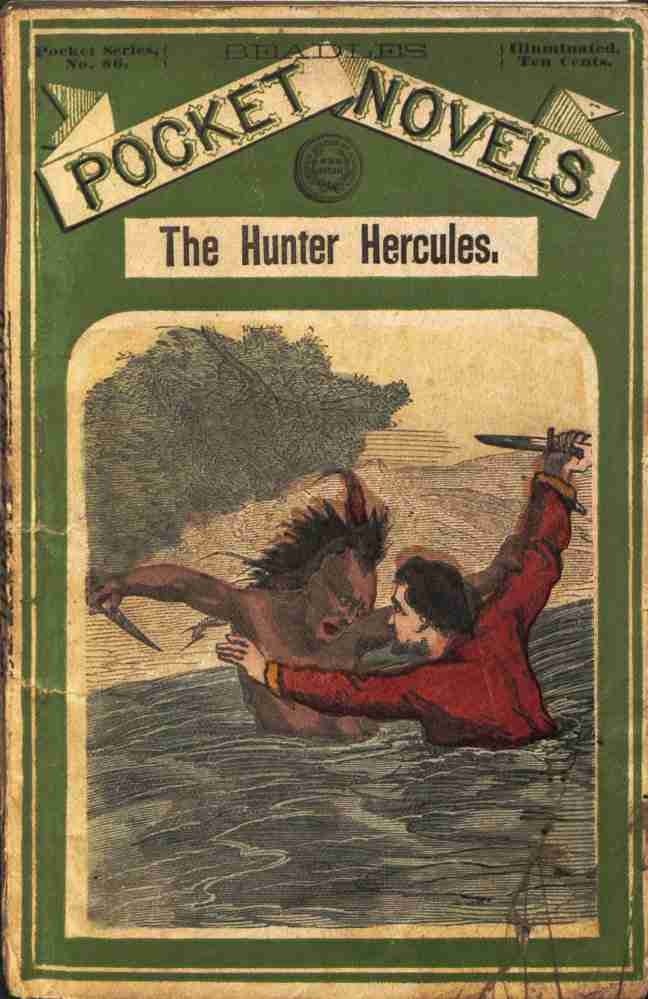
WHY RALPH WAS CALLED THE “HUNTER HERCULES.”
How the naturalist happened to think of this very extraordinary idea, none of the others knew. They saw, however, that it had proved a success, and that was enough just then.
Monsieur Tierney was not hurt in the least, for the big umbrella had let him down as softly as though it had just been made for that purpose. The three others soon had hold of the Frenchman, but they could not hold him long.
Breaking away, he rushed over to where his case lay, and opening it, he began to laugh with joy when he found the precious herb just as he had left it. The guide soon explained the curious (to the young hunter and Barry) antics of his patron.
“Ye see, boys, he cum out to find an ’arb that he sed would make him famous, an’ I guess he’s found it. Ye must excuse him, for ye know he’s only a Parley Voo, frog-eating Frenchman.”
At length they managed to get the “mounseer,” as Ralph called the naturalist, over to where the fire was burning.
The guide cut off the choice portions of the defunct bear, and then followed them. The naturalist held his case under his arm, as if it was a loving friend, and in truth was it not?
Did it not contain that which was a mine of wealth to the “mounseer?” The Frenchman was right in guarding the case closely.
Already he saw in his mind the astonishment and joy of the renowned professors, whose equal he was to become, and the chagrin and rage of his hated rival, when he appeared once more in Paris, bringing the precious and long-sought-for herb.
While the Frenchman was sitting at the foot of a tree, doting upon his treasure, the others were lounging around the fire.
All at once a thought struck Chauncy, and he turned to the guide who lay near the fire smoking his pipe with evident relish.
“Ralph,” said he, “I’ve a favor to ask of you. My father told me that you was called the Hunter Hercules by the Indians and hunters, but refused to tell me the story. He told me to ask you to give it, and I do so now. Come, toe the mark, old boy, and begin.”
“Wal, boy, I might az well come to the scratch, I see, for ye’re bound to hev it out o’ me, an’ az it ain’t a very big yarn, though a true one. The kurnel, or major, I forget which he is now, boy, but I mean yer daddy, always said that the name was very appropriate, an’ I must acknowledge myself that I am some on the lift, in fact I never seen my equal. Wait till I get in a fight, an’ then I’ll show ye how I came to git the name. But ye want to know how I got the name on me first. Wal, then, I lay myself out to it an’ begin.
“Ye see I haven’t always been a hunter an’ a trapper, a guide an’ an army scout. I used to be a merchant once, and was pretty well off, but a blarsted feller az I took in az a pardner, he run off wid every thing he c’u’d lay hands on, an’ left me ter pay the debts, an’ to do this I had to sell every thing.
“Seein’ az a feller widout money couldn’t get on very well in the city, I started for the prairies, an’ for the last twenty years I have been out West. I made a heap o’ money at the gold mines in California, an’ I might go to the East now if I wanted, an’ live like a gentleman. But to go on wid my yarn.
“Ye see, I jined teams wid an old hunter, an’ for a cupple o’ years we roamed over the prairies, a-huntin’, trappin’ an’ doin’ a little o’ Injin-fightin’.
“My chum, a feller named Buck Rawson, hed never seen me in a hand-to-hand fight, an’ so he didn’t think I was much.
“One time we were up at Fort Laramie, an’ it war there that I got the name ye talk about. There was a strappin’ big feller, a head taller than me, an’ he was reckoned more than a match for any feller in the fort, an’ there war some well-known Injin-fighters around at that time too. This feller war az big a bully az ever I seen, an’ the way he made soldiers, miners, hunters an’ reds obey him would have made any one believe that he war the kurnel that had command o’ the fort.
“He had a terrible fist on him, and was reckoned a dead fighter. I always had been a well-known wrestler an’ a very strong man, an’ the very minnit I set eyes on this ‘Red’ Lawson, I resolved that he wouldn’t come any o’ his tricks over ‘yours truly.’
“If he tried it on me, he’d find himself in hot water an’ there would be a fight, for I had made up my mind to go for him. Some of the hunters an’ trappers knew Buck an’ me, an’ we war not long in gettin’ rid o’ our pelts.
“The fort warn’t much then; a sorter tradin’-post, wid a few blue-coats in it, so ye see this ‘Red’ Lawson had it just his own way. I made up my mind that he had had his way long enough, an’ that I would be the one that was to polish him off.
“Buck Rawson war the feller that could give ye a good description o’ that fight, but, poor feller, he’s rubbed out. Got shot by a cussed Navajo, while we were rescuing a woman from ’em.
“Wal, the way the fight come about, war az follows:
“The second day after I arrived at the fort, I war goin’ along the street, where the log hut air, when I heerd a woman squeal. That is a sound I never could resist. If a woman yelled for help, an’ certain death stared me in the face, I would always run to the rescue. The sound came from a log hut, an’ I dashed open the door an’ rushed in. There, in the middle o’ the only room it contained, was that villain, ‘Red’ Lawson, a-tryin’ to kiss a pretty woman, while her husband, scared e’en’most out o’ his life, stood lookin’ on. That man war wuss nor a coward.
“A coward will always fight for one he loves, but this baby just stood an’ looked on, while the ruffian tried to kiss his wife, too scared to raise a hand in her behalf.
“Wid one blow I knocked the feller senseless, an’ ye may be sure that blow war a pretty hard one. It cum straight from the shoulder, an’ them kind o’ blows are generally killing.
“I dragged him out o’ the house and left him in the street, an’ wid the thanks o’ the pretty woman yet in my ears, I walked off. Thet arternoon Buck came rushin’ inter the hut we occupied.
“‘Jewhilikens!’ sez he, nearly out o’ breath; ‘thar’s goin’ ter be great doings hyur this evenin’. Some foolish cuss went for ‘Red’ Lawson, an’ he’s goin’ to keelhaul him this evenin’. He’ll do it too, I b’lieve, for he’s in a terrible rage.’
“‘Do yer know who the man is?’ I asked.
“‘No,’ sed he.
“‘I do,’ sez I.
“‘Ye do. Who is it?’ exclaimed Buck.
“‘Ralph Bison,’ I replied, az quietly az I could. Buck instantly wanted me to gather up my traps an’ clear out, ‘fur,’ sez he, ‘ye’ll never see the light o’ another day.’ I refused to move a step, an’ then Buck told me he would see fair play.
“‘If,’ sez he, ‘“Red” Lawson tries foul play, I’ll put an ounce o’ lead in his black heart, an’ do a good deed.’
“Toward evenin’ we went out, an’ soon I saw ‘Red’ comin’ toward me wid a crowd follerin’ him.
“When he got close up, he drew a knife an’ made a rush at me. Nothin’ loth, I drew mine, but at the first strike both o’ the weapons flew from our hands. We daren’t draw our pistols at that short distance, so ‘Red’ he struck at me wid his fist.
“I dodged, an’ guv him a blow behind the ear that kind o’ made him see stars an’ smell the ground.
“Up he got an’ made another rush at me, but went down ag’in. The third time he closed, thinking that he might lift me up from my feet an’ throw me down. Ha! ha! he found himself in az tight an’ lovin’ a clasp az if a grizzly had hold o’ him.
“His breath came in gasps, an’ I might have squeezed the life out o’ him then and thar, but I didn’t want to kill the crittur.
“Then I astonished the heathens, by liftin’ the heavy feller above my head an’ pitchin’ him twenty feet off as though he was a five-pound weight. Thar’s a heap o’ strength left in these arms yet, though I am well on to fifty-five. Arter that I became known as the Hunter Hercules, an’ have gone by that name ever since. Now ye’ve got the yarn, boy, an’ though it ain’t an all-fired bloody one, like some I could tell ye, but not vouch for, it’s true, az fifty fellers az seen it kin swear,” and the hunter proceeded to light his pipe which had gone out during his recital, with a burning brand taken from the fire near which he sat.
CHAPTER XVI.
DONNA IOLA MEETS THE TRAILERS.
We will now return to the Donna Iola, whom we have left altogether too long, to follow the fortunes of our hero.
The young girl would have felt very glad had Chauncy but beckoned to her to stop, for then she might at least die at his side. She had conceived a very strong love for her rescuer, and it was with great reluctance that she separated from him.
How was she to know whether she would ever see him again? More than once she had half-resolved to turn back and stay with him, in spite of his entreaties.
But then she remembered what Chauncy had said about her finding assistance and coming to rescue him.
Although the hope was not very strong in her breast that she would find her father and his men, yet she could not help thinking that perhaps, after all, there might be happy days in store for Chauncy and herself.
As long as Chauncy was in sight, she kept turning in the saddle to watch him. Then, when she was out of his sight, she urged the brave horse on still faster.
She was unconsciously following the trail the Indians had made when they had her a captive.
Had she known this, she would have kept on it, knowing that in a day or so she must come up to her father, if he was trailing her up, as she was sure of.
After riding seven or eight miles, she slackened up the speed of her horse, and let him walk, for the animal had had quite a sharp run.
Soon she dismounted and walked beside him for nearly a mile, patting him on the neck, and feeling very proud when the noble animal rubbed his velvet muzzle against her cheeks, as he was wont to do to Chauncy. He evidently saw in Iola one whom he might, in some future time, call his mistress.
It was while Iola was walking beside her steed that she suddenly branched off from the trail she had been pursuing, though unconsciously. It was well for her afterward that she was walking when she left the trail, as the reader will soon see.
All day long the lovely Donna rode on in what she believed to be the right direction. Just as night came on, she found, to her horror, that she had arrived at the place she had started to ride off from the trail at. She had been riding in a circle all day.
She found plenty of provisions in the bundle which was strapped to the saddle, and made a good supper, despite her situation.
She slept that night on the open prairie, with none to watch over her but her Father in heaven. And yet Iola was not one to be easily frightened.
She could not help wondering, however, whether her next night would be passed in the same way.
Long before the sun arose, she was up and off, eating her scanty breakfast as she rode. She knew that she had kept edging toward the right the day before (and this is natural to one not much accustomed to the open plain where there is hardly any mark to guide one) and to remedy this evil she kept turning a little to the left every now and then.
In this way she managed to go in quite a straight line but although she did not know it, yet she was heading in the wrong direction, and was going nearly east instead of south.
All day long she rode, keeping a good look-out, but late in the afternoon she felt that it was fated that she should spend another night alone. When she reached a “motte” of trees she resolved to camp here, as it was a great deal better than the open plain, and there was a cool spring in among the trees, too, and this the Donna and her horse attacked with a vigor which was sharpened by long thirsting.
Upon going to the edge of the grove to see the sunset, she was surprised and somewhat startled to see a band of horsemen coming toward the trees, directly from the west.
Who could they be? This was the question that the Donna asked herself, as her eyes first fell upon them.
Friends or foes, which?
She resolved to be ready for any emergency, however, and putting the saddle on the horse again she mounted him, and waited on the edge of the trees, anxious to know who the horsemen were. She had no fears of being captured, even should they prove to be Comanches. Her horse, though tired, could not be in a worse condition than those of the band coming toward her, and she could keep ahead of them until darkness came on, which would not be long for it was already getting dusk.
As the band of horsemen came closer, the Donna saw one thing and that was: they were following her trail.
This made her feel that they were her enemies, the Comanches, for what would her father and his men be doing away out here?
They would follow the trail left by Red Buffalo and his warriors when they had the Donna a captive.
The Donna could see one man dismount as dusk came on, and follow up her trail on foot, one of his comrades leading his horse by the bridle. Iola would have fled at once, but it seemed to her as though the men were not naked from the waist up.
The band were hardly distinguishable as they rode up to the “motte.” It was evident that they intended to encamp in the trees.
As they drew near Iola heard one of them speak, and to her intense delight the words were not spoken in the Comanche tongue, but in fluent Mexican.
“Señor,” said the voice, coming from the dismounted trailer, “we will have to rest here until the moon rises. Then we will take up the trail again, and follow it all night if necessary.”
“You are right, Alvarez, we will follow it as long as possible. We know that at the end of this trail is your mistress, and that end must be reached,” said a voice, that made the Donna start and with a sobbing cry dash out.
The next moment she was in the arms of her father, Don Carlos, and the vaqueros and peons, brave men, every one of them, were crowding around her. A fire was soon lighted, and, over a hearty supper, Donna Iola related her adventures to her father. He agreed with her when she said that an effort must be made to rescue Chauncy from the Comanches and when she related what the brave young man had done, the men (there were thirty of them) all signified their approval of his decision. They loved the Donna, and any one that had twice saved her from death, at the risk of his own life, must not be forgotten.
The Donna soon learned how she came to be tracked.
The men had come to where she left the trail, early that morning, in fact just after she was out of sight.
The trailer, Alvarez, after the Don had recognized the tracks of the Donna’s feet, soon found out the true state of affairs.
He knew that the Donna had made a circuit and had camped on the spot. He also knew that the fresh marks was the trail for them to follow. It was very lucky that the Donna had happened to be on foot when she left the main trail; otherwise the trackers would never have suspicioned who rode the horse, the hoof-marks of which they would have seen.
The Donna slept that night in security, and early the next morning the whole band took the back trail.
That night they camped on the spot where Iola had left the Indian trail, and where she had camped two nights before.
The next day they took up the trail, and when night overtook them they were not many miles from the river on the bank of which our hero and his three friends were encamped, and where Monsieur Tierney had that day performed his exploit with his umbrella.
The moon arose, and as it lit up the earth the band, who were in a clump of trees, heard the noise of a fight, just behind another small grove about a mile distant. The yells of the Comanches and the hurrahs of white men could be plainly heard.
Common humanity prompted Don Carlos to leave the Donna in charge of a man, and to go to the aid of the whites.
But it was something more that made Iola hurry the men off. She had a presentiment that her lover was one of the whites, and that he was in a pretty bad fix and needed aid.
CHAPTER XVII.
A STERN CHASE IS GENERALLY A LONG ONE.
After Ralph had finished his yarn, the whites sat for some time talking around the fire.
The afternoon began to rapidly draw to a close, and darkness was soon at hand. The sky was clear of clouds, and all knew when the moon did rise it would have a clear field before it. The day had been pretty warm, but night brought cool and very pleasant breezes with it. The birds had all gone to their nests or were asleep in the branches of the trees with their heads underneath their wings. The animals which were generally seen in the daytime were all gone now, and the many voices of the night were the only things to be heard.
From the trees came the shrill scream of the panther, the lonely hoot of the owl, the scream of the night-hawk and cries from other animals and birds. From the plains came the howls of the wolves, sounding dismally through the darkness of the night. From the river came the croaking of frogs and the buzzing of many insects that infest watery places.
All were accustomed to these night noises and did not notice them in the least. They were listening to the guide, who was telling a splendid story about “Kit Carson on the war-path,” and how he avenged the death of a poor settler.
The hunter was an old friend of Ralph’s, and many a time had these two hunted together on the plains.
The three others were listening with great interest, for the yarn (and it was a true one) was a very wild one, and well calculated to make the hearers feel an intense interest in it.
All at once, while in the middle of a sentence, the guide stopped, and held up his hand for the others to remain quiet. He had heard some noise that sounded suspicious.
What it was none of the others knew just then, but they watched the hunter as with head on one side he sat listening.
They wondered what noise the old hunter had heard, but in fact it was not a noise that he heard but the sudden stoppage of one which had been sounding in his ears since darkness had set in.
The wolves on the burnt plain, on the opposite side of the river, had suddenly stopped howling. To any of the others, this incident would not have meant any thing even had they noticed it, which is very doubtful. But to an old hunter and Indian-fighter it meant a good deal. The wolves would never stop howling unless some human being was near them. Therefore Ralph was listening for some sound which would tell whether there were men on the other side of the river or not. He did not have long to wait.
A sound came to their ears, even though the wind was not coming from the river to them, that even the Frenchman heard, although of course he did not know what made them.
The sound which all heard was like that made by a crowd of horses or buffaloes, but the old hunter knew that every one of those horses had a rider upon its back. At first he thought it must be Red Buffalo and the remnant of his band returning to the river after the fire to see if the whites had escaped or been burned up.
He soon knew, however, that the noise was a great deal too heavy to be made by the Comanche chief and the few men who had escaped with him. Whoever it was coming, there were scores of horses, as the old hunter knew by his natural sharpness.
Like a flash he sprung to his feet and stamped upon the fire. The young hunter and the circus-rider were not backward in following his example, and the fire was soon extinguished, to the last spark.