
WeRead Powered by ReaderPub
The Industrial Condition of Women and Girls in Honolulu: A Social Study cover

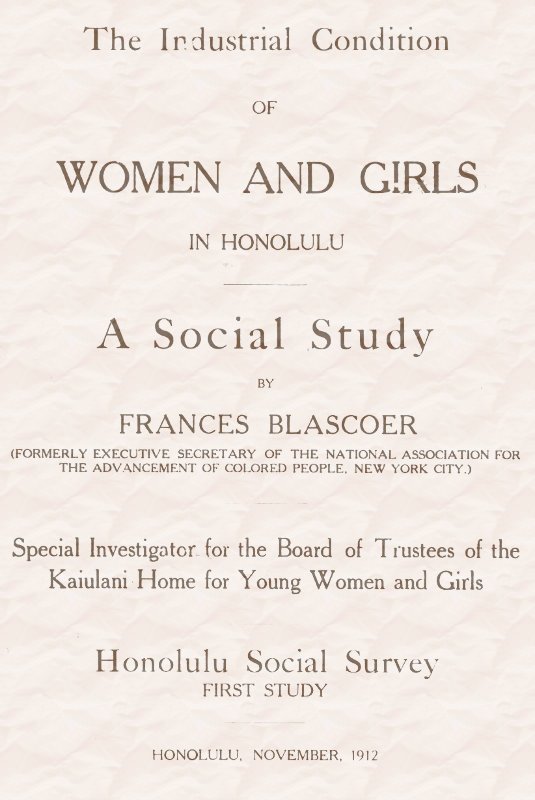
The Industrial Condition of Women and Girls in Honolulu: A Social Study

Chapter 32: TRANSCRIBER’S NOTES
Open in WeRead

Explore more books like this:

About This Book

A months-long social survey of Honolulu’s working women and girls compiles observations on employment conditions, housing, public health, and community life, balancing praise for good light, air, and comparatively moderate hours with concern about overcrowded tenements, precarious wages, and social risks facing young women. The study examines dependent children, local amusements, and the presence of unmarried men as factors affecting female welfare, compares local practices with reform measures elsewhere, and outlines preventive, organized responses such as vocational services, coordinated charitable action, housing improvements, and other constructive programs to address identified needs.

GLOSSARY OF HAWAIIAN TERMS

Aloha—Good will; friendship.

Kona—South; hot.

Kamaaina—Old settlers; long time residents.

Popola—Wild spinach, valued as a food for its medicinal properties.

Lei—A garland for the neck or hat made of flowers, shells, seeds, etc.

Poi—Pounded root of the Taro plant—the staple native food.

Tapa—A stencilled material made by the pounded fibre of a native tree; and formerly used for making the chief article of dress by the natives.

Lauhala—A native shrub, growing ten to fifteen feet in height, with lance-like leaves which when dried are used for mats, baskets, etc.

Papaia—A native fruit, somewhat like a muskmelon.


TRANSCRIBER’S NOTES

  1. Silently corrected typographical errors and variations in spelling.
  2. Anachronistic, non-standard, and uncertain spellings retained as printed.