
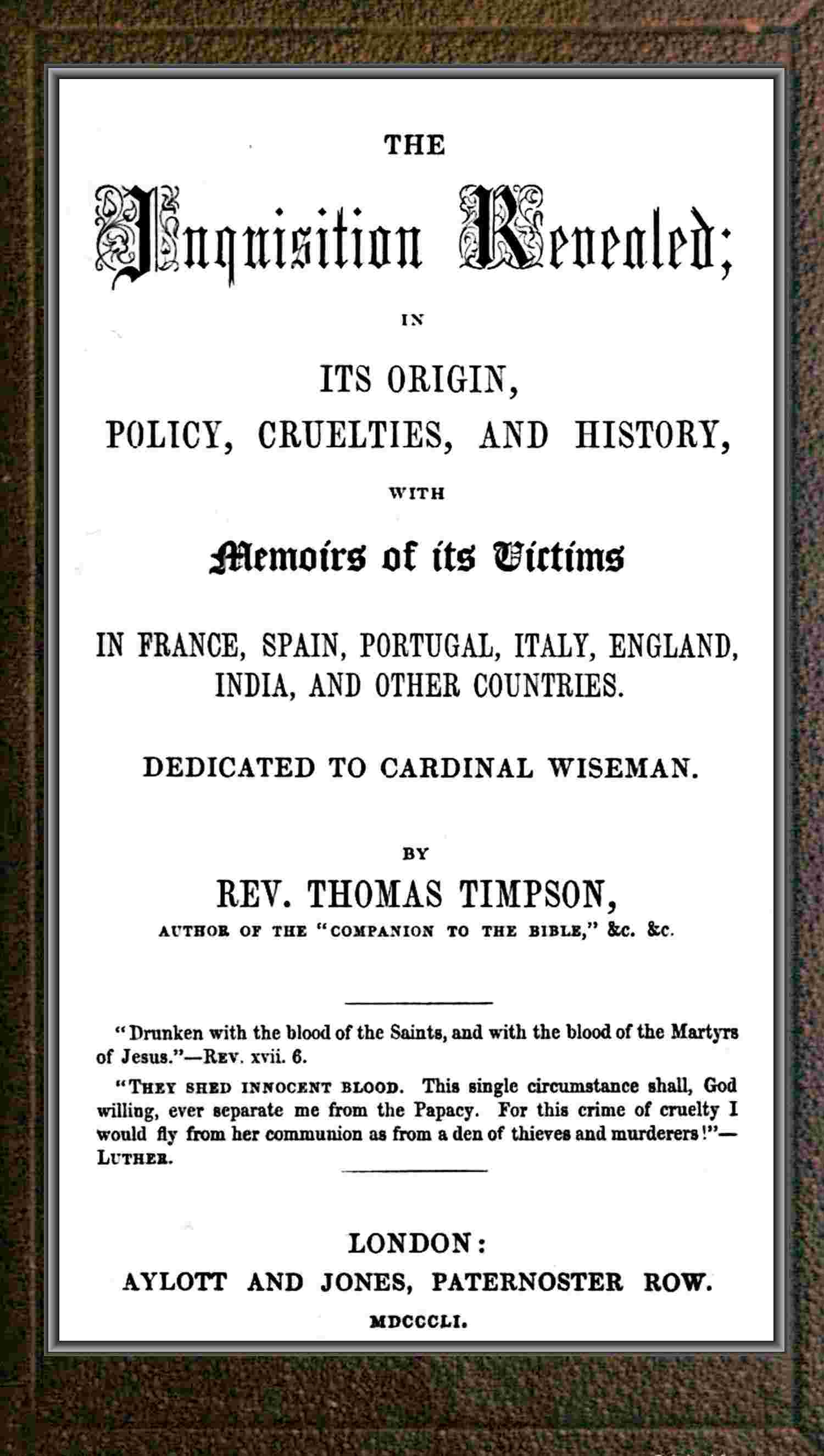
The Project Gutenberg eBook of The Inquisition revealed
Title: The Inquisition revealed
in its origin, policy, cruelties, and history, with memoirs of its victims in France, Spain, Portugal, Italy, England, India, and other countries
Author: Thomas Timpson
Release date: October 10, 2023 [eBook #71850]
Most recently updated: December 2, 2023
Language: English
Original publication: London: Aylott and Jones, 1851
Credits: Brian Coe, Chuck Greif and the Online Distributed Proofreading Team at https://www.pgdp.net (This book was produced from images made available by the HathiTrust Digital Library.)
THE
Inquisition Revealed;
IN
ITS ORIGIN,
POLICY, CRUELTIES, AND HISTORY,
WITH
Memoirs of its Victims
IN FRANCE, SPAIN, PORTUGAL, ITALY, ENGLAND,
INDIA, AND OTHER COUNTRIES.
DEDICATED TO CARDINAL WISEMAN.
BY
REV. THOMAS TIMPSON,
AUTHOR OF THE “COMPANION TO THE BIBLE,” &c. &c.
“Drunken with the blood of the Saints, and with the blood of the Martyrs of Jesus.”—Rev. xvii. 6.
“They shed innocent blood. This single circumstance shall, God willing, ever separate me from the Papacy. For this crime of cruelty I would fly from her communion as from a den of thieves and murderers!”—Luther.
LONDON:
AYLOTT AND JONES, PATERNOSTER ROW.
MDCCCLI.
LONDON
J. UNWIN, GRESHAM STEAM PRESS.
BUCKLERSBURY.
DEDICATION.
TO
HIS EMINENCE, CARDINAL WISEMAN.
My Lord Cardinal,
Roman Catholics and Protestants are alike interested in this volume: designed, as it is, to advance pure Christianity. They have an equal right to profess their own peculiar faith, and to propagate their religious opinions. But, in the free exercise of that right, they are equally bound, by every principle of justice and charity, to cherish towards each other mutual esteem and benevolence.
Romanists, however, do not admit the Holy Scriptures as the sole authority in religion; and their principles will not allow them, therefore, to grant toleration to those who dissent from them. Their intolerance arises from the policy of the Hierarchy and the reception of unscriptural traditions. Hence their illiberality in Italy, Sardinia, Spain, Portugal, the Brazils, and other countries, where the priesthood is dominant. Hence the inveterate hostility of the Romish priests against the popular reading of the Bible. Their people are kept thus in ignorance, deluded by false doctrines; and theirs being not exclusively the principles of the Holy Scriptures, cannot be the religion of our Lord Jesus Christ.
My Lord Cardinal—Every Briton should understand the character and claims of the Papacy. For, as predicted in “the oracles of God,” Protestants hold that Popery is the “man of sin,”—the “mystery of iniquity,”—the “MOTHER OF HARLOTS AND ABOMINATIONS OF THE EARTH,”—“drunken with the blood of the saints, and with the blood of the martyrs of Jesus.”—2 Thess. ii. 3—7; Rev. xvii. 5, 6.
Every British Christian is deeply interested in studying the doctrines of Popery; its Priestly power—Absolution—Transubstantiation—Tradition—and Purgatory; and in considering its evil doings in Auricular confession—Penance—Mariolatry—Priestly celibacy—Spiritual domination—and the Inquisition. The history of these is the condemnation of Popery.
This volume contains the substance of the valuable works of Limborch, Llorente, Dellon, Gavin, Buchanan, Bower, Newton, Gibbon, Watson, Ranke, Sismondi, Jones, Puigblanch, Edgar, Elliott, Mendham, Giesler, Dowling, D’Aubigné, De Castro, Achilli, and many others, regarding the Inquisition.
This volume is designed as an Antidote to Popery; especially as a present to young persons; and it is believed, by judicious friends, to be most seasonable, to instruct inquirers, and to advance the truth of the Gospel of Jesus Christ.
Having these objects in view, this work is dedicated, with due respect, to
CONTENTS.
THE INQUISITION REVEALED.
CHAPTER I.
POPERY AS PREDICTED IN SCRIPTURE.
The Court of Inquisition cruel and execrable—Christianity benevolent—The Inquisition predicted, 2 Thess. ii. 3, 4; 1 Tim. iv. 1-3; Rev. xvii. 1-18—Comments by Elliott, Bp. Newton, and Scott.
Religion, as taught by the Romish priesthood, has been enforced and guarded by pains and penalties during many ages. For the last six centuries, this has been done chiefly by a court, denominated, in all countries where it has been established, “The Holy Inquisition.” But this court has been execrated, in every country in which it has existed, as the most dreadful, cruel, and sanguinary of all tribunals, even by professors of the faith of Rome. Still it is supported by the papal hierarchy, as the agents of the Pope may be able to obtain permission of the governments who observe the Romish religion.
Christianity has thus been dishonoured in the assumption of its sacred name by Roman Catholics, while they have practised these cruelties, so contrary to the letter and to the spirit of the religion of Jesus Christ; for all His principles and precepts manifest Divine benevolence, as chanted at the birth of the Redeemer, by a multitude of the heavenly host, praising God, and saying, “Glory to God in the highest, and on earth peace, good-will towards men.”
Christianity is the religion of love, and like its ever blessed Author, the Son of God. “God is love; and he that dwelleth in love, dwelleth in God, and God in him.” It enjoins upon all its professors the practice of benevolence. It requires them to possess and exemplify that spirit. Its moral code is comprehended in that summary of the Divine law, as given by our Saviour, “Thou shalt love the Lord thy God with all thy heart, and with all thy soul, and with all thy mind. And thou shalt love thy neighbour as thyself.” Its chief practical maxim is, “Whatsoever ye would that men should do to you, do ye even so to them: for this is the law and the prophets.” These precepts were followed by the early believers of the Gospel, constraining the heathen to admire their benevolence, exclaiming, “See how these Christians love one another!”
False teachers, however, having corrupted the doctrines and ordinances of Christ, were influenced by another spirit; and, in the course of a few ages, the professed ministers of the loving Redeemer exhibited intolerance, malevolence, and cruelty, exceeding what had ever been witnessed under any form of religion. These enormities have been seen chiefly in the operations of the Roman Catholics, and especially by their execrable “Court of Inquisition,” as this has been established in Spain, France, Portugal, India, and Rome. This court, though denominated “Holy,” has been the most arbitrary, inhuman, and sanguinary that ever existed among men; and because of its enormities, by its various machinery, and by its savage armies, it is symbolised in the Holy Scriptures under the emblem of a harlot, deluding the nations with her intoxicating draughts, and herself “drunken with the blood of the saints, and with the blood of the martyrs of Jesus.”—(Rev. xvii. 6.)
Before we enter upon the direct history of the Inquisition, therefore, it will be necessary to notice the inspired prophecies relating to this apostate and cruel hierarchy of popery; and to take a brief review of the rise and progress of that terrible and hated system of Antichrist.
“Known unto God are all his works from the beginning of the world.” And equally foreseen were all the forms of falsehood, cruelty, and evil upon the earth. Hence the inspired predictions concerning the hateful enemy of Christ.
Our blessed Lord repeatedly admonished his disciples concerning false teachers, who would be distinguished by their inhumanity; and the apostle Paul, in correcting the mistakes of some, regarding the day of judgment as being near, says, “Let no man deceive you by any means: for that day shall not come, except there come a falling away first, and that man of sin be revealed, the son of perdition; who opposeth and exalteth himself above all that is called God, or that is worshipped; so that he, as God, sitteth in the temple of God, showing himself that he is God.”—(2 Thess. ii. 3, 4.) Again, he represents the character of Romish teachers, and says, “Now the Spirit speaketh expressly, that in the latter times some shall depart from the faith, giving heed to seducing spirits, and doctrines of devils; speaking lies in hypocrisy; having their conscience seared with a hot iron; forbidding to marry, and commanding to abstain from meats, which God hath created to be received with thanksgiving of them who believe and know the truth.”—(1 Tim. iv. 1—3.)
Still more remarkable is the prediction described by the apostle John: “And there came one of the seven angels which had the seven vials, and talked with me, saying unto me, Come hither; I will show unto thee the judgment of the great whore that sitteth upon many waters: with whom the kings of the earth have committed fornication, and the inhabitants of the earth have been made drunk with the wine of her fornication. So he carried me away in the spirit into the wilderness: and I saw a woman sit upon a scarlet-coloured beast, full of names of blasphemy, having seven heads and ten horns. And the woman was arrayed in purple and scarlet colour, and decked with gold and precious stones and pearls, having a golden cup in her hand full of abominations and filthiness of her fornication: and upon her forehead was a name written, Mystery, Babylon the Great, the Mother of Harlots and abominations of the earth. And I saw the woman drunken with the blood of the saints, and with the blood of the martyrs of Jesus; and when I saw her, I wondered with great admiration. And the angel said unto me, Wherefore dost thou marvel? I will tell thee the mystery of the woman, and of the beast that carrieth her, which hath the seven heads and ten horns. The beast that thou sawest was, and is not; and shall ascend out of the bottomless pit, and go into perdition. The seven heads are seven mountains, on which the woman sitteth. And there are seven kings. And the ten horns which thou sawest are ten kings, who have received no kingdom as yet; but receive power as kings one hour with the beast. These shall make war with the Lamb, and the Lamb shall overcome them: for he is Lord of lords, and King of kings: and they that are with him are called, and chosen, and faithful. And he saith unto me, The waters which thou sawest, where the whore sitteth, are peoples, and multitudes, and nations, and tongues. And the woman whom thou sawest is that great city, which reigneth over the kings of the earth.”—(Rev. xvii. 1—18.)
All these several predictions have been fulfilled with the most striking completeness; and we may have to refer to them in the course of this work; but the descriptions in those from the Revelation require our very special notice, as they lead us more particularly to the Romish hierarchy, and to the terrible court of inquisition. The Rev. Mr. Elliott, in his “Commentary” on this chapter, says:—
“This vision represented pictorially a gaudily dressed drunken harlot, seated on a beast of monstrous form, with seven heads, and on the seventh ten horns. The beast, in respect of its body, depicted the papal empire of the ten western European kingdoms; and in respect of the seventh, or rather, eighth head, the succession of Roman popes, constituting, from after the sixth century, that empire’s spiritual rulers. So the woman represented Rome in its character of the papal see, and mother-church of Western Christendom; including, doubtless, as part and parcel of herself, the ecclesiastical state, or Peter’s patrimony, in Italy, and vast dominions, convents, churches, and other property appertaining to the papal church elsewhere, both in Europe and over the world.
“1. As the beast’s body both upheld and was subject to the woman, the rider, so the empire, as a whole, with the power of its secular kingdoms and many peoples, upheld, and was also at the same time ruled by papal Rome, the mother-church of Christendom.
“2. As the woman was here depicted before St. John under a double character, viz., as a harlot to the ten kings, and a vintner or tavern-hostess vending wines to the common people, just according to the custom of earlier times, in which the harlot and the hostess of a tavern were characters frequently united; so the church of Rome answered to the symbol in either point of view; interchanging mutual favours, such as might suit their respective characters, with the kings of Anti-Christendom; and to the common people dealing out for sale the wine of the poison of her fornication, her indulgences, relics, transubstantiation-cup, as if the cup of salvation, &c. (see the Pope’s own medal, holding out the cup of her apostacy, struck at Rome on occasion of the Jubilee in 1825), therewith drugging and making them besotted and drunk.
“3. With regard to the portraiture of the woman, robed in purple and scarlet, and adorned with gold, and precious stones and pearls, it is, as applied to the Romish church, a picture, characteristic and from life; the dress specified being distinctively that of the Romish ecclesiastical dignitaries, and the ornaments those with which it has been bedecked beyond any church called Christian; nay, beyond any religion, probably, that has ever existed in the world; not to add that even the very name on the harlot’s forehead, Mystery, (a name allusive, evidently, to St. Paul’s predicted mystery of iniquity,) was one, if we may repose credit on no vulgar authority, once written on the Pope’s tiara; and the apocalyptic title, ‘Mother of harlots and of the abominations of the earth,’ the very parody, if I may so say, of the title Rome arrogates to herself, ‘Rome, mother and mistress.’
“4. As to the harlot’s being depicted ‘drunken with the blood of the saints,’ its applicability to the Romish church, throughout the latter half, at least, portion of the beast’s 1260 predicted years of prospering, is written in deep-dyed characters on the page of history.”
Nothing can be more evident than that “Babylon the Great” designs the mystical city of the papal commonwealth, a regnant system of spiritual wickedness—an idolatrous church. This was the judgment of all the chief reformers in Germany, Switzerland, France, England, and Scotland. Some even of the Roman Catholics had the same conviction; and Petrarch, the celebrated Italian poet, calls the papal court “The Babylonian harlot, mother of all idolatries.”
Bishop Newton, having reviewed the prophecy, says, “Moreover, the woman, like other harlots who give philters and love-potions to inflame their lovers, hath ‘a golden cup in her hand, full of abominations, and filthiness of her fornication,’ to signify the specious and alluring arts wherewith she bewitcheth and inciteth men to idolatry, which is ‘abomination and spiritual fornication.’ It is an image copied from Jeremiah li. 7, ‘Babylon hath been a golden cup in the Lord’s hand, that made all the earth drunken.’ And is not this a much more proper emblem of pontifical than of imperial Rome?
“Yet farther to distinguish the woman, she has her name inscribed upon her forehead (verse 5), in allusion to the practice of some notorious prostitutes, who had their names written in a label upon their foreheads. The inscription is so very particular, that we cannot easily mistake the person; ‘Mystery, Babylon the great, the mother of harlots, or rather, of fornications and abominations of the earth.’ Her name, Mystery, can imply no less than that she dealeth in mysteries; her religion is a mystery, a mystery of iniquity; and she herself is mystically and spiritually ‘Babylon the great.’ But the title of mystery is in no respect proper to ancient Rome, more than any other city; and neither is there any mystery in substituting one heathen, idolatrous, and persecuting city for another; but it is indeed a mystery, that a Christian city, professing and boasting herself to be the city of God, should prove another Babylon in idolatry and cruelty to the people of God. She glories in the name of Roman Catholic, and well, therefore, may she be called ‘Babylon the great.’
“Infamous as the woman is for her idolatry, she is no less detestable for her cruelty, which are the two principal characteristics of the antichristian empire. ‘She is drunken with the blood of the saints, and with the blood of the martyrs of Jesus,’ (ver. 6) which may indeed be applied both to pagan and to Christian Rome, for both have in their turns cruelly persecuted ‘the saints and the martyrs of Jesus;’ but the latter is more deserving of the character, as she hath far exceeded the former, both in the degree and duration of her persecutions. It is very true, that if Rome pagan hath slain her thousands of innocent Christians, Rome Christian hath slain her ten thousands; for, not to mention other outrageous slaughters and barbarities, the crusades against the Waldenses and Albigenses; the murders committed by the Duke of Alva in the Netherlands; the massacres in France and Ireland, will probably amount to above ten times the number of all the Christians slain in all the ten persecutions of the Roman emperors put together. St. John’s admiration also plainly evinces that Christian Rome was intended, for it could be no matter of surprise to him that a heathen city should persecute the Christians; but that a city professedly Christian should wanton and riot in the blood of Christians, was a subject of astonishment indeed; and well might he, as it is emphatically expressed, ‘wonder with great wonder.’”
Mr. Scott, in his commentary on 2 Thessalonians ii. 3, 4, remarks, “No apostacy of equal magnitude and duration, no delusions equally pernicious and abominable, have taken place since the apostle’s days, as those of Rome. The imposture of Mohammed alone can be compared with it, and this could not be intended; for that impostor and his successors were not placed in the temple of God, the visible church (Rev. xi. 1, 2), but without it, and in direct opposition to the very name of Christianity; they propagated their delusions mainly by the sword, and not lying miracles; and, indeed, the impieties of Mohammed never equalled the blasphemies here predicted. This ‘man of sin’ would be the ‘son of perdition’ (John xvii. 12); a genuine descendant of Judas, the apostle and traitor, who sold his Lord for money, and destroyed him with a kiss; a peculiar factor and agent of Satan, in destroying the souls of men, and finally sinking into perdition as his inheritance. It is manifest, that no succession of men have yet appeared on earth to whom this description fully accords, except that of the Roman pontiffs. This deceiver would oppose and exalt himself above all that is called God, or is ‘worshipped,’ either by Christians or pagans; thus the Roman pontiffs have opposed the truths, commandments, and disciples of Christ, in every age; the prophetical office of Christ, by teaching human inventions—his priestly office, by the doctrine of human merits and created intercessors—and his kingly office, by changing and dispensing with his laws. They have exalted themselves ‘above all that is called God,’ and is ‘worshipped,’ by claiming authority to forgive sins; by granting indulgences to men to break the commandments of God; by dispensing with his laws, and presuming to give meaning and authority to the Scriptures themselves. Moreover, this ‘man of sin’ ‘sits as God’ in the temple of God; and we must, therefore, look for him within the visible church; there he blasphemously usurps the throne of God, ‘showing himself to be God.’ Many Roman emperors affected divine honours, and demanded adoration; but there was no antecedent apostacy from Christianity or the worship of Jehovah; and they might rather be said to sit in the temple of Jupiter or Mars, than in that of God, whose temple must be considered to be among his professed worshippers, and not among avowed heathen. But the Roman pontiff—claiming to be the universal head of the whole church of God, called by his flatterers ‘Vice-God,’ a ‘God upon earth,’ arrogating the title of ‘His Holiness,’ boasting of ‘infallibility,’ claiming a right to depose kings and bestow kingdoms on whom he pleases—answers exactly to the description here given. While the Roman pontiff opposes the worship of God, by enjoining the worship of images, of saints, and angels, and the authority of his laws, to enforce subjection to his own edicts, he himself may be called the great idol, as well as the great tyrant, of the Romish church!”
Human sagacity could by no means have conjectured such a character rising up among the people of God, and such deeds perpetrated in the name and form of religion. This required the prescience of the Infinite Mind. But we shall see them all in their dreadful enormity, as we pursue the history of the Romish Inquisition.
CHAPTER II.
PROGRESS OF ANTICHRIST.
Spirit of Antichrist—Priests, Clergy, and Laity—Ceremonies—Mosheim—“Pious Frauds”—Splendour of Prelates—Constantine—the Hierarchy—Titles—Creeds—Arianism—Persecution—Rome and Constantinople—Pope John—Pope Gregory—Mohammed—Claims of the Pope—Henry IV.—Corrupt principles.
Divine Wisdom having foreseen, and thus foretold, all the dreadful corruptions of the Christian church, we are interested in marking the steps by which the progress was made. The spirit of popery we behold in the conduct of the judaising teachers of the early Christians, as censured by Paul, and as seen in the proceedings of Diotrephes, who is believed to have been a pastor. John complained of his refusing to “receive the brethren,” the messengers of the apostle, and of his “malicious words,” persecuting some, and casting others out of the church.—(2 John 9, 10.)
This ambitious spirit led the pastors in some of the larger churches, early in the second century, to assume the character and title of priests, as peculiar to their order. They claimed the privilege of being the Lord’s “heritage,” or clergy, which belonged to the faithful, as distinct from their ministers.—(1 Pet. v. 31.) But they persuaded the people that they had succeeded to the rights of the Jewish priesthood, as God’s clergy; and hence the distinction of clergy and laity, which has no foundation in Christianity. This distinction being established, gave immense force to the spirit of popery, which advanced rapidly among the ignorant people. Dr. Mosheim states, “The Christian doctors had the good fortune to persuade the people, that the ministers of the Christian church succeeded to the character, rights, and privileges of the Jewish priesthood; and this persuasion was a new source of honour and profit to the sacerdotal order. This notion was propagated with industry, some time after the second destruction of Jerusalem [A.D. 135] had extinguished all hopes of seeing their government restored to its former lustre, and their country arising from its ruins. And, accordingly, the bishops considered themselves invested with a rank and character similar to those of the high priests among the Jews, while the presbyters represented the priests, and the deacons the Levites.”
Christianity having no splendid ceremonial to recommend the preaching of the Gospel, priests devised various forms to be added to the Lord’s supper, which was administered every Sabbath, and ceremonies were invented, partly derived from the Jews and some from the idolators, to attract the minds of the people, and with a view to gratify the converts from heathenism. The performance of these, especially in the Lord’s supper, served also as the means of employing the priests in their newly created offices; and they were called mysteries, as having a hidden meaning and a peculiar virtue, after the manner of the rites of the Pagan priests. Hence originated the term sacraments, the Latin word for mysteries, applied to various rites, especially baptism and the Lord’s supper.
Dr. Mosheim, therefore, remarks, “The bishops, by an innocent allusion to the Jewish manner of speaking, had been called ‘chief priests;’ the elders or presbyters had received the title of ‘priests,’ and the deacons that of ‘Levites.’ But in a little time these titles were abused by an aspiring clergy, who thought proper to claim the same rank and station, the same rights and privileges, that were conferred with those titles upon the ministers of religion under the Mosaic dispensation. Hence the rise of tithes, first-fruits, splendid garments, and many other circumstances of external grandeur, by which ecclesiastics were eminently distinguished.”
Priestly power was greatly augmented at this time by the meetings of the bishops, as delegates from the churches, to consult respecting their mutual defence and security against their persecuting enemies. In these synods or councils, as they were called, various decisions were formed unfriendly to the interests of the people; for the bishops soon asserted authority to prescribe laws, and to impose creeds, which led to the most grievous persecution in the following ages. Superiority was claimed in these assemblies by the bishops of the chief cities, especially by the bishop of Rome, as the imperial metropolis. Dr. Mosheim, therefore, states, “Toward the conclusion of this century, Victor, bishop of Rome, took it into his head to force the Asiatic Christians, by the pretended authority of his laws and decrees, to observe the Roman custom of keeping Easter.” They refused compliance; and, as Milner says, “Victor, with much arrogance, as if he had felt the very soul of the future papacy formed in himself, inveighed against the Asiatic churches, and pronounced their excommunication.”
In the second century, popery was further advanced by the peculiar practices of the Egyptian monks being cherished among the Christians. They magnified the virtues of fasting, celibacy, and a solitary life, as the perfection of excellence; and hence the origin of the Romish monks, nuns, and celibacy of the clergy.
Christianity, in the third century, was still more corrupted by the priesthood; for “pious frauds,” or false miracles, were commonly practised. Several of the teachers were guilty of these in the second century; but, to the dishonour of religion, they were now publicly defended, even by some good men, provided they were employed with a design to convert men and advance the cause of Christianity!
Popery continued to advance in this century by rapid strides; for the clergy maintained their various dignities with determined zeal. The simple ordinances of Christ in the ministry of the Gospel were laid aside for the performance of priestly rites. Ecclesiastical government degenerated towards the form of a religious monarchy; while the people were, in most cases, excluded from all share in the management of their own affairs in the churches. Dr. Mosheim, therefore, testifies—“The bishops assumed, in many places, a princely authority, particularly those who presided over the most opulent assemblies. They appropriated to their evangelical function the splendid ensigns of temporal majesty. A throne, surrounded with ministers, exalted above his equals the servant of the meek and humble Jesus, and sumptuous garments dazzled the eye and the mind of the multitude into an ignorant veneration for their arrogated authority. The example of the bishops was ambitiously imitated by the presbyters, who, neglecting the sacred duties of their station, abandoned themselves to the indolence and delicacy of an effeminate and luxurious life. When the honours and privileges of the bishops and presbyters were augmented, the deacons also began to extend their ambitious views, and to despise those lower functions and employments which they had hitherto exercised with such humility and zeal; and the effects of a corrupt ambition were spread through every rank of the sacred order.”
Ecclesiastical ambition was not satisfied with the creation of a hierarchy of bishops, priests, and deacons; but various lesser orders of ministers were now instituted, on account of the increasing ceremonies which had been adopted in imitation of the heathen mysteries. Various forms of prayer and consecration were prepared for these ceremonies; the table of the Lord was converted into an altar; wax tapers were burnt upon it; the bread and wine were regarded as possessing a kind of saving virtue; and much solemn pomp was observed in celebrating the Lord’s supper. Baptism was preceded by a terrifying process—exorcism, to expel the evil spirit, and the newly baptised persons were required to taste milk and honey, as indicating spiritual food, and the converts from heathenism were sent home from the ceremony adorned with crowns and white garments.
Popery received a vast accession of power, in the beginning of the fourth century, by the conversion of the Emperor Constantine. He became a most munificent patron of Christianity, as by its profession he succeeded to the throne of the Cæsars. The extravagant claims of the ambitious prelates were now confirmed, and the spiritual institution of Jesus Christ was transformed into a worldly system, framed to resemble the civil government of the empire. The bishops of Rome, Antioch, and Alexandria were already regarded as superior to the other prelates—as archbishops, with the title of patriarch; and to these was added a fourth, for the new imperial city of Constantinople. Under this first Christian emperor, as Dr. Haweis remarks, “the prelatical government became modelled, after the imperial, into great prefectures, of which Rome, Alexandria, Antioch, and Constantinople, claimed superiority; whilst a sort of feudality was established, descending from patriarchs to metropolitans, archbishops, bishops, some with greater, and others with less extensive spheres of dominion. Instead of the people choosing their own bishops and presbyters, they were no more consulted. The presbyters wholly depended on the bishops and patrons; the bishops were the creatures of patriarchs and metropolitans; or, if the see was important, appointed by the emperor. So ‘church and state’ formed the first inauspicious alliance; and the corruption, which had been plentifully sown before, now ripened by court intrigues for political bishops of imperial appointment, or at the suggestion of the prime minister.”
“This pernicious example,” says Dr. Mosheim, “was soon followed by the several ecclesiastical orders. The presbyters, in many places, assumed an equality with the bishops, in point of rank and authority. Those more particularly of the presbyters and deacons, who filled the first stations of these orders, carried their pretensions to an extravagant length, and were offended at the notion of being placed upon an equal footing with their colleagues. For this reason, they assumed the titles of archpresbyters and archdeacons.”
These newly created dignities required a corresponding style of address, which was soon contrived. It may be remarked, that all these things are contrary to the New Testament; for though all Christians are there described as saints, or holy persons; they are never addressed with pompous titles. Even the apostles are never called Saint John and Saint Peter; these titles are the inventions of popery. Lord Chancellor King remarks, therefore, “It is very seldom, if ever, that the ancients give the title of saints to those holy persons, but singly style them Peter, Paul, John, &c.; not Saint Peter, Saint Paul, Saint John.” Priestly dignities originated the addresses of “reverend,” “very reverend,” “right reverend,” “most reverend,” “your grace,” “your holiness.”
Constantine having arranged the offices of his government in church and state, soon found it necessary to attempt to produce uniformity of faith, especially as Arius, a presbyter of Alexandria, had declared his belief that the Son of God is inferior to the Father, of another nature, and only the first of all created beings. Finding this heresy prevail, he called the bishops of all the provinces to an assembly, A.D. 325, at Nice, in Bithynia. This assembly, famous, as the first general council, consisted of about two thousand and fifty persons, of whom three hundred and eighteen were bishops. These prelates delivered to the emperor letters of grievous accusation against each other, but the prudent sovereign threw the whole into the fire, and referred them to the day of judgment for a settlement. After two months’ deliberation, they agreed on that form denominated “The Nicene Creed,” which required to be believed by all Christians. But, by this celebrated act, the foundation was laid for the pernicious influence of a political priesthood, and for the authority of councils in ecclesiastical matters, above even the Holy Scriptures; and this authority, claimed and acted upon, produced all the superstition, intolerance, and cruelty, which characterise the terrible Inquisition.
Constantine having established the “creed,” required its universal reception. But the Arians refused; and the bishops prevailed on him to issue edicts against them, as enemies of truth, forbidding their public meetings, and giving their places of worship to the orthodox. He banished Arius, and decreed that his books should be burnt; and that whosoever should dare to keep any of them, as soon as this was proved, should suffer death! In two or three years after, the emperor recalled Arius, and repealed his severe laws against his heresy, which prevailed under his son and successor, Constantius. Athanasius, patriarch of Alexandria, became the champion of orthodoxy; and thus two parties arose among the clergy.
Decrees and state power authorised inquisition and persecution; and “Hence,” says Dr. Mosheim, “arose endless animosities and seditions, treacherous plots, and open acts of injustice and violence, between the two contending parties. Council was assembled against council, and their jarring and contradictory decrees spread perplexity and confusion throughout the Christian world.” One fact will illustrate the spirit of party in this age: eighty orthodox bishops having waited on the Emperor Valerius, to complain of his appointing an Arian bishop of Constantinople, they were murdered by his order, on shipboard, at sea, A.D. 370.
Popery prevailed amid all the contentions; and, A.D. 410, four bishops, deputed from Carthage, obtained an edict from the Emperor Honorius, which doomed to death every one who differed from the Catholic faith. From this edict serious persecutions arose. But, A.D. 451, the council of Chalcedon resolved, “that the same rights and honours conferred on the bishop of Rome, were due to the bishop of Constantinople,” confirming his jurisdiction, which he had before claimed, over all the provinces of Asia.
Imperial dominion, however, was now declining, under a succession of feeble princes. At the opening of the fifth century, Constantinople was the eastern capital, in which Arcadius presided as emperor, while Rome continued the western metropolis; though Honorius kept his court at Ravenna. Swarms of savage hordes, from the northern regions of Europe, under the names of Goths, Visigoths, Vandals, Franks, Burgundians, overran the richest provinces, sacking cities, and committing every species of barbarity and cruelty. Some of these barbarians had embraced the name of Christ from Arian teachers; and many of those bishops who held the true divinity of Christ were tortured, banished, or massacred with their people.
Religion became still more corrupted; and public worship consisted chiefly in the performance of ceremonies, differing but little from those of the pagan Greeks and Romans. Both of them had a splendid ritual, gorgeous robes, tiaras, mitres, wax tapers, crosiers, processions, lustrations, images, and many such circumstances of pageantry, were to be seen equally in the heathen temples and in Christian churches. To engage the admiration of the ignorant population, pictures and statues of Christ, of the Virgin Mary with the infant Jesus in her arms, and of numerous saints, were set up in the churches, to be admired and worshipped. An invincible efficacy, in expelling evil spirits and healing diseases, was attributed to the presence of the bones of martyrs. The riches and magnificence of the churches exceeded all bounds; and the altars and the chests for the relics of saints were made of the richest materials, some of solid silver.
Everything in the forms of the Catholic religion appeared to produce false ideas, or to excite the worst passions of the human heart. Hence superstition and intolerance, and dreadful persecution among the different parties. Mr. Gibbon states, of the party called Donatists, that “three hundred bishops, with many thousands of the inferior clergy, were torn from their churches, stripped of their ecclesiastical possessions, banished to the islands, and proscribed by the laws, if they presumed to conceal themselves in the provinces of Africa.”
“Religion in the sixth century became still more corrupt; it lay expiring,” as Dr. Mosheim remarks, “under an enormous heap of superstitious inventions. The worship of Christians was now paid to the remains of the true cross, to the images of the saints, and to bones, whose real owners were extremely dubious. The progress of vice among the clergy was truly shocking. In those very places which were consecrated to the advancement of piety, and the service of God, there was little else to be seen but ghostly ambition, insatiable avarice, pious frauds, intolerable pride, and a superstitious contempt of the natural rights of the people, with many other evils still more enormous.”
Episcopal claims continued to be the subjects of constant disputes, especially between the patriarchs of Rome and Constantinople. John of Rome visited the eastern capital, A.D. 525, to serve his own purpose, but charged by Theodore, the Gothic king of Italy, to engage the emperor Justin to cease from persecuting the Arians. With a crowd of the nobility and clergy, the emperor met him, and bowed down to the very ground before the vicar of the blessed Peter, and coveting the honour of being crowned by him, received at his hands the imperial diadem! The patriarch invited the Pope to perform Divine service in the great church together with him; but he would neither accept the invitation, nor even see the patriarch, till he agreed not only to yield him the first place, but to seat him on a kind of throne above himself, alleging no other reason than because he was the Roman High Priest! The patriarch indulged him in every thing he required, and they celebrated Easter together, with extraordinary pomp and solemnity. The Pope officiated in the Latin tongue, according to the rites of the Latin church.
Pre-eminence being thus acknowledged by the patriarch of Constantinople to the pontiff of Rome, it cannot be matter of wonder that Justinian, the nephew and successor of the emperor Justin, in his epistle to the new Pope, John II., writes, A.D. 533, “We hasten to SUBJECT and to unite to your holiness all the priests of the whole East. Nor do we suffer anything which belongs to the state of the church, however manifest and undoubted, that is agitated, to pass without the knowledge of your holiness, the head of all the holy churches!”
This pre-eminence was given more fully, two years after, in a memorial to the pontiff, by “the bishops and clergy of Constantinople.” It was addressed—“To our most holy lord, and most blessed father of fathers, Agapetus, archbishop of the Romans and patriarch, the bishops of the oriental diocese, and those who dwell in the holy places of Christ our Lord, with the residents and other classes assembled in this royal city.” Plain Christians may wonder at all this sacerdotal blasphemy, so utterly at variance with all that they read in the New Testament, except of the predicted Antichrist!
But the dignity of “universal patriarch” being assumed by the bishop of Constantinople, “Gregory the Great” denounced it as a “profane,” “proud,” “antichristian” title; as “impious,” “execrable,” “blasphemous,” “infernal,” “diabolical.” On this occasion, Gregory assumed the title of affected humility, ever since retained by the Popes, “Servant of the servants of God!” Still that lofty title, which he condemned in his ambitious brother John, he sought for himself, as is evident from his adulatory letter to those monsters of wickedness, Phocas and his wife Leontia.
Phocas had opened a passage to the imperial throne, by the murder of Mauricius and his six sons; and afterwards, most barbarously, of the empress Constantia, and her three daughters, dragging them from their refuge in one of the churches of Constantinople. Mauricius is commended as a prince of many virtues, and of but few vices; and Gregory, in his letters to him, hypocritically declares, that “his tongue could not express the good he had received of the Almighty, and his lord the emperor; and that he thought himself bound, in gratitude, to pray incessantly for the life of his most pious and most Christian lord; and that, in return for the goodness of his most religious lord to him, he could do no less than love the very ground on which he trod.”
Mauricius, however, favouring the title assumed by the patriarch John, Gregory was offended; and, like many a courtier, congratulated the murderer, Phocas, on his being proclaimed emperor; saying, with the most consummate hypocrisy, “Let the heavens rejoice! let the earth leap for joy! let the whole people return thanks for so happy a change!” In the same strain he wrote, in reply to the first letter of Phocas, and to the Empress Leontia he says, “What tongue can utter, what mind can conceive, the thanks we owe to God, who has placed you on the throne, to ease us of the yoke with which we have hitherto been so cruelly galled? Let the angels give glory to God in heaven! let men return thanks to God upon earth! for the republic is relieved, and our sorrows are banished!”
Mr. Bower, in his “Life of Gregory,” asks, “Who would have expected such letters from a Christian bishop to a usurper! a tyrant! a murderer! a regicide? Who would not have thought Gregory, of all men, the least capable of becoming his panegyrist, of applauding him in his usurpation, murder, and tyranny? Gregory, I say, whose manners and whole conduct have hitherto appeared irreproachable! But what virtue can be proof in a Pope against the jealousy of a rival?”
“Gregory the Great” died A.D. 604, without attaining his object; but he has been highly extolled by the Romish church, by whom he has been canonised as a saint. He was a man of profound talents, and of equal priestcraft, as the venerable martyrologist, John Fox, says of this Pope, “Of the number of all the first bishops before him in the primitive time, he was the basest; of all them that came after him he was the best.”
Sabinian succeeded to the popedom, A.D. 605; and Boniface, A.D. 607. This latter priest, formerly nuncio of Gregory, by flattering the emperor, as his master had done, prevailed on Phocas to “revoke the decree of Constantinople in 588, entailing the title of universal bishop on the bishop of Constantinople, and to transfer it to Boniface and his successors, declaring the bishop of Rome the head of the universal church!”
Pope Boniface, therefore, on receiving this imperial edict, assembled a council in the church of St. Peter at Rome, consisting of seventy-two bishops, and thirty-four presbyters, and all the deacons and inferior clergy of the city, and issued a decree as absolute monarch of the church! His successors pursued his policy; “nor did their boundless ambition allow them or the world,” as Mr. Bower states, “to enjoy any rest, till they got themselves acknowleged for UNIVERSAL MONARCHS, as well as UNIVERSAL BISHOPS!”
Throughout the seventh century, popery advanced, while the name of Christianity was dreaded, and by many abhorred, on account of the wicked lives of its professed ministers. It was dishonoured by various heresies and idolatries. Some of their leaders filled the eastern empire with carnage and assassinations, of which, indeed, the Catholics were scarcely less guilty; so that the vengeance of the Christians was regarded with the deepest horror. This shocking exhibition was observed with astonishment by reflecting Jews and pagans; when Mohammed, an Arab travelling merchant, a young man of singular talents, ambition, and enthusiasm, having witnessed these abominations, formed a design of a new system of religion, which should destroy the popular idolatries. Aided, and perhaps prompted by a learned Jew, and an apostate from Christianity, he succeeded. His system rejected the idolatry of the Arabs, and the worship of saints and relics by professed Christians, while it included the chief facts of patriarchal history in the Scriptures, mingled with many Arabian and Jewish fables. This he pretended was the pure religion taught by Moses, by the prophets, and by Jesus Christ. By this artful device, and as a military chief, he engaged multitudes of followers; and thus, by rapine and war, he soon obtained the sovereignty of Arabia and several adjoining countries. In this century, therefore, “the mystery of iniquity” prevailed, fulfilling the Divine prophecies regarding Antichrist in the west, as monarch in the church at Rome, but in the language of Scripture, a “BEAST;” and, in the east, by the imposture of Mohammed, as the predicted “FALSE PROPHET.” (Rev. xvi. 13-xvii.)
Mohammedanism reigned, in all its savage bigotry, in the eighth, ninth, and tenth centuries, under the Saracen and Turkish military leaders, over the finest parts of Asia and Africa, and in several kingdoms of Europe; and as image-worship prevailed among professing Christians, with endless priestly abuses and pious frauds, the Scriptures being almost unknown to the people, many families, nominally Christian, relinquished the name of Christ, assuming that of the false prophet, Mohammed.
Popery still advanced in the west; and the barbarous nations proselyted from paganism, being kept in ignorance of the Holy Scriptures, were unable to detect the gross impositions of the priests, who pretended to possess the power of forgiving the sins of men. Hence, many of the princes and nobles, having acquired wealth by rapine and murder, gave large donations to their religious instructors, to save them from the torments in the future world due to their crimes. These gifts were commonly called “The price of transgression for the redemption of souls!” Pepin, king of France, transferred to Pope Stephen III., A.D. 756, the Italian provinces, which he had conquered from the Lombards; and this was enlarged by the addition of Rome itself, by Charlemagne, a few years after. From that time to the present, that territory has been regarded as “the temporal patrimony of St. Peter.”
Immense riches were by this means soon possessed by the priesthood. Emperors, kings, and princes invested bishops with the possession of whole provinces, cities, castles, and fortresses, with the rights of sovereignty! But, among all these, the Pope maintained his pre-eminence; and this was willingly conceded, as essential to the usurped dominations of the inferior prelates. The western barbarians who received the name of Christ, looked upon the bishop of Rome as they had regarded their arch-druid; and the ignorant people yielded to the bishops a boundless authority, which they had given to their priests in paganism. The consequences of this superstition were most pernicious; for it gave to the Roman pontiff a despotic power in civil affairs; and hence arose the horrible notion, that all those who were excommunicated by the Pope forfeited thereby all their rights as citizens, and the common claims of humanity.
Twenty-eight popes, amid five dreadful schisms, are enumerated in the tenth century; several were sons of the infamous prostitutes Theodora and her daughters, Theodora and Merozia influencing the chief ecclesiastics. Their premature deaths or deposition were the fruits of their flagitious lives, details of which cannot stain these pages. Dr. Mosheim truly states, “the history of the Roman pontiffs that lived in this century, is a history of so many monsters, and not of men, and exhibits a horrible series of the most flagitious, tremendous, and complicated crimes.” Cardinal Baronius describes them as “monstrous and infamous in their lives, dissolute in their manners, and villanous in all things.”
Popery attained its highest elevation in the eleventh century; and this will be seen in its genuine form, as the “man of sin,” “exalting himself above all that is called God, or that is worshipped,” in the extravagant titles now assumed by the popes. They were called “universal fathers,” and “masters of the world.” Notwithstanding vigorous opposition from several sovereigns, they carried their insolent pretensions so far as to proclaim themselves, “lords of the universe,” “arbiters of the fate of nations,” and “supreme rulers of the kings and princes of the earth!” One instance of this abominable assumption will best illustrate the hateful spirit of popery, while the reading of it will not fail to shock the feelings of every Christian.
Henry IV., emperor of Germany, opposed the arrogant claims of Gregory VII. The haughty pontiff at once excommunicated him, and excited the princes of the empire to make war upon him. Being ignorant of the Holy Scriptures, and bowed down by superstition, he was terrified by the anathemas of the Pope, as if he had command over the destinies of men, as the pretended vicar of Christ; he was, therefore, persuaded to throw himself into the hands of the pontiff, to yield to his clemency, and to await his dread decision. Filled with apprehension of eternal consequences if he refused, Henry consented; and submitted to the degrading penance which had been prescribed; so as to stand, with his empress and family, at the gates of the fortress of Canusium, during three days, in the open air, in a severe February, A.D. 1077, having his feet bare, his head uncovered, and with no other raiment than a piece of coarse woollen cloth thrown over his body, to cover his nakedness. On the fourth day he was with difficulty admitted to the presence of that lordly priest, who, with the utmost hypocrisy, as a minister of religion, and with much ceremony, granted him absolution! But he forbade him ever after to assume the title or the ensigns of sovereignty! Such a daring outrage upon humanity, as well as royalty, excited universal abhorrence; but not one of the greatest princes in Europe had the courage to utter a word of reproof to the terrible Antichrist!! Such was the spirit and the power that originated and carried on the execrable Court of Holy Inquisition!!
With these advances of the papal power there was a corresponding corruption in the doctrines and ceremonies of religion. While Romanists pretend that theirs is the only pure form of Christianity, we know that all their peculiarities are novelties, the contrivances of priests, to serve their own purposes. Their doctrines were never formed into a system or settled until the council of Trent, at the close of which, A.D. 1564, they were first published in the creed of Pope Pius IV. And one of the greatest points,—relating to the Virgin Mary, whether she were conceived in sin,—fiercely contested between monkish sects in the Romish Church,—was determined in the affirmative, first by Pope Pius IX., in 1849.
Many of the practices had previously been inculcated by individuals, before their establishment as follows:—
| A.D. | |
| The celibacy of the clergy first ordained | 305 |
| The invocation of Saints and Angels | 350 |
| The Virgin called Mother of God | 431 |
| The Virgin invoked in litanies | 620 |
| The worship of images | 787 |
| Transubstantiation originated | 831 |
| Transubstantiation established | 1215 |
| Auricular confession, and priestly pardon | 1215 |
| Purgatory affirmed, A.D. 1140: Decreed | 1563 |