
| Alexander the Great Mourning for Boukephalos | Frontispiece | |||
| By the Autotype Company from a French MS. in the British Museum of the Life of Alexander the Great, written in the fifteenth century. | ||||
| FIG. | PAGE | |||
| 1. | Lysimachos | Gold coin of Lysimachos (B.C. 306-281), struck at Lysimachia, in the British Museum | 16 | |
| 2. | Aristotle | From an intaglio gem, engraved on sard, in the British Museum | 16 | |
| 3. | Seal of Darius | From a cylinder of chalcedony, inscribed “I am Darius the great king,” in Persian, Median, and Babylonian, in the Brit. Museum | 29 | |
| 4. | Alexander the Great | On a silver coin struck in Thrace by Lysimachos, in the Brit. Museum | 48 | |
| 5. | Diodotos | On a gold stater struck in Baktria, in the British Museum | 52 | |
| 6. | Antiochos the Great | On a gold coin (B.C. 222-187), in the British Museum | 52 | |
| 7. | Euthydêmos | On a silver Baktrian coin, in the British Museum | 53 | |
| 8. | The Tyrian Heraklês | On a silver coin struck at Tyre (B.C. 125), in the British Museum | 71 | |
| 9. | Eumenês | Silver coin of Eumenês I. (B.C. 263-241), struck at Pergamos, in the British Museum | 120 | |
| 10. | Ptolemy Sôtêr | On a silver coin (B.C. 306-284), in the British Museum | 151 | |
| 11. | Indian Bowman | From a coin of Chandragupta II. (A.D. 395-415), in the Brit. Mus. | 210 | |
| 12. | Sôphytês | From a silver coin, in the Brit. Mus. | 280 | |
| 13. | Greek Warship | From a silver coin of Sidon, in the British Museum | 316 | |
| 14. | Seleucus Nicator | Obverse of a silver coin struck in Pergamos, in the British Museum | 327 | |
| 15. | Eukratidês | On a silver Baktrian coin, in the British Museum | 344 | |
| 16. | Antimachos | On a silver Baktrian coin, in the British Museum | 370 | |
| 17. | Agathoklês | Silver coin of Agathoklês, in the British Museum | 371 | |
| 18. | Helioklês | On a silver Baktrian coin, in the British Museum | 371 | |
| 19. | Apollodotos | On a silver Baktrian coin, in the British Museum | 372 | |
| 20. | Aśôka Inscription | Reduced from an impression of the Kalsi Edict by Dr. James Burgess, C.I.E. | 373 | |
| 21. | Antigonos Gonatas | Silver coin of Antigonos Gonatas (B.C. 277-239), in the Brit. Mus. | 376 | |
| 22. | Antigonos Dôsôn | Silver coin of Antigonos Dôsôn (B.C. 229-220), in the British Museum | 377 | |
| 23. | Antiochos II. | On a silver coin (B.C. 261-246), in the British Museum | 377 | |
| 24. | Demetrios Poliorkêtês | Silver coin of Demetrios Poliorkêtês (B.C. 294-288), in the Brit. Mus. | 383 | |
| 25. | Ptolemy III. | On a gold coin (B.C. 247-222), in the British Museum | 403 | |
| MAPS | ||||
| Map of Alexander’s Route in the Panjâb | Facing | 57 | ||
| Map of the Route taken by Alexander in his Asiatic Expedition | 432 | |||
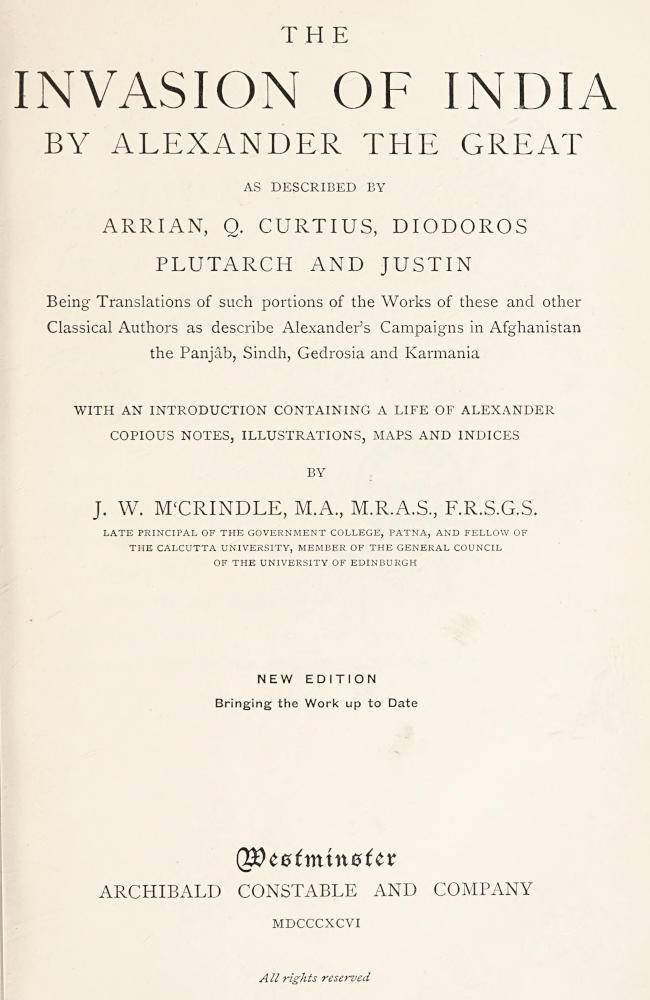
The Invasion of India by Alexander the Great as described by Arrian, Q. Curtius, Diodoros, Plutarch and Justin: Being Translations of such portions of the Works of these and other Classical Authors as describe Alexander's Campaigns in Afghanistan, the Panjâb, Sindh, Gedrosia and Karmania
Explore more books like this:
About This Book
A collection of English translations of ancient historians presenting the campaigns of Alexander as he advanced into regions corresponding to Afghanistan, the Punjab, Sindh, Gedrosia, and Karmania. The translations recount marches, engagements, encounters with local peoples, and the logistical and environmental hardships faced along the routes. Extensive editorial material — including introductions, annotations, maps, and indices — accompanies the narratives to clarify geographical references and to correct earlier identifications of obscure places mentioned by the classical authorities.