
“Of the life of Alexander we have five consecutive narratives, besides numerous allusions and fragments scattered up and down various Greek and Latin writers.... Unluckily, among all the five there is not a single contemporary chronicler.... The value of all, it is clear, must depend upon the faithfulness with which they represent the earlier writings which they had before them, and upon the amount of critical power which they may have brought to bear upon their examination. Unluckily again, among all the five, one only has any claim to the name of a critic. Arrian alone seems to have had at once the will and the power to exercise a discreet judgment upon the statements of those who went before him. Diodôros we believe to be perfectly honest, but he is, at the same time, impenetrably stupid. Plutarch, as he himself tells us, does not write history, but lives; his object is rather to gather anecdotes, to point a moral, than to give a formal narrative of political and military events. Justin is a feeble and careless epitomizer. Quintus Curtius is, in our eyes, little better than a romance writer; he is the only one of the five whom we should suspect of any wilful departure from the truth.”—From Historical Essays, by Professor Freeman, 2d series, third edition, pp. 183, 184.
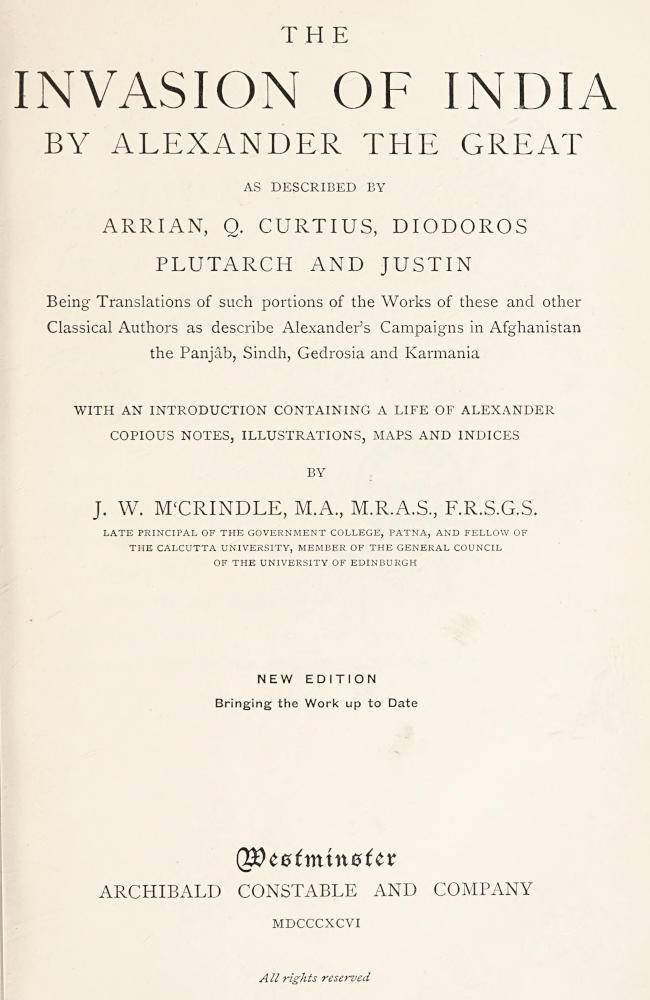
The Invasion of India by Alexander the Great as described by Arrian, Q. Curtius, Diodoros, Plutarch and Justin: Being Translations of such portions of the Works of these and other Classical Authors as describe Alexander's Campaigns in Afghanistan, the Panjâb, Sindh, Gedrosia and Karmania
Explore more books like this:
About This Book
A collection of English translations of ancient historians presenting the campaigns of Alexander as he advanced into regions corresponding to Afghanistan, the Punjab, Sindh, Gedrosia, and Karmania. The translations recount marches, engagements, encounters with local peoples, and the logistical and environmental hardships faced along the routes. Extensive editorial material — including introductions, annotations, maps, and indices — accompanies the narratives to clarify geographical references and to correct earlier identifications of obscure places mentioned by the classical authorities.