
WeRead Powered by ReaderPub
The Italian Alp-bee; or, The gold mine of husbandry / short and practical instructions to breed genuine prolific Italian queens; to multiply them by hundreds in a few months and how to change German hives into Italian cover

The Italian Alp-bee; or, The gold mine of husbandry / short and practical instructions to breed genuine prolific Italian queens; to multiply them by hundreds in a few months and how to change German hives into Italian

Chapter 2: H. C. HERMANN,
Open in WeRead

About This Book

The treatise describes the natural history and distinguishing features of the yellow Alp bee (Apis helvetica), noting its alpine habitat, lighter coloration, larger queens and drone morphology, and differences in comb structure and temperament. It presents practical, step-by-step methods to breed prolific Italian queens, multiply colonies rapidly, and convert darker local hives into pure Italian stock while preserving purity. The work includes instructions on managing and handling colonies, recommendations for hive types and fittings, and measurements and drawings to aid replication. Emphasis is on profitable, humane beekeeping and on techniques to propagate and maintain the desirable race.

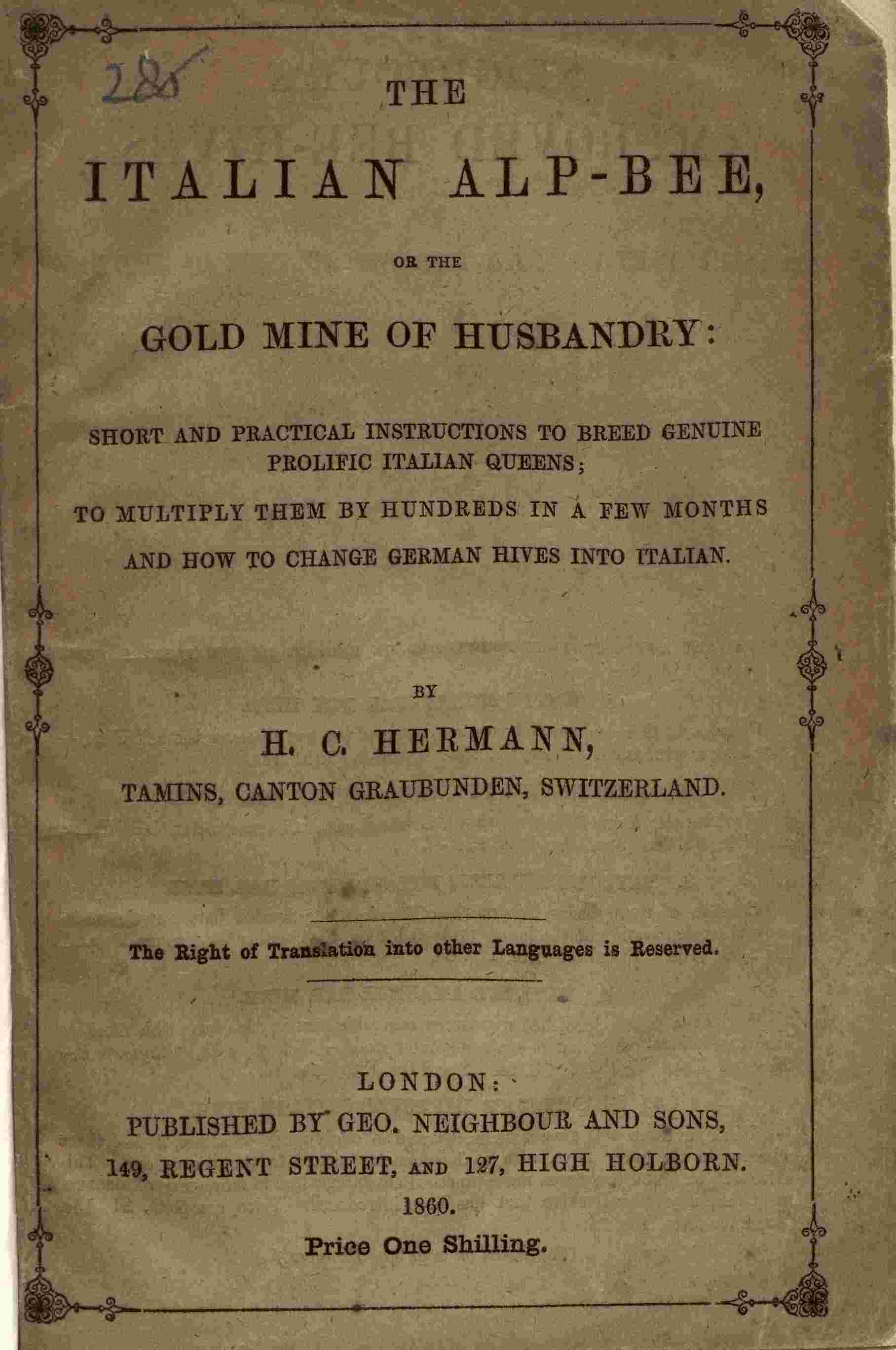
THE
ITALIAN ALP-BEE
OR THE
GOLD MINE OF HUSBANDRY:

SHORT AND PRACTICAL INSTRUCTIONS TO BREED GENUINE
PROLIFIC ITALIAN QUEENS;
TO MULTIPLY THEM BY HUNDREDS IN A FEW MONTHS
AND HOW TO CHANGE GERMAN HIVES INTO ITALIAN

BY

H. C. HERMANN,

TAMINS, CANTON GRAUBUNDEN, SWITZERLAND


The Right of Translation into other Languages is Reserved.


LONDON:
PUBLISHED BY GEO. NEIGHBOUR AND SONS,
149, REGENT STREET, and 127, HIGH HOLBORN.
1860.


In sending this little Treatise to the Press it has been thought desirable to present it to the Public as a literal translation from the pen of M. Hermann, rather than a more highly finished production in the English, language.

We take the present opportunity of mentioning, that the first introduction of the Ligurian Bee into England was through our agency. A letter to us from M. Hermann, dated 5th July, 1859, (an extract from which appeared in the "Cottage Gardener" of that month) has given rise to the interesting discussion in that periodical.

G. N. & SONS.