
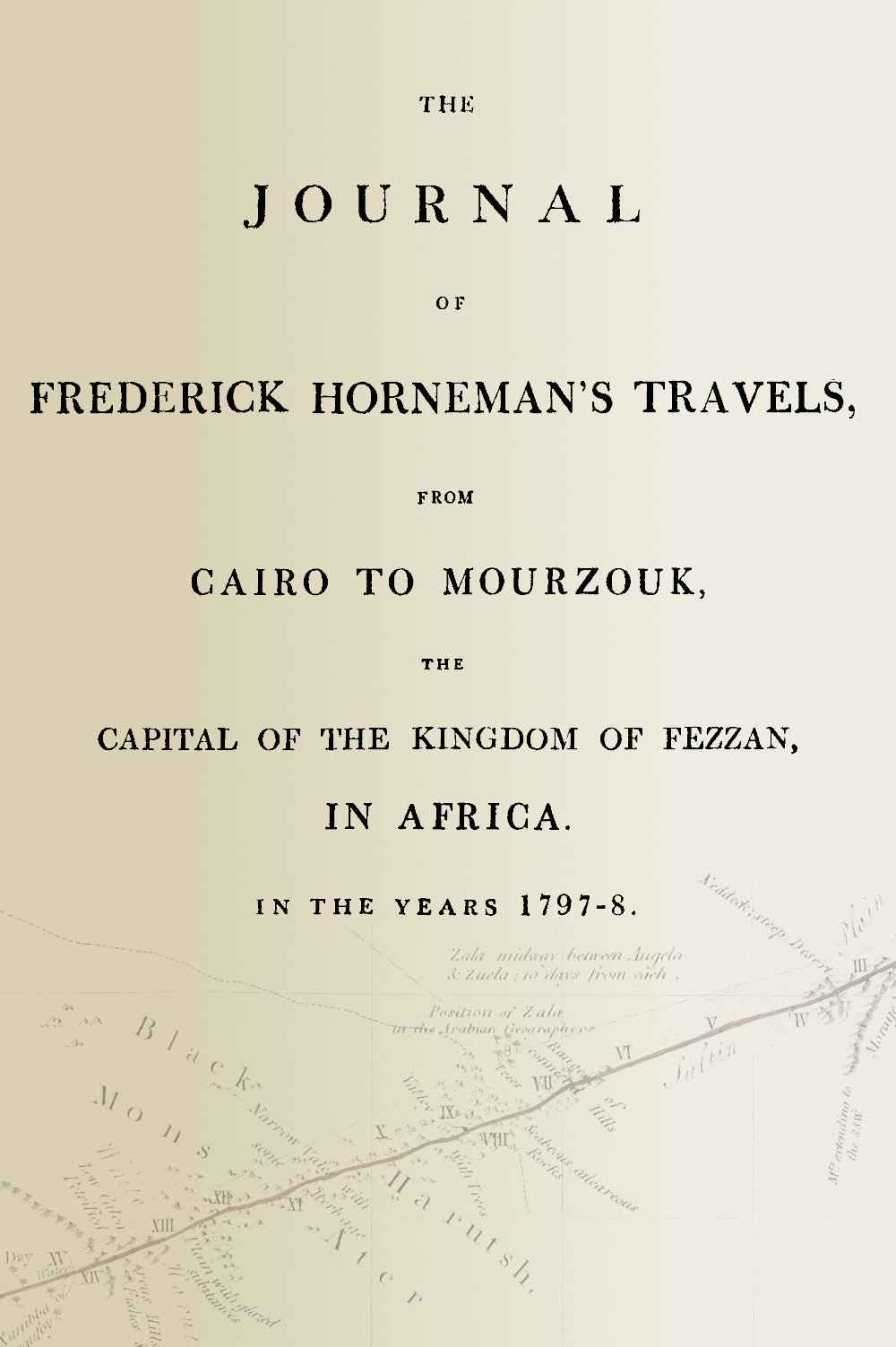
The Project Gutenberg eBook of The journal of Frederick Horneman's travels, from Cairo to Mourzouk, the capital of the kingdom of Fezzan, in Africa, in the years 1797-8
Title: The journal of Frederick Horneman's travels, from Cairo to Mourzouk, the capital of the kingdom of Fezzan, in Africa, in the years 1797-8
Author: Friedrich Hornemann
Contributor: William Marsden
James Rennell
bart. William Young
Editor: Association for Promoting the Discovery of the Interior Parts of Africa
Release date: August 17, 2023 [eBook #71426]
Most recently updated: January 16, 2025
Language: English
Original publication: London: G. and W. Nicol, 1802
Credits: Galo Flordelis (This file was produced from images generously made available by The Internet Archive)
THE
JOURNAL
OF
FREDERICK HORNEMAN’S
TRAVELS,
FROM
CAIRO TO MOURZOUK,
THE
CAPITAL OF THE KINGDOM OF
FEZZAN,
IN AFRICA.
IN THE YEARS 1797-8.
LONDON:
PRINTED BY W. BULMER AND CO.
CLEVELAND-ROW, ST. JAMES’S;
FOR G. AND W. NICOL, BOOKSELLEES TO HIS
MAJESTY,
PALL-MALL.
1802.
TABLE OF CONTENTS.
| Introduction | page i |
| Preface, containing some Account of F. Horneman; of the Preparations for his Voyage; and of Events previous to his leaving Cairo | xvii |
| CHAPTER I. | |
| Section I.—To Ummesogeir | 1 |
| Section II.—Observations on the Desert; passing from the Valley of Natron to the Mountains of Ummesogeir | 8 |
| Section III.—Ummesogeir, and further Journey to Siwah | 11 |
| Section IV.—Siwah | 14 |
| Section V.—Antiquities of Siwah | 20 |
| Section VI.—Departure from Siwah; Journey to Schiacha; and Danger which the Traveller there incurred | 29 |
| Section VII.—Departure from Schiacha; Arrival at Augila | 36 |
| CHAPTER II. | |
| Section I.—Augila, and further Progress to the Confines of Temissa | 40 |
| Section II.—Observations on the Region of the Harutsch | 48 |
| Section III.—Arrival at Temissa, and further Journey | 53 |
| Section IV.—Of Zuila | 56 |
| Section V.—Farther Journey, and Arrival at Mourzouk, the Capital of the Kingdom of Fezzan | 59 |
| CHAPTER III. | |
| Some Account of Mourzouk, and of the Kingdom of Fezzan | 62 |
| APPENDIX. | |
| No. I. | |
| Observations on F. Horneman’s Description of the Country and Antiquities of Siwah; with Reference to ancient Accounts of the Oasis and Temple of Ammon. By Sir William Young, Bart. F. R. S. | 75 |
| No. II. | |
| Some Account of F. Horneman, after his Arrival at Mourzouk | 97 |
| No. III. | |
| A Memoir, containing various Informations respecting the Interior of Africa; transmitted from Mourzouk in 1799, by F. Horneman | 105 |
| No. IV. | |
| Geographical Illustrations of the Travels and Informations of F. Horneman, with Maps; by Major James Rennell, F. R. S. | 121 |
| No. V. | |
| Observations on the Language of Siwah; in a Letter to the Rt. Hon. Sir Joseph Banks; by William Marsden, Esq. F. R. S. | 189 |
| No. VI. | |
| List of the Members of the Society, instituted for the Purpose of promoting a Discovery of the Interior Parts of Africa | 193 |
ERRATA
| Pag | 6, | Line | 9, | for roum, read rouin. |
| — | 14, | — | 7, | for monachie, read menschie. |
| — | 19, | — | 10, | for Logman, read Logmam. |
| — | — | — | 13, | for fennel, read flesh or meat. |
| — | — | — | 14, | for eyelid, read eyebrow. |
| — | 46, | — | 9, | after watering-place, insert called Ennaté. |
| — | 95, | — | 6, | for would, read wouldst. |
| — | — | — | 27, | for rare, read sure. |
| — | 105, | — | 9, | for Ungila and Supah, read Augila and Siwah. |
| — | — | — | 15, | after is, insert not. |
| — | 107, | — | 17, | for Burnû, read Burgû. |
| — | — | — | 22, | for SSW, read SSE. |
| — | 112, | — | 17, | for the culture of their land, read their preparation of leather. |
INTRODUCTION.
The Society, instituted in the year 1788, for the purpose of exploring the Interior of Africa, in pursuing their great design, adopted wise and certain principles of procedure: they inquired, and then examined; they sought intelligence, and then directed research: their progress has been answerable to the just system of their pursuits and perseverance; and the Society, from the epoch of 1798, have been enabled to direct their efforts for further discovery, on data from actual visitation and experiment.
A volume of the transactions of the Society, printed in the years 1790—92, sets forth in detail, such communications respecting the Interior of Africa, as might be collected on inquiry from British Consuls; from the recital of Negro, or Moorish traders; or from that of Shereefs and others, who had passed with the caravans on religious pilgrimage, in different directions between Mecca and the various and remote stations of Mahomedans in Africa.
Those communications were, at the time, most interesting and useful; they afforded at once the incentive and the direction to farther inquiry; they opened new objects to commercial enterprize, and new matter for scientific speculation, on the productions of nature, and the manners and conditions of society, in a quarter of the globe hitherto unexplored: further, they pointed out the road, and facilitated the means, of ascertaining the truth of each account, and of estimating its importance and advantages by actual visitation and experiment.
Be it allowed, that the narrators spoke of what they had heard, as well as of what they had seen; let it be granted that they were mostly ignorant, credulous, or partially informed; and that, distinctively and in detail, the accuracy of their representations was little to be depended on; yet on points wherein their accounts agreed, they merited attention and regard; they together opened a general view of the society, and of the country; and afforded matter of such reasonable conjecture and inference, as might warrant and direct the course of further investigation. Reflecting on these and other relations made by unenlightened men, it appears, that as the great continent of Africa, amidst its seas of sand, occasionally shews its Oasis, or fertile isle, rising in each desert; so, in analogy to the face of the country, does the blank and torpid mind of its people, display occasionally notes of intelligence and philanthropy; rich spots of genius, and partial scenes of improved social establishment. Having passed whole regions sterilized by apathy and ignorance, the result of superstitions, prejudice, and oppression, the enlightened traveller comes to a sudden view of some rich field of character, and contemplates with delight the free-born spirit and sagacity of the Tuarick of Hagara, and the ingenuity and benevolence of the Houssan. To unfold and disseminate these germs of civilization, is surely a noble task! What description of men and country can be more interesting? whither could the refinement of arts? whither could enlightened philosophy better tend, to humanize and improve? whither could the spirit of trade better direct its course? As we speculate on the projected intercourse, the noblest views open to the mind, anticipating reciprocal advantages: in the dispensation of intelligence and the arts of peace, carrying therewith complacent manners to rude and ferocious nations; and in a full compensation to the enlightened adventurers, from new materials of ingenuity and of commerce, and from new subjects of scientific inference, extending the advancement of human knowledge in all its branches.
The communications in question, operating on the minds of intelligent Members of the African Society, and giving a spur to the curiosity and enterprize of the agents they might employ, formed a suitable and necessary Preface to the undertaking and efforts for practical discovery, and for ensuring the advantages thence to be derived.
The compilation of various informations respecting Africa, had thus an intrinsic value, as affording premises of inquiry, and as giving encouragement and direction to adventure.
But further, and even immediately, wisdom and sagacity will extract truth from accounts, however contradictory, and useful and certain inference, from documents the most ambiguous or incomplete.
Efforts of rude ingenuity often suggest not only improvement but discovery; the rustic forms a lever to raise the mass, and the sagacity of the mechanic applies it to ascertain the weight.
Science often works with effect on the loose and disjointed materials which ignorance has heaped together; compares, arranges, and connects their substances and forms; shews in their matter, construction, or decomposition, new uses; derives new informations, and adds to the stock of human inventions and knowledge.
Were it necessary to illustrate such position by example, the writer would refer, as a special instance, to the elucidations of Major Rennell on the communications in question: to that most accurate and acute philosopher and geographer, the details have afforded matter of enquiry and deduction of the highest import to science. By analysis, and a comparative view of accounts given of journies and places, in reference to the plans of D’Anville, and other geographers; to modern travels; to ancient expeditions; to descriptions of ancient writers; and above all, to those of the father of history, Herodotus; Major Rennell hath corrected the map of Africa, with a learning and sagacity which hath converted conjecture into knowledge; and on experience of those who have explored parts of that great continent, given confidence to each future traveller who may visit its remotest regions.
Had the proceedings of the Society stopped here, and its work been confined to the compilation above alluded to, and to the comments of Major Rennell, the usefulness of its institution would have been acknowledged by posterity.
But happily the Journal of Mr. Park’s travels to the Niger, and that of Mr. Horneman’s journey from Cairo to Mourzouk, will fully shew, that the attainments of the Society are no longer narrowed to the mere rudiments of discovery, which tradition and ingenious inference, alone before supplied.
Even under the inauspicious circumstances of wars and revolutions which from nearly the date of the establishment of the Society, have spread desolation far and wide, and in the year 1798, reached to the very capital of Africa; their chosen emissaries have surmounted all the dangers and difficulties, which these events superadded to the ordinary risk of enterprise.
It should not be omitted, that the traveller, (whose work is now submitted to the public,) was further indebted to the liberal and enlightened spirit, which directs the genius of truly great men to foster useful arts and sciences amidst the horrors of war; and give orders to the armies under their command, to forbear all molestation of the emissary from even an hostile country, whose intentions and pursuits are directed to objects of common value and concern, to the nations of the world at large.
Under such patronage and protection from the General Bonaparte, and with his special passport and safeguard, Frederick Horneman safely reached the caravan passing from Mecca, and pursued, and accomplished his journey from Cairo to the kingdom of Fezzan; which from the general resort of caravans to its capital, Mourzouk, may be considered as the proper post of direction and outfit, for his further travels to the remotest regions of Africa.
In planning the routes of Park and of Horneman, the Society availed itself of former communications, sagaciously discriminated the proper path of research, and have to exult in the success of each adventure. These emissaries have explored roads which shortly mercantile adventure will, and must enter. In this new race of commerce, shame indeed would it be to our national councils, could it possibly be supposed that from the default of patronage and support of Government, our commercial people may lose the start for a priority of factories and establishments of trade, and permit other nations to usurp the vantage ground which British enterprise, under the auspices of a patriotic and enlightened, but private institution, shall have explored, marked out, and prepared for them.
By Mr. Park’s discoveries, a gate is opened to every commercial nation to enter and trade from the west to the eastern extremity of Africa. The navigable parts of the rivers Gambia and Niger are not so far distant, but that great facilities of trade may thence be derived, aided by the establishment of intermediate stations and points of intercourse. A considerable traffic is carried on by the natives for ostrich feathers, drugs, ivory, and gold, even without such advantage. On due direction and exertions of British credit and enterprise, it is difficult to imagine the possible extent to which the demand for our country’s manufactures might arrive, from such vast and populous countries in the bosom of which gold, the great medium of commerce, is readily found; and which would be sought for and brought into circulation with new avidity and success, in proportion as objects for the exchange, became known, desirable, and necessary to the people.
This subject has already been recommended by the Society, to the attention of Government; and on the return of peace, it is not doubted, but it will be treated with a consideration and regard, suitable to the important interests which it involves.
When the thorny track of a Park or a Horneman is become the beaten road of the merchant, advantages of another sort will quickly follow; and the intercourse extend to the instruction of the naturalist and philosopher, to the promotion of civilization, and to the increase of the general stock of human knowledge and happiness.
Contemplating such accomplishment of the wise and benevolent purposes of their Institution, the patriotic members of this Society cannot but look back with exultation to the hour of its establishment, and they will with satisfaction recapitulate its means and progress, towards such happy termination of their labours.
Of those who transmitted accounts which they had received, concerning the people and country of Africa, Mr. Ledyard and Mr. Lucas were specially employed, with the further intent of progress into the heart of the country; for the purpose of ascertaining the truth of these recitals, the correcting them on personal information, and the elucidating, on actual survey, any future plan for turning the knowledge thence derived to account.
Mr. Ledyard died at Cairo, ere his eager and enterprising spirit could even start towards its object: Mr. Lucas, deterred by impending difficulties and dangers, proceeded not further than to Mesurata, seven days journey S. E. of Tripoly; there collected informations from the Shereef Imhammed, and traders of Fezzan, and then measured his road back to Tripoly; and shortly after returned to England.
The Society, with that persevering spirit which ever distinguishes manly minds, engaged on sound principles, and for noble purposes, were not appalled by the death of one emissary, or the failure of another.
They sought out and appointed a new traveller, and to take a new road. Mr. Ledyard was to have penetrated from the east, Mr. Lucas from the north; Major Houghton was appointed in the year 1790, to sail for the mouth of the Gambia, and to traverse the country from west to east: Major Houghton arrived on the coast of Africa November 10, of that year, immediately commenced his journey, ascended the Gambia to Medina, 900 miles (by the water-course) distant from the mouth of the river, and thence proceeded to Bambouk and to the adjoining kingdom of Kasson; where, in September 1791, he unfortunately terminated his travels with his life, near to the town of Jarra. Mr. Park, who was engaged in the service of the Society, in 1795, more successfully followed the route of Major Houghton, and further explored to the banks of the Niger, to Sego, and to Silla, the first of that great line of populous and commercial cities, dividing the southern from the northern deserts of Africa; and the very existence of which, for centuries past, hath been rather matter of rumour than of information; and been made the subject of philosophic romance,[1] in default of authentic account and description.
The informations of Mr. Park were communicated to the Society at their annual Meeting in May 1798.
The year 1798 will ever be noted, as the memorable epoch, when the researches of this Society announced to the world the course of the Niger, from west to east; and, after the distance of 2300 years, corroborated the testimony of the Nasamones, and accounts of Herodotus, contested during that long period by ancient and later writers, and ultimately rejected within the century past, by the learned D’Anville. But further, the settlements on its fertile shores, are by the informations of Park, derived from inquiries so near to the source, as now greatly to be depended on; at least so far, as to give assurance of objects of commerce and learned inquiry, that will amply repay further research. The just motto of the Society is, “quod non peractum, pro non inchoato est;” its exertions and perseverance answer to it, and it is to be congratulated that the task is now easy, its accomplishment assured.
The writer of this Essay, not presuming to graft addition or observation on the intelligent and authentic Journal of Mungo Park, ventures a single comment, of import to the Society, and in justice to its agent.
Mr. Park has not only designated the route of country but of men. He hath marked the districts of population covering the great belt of land intersecting Africa from west to east, and at the same time hath noted the distinctions of Moor and Negro, in manners, prejudices, and government. He hath thereby given to the Society information of the viaticum of character and accomplishments proper and necessary to ensure the success of their future agents: he hath pointed out the roads to districts and cities of the greatest interest, and at the same time hath shewn the means of securing entrance and hospitable reception.
The Society hath availed itself of the intelligence; and a new emissary, Mr. Horneman, hath given his lesson full effect in an expedition which is the subject of the present Volume.
Of the further progress of this accomplished traveller, the Editor forbears to intimate design or suggestion.
The season of mere expectation and conjecture is gone by. It were idle indeed at this period of actual discovery, to hazard surmise for future correction on experiment.
At outset of the Society instituted for the purpose of exploring the Interior of Africa, it might have been proper to set forth, in glowing colours, all that was rumoured, and all that might be expected; well were general reports and ingenious inferences suited to rouze curiosity, to excite adventurous spirit, and to give a spring to the first movements and purposes of the Institution.
Such incentives are no longer necessary; and knowledge actually acquired, demands, in the future display, merely accuracy and precision, as the guides to further success.
The Society is confirmed in its purpose, and assured of its objects and of the means of attainment.
Its travellers will not in future rush on with zealous but unadvised curiosity; or hesitate as in the dark, and on unfounded apprehensions; but, disciplined and educated, proceed with a spirit corrected and confirmed by knowledge and precaution, towards certain purposes and ends.
An adventurer may yet fail; but it is presumed the adventure cannot, unless from failure of the funds and resources of the Society; which, in this great and opulent country, it would be a calumny on the generosity and patriotism of its people, for one moment to anticipate as possible.
Yet let it be remembered, that the extent of our undertakings can only be commensurate with our means.
Expense and charge attend our present inquiries; and even a more advantageous extension of our researches apart, demands of much beyond what our actual numbers and contributions can furnish, will be necessary to ensure the effect of national advantage, and turn to public account the successful experiment of an enlightened and patriotic, but not numerous, Association.
The Society cannot condescend to solicitation; nor is it necessary: it will suffice, that, emboldened by success, they suggest to their countrymen, that, under proper patronage, and with the means of extending their researches, the conclusion will be of advantage, to Great Britain—to Africa—and to the World.
W. YOUNG,
SECRETARY TO THE AFRICAN SOCIETY.
FOOTNOTES:
[1]By Bishop Berkeley.
PREFACE TO THE JOURNAL, &c.
GIVING SOME ACCOUNT OF MR. FREDERICK HORNEMAN; OF THE PREPARATIONS FOR HIS VOYAGE; AND OF EVENTS PREVIOUS TO HIS LEAVING CAIRO.
At the time that Mr. Mungo Park, engaged in the service of the Society instituted for the purpose of exploring the Interior of Africa, was prosecuting discoveries eastward from the river Gambia, it was thought proper to extend their researches in another line of direction, and engage an emissary to explore that great continent, proceeding westward from the city of Cairo.
Early in the year 1796, Mr. F. Horneman offered himself to the Committee of the Society for this service; he appeared to be young, robust, and, in point of constitution and health, suited to a struggle with different climates and fatigues: in his manner and conversations he displayed temper, acuteness, and prudence: he was well apprized of the dangers and difficulties of the enterprize he was to engage in, and shewed a spirit and zeal for the undertaking, which strongly recommended him as a proper person to be employed for the carrying it into effect.
The Committee accordingly engaged his services; and observing in him such foundation of good ordinary education, as further attainments might readily be engrafted upon, they sent him, at the expense of the Society, to Gottingen; there to study the rudiments and writing of the Arabic language, and, generally, such sciences as (in the result of due application of the knowledge acquired), might render any account of his future travels more interesting and useful to his employers, and to the public.
F. Horneman pursued the requisite studies for several months with great assiduity, under the tuition of Professors Blumenbach, Heeren, Hoffman, Tyschen, and Heyne; and in May, 1797, returned to England, properly instructed for his intended voyage. He was then introduced to a general meeting of the Society, when his engagement was approved of, and he was directed to proceed to Egypt with all convenient dispatch.
Passports from Paris were applied for, and granted, permitting him to pass through France; and in July, 1797, he left London on his way to Paris.
He was furnished with letters of introduction to several persons of literary distinction in that capital; and, on arrival, his reception was liberal and friendly, and proportionate to the lively interest which was every where taken in his scheme of enterprize, and in the means of promoting its success. He was invited to a meeting of the National Institute. The first members of that learned society tendered their patronage, encouragement, and assistance: Mr. Lalande furnished him with copies of his “Memoire sur L’Afrique.” Mr. Broussonet recommended him to Mr. Laroche, appointed Consul for Mogadore; and by this latter gentleman’s means he made a further and most useful acquaintance with a Turk of distinction (a native of Tripoly), then resident at Paris. This Mussulman entered into the motives and plan of his travels with a liberal approbation, and a zealous interest in the success; which was little to have been expected from one of such persuasion and character. He gave Mr. Horneman letters of introduction, strongly recommending him to the friendship and protection of several leading Mahommedan merchants at Cairo, who were in the habits of trade with people of the remotest regions of Africa; and he added his own advice, and instructions for the journey.
Thus provided, Mr. Horneman, in August, left Paris for Marseilles, where he embarked the end of the month, and arrived at Alexandria the middle of September: he staid at Alexandria but a few days, and then went to Cairo, where he purposed residing some time, to study the language and manners of the Mograbins, or western Arabs, with whom he was to associate in his future travels. His own letter will best describe his further progress.
(Translation.)
| “Sir, | Cairo, August 31, 1798. |
“In my last letter I mentioned my intentions of leaving Cairo about the end of May. The plague beginning to rage in the month of April, it became a proper and necessary precaution not only to defer my journey, but absolutely to shut myself up in my house. My zeal for the undertaking I have engaged in, would have led me to break through this confinement and leave the city, with a view to join the merchants at their place of rendezvous, whence they were directly to depart for Fezzan, had not obstacles arising from the difficulty of procuring the necessary credits for my equipment prevented my immediate procedure.
“As soon as from abatement of the pestilence, I could safely go abroad, I met and renewed my acquaintance with several of the caravan, who remained in the city, expecting the return of others from Mecca. A French commercial house, on whom I had no letters of credit or other claim to confidence, than what arose from private friendship and esteem, having handsomely offered such advance of monies as I might require, I was enabled to prepare for my journey, and set out with this caravan, as soon as complete and ready for departure. All these designs were suddenly frustrated by the arrival of the French on the coast of Egypt. Those who formed the caravan at Cairo quickly dispersed; that from Mecca coming to join it was not yet arrived: myself and other Europeans were seized and confined in the castle, rather as a place of refuge from the indignation and fanaticism of the populace, than as a prison, and we remained there until the arrival of the French at Cairo.
“Soon after their coming, I made acquaintance with two of their learned men, Berthollet and Monge, they liberated and presented me to the Commander in Chief, and he received me with every mark of attention and goodness. His regard for science, and esteem of learned men are too well known to render it necessary for me to expatiate on these high qualities. He promised me protection, he offered me money or whatever was requisite to my undertaking, and he directed the necessary passports to be prepared for me.
“I lost no time in seeking out my friends, the merchants of Fezzan, and renewing my connections with them. Gradually as the public tranquillity became assured, they returned, one by one into the city, till the whole were again assembled; and fifteen days have now passed, since we have been making preparations for our final departure, actually fixed for the day after to-morrow.
“Commonly those who engage in an extraordinary enterprise, consider means yet more extraordinary, as requisite to the success of the undertaking: my opinion, and therewith procedure will be founded on directly the contrary proposition. The plan which I have chalked out for my journey will be simple and easy to pursue. You shall have it in a single line, “it is to travel as a Mahommedan merchant of the caravan.” I am assured that under such character, I can travel with the same surety as the natives of the country.
“Many of the caravan having been at Mecca, are aware that there are numbers of good Mussulmen from various countries who speak not Arabic, and who have different usages and customs; and thus simply attaining a knowledge of certain religious ceremonies and prayers, there is no difficulty in passing generally as a Mahommedan; for as to a certain less equivocal criterion of a personal nature, the delicacy of Mahommedan manners precludes any danger of inquiry.
“To travel as a Christian, will perhaps be impracticable for at least five years to come, for it is incredible how deep and strong an impression the expedition of the French has made on the minds of the pilgrims to and from Mecca: dispersed to their several homes they will carry an aggravated prejudice against Christians far and wide, and to the very heart of Africa.
“Should it be objected to me, that I risk a similar fate with that of Major Houghton, by travelling as a trader, my answer is, “that by travelling as a Mahommedan trader, I shall never travel alone; and with those too of the caravan, considered as one of the least of its merchants.
“In respect to my astronomical instruments, I shall take special care never to be discovered in the act of observation; should those instruments, however, attract notice, the answer is ready, “they are articles for sale;” nor is there fear that I should be deprived of them, whilst master of my price. My comrades know the value of gold at least better than myself. In a word, the merchants of our Fezzan caravan, are men of wealth, integrity, and enterprise; but Mahommedans, the most prejudiced and fanatic.
“I have not yet fixed or methodized my design, as to further journey into the interior of Africa; but I have made acquaintance with a man who has been at Bornou and Cashna, a place, from every account which I can collect, and particularly from the Jalabs, deserving my immediate attention after arrival at Fezzan.
“I expect to be at Fezzan by the beginning of November, and I should propose in the next year, setting out for the Agades and Cashna, residing in and exploring those countries during ten months, and then returning viâ Mecca or Senegambia. Should any necessity of the case oblige me to return to Tripoly, I should not consider my tour as complete, but (with permission of the Society,) hold myself in readiness for a further undertaking.
“I will write again from Fezzan, if I can do so without danger; the safest plan that occurs, is to pack up some bale of goods with an ordinary letter of advice in Arabic, making my real dispatch the package or covering of some article of trade.
“Pray write to and direct the English Consul at Tripoly, or elsewhere, never to make inquiry after me of the traders from Fezzan, and particularly when conveying any thing from me consigned to you. These people are of a very jealous and inquisitive temper, and any inquiries made after me by a Christian, might raise a thousand suspicions, and prove even of fatal consequence to me.
“Nay, should yourselves not hear of me these three years, make no inquiry. Under such precaution, my danger will not be that I travel as a trader and Mahommedan, but such only as results from climate and ordinary perils of voyage in these countries; which I trust successfully to oppose, with a good constitution and strength of body, and with courage and suitable temper of mind.
“It remains only for me to recommend to the Committee, the man whom I mentioned in a former letter. I met with the person in question, Joseph Frendenburgh, who was born in Germany, just on the eve of his intended departure from Cairo for his native country. I engaged and employed him as interpreter; and, pleased with the office, he offered to continue in my service, and attend me in my expedition. He had been ten or twelve years past forced to embrace the Mohammedan religion; had three times made the voyage to Mecca, and spoke perfectly both the Arabic and Turkish languages; in short, he was precisely the man that suited me. The connection with him will ensure me character and confidence from others, and indeed, without him, I should scarcely be able to pursue my journey, without actually embracing and professing Mahommedanism myself, I now well know him on ten months experience, and in just reliance on him, have no apprehension of the calamity incident to travellers, of being robbed by their servants.
“I shall consign to him the care of my camels and my horses, (for we merchants of the caravan all go armed, and on horseback,) he will further have the care of my merchandize, and altogether, I shall have leisure for my inquiries, and for attending to the general objects of my undertaking. The demands of this man are far from exorbitant, and I request of the Society, the attending to a just remuneration of his services, and specially, if in case of my death, he should faithfully preserve my journals and papers, and proceed with them to England.
“I have been in some doubt as to the means of sending this letter, but on my request, General Bonaparte has with great goodness, himself condescended to take charge of its safe conveyance.
“I hope my next will be from Fezzan, and that after three years, I shall be enabled to give account of the interior of Africa.
“I am, &c. &c. &c.
“FREDERICK HORNEMAN.”
To Mr. Edwards, Secretary to the Society, instituted for exploring the interior of Africa.
The above letter was transmitted to the African Committee, under the seal of General Bonaparte, who in addition to other marks of favour and protection shewn to the enterprise of Horneman, took on himself the care of forwarding his dispatches, as above stated.
Mr. Horneman’s Journal of his Travels from Cairo to Fezzan commences five days after the date of this letter. It was by him written in German, and in that language transmitted to the Committee of the African Society. Under their direction, a translation of it was made by a native of Germany, sufficiently versed in the English language, to render the sense of the original with truth and perspicuity; and, on collating his version, it appears to have been executed with fidelity and care. Some correction of foreign idioms and style was yet required: the Secretary, in performing this duty of Editor, has been attentive to the preserving not only the genuine descriptions, remarks, and precise meaning of the traveller, but likewise the spirit, and (at the same time) simplicity of narrative which characterizes his Journal; and, it is presumed, that on reference to the original, the translation offered in its present form will yet appear to be as nearly literal, as the different idioms and context of the English and German languages will admit of.
To the Journal now printed is added an Appendix, containing,
1st. A Note, on Mr. Horneman’s Description of the Country and Antiquities of Siwah; with Reference to ancient Accounts of the Oasis and Temple of Ammon; by the Secretary, Sir William Young, Bart. F. R. S.
2d. A Memoir, containing various informations respecting the interior of Africa, transmitted from Mourzouk, in 1799, by F. Horneman.
3d. Geographical Elucidations of the Travels and of the Informations of F. Horneman, with Maps, by Major James Rennell, F. R. S.
4th. Remarks on the Language of Siwah, in a Letter to the Right Hon. Sir Joseph Banks, P. R. S. by William Marsden, Esq. F. R. S.