
Come blow your horn,
Your cows are eating
Farmer Green's corn,"
Goodness me! Dapple Gray was so startled that he stood up on his hind legs and nearly upset his small rider.
"Don't blow it again till I get out of the meadow," said Little Sir Cat, and he rode away. By-and-by, after a while, he came to a neat-looking cottage with a red chimney and pink blinds. So he knocked on the door, and who do you suppose opened it? You'll never guess, so I'll tell you right away. Why, Old Mother Hubbard and her dog. Wasn't that strange? For the last time Little Sir Cat had seen them was in Old Mother Goose Country, and of course he was surprised to meet them. All of a sudden, the Dog began to sing:
To get me a bone any more;
For she has an excuse, so what is the use?
She remembers what happened before.
So now we both go to a nice movie show,
And then to a restaurant fine,
Where we order a stew of giblets for two,
And the orchestra plays while we dine."
"Hurray!" cried Little Sir Cat, "things are certainly very different in this country." And pretty soon he told them he must be on his way. So off he went through the woods, and by-and-by he came to a deep pool under a great oak tree. But he didn't know that a Frog Prince lived in it. No, Siree. And perhaps it was just as well that he didn't, for the Frog Prince didn't like cats at all.
Well, as soon as he saw Little Sir Cat, he gave a dreadful loud croak and hopped out on the bank.
"Shall I kick him?" asked Dapple Gray with a toss of his head, for he wasn't afraid of that croaky old frog, not the least little bit.
"Of course not," answered Little Sir Cat. "Are you really a frog, or an enchanted prince?" he asked, turning to the Frog Prince.
And, would you believe it, the tears came to that poor frog's eyes, as he answered:
"A wicked witch has cast a spell over me. I was once a handsome prince."
"I will help you," answered Little Sir Cat, and, jumping off Dapple Gray, he hunted through the grass until he found a tiny, little flower, blue as the summer sky.
"Tomorrow morning when the cock crows eat this flower," he said, handing it to the Frog Prince, "and you will once more be your natural self." And before the happy frog could thank him he jumped on Dapple Gray and rode away to the next story.
Had a wife and couldn't keep her;
He made a car of the pumpkin shell,
And there he kept her very well.
MAY DAY FROLICS IN MERRY OLD ENGLAND
Suppose we "go a-Maying" among old traditions and see with what ceremonies our English ancestors welcomed the "merry month." We do not celebrate the first day of May to any extent in this country, but in England, where the season is much earlier than ours, and the earth is already covered with wild flowers, May-day is more fitly celebrated; but even in England the old customs have sadly fallen away.
Once upon a time every village had its annual setting up of the May-pole, which was consecrated to the Goddess of Flowers, and early on May morning the young people went out to "gather the May." The first thing was to select the May-pole. The landed gentry allowed the villagers the choice of a suitable tree on their domains. A tall, straight sapling having been selected, it was speedily cut down and dragged to the village green by oxen gayly decorated with flowers and bright colored ribbons. Following after came the youths and maidens with wreaths of flowers, which they twined around cottage doorways on their way to the green, where they were to choose from among their number a Lord and Lady of May.
After a bower was built for them and the May-pole set up, there were merry dances, the revellers donning mask and costume to represent Robin Hood, Friar Tuck, Maid Marian, Much the Miller's Son, Little John, Will Scarlet and all the other famous characters of merry Sherwood. Pantomime was also indulged in, for this was a simple age, when simple pleasures satisfied the country people. Into the ring would come a hobby-horse and a dragon, the former ambling and prancing about, while the latter hissed and shook his wings, to the great delight of the spectators. There were also morris-dancers, with bells attached to their knees and elbows, who danced and capered musically. After this came trials of skill in archery by Robin Hood and his fellows, and when all these amusements grew tiresome, the villagers thronged about the May-pole and spent the remainder of the day in dancing.
But these May-day observances were not confined only to the country. In London at one time tall poles were erected on May morning, and green arbors and branches decorated the streets. It was a great day for the milkmaids and chimney-sweeps, who paraded the streets in companies, begging a trifle from their customers.
The leader of the chimney-sweeps, called "Jack in the Green," was covered, with the exception of his legs, with green boughs, garlands and nosegays. He looked like a dancing bouquet, as he moved up and down the street. Many a penny the sweeps collected from the admiring bystanders. This was a custom up to about one hundred years ago, and will perhaps remind some of my little readers of the ragamuffins who parade the streets of New York on Thanksgiving Day, begging a penny from every passer-by.
Finally, many abuses arose in the observance of the day. In 1644 Parliament passed an act forbidding the erection of May-poles. Later, during the restoration of the gay Charles the Second, the May-poles came back and flourished for a long time. Gradually, however, as the ancient simplicity of manners departed from the lower orders of the people, who were its chief upholders, the May-day festival fell into disuse, and now there are neither May-poles nor morris-dancers nor Jacks in the Green.
THE SPIDER AND THE FLY
Spinning her lacey web all day;
And when she had finished it, close to the wall
She curled herself up in a round black ball.
Lazily buzzing, buzzing away,
A little Blue Fly was buzzing all day.
Into the open window he flew
And close to the Spider's web he drew.
"Oh, what a pretty piece of lace
Swinging away in the window space!"
The little Blue Fly remarked to himself,
As he carefully crawled on the narrow shelf.
Then he brushed the dirt from his gauzy wing
And watched the spider web swing and swing.
Now this little Fly was a mischievous Fly,
And there wasn't a bit of green in his eye!
So, as he watched it swing and swing,
He thought 'twould be fun to cut the string.
Then Mrs. Spider's hammock would fall
Down with a somersault off the wall.
Creeping up to her hiding place,
He gave a pull on the flimsy lace.
Down one end of the hammock fell,
While the Big Black Spider gave a yell.
Out thro' the window the little Fly flew;
'Twas safer out there for him, he knew.
And he said, as he winked his little blue eye:
"Good-by, Mrs. Spider; good-by, good-by!"
I hate to go to bed at night,
Or get up when again it's light— It's funny that I love to do 'Most anything between these two. |
Bennie's Easter Dream
Bennie woke up on Easter morning and saw a little rabbit with a big bow of blue ribbon around his neck standing in the doorway.
"Come along!" he said. "I'm going to give you a ride on my back."
In a few minutes Bennie had on his clothes and tiptoeing down the stairs, they slipped out of the front door.
"Hold on to my ears!" said the rabbit, and away they went down the garden walk. When they reached the barnyard the rabbit stopped before the haystack, and pulling out a small basket and a big silver spoon, said to Bennie:
"Take this basket and come with me to the hen-house. If we get there before the fairies we will find the pretty colored eggs which the hens lay for Easter. But hurry, for we must get there first."
They opened the door quietly, just as the big Red Rooster began to crow. "Lift up the eggs with the silver spoon," said the rabbit, as they peeped into the nests; "don't touch one with your hand or it will lose its lovely color." Soon the basket was full. "Come on," cried the rabbit; "hurry up and get on my back; it's getting late." Bennie jumped on, but just as they started off four little chickens ran out of their coop and screamed:
You've got my egg of blue;
My yellow one, my purple one,
My little green one, too!
Suddenly he found himself in his own little bed, while outside the happy Easter bells were ringing. He wondered where his little friend the rabbit had disappeared to, and the four little chickens.
Then he looked down at the counterpane, and what do you suppose he saw. A whole nest full of beautiful, painted Easter eggs with the funniest faces and the brightest colors. Bennie gave a squeal of delight and hopped out of bed to dress so that he could show his treasure to all the other children he knew, but in his excitement forgot all about the dear little bunny.
A LITTLE GIRL'S DIARY
As she goes to church with me,
With her little gilt-edged Bible
Held close and reverently.
Sunday morning Father and I start off for church before the rest of the family, because Father wants his early walk, and I love to go with him. Through the park we go, watching the pretty little squirrels who run up to us, for they seem to know that Father will let me wait a few minutes to give them some nuts or little pieces of cracker which I have almost always in my pocket. I call one squirrel the "Little Minister" because he looks so solemn, and walks up so quietly and slowly to me, and then holds his nut between his paws and looks it over, as if it were a book, before he starts to open the cover and eat the inside. After church we all come home and have early dinner. In the afternoon, brother and I go for a long walk in the park. After supper, the nicest part of all the day, we sing hymns and Brother Jack and I say a piece of poetry, which we learn for each Sunday. Then we kiss everybody good night.
LITTLE SIR CAT
Papa catch him with a hook,
Mamma fry him in the pan,
Johnny eat him like a man,"
"Of course," answered Dame Trot, "fish don't catch themselves, unless they're playing tag in the pool."
Well, it didn't take Little Sir Cat long to finish his meal, and when Dapple Gray was saddled, he set out again on his journey through Mother Goose Land, and by-and-by, after a while, he came to a bridge, and when he looked over the railing, he saw a pretty silver fish swimming on the top of the water.
"Helloa there, silver fish! If I had a hook and line I'd soon catch you," and Little Sir Cat grinned at his own reflection in the clear water. But if the fish had seen it I guess he would have darted away, for it looked just like a real cat in the water.
"You can drop me a line," replied the fish with a swish of his tail, "but I won't promise to bite."
"I don't care for any more fish to-day," answered Little Sir Cat, "I've just had a feast at Dame Trot's little Inn."
Giving his tail a shimmery swish,
"I'll go right home to Mrs. Trout
And tell her it's safe for her to go out."
And away went that poetical old trout, and so did Little Sir Cat, and after he had ridden for maybe a mile or three, he met the Maiden All Forlorn Who Milked the Cow with the Crumpled Horn. But she wasn't miserable now at all. No, Siree. She wore a lovely smile and a pink sun-bonnet with a bit of ribbon on it. And as soon as she saw Little Sir Cat her smile broke into a laugh: "Here is my dear little puss. Where has he been this long time?"
"Oh, just traveling," he answered. "What have you been doing?"
Well, he made lots of money in cotton and corn.
So he bought me an automobile and a ring,
And the minister married us both in the spring,"
"There, you look like a prize winner," she laughed, and after that she ran back into the farm yard to see if the Little Black Hen had laid a white egg for breakfast.
By-and-by Little Sir Cat met the Spider who frightened Miss Muffet. She was busy spinning a big web and said to him,
For I'm as busy as can be."
So you must wait for the next story to hear what happened to Tommy Green, unless
Puts salt in her cider.
THE LOST PUSSY CAT
To see if pussy comes no more.
Yesterday he left the house
To go a-hunting for a mouse.
ACROSS THE PRAIRIE!
'Way back in the early days of this country, when there weren't any railroad trains crossing the great Western plains, only big herds of wild buffalo by day and fierce wolves by night; when the only way to reach one's destination was in a big, canvas-covered wagon drawn by oxen; when every man rode a horse and carried a gun, and when even the women knew how to handle a rifle—then there were lots of Indians.
Those were dangerous times, and it needed a brave heart and a quick hand and a steady head to overcome the perils of crossing the great plains in search of a new home and a fortune.
This was what Dick's father was doing, however, and Dick was the happiest boy on earth, he thought, when they started out on their journey. The big "prairie schooner" was their Pullman car, and the patient team of oxen the motive power. Dick was old enough to straddle a mustang, and so he rode by father and Uncle Billy. Mother and Aunt Mary, Sister Lou and Cousin Tommy all rode in the wagon, and when night came on they got the supper, all except Billy, of course; he just watched.
Father and Uncle Billy made the fire and unhitched the oxen and tethered the ponies.
Dick soon learned that the most important thing to do as the day came to a close was to find a good grazing place on which to pitch tent for the night, as the best grass for the animals must be selected with care, near water if possible. The animals must be looked out for first, otherwise how would they ever get anywhere if these faithful friends should become sick and die?
The next thing Dick did was to collect for the fire the dry buffalo dung which covered the prairie, and after making a pile in the shape of a huge cone he lighted a few sticks of kindling, a supply of which was always carried in a sack hung from the bottom of the wagon, and soon the heap was a mass of dull, glowing coals; then the tin coffee pail and the frying pan, and then, thank goodness!—for Dick was always hungry—supper.
After that they pulled down the big, long canvas back of the wagon cover, which was spread double over the top of the wagon during the day, and fastened it to the ground with pegs, and under this slanting roof, with their blankets between them and the earth, with their toes towards the fire, they slept quite comfortably through the night.
The oxen and the ponies knew enough not to stray any great distance from the campfire, and if frightened at anything would come rushing back, helter-skelter, for protection. They know that on the prairie man is their best friend and protector.
"What are those figures away over there to the westward?" said Dick's father. Uncle Billy shaded his eyes with his hand and looked in that direction for a few minutes without answering. "Don't know," he replied, uneasily. "They look like horses, but I don't see any riders." "Nor I," replied Dick's father, "but those wily redskins have a way of hanging over the far-side of the animal so's to deceive any one who happens to catch sight of them. They don't act like wild horses."
It was an anxious moment. Neither man spoke for some time, but rode along quietly, keeping a sharp look-out, however, in order to detect the slightest change in the appearance of the figures to the westward. "They seem to be following our way," suggested Uncle Billy about an hour later. "Supposing we pitch camp to-night a little earlier. That clump of trees yonder will give us some protection in case they turn out to be redskins."
"Good plan," murmured Dick's father, turning in the direction of the trees. "We needn't let on we're worried to the women folks," he added, "we'll just wait and see how things turn out. Maybe nothing will happen."
But something did happen. About midnight Dick's father awoke with a start. A shadow fell across the opening in the canvas. In another moment he was grappling with an Indian. Over and over he rolled, but the Indian had found his match. Dick's father was a powerful man, and, whipping out his revolver, shot him dead. None too soon, for Uncle Billy was being hard pressed by a number of redskins, two of whom he had already laid low with his rifle.
"Get into the wagon, Mother!" yelled Dick's father, "and pick off a few with your rifle!" Mother and Aunt Mary were soon blazing away from the canvas fort, and after a short time the Indians retired, evidently to consider what was the next best move.
"Where's Dick?" said his father, looking around anxiously.
"Here I am!" came a voice, and sure enough, under the wagon, crouching down behind the bag of kindling wood, which he had used for a shield, was Dick. "I cracked two, dad!" he called out, "one Injun was sneaking up by the pole, when I dropped him; he's out there now, I can just see his outline."
Just then, a number of arrows fell around the wagon, and Uncle Billy caught sight of half a dozen shadowy figures creeping along the grass in the shadows of the trees to the right. "Look out," he whispered, "let 'em get pretty close and then give 'em hail Columbia."
It was a fierce struggle, for the Indians outnumbered our brave defenders. Twice the redskins rushed up close to the wagon, only to be beaten off in time by courage and good marksmanship. Both Dick's father and Uncle Billy were "nipped" by arrows, but not seriously hurt, and Dick himself had a narrow escape from being captured by a daring enemy who sneaked up behind. But Dick turned and saw him just in time, otherwise our story would have had a sad ending. Mother and Aunt Mary bravely kept up the firing, and the Indians, thinking that there were more defenders than there were, finally withdrew, much to the relief of the besieged.
There was no more sleep in the camp that night, and in the morning, at the first break of day, Dick's father went out to investigate. Two dead Indians close to the camp testified to the good aim of its defenders. "They took the other dead and wounded with them," said Dick's father, turning to his brave boy, "they didn't dare come in so close to get them. Here's the fellow you shot, sonny—I remember he was just about to tomahawk me as you shot him in the nick of time—guess you saved your dad's life," and Dick felt as proud as Punch when his father slapped him on the back like a man.
LITTLE SIR CAT
I'm sure it won't be wrong.
Perhaps my Mary will come out,
I've waited here so long,"
"I can't do that," answered Little Sir Cat, "the teacher wouldn't like it." Just then all the children ran out of the little red school-house. But, oh, dear me! One of the boys pinched Little Sir Cat's tail.
And I don't know what would have happened if the teacher hadn't looked out of the window at that moment. Well, it didn't take him long to run out and give that naughty boy a good shaking.
"I know it was you, Tommy Green. You're the boy who drowned poor pussy cat, who never did you any harm but killed the mice in your father's barn!" And then that angry teacher pulled that naughty boy into the school-house.
"Tommy Green, I'm going to send you home with a letter to your father. I think he had better keep you away from school. We don't want boys who are unkind to animals."
"Oh, please sir," sobbed Tommy Green, "don't do that. I got an awful whipping when I put pussy in the well; I didn't mean to drown her, I only wanted to see her swim. And I didn't pull this cat's tail hard. I just gave it a little pinch to see how thick the fur was."
"Please, professor," said tender-hearted Little Sir Cat, holding up his paw as he had seen the children do in school, "if it's all the same to you, I'd like to give Tommy a chance to be good. I don't want him whipped. My tail doesn't hurt at all now, professor."
Well, goodness me. You should have seen that teacher smile when Little Sir Cat called him "professor."
"This is certainly a lesson to you children," he said; "a great lesson to be kind to all God's creatures."
And then Tommy began to cry. You see, he wasn't a bad boy at heart, and Little Sir Cat's forgiveness made him feel dreadfully ashamed. I guess it did him more good than any number of whippings.
To small four-footed things.
Oh, never pinch a pussy's tail
Nor pull a poor fly's wings.
And never tease your little dog,
With unkind act or word,
And never throw a cruel stone
At any little bird.
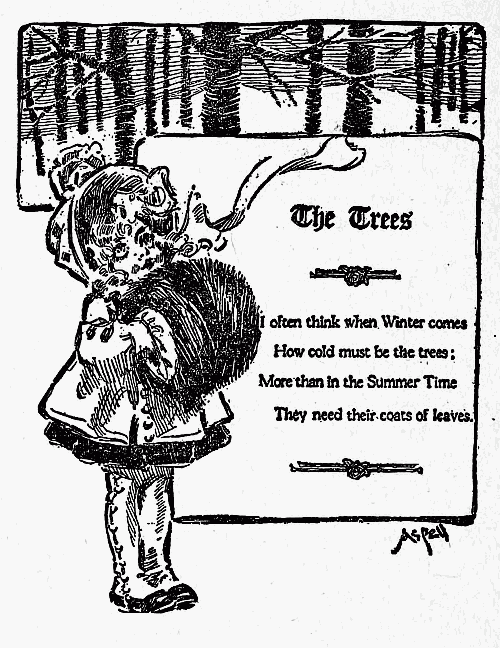
I often think when Winter comes
How cold must be the trees;
More than in the Summer Time
They need their coats of leaves.
THE CANARY
In your golden jail,
On your trapeze balancing
With your yellow tail,
Don't you wish that you could fly
Through the window pane
To the Robin Redbreast gay
Singing in the lane?
Where the apple trees in bloom
Drop their petals white,
So you almost think it has
Snowed 'most all the night?
Would you love to see the nest
Mrs. Robin's made,
And the eggs of china blue
Which she just has laid?
Don't you want to leave your cage?
See, the door is wide
Open and the window, too—
You can fly outside.
THE LAND OF NOWHERE
Jack and Grace were in the nursery playing with their toys, when suddenly they were startled by a tiny voice calling out "Good-by!"
They looked up quickly, and to their surprise their little tin airship was slowly rising from the floor. In another moment it sailed across the room and out of the top of the window, which was down a little to let in fresh air. The little man at the steering wheel waved his hand as the airship disappeared. Jack rushed to the window.
"Grace, Grace!" he shouted, "did you ever hear of such a thing? Come on. I'm going to run outside and see where it goes." Both children hurried down stairs and out on the sidewalk. Sure enough, just over the top of the next house they could distinguish their Christmas present ascending higher and higher into the clear blue sky.
Just then something fluttered at their feet. Jack stooped down and picked up a piece of paper on which was written:
"Sorry I didn't have time to tell you as the airship was under way and I didn't dare make a turn inside the room, but if you both will come up on the roof, I will come back and tell you something lovely."
"Let's!" exclaimed Grace, who had read the note over Jack's shoulder; and in another moment both children were running up to the attic. After some difficulty, they raised the little door in the ceiling and stood upon the roof. Sure enough, just overhead and about to descend was an airship. But, goodness me! it was a regular airship, just like the kind they had seen in pictures, and not the little toy machine which they had but a few minutes before seen sailing out of the window and up over the next house. Nor did the lovely fairy who now alighted from the airship look anything like the queer little painted man. "Hello!" she said, in a very friendly voice: "would you like to take a sail?"
Jack helped Grace in, and before long they were flying above the clouds, which looked like huge snow banks below them, white and fluffy. Everything was blue about them, and the air seemed full of perfume.
"Isn't it lovely, Jack!" exclaimed Grace. "I'm so glad I came!"
"So am I," replied her brother, "but I wonder where we are going. I don't see the earth any more; we must be going somewhere. Where are you taking us, little Fairy Queen?" he called out, and he and Grace waited anxiously for the answer.
"Nowhere!" she answered.
"Don't you know where Nowhere is?"
"Well, not exactly," replied Jack. "I've often heard of it, but I've never been there."
Just then the airship swerved to the right and in a few seconds landed gracefully on the broad steps of a beautiful castle. Everything was blue, even the tall chimney was built of blue bricks. The fairy had hardly turned off the power, and the big airship was still quivering, when the castle door opened, and a beautiful princess, dressed all in blue, came graciously forward. The only thing about her that wasn't blue was her long flowing hair, which was of the most wonderful golden hue that Grace had ever seen. "How do you do?" she said in a sweet voice. "Come in. Have you come from very far away?"
"We don't know, Princess," answered Jack, bowing politely, while Grace made a pretty courtesy; "we really don't know how far we have come, nor just where we are."
"Well, I'll tell you then," answered the lovely blue Princess, taking them each by the hand and walking between them through the open castle door; "at least, I'll tell you where you are and then after that you can tell me where you came from, and then we'll know a little more about each other."
"How beautiful you are," said Grace as they all three sat down on a big blue sofa in the big blue hall of the stately blue castle.
"Am I, dear?" said the Princess, looking at Grace with a smile, "and why do you think so?"
"I never saw such wonderfully beautiful gold hair," exclaimed Grace, admiringly, gradually getting over her bashfulness.
The lovely Blue Princess laughed. "When I was a little girl," she said, taking hold of Jack's hand so as not to leave him out in the cold, "the Sun Man told me if I would comb my hair every morning for a whole year, at break of day, when he first got up, that it would turn gold. And so every morning for a whole year I got up at peep o' day and stood by the east window and combed my hair."
"And it did?" said Jack, speaking for the first time since they had entered the Blue Castle. "Why don't you try it, Grace? You love gold hair so much," and he gave her braid a mischievous pull behind the back of the Blue Princess.
Grace gave a little scream. "Don't, Jack"—and then, to her surprise, she found herself with her arms around her new dolly in the big armchair in their own room at home. She looked over to where Jack was busily engaged with his train of cars. "I must have been dreaming," Grace exclaimed, and as she looked at her golden-haired doll, with the beautiful blue dress, she laughed and said:
"Oh, dolly, I guess it was you I dreamed was the beautiful Blue Princess!"
LITTLE SIR CAT
And it was a pity she didn't have two.
It was crowded so tight from the heel to the toe
The children were packed like sardines in a row.
Well, as Little Sir Cat went on his way to find his fortune in Mother Goose Land, he came in sight of a queer-looking little house, and when he drew nearer he found it wasn't a house at all, but a big shoe, with a little chimney on top and a tiny door in the toe and two small windows above the heel.
"I'd ask you to make us a visit," said the Old Woman, "but, dearie me! I haven't even a spare closet, and rents are so high I've not been able to hire another old shoe."
"Thank you just the same," replied Little Sir Cat, and off he went, and by-and-by, after a while, not so very long, he saw a little bear dressed in a red cap and khaki trousers, but I don't think he wore anything on his feet because his claws were so sharp they made holes in his shoes and his mother wouldn't buy him any more.
"If you want to find your fortune?" said the little bear, "follow me," and he led Little Sir Cat down a narrow path till they came to a cave in a great rock. And, oh my, it looked dark inside, but the little bear wasn't afraid, and by-and-by he found a candle. And when he had lighted it, they went farther into the big dark cave till they came to a little iron door. But before the little bear opened it, he said, "If anybody speaks to you, you mustn't say anything but 'Bumpty bump!'" Then the little bear opened the door and there sat twenty-one little dwarfs at a table filling little bags with gold.
"What are you doing here?" they asked, all in one voice.
"Bumpty bump!" replied the little bear.
"And what are you doing here?" And, oh, dear me! for a moment Little Sir Cat forgot what the little bear had told him. And if he hadn't remembered to say "Bumpty bump!" pretty quick I guess something dreadful might have happened.
Then all the little dwarfs looked frightened to death, and they whispered together and tried to hide the bags of gold under the three-legged stools. But the little bear wouldn't go away, and of course Little Sir Cat did just what the little bear did, for he didn't know what else to do, you know.
Well, after a while the dwarfs asked, "What do you want?" And Little Sir Cat replied, "Bumpty bump!" And then the little dwarfs looked at one another, and, oh, dear me! how they did scowl. But pretty soon one of them filled two small bags with gold and gave them to him.
"Bumpty bump!" said Little Sir Cat with a bow, and then the little bear opened the door and led him back through the big cave till they came out into the sunlight again.
And that's how Little Sir Cat found his fortune.
Transcriber's Notes:
Obvious punctuation errors repaired.
As this book had no page numbers, errata will be listed by story or rhyme instead.
"Chesire" changed to "Cheshire" (his from Cheshire)
The final line of the first stanza was not indented in the original. This was changed to match the form of the rest of the poem.
"litle" changed to "little" (speak the little waif)