
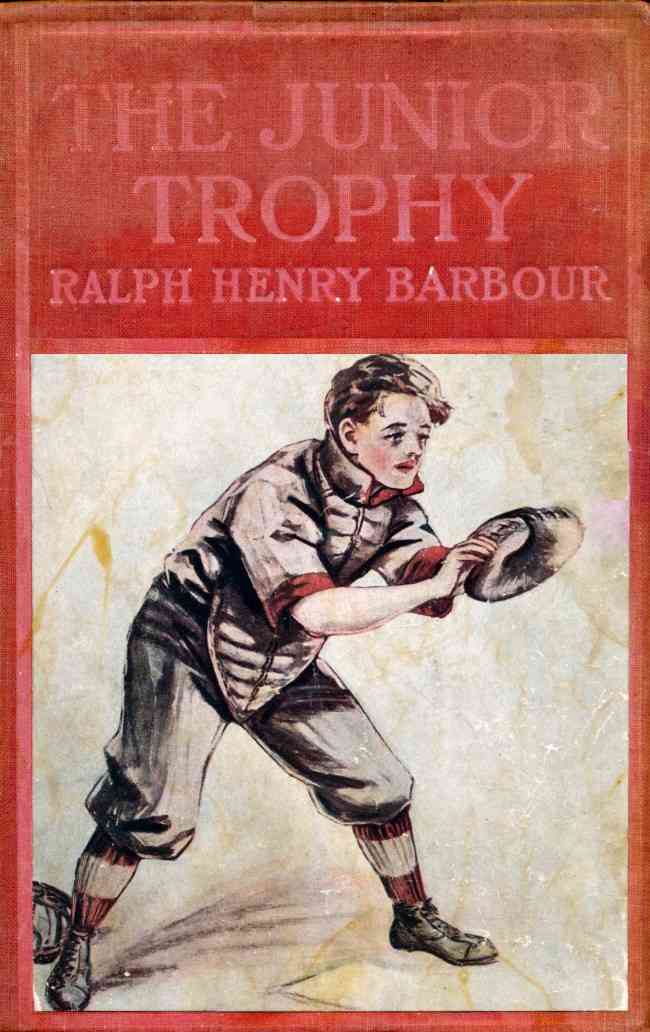
House surely got down to hard work on Monday. Never before perhaps had ten boys labored more heroically to win a game of ball. There was batting practice between morning school and dinner, pitching practice whenever Waters and Perkins could get ten minutes of time, and general work in the afternoon. On Wednesday Ben called in Small and Kid and made up two teams of six each. Neither team had any outfield and when a long hit was made the game stopped while a baseman trotted after the ball. But the plan worked very well in spite of that. Perkins pitched for one team and Waters for the other and the six inning contest gave the fellows a chance to practice base running. As Bert said afterwards, it was worth a lot of money to see Small trying to steal second and being invariably caught between bases. Since the first game the Day Team had been holding practice in the village, a very satisfactory arrangement for them and for their opponents. As may be imagined, studies suffered these days and only the most dire threats from Dr. Merton kept the students to any semblance of labor. House awoke on Friday full of hope. It retired Friday night filled with gloom and apprehension.
Just before morning school was dismissed Mr. Crane announced that Doctor Merton wished to see Holden and Bryant in his office at a quarter past twelve. Uneasy and questioning glances passed from seat to seat, and in the hall the House fellows clustered anxiously around Ben, demanding to know what was up. Ben only shrugged his shoulders and declared that he hadn’t any idea what was wanted of him. But he looked a little worried, nevertheless, and he and Bert made their way down the corridor to the office at the appointed time.
“Boys,” said the Doctor, “what do you know about this?”
“This” was a much-tattered story-paper which the Doctor held to view. Across the top of the first page ran the legend “Hairbreadth Harry, the Gentleman Scout.” Bert looked blank, but Ben flushed. The Doctor viewed them gravely and waited. As there was no reply he addressed Ben.
“Holden,” he asked, “is this your property?”
Ben hesitated for an instant. Then, “No, sir,” he answered.
The Doctor turned to Bert. “It was found in your room this morning, boys. It must belong to one of you. Is it yours, Bryant?”
Bert did some hard thinking in a small fraction of time. Then he nodded without speaking. Ben shot a look of amazement at him and the Doctor, watching narrowly, saw and frowned.
“Hm. You’re quite certain it isn’t yours, Holden?” he asked again. Again Ben hesitated. Finally,
“I—no, sir, it isn’t mine,” he replied.
“I’m glad to hear it,” said the Doctor. “You’re an old boy here and you, at least, should know better than to bring such—such indecent trash into school. There is perhaps a little more excuse for Bryant. He has not been with us very long. However, that is not excuse enough. The rule prohibiting such literature is well known. You knew of it, Bryant?”
“Yes, sir,” answered Bert in a low voice.
“Quite so. Well—” The Doctor hesitated, turning the pages of the obnoxious pamphlet. “As this is your first misdemeanor of any sort since you have been in school, Bryant, I propose to be lenient with you. I want first, however, your promise that as long as you are with us you will not again own or read such stuff as this. Very good. As punishment I will prohibit you from taking part in the baseball game to-morrow. Another time you will not escape so easily. That is all. You may go, boys.”
Once out in the corridor, Ben turned to Bert. “Why did you tell him it was yours?” he demanded in a hoarse whisper.
“Why not?” replied Bert. “He was after one of us. It wouldn’t have made it any different if you’d told him you’d just borrowed it. He’d have punished you just the same, I guess. It doesn’t matter if I don’t play to-morrow, but it would make a heap of difference if you didn’t, Ben. You’re the only fellow we’ve got who can catch a little bit.”
“I know, but—but it isn’t your funeral,” grumbled Ben. “The thing belongs to Kid and Kid ought to be the goat.”
“That wouldn’t do you any good, Ben. You borrowed it. It was in our room, you see. Besides, there’s no use in lugging Kid into it. I don’t mind not playing—much.”
“It’s a shame!” said Ben. “I don’t like it. It’s up to me and I ought to face the music.”
“Yes, and then we lose the game,” replied Bert with a shrug. “That’s a bully idea, isn’t it? You keep quiet and it will be all right. I’m sorry I had to lie about it, but I hated to see Day get that trophy!”
Ben said no more then, but all during dinner Bert noticed that he was unusually quiet and worried looking. Afterward, in the hall before afternoon school, Bert managed to whisper to him:
“Look here, Ben, don’t you go and do anything silly about that, will you? It’s all right. I don’t mind not playing. Besides, maybe you wouldn’t need me anyhow. Just you keep mum, Ben.”
Ben nodded, but the nod didn’t seem to promise much. Still, Bert thought the other looked more cheerful and that doubtless meant that he had abandoned any quixotic notions he might have entertained of assuming the blame.
But if Bert had followed Ben from the classroom after school he would not have felt so easy in his mind, for Ben marched straight to Dr. Merton’s office and waited there until the Doctor came in.
“Ah, Holden!” The Doctor looked a little surprised. “Want to see me, do you?”
“Yes, sir, if you please. It’s about ‘Hairbreadth Harry,’ sir.”
“About—who?” asked the Doctor bewilderedly.
“About that—that dime novel, sir.”
“Oh!” The Doctor frowned. “What about it, Holden?”
“Well, sir, you asked if it was mine and I said it wasn’t. It isn’t mine, but I—I was reading it. It—it was in my possession.”
“So? And whose is it?”
“I’d rather not say, sir, if you please.”
“But Bryant told me it belonged to him. Ah, I see. It belongs to Bryant and you were reading it.”
“No, sir, it isn’t his, Doctor. He—he hadn’t anything to do with it. I had nothing to read one day and somebody had this and I—I borrowed it. I’m sorry.”
“And why do you tell me this, Holden?” asked the Doctor gently.
“It didn’t seem fair, sir, for Bryant to take the blame and the punishment. He said it was his for fear you wouldn’t let me play in to-morrow’s game. You see, there isn’t any one else to hold Waters—”
“To hold water?”
“No, sir, to hold Waters—George Waters; that is, to catch him?”
“Oh, I see. And Bryant was afraid you’d get beaten. Is that it?”
“Yes, sir.”
“And so he told a lie.”
Ben was silent. The Doctor swung about and looked through the open window for a minute. At last, “Well, Holden, I’m sorry about this,” he said, facing the culprit again. “But what was mete for Bryant is none too severe for you. In fact, as you are an older boy, the punishment in your case ought of right to be more severe. But as you have done an honest, manly thing in coming and telling me, my boy, I’ll be as lenient as I may. I’m sorry, but I don’t think I can let you take part to-morrow.”
“Yes, sir,” replied Ben mournfully. “And Bert, sir? You’ll let him off, won’t you? He’s just a kid yet, and——”
“I’m afraid that is not possible, Holden. His lie was, perhaps, told impulsively and with the desire to shield you, but a lie is a lie, Holden, and I cannot condone untruthfulness. Bryant’s sentence must stand. I’m sorry for you both. I realize that it will be a great disappointment to you not to be able to play to-morrow.”
“I can stand it, sir, but it—it means that we get beaten.” And Ben gulped. The Doctor nodded.
“I’m sorry. Was there anything else?”
“No, sir, thank you.”
“Thank you, Holden, for coming and telling me.”
Ten minutes later it was known that the House Team would play to-morrow without its captain, and the gloom hung heavy. Some of the fellows censured Ben for confessing to the Doctor. There had been no call for such a silly course, they declared. Every one agreed that certain defeat stared them in the face. Ben said very little, but what he did say was to the point.
“I can’t play, but I’m still captain. Somebody else will have to catch and I guess it had better be Steve. Kid, you run up and get my mitt. We’re not beaten, yet, so don’t let’s talk like it. Steve, you and George and Sam come down to the net with me. You’ve got to learn the signals.”
The rest of the team, which was to have no work to-day, followed gloomily and stood around while Steve Lovell, with Ben’s big catcher’s mitt on his hand, stood up in front of the net and let Waters and Perkins take turns in slamming the ball in to him, while Ben stood by and explained and coached, sometimes swinging at a ball with the bat to accustom Steve to the work before him. It was almost dark when Ben called a halt and Steve, tired and nervous, pulled the mitt off with a sigh of relief.
“I’ll make a fearful mess of it to-morrow, Ben,” he groaned. “I know I shall!”
“You mustn’t,” answered Ben grimly. “You can’t afford to. If you do as well as you’ve done to-day we’ll get by.”
“Who’s going to play my bag?” asked Steve.
“Sam. Kid goes into right.”
Steve laughed mirthlessly. “Gee, we’re going to be a wonderful aggregation of ball players, we are!” he said as he followed Ben up the path. “I can see Kid when a fly comes his way!”
“It’s the best we can do,” answered Ben. “And it can’t be helped now.”
“Say, Ben,” said Kid in the hall, later, “I’ve been thinking that maybe if I went to the Doc and told him that dime novel was mine he might let up on you and Bert.”
“He wouldn’t, Kid. You keep your mouth shut tight.”
“But he might. And I’d be glad to do it, Ben. He couldn’t do anything to me to hurt the game.”
“He couldn’t, eh? You’re going to play right field to-morrow, Kid.”
“I am? Honest, Ben?” Kid’s eyes grew round with excitement. “You’re not fooling?”
“No, I’m not fooling. You’ll play right field and bat in Perkins’ place. So shut up now and get out.”
House spent the evening discussing what was going to happen to-morrow when their crippled team met Day. But there was a more hopeful tone apparent and the fellows who had condemned Ben in the first flush of disappointment now acknowledged that he had done the square thing.
“It took a lot of pluck to do what Ben did,” declared Steve Lovell, “and I guess if it had been me I’d have flunked it. And, anyhow, whether we win or we lose, we’ve got the whitest fellow in school for captain. Besides, winning games isn’t everything, I guess.”