
OPINIONS OF THE PRESS.
From the Sailor’s Magazine.
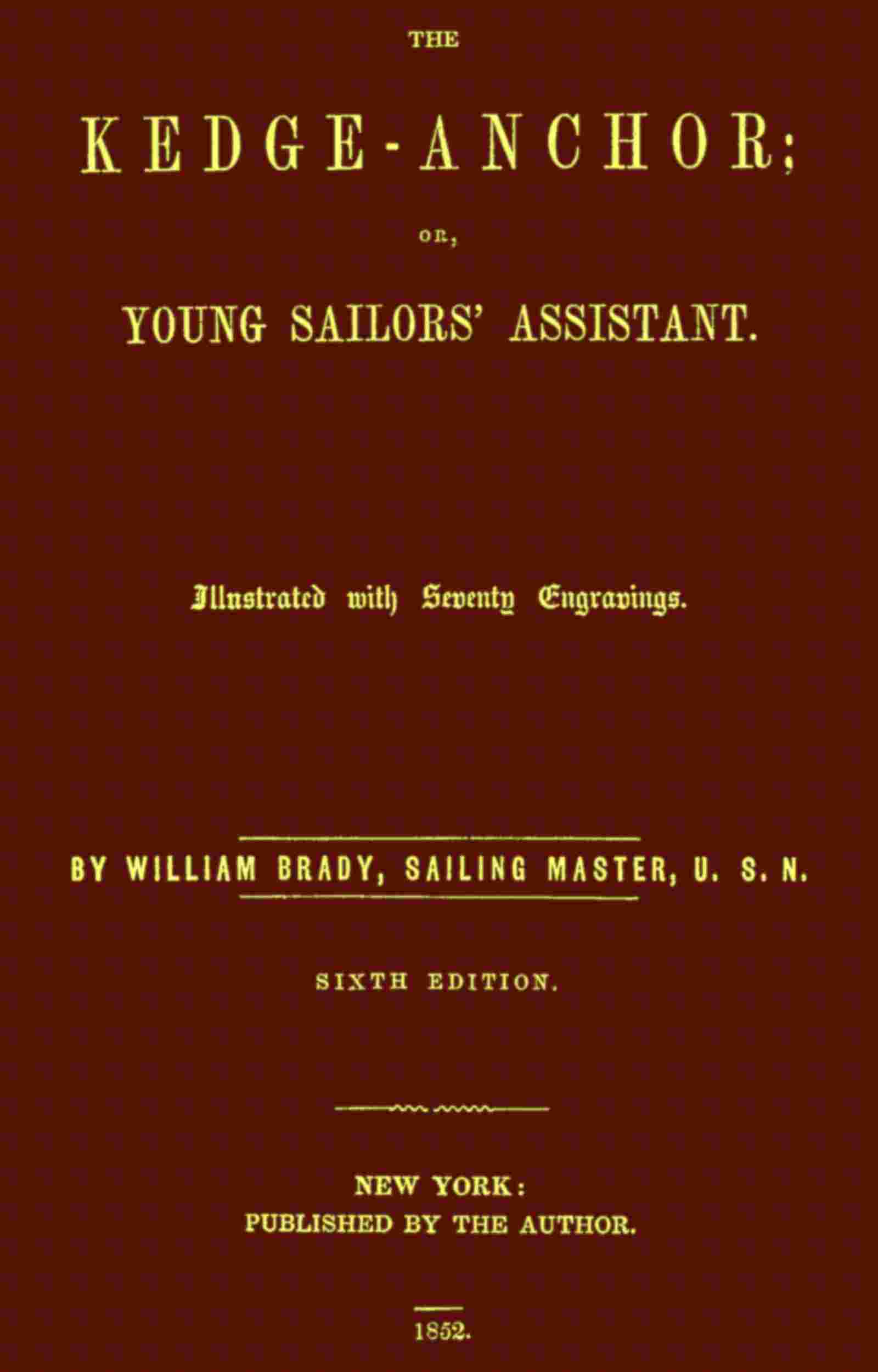
The Kedge Anchor; or, Young Sailor’s Assistant: second edition, improved and enlarged with additional matter, illustrated with seventy engravings, and tables, 8vo., pp. 420. By William Brady, Sailing Master, U. S. Navy; reviewed by a Master Mariner.
This is a work very much needed for the younger members of our profession, being the most complete thing of the kind that has ever been published. There is nothing of the smallest moment in use on board a man-of-war, or merchantman, but it has illustrated in a plate, and its use or uses fully described. With singular faithfulness it details the whole minutiæ of ship’s duty, from the knotting of ropeyarns to splicing heavy cables and fitting standing rigging. It not only embraces all the particulars of the rigging work, but explains with equal clearness the various mechanical operations necessarily combined to fit out a first class ship. Here the novice may acquire a great deal by practising from the various plates and figures, while preparing for a nautical life; besides, from its fullness on those subjects the most interesting to the young sailor, it will be calculated to lead him to study his Manual, and thereby not entirely lose all relish for study, when first embarking in his ocean life, which has hitherto been so common and so disadvantageous to young men. There is no kind of duty on ship-board but is here explained, and I conceive it the most valuable work not only for novices, but for every grade in our profession. There is a great deal of very useful information for all, however experienced they may be. Every kind of spar is described, with its relative proportions and use—the rules for which few men can carry in their minds. And it is quite important to know, in masting and sparring a ship, what are the principles which govern the usage of the day, even if we alter the proportions afterward to suit our own caprice or fancy.
The author has clearly shown himself to be master of his business; he has described fully all the various parts of the ship’s hull and spars—the different pieces of standing and running rigging, with the way to fit the one and how to cut and reeve the other. He teaches how to get the masts and yards on board, aloft, and rigged—he speaks of all with sufficient clearness, and at the same time does not unnecessarily multiply words. After rigging and sparring the ship, he bends the sails, after the most judicious plan in fitting out for sea, or when blown away or split in a storm—and after putting the ship to sea, as it were, he then, in a seamanlike manner, explains all the various evolutions through which a ship may be passed, and supposes almost every extremity to which a ship is liable, giving the modern, and I might add, profitably improved method of doing things: for it is well known, that during the last 30 years there have been very many and equally great improvements in the method of rigging as well as working sea-going ships.
I observe the author explains, in such places as have been deemed necessary, the different methods in use on board heavy-armed ships and merchantmen, which makes the book the more valuable to both classes of the service. Mr. Brady has some capital and useful remarks on the subject of the barometer, some of which I found entirely new to myself, although having used one for the last twenty years. But I conceive that his tables are very valuable even to shipmasters. Instead of lumbering up this book with what in fact belongs to an epitome of navigation, as has been the practice generally hitherto, he has confined himself, strictly speaking, to only those subjects which would naturally occur to one as coming under the head of seamanship—or, in other words, he has compiled literally “a Sailor’s Assistant.” I confidently assert, I have never seen the same amount of really useful and practical information in the same space adapted to our profession before. Here we find enumerated for the various classes of vessels, according to their tonnage, the requisite number of anchors, cables, guns, carriages, shot, &c., with their size, weight, and the comparative strength of the cables and rigging both chain and hemp: also a variety of most useful intelligence, and which must have been elicited only after considerable practical experiment—all of the most interesting as well as useful importance, not only to the novice, but the officer—the master—and I would even confidently add, that there is a great deal of information contained in this work which would make it a valuable acquisition to every ship-owner’s counting-room. There is nothing put on board the various classes of ships, but is described in the book, first to tell how it is made, and how it is rigged—how it is taken on board (if heavy)—its weight, and the amount allowed according to the length of the cruise. Nothing is omitted. I conceive that every ship-owner would find it an acquisition as a counting-house companion, as well as a “Young Sailor’s Assistant.” His recipes, which I find at the termination of the book, are not without their value; and although simple in themselves, yet not generally known.
I cannot close without saying a few words in relation to the very judicious remarks he has made under the head of “good order” (merchant service) and cleanliness. It is undeniable that temperance and cleanliness would add much to the health, comfort, and good order of a crew; but it must be allowed that comparatively little has been done for the sailor—much more must be done before he will be made to realize the terrible effects of intemperance and licentiousness upon both body and soul, for time and eternity. It is cheering to see that spirits have been banished from the list of small stores on board of respectable American ships: and we can but hope that, ere long, through the influence of the efforts that are being made, especially for seamen, among several denominations of Christians in this city—by their building handsome churches on shore and afloat—splendid Homes which are made to them homes indeed when they resort to them—by their donations of books and libraries adapted to their characters and profession—that a few years will see them a different and vastly improved class of men. Already do we begin to see the influence of the leaven that has been cast among them, which leads us to the conviction that there is a better time coming for the sailor; and we cannot but hope and trust that all ranks of Christians will be diligent in prayer to God that “the abundance of the sea may be speedily converted unto him.” Finally, with the author I also think it entirely unnecessary for him to offer any apology in sending this work abroad to the public. If I may be allowed to offer an opinion on the merits of the composition or its style, I must say I have come to the conclusion, in the absence of any other guide but this book, being an utter stranger to the author, that he is—he must be—a seaman—a scholar—and a gentleman. I observe he professes, as his motto, “Hope for his anchor, and Heaven for his guide,” and I fervently pray that neither the one nor the other may ever fail him.
From the Literary World.
The Kedge Anchor; or, Young Sailor’s Assistant. By Wm. Brady, Sailing Master, U. S. N. Published by the Author.
Nowadays, when all science, arts, and callings are delineated in books, and the pen is wielded by members of every profession, it is no marvel that an excellently planned work, upon all things pertaining to seamanship, should be presented to the public by a gentleman of the marline-spike. And albeit the author tells us that that instrument is to him more familiar than the pen, he has, nevertheless, shown himself quite expert with the latter.
“The Kedge Anchor” (a happy title, at least to Jack) has already run through one edition, which, for a purely practical work, is the best evidence of its merits. The present edition is, in many respects, an improvement upon the former, containing additional matter, plates and tables. To a sailor this work is invaluable; indeed, it is by far the best of the sort we ever remember to have seen. Generally, works of this description are loosely and carelessly put together; to use a nautical phrase, they are by no means “ship-shape and Bristol fashion,” and, in many cases, are mere servile copies, or abridgments of obsolete books on the same subject. The sailor-poet’s (Falconer) Marine Dictionary, published many years ago, has been the source from which most of them have been compiled. But in seamanship, as in everything else, great improvements and changes have, from time to time, been effected, and Mr. Brady’s volume contains them all. We cordially commend his book to all the purchasers of Bowditch’s Navigation; and we will furthermore guaranty that he who masters both, will be fully qualified to conduct a vessel round the globe with unerring certainty—enter a harbor as unexceptionably and gracefully as ever Brummel did a drawing-room, and cockbill his yards at a symmetrical angle.
Not only to seamen, but to many landsmen, the “Kedge Anchor” cannot fail to be an acceptable volume. Its copious dictionary of sea terms, its excellent illustrations of nautical manœuvres and the information imparted upon all things pertaining to the construction, rig, and appointment of the ships in our navy, make the book truly valuable. From the “gammoning” of a bowsprit, and the staying of a royal-mast, to the taking of a “bowline-in-the-bight,” the student in tar will find all the information he can desire.
The book is well got up, contains numerous well-executed cuts, and is alike creditable to author and publisher. We specially commend it to the members of the Yacht Club, as a vade mecum for blue water.
From the New York Journal of Commerce.
The Kedge Anchor; or, Young Sailor’s Assistant. By William Brady, S. M., U. S. N.
This work, as its title imports, is designed as an assistant for the young Sailor, through the various branches of his arduous profession. It contains useful instructions in every department of seamanship, with ample directions, which will impart to the young officer a great deal of valuable information in the duties of his profession, and enable him to act in the most judicious manner in many trying emergencies.
In addition to many suggestions, which will prove valuable to every grade of seamen, it contains more thorough descriptions of the innumerable articles belonging to the various classes of vessels, than any other work ever published in this country; and is embellished with over seventy engravings, in illustration of the subjects treated of in its pages. The work is furnished with over one hundred pages of tables, which are valuable not only to the sea-faring man, but to all who are in any way interested in maritime pursuits. The entire work is contained in a volume of 420 pages, octavo, stereotype edition. It is printed on fine paper, and bound in handsome style. For sale by R. L. Shaw, No. 222 Water street, N. Y.
From the True Sun.
The Kedge Anchor; or, Young Sailor’s Assistant.
We have had for several days lying on our table a massive octavo volume of some 420 pages, of which we have given the title. The author of it is William Brady, S. M., U. S. N., and it is on sale at the Sailor’s Home, and by most of the nautical stationers. The whole science of seamanship appears to be included in this fine volume, from the coiling of a rope to the dissection of a man-of-war and every nautical appendage thereof. No jot or tittle of a seaman’s duty appears to have been overlooked; everything is explained, and the most intricate things illustrated by engravings. The entire typographical execution and material of the volume are excellent; we do not find the price attached to it; but to the seaman—to the young seaman particularly—it must be invaluable.
From the New York Courier & Enquirer.
The Kedge Anchor; or, Young Sailor’s Assistant, &c., &c., illustrated with seventy engravings. By Wm. Brady, S. M., U. S. N. 2d edition, enlarged and improved. New York.
This is a handsome and no doubt a useful handbook for the young sailor or officer, explaining as it does, and illustrating by handsome cuts the various manipulations of the Sailor’s craft.
The instruction comprehends the whole of the duties of the sailor, as well as regards the practical evolutions of the vessel, as the various details connected with rigging the vessel.
The volume has already gone through one edition, which is presumptive evidence of its merits—and we dare say there will be ample demand for this second edition.
From the Long Island Star.
The Kedge Anchor; or, Young Sailor’s Assistant.
We have just received the second edition of a very neat work, entitled “The Kedge Anchor,” improved and enlarged, with additional matter, plates, and tables, by Mr. William Brady, and dedicated to the United States Navy and Merchant Service.
It is very neatly bound and good print, and is intended to instruct “Young Seamen” in rigging, knotting, splicing, blocks, purchases, and other miscellaneous matter applicable to vessels and ships of war. It is illustrated with seventy engravings, also a great number of Tables useful to seamen. It is also printed on beautiful paper, and it instructs you to build vessels of war.
Published at New York by Mr. Wm. Brady, and sold at R. L. Shaw’s Nautical Store, 222 Water street, N. Y.
It is octavo size, 420 pages, and handsomely illustrated with fine wood-cuts, representing many of the most beautifully modeled vessels in the U. S. Navy. It is a work of much labor and expense, and should be in the possession of every seaman, more especially those of the Navy. A copy of the work may be seen at this office.
From the New York Sunday Dispatch.
The Kedge Anchor; or, Young Sailor’s Assistant.
The extraordinary demand for the above meritorious work has, in a very short time, exhausted the first edition.
The author, William Brady, a sailing master in the United States Navy, has published a second edition, with additional tables and somewhat improved in typographical beauty. It is useless for us to speak of its merits as a text-book for the young officer. It is most emphatically a work of great merit, and one which will commend itself to all classes whose “march is o’er the mountain wave.” The remarks it contains on that invaluable instrument the Barometer, are correct, and will do much to destroy the unfounded prejudice which some have against it.
The volume contains a great number of plates, neatly executed, which serve to illustrate with precision a variety of nautical evolutions. The precautions for scudding are worthy of attention. It is a well-known fact among sailors that many a good ship has been boarded by a sea, while scudding under short sail, when the disaster might easily have been avoided by showing more canvas. The work contains all the tables necessary for sparring and rigging a ship, and that in so plain and practical a manner that we cannot see how it is possible for any one to make a mistake; on the whole, we are inclined to think, that, though the author modestly calls it a Kedge Anchor, there is many an old salt who will look upon it as his best bower.
From the New York Express.
The Kedge Anchor. By William Brady, U. S. N.
This is the title of a very handsome volume, professing to give thorough descriptions of the almost innumerable equipments belonging to the various classes of vessels. We are not “old salt” enough to speak as to the accuracy of its teachings, but it seems to be very complete and intelligible; and is illustrated with drawings of more ways of doing things than any but a sailor would ever dream of.
From the New York Tribune.
The Kedge Anchor; or, Young Sailor’s Assistant. By William Brady, S. M., U. S. N. New York: R. L. Shaw, 222 Water st., 1 vol. 8vo., pp. 420, with numerous engravings.
This work, as its title imports, is designed as an assistant for the young Sailor through the various branches of his arduous profession. It contains useful instructions in every department of seamanship, with ample directions, which will impart to the young officer a great deal of valuable information in the duties of his profession, and enable him to act in the most judicious manner in many trying emergencies.
In addition to many suggestions, which will prove valuable to every grade of seamen, it contains more thorough descriptions of the innumerable articles belonging to the various classes of vessels than any other work ever published in this country; and is embellished with over seventy engravings in illustration of the subjects treated of in its pages. The work is furnished with over one hundred pages of tables, which are valuable not only to the seafaring man but to all who are in any way interested in maritime pursuits. The entire work is contained in a volume of 420 pages, octavo stereotype edition. It is printed on fine paper and bound in handsome style.
From the Brooklyn Daily Advertiser.
The Kedge Anchor; or, Young Sailor’s Assistant—is the title of a work just published by William Brady, Sailing Master in the U. S. Navy. Mr. Brady is a thorough seaman and eminently qualified to the task he has here undertaken. Every information is given appertaining to the practical evolutions of modern seamanship—rigging, knotting, splicing, blocks, purchases, running rigging, and other miscellaneous matters, applicable to ships of war and others. Illustrated with several engravings. Also tables of rigging, spars, sails, blocks, canvas, cordage, chain and hemp-cables, hawsers, &c., relative to every class of vessels. To those who are about to become sailors, the Kedge Anchor is invaluable; and those who have followed the sea, no matter how long, may derive information therefrom. It should be on board every vessel and in every library, as much may be found to interest even the landsman. The work meets the approval of the most able commanders in the merchant and naval service. The author is now attached to the Brooklyn Navy Yard, holding the appointment of Sailing Master, and is known as one of the best practiced seamen in the navy.
From the New York Sun.
The Kedge Anchor; or, Young Sailor’s Assistant, by Wm. Brady, of the U. S. Navy, is the most unique and useful book for young seamen we have any knowledge of. Published by the author.
From the New York Herald.
The Kedge Anchor; or, Young Sailor’s Assistant. By Wm. Brady, S. M., U. S. N., second edition. R. L. Shaw, 222 Water street. This is decidedly the best work for the maritime community, and the best adapted to convey perfect instruction to all who desire to learn the profession of seamanship, that we have ever seen. It has reached a second edition, and deserves to reach twenty, as it no doubt will. We shall have more to say respecting this valuable work; and in the mean time it should find a place in every library and on board every ship.
Transcriber’s Notes
Depending on the hard- and software used to read this text and on their settings, not all elements may display as intended. In particular, the (larger) tables towards the end of this text may require horizontal and vertical scrolling or be illegible on small screens or in small windows. Several tables might be considered continuations of the foregoing table(s). Due to the order in which they were printed and differences in lay-out they have been included here as separate tables.
Page numbers 211 and 212 are not used in the source document, the pagination jumps directly from 210 to 213.
Except as mentioned under Changes below, the text in this e-text is that of the source document, including archaic, obsolete, unusual and inconsistent spelling (also of proper names), hyphenation and grammar. Repeated illustrations (including those that appear to be ornamental only) and text have not been deleted. Differences in wording between the Table of Contents and the section titles have not been standardised.
Table data and calculations have not been checked or corrected, except as listed below. Several tables towards the end of the book that were printed on separate pages in the source document have been recombined when their contents and lay-out suggested they were intended to be read as single tables. Many of the tables give no units for lengths etc.
The author often uses full stops between feet and inches (so 2 feet 10 inches may be written 2.10), and between tons, hundredweights, quarters and pounds (as in 1.13.1.24), etc. which may resemble but are not decimal points.
References to tables: unless the context or the reference itself make it clear which of the tables is intended, reference is assumed to be made to the part of the book containing all of the tables in general.
Page 31, ... which has been described before on another page: it is unclear to which other page this refers.
Page 53, footnote [3]: this footnote also refers to the very section where it is included.
Plate following Page 102: the Sail room is not included in the captions to the right of the illustration; the caption may be found next to item 10 in the drawing.
Page 148, 28, 4.17 seconds: as printed in the source document, including the comma and period, the spacing and the values.
Page 281, (See Pudding.): there is no such entry in the word list, but the subject is discussed in several places in the body text.
Page 293, Table 499: the value 2¹⁄₄ in column Size is possibly an error for 2¹⁄₂.
Page 314. Columns Frigates and Smaller of sub-category Receiving Vessels: it is not clear from the source document which ranks are included in the phrase By special order.
Page 318, Table 517, row Mizen Royal Yard, values 11 (in this context: .11 inch) in columns Masthead: possibly error for 1 1 (in this context: 1 foot 1 inch) (2×).
Page 344: the two entries here included as ??? were illegible in the source document.
Page 384: Table 525, row Size of Spar-deck Beam: 10 is possibly an error for 1.0.
Changes made:
Multi-page tables from the original have been re-combined into single tables; in those cases repeated table and column headers have been deleted, as have connecting elements like Brought and Carried forward. Ditto marks and do. in some tables have been replaced with the dittoed text.
Plates and illustrations have been moved outside text paragraphs. Footnotes were moved to underneath the sections or tables to which they belong. Some plates and individual illustrations have been rotated.
Obviously missing or erroneous punctuation was added or otherwise corrected silently. Obvious minor misprints and typographical errors have been corrected silently as well.
Text in dotted boxes has been copied from the illustration for easier legibility.
Page 21: Part heading PART I. inserted cf. Table of Contents.
Plate following Page 24: transcription of caption A Back-wall Hitch changed to A Black-wall Hitch.
Page 29: ... as you see in Plate No. 3. changed to ... as you see in Plate No. 2.
Pages 31 and 33: See Plate No. 4 changed to See Plate No. 3.
Page 40 : (HOGSHEAD SLINGS) Is a piece of rope about ... changed to Are pieces of rope about ....
Page 54: The formost leg is once and a-half ... changed to The foremost leg is once and a-half ... as elsewhere.
Page 56: ... the men on the trestle-tress ... changed to ... the men on the trestle-trees ....
Page 77: ... strapped in toa bolt ... changed to ... strapped into a bolt ....
Page 78: When the half spiritsail yard ... changed to When the half spritsail yard ....
Page 90, illustration: some white space deleted between the two blocks.
Page 127: ... and the all hooks should be well moused. changed to ... and all the hooks should be well moused.
Page 162: ... as she comes too; ... changed to ... as she comes to; ....
Page 169: ... take the end of a rope from the forcastle ... changed to ... take the end of a rope from the forecastle ....
Page 183: ... heave the ship too; ... changed to ... heave the ship to; ....
Page 193, Footnote 3: See wrecked in a gale. changed to See Wrecked in a Gale.
Page 199: ... ready hooked to there respective lanyards. changed to ... ready hooked to their respective lanyards.
Page 220: ... when they have there proper masts ... changed to ... when they have their proper masts ....
Caption with illustration following Page 224: A Sloop-of-War hove too ... changed to A Sloop-of-War hove to ....
Page 255: the Representation of a Temporary Rudder has been moved to Section 477.
Page 294-297 (tables 498, 499, 500 and 501): column Mean changed from a separate column to a third sub-column of the column Breaking strain in tons.
Page 309, third table (The Fore-mast from top of deck ...): the final two columns have been laid out as similar columns on this page, i.e. as a single column with a separating full stop between feet and inches.
Page 314: 510.--A Table showing the Complement of Officers ... changed to 516.--A Table showing the Complement of Officers ....
Page 323: 310 feet changed to 710 feet (giving 118 fathom 2 feet).
Page 326: 513.--A Table showing the Complement ... changed to 519.--A Table showing the Complement ....