
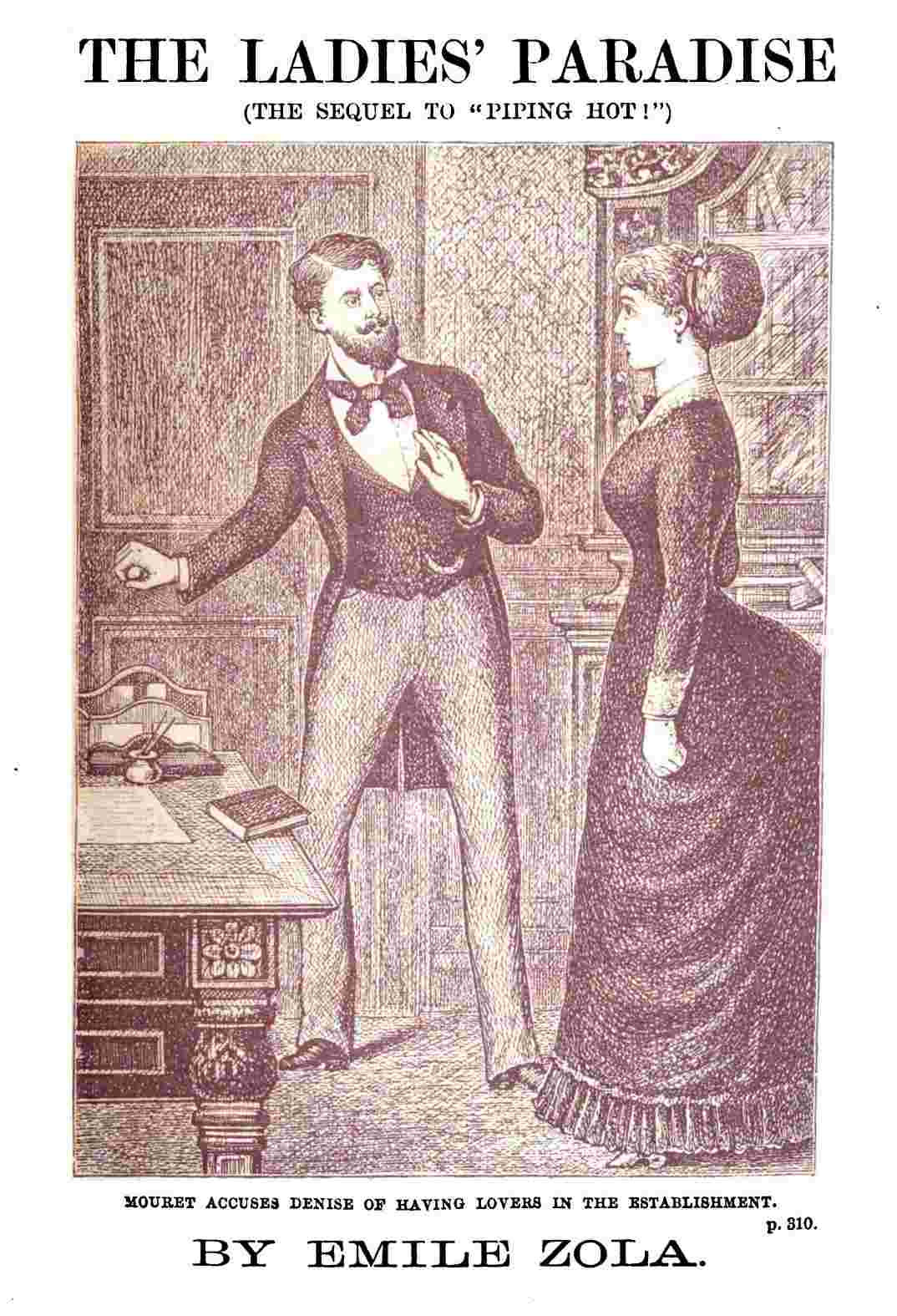
Mouret had the strength to smile. The baron was looking at him, so touched by his graceful command over himself that he changed the conversation, returning to the fêtes to be given to the King of Prussia, saying they would be superb, the whole trade of Paris would profit by them. Henriette remained silent and thoughtful, divided between the desire to forget Denise in the ante-room, and the fear that Mouret, now aware of her presence, might go away. At last she quitted her chair.
“You will allow me?”
“Certainly, my dear,” replied Madame Marty. “I'll do the honours of the house for you.”
She got up, took the teapot, and filled the cups. Henriette turned towards Baron Hartmann, saying: “You'll stay a few minutes, won't you?”
“Yes; I want to speak to Monsieur Mouret. We are going to invade your little drawing-room.”
She went out, and her black silk dress, rustling against the door, produced a noise like that of a snake wriggling through the brushwood. The baron at once manoeuvred to carry Mouret off, leaving the ladies to Bouthemont and De Vallagnosc. Then they stood talking before the window of the other room in a low tone. It was quite a fresh affair. For a long time Mouret had cherished a desire to realise his former project, the invasion of the whole block by The Ladies' Paradise, from the Rue Monsigny to the Rue de la Michodière and from the Rue Neuve-Saint-Augustin to the Rue du Dix-Décembre. There was still a vast piece of ground, in the latter street, remaining to be acquired, and that sufficed to spoil his triumph, he was tortured with the desire to complete his conquest, to erect there a sort of apotheosis, a monumental façade. As long as his principal entrance should remain in the Rue Neuve-Saint-Augustin, in a dark street of old Paris, his work would be incomplete, wanting in logic. He wished to set it up before new Paris, in one of these modern avenues through which passed the busy crowd of the latter part of the nineteenth century. He saw it dominating, imposing itself as the giant palace of commerce, casting a greater shadow over the city than the old Louvre itself. But up to the present he had been baulked by the obstinacy of die Crédit Immobilier, which still held to its first idea of building a rival to the Grand Hôtel on this land. The plans were ready, they were only waiting for the clearing of the Rue du Dix-Décembre to commence the work. At last, by a supreme effort, Mouret had almost convinced Baron Hartmann.
“Well!” commenced the latter, “we had a board-meeting yesterday, and I came to-day, thinking I should meet you, and being desirous of keeping you informed. They still resist.” The young man gave way to a nervous gesture. “But it's ridiculous. What do they say?”
“Dear me! they say what I have said to you myself, and what I am still inclined to think. Your façade is only an ornament, the new buildings would only extend by about a tenth the surface of your establishment, and it would be throwing away immense sums on a mere advertisement.”
At this Mouret burst out “An advertisement! an advertisement! In any case this will be in stone and outlive all of us. Just consider that it would increase our business tenfold! We should see our money back in two years. What matters about what you call the wasted ground, if this ground returns you an enormous interest! You will see the crowd, when our customers are no longer obliged to struggle through the Rue Neuve-Saint-Augustin, but can freely pass down a thoroughfare large enough for six carriages abreast.”
“No doubt,” replied the baron, laughing. “But you are a poet in your way, let me tell you once more. These gentlemen think it would be dangerous to further extend your business.' They want to be prudent for you.”
“What do they mean? Prudent! I don't understand. Don't the figures show the constant progression of our business? At first, with a capital of five hundred thousand francs, I did business to the extent of two millions, turning the capital over four times. It then became four million francs, which, turned over ten times, has produced business to the extent of forty millions. In short, after successive increases, I have just learnt, from the last stock-taking, that the amount of business done now amounts to a total of eighty millions; thus the capital, only slightly increased—for it does not exceed six millions—has passed over our counters in the form of more than twelve times.”
He raised his voice, tapping the fingers of his right hand on the palm of his left hand, knocking down these millions as he would have cracked a few nuts. The baron interrupted him.
“I know, I know. But you don't hope to keep on increasing in this way, do you?”
“Why not?” asked Mouret, ingenuously. “There's no reason why it should stop. The capital can be turned over as often as fifteen times. I predicted as much long ago. In certain departments it can be turned over twenty-five or thirty times. And after? well! after, we'll find a means of turning it over more than that.”
“So you'll finish by drinking up all the money in Paris, as you'd drink a glass of water?”
“Most decidedly. Doesn't Paris belong to the women, and don't the women belong to us?”
The baron laid his hands on Mouret's shoulders, looking at him with a paternal air. “Listen, you're a fine fellow, and I am really fond of you. There's no resisting you. We'll go into the matter seriously, and I hope to make them listen to reason. Up to the present, we are perfectly satisfied with you. Your dividends astonish the Bourse. You must be right; it will be better to put more money into your business, than to risk this competition with the Grand Hôtel, which is hazardous.”
Mouret's excitement subsided at once; he thanked the baron, but without any of his usual enthusiasm; and the latter saw him turn his eyes towards the door of the next room, again seized with the secret anxiety which he was concealing. However, De Vallagnosc had come up, understanding that they had finished talking business. He stood close to them, listening to the baron, who was murmuring with the gallant air of an old man who had seen life:
“I say, I fancy they're taking their revenge.”
“Who?” asked Mouret, embarrassed.
“Why, the women. They're getting tired of belonging to you; you now belong to them, my dear fellow; it's only just!” He joked him, well aware of the young man's notorious love affairs: the mansion bought for the actress, the enormous sums squandered with girls picked up in private supper rooms, amused him as an excuse for the follies he had formerly committed himself. His old experience rejoiced.
“Really, I don't understand,” repeated Mouret.
“Oh! you understand well enough. They always get the last word. In fact, I said to myself: It isn't possible, he's boasting he can't be so strong as that! And there you are! Bleed the women, work them as you would a coal mine, and what for? In order that they may work you afterwards, and force you to refund at last! Take care, for they'll draw more blood and money from you than you have ever sucked from them.”
He laughed louder still; and De Vallagnosc was also grinning, without, however, saying a word.
“Dear me! one must have a taste of everything,” confessed Mouret, at last, pretending to laugh as well. “Money is so stupid, if it isn't spent.”
“As for that, I agree with you,” resumed the baron. “Enjoy yourself, my dear fellow, I'll not be the one to preach to you, nor to tremble for the great interests we have confided to your care. Every one must sow his wild oats, and his head is generally clearer afterwards. Besides, there's nothing unpleasant in ruining one's self when one feels capable of building up another fortune. But if money is nothing, there are certain sufferings——”
He stopped, his smile became sad, former sufferings presented themselves amid the irony of his scepticism. He had watched the duel between Henriette and Mouret with the curiosity of one who still felt greatly interested in other people's love battles; and he felt that the crisis had arrived, he guessed the drama, well acquainted with the story of this Denise, whom he had seen in the ante-room.
“Oh! as for suffering, that's not in my line,” said Mouret, in a tone of bravado. “It's quite enough to pay.”
The baron looked at him for a moment without speaking. Without wishing to insist on his discreet allusion he added, slowly—“Don't make yourself worse than you are! You'll lose something else besides your money at that game. Yes, you'll lose a part of yourself, my dear fellow.” He stopped, again laughing, to ask, “That often happens, doesn't it, Monsieur de Vallagnosc?”
“So they say, baron,” the young man simply replied.
Just at this moment the door was opened. Mouret, who was going to reply, slightly started. The three men turned round. It was Madame Desforges, looking very gay, putting her head through the doorway to call, in a hurried voice—
“Monsieur Mouret! Monsieur Mouret!” Then, when she perceived the three men, she added, “Oh! you'll excuse me, won't you, gentlemen? I'm going to take Monsieur Mouret away for a minute. The least he can do, as he has sold me a frightful mantle, is to give me the benefit of his experience. This girl is a stupid, without the least idea. Come, come! I'm waiting for you.”
He hesitated, undecided, flinching before the scene he could foresee. But he had to obey. The baron said to him, with his air at once paternal and mocking, “Go, my dear fellow, go, madame wants you.”
Mouret followed her. The door closed, and he thought he could hear De Vallagnosc's grin stifled by the hangings. His courage was entirely exhausted. Since Henriette had quitted the drawing-room, and he knew Denise was alone in the house in jealous hands, he had experienced a growing anxiety, a nervous torment, which made him listen from time to time as if suddenly startled by a distant sound of weeping. What could this woman invent to torture her? And his whole love, this love which surprised him even now, went out to the young girl like a support and a consolation. Never had he loved her so strongly, with that charm so powerful in suffering. His former affections, his love for Henriette herself—so delicate, so handsome, the possession of whom was so flattering to his pride—had never been more than agreeable pastimes, frequently a calculation, in which he sought nothing but a profitable pleasure. He used quietly to leave his mistresses and go home to bed, happy in his bachelor liberty, without a regret or a care on his mind; whilst now his heart beat with anguish, his life was taken, he no longer enjoyed the forgetfulness of sleep in his great, solitary bed. Denise was his only thought. Even at this moment she was the sole object of his anxiety, and he was telling himself that he preferred to be there to protect her, notwithstanding his fear of some regrettable scene with the other one.
At first, they both crossed the bed-room, silent and empty. Then Madame Desforges, pushing open a door, entered the dressing-room, followed by Mouret. It was a rather large room, hung with red silk, furnished with a marble toilet table and a large wardrobe with three compartments and great glass doors. As the window looked into the yard, it was already rather dark, and the two nickel-plated gas burners on either side of the wardrobe had been lighted.
“Now, let's see,” said Henriette, “perhaps we shall get on better. This girl is a stupid, without the least idea. Come, come! I'm waiting for you.”
On entering, Mouret had found Denise standing upright, in the middle of the bright light. She was very pale, dressed in a cashmere jacket, and a black hat.
He hesitated, undecided, flinching before the scene he could foresee. But he had to obey. The baron said to him, with his air at once paternal and mocking, “Go, my dear fellow, go, madame wants you.”
Mouret followed her. The door closed, and he thought he could hear De Vallagnosc's grin stifled by the hangings. His courage was entirely exhausted. Since Henriette had quitted the drawing-room, and he knew Denise was alone in the house in jealous hands, he had experienced a growing anxiety, a nervous torment, which made him listen from time to time as if suddenly startled by a distant sound of weeping. What could this woman invent to torture her? And his whole love, this love which surprised him even now, went out to the young girl like a support and a consolation. Never had he loved her so strongly, with that charm so powerful in suffering. His former affections, his love for Henriette herself—so delicate, so handsome, the possession of whom was so flattering to his pride—had never been more than agreeable pastimes, frequently a calculation, in which he sought nothing but a profitable pleasure. He used quietly to leave his mistresses and go home to bed, happy in his bachelor liberty, without a regret or a care on his mind; whilst now his heart beat with anguish, his life was taken, he no longer enjoyed the forgetfulness of sleep in his great, solitary bed. Denise was his only thought. Even at this moment she was the sole object of his anxiety, and he was telling himself that he preferred to be there to protect her, notwithstanding his fear of some regrettable scene with the other one.
At first, they both crossed the bed-room, silent and empty. Then Madame Desforges, pushing open a door, entered the dressing-room, followed by Mouret. It was a rather large room, hung with red silk, furnished with a marble toilet table and a large wardrobe with three compartments and great glass doors. As the window looked into the yard, it was already rather dark, and the two nickel-plated gas burners on either side of the wardrobe had been lighted.
“Now, let's see,” said Henriette, “perhaps we shall get on better.”
On entering Mouret had found Denise standing upright, in the middle of a bright light. She was very pale, modestly dressed in a cashmere jacket with a black hat, and was holding on one arm the mantle bought at The Ladies Paradise. When she saw the young man her hands slightly trembled.
“I wish Monsieur Mouret to judge,” resumed Henriette. “Just help me, mademoiselle.”
And Denise, approaching, had to give her the mantle. She had already placed some pins on the shoulders, the part that did not fit. Henriette turned round to look at herself in the glass.
“Is it possible? Speak frankly.”
“It really is a failure, madame,” said Mouret, to cut the matter short. “It's very simple; the young lady will take your measure, and we will make you another.”
“No, I want this one, I want it immediately,” resumed she, with vivacity. “But it's too narrow across the chest, and it forms a ruck at the back between the shoulders.” Then, in her sharpest voice, she added: “It's no use you standing looking at me, mademoiselle, that won't make it any better! Try and find a remedy. It's your business.”
Denise again commenced to place the pins, without saying a word. That went on for some time: she had to pass from one shoulder to the other, and was even obliged to go almost on her knees, to pull the mantle down in front. Above her placing herself entirely in Denise's hands, Madame Desforges gave her face the harsh expression of a mistress exceedingly difficult to please. Delighted to lower the young girl to this servant's work, she gave her sharp and brief orders, watching for the least sign of suffering on Mouret's face.
“Put a pin here! No! not there, here, near the sleeve. You don't seem to understand! That isn't it, there's the ruck showing again. Take care, you're pricking me now!”
Twice had Mouret vainly attempted to interfere, to put an end to this scene. His heart was beating violently from this humiliation of his love; and he loved Denise more than ever, with a deep tenderness, in the presence of her admirably silent and patient attitude. If the young girl's hands still trembled somewhat, at being treated in this way before his face, she accepted the necessities of her position with the proud resignation of a courageous girl. When Madame Desforges found they were not likely to betray themselves, she tried another way, she commenced to smile on Mouret, treating him openly as her lover. The pins having run short, she said to him:
“Look, my dear, in the ivory box on the dressing-table. Really! it's empty? Kindly see on the chimney-piece in the bed-room; you know, at the corner of the looking-glass.”
She spoke as if he were quite at home, in the habit of sleeping there, and knew where to find everything, even the brushes and combs. When he brought back a few pins, she took them one by one, and forced him to stay near her, looking at him and speaking low.
“I don't fancy I'm hump-backed. Give me your hand, feel my shoulders, just to please me. Am I really made like that?”
Denise slowly raised her eyes, paler than ever, and set about placing the pins in silence. Mouret could only see her blonde tresses, twisted at the back of her delicate neck; but by the slight shudder which was raising them, he thought he could perceive the uneasiness and shame of her face. Now, she would certainly repulse him, and send him back to this woman, who did not conceal her connection even before strangers. Brutal thoughts came into his head, he could have struck Henriette. How was he to stop her talk? How should he tell Denise that he adored her, that she alone existed for him at this moment, and that he was ready to sacrifice for her all his former affections? The worst of women would not have indulged in the equivocal familiarities of this well-born lady. He took his hand away, and drew back, saying:
“You are wrong to go so far, madame, since I myself consider the garment to be a failure.”
One of the gas-burners was hissing, and in the stuffy, moist air of the room, nothing else was heard but this ardent breath. The looking-glasses threw large sheets of light on the red silk hangings, on which were dancing the shadows of the two women. A bottle of verbena, of which the cork had been left out, spread a vague odour, something like that of a fading bouquet.
“There, madame, I can do no more,” said Denise, at last, rising up.
She felt thoroughly worn out. Twice she had run the pins in her fingers, as if blinded, her eyes in a mist. Was he in the plot? Had he sent for her, to avenge himself for her refusal, by showing that other women loved him? And this thought chilled her; she never remembered to have stood in need of so much courage, not even during the terrible hours of her life when she wanted for bread. It was comparatively nothing to be humiliated, but to see him almost in the arms of another woman, as if she had not been there! Henriette looked at herself in the glass, and once more broke out into harsh words.
“But it's absurd, mademoiselle. It fits worse than ever. Just look how tight it is across the chest I look like a wet nurse.”
Denise, losing all patience, made a rather unfortunate remark. “You are slightly stout, madame. We cannot make you thinner than you are.”
“Stout! stout!” exclaimed Henriette, who now turned pale in her turn. “You're becoming insolent, mademoiselle. Really, I should advise you to criticise others!”
They both stood looking at each other, face to face, trembling. There was now neither lady or shop-girl. They were simply two women, made equal by their rivalry. The one had violently taken off the mantle and cast it on a chair, whilst the other was throwing on the dressing-table the few pins she had in her hands.
“What astonishes me,” resumed Henriette, “is that Monsieur Mouret should tolerate such insolence. I thought, sir, that you were more particular about your employees.”
Denise had again assumed her brave, calm manner. She gently replied: “If Monsieur Mouret keeps me, it's because he has no fault to find. I am ready to apologise to you, if he wishes it.”
Mouret was listening, excited by this quarrel, unable to find a word to put a stop to it. He had a great horror of these explanations between women, their asperity wounding his sense of elegance and gracefulness. Henriette wished to force him to say something in condemnation of the young girl; and, as he remained mute, still undecided, she stung him with a final insult:
“Very good, sir. It seems that I must suffer the insolence of your mistresses in my own house even! A girl you've picked up out of the gutter!”
Two big tears gushed from Denise's eyes. She had kept them back for some time, but her whole being succumbed beneath this last insult. When he saw her weeping like that, without the slightest attempt at retaliation, with a silent, despairing dignity, Mouret no longer hesitated, his heart went out towards her in an immense burst of tenderness. He took her hands in his and stammered:
“Go away immediately, my child, and forget this house!”
Henriette, perfectly amazed, choking with anger, stood looking at them.
“Wait a minute,” continued he, folding up the mantle himself, “take this garment away. Madame can buy another elsewhere. And pray don't cry any more. You know how much I esteem you.”
He went with her to the door, which he closed after her. She had not said a word; but a pink flame had coloured her cheeks, whilst her eyes were wet with fresh tears, tears of a delicious sweetness. Henriette, who was suffocating, had taken out her handkerchief and was crushing her lips with it. This was a total overthrowing of her calculations, she herself had been caught in the trap she had laid. She was mortified with herself for having pushed the matter too far, tortured with jealousy. To be abandoned for such a creature as that! To see herself disdained before her! Her pride suffered more than her love.
“So, it's that girl that you love?” said she, painfully, when they were alone.
Mouret did not reply at once; he was walking about from the window to the door, as if absorbed by some violent emotion. At last he stopped, and very politely, in a voice which he tried to render cold, he replied with simplicity: “Yes, madame.”
The gas burner was still hissing in the stifling air of the dressing-room. But the reflex of the glasses were no longer traversed by dancing shadows, the room seemed bare, of a heavy dulness. Henriette suddenly dropped on a chair, twisting her handkerchief in her febrile fingers, repeating amidst her sobs:
“Good heavens! How miserable I am!”
He stood looking at her for several seconds, and then went away quietly. She, left all alone, wept on in silence, before the pins scattered over the dressing-table and the floor.
When Mouret returned to the little drawing-room, he found De Vallagnosc alone, the baron having gone back to the ladies. As he felt himself very agitated still, he sat down at the further end of the room, on a sofa; and his friend, seeing him turn pale, charitably came and stood before him, to conceal him from curious eyes. At first, they looked at each other without saying a word. Then De Vallagnosc, who seemed to be inwardly amused at Mouret's confusion, finished by asking in his bantering voice:
“Are you still enjoying yourself?”
Mouret did not appear to understand him at first. But when he remembered their former conversations on the empty stupidity and the useless torture of life, he replied: “Of course, I've never before lived so much. Ah! my boy, don't you laugh, the hours that make one die of grief are by far the shortest.” He lowered his voice, continuing gaily, beneath his half-wiped tears: “Yes, you know all, don't you? Between them they have rent my heart. But yet it's nice, as nice as kisses, the wounds they make. I am thoroughly worn out; but, no matter, you can't think how I love life! Oh! I shall win her at last, this little girl who still says no!”
De Vallagnosc simply said: “And after?”
“After? Why, I shall have her! Isn't that enough? If you think yourself strong, because you refuse to be stupid and to suffer, you make a great mistake! You are merely a dupe, my boy, nothing more! Try and long for a woman and win her at last: that pays you in one minute for all your misery,” But De Vallagnosc once more trotted out his pessimism. What was the good of working so much if money could not buy everything? He would very soon have shut up shop and given up work for ever, the day he found out that his millions could not even buy the woman he wanted! Mouret, listening to him, became grave. Then he set off violently, he believed in the all-powerfulness of his will.
“I want her, and I'll have her! And if she escapes me, you'll see what a place I shall have built to cure myself. It will be splendid, all the same. You don't understand this language, old man, otherwise you would know that action contains its own recompense. To act, to create, to struggle against facts, to overcome them or be overthrown by them, all human health and joy consists in that!”
“Simple method of diverting one's self,” murmured the other.
“Well, I prefer diverting myself. As one must die, I would rather die of passion than boredom!”
They both laughed, this reminded them of their old discussions at college. De Vallagnosc, in an effeminate voice, then commenced to parade his theories of the insipidity of things, investing with a sort of fanfaronade the immobility and emptiness of his existence. Yes, he dragged on from day to day at the office, in three years he had had a rise of six hundred francs; he was now receiving three thousand six hundred, barely enough to pay for his cigars; it was getting worse than ever, and if he did not kill himself, it was simply from a dislike of all trouble. Mouret having spoken of his marriage with Mademoiselle de Boves, he replied that notwithstanding the obstinacy of the aunt in refusing to die, the matter was going to be concluded; at least, he thought so, the parents were agreed, and he was ready to do anything they might tell him to do. What was the use of wishing or not wishing, since things never turned out as one desired? He quoted as an example his future father-in-law, who expected to find in Madame Guibal an indolent blonde, the caprice of an hour, but who was now led by her with a whip, like an old horse on its last legs. Whilst they supposed him to be busy inspecting the stud at Saint-Lo, she was squandering his last resources in a little house hired by him at Versailles.'
“He's happier than you,” said Mouret, getting up.
“Oh! rather!” declared De Vallagnosc. “Perhaps it's only doing wrong that's somewhat amusing.”
Mouret had now recovered his spirits. He was thinking about getting away; but not wishing his departure to resemble a flight he resolved to take a cup of tea, and went into the other drawing-room with his friend, both in high spirits. The baron asked him if the mantle had been made to fit, and Mouret replied, carelessly, that he gave it up as far as he was concerned. They all seemed astonished. Whilst Madame Marty hastened to serve him, Madame de Boves accused the shops of always keeping their garments too narrow. At last, he managed to sit down near Bouthemont, who had not stirred. They were forgotten for a moment, and, in reply to anxious questions put by Bouthemont, desirous of knowing what he had to say to him, Mouret did not wait to get into the street, but abruptly informed him that the board of directors had decided to deprive themselves of his services. Between each phrase he drank a drop of tea, protesting all the while that he was in despair. Oh! a quarrel that he had not even then got over, for he had left the meeting beside himself with rage. But what could he do? he could not break with these gentlemen about a simple question of staff. Bouthemont, very pale, had to thank him once more.
“What a terrible mantle,” observed Madame Marty. “Henriette can't get over it.”
And really, this prolonged absence began to make every one feel awkward. But, at that very moment, Madame Desforges appeared.
“So you've given it up as well?” cried Madame de Boves, gaily.
“How do you mean?”
“Why, Monsieur Mouret told us you could do nothing with it.”
Henriette affected the greatest surprise. “Monsieur Mouret was joking. The mantle will fit splendidly.”
They had again returned to the big shops. Mouret had to give his opinion; he came up to them and affected to be very just The Bon Marche was an excellent house, solid, respectable, but the Louvre certainly had a more aristocratic class of customers.
“In short, you prefer The Ladies' Paradise,” said the baron, smiling.
“Yes,” replied Mouret, quietly. “There we really love our customers.”
All the women present were of his opinion. It was just that, they were at a sort of private party at The Ladies' Paradise, they felt, there a continual caress of flattery, an overflowing adoration which detained the most dignified and virtuous woman. The enormous success of the establishment sprung from this gallant seduction.
“By the way,” asked Henriette, who wished to appear entirely at her ease, “what have you done with my protege. Monsieur Mouret? You know—Mademoiselle de Fontenailles.” And turning towards Madame Marty she explained, “A maricheness, poor girl, fallen into poverty.”
“Oh!” said Mouret, “she earns three francs a day stitching.”
De Vallagnosc wished to interfere for a joke. “Don't push him too far, madame, or he'll tell you that all the old families of France ought to sell calico.”
“Well,” declared Mouret, “it would at least be an honourable end for a great many of them.”
They set up a laugh, the paradox seemed rather strong. He continued to sing the praises of what he called the aristocracy of work. A slight flush had coloured Madame de Boves's cheeks, she was wild at the shifts she was put to by her poverty; whilst Madame Marty on the contrary approved, stricken with remorse on thinking of her poor husband. The footman had just ushered in the professor, who had called to take her home. He was drier, more emaciated than ever by his hard labour, and still wore his thin shining frock coat. When he had thanked Madame Desforges for having spoken for him at the Ministry, he cast at Mouret the timid glance of a man meeting the evil that is to kill him. And he was quite confused when he heard the latter asking him:
“Isn't it true, sir, that work leads to everything?”
“Work and economy,” replied he, with a slight shivering of his whole body. “Add economy, sir.”
Meanwhile, Bouthemont had not moved from his chair, Mouret's words were still ringing in his ears. He at last got up, and went and said to Henriette in a low tone: “You know, he's given me notice; oh! in the kindest possible manner. But may I be hanged if he sha'n't repent it! I've just found my sign, The Four Seasons, and shall plant myself close to the Opera House!”
She looked at him with a gloomy expression. “Reckon on me, I'm with you. Wait a minute.” And she immediately drew Baron Hartmann into the recess of a window, and boldly recommended Bouthemont to him, as a fellow who was going to revolutionise Paris, in his turn, by setting up for himself. When she spoke of an advance of funds for her new protegee, the baron, though now astonished at nothing, could not suppress a gesture of bewilderment. This was the fourth fellow of genius she had confided to him, and he began to feel himself ridiculous. But he did not directly refuse, the idea of starting a competitor to The Ladies' Paradise even pleased him somewhat; for he had already invented, in banking matters, this sort of competition, to keep off others. Besides, the adventure amused him, and he promised to look into the matter.
“We must talk it over to-night,” whispered Henriette, returning to Bouthemont. “Don't fail to call about nine o'clock. The baron is with us.”
At this moment the vast room was foil of voices. Mouret still standing up, in the midst of the ladies, had recovered his habitual elegant gracefulness, and was gaily defending himself from the charge of ruining them in dress, offering to prove by the figures that he enabled them to save thirty per cent on their purchases. Baron Hartmann watched him, seized with the fraternal admiration of a former man about town. Come! the duel was finished, Henriette was decidedly beaten, she certainly was not the coming woman. And he thought he could see the modest profile of the young girl whom he had observed on passing through the ante-room. She was there, patient, alone, redoubtable in her sweetness.
CHAPTER XII.
It was on the 25th of September that the building of the new façade of The Ladies' Paradise was commenced. Baron Hartmann, according to his promise, had had the matter settled at the last general meeting of the Crédit Immobilier. And Mouret was at length going to enjoy the realisation of his dreams; this façade, about to arise in the Rue du Dix-Décembre, was like the very blossoming of his fortune. He wished, therefore, to celebrate the laying of the first stone, to make a ceremony of the work, and he distributed gratuities amongst his employees, and gave them game and champagne for dinner in the evening. Every one noticed his wonderfully good humour during the ceremony, his victorious gesture as he laid the first stone, with a flourish of the trowel. For weeks he had been anxious, agitated by a nervous torment that he did not always succeed in concealing; and his triumph served as a respite, a distraction in his suffering. During the afternoon he seemed to have returned to his former healthy gaiety. But, after dinner, when he went through the refectory to drink a glass of champagne with his staff, he appeared feverish again, smiling with a painful look, his features drawn up by the unavowed pain that was devouring him. He was once more mastered by it.
The next day, in the ready-made department, Clara tried to be disagreeable with Denise. She had noticed Colomban's bashful passion, and took it into her head to joke about the Baudus. As Marguerite was sharpening her pencil while waiting for customers, she said to her, in a loud voice:
“You know my lover opposite. It really grieves me to see him in that dark shop, where no one ever enters.”
“He's not so badly off,” replied Marguerite, “he's going to marry the governor's daughter.”
“Oh! oh!” replied Clara, “it would be good fun to lead him astray, then! I'll try the game on, my word of honour!” And she continued in the same strain, happy to feel Denise was shocked. The latter forgave her everything else; but the idea of her dying cousin Geneviève, finished by this cruelty, threw her into an indignant rage. At that moment a customer came in, and as Madame Aurélie had just gone downstairs, she took the direction of the counter, and called Clara.
“Mademoiselle Prunaire, you had better attend to this lady instead of gossiping there.”
“I wasn't gossiping.”
“Have the kindness to hold your tongue, and attend to this lady immediately.”
Clara gave in, conquered. When Denise showed her authority, quietly, without raising her voice, not one of them resisted. She had acquired absolute authority by her very moderation and sweetness. For a moment she walked up and down in silence, amidst the young ladies, who had become very serious. Marguerite had resumed sharpening her pencil, the point of which was always breaking. She alone continued to approve of Denise's resistance to Mouret, shaking her head, not acknowledging the baby she had had, but declaring that if they had any idea of the consequences of such a thing, they would prefer to remain virtuous.
“What! you're getting angry?” said a voice behind Denise.
It was Pauline, who was crossing the department. She had noticed the scene, and spoke in a low tone, smiling.
“But I'm obliged to,” replied Denise in the same tone, “I can't manage them otherwise.”
Pauline shrugged her shoulders. “Nonsense, you can be queen over all of us whenever you like.”
She was still unable to understand her friend's refusal. Since the end of August, Pauline had been married to Baugé, a most stupid affair, she would sometimes gaily remark. The terrible Bourdoncle treated her anyhow, now, considering her as lost for trade. Her only terror was that they might one fine day send them to love each other elsewhere, for the managers had decreed love to be execrable and fatal to business. So great was her fear, that, when she met Baugé in the galleries, she affected not to know him. She had just had a fright—old Jouve had nearly caught her talking to her husband behind a pile of dusters.
“See! he's followed me,” added she, after having hastily related the adventure to Denise. “Just look at him scenting me out with his big nose!”
Jouve, in fact, was then coming from the lace department, correctly arrayed in a white tie, his nose on the scent for some delinquent. But when he saw Denise he assumed a knowing air, and passed by with an amiable smile.
“Saved!” murmured Pauline. “My dear, you made him swallow that! I say, if anything should happen to me, you would speak for me, wouldn't you! Yes, yes, don't put on that astonished air, we know that a word from you would revolutionise the house.”
And she ran off to her counter. Denise had blushed, troubled by these amicable allusions. It was true, however. She had a vague sensation of her power by the flatteries with which she was surrounded. When Madame Aurélie returned, and found the department quiet and busy under the surveillance of the second-hand, she smiled at her amicably. She threw over Mouret himself, her amiability increased daily for this young girl who might one fine morning desire her situation as first-hand. Denise's reign was commencing.
Bourdoncle alone still stood out. In the secret war which he continued to carry on against the young girl, there was in the first place a natural antipathy, he detested her for her gentleness and her charm. Then he fought against her as a fatal influence which would place the house in peril the day when Mouret should succumb. The governor's commercial genius seemed bound to sink amidst this stupid affection: what they had gained by women would be swallowed up by this woman. None of them touched his heart, he treated them with the disdain of a man without passion, whose trade is to live on them, and who had had his last illusions dispelled by seeing them too closely in the miseries of his traffic. Instead of intoxicating him, the odour of these seventy thousand customers gave him frightful headaches: and so soon as he reached home he beat his mistresses. And what made him especially anxious in the presence of this little saleswoman, who had gradually become so redoubtable, was that he did not in the least believe in her disinterestedness, in the genuineness of her refusals. For him she was playing a part, the most skilful of parts; for if she had yielded at once, Mouret would doubtless have forgotten her the next day; whilst by refusing, she had goaded his desires, rendering him mad, capable of any folly. An artful jade, a woman learned in vice, would not have acted any different to this pattern of innocence.
Thus Bourdoncle could never catch sight of her, with her clear eyes, sweet face, and simple attitude, without being seized with a real fear, as if he had before him some disguised female flesh-eater, the sombre enigma of woman, Death in the guise of a virgin. In what way could he confound the tactics of this false novice? He was now only anxious to penetrate her artful ways, in the hope of exposing them to the light of day. She would certainly commit some fault, he would surprise her with one of her lovers, and she should again be dismissed. The house would then resume its regular working like a well wound-up machine.
“Keep a good look-out, Monsieur Jouve,” repeated Bourdoncle to the inspector. “I'll take care that you shall be rewarded.”
But Jouve was somewhat lukewarm, he knew something about women, and was asking himself whether he had not better take the part of this young girl, who might be the future sovereign mistress of the place. Though he did not now dare to touch her, he still thought her bewitchingly pretty. His colonel in bygone days had killed himself for a similar little thing, with an insignificant face, delicate and modest, one look from whom ravaged all hearts.
“I do,” replied he. “But, on my word, I cannot discover anything.”
And yet stories were circulating, there was quite a stream of abominable tittle-tattle running beneath the flattery and respect Denise felt arising around her. The whole house now declared that she had formerly had Hutin for a lover; no one could swear that the intimacy still continued, but they were suspected of meeting from time to time. Deloche also was said to sleep with her, they were continually meeting in dark corners, talking for hours together. It was quite a scandal!
“So, nothing about the first-hand in the silk department, nor about the young man in the lace one?” asked Bourdoncle.
“No, sir, nothing yet,” replied the inspector.
It was with Deloche especially that Bourdoncle expected to surprise Denise. One morning he himself had caught them laughing together downstairs. In the meantime, he treated her on a footing of perfect equality, for he no longer disdained her, he felt her to be strong enough to overthrow even him, notwithstanding his ten years' service, if he lost the game.
“Keep your eye on the young man in the lace department,” concluded he each time. “They are always together. If you catch them, call me, I'll manage the rest.”
Mouret, however, was living in anguish. Was it possible that this child could torture him in this manner? He could always recall her arriving at The Ladies' Paradise, with her big shoes, thin black dress, and savage airs. She stammered, they all used to laugh at her, he himself had thought her ugly at first. Ugly! and now she could have brought him on his knees by a look, he thought her nothing less than an angel! Then she had remained the last in the house, repulsed, joked at, treated by him as a curious specimen of humanity. For months he had wanted to see how a girl sprung up, and had amused himself at this experiment, without understanding that he was risking his heart. She, little by little grew up, became redoubtable. Perhaps he had loved her from the first moment, even at the time he thought he felt nothing but pity for her. And yet he had only really begun to feel this love the evening of their walk under the chestnut trees of the Tuileries. His life started from there, he could still hear the laughing of a group of little girls, the distant fall of a jet of water, whilst in the warm shade she walked on beside him in silence. After that he knew no more, his fever had increased hour by hour; all his blood, his whole being, in fact, was sacrificed. And for such a child—was it possible? When she passed him now, the slight wind from her dress seemed so powerful that he staggered.
For a long time he had struggled, and even now he frequently became indignant, endeavouring to extricate himself from this idiotic possession. What secret had she to be able to bind him in this way? Had he not seen her without boots? Had she not been received almost out of charity? He could have understood it had it been a question of one of those superb creatures who charm the crowd, but this little girl; this nobody! She had, in short, one of those insignificant faces which excite no remark. She could not even be very intelligent, for he remembered her bad beginning as a saleswoman. But, after every explosion of anger, he had experienced a relapse of passion, like a sacred terror at having insulted his idol. She possessed everything that renders a woman good—courage, gaiety, simplicity; and there exhaled from her gentleness, a charm of a penetrating, perfume-like subtlety. One might at first ignore her, or elbow her like any other girl; but the charm soon began to act, with a slow invincible force; one belonged to her for ever, if she deigned to smile. Everything then smiled in her white face, her pretty eyes, her cheeks and chin full of dimples; whilst her heavy blonde hair seemed to light up also, with a royal and conquering beauty. He acknowledged himself vanquished; she was as intelligent as she was beautiful, her intelligence came from the best part of her being. Whilst the other saleswomen had only a superficial education, the varnish which scales off from girls of that class, she, without any false elegance, retained her native grace, the savour of her origin. The most complete commercial ideas sprang up from her experience, under this narrow forehead, the pure lines of which clearly announced the presence of a firm will and a love of order. And he could have clasped his hands to ask her pardon for having blasphemed her during his hours of revolt.
Why did she still refuse with such obstinacy. Twenty times had he entreated her, increasing his offers, offering money and more money. Then, thinking she must be ambitious, he had promised to appoint her first-hand, as soon as there should be a vacant department And she refused, and still she refused Î For him it was a stupor, a struggle in which his desire became enraged. Such an adventure appeared to him impossible, this child would certainly finish by yielding, for he had always regarded a woman's virtue as a relative matter. He could see no other object, everything disappeared before this necessity: to have her at last in his room, to take her on his knees, and, kiss her on her lips; and at this vision, the blood of his veins ran quick and strong, he trembled, distracted by his own powerlessness.
His days now passed in the same grievous obsession, Denise's image rose with him; after having dreamed of her all night, it followed him before the desk in his office, where he signed his bills and orders from nine to ten o'clock: a work which he accomplished mechanically, never ceasing to feel her present, still saying no, with her quiet air. Then, at ten o'clock, came the board-meeting, a meeting of the twelve directors, at which he had to preside; they discussed matters affecting the in-door arrangements, examined the purchases, settled the window displays; and she was still there, he heard her soft voice amidst the figures, he saw her bright smile in the most complicated financial situations. After the board-meeting, she still accompanied him, making with him the daily inspection of the counters, returned with him to his office in the afternoon, remaining close to his chair from two till four o'clock, whilst he received a crowd of important business men, the principal manufacturers of all France, bankers, inventors; a continual come-and-go of the riches and intelligence of the land, an excited dance of millions, rapid interviews during which were hatched the biggest affairs on the Paris market. If he forgot her for a moment whilst deciding on the ruin or the prosperity of an industry, he found her again at a twitch of his heart; his voice died away, he asked himself what was the use of this princely fortune when she still refused. At last, when five o'clock struck, he had to sign the day's correspondence, the mechanical working of his hand again commenced, whilst she rose up before him more dominating than ever, seizing him entirely, to possess him during the solitary and ardent hours of the night. And the morrow was the same day over again, those days so active, so full of a colossal labour, which the slight shadow of a child sufficed to ravage with anguish.
But it was especially during his daily inspection of the departments that he felt his misery. To have built up this giant machine, to reign over such a world of people, and to be dying of grief because a little girl would not accept him! He scorned himself, dragging the fever and shame of his pain about with him everywhere. On certain days he became disgusted with his power, feeling a nausea at the very sight of the long galleries. At other times he would have wished to extend his empire, and make it so vast that she would perhaps yield out of sheer admiration and fear.
He first of all stopped in the basement opposite the shoot. It was still in the Rue Neuve-Saint-Augustin; but it had been necessary to enlarge it, and it was now as wide as the bed of a river, down which the continual flood of goods rolled with the loud noise of rushing water; it was a constant succession of arrivals from all parts of the world, rows of waggons from all railways, a ceaseless discharging of merchandise, a stream of boxes and bales running underground, absorbed by the insatiable establishment. He gazed at this torrent flowing into his house, thought of his position as one of the masters of the public fortune, that he held in his hands the fate of the French manufacturers, and that he was unable to buy a kiss from one of his saleswomen.
Then he passed on to the receiving department, which now occupied that part of the basement running along the Rue Monsigny. Twenty tables were ranged there, in the pale light of the air-holes; dozens of shopmen were bustling about, emptying the cases, checking the goods, and marking them in plain figures, amidst the roar of the shoot, which almost drowned their voices. Various managers of departments stopped him, he had to resolve difficulties and confirm orders. This cellar was filled with the tender glimmer of the satin, the whiteness of the linen, a prodigious unpacking in which the furs were mingled with the lace, the fancy goods with the Eastern curtains. With a slow step he made his way amongst all these riches thrown about in disorder, heaped up in their rough state. Above, they were destined to ornament the window displays, letting loose the race after money across the counters, no sooner shown than carried off, in the furious current of business which traversed the place. He thought of his having offered the young girl silks, velvets, anything she liked to take in any quantities, from these enormous heaps, and that she had refused by a shake of her fair head.
After that, he passed on to the other end of the basement, to pay his usual visit to the delivery department. Interminable corridors ran along, lighted up with gas; to the right and to the left, the reserves, closed in with gratings, were like so many subterranean stores, a complete commercial quarter, with its haberdashery, underclothing, glove, and other shops, sleeping in the shade. Further on was placed one of the three stoves; further still, a fireman's post guarding the gas-meter, enclosed in its iron cage. He found, in the delivery department, the sorting tables already blocked with loads of parcels, bandboxes, and cases, continually arriving in large baskets; and Campion, the superintendent, gave him some particulars about the current work, whilst the twenty men placed under his orders distributed the parcels into large compartments, each bearing the name of a district of Paris, and from whence the messengers took them up to the vans, ranged along the pavement. One heard a series of cries, names of streets, and recommendations shouted out; quite an uproar, an agitation such as on board a mail boat about to start. And he stood there for a moment, motionless, looking at this discharge of goods which he had just seen absorbed by the house, at the opposite extremity of the basement: the enormous current there discharged itself into the street, after having filled the tills with gold. His eyes became misty, this colossal business no longer had any importance; he had but one idea, that of going away to some distant, land, and abandoning everything, if she persisted in saying no.
He then went upstairs, continuing his inspection, talking, and agitating himself more and more, without finding any respite. On the second floor he entered the correspondence department, picking quarrels, secretly exasperated against the perfect regularity of this machine that he had himself built up. This department was the one that was daily assuming the most considerable importance; it now required two hundred employees—some opening, reading, and classifying the letters coming from the provinces and abroad, whilst others gathered into compartments the goods ordered by the correspondents. And the number of letters was increasing to such an extent that they no longer counted them; they weighed them, receiving as much as a hundred pounds per day. He, feverish, went through the three offices, questioning Levasseur as to the weight of the correspondence; eighty pounds, ninety pounds, sometimes, on a Monday, a hundred pounds. The figure increased daily, he ought to have been delighted. But he stood shuddering, in the noise made by the neighbouring squad of packers nailing down the cases. Vainly he roamed about the house; the fixed idea remained fast in his mind, and as his power unfolded itself before him, as the mechanism of the business and the army of employees passed before his gaze, he felt more profoundly than ever the insult of his powerlessness. Orders from all Europe were flowing in, a special post-office van was required for his correspondence; and yet she said no, always no.
He went downstairs again, visiting the central cashier's office, where four clerks guarded the two giants safes, in which there had passed the previous year forty-eight million francs. He glanced at the clearing-house, which now occupied twenty-five clerks, chosen from amongst the most trustworthy. He went into the next office, where twenty-five young men, junior clerks, were engaged in checking the debit-notes, and calculating the salesmen's commission. He returned to the chief cashier's office, exasperated at the sight of the safes, wandering amidst these millions, the uselessness of which drove him mad. She said no, always no.
And it was always no, in all the departments, in the galleries, in the saloons, and in every part of the establishment! He went from the silk to the drapery department, from the linen to the lace department, he ascended to the upper floors, stopping on the flying bridges, prolonging his inspection with a maniacal, grievous minuteness. The house had grown out of all bounds, he had created this department, then this other; he governed this fresh domain, he extended his empire into this industry, the last one conquered; and it was no, always no, in spite of everything. His staff would now have sufficed to people a small town: there were fifteen hundred salesmen, and a thousand other employees of every sort, including forty inspectors and seventy cashiers; the kitchens alone gave occupation to thirty-two men; ten clerks were set apart for the advertising; there were three hundred and fifty shop messengers, all wearing livery, and twenty-four firemen living on the premises. And, in the stables, royal buildings situated in the Rue Monsigny, opposite the warehouse, were one hundred and forty-five horses, a luxurious establishment which was already celebrated in Paris. The first four conveyances which used formerly to stir up the whole neighbourhood, when the house occupied only the corner of the Place Gaillon, had gradually increased to sixty-two trucks, one-horse vans, and heavy two-horse ones. They were continually scouring Paris, driven with knowing skill by drivers dressed in black, promenading the gold and purple sign of The Ladies' Paradise. They even went beyond the fortifications, into the suburbs; they were to be met on the dusty roads of Bicêtre, along the banks of the Marne, even in the shady drives of the Forest of Saint-Germain. Sometimes one would spring up from the depths of some sunny avenue, where all was silent and deserted, the superb animals trotting along, throwing into the mysterious peacefulness of this grand nature the loud advertisement of its varnished panels. He was even dreaming of launching them further still, into the neighbouring departments; he would have liked to hear them rolling along every road in France, from one frontier to the other. But he no longer even troubled to visit his horses, though he was passionately fond of them. Of what good was this conquest of the world, since it was no, always no?
At present, in the evening, when he arrived at Lhomme's desk, he still looked through habit at the amount of the takings written on a card, which the cashier stuck on an iron file at his side; this figure rarely fell below a hundred thousand francs, sometimes it ran up to eight and nine hundred thousand, on big sale days; but these figures no longer sounded in his ears like a trumpet-blast, he regretted having looked at them, going away full of bitterness and scorn for money.
But Mouret's sufferings were destined to increase, for he became jealous. One morning, in the office, before the boardmeeting commenced, Bourdoncle ventured to hint that the little girl in the ready-made department was playing with him.
“How?” asked he, very pale.
“Yes! she has lovers in this very building.”
Mouret found strength to smile. “I don't think any more about her, my dear fellow. You can speak freely. Who are her lovers?”
“Hutin, they say, and then a salesman in the lace department—Deloche, that tall awkward fellow. I can't speak with certainty, never having seen them together. But it appears that it's notorious.”
There was a silence. Mouret affected to arrange the papers on his desk, to conceal the trembling of his hands. At last, he observed, without raising his head: “We must have proofs, try and bring me some proofs. As for me, I assure you I don't, care in the least, for I'm quite sick of her. But we can't allow such things to go on here.”
Bourdoncle simply replied: “Never fear, you shall have proofs one of these days. I'm keeping a good look out.”
This news deprived Mouret of all rest. He no longer had the courage to return to this conversation, but lived in the continual expectation of a catastrophe, in which his heart would be crushed. And this torment rendered him terrible, the whole house trembled before him. He now disdained to conceal himself behind Bourdoncle, but performed the executions in person, feeling a nervous desire for revenge, solacing himself by an abuse of his power, of that power which could do nothing for the contentment of his sole desire. Each one of his inspections became a massacre, his appearance caused a panic to run along from counter to counter. The dead winter season was just then approaching, and he made a clean sweep in the departments, multiplying the victims and pushing them into the streets. His first idea had been to dismiss Hutin and Deloche; then he had reflected that if he did not keep them, he would never discover anything; and the others suffered for them: the whole staff trembled. In the evening, when he found himself alone again, his eyes swelled up, big with tears.
One day especially terror reigned supreme. An inspector had the idea that Mignot was stealing. There were always a lot of strange-looking girls prowling around his counter; and one of them had just been arrested, her thighs and bosom padded with sixty pairs of gloves. From that moment a watch was kept, and the inspector caught Mignot in the act, facilitating the sleight of hand of a tall fair girl, formerly a saleswoman at the Louvre, but since gone wrong: the manouvre was very simple, he affected to try some gloves on her, waited till she had padded herself, and then conducted her to the pay-desk, where she paid for a single pair only. Mouret happened to be there, just at that moment. As a rule, he preferred not to mix himself up with these sort of adventures, which were pretty frequent; for notwithstanding the regular working of the well-arranged machine, great disorder reigned in certain departments of The Ladies' Paradise, and scarcely a week passed without some employee being dismissed for theft. The authorities preferred to hush up such matters as far as possible, considering it useless to set the police at work, and thus expose one of the fatal plague-spots of these great bazaars. But, that day, Mouret felt a real need of getting angry with some one, and he treated the handsome Mignot with such violence, and the latter stood there trembling with fear, his face pale and discomposed.
“I ought to call a policeman,” cried Mouret, before all the other salesmen. “But why don't you answer? who is this woman? I swear I'll send for the police, if you don't tell me the truth.”
They had taken the woman away, and two saleswomen were undressing her. Mignot stammered out: “I don't know her, sir. She's the one who came——”
“Don't tell lies!” interrupted Mouret, in a violent rage. “And there's nobody here to warn us! You are all in the plot, on my word! We are in a regular wood, robbed, pillaged, plundered. It's enough to make us have the pockets of each one searched before going out!”
Murmurs were heard. The three or four customers buying gloves stood looking on, frightened.
“Silence!” resumed he, furiously, “or I'll clear the place!”
But Bourdoncle came running up, anxious at the idea of the scandal. He whispered a few words in Mouret's ear, the affair was assuming an exceptional gravity; and he prevailed on him to take Mignot into the inspectors' office, a room on the ground floor near the entrance in the Rue Gaillon. The woman was there, quietly putting on her stays again. She had just mentioned Albert Lhomme's name. Mignot, again questioned, lost his head, and commenced to sob; he wasn't in fault, it was Albert who sent him his mistresses; at first he had merely afforded them certain advantages, enabling them to profit by the bargains; then, when they at last took to stealing, he was already too far compromised to report the matter. The principals now discovered a series of extraordinary robberies; goods taken away by girls, who went into the neighbouring W.Cs, built near the refreshment bar and surrounded by evergreen plants, to hide the goods under their petticoats; purchases that a salesman neglected to call out at a pay-desk, when he accompanied a customer there, the price of which he divided with the cashier; even down to false returns, articles which they announced as brought back to the house, pocketing the money thus repaid; without even mentioning the classical robbery, parcels taken out under their coats in the evening, rolled round their bodies, and sometimes even hung down their leg's. For the last fourteen months, thanks to Mignot and other salesmen, no doubt, whom they refused to name, this pilfering had been going on at Albert's desk, quite an impudent trade, for sums of which no one ever knew the exact total.
Meanwhile the news had spread into the various departments, causing the guilty consciences to tremble, and the most honest ones to quake at the general sweep that seemed imminent. Albert had disappeared into the inspectors' office. Next his father had passed, choking, his face full of blood, showing signs of apoplexy. Madame Aurélie herself was then called; and she, her head high beneath the affront, had the fat, puffed-up appearance of a wax mask. The explanation lasted some time, no one knew the exact details; but it was said the firsthand had slapped her son's face, and that the worthy old father wept, whilst the governor, contrary to all his elegant habits, swore like a trooper, absolutely wanting to deliver the offenders up to justice. However, the scandal was hushed up. Mignot was the only one dismissed there and then. Albert did not disappear till two days later; no doubt his mother had begged that the family should not be dishonoured by an immediate execution. But the panic lasted several days longer, for after this scene Mouret had wandered from one end of the establishment to the other, with a terrible expression, venting his anger on all those who dared even to raise their eyes.
“What are you doing there, sir, looking at the flies? Go and be paid!”
At last, the storm burst one day on the head of Hutin himself. Favier, appointed second-hand, was undermining the first-hand, in order to dislodge him from his position. This was always the way; he addressed crafty reports to the directors, taking advantage of every occasion to have the first-hand caught doing something wrong. Thus, one morning, as Mouret was going through the silk department, he stopped, surprised to see Favier engaged in altering the price tickets of a stock of black velvet.
“Why are you lowering the prices?” asked he. “Who gave you the order to do so?”
The second-hand, who was making a great noise over this work, as if he wished to attract the governor's attention, foreseeing the result, replied with an innocent, surprised air:
“Why, Monsieur Hutin told me, sir.”
“Monsieur Hutin! Where is Monsieur Hutin?”
And when the latter came upstairs, called by a salesman, an animated explanation ensued. What! he undertook to lower the prices himself now! But he appeared greatly astonished in his turn, having merely talked over the matter with Favier, without giving any positive orders. The latter then assumed the sorrowful air of an employee who finds himself obliged to contradict his superior. However, he was quite willing to accept the blame, if it would get the latter out of a scrape. Things began to look very bad.
“Understand, Monsieur Hutin!” cried Mouret, “I have never tolerated these attempts at independence. We alone decide about the prices.”
He continued, with a sharp voice, and wounding intentions, which surprised the salesmen, for as a rule these discussions were carried on quietly, and the case might really have resulted from a misunderstanding. One could feel he had some unavowed spite to satisfy. He had at last caught that Hutin at fault, that Hutin who was said to be Denise's lover! He could now solace himself, by making him feel that he was the master! And he exaggerated matters, even insinuating that this reduction of price appeared to conceal very questionable intentions.
“Sir,” repeated Hutin, “I meant to consult you about it. It is really necessary, as you know, for these velvets have not succeeded.”