
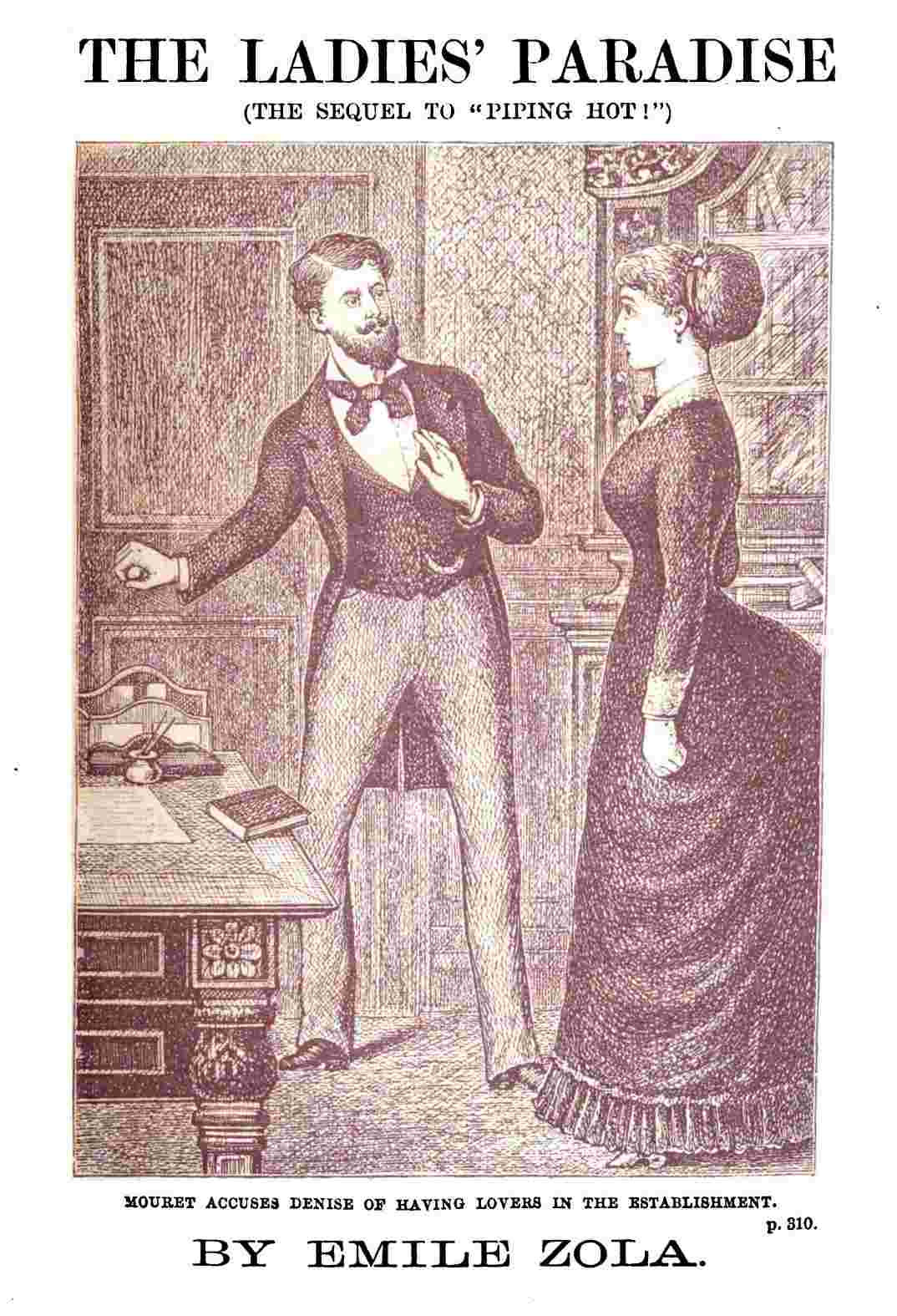
Mouret cut him short with a final insult. “Very good, sir; we will look into the matter. But don't do such a thing again, if you value your place.”
And he walked off. Hutin, bewildered, furious, finding no one but Favier to confide in, swore he would go and throw his resignation at the brute's head. But he soon left off talking of going away, and began to stir up all the abominable accusations which were current amongst the salesmen against their chiefs. And Favier, his eye sparkling, defended himself with a great show of sympathy. He was obliged to reply, wasn't he? Besides, could any one have foreseen such a row for so trifling a matter? What had come to the governor lately, that he should be so unbearable?
“We all know what's the matter with him,” replied Hutin, “Is it my fault if that little jade in the dress-department is turning his head? My dear fellow, you can see the blow comes from there. He's aware I've slept with her, and he doesn't like it; or perhaps it's she herself who wants to get me pitched out, because I'm in her way. But I swear she shall hear from me, if ever she crosses my path.”
Two days after, as Hutin was going up into the work-room, upstairs, under the roof, to recommend a person, he started on perceiving at the end of a passage Denise and Deloche leaning out of a window, and plunged so deeply in private conversation that they did not even turn round. The idea of having them caught occurred to him suddenly, when he perceived with astonishment that Deloche was weeping. He at once went away without making any noise; and meeting Bourdoncle and Jouve on the stairs, told them some story about one of the extincteurs the door of which seemed to be broken; in this way they would go upstairs and drop on to the two others. Bourdoncle discovered them first. He stopped short, and told Jouve to go and fetch the governor, whilst he remained there. The inspector had to obey, greatly annoyed at being forced to compromise himself in such a matter.
This was a lost corner of the vast world in which the people of The Ladies' Paradise worked. One arrived there by a complication of stairs and passages. The work-rooms occupied the top of the house, a succession of low sloping rooms, lighted by large windows cut in the zinc roof, furnished solely with long tables and enormous iron stoves; and right along were a crowd of work-girls of all sorts, for the under-clothing, the lace, the dressmaking, and the house furnishing; living winter and summer in a stifling heat, amidst the odour special to the business; and one had to go straight through the wing, and turn to the right on passing the dressmakers, before coming to this solitary end of the corridor. The rare customers, that a salesman occasionally brought here for an order, gasped for breath, tired out, frightened, with the sensation of having been turning round for hours and hours, and of being a hundred leagues above the street.
Denise had often found Deloche waiting for her. As secondhand she had charge of the arrangements between her department and the work-room where only the models and alterations were done, and was always going up and down to give the necessary orders. He watched for her, inventing any pretext to run after her; then he affected to be surprised when he met her at the work-room door. She got to laugh about the matter, it became quite an understood thing. The corridor ran alongside the cistern, an enormous iron tank containing twelve thousand gallons of water; and there was another one of equal size on the roof, reached by an iron ladder. For an instant, Deloche would stand talking, leaning with one shoulder against the cistern in the continual abandonment of his long body, bent with fatigue. The noise of the water was heard, a mysterious noise of which the iron tank ever retained the musical vibration. Notwithstanding the deep silence, Denise would turn round anxiously, thinking she had seen a shadow pass on the bare, yellow-painted walls. But the window would soon attract them, they would lean out, and forget themselves in a pleasant gossip, in endless souvenirs of their native place. Below them, extended the immense glass roof of the central gallery, a lake of glass bounded by the distant housetops, like a rocky coast. Beyond, they saw nothing but the sky, a sheet of sky, which reflected in the sleeping water of the glazed work the flight of its clouds and the tender blue of its azure.
It so happened that Deloche was speaking of Valognes that day. “I was six years old; my mother took me to Valognes market in a cart. You know it's ten miles away; we had to leave Bricquebec at five o'clock. It's a fine country down our way. Do you know it?”
“Yes, yes,” replied Denise, slowly, her looks lost in the distance. “I was there once, but was very little then. Nice roads with grass on each side, aren't there? and now and again sheep browsing in couples, dragging their clog along by the rope.” She stopped, then resumed with a vague smile: “Our roads run as straight as an arrow for miles between rows of trees which afford a lot of shade. We have meadows surrounded with hedges taller than I am, where there are horses and cows feeding. We have a little river, and the water is very cold, under the brushwood, in a spot I know well.”
“It is the same with us, exactly!” cried Deloche, delighted. “There's grass everywhere, each one encloses his plot with thorns and elms, and is at once at home; and it's quite green, a green far different to what we see in Paris. Dear me! what fun I've had at the bottom of the road, to the left, coming down from the mill!”
And their voices died away, they stopped with their eyes fixed and lost on the sunny lake of the glazed work. A mirage rose up before them from this blinding water, they saw an endless succession of meadows, the Cotentin bathed in the balmy breath of the ocean, a luminous vapour, which melted the horizon into a delicate pearly grey. Below, under the colossal iron framework, in the silk hall, roared the business, the trepidation of the machine at work; the entire house vibrated with the trampling of the crowd, the bustle of the shopmen, and the life of the thirty thousand persons elbowing each other there; and they, carried away by their dreams, on feeling this profound and dull clamour with which the roofs were resounding, thought they heard the wind passing over the grass, shaking the tall trees.
“Ah! Mademoiselle Denise,” stammered Deloche, “why aren't you kinder to me? I love you so much!” Tears had come into his eyes, and as she tried to interrupt him with a gesture, he continued quickly: “No—let me tell you these things once more. We should get on so well together! People always find something to talk about when they come from the same place.”
He was choking, and she at last managed to say kindly: “You're not reasonable; you promised me never to speak of that again. It's impossible. I have a good friendship for you, because you're a nice fellow; but I wish to remain free.”
“Yes, yes. I know it,” replied he in a broken voice, “you don't love me. Oh! you may say so, I quite understand it. There's nothing in me to make you love me. Listen, I've only had one sweet moment in my life, and that was when I met you at Joinville, do you remember? For a moment under the trees, when it was so dark, I thought your arm trembled, and was stupid enough to imagine——”
But she again interrupted him. Her quick ear had just caught Bourdoncle's and Jouve's steps at the end of the corridor.
“Hark, there's some one coming.”
“No,” said he, preventing her leaving the window, “it's in the cistern: all sorts of extraordinary noises come up from it, as if there were some one inside.”
And he continued his timid, caressing complaints. She was no longer listening to him, rocked into dreamland by this declaration of love, her looks wandering over the roofs of The Ladies' Paradise. To the right and the left of the glazed gallery, other galleries, other halls, were glistening in the sun, between the tops of the houses, pierced with windows and running along symmetrically, like the wings of a barracks. Immense metallic works rose up, ladders, bridges, describing a lacework of iron in the air; whilst the kitchen chimneys threw out an immense volume of smoke like a factory, and the great square cistern, supported in the air on wrought-iron pillars, assumed a strange, barbarous profile, hoisted up to this height by the pride of one man. In the distance, Paris was roaring.
When Denise returned from this dreamy state, from this fanciful development of The Ladies' Paradise, in which her thoughts floated as in a vast solitude, she found that Deloche had seized her hand. And he appeared so woe-begone, so full of grief, that she had not the heart to draw it away.
“Forgive me,” he murmured. “It's all over now; I should be quite too miserable if you punished me by withdrawing your friendship. I assure you I intended to say something else. Yes, I had determined to understand the situation and be very good.” His tears again began to flow, he tried to steady his voice. “For I know my lot in life. It is too late for my luck to turn. Beaten at home, beaten in Paris, beaten everywhere. I've now been here four years and am still the last in the department So I wanted to tell you not to trouble on my account. I won't annoy you any longer. Try to be happy, love some one else; yes, that would really be a pleasure for me. If you are happy, I shall be also. That will be my happiness.”
He could say no more. As if to seal his promise he raised the young girl's hand to his lips—kissing it with the humble kiss of a slave. She was deeply affected, and said simply, in a tender, sisterly tone, which attenuated somewhat the pity of the words:
“My poor boy!”
But they started, and turned round; Mouret was standing before them.
For the last ten minutes, Jouve had been searching for the governor all over the place; but the latter was looking at the works going on for the new façade in the Rue du Dix-Décembre. He spent long hours there every day, trying to interest himself in this work, of which he had so long dreamed. This was his refuge against his torments, amidst the masons laying the immense corner-stones, and the engineers setting up the great iron framework. The façade already appeared above the level of the street, indicating the vast porch, and the windows of the first storey, a palace-like development in its crude state. He scaled the ladders, discussing with the architect the ornamentation which was to be something quite new, scrambled over the heaps of brick and iron, and even went down into the cellar; and the roar of the steam-engine, the tic-tac of the trowels, the noise of the hammers, the clamour of this people of workmen, all over this immense cage surrounded by sonorous planks, really distracted him for an instant. He came out white with plaster, black with iron-filings, his feet splashed by the water from the pumps, his pain so far from being cured that his anguish returned and his heart beat stronger than ever, as the noise of the works died away behind him. It so happened, on the day in question, a slight distraction had restored him his gaiety, and he was deeply interested in an album of drawings of the mosaics and enamelled terra-cottas which were to decorate the friezes, when Jouve came up to fetch him, out of breath, annoyed at being obliged to dirty his coat amongst all this building material. At first Mouret had cried out that they must wait; then, at a word spoken in a low tone by the inspector, he had immediately followed him, shivering, a prey again to his passion. Nothing else existed, the façade crumbled away before being built; what was the use of this supreme triumph of his pride, if the simple name of a woman whispered in his ear tortured him to this extent.
Upstairs, Bourdoncle and Jouve thought it prudent to vanish. Deloche had already run away, Denise alone remained to face Mouret, paler than usual, but looking straight into his eyes.
“Have the kindness to follow me, mademoiselle,” said he in a harsh voice.
She followed him, they descended the two storeys, and crossed the furniture and carpet departments without saying a word. When he arrived at his office, he opened the door wide, saying, “Walk in, mademoiselle.”
And, closing the door, he went to his desk. The new director's office was fitted up more luxuriously than the old one, the reps hangings had been replaced by velvet ones, and a book-case, incrusted with ivory, occupied one whole side; but on the walls there was still no picture but the portrait of Madame Hédouin, a young woman with a handsome calm face, smiling in its gold frame.
“Mademoiselle,” said he at last, trying to maintain a cold, severe air, “there are certain things that we cannot tolerate. Good conduct is absolutely necessary here.”
He stopped, choosing his words, in order not to yield to the furious anger which was rising up within him. What! she loved this fellow, this miserable salesman, the laughingstock of his counter! and it was the humblest, the most awkward of all that she preferred to him, the master! for he had seen them, she leaving her hand in his, and he covering that hand with kisses.
“I've been very good to you, mademoiselle,” continued he, making a fresh effort “I little expected to be rewarded in this way.”
Denise, immediately on entering, had been attracted by Madame Hédouin's portrait; and, notwithstanding her great trouble, was still pre-occupied by it. Every time she came into the director's office her eyes were sure to meet those of this lady. She felt almost afraid of her, although she knew her to have been very good. This time, she felt her to be a protection.
“You are right, sir,” he said, softly, “I was wrong to stop and talk, and I beg your pardon for doing so. This young man comes from my part of the country.”
“I'll dismiss him!” cried Mouret, putting all his suffering into this furious cry.
And, completely overcome, entirely forgetting his position as a director lecturing a saleswoman guilty of an infraction of the rules, he broke out into a torrent of violent words. Had she no shame in her? a young girl like her abandoning herself to such a being! and he even made most atrocious accusations, introducing Hutin's name into the affair, and then others, in such a flood of words, that she could not even defend herself. But he would make a clean sweep, and kick them all out. The severe explanation he had promised himself, when following Jouve, had degenerated into the shameful violence of a scene of jealousy.
“Yes, your lovers! They told me about it, and I was stupid enough to doubt it But I was the only one! I was the only one!”
Denise, suffocating, bewildered, stood listening to these frightful charges, which she had not at first understood. Did he really suppose her to be as bad as this? At another remark, harsher than all the rest, she silently turned towards the door. And, in reply to a movement he made to stop her, said:
“Let me alone, sir, I'm going away. If you think me what you say, I will not remain in the house another second.”
But he rushed in front of the door, exclaiming: “Why don't you defend yourself? Say something!”
She stood there very stiff, maintaining an icy silence. For a long time he pressed her with questions, with a growing anxiety; and the mute dignity of this innocent girl once more appeared to be the artful calculation of a woman learned in all the tactics of passion. She could not have played a game better calculated to bring him to her feet, tortured by doubt, desirous of being convinced.
“Come, you say he is from your part of the country? Perhaps you've met there formerly. Swear that there has been nothing between you and this fellow.”
And as she obstinately remained silent, as if still wishing to open the door and go away, he completely lost his head, and broke out into a supreme explosion of grief.
“Good heavens! I love you! I love you! Why do you delight in tormenting me like this? You can see that nothing else exists, that the people of whom I speak only touch me through you, and you alone can occupy my thoughts. Thinking you were jealous, I gave up all my pleasures. You were told I had mistresses; well! I have them no longer; I hardly set foot outside. Did I not prefer you at that lady's house? have I not broken with her to belong solely to you? And I am still waiting for a word of thanks, a little gratitude. And if you fear that I should return to her, you may feel quite easy: she is avenging herself by helping one of our former salesmen to found a rival establishment. Tell me, must I go on my knees to touch your heart?”
He had come to this. He, who did not tolerate the slightest peccadillo with the shopwomen, who turned them out for the least caprice, found himself reduced to imploring one of them not to go away, not to abandon him in his misery. He held the door against her, ready to forgive her everything, to shut his eyes, if she merely deigned to lie. And it was true, he had got thoroughly sick of girls picked up at theatres and night-houses; he had long since given up Clara and now ceased to visit at Madame Desforges's house, where Bouthemont reigned supreme, while waiting for the opening of the new shop, The Four Seasons, which was already filling the newspapers with its advertisements.
“Must I go on my knees?” repeated he, almost choked by suppressed tears.
She stopped him, herself quite unable to conceal her emotion, deeply affected by this suffering passion. “You are wrong, sir, to agitate yourself in this way,” replied she, at last “I assure you that all these wicked reports are untrue. This poor fellow you have just seen is no more guilty than I am.”
She said this with her brave, frank air, looking with her bright eyes straight into his face.
“Very good, I believe you,” murmured he. “I'll not dismiss any of your comrades, since you take all these people under your protection. But why, then, do you repulse me, if you love no one else?”
A sudden constraint, an anxious bashfulness seized the young girl.
“You love some one, don't you?” resumed he, in a trembling voice. “Oh! you may speak out; I have no claim on your affections. Do you love any one?”
She turned very red, her heart was in her mouth, and she felt all falsehood impossible before this emotion which was betraying her, this repugnance for a lie which made the truth appear in her face in spite of all.
“Yes,” she at last confessed, feebly. “But I beg you to let me go away, sir, you are torturing me.”
She was now suffering in her turn. Was it not enough to have to defend herself against him? Was she to be obliged to fight against herself, against the breath of tenderness which sometimes took away all her courage? When he spoke to her thus, when she saw him so full of emotion, so overcome, she hardly knew why she still refused; and it was only afterwards that she found, in the depths of her healthy, girlish nature, the pride and the prudence which maintained her intact in her virtuous resolution. It was by a sort of instinct of happiness that she still remained so obstinate, to satisfy her need of a quiet life, and not from any idea of virtue. She would have fallen into this man's arms, her heart seduced, her flesh overpowered if she had not experienced a sort of revolt, almost a feeling of repulsion before the definite bestowal of her being, ignorant of her future fate. The lover made her afraid, inspiring her with that fear that all women feel at the approach of the male.
Mouret gave way to a gesture of gloomy discouragement. He could not understand her. He turned towards his desk, took up some papers and then laid them down again, saying: “I will retain you no longer, mademoiselle; I cannot keep you against your will.”
“But I don't wish to go away,” replied she, smiling. “If you believe me to be innocent, I will remain. One ought always to believe a woman to be virtuous, sir. There are numbers who are so, I assure you.”
Denise's eyes had involuntarily wandered towards Madame Hédouin's portrait: that lady so wise and so beautiful, whose blood, they said, had brought good fortune to the house. Mouret followed the young girl's look with a start, for he thought he heard his dead wife pronounce this phrase, one of her own sayings which he at once recognised. And it was like a resurrection, he discovered in Denise the good sense, the just equilibrium of her he had lost, even down to the gentle voice, sparing of useless words. He was struck by this resemblance, which rendered him sadder still.
“You know I am yours,” murmured he in conclusion. “Do what you like with me.”
Then she resumed gaily: “That is right, sir. The advice of a woman, however humble she may be, is always worth listening to when she has a little intelligence. If you put yourself in my hands, be sure I'll make nothing but a good man of you!”
She smiled, with that simple unassuming air which had such a charm. He also smiled in a feeble way, and escorted her as far as the door, as he would a lady.
The next day Denise was appointed first-hand. The dress and costume department was divided, the management creating especially for her one for children's costumes, which was installed close to the ready-made one. Since her son's dismissal, Madame Aurélie had been trembling, for she found the directors getting cool towards her, and saw the young girl's power increasing daily. Would they not shortly sacrifice her in favour of this latter, by taking advantage of the first pretext? Her emperor's mask, puffed up with fat, seemed to have got thinner from the shame which now stained the whole Lhomme dynasty; and she made a show of going away every evening on her husband's arm, for they were brought nearer together by misfortune, and felt vaguely that the evil came from the disorder of their home; whilst the poor old man, more affected than her, in a sickly fear of being himself suspected of robbery, counted over the receipts, again and again, noisily, performing miracles with his amputated arm. So that, when she saw Denise appointed first-hand in the children's costume department, she experienced such joy that she paraded the most affectionate feeling towards the young girl, really grateful to her for not having taken her place away. And she overwhelmed her with attentions, treating her as an equal, often going to talk to her in the neighbouring department, with a stately air, like a queen-mother paying a visit to a young queen.
In fact, Denise was now at the summit. Her appointment as first-hand had destroyed the last resistance. If some still babbled, from that itching of the tongue which ravages every assemblage of men and women, they bowed very low before her face. Marguerite, now second-hand, was full of praise for her. Clara, herself, inspired with a secret respect before this good fortune, which she felt herself incapable of achieving, had bowed her head. But Denise's victory was more complete still over the gentlemen; over Jouve, who now bent almost double whenever he addressed her; over Hutin, seized with anxiety on feeling his position giving way under him; and over Bourdoncle, reduced at last to powerlessness. When the latter saw her coming out of the director's office, smiling, with her quiet air, and that the next day Mouret had insisted on the board creating this new department, he had yielded, vanquished by a sacred terror of woman. He had always given in thus before Mouret, recognising him to be his master, notwithstanding his escapades and his idiotic love affairs. This time the woman had proved the stronger, and he was expecting to be swept away by the disaster.
However, Denise bore her triumph in a peaceable, charming manner, happy at these marks of consideration, even affecting to see in them a sympathy for the miseries of her debut and the final success of her patient courage. Thus she received with a laughing joy the slightest marks of friendship, and this caused her to be really loved by some, she was so kind, sympathetic, and full of affection. The only person for whom she still showed an invincible repugnance was Clara, having learned that this girl had amused herself by taking Colomban home with her one night as she had said she would do for a joke; and he, carried away by his passion, was becoming more dissipated every day, whilst poor Geneviève was slowly dying. The adventure was talked of at The Ladies' Paradise, and thought very droll.
But this trouble, the only one she had outside, did not in any way change Denise's equable temper. It was especially in her department that she was seen at her best, in the midst of her little world of babies of all ages. She was passionately fond of children, and she could not have been placed in a better position. Sometimes there were fully fifty girls and as many boys there, quite a turbulent school, let loose in their growing coquettish desires. The mothers completely lost their heads. She, conciliating, smiling, had the little ones placed in a line, on chairs; and when there happened to be amongst the number a rosy-cheeked little angel, whose pretty face tempted her, she would insist on serving her herself, bringing the dress and trying it on the child's dimpled shoulders, with the tender precaution of an elder sister. There were fits of laughter, cries of joy, amidst the scolding voices of the mothers. Sometimes a little girl, already a grand lady, nine or ten years old, having a cloth jacket to try on, would stand studying it before a glass, turning round, with an absorbed air, her eyes sparkling with a desire to please. The counters were encumbered with the things unpacked, dresses in pink and blue Asian linen for children of from one to five years, blue sailor costumes, with plaited skirt and blouse, trimmed with fine cambric muslin, Louis XV. costumes, mantles, jackets, a pell-mell of narrow garments, stiffened in their infantine grace, something like the cloak-room of a regiment of big dolls, taken out of the wardrobes and given up to pillage. Denise had always a few sweets in her pockets, to appease the tears of some youngster in despair at not being able to carry off a pair of red trousers; and she lived there amongst these little ones as in her own family, feeling quite young again herself from the contact of all this innocence and freshness incessantly renewed around her skirts.
She now had frequent friendly conversations with Mouret. When she went to the office to take orders and furnish information, he kept her talking, enjoying the sound of her voice. It was what she laughingly called “making a good man of him.” In her prudent, cautious Norman head there sprang up all sorts of projects, ideas about the new business which she had already ventured to hint at when at Robineau's, and some of which she had expressed on the evening of their walk in the Tuileries gardens. She could not be occupied in any matter, see any work going on, without being moved with a desire to introduce some improvement in the mechanism. Then, since her entry into The Ladies' Paradise, she was especially pained by the precarious position of the employees; the sudden dismissals shocked her, she thought them iniquitous and stupid, hurtful to all, to the house as much as to the staff. Her former sufferings were still fresh in her mind, and her heart was seized with pity every time she saw a new comer, her feet bruised, her eyes dim with tears, dragging herself along in her misery in her silk dress, amidst the spiteful persecution of the old hands. This dog's life made the best of them bad; and the sad work of destruction commenced: all eaten up by the trade before the age of forty, disappearing, falling into unknown places, a great many dying in harness, some of consumption and exhaustion, others of fatigue and bad air, a few thrown on the street, the happiest married, buried in some little provincial shop. Was it humane, was it just, this frightful consumption of human life that the big shops carried on every year? And she pleaded the cause of the wheel-work of the colossal machine, not from any sentimental reasons, but by arguments appealing to the very interests of the employers. To make a machine solid and strong, it is necessary to use good iron; if the iron breaks or is broken, there is a stoppage of work, repeated expenses of starting, quite a loss of power.
Sometimes she would become quite animated, she would picture an immense ideal bazaar, the phalansterium of modern commerce, in which each one should have his exact share of the profits, according to his merits, with the certainty of the future, assured to him by a contract Mouret would feel amused at this, notwithstanding his fever. He accused her of socialism, embarrassed her by pointing out the difficulties of carrying out these schemes; for she spoke in the simplicity of her soul, bravely trusting in the future, when she perceived a dangerous hole underlying her tender-hearted plans. He was, however, shaken, captivated by this young voice, still trembling from the evils endured, so convinced and earnest in pointing out the reforms which would tend to consolidate the house; yet he listened while joking with her; the salesmen's position gradually improved, the wholesale dismissals were replaced by a system of holidays granted during the dead seasons, and there was also about to be created a sort of benefit club which would protect the employees against bad times and ensure them a pension. It was the embryo of the vast trades' unions of the twentieth century.
Denise did not confine her attention solely to healing the wounds from which she had herself bled; she conceived various delicate feminine ideas, which, communicated to Mouret, delighted the customers. She also caused Lhomme's happiness by supporting a scheme he had long nourished, that of creating a band of music, in which all the executants should be chosen from amongst the staff. Three months later Lhomme had a hundred and twenty musicians under his direction, the dream of his whole life was realised. And a grand fête was given on the premises, a concert and a ball, to introduce the band of The Ladies' Paradise to the customers and the whole world. The newspapers took the matter up, Bourdoncle himself, frightened by these innovations, was obliged to bow before this immense advertisement. Afterwards, a recreation room for the men was established, with two billiard tables and backgammon and chess boards. Then classes were held in the house of an evening; there were lessons in English and German, in grammar, arithmetic, and geography; they even had lessons in riding and fencing. A library was formed, ten thousand volumes were placed at the disposal of the employees. And a resident doctor giving consultations gratis was also added, together with baths, and hair-dressing and refreshment saloons. Every want in life was provided for, everything was to be obtained without going outside—board, lodging, and clothing. The Ladies' Paradise sufficed entirely for all its own wants and pleasures, in the very heart of Paris, taken up by all this clatter, by this working city which was springing up so vigorously out of the ruins of the old streets, at last opened to the rays of the sun.
Then a fresh movement of opinion took place in Denise's favour. As Bourdoncle, vanquished, repeated with despair to his friends that he would give a great deal to put Denise into Mouret's arms himself, it was concluded that she had not yielded, that her all-powerfulness resulted from her refusal. From that moment she became immensely popular. They knew for what indulgences they were indebted to her, and they admired her for the force of her will. There was one, at least, who could master the governor, who avenged all the others, and knew how to get something else besides promises out of him! So she had come at last, she who was to make him treat the poor devils with a little respect! When she went through the shop, with her delicate, self-willed head, her tender, invincible air, the salesmen smiled at her, were proud of her, and would willingly have exhibited her to the crowd. Denise, in her happiness, allowed herself to be carried along by this increasing sympathy. Was it all possible? She saw herself arrive in a poor dress, frightened, lost amidst the mechanism of the terrible machine; for a long time she had had the sensation of being nothing, hardly a grain of seed beneath these millstones which were crushing a whole world; and now to-day she was the very soul of this world, she alone was of consequence, able at a word to increase or slacken the pace of the colossus lying at her feet. And yet she had not wished for these things, she had simply presented herself, without calculation, with the sole charm of her sweetness. Her sovereignty sometimes caused her an uneasy surprise; why did they all obey her? she was not pretty, she did nothing wrong. Then she smiled, her heart at rest, feeling within herself nothing but goodness and prudence, a love of truth and logic which constituted all her strength.
One of Denise's greatest joys was to be able to assist Pauline. The latter, being about to become a mother, was trembling, aware that two other saleswomen in the same condition had been sent away. The principals did not tolerate these accidents, maternity being suppressed as cumbersome and indecent; they occasionally allowed marriage, but would admit of no children. Pauline had, it was true, her husband in the house; but still she felt anxious, it being almost impossible for her to appear at the counter; and in order to postpone a probable dismissal, she laced herself very tightly, resolved to conceal her state as long as she could. One of the two saleswomen who had been dismissed, had just been delivered of a still-born child, through having laced herself up in this way; and it was not certain that she herself would recover. Meanwhile, Bourdoncle had observed that Pauline's complexion was getting very livid, and that she had a painfully stiff way of walking. One morning he was standing near her, in the under-linen department, when a messenger, taking away a bundle, ran up against her with such force that she cried out with pain. Bourdoncle immediately took her on one side, made her confess, and submitted the question of her dismissal to the board, under the pretext that she stood in need of country air: the story of this accident would spread, and would have a disastrous effect on the public if she should have a miscarriage, as had already taken place in the baby linen department the year before. Mouret, who was not at the meeting, could only give his opinion in the evening. But Denise having had time to interfere, he closed Bourdoncle's mouth, in the interest of the house itself. Did they wish to frighten the heads of families and the young mothers amongst their customers? And it was decided, with great pomp, that every married saleswoman should, when in the family way, be sent to a special midwife's as soon as her presence at the counter became offensive to the customers.
The next day when Denise went up into the infirmary to see Pauline, who had been obliged to take to her bed on account of the blow she had received, the latter kissed her violently on both cheeks. “How kind you are! Had it not been for you I should have been turned away. Pray don't be anxious about me, the doctor says it's nothing.”
Baugé, who had slipped away from his department, was also there, on the other side of the bed. He likewise stammered his thanks, troubled before Denise, whom he now treated as an important person, of a superior class. Ah! if he heard any more nasty remarks about her, he would soon close the mouths of the jealous ones! But Pauline sent him away with a good-natured shrug of the shoulders.
“My poor darling, you're always saying something stupid. Leave us to talk together.”
The infirmary was a long, light room, containing twelve beds, with their white curtains. Those who did not wish to go home to their families were nursed here. But on the day in question, Pauline was the only occupant, in a bed near one of the large windows which looked on to the Rue Neuve-Saint-Augustin. And they immediately commenced to exchange whispered words, tender confidences, in the calm air, perfumed with a vague odour of lavender.
“So he does just what you wish him to? How cruel you are, to make him suffer so! Come, just explain it to me, now I've ventured to approach the subject. Do you detest him?” Pauline had retained hold of Denise's hand, as the latter sat near the bed, with her elbow on the bolster; and overcome by a sudden emotion, her cheeks invaded with colour, she had a moment of weakness at this direct and unexpected question. Her secret escaped her, she buried her head in the pillow, murmuring:
“I love him!”
Pauline was astonished. “What! you love him? But it's very simple: say yes.”
Denise, her face still concealed, replied “No!” by an energetic shake of the head. And she did so, simply because she loved him, without being able to explain the matter. No doubt it was ridiculous; but she felt like that, she could not change her nature. Her friend's surprise increased, and she at length asked: “So it's all to make him marry you?”
At this the young girl sprung up, quite confused: “Marry me! Oh! no! Oh! I assure you that I have never wished for anything of the kind! No, never has such an idea entered my head; and you know what a horror I have of all falsehood!”
“Well, dear,” resumed Pauline, kindly, “you couldn't have acted otherwise, if such had been your intention. All this must come to an end, and it is very certain that it can only finish by a marriage, as you won't let it be otherwise. I must tell you that every one has the same idea; yes, they feel persuaded that you are riding the high horse, in order to make him take you to church. Dear me! what a funny girl you are!”
And she had to console Denise, who had again dropped her head on to the bolster, sobbing, declaring that she would certainly go away, since they attributed all sorts of things to her that had never crossed her mind. No doubt, when a man loved a woman he ought to marry her. But she asked for nothing, she had made no calculations, she simply begged to be allowed to live quietly, with her joys and her sorrows, like other people. She would go away.
At the same moment Mouret was going through the premises below. He had wanted to forget his thoughts by visiting the works once more. Several months had elapsed, the façade now reared its monumental lines behind the vast hoardings which concealed it from the public. Quite an army of decorators were at work: marble-cutters, mosaic-workers, and others. The central group above the door was being gilded; whilst on the acroteria were being fixed the pedestals destined to receive the statues of the manufacturing cities of France. From morning to night, in the Rue du Dix-Décembre, lately opened to the public, a crowd of idlers stood gaping about, their noses in the air, seeing nothing, but pre-occupied by the marvels that were related of this façade, the inauguration of which was going to revolutionise Paris. And it was on this feverish working-ground, amidst the artists putting the finishing touches to the realisation of his dream commenced by the masons, that Mouret felt more bitterly than ever the vanity of his fortune. The thought of Denise had suddenly arrested him, this thought which incessantly pierced him with a flame, like the shooting of an incurable pain. He had run away, unable to find a word of satisfaction, fearful lest he should show his tears, leaving behind him the disgust of his triumph. This façade, which was at last erected, seemed little in his eyes, very much like one of those walls of sand that children build, and it might have been extended from one end of the city to the other, elevated to the starry sky, yet it would not have filled the emptiness of his heart, that the “yes” of a mere child could alone fill.
When Mouret entered his office he was almost choking with sobs. What did she want? He dared not offer her money now; and the confused idea of a marriage presented itself amidst his young widower's revolts. And, in the debility of his powerlessness, his tears began to flow. He was very miserable.
CHAPTER XIII.
One morning in November, Denise was giving her first orders in the department when the Baudus' servant came to tell her that Mademoiselle Geneviève had passed a very bad night, and wished to see her cousin immediately. For some time the young girl had been getting weaker and weaker, and she had been obliged to take to her bed two days before.
“Say I am coming at once,” replied Denise, very anxious.
The blow which was finishing Geneviève was Colomban's sudden disappearance. At first, chaffed by Clara, he had stopped out several nights; then, yielding to the mad desires of a quiet, chaste fellow, he had become her obedient slave, and had not returned one Monday, but had simply sent a farewell letter to Baudu, written in the studied terms of a man about to commit suicide. Perhaps, at the bottom of this passion, there was also the crafty calculation of a fellow delighted at escaping a disastrous marriage. The draper's business was in as bad a way as his betrothed; the moment was propitious to break with them through any stupidity. And every one cited him as an unfortunate victim of love.
When Denise arrived at The Old Elbeuf, Madame Baudu was there alone, sitting motionless behind the pay-desk, with her small white face, eaten up by anæmia, silent and quiet in the cold, deserted shop. There were no assistants now. The servant dusted the shelves, and it was even a question of replacing her by a charwoman. A dreary cold fell from the ceiling, hours passed away without a customer coming to disturb this silence, and the goods, no longer touched, became mustier and mustier every day.
“What's the matter?” asked Denise, anxiously. “Is Geneviève in danger?”
Madame Baudu did not reply at first. Her eyes filled with tears. Then she stammered: “I don't know; they don't tell me anything. Ah, it's all over, it's all over.”
And she cast a sombre glance around the dark old shop, as if she felt her daughter and the shop disappearing together. The seventy thousand francs, produce of the sale of their Rambouillet property, had melted away in less than two years in this gulf of competition. In order to struggle against The Ladies' Paradise, which now kept men's cloths and materials for hunting and livery suits, the draper had made considerable sacrifices. At last he had been definitely crushed by the swanskin cloth and flannels sold by his rival, an assortment that had not its equal in the market. Little by little his debts had increased, and, as a last resource, he had resolved to mortgage the old building in the Rue de la Michodière, where Finet, their ancestor, had founded the business; and it was now only a question of days, the crumbling away had commenced, the very ceilings seemed to be falling down and turning into dust, like an old worm-eaten structure carried away by the wind.
“Your uncle is upstairs,” resumed Madame Baudu in her broken voice. “We stay with her two hours each. Some one must look out here; oh! but only as a precaution, for to tell the truths——”
Her gesture finished the phrase. They would have put the shutters up had it not been for their old commercial pride, which still propped them up in the presence of the neighbourhood.
“Well, I'll go up, aunt,” said Denise, whose heart was bleeding, amidst this resigned despair that even the pieces of cloth themselves exhaled.
“Yes, go upstairs quick, my girl. She's waiting for you. She's been asking for you all night. She has something to tell you.”
But just at that moment Baudu came down. The rising bile gave his yellow face a greenish tinge, and his eyes were bloodshot. He was still walking with the muffled step with which he had quitted the Sick room, and murmur-ed, as if he might be heard upstairs, “She's asleep.”
And, thoroughly worn out, he sat down on a chair, wiping his forehead with a mechanical gesture, puffing like a man who has just finished some hard work. A silence ensued, but at last he said to Denise: “You'll see her presently. When she is sleeping, she seems to me to be all right again.”
There was again a silence. Face to face, the father and mother stood looking at each other. Then, in a half whisper, he went over his grief again, naming no one, addressing no one directly: “My head on the block, I wouldn't have believed it! He was the last one. I had brought him up as a son. If any one had come and said to me, 'They'll take him away from you as well; he'll fall as well,' I would have replied 'Impossible, it could not be.' And he has fallen all the same! Ah! the scoundrel, he who was so well up in real business, who had all my ideas! And all for a young monkey, one of those dummies that parade at the windows of bad houses! No! really, it's enough to drive one mad!”
He shook his head, his eyes fell on the damp floor worn away by generations of customers. Then he continued in a lower voice, “There are moments when I feel myself the most culpable of all in our misfortune. Yes, it's my fault if our poor girl is upstairs devoured by fever. Ought not I to have married them at once, without yielding to my stupid pride, my obstinacy in refusing to leave them the house less prosperous than before? Had I done that she would now have the man she loved, and perhaps their united youthful strength would have accomplished the miracle that I have failed to work. But I am an old fool, and saw through nothing; I didn't know that people fell ill over such things. Really he was an extraordinary fellow: with such a gift for business, and such probity, such simplicity of conduct, so orderly in every way—in short, my pupil.”
He raised his head, still defending his ideas, in the person of the shopman who had betrayed him. Denise could not bear to hear him accuse himself, and she told him so, carried away by her emotion, on seeing him so humble, with his eyes full of tears, he who used formerly to reign as absolute master.
“Uncle, pray don't apologise for him. He never loved Geneviève, he would have run away sooner if you had tried to hasten the marriage. I have spoken to him myself about it; he was perfectly well aware that my cousin was suffering on his account, and you see that did not prevent him leaving. Ask aunt.”
Without opening her lips, Madame Baudu confirmed these words by a nod. The draper turned paler still, blinded by his tears. He stammered out: “It must be in the blood, his father died last year through having led a dissolute life.”
And he once more looked round the obscure shop, his eyes wandering from the empty counters to the full shelves, then resting on Madame Baudu, who was still at the pay-desk, waiting in vain for the customers who did not come.
“Come,” said he, “it's all over. They've ruined our business, and now one of their hussies is killing our daughter.”
No one spoke. The rolling of the vehicles, which occasionally shook the floor, passed like a funereal beating of drums in the still air, stifled under the low ceiling. Suddenly, amidst this gloomy sadness of the old dying shop, could be heard several heavy knocks, struck somewhere in the house. It was Geneviève, who had just awoke, and was knocking with a stick they had left near her bed.
“Let's go up at once,” said Baudu, rising with a start. “Try and be cheerful, she mustn't know.”
He himself rubbed his eyes to efface the trace of his tears. As soon as he had opened the door, on the first storey, they heard a frightened, feeble voice crying: “Oh, I don't like to be left alone. Don't leave me; I'm afraid to be left alone.” Then, when she perceived Denise, Geneviève became calmer, and smiled joyfully. “You've come, then! How I've been longing to see you since yesterday. I thought you also had abandoned me!”
It was a piteous sight. The young girl's room looked out on to the yard, a little room lighted by a livid light At first her parents had put her in their own room, in the front; but the sight of The Ladies' Paradise opposite affected her so much, that they had been obliged to bring her back to her own again. And there she lay, so very thin, under the bed-clothes, that one hardly suspected the form and existence of a human body. Her skinny arms, consumed by a burning fever, were in a perpetual movement of anxious, unconscious searching; whilst her black hair seemed thicker still, and to be eating up her poor face with its voracious vitality, that face in which was agonising the final degenerateness of a family sprung up in the shade, in this cellar of old commercial Paris. Denise, her heart bursting with pity, stood looking at her. She did not at first speak, for fear of giving way to tears. At last she murmured:
“I came at once. Can I be of any use to you? You asked for me. Would you like me to stay?”
“No, thanks. I don't want anything. I only wanted to embrace you.”
Tears filled her eyes. Denise quickly leant over, and kissed her on both cheeks, trembling to feel on her lips the flame of those hollow cheeks. But Geneviève, stretching out her arms, seized and kept her in a desperate embrace. Then she looked towards her father.
“Would you like me to stay?” repeated Denise. “Perhaps there is something I can do for you.”
Geneviève's glance was still obstinately fixed on her father, who remained standing, with a stolid air, almost choking. He at last understood, and went away, without saying a word; and they heard his heavy footstep on the stairs.
“Tell me, is he with that woman?” asked the sick girl immediately, seizing her cousin's hand, and making her sit on the side of the bed. “I want to know, and you are the only one can tell me. They're living together, aren't they?” Denise, surprised by these questions, stammered, and was obliged to confess the truth, the rumours that were current in the shop. Clara, tired of this fellow, who was getting a nuisance to her, had already broken with him, and Colomban, desolated, was pursuing her everywhere, trying to obtain a meeting from time to time, with a sort of canine humility. They said that he was going to take a situation at the Grands Magasins du Louvre.
“If you still love him, he may return,” said Denise, to cheer the dying girl with this last hope. “Get well quick, he will acknowledge his errors, and marry you.”
Geneviève interrupted her. She had listened with all her soul, with an intense passion that raised her in the bed. But she fell back almost immediately. “No, I know it's all over! I don't say anything, because I see papa crying, and I don't wish to make mamma worse than she is. But I am going, Denise, and if I called for you last night it was for fear of going off before the morning. And to think that he is not happy after all!”
And Denise having remonstrated, assuring her that she was not so bad as all that, she cut her short again, suddenly throwing off the bed-clothes with the chaste gesture of a virgin who has nothing to conceal in death. Naked to the waist, she murmured: “Look at me! Is it possible?”
Trembling, Denise quitted the side of the bed, as if she feared to destroy this fearful nudity with a breath. It was the last of the flesh, a bride's body used up by waiting, returned to the first infantile slimness of her young days. Geneviève slowly covered herself up again, saying: “You see I am no longer a woman. It would be wrong to wish for him still!” There was a silence. Both continued to look at each other, unable to find a word to say. It was Geneviève who resumed: “Come, don't stay any longer, you have your own affairs to look after. And thanks, I was tormented by the wish to know, and am now satisfied. If you see him, tell him I forgive him. Adieu, dear Denise. Kiss me once more, for it's the last time.” The young girl kissed her, protesting: “No, no, don't despair, all you want is loving care, nothing more.” But the sick girl, shaking her head in an obstinate way, smiled, quite sure of what she said. And as her cousin was making for the door, she exclaimed: “Wait a minute, knock with this stick, so that papa may come up. I'm afraid to stay alone.”
Then, when Baudu arrived in that small, gloomy room, where he spent hours seated on a chair, she assumed an air of gaiety, saying to Denise—“Don't come to-morrow, I would rather not. But on Sunday I shall expect you; you can spend the afternoon with me.”
The next morning, at six o'clock, Geneviève expired after four hours' fearful agony. The funeral took place on a Saturday, a fearfully black, gloomy day, under a sooty sky which hung over the shivering city. The Old Elbeuf, hung with white linen, lighted up the street with a bright spot, and the candles burning in the fading day seemed so many stars drowned in the twilight The coffin was covered with wreaths and bouquets of white roses; it was a narrow child's coffin, placed in the obscure passage of the house on a level with the pavement, so near the gutter that the passing carriages had already splashed the coverings. The whole neighbourhood exhaled a dampness, a cellar-like mouldy odour, with its continual rush of pedestrians on the muddy pavement.
At nine o'clock Denise came over to stay with her aunt. But as the funeral was starting, the latter—who had ceased weeping, her eyes burnt with tears—begged her to follow the body and look after her uncle, whose mute affliction and almost idiotic grief filled the family with anxiety. Below, the young girl found the street full of people, for the small traders in the neighbourhood were anxious to show the Baudus a mark of sympathy, and in this eagerness there was also a sort of manifestation against The Ladies' Paradise, whom they accused of causing Geneviève's slow agony. All the victims of the monster were there—Bédoré and sister from the hosier's shop in the Rue Gaillon, the furriers, Vanpouille Brothers, and Deslignières the toyman, and Piot and Rivoire the furniture dealers; even Mademoiselle Tatin from the underclothing shop, and the glover Quinette, long since cleared off by bankruptcy, had made it a duty to come, the one from Batignolle, the other from the Bastille, where they had been obliged to take situations. Whilst waiting for the hearse, which was late, these people, tramping about in the mud, cast glances of hatred towards The Ladies' Paradise, the bright windows and gay displays of which seemed an insult in face of The Old Elbeuf, which, with its funeral trappings and glimmering candles, cast a gloom over the other side of the street A few curious faces appeared at the plate-glass windows; but the colossus maintained the indifference of a machine going at full speed, unconscious of the deaths it may cause on the road.
Denise looked round for her brother Jean, whom she at last perceived standing before Bourras's shop, and she went and asked him to walk with his uncle, to assist him if he could not get along. For the last few weeks Jean had been very grave, as if tormented by some worry. To-day, buttoned up in his black frock-coat, a full grown man, earning his twenty francs a day, he seemed so dignified and so sad that his sister was surprised, for she had no idea he loved his cousin so much as that. Desirous of sparing Pépé this needless grief, she had left him with Madame Gras, intending to go and fetch him in the afternoon to see his uncle and aunt.
The hearse had still not arrived, and Denise, greatly affected, was watching the candles burn, when she was startled by a well-known voice behind her. It was Bourras. He had called the chestnut-seller opposite, in his little box, against the public-house, and said to him:
“I say, Vigouroux, just keep a look-out for me a bit, will you? You see I've closed the door. If any one comes tell them to call again. But don't let that disturb you, no one will come.”
Then he took his stand on the pavement, waiting like the others. Denise, feeling rather awkward, glanced at his shop. He entirely abandoned it now; there was nothing left but a disorderly array of umbrellas eaten up by the damp air, and canes blackened by the gas. The embellishments that he had made, the delicate green paint work, the glasses, the gilded sign, were all cracking, already getting dirty, presenting that rapid and lamentable decrepitude of false luxury laid over ruins. But though the old crevices were re-appearing, though the spots of damp had sprung up over the gildings, the house still held its ground obstinately, hanging on to the flanks of The Ladies' Paradise like a dishonouring wart, which, although cracked and rotten, refused to fall off.
“Ah! the scoundrels,” growled Bourras, “they won't even let her be carried away.”
The hearse, which had at last arrived, had just got into collision with one of The Ladies' Paradise vans, which was spinning along, shedding in the mist its starry radiance, with the rapid trot of two superb horses. And the old man cast on Denise an oblique glance, lighted up under his bushy eyebrows. Slowly, the funeral started off, splashing through the muddy pools, amid the silence of the omnibuses and carriages suddenly pulled up. When the coffin, draped with white, crossed the Place Gaillon, the sombre looks of the cortege were once more plunged into the windows of the big shop, where two saleswomen alone had run up to look on, pleased at this distraction. Baudu followed the hearse with a heavy mechanical step, refusing by a sign the arm offered by Jean, who was walking with him. Then, after a long-string of people, came three mourning coaches. As they passed the Rue Neuve-des-Petits-Champs, Robineau ran up to join the cortege, very pale, and looking much older.
At Saint-Roch, a great many women were waiting, the small traders of the neighbourhood, who had been afraid of the crowd at the house. The manifestation was developing into quite a riot; and when, after the service, the procession started off back, all the men followed, although it was a long walk from the Rue Saint-Honoré to the Montmartre Cemetery. They had to go up the Rue Saint-Roch, and once more pass The Ladies' Paradise. It was a sort of obsession; this poor young girl's body was paraded round the big shop like the first victim fallen in time of revolution. At the door some red flannels were flapping like so many flags, and a display of carpets blazed forth in a florescence of enormous roses and full-blown pæonies. Denise had got into one of the coaches, being agitated by some smarting doubts, her heart oppressed by such a feeling of grief that she had not the strength to walk At that moment there was a stop, in the Rue du Dix-Décembre, before the scaffolding of the new façade which still obstructed the thoroughfare. 'And the young girl observed old Bourras, left behind, dragging along with difficulty, close to the wheels of the coach in which she was riding alone. He would never get as far as the cemetery, she thought. He raised his head, looked at her, and all at once got into the coach.
“It's my confounded knees,” exclaimed he. “Don't draw back! Is it you that we detest?”
She felt him to be friendly and furious as in former days. He grumbled, declared that Baudu must be fearfully strong to be able to keep up after such blows as he had received. The procession had resumed its slow pace; and on leaning out, Denise saw her uncle walking with his heavy step, which seemed to regulate the rumbling and painful march of the cortege. She then threw herself back into the corner, listening to the endless complaints of the old umbrella maker, rocked by the melancholy movement of the coach.
“The police ought to clear the public thoroughfare, my word! They've been blocking up our street for the last eighteen months with the scaffolding of their façade, where a man was killed the other day. Never mind! When they want to enlarge further they'll have to throw bridges over the street. They say there are now two thousand seven hundred employees, and that the business will amount to a hundred millions this year. A hundred millions! Just fancy, a hundred millions!”
Denise had nothing to say in reply. The procession had just turned into the Rue de la Chaussée d'Antin, where it was stopped by a block of vehicles. Bourras went on, with a vague expression in his eyes, as if he were dreaming aloud. He still failed to understand the triumph achieved by The Ladies' Paradise, but he acknowledged the defeat of the old-fashioned traders.
“Poor Robineau's done for, he's got the face of a drowning man. And the Bédorés and the Vanpouilles, they can't keep going; they're like me, played out Deslignières will die of apoplexy. Piot and Rivoire have the yellow jaundice. Ah! we're a fine lot; a pretty cortege of skeletons to follow the poor child. It must be comical for those looking on to see this string of bankrupts pass. Besides, it appears that the clean sweep is to continue. The scoundrels are creating departments for flowers, bonnets, perfumery, shoemaking, all sorts of things. Grognet, the perfumer in the Rue de Grammont, can clear out, and I wouldn't give ten francs for Naud's shoe-shop in the Rue d'Antin. The cholera has spread as far as the Rue Sainte-Anne, where Lacassagne, at the feather and flower shop, and Madame Chadeuil, whose bonnets are so well-known, will be swept away before long. And after those, others; it will still go on! All the businesses in the neighbourhood will suffer. When counter-jumpers commence to sell soap and goloshes, they are quite capable of dealing in fried potatoes. My word, the world is turning upside down!”
The hearse was just then crossing the Place de la Trinité to ascend the steep Rue Blanche, and from the corner of the gloomy coach Denise, who, broken-hearted, was listening to the endless complaints of the old man, could see the coffin as they issued from the Rue de la Chaussée d'Antin. Behind her uncle, marching along with the blind, mute face of an ox about to be poleaxed, she seemed to hear the tramping of a flock of sheep led to the slaughter-house, the discomfiture of the shops of a whole district, the small traders dragging along their ruin, with the thud of damp shoes, through the muddy streets of Paris. Bourras still went on, in a deeper voice, as if slackened by the difficult ascent of the Rue Blanche.
“As for me, I am settled. But I still hold on all the same, and won't let go. He's just lost his appeal case. Ah! that's cost me something, what with nearly two years' pleading, and the solicitors and the barristers! Never mind, he won't pass under my shop, the judges have decided that such a work could not be considered as a legitimate case of repairing. Fancy, he talked of creating underneath a light saloon to judge the colours of the stuffs by gas-light, a subterranean room which would have united the hosiery to the drapery department! And he can't get over it; he can't swallow the fact that an old humbug like me should stop his progress when everybody are on their knees before his money. Never! I won't! that's understood. Very likely I may be worsted. Since I have had to go to the money-lenders, I know the villain is looking after my paper, in the hope to play me some villanous trick, no doubt. But that doesn't matter. He says 'yes,' and I say 'no,' and shall still say 'no,' even when I get between two boards like this poor little girl who has just been nailed up.”
When they reached the Boulevard de Clichy, the coach went at a quicker pace; one could hear the heavy breathing of the mourners, the unconscious haste of the cortege, anxious to get the sad ceremony over. What Bourras did not openly mention, was the frightful misery into which he had fallen, bewildered amidst the confusion of the small trader who is on the road to ruin and yet remains obstinate, under a shower of protested bills. Denise, well acquainted with his situation, at last interrupted the silence by saying, in a voice of entreaty:
“Monsieur Bourras, pray don't stand out any longer. Let me arrange matters for you.”
But he interrupted her with a violent gesture. “You be quiet. That's nobody's business. You're a good little girl, and I know you lead him a hard life, this man who thought you were for sale like my house. But what would you answer if I advised you to say 'yes?' You'd send me about my business. Therefore, when I say 'no,' don't you interfere in the matter.”
And the coach having stopped at the cemetery gate, he got out with the young girl. The Baudus' vault was situated in the first alley on the left. In a few minutes the ceremony was terminated. Jean had drawn away his uncle, who was looking into the grave with a gaping air. The mourners wandered about amongst the neighbouring tombs, and the faces of all these shopkeepers, their blood impoverished by living in their unhealthy shops assumed an ugly suffering look under the leaden sky. When the coffin slipped gently down, their blotched and pimpled cheeks paled, and their bleared eyes, blinded with figures, turned away.
“We ought all to jump into this hole,” said Bourras to Denise, who had kept close to him. “In burying this poor girl they are burying the whole district. Oh! I know what I am saying, the old-fashioned business may go and join the white roses they are throwing on to her coffin.”
Denise brought back her uncle and brother in a mourning coach. The day was for her exceedingly dull and melancholy. In the first place, she began to get anxious at Jean's paleness, and when she understood that it was on account of another woman, she tried to quiet him by opening her purse, but he shook his head and refused, saying it was serious this time, the niece of a very rich pastry-cook, who would not accept even a bunch of violets. Afterwards, in the afternoon, when Denise went to fetch Pépé from Madame Gras's, the latter declared that he was getting too big for her to keep any longer; another annoyance, for she would be obliged to find him a school, perhaps send him away. And to crown all she was thoroughly heart-broken, on bringing Pépé back to kiss his aunt and uncle, to see the gloomy sadness of The Old Elbeuf. The shop was closed, and the old couple were at the further end of the little room, where they had forgotten to light the gas, notwithstanding the complete obscurity of this winter's day. They were now quite alone, face to face, in the house, slowly emptied by ruin; and the death of their daughter deepened the shady corners, and was like the supreme cracking which was soon to break up the old rafters, eaten away by the damp. Beneath this destruction, her uncle, unable to stop himself, still kept walking round the table, with his funeral-like step, blind and silent; whilst her aunt said nothing, she had fallen into a chair, with the white face of a wounded person, whose blood was running away drop by drop. They did not even weep when Pépé covered their cold cheeks with kisses. Denise was choked with tears.
That same evening Mouret sent for the young girl to speak of a child's garment he wished to launch forth, a mixture of the Scotch and Zouave costumes. And still trembling with pity, shocked at so much suffering, she could not contain herself; she first ventured to speak of Bourras, of that poor old man whom they were about to ruin. But, on hearing the umbrella maker's name, Mouret flew into a rage at once. The old madman, as he called him, was the plague of his life, and spoilt his triumph by his idiotic obstinacy in not giving up his house, that ignoble hovel which was a disgrace to The Ladies' Paradise, the only little corner of the vast block that escaped his conquest. The matter was becoming a regular nightmare; any one else but Denise speaking in favour of Bourras would have run the risk of being dismissed immediately, so violently was Mouret tortured by the sickly desire to kick the house down. In short, what did they wish him to do? Could he leave this heap of ruins sticking to The Ladies' Paradise? It would be got rid of, the shop was to pass through it. So touch the worse for the old fool! And he spoke of his repeated proposals; he had offered him as much as a hundred thousand francs. Wasn't that fair? He never higgled, he gave the money required; but in return he expected people to be reasonable, and allow him to finish his work! Did any one ever try to stop the locomotives on a railway? She listened to him, with drooping eyes, unable to find any but purely sentimental reasons. The old man was so old, they might have waited till his death; a failure would kill him. Then he added that he was no longer able to prevent things going their course. Bourdoncle had taken the matter up, for the board had resolved to put an end to it. She had nothing more to add, notwithstanding the grievous pity she felt for her old friend.