
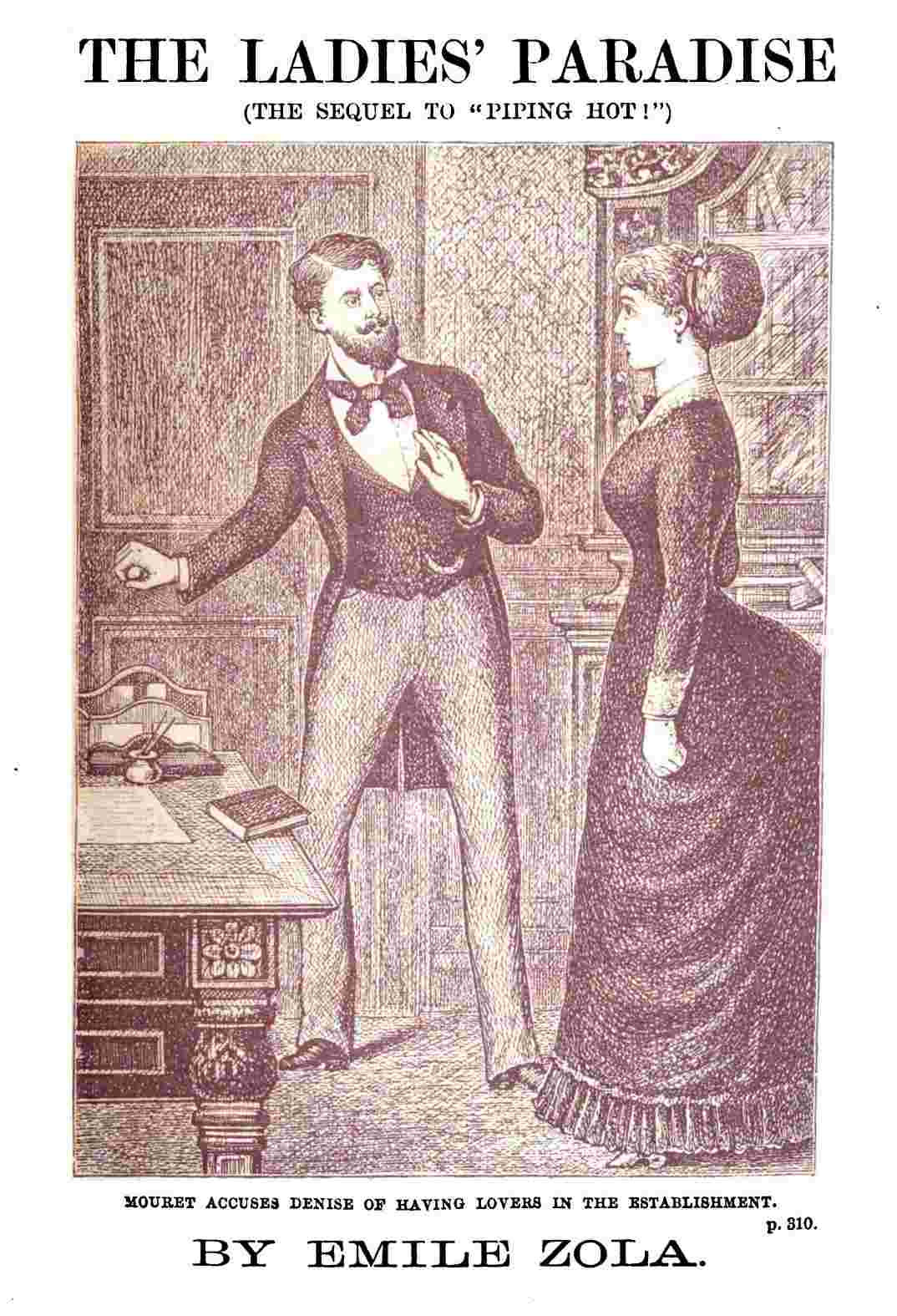
However, Madame Aurélie herself, had just put the mantle on Madame Marty, and they all exclaimed: “Oh! how nice! delightful!” It at once looked quite different. Madame Desforges decided it would be impossible to improve on it.
There was a good deal of bowing. Mouret took his leave, whilst Vallognosc, who had perceived Madame de Boves and her daughter in the lace department, hastened to offer his arm to the mother. Marguerite, standing before one of the pay-desks, was already calling out the different purchases made by Madame Marty, who settled for them and ordered the parcel to be taken to her cab. Madame Desforges had found her articles at pay-desk No. 10. Then the ladies met once more in the oriental saloon. They were leaving, but it was amidst a loquacious feeling of admiration. Even Madame Guibal became enthusiastic.
“Oh! delicious! makes you think you are in the East; doesn't it?”
“A real harem, and not at all dear!”
“And the Smyrnas! oh, the Smyrnas! what tones, what delicacy!”
“And this Kurdestan! Just look, a Delacroix!”
The crowd was slowly diminishing. The bell, at an hour's interval, had already announced the two first dinners; the third was about to be served, and in the departments there were now only a few lingering customers, whose fever for spending had made them forget the time. Outside nothing was heard but the rolling of the last carriages amidst the husky voice of Paris, the snort of a satiated ogre digesting the linens and cloths, silks and lace, with which he had been gorged since the morning. Inside, beneath the flaming gas-jets, which, burning in the twilight, had lighted up the supreme efforts of the sale, everything appeared like a field of battle still warm with the massacre of the various goods. The salesmen, harassed and fatigued, camped amidst the contents of their shelves and counters, which appeared to have been thrown into the greatest confusion by the furious blast of a hurricane. It was with difficulty that one traversed the galleries on the ground floor, blocked up with a crowd of chairs, and in the glove department it was necessary to step over a pile of cases heaped up around Mignot; in the woollen department there was no means of passing at all, Liénard was dozing on a sea of bales, in which certain piles, still standing, though half destroyed, seemed to be houses that an overflowing river was carrying away; and, further on, the linen department was like a heavy fall of snow, one ran up against icebergs of napkins, and walked on light flakes of handkerchiefs.
The same disorder prevailed upstairs in the departments; the furs were scattered over the flooring, the readymade clothes were heaped up like the great-coats of wounded soldiers, the lace and the underlinen, unfolded, crumpled, thrown about everywhere, made one think of an army of women who had disrobed there in the disorder of some sudden desire; whilst downstairs, at the other end of the house, the delivery department in full activity was still disgorging the parcels with which it was bursting, and which were carried off by the vans—last vibration of the overheated machine. But it was in the silk department especially that the customers had flung themselves with the greatest ardour. There they had cleared off everything, there was plenty of room to pass, the hall was bare; the whole of the colossal stock of Paris Paradise had been cut up and carried away, as if by a swarm of devouring locusts. And in the midst of this emptiness, Hutin and Favier were running through the counterfoils of their debit-notes, calculating their commission, still out of breath after the struggle. Favier had made fifteen francs, Hutin had only managed to make thirteen, thoroughly beaten that day, enraged at his bad luck. Their eyes sparkled with the passion for money. The whole shop around them was also adding up figures, glowing with the same fever, in the brutal gaiety of the evening of the battle.
“Well, Bourdoncle!” cried out Mouret, “are you trembling still?”
He had returned to his favourite position at the top of the stairs of the first floor, against the balustrade; and, in the presence of the massacre of stuffs which was spread out under him, he indulged in a victorious laugh. His fears of the morning, that moment of unpardonable weakness which nobody would ever know of, inspired him with a greater desire to triumph. The battle was definitely won, the small tradespeople of the neighbourhood were done for, and Baron Hartmann was conquered, with his millions and his land. Whilst he was looking at the cashiers bending over their ledgers, adding up long columns of figures, whilst he was listening to the sound of the gold, falling from their fingers into the metal bowls, he already saw The Ladies' Paradise growing beyond all bounds, enlarging its hall and prolonging its galleries as far as the Rue du Dix-Décembre.
“And now are you convinced, Bourdoncle,” he resumed, “that the house is really too small? We could have sold twice as much.”
Bourdoncle humbled himself, enraptured, moreover, to find himself in the wrong. But a new spectacle rendered them grave. As was the custom every evening, Lhomme, the chief cashier, had just collected the receipts from each pay-desk; after having added them up, he usually posted up the total amount after placing the paper on which it was written on his file. He then took the receipts up to the chief cashier's office, in a leather case and in bags, according to the nature of the cash. On this occasion the gold and silver predominated, and he was slowly walking upstairs, carrying three enormous bags. Deprived of his right arm, cut off at the elbow, he clasped them in his left arm against his breast, holding one up with his chin to prevent it slipping. His heavy breathing could be heard at a distance, he passed along, staggering and superb, amidst the respectful shopmen.
“How much, Lhomme?” asked Mouret.
“Eighty thousand seven hundred and forty-two francs two sous,” replied the cashier.
A joyous laugh stirred up The Ladies' Paradise. The amount ran through the establishment. It was the highest figure ever attained in one day by a draper's shop.
That evening, when Denise went up to bed, she was obliged to lean against the partition in the corridor under the zinc roof. When in her room, and with the door closed, she fell down on the bed; her feet pained her so much. For a long time she continued to look with a stupid air at the dressing-table, the wardrobe, all the hotel-like nudity. This, then, was where she was going to live; and her first day tormented her—an abominable, endless day. She would never have the courage to go through another. Then she perceived she was dressed in silk; and this uniform depressed her. She was childish enough, before unpacking her box, to put on her old woollen dress, which hung on the back of a chair. But when she was once more dressed in this poor garment of hers, a painful emotion choked her; the sobs which she had kept back all day burst forth suddenly in a flood of hot tears. She fell back on the bed, weeping at the thought of the two children, and she wept on, without feeling to have the strength to take off her boots, completely overcome with fatigue and grief.
CHAPTER V.
The next day Denise had scarcely been downstairs half an hour, when Madame Aurélie said to her in her sharp voice: “You are wanted at the directorate, mademoiselle.”
The young girl found Mouret alone, in the large office hung with green repp. He had suddenly remembered the “unkempt girl,” as Bourdoncle called her; and he, who usually detested the part of fault-finder, had had the idea of sending for her and waking her up a bit, if she were still dressed in the style of a country wench. The previous day, notwithstanding his pleasantry, he had experienced, in Madame Desforges's presence, a feeling of wounded vanity, on seeing the elegance of one of his saleswomen discussed. He felt a confused sentiment, a mixture of sympathy and anger.
“We have engaged you, mademoiselle,” commenced he, “out of regard for your uncle, and you must not put us under the sad necessity——”
But he stopped. Opposite him, on the other side of the desk, stood Denise, upright, serious, and pale. Her silk dress was no longer too big for her, but fitted tight round her pretty figure, displaying the pure lines of her virgin shoulders; and if her hair, knotted in thick tresses, still appeared untidy, she tried at least to keep it in order. After having gone to sleep with her clothes on, her eyes red with weeping, the young girl had felt ashamed of this attack of nervous sensibility on waking up about four o'clock, and she had immediately set about taking in her dress. She had spent an hour before the small looking-glass, combing her hair, without being able to reduce it as she would have liked to.
“Ah! thank heavens!” said Mouret, “you look better this morning. But there's still that dreadful hair!” He rose from his seat and went up to her to try and smooth it down in the same familiar way Madame Aurélie had attempted to do it the previous day. “There! just tuck that in behind your ear. The chignon is too high.”
She did not speak, but let him continue to arrange her hair; notwithstanding her vow to be strong, she had arrived at the office full of misgivings, certain that she had been sent for to be informed of her dismissal. And Mouret's evident kindliness did not reassure her; she still felt afraid of him, feeling when near him that uneasiness which she attributed to a natural anxiety in the presence of a powerful man on whom her fate depended. When he saw her so trembling under his hands, which were grazing her neck, he was sorry for his movement of good-nature, for he feared above all to lose his authority.
“In short, mademoiselle,” resumed he, once more placing the desk between himself and her, “try and look to your appearance. You are no longer at Valognes; study our Parisian young ladies. If your uncle's name has sufficed to gain your admittance to our house, I feel sure you will carry out what your person seemed to promise to me. Unfortunately, everybody here is not of my opinion. Let this be a warning to you. Don't make me tell a falsehood.”
He treated her like a child, with more pity than kindness, his curiosity in matters feminine simply awakened by the troubling, womanly charm which he felt springing up in this poor and awkward child. And she, whilst he was lecturing her, having suddenly perceived Madame Hedouin's portrait—the handsome regular face smiling gravely in the gold frame—felt herself shivering again, notwithstanding the encouraging words he addressed to her. This was the dead lady, she whom people accused him of having killed, in order to found the house with the blood of her body.
Mouret was still speaking. “Now you may go,” said he at last, sitting down and taking up his pen. She went away, heaving a deep sigh of relief.
From that day forward, Denise displayed her great courage. Beneath these rare attacks of sensitiveness, a strong sense of reason was constantly working, quite a feeling of bravery at finding herself weak and alone, a cheerful determination to carry out her self-imposed task. She made very little noise, but went straight ahead to her goal, with an invincible sweetness, overcoming all obstacles, and that simply and naturally, for such was her real character.
At first she had to surmount the terrible fatigues of the department The parcels of garments tired her arms, so much so that during the first six weeks she cried with pain when she turned over at night, bent almost double, her shoulders bruised. But she suffered still more from her shoes, thick shoes brought from Valognes, want of money preventing her replacing them with light boots. Always on her feet, trotting about from morning to night, scolded if seen leaning for a moment against any support, her feet became swollen, little feet, like those of a child, which seemed ground up in these torturing bluchers; her heels throbbed with fever, the soles were covered with blisters, the skin of which chafed off and stuck to the stocking. She felt her entire frame shattered, her limbs and organs contracted by the lassitude of her legs, the certain sudden weaknesses incident to her sex betraying themselves by the paleness of her flesh. And she, so thin, so frail, resisted courageously, whilst a great many saleswomen around her were obliged to quit the business, attacked with special maladies. Her good grace in suffering, her valiant obstinacy maintained her, smiling and upright, when she felt ready to give way, thoroughly worn out and exhausted by work to which men would have succumbed.
Another torment was to have the whole department against her. To the physical martyrdom there was added the secret persecution of her comrades. Two months of patience and gentleness had not disarmed them. She was constantly exposed to wounding remarks, cruel inventions, a series of slights which cut her to the heart, in her longing for affection. They had joked for a long time over her unfortunate first appearance; the words “clogs” and “numbskull” circulated. Those who missed a sale were sent to Valognes; she passed, in short, for the fool of the place. Then, when she revealed herself later on as a remarkable saleswoman, well up in the mechanism of the house, the young ladies arranged together so as never to leave her a good customer. Marguerite and Clara pursued her with an instinctive hatred, closing up the ranks in order not to be swallowed up by this new comer, whom they really feared in spite of their affectation of disdain. As for Madame Aurélie, she was hurt by the proud reserve displayed by the young girl, who did not hover round her skirts with an air of caressing admiration; she therefore abandoned Denise to the rancour of her favourites, to the favoured ones of her court, who were always on their knees, engaged in feeding her with a continual flattery, which her large authoritative person needed to make it blossom forth. For a while, the second-hand, Madame Frédéric, appeared not to enter into the conspiracy, but this must have been by inadvertence, for she showed herself equally harsh the moment she saw to what annoyances her good-nature was likely to expose her. Then the abandonment became complete, they all made a butt of the “unkempt girl,” who lived in an hourly struggle, only managing by the greatest courage to hold her own in the department.
Such was her life now. She had to smile, look brave and gracious in a silk dress which did not belong to her, although dying with fatigue, badly fed, badly treated, under the continual menace of a brutal dismissal. Her room was her only refuge, the only place where she could abandon herself to the luxury of a cry, when she had suffered too much during the day. But a terrible coldness fell from the zinc roof, covered with the December snow; she was obliged to nestle in her iron bedstead, throw all her clothes over her, and weep under the counterpane to prevent the frost chapping her face. Mouret never spoke to her now. When she caught Bourdoncle's severe looks during business hours she trembled, for she felt in him a born enemy who would not forgive her the slightest fault. And amidst this general hostility, Jouve the inspector's strange friendliness astonished her. If he met her in any out-of-the-way corner he smiled at her, made some amiable remark; twice he had saved her from being reprimanded without any show of gratitude on her part, for she was more troubled than touched by his protection.
One evening, after dinner, as the young ladies were setting the cupboards in order, Joseph came and informed Denise that a young man wanted her below. She went down, feeling very anxious.
“Hullo!” said Clara, “the 'unkempt girl' has got a young man.”
“He must be hard up for a sweetheart,” declared Marguerite.
Downstairs, at the door, Denise found her brother Jean. She had formally prohibited him from coming to the shop in this way, as it looked very bad. But she did not dare to scold him, so excited did he appear, bareheaded, out of breath through running from the Faubourg du Temple.
“Have you got ten francs?” stammered he. “Give me ten francs, or I'm a lost man.”
The young rascal looked so comical, with his flowing locks and handsome girlish face, launching out with this melodramatic phrase, that she could have smiled had it not been for the anguish which this demand for money caused her.
“What! ten francs?” she murmured. “Whatever's the matter?”
He blushed, and explained that he had met a friend's sister. Denise stopped him, feeling embarrassed, not wishing to know any more about it. Twice already had he rushed in to obtain similar loans, but the first time it was only twenty-five sous, and the next thirty. He was always getting mixed up with women.
“I can't give you ten francs,” resumed she. “Pépé's board isn't paid yet, and I've only just the money. I shall have hardly enough to buy a pair of boots, which I want badly. You really are not reasonable, Jean. It's too bad of you.”
“Well, I'm lost,” repeated he, with a tragical gesture. “Just listen, little sister; she's a tall, dark girl; we went to the café with her brother. I never thought the drinks——”
She had to interrupt him again, and as tears were coming into his eyes, she took out her purse and slipped a ten-franc piece into his hand. He at once set up a laugh.
“I was sure—But my word of honour! never again! A fellow would have to be a regular scamp.”
And he ran off, after having kissed his sister, like a madman. The fellows in the shop seemed astonished.
That night Denise did not sleep much. Since her entry in The Ladies' Paradise, money had been her cruel anxiety. She was still a probationer, without salary; the young ladies in the department frequently prevented her from selling, and she just managed to pay Pépé's board and lodging, thanks to the unimportant customers they were good enough to leave her. It was a time of black misery—misery in a silk dress. She was often obliged to spend the night repairing her small stack of clothes, darning her linen, mending her chemises as if they had been lace; without mentioning the patches she put on her boots, as cleverly as any bootmaker could have done. She even risked washing things in her hand basin. But her old woollen dress was an especial cause of anxiety to her; she had no other, and was forced to put it on every evening when she quitted the uniform silk, and this wore it terribly; a spot on it gave her the fever, the least tear was a catastrophe. And she had nothing, not a sou, not even enough to buy the trifling articles which a woman always wants; she had been obliged to wait a fortnight to renew her stock of needles and cotton. Thus it was a real disaster when Jean, with his love affairs, dropped down all at once and pillaged her purse. A franc-piece taken away caused a gulf which she did not know how to fill up. As for finding ten francs on the morrow it was not to be thought of for a moment. The whole night she slept an uncomfortable sleep, haunted by the nightmare, in which she saw Pépé thrown into the street, whilst she was turning over the flagstones with her bruised fingers to see if there were not some money underneath.
It happened that the next day she had to play the part of the well-dressed girl. Some well-known customers came in, and Madame Aurélie called her several times in order that she should show off the new styles. And whilst she was posing there, with the stiff graces of a fashion-plate, she was thinking of Pépé's board and lodging, which she had promised to pay that evening. She could very well do without boots for another month; but even on adding the thirty francs she had left to the four francs which she had saved sou by sou, that would never make more than thirty-four francs, and where was she to find six francs to complete the sum? It was an anguish in which her heart failed her.
“You will notice the shoulders are free,” Madame Aurélie was saying. “It's very fashionable and very convenient. The young person can fold her arms.”
“Oh! easily,” replied Denise, who continued to smile amiably. “One can't feel it. I am sure you will like it, madame.”
She now blamed herself for having gone to fetch Pépé from Madame Gras's, the previous Sunday, to take him for a walk in the Champs-Elysées. The poor child so seldom went out with her! But she had had to buy some gingerbread and a little spade, and then take him to see Punch and Judy, and that had mounted at once to twenty-nine sous. Really Jean could not think much about the little one, or he would not be so foolish. Afterwards, everything fell upon her shoulders.
“Of course, if it does not suit you, madame—” resumed the first-hand. “Just put this cloak on, mademoiselle, so that the lady may judge.”
And Denise walked slowly round, with the cloak on, saying: “This is warmer. It's this year's fashion.”
And she continued to torture herself, behind her professional good graces, until the evening, to know where she was to find this money. The young ladies, who were very busy, had left her an important sale; but it was only Tuesday, and she had four days to wait before drawing any money. After dinner she decided to postpone her visit to Madame Gras till the next day. She would excuse herself, say she had been detained, and before then she would have the six francs, perhaps.
As Denise avoided the slightest expense, she went to bed early. What could she do in the streets, with her unsociableness, still frightened by the big city in which she only knew the streets near the shop? After having ventured as far as the Palais-Royal, to get a little fresh air, she would quickly return, lock herself in her room and set about sewing or washing.
It was, along the corridor of the bed-rooms, a barrack-like promiscuity—girls, who were often not very tidy, a gossiping over dirty water and dirty linen, quite a disagreeable feeling, which manifested itself in frequent quarrels and continual reconciliations. They were, moreover, prohibited from going up to their rooms in the day-time; they did not live there, but merely slept there at night, not going up till the last minute, leaving again in the morning still half asleep, hardly awakened by a rapid wash; and this gust of wind which was continually sweeping through the corridor, the fatigue of the thirteen hours' work which threw them on their beds thoroughly worn out, changed this upper part of the house into an inn traversed by the tired ill-temper of a host of travellers. Denise had no friend. Of all the young ladies, one alone, Pauline Cugnot, showed her a certain tenderness; and the ready-made and under-clothing departments being close to one another, and in open war, the sympathy between the two saleswomen had hitherto been confined to a few rare words hastily exchanged. Pauline occupied a neighbouring room, to the right of Denise's; but as she disappeared immediately after dinner and only returned at eleven o'clock, the latter only heard her get into bed, without ever meeting her after business hours.
This evening, Denise had made up her mind to play the part of bootmaker once more. She was holding her shoes, turning them about, wondering how she could make them last another month. At last she decided to take a strong needle and sew on the soles, which were threatening to leave the uppers. During this time a collar and a pair of cuffs were soaking in the basin full of soapsuds.
Every evening she heard the same noises, the young ladies coming in one by one, short whispered conversations, laughing, and sometimes a dispute, which they stifled as much as possible. Then the beds creaked, the tired occupants yawned, and fell into a heavy slumber. Denise's left hand neighbour often talked in her sleep, which frightened her very much at first Perhaps others, like herself, stopped up to mend their things, in spite of the rules; but if so they probably took the same precautions as she did herself, keeping very quiet, avoiding the least shock, for a shivering silence reigned in all the rooms.
It had struck eleven about ten minutes before when a sound of footsteps made her raise her head. Another young lady late! And she recognised it to be Pauline, by hearing the latter open the door next to her.
But she was astonished when Pauline returned quietly and knocked at her door.
“Make haste, it's me!”
The saleswomen not being allowed to visit each other in their rooms, Denise quickly unlocked the door, so that her neighbour should not be caught by Madame Cabin, who was supposed to see this rule strictly carried out.
“Was she there?” asked Denise, closing the door.
“Who? Madame Cabin?” replied Pauline. “Oh, I'm not afraid of her, she's easily settled with a five-franc-piece!” Then she added: “I've wanted to have a talk with you for a long time past. But it's impossible to do so downstairs. Besides, you looked so down-hearted to-night at table.”
Denise thanked her, and invited her to sit down, touched by her good-natured air. But in the trouble caused by the sudden visit she had not laid down the shoe she was mending, and Pauline's eyes fell on it at once. She shook her head, looked round and perceived the collar and cuffs in the basin.
“My poor child, I thought as much,” resumed she. “Ah, I know what it is! When I first came up from Chartres, and old Cugnot didn't send me a sou, I many a time washed my own chemises! Yes, yes, even my chemises! I had two, and there was always one in soak.”
She sat down, still out of breath from running. Her large face, with small bright eyes, and big tender mouth, had a certain grace, notwithstanding the rather coarse features. And, without transition, all of a sudden, she related her history; her childhood at the mill; old Cugnot ruined by a lawsuit; her being sent to Paris to make her fortune with twenty francs in her pocket; then her start as a shop-girl in a shop at Batignolles, then at The Ladies' Paradise—a terrible start, all the sufferings and all the privations imaginable; she then spoke of her present life, of the two hundred francs she earned a month, the pleasures she indulged in, the carelessness in which she allowed her days to glide away. Some jewellery, a brooch, a watch-chain, glistened on her dark-blue cloth dress, coquettishly made to the figure; and she wore a velvet hat, ornamented with a large grey feather.
Denise had turned very red, with her shoe. She began to stammer out an explanation.
“But the same thing happened to me,” repeated Pauline.
“Come, come, I'm older than you, I'm over twenty-six, though I don't look it. Just tell me your little troubles.”
Denise yielded, conquered by this friendship so frankly offered. She sat down in her petticoat, with an old shawl over her shoulders, near Pauline in full dress; and an interesting gossip ensued.
It was freezing in the room, the cold seemed to run down the bare prison-like walls; but they did not notice that their fingers were almost frost-bitten, they were so fully taken up by their conversation. Little by little, Denise opened her heart entirely, spoke of Jean and Pépé, and how much the money question tortured her; which led them both to abuse the young ladies in the dress department. Pauline relieved her mind.
“Oh, the hussies! If they treated you properly and in a friendly manner, you could make more than a hundred francs a month.”
“Everybody is down on me, and I'm sure I don't know why,” said Denise, beginning to cry. “Look at Monsieur Bourdoncle, he's always watching me for a chance of finding me in fault, as if I were in his way. Old Jouve is about the only one——”
The other interrupted her. “What, that old monkey of an inspector! Ah! my dear, don't you trust him. You know, men with big noses like his! He may display his decoration as much as he likes, there's a story about something that happened to him in our department. But what a child you are to grieve like this! What a misfortune it is to be so sensitive! Of course, what is happening to you happens to every one; they are making you pay your footing.”
She seized her hands and kissed her, carried away by her good heart The money-question was a graver one. Certainly a poor girl could not support her two brothers, pay the little one's board and lodging, and regale the big one's mistresses with the few paltry sous picked up from the others' cast-off customers; for it was to be feared that she would not get any salary until business improved in March.
“Listen to me, it's impossible for you to live in this way any longer. If I were you——” said Pauline.
But a noise in the corridor stopped her. It was probably Marguerite, who was accused of prowling about at night to watch the others. Pauline, who was still pressing her friend's hand, looked at her for a moment in silence, listening. Then she resumed in a very low tone, with an air of tender conviction: “If I were you I should take some one.”
“How some one?” murmured Denise, not understanding at first.
When she understood, she withdrew her hands, looking very confused. This advice made her feel awkward, like an idea which had never occurred to her, and of which she could not see the advantage.
“Oh! no,” replied she simply.
“Then,” continued Pauline, “you'll never manage, I tell you so, plainly. Here are the figures: forty francs for the little one, a five franc piece now and again for the big one; and then there's yourself, you can't always go about dressed like a pauper, with boots that make the other girls laugh at you; yes, really, your boots do you a deal of harm. Take some one, it would be much better.”
“No,” repeated Denise.
“Well! you are very foolish. It's inevitable, my dear, and so natural. We all do it sooner or later. Look at me, I was a probationer, like you, without a sou. We are boarded and lodged, it's true; but there's our dress; besides, it's impossible to go without a copper in one's pocket, shut up in one's room, watching the flies. So you see girls forcibly drift into it.”
She then spoke of her first lover, a lawyer's clerk whom she had met at a party at Meudon. After him, came a post-office clerk. And, finally, ever since the autumn, she had been keeping company with a salesman at the Bon Marche, a very nice tall fellow, with whom she spent all her leisure time. Never more than one sweetheart at a time, however. She was very respectable in her way, and became indignant when she heard talk of those girls who yielded to the first-comer.
“I don't tell you to misconduct yourself, you know!” said she quickly. “For instance, I should not like to be seen with your Clara, for fear people should say I was as bad as she. But when a girl stays quietly with one lover, and has nothing to blame herself for—do you think that wrong?”
“No,” replied Denise. “But I don't care for it, that's all.” There was a fresh silence. In the small icy-cold room they were smiling to each other, greatly affected by this whispered conversation. “Besides, one must have some affection for some one before doing so,” resumed she, her cheeks scarlet.
Pauline was astonished. She set up a laugh, and embraced her a second time, saying: “But, my darling, when you meet and like each other! You are funny! People won't force you. Look here, would you like Baugé to take us somewhere in the country on Sunday? He'll bring one of his friends.”
“No,” said Denise, in her gently obstinate way.
Pauline insisted no longer. Each one was free to act as she liked. What she had said was out of pure kindness of heart, for she felt really grieved to see a comrade so miserable. And as it was nearly midnight, she got up to leave. But before doing so she forced Denise to accept the six francs she wanted, begging her not to trouble about the matter, but to repay the amount when she earned more.
“Now,” added she, “blow your candle out, so that they can't see which door opens; you can light it again immediately.”
The candle blown out, they shook hands; and Pauline ran off to her room, without leaving any trace in the darkness but the vague rustling of her petticoats amidst the deep slumber of the occupants of the other little rooms.
Before going to bed Denise wanted to finish her boot and do her washing. The cold became sharper still as the night advanced; but she did not feel it, this conversation had stirred up her heart's blood. She was not shocked, it seemed to her that every one had a right to arrange her life as she liked, when alone and free in the world. She had never given way to such ideas; her sense of right and her healthy nature maintained her naturally in the respectability in which she had always lived. About one o'clock she at last went to bed. No, she did not love any one. So what was the use of disarranging her life, of spoiling the maternal devotion she had vowed for her two brothers? However, she did not sleep; a crowd of indistinct forms passed before her closed eyes, vanishing in the darkness.
From this moment Denise took an interest in the love-stories of the department. During the slack moments they were constantly occupied by their affairs with the men. Gossiping tales flew about, stories of adventures amused the girls for a week. Clara was a scandal; she had three lovers, without counting a string of chance admirers whom she had in tow; and, if she did not leave the shop, where she did the least work possible, disdaining the money which she could easily and more agreeably earn elsewhere, it was to shield herself from her family; for she was mortally afraid of old Prunaire, who threatened to come to Paris and break her arms and legs with his clogs. Marguerite, on the contrary, behaved very well, and was not known to have any lover; this caused some surprise, for all knew of her adventure—her coming to Paris to be confined in secret; how had she come to have the child, if she were so virtuous? And there were some who hinted at an accident, adding that she was now reserving herself for her cousin at Grenoble. The young ladies also joked about Madame Frédéric, declaring that she was discreetly connected with certain great personages; the truth was that they knew nothing of her love-affairs; for she disappeared every evening, stiff as starch in her widow's ill-temper, evidently in a great hurry, though nobody knew where she was running off to so eagerly. As to Madame Aurélie's passions, her pretended larks with obedient young men, they were certainly false; mere inventions, spread abroad by discontented saleswomen just for fun. Perhaps she had formerly displayed rather too much motherly feeling for one of her son's friends, but she now occupied too high a place in the drapery business to allow her to amuse herself with such childish matters. Then there was the crowd leaving in the evening, nine girls out of every ten having young men waiting for them at the door; in the Place Gaillon, along the Rue de la Michodière, and the Rue Neuve-Saint-Augustin, there was always quite a troop of men standing motionless, watching for the girls coming out; and, when they came, each one gave his arm to his lady and disappeared, talking with a marital tranquillity.
But what troubled Denise most was to have discovered Colomban's secret. He was continually to be seen on the other side of the street, at the door of The Old Elbeuf, his eyes raised, and never quitting the young ladies in the readymade department. When he felt Denise was watching him he blushed and turned away his head, as if afraid she might betray him to Geneviève, although there had been no further connection between the Baudus and their niece since her engagement at The Ladies' Paradise. At first she had thought he was in love with Marguerite, on seeing his despairing looks, for Marguerite, being very quiet, and sleeping in the building, was not very easy to get at. But what was her astonishment to find that Colomban's ardent glances were intended for Clara. He had been like that for months, devoured by passion on the opposite side of the way, without finding the courage to declare himself; and that for a girl who was perfectly free, who lived in the Rue Louis-le-Grand, and whom he could have spoken to any evening before she walked off on the arm of a fresh fellow! Clara herself appeared to have no idea of her conquest. Denise's discovery filled her with a painful emotion. Was love, then, such a stupid thing as that? What! this fellow, who had real happiness within his reach, was ruining his life, enraptured with this good-for-nothing girl as if she were a saint! From that day she was seized with a feeling of grief every time she saw Geneviève's pale and suffering face behind the green panes of The Old Elbeuf.
In the evening, Denise could not help thinking a great deal, on seeing the young ladies march off with their sweethearts Those who did not sleep at The Ladies' Paradise, disappeared until the next day, bringing back into their departments an outside odour, a sort of troubling, unknown impression. The young girl was sometimes obliged to reply with a smile to a friendly nod from Pauline, whom Baugé waited for every evening regularly at half-past eight, at the corner of the fountain in the Place Gaillon. Then, after having gone out the last and taken a furtive walk, always alone, she was invariably the first in, going upstairs to work, or to bed, her head filled with dreams, full of curiosity about this outdoor life, of which she knew nothing. She certainly did not envy the young ladies, she was happy in her solitude, in that unsociableness to which her timidity condemned her, as to a refuge; but her imagination carried her away, she tried to guess things, evoking the pleasures constantly described before her, the cafés, the restaurants, the theatres, the Sundays spent on the water and in the country taverns. This filled her with a mental weakness, a desire mingled with lassitude; and she seemed to be already tired of those amusements which she had never tasted.
However, there was but little room for these dangerous dreams in her daily working life. During the thirteen hours' hard work in the shop, there was no time for any display of tenderness between the salesmen and the saleswomen. If the continual fight for money had not abolished the sexes, the unceasing press of business which occupied their minds and fatigued their bodies would have sufficed to kill all desire. But very few love-affairs had been known in the establishment amidst the hostilities and friendships between the men and the women, the constant elbowings from department to department. They were all nothing but the wheels, turned round by the immense machine, abdicating their personalities, simply contributing their strength to this commonplace, powerful total. It was only outside that they resumed their individual lives, with the abrupt flame of awakening passions.
Denise, however, one day saw Albert Lhomme slipping a note into the hand of a young lady in the underclothing department, after having several times passed through with an air of indifference. The dead season, which lasts from December to February was commencing; and she had periods of rest, hours spent on her feet, her eyes wandering all over the shop, waiting for customers. The young ladies of her department were especially friendly with the salesmen who served the lace, but their intimacy never went any further than some rather risky jokes, exchanged in whispers. In the lace department there was a second-hand, a gay youth who pursued Clara with all sorts of abominable stories, simply for a joke—so careless at heart that he made no effort to meet her outside; and thus it was from counter to counter, between the gentlemen and the young ladies, a series of winks, nods, and remarks, which they alone understood. At times they indulged in some sly gossip with their backs half turned and with a dreamy air, in order to put the terrible Bourdoncle off the scent As for Deloche, for a long time he contented him self with smiling at Denise when he met her; but, getting bolder, he occasionally murmured a friendly word. The day she had noticed Madame Aurélie's son giving a note to the young lady in the under-linen department, Deloche was asking her if she had enjoyed her lunch, feeling to want to say something, and unable to find anything more amiable. He also saw the white paper; and looking at the young girl, they both blushed at this intrigue carried on before them.
But under these rumours which gradually awoke the woman in her, Denise still retained her infantine peace of mind. The one thing that stirred her heart was meeting with Hutin. But even that was only gratitude in her eyes; she simply thought herself touched by the young man's politeness. He could not bring a customer to the department without her feeling quite confused. Several times, on returning from a pay-desk, she found herself making a détour, uselessly passing the silk counter, her bosom heaving with emotion. One afternoon she met Mouret there, who seemed to follow her with a smile. He paid no more attention to her now, only addressing a few words to her from time to time, to give her a few hints about her toilet, and to joke with her, as an impossible girl, a little savage almost like a boy, of whom he would never make a coquette, notwithstanding all his knowledge of women; sometimes he even ventured to laugh at and tease her, without wishing to acknowledge to himself the charm which this little saleswoman inspired in him, with her comical head of hair. Before this mute smile, Denise trembled, as if she were in fault Did he know why she was going through the silk department, when she could not herself have explained what made her make such a détour?
Hutin, moreover, did not seem to be aware in any way of the young girl's grateful looks. The shop-girls were not his style, he affected to despise them, boasting more than ever of extraordinary adventures with the lady customers; a baroness had been struck with him at his counter, and the wife of an architect had fallen into his arms one day when he went to her house about an error in measuring he had made. Beneath this Norman boasting he simply concealed girls picked up in cafés and music-halls. Like all young gentlemen in the drapery line, he had a mania for spending, fighting in his department the whole week with a miser's greediness, with the sole wish to squander his money on Sunday on the racecourses, in the restaurants, and dancing-saloons; never thinking of saving a penny, spending his salary as soon as he drew it, absolutely indifferent about the future. Favier did not join him in these parties. Hutin and he, so friendly in the shop, bowed to each other at the door, where all further intercourse ceased. A great many of the shopmen, in continual contact indoors, became strangers, ignorant of each other's lives, as soon as they set foot in the streets. But Liénard was Hutin's intimate friend. Both lived in the same lodging-house, the Hôtel de Smyrne, in the Rue Sainte-Anne, a murky building entirely inhabited by shop assistants. In the morning they arrived together; then, in the evening, the first one free, after the folding was done, waited for the other at the Cafe Saint-Roch, in the Rue Saint-Roch, a little café where the employees of The Ladies' Paradise usually met, brawling, drinking, and playing cards amidst the smoke of their pipes. They often stopped there till one in the morning, until the tired landlord turned them out. For the last month they had been spending three evenings a week at a free-and-easy at Montmartre; and they took their friends with them, creating a success for Mademoiselle Laure, a music-hall singer. Hutin's latest conquest, whose talent they applauded with such violent blows and such a clamour that the police had been obliged to interfere on two occasions.
The winter passed in this way, and Denise at last obtained three hundred francs a-year fixed salary. It was quite time, for her shoes were completely worn out. For the last month she had avoided going out, for fear of bursting them entirely.
“What a noise you make with your shoes, mademoiselle!” Madame Aurélie very often remarked, with an irritated look. “It's intolerable. What's the matter with your feet?”
The day Denise appeared with a pair of cloth boots, for which she had given five francs, Marguerite and Clara expressed their astonishment in a kind of half whisper, so as to be heard.
“Hullo! the 'unkempt girl' has given up her goloshes,” said the one.
“Ah,” retorted the other, “she must have cried over them. They were her mother's.”
In point of fact, there was a general uprising against Denise. The girls of her department had found out her friendship with Pauline, and thought they saw a certain bravado in this affection displayed for a saleswoman of a rival counter. They spoke of treason, accused her of going and repeating their slightest words. The war between the two departments became more violent than ever, it had never waxed so warm; hard words were exchanged like cannon-balls, and there was even a slap given one evening behind some boxes of chemises. Perhaps this remote quarrel arose from the fact that the young ladies in the under-linen department wore woollen dresses, whilst those in the ready-made one wore silk. In any case, the former spoke of their neighbours with the shocked air of respectable girls; and facts proved that they were right, for it had been remarked that the silk dresses appeared to have a certain influence on the dissolute habits of the young ladies who wore them. Clara was taunted with her troop of lovers, even Marguerite had, so to say, had her child thrown in her face, whilst Madame Frédéric was accused of all sorts of concealed passions. And this was solely on account of that Denise!
“Now, young ladies, no ugly words; behave yourselves!” Madame Aurélie would say with her imperial air, amidst the rising passions of her little kingdom. “Show who you are.”
At heart she preferred to remain neutral. As she confessed one day, when talking to Mouret, these girls were all about the same, one was as good as the other. But she suddenly became impassioned when she learnt from Bourdoncle that he had just caught her son downstairs kissing a young girl belonging to the under-linen department, the saleswoman to whom he had passed several letters. It was abominable, and she roundly accused the under-linen department of having laid a trap for Albert. Yes, it was a got-up affair against herself, they were trying to dishonour her by ruining a child without experience, after seeing that it was impossible to attack her department. Her only object in making such a noise was to complicate the business, for she knew what her son was, fully aware that he was capable of doing all sorts of stupid things. For a time the matter assumed a grave aspect, Mignot, the glove salesman, was mixed up in it. He was a great friend of Albert's, and the rumour got circulated that he favoured the mistresses Albert sent him, girls with big chignons, who rummaged in the boxes for hours together; and there was also a story about some Swedish kid gloves given to the girl of the under-linen department which was never properly cleared up. At last the scandal was hushed up out of regard for Madame Aurélie, whom Mouret himself treated with deference. Bourdoncle contented himself a week after with dismissing, for some slight offence, the girl who allowed herself to be kissed. If they shut their eyes to the terrible doings of their employees outdoors, the managers did not tolerate the least nonsense in the house.
And it was Denise who suffered for all this. Madame Aurélie, although perfectly well aware of what was going on, nourished a secret rancour against her; she saw her laughing one evening with Pauline, and took it for bravado, concluding that they were gossiping over her son's love-affairs. And she caused the young girl to be isolated more than ever in the department. For some time she had been thinking of inviting the young ladies to spend a Sunday near Rambouillet, at Rigolles, where she had bought a country house with the first hundred thousand francs she had saved; and she suddenly decided to do so; it would be a means of punishing Denise, of putting her openly on one side. She was the only one not invited. For a fortnight in advance, nothing was talked of but this party; the girls kept their eyes on the sky, and had already mapped out the whole day, looking forward to all sorts of pleasures: donkey-riding, milk and brown bread. And they were to be all women, which was more amusing still! As a rule, Madame Aurélie killed her holidays in this way, going out with her lady friends; for she was so little accustomed to being at home, she always felt so uncomfortable, so strange, during the rare occasions she could dine with her husband and son, that she preferred to throw up even those occasions, and go and dine at a restaurant. Lhomme went his own way, enraptured to resume his bachelor existence, and Albert, greatly relieved, went off with his beauties; so that, unaccustomed to being at home, feeling in each other's way, and wearying each other when together on a Sunday, they paid nothing more than a flying visit to the house, as to some common hôtel where people take a bed for the night. Regarding the excursion to Rambouillet, Madame Aurélie simply declared that propriety prevented Albert joining them, and that the father himself would display great tact by refusing to come; a declaration which enchanted the two men. However, the happy day was drawing near, and the young girls chattered more than ever, relating their preparations in the way of dress, as if they were going on a six months' tour, whilst Denise had to listen to them, pale and silent in her abandonment.
“Ah, they make you wild, don't they?” said Pauline to her one morning. “If I were you I would just catch them nicely! They are going to enjoy themselves. I would enjoy myself too. Come with us on Sunday, Baugé is going to take me to Joinville.”
“No, thanks,” said the young girl with her quiet obstinacy.
“But why not? Are you still afraid of being taken by force?”
And Pauline, laughed heartily. Denise also smiled. She knew how such things came about; it was always during some similar excursions that the young ladies had made the acquaintance of their first lovers, brought by chance by a friend; and she did not want to.
“Come,” resumed Pauline, “I assure you that Baugé won't bring any one. We shall be all by ourselves. As you don't want to, I won't go and marry you off, of course.”
Denise hesitated, tormented by such a strong desire to go that the blood flew to her cheeks. Since the girls had been talking about their country pleasures she had felt stifled, overcome by a longing for fresh air, dreaming of the tall grass into which she could sink down up to the neck, of the giant trees the shadows of which should flow over her like so much cooling water. Her childhood, spent in the rich verdure of the Cotentin, was awakening with a regret for sun and air.
“Well! yes,” said she at last.
Everything was soon arranged. Baugé was to come and fetch them at eight o'clock, in the Place Gaillon; from there they would take a cab to the Vincennes Station. Denise, whose twenty-five francs a month was quickly swallowed up by the children, had only been able to do up her old black woollen dress, by trimming it with strips of check poplin; and she had also made herself a bonnet, a shape covered with silk and ornamented with a simple blue ribbon. In this simple attire she looked very young, like an overgrown girl, exceedingly clean, rather shamefaced and embarrassed by her luxuriant hair, which appeared through the nakedness of her bonnet.
Pauline, on the contrary, displayed a pretty violet and white striped silk dress, a hat richly trimmed and laden with feathers, jewels round her neck and rings on her fingers, which gave her the appearance of a well-to-do tradesman's wife. It was like a Sunday revenge on the woollen dress she was obliged to wear all the week in the shop; whilst Denise, who wore her uniform silk from Monday to Saturday, resumed, on Sunday, her thin woollen dress of misery.
“There's Baugé,” said Pauline, pointing to a tall fellow standing near the fountain.
She introduced her lover, and Denise felt at her ease at once, he seemed such a nice fellow. Baugé, big, strong as an ox, had a long Flemish face, in which his expressionless eyes twinkled with an infantine puerility. Born at Dunkerque, the younger son of a grocer, he had come to Paris, almost turned out by his father and brother, who thought him a fearful dunce. However, he made three thousand five hundred francs a year at the Bon Marche. He was rather stupid, but a very good hand in the linen department. The women thought him nice.
“And the cab?” asked Pauline.
They had to go as far as the Boulevard. It was already rather warm in the sun, the glorious May morning seemed to laugh on the street pavement. There was not a cloud in the sky; quite a gaiety floated in the blue air, transparent as crystal. An involuntary smile played on Denise's lips; she breathed freely; it seemed to her that her bosom was throwing off the stifling sensation of six months. At last she no longer felt the stuffy air and the heavy stones of The Ladies' Paradise weighing her down! She had then the prospect of a long day in the country before her! and it was like a new lease of life, an endless joy, into which she entered with all the glee of a little child. However, when in the cab, she turned her eyes away, feeling very awkward as Pauline bent over to kiss her lover.
“Oh, look!” said she, her head still at the window, “there's Monsieur Lhomme. How he does walk!”
“He's got his French horn,” added Pauline, leaning out. “What an old stupid! One would think he was running to meet his girl!”
Lhomme, with his instrument under his arm, was spinning along past the Gymnase Theatre, his nose in the air, laughing with delight at the thought of the treat in store for him. He was going to spend the day at a friend's, a flautist at a small theatre, where a few amateurs indulged in a little chamber music on Sundays as soon as breakfast was over.
“At eight o'clock! what a madman!” resumed Pauline. “And you know that Madame Aurélie and all her clique must have taken the Rambouillet train that left at half-past six. It's very certain the husband and wife won't come across each other.”
Both then commenced talking of the Rambouillet excursion. They did not wish it to be rainy for the others, because they themselves would be obliged to suffer as well; but if a cloud could burst over there without extending to Joinville, it would be funny all the same. Then they attacked Clara, a dirty slut, who hardly knew how to spend the money her men gave her: hadn't she bought three pairs of boots all at the same time, which she threw away the next day, after having cut them with her scissors, on account of her feet, which were covered with bunions. In fact, the young ladies were just as bad as the fellows, they squandered everything, never saving a sou, wasting two or three hundred francs a month on dress and dainties.
“But he's only got one arm,” said Baugé all of a sudden. “How does he manage to play the French horn?”
He had kept his eyes on Lhomme. Pauline, who sometimes amused herself by playing on his stupidity, told him the cashier kept the instrument up by placing it against a wall. He thoroughly believed her, and thought it very ingenious. Then, when stricken with remorse, she explained to him in what way Lhomme had adapted to his stump a system of keys which he made use of as a hand, he shook his head, full of suspicion, declaring that they wouldn't make him swallow that.
“You are ready too stupid!” she retorted, laughingly. “Never mind, I love you all the same.”
They reached the Vincennes Station just in time for a train. Baugé paid; but Denise had previously declared that she wished to pay her share of the expenses; they would settle up in the evening. They took second-class tickets, and found the train full of a gay noisy throng. At Nogent, a wedding-party got out, amidst a storm of laughter. At last they arrived at Joinville and went straight to the island to order lunch; and they stopped there, lingering on the banks of the Marne, under the tall poplars. It was rather cold in the shade, a sharp breese was blowing in the sunshine, extending far into the distance, on the other side of the river, the limpid parity of a plain dotted with cultivated fields. Denise lingered behind Pauline and her lover, who were walking with their arms round each others waists. She had picked a handful of buttercups, and was watching the view of the river, happy, her heart beating, her head drooping, each time Baugé leant over to kiss his mistress. Her eyes filled with tears. And yet she was not suffering. What was the matter with her that she had this feeling of suffocation? and why did this vast landscape, where she had looked forward to having so much enjoyment, fill her with a vague regret she could not explain? Then, at lunch, Pauline's noisy laugh bewildered her. That young lady, who loved the suburbs with the passion of an actress living in the gas-light, in the thick air of a crowd, wanted to lunch in an arbour, notwithstanding the sharp wind. She was delighted with the sudden gusts which blew up the table-cloth, she thought the arbour very funny in its nudity, with the freshly-painted trelliswork, the lozenges of which cast a reflection on the cloth. She ate ravenously, devouring everything with the voracity of a girl badly fed at the shop, making up for it outside by giving herself an indigestion with the things she liked; this was her vice, she spent most of her money in cakes and indigestible dainties of all kinds, favourite dishes stowed away in her leisure moments. As Denise seemed to have had enough of the eggs, fried fish, and stewed chicken, she restrained herself, not daring to order any strawberries, a luxury still very dear, for fear of running the bill up too high.
“Now, what are we going to do?” asked Baugé when the coffee was served.
As a rule Pauline and he returned to Paris to dine, and finish their day in some theatre. But at Denise's request, they decided to stay at Joinville all day; they would be able to have their fill of the country. So they stopped and wandered about the fields all the afternoon. They spoke for a moment of going for a row, but abandoned the idea; Baugé was not a good waterman. But they found themselves walking along the banks of the Marne, all the same, and were greatly interested by the life on the river, the squadrons of yawls and other boats, and the young men who formed the crews. The sun was going down, they were returning to Joinville, when they saw two boats coming down stream at a racing speed, exchanging volleys of insults, in which the repeated cries of “Sawbones!” and “Counter-jumpers!” dominated.
“Hallo!” said Pauline, “it's Monsieur Hutin.”
“Yes,” said Baugé, shading his face with his hand, “I recognise his mahogany boat. The other one is manned by students, no doubt.”
And he explained the deadly hatred existing between the young students and the shopmen. Denise, on hearing Hutin's name mentioned, suddenly stopped, and followed, with fixed eyes, the frail skiff spinning along like an arrow. She tried to distinguish the young man among the rowers, but could only manage to make out the white dresses of two women, one of whom, who was steering, wore a red hat. Their voices were drowned by the rapid flow of the river.
“Pitch 'em in, the sawbones!”
“Duck 'em, the counter-jumpers!”
In the evening they returned to the restaurant on the island. But it had turned too chilly, they were obliged to dine in one of the closed rooms, where the table-cloths were still damp from the humidity of the winter. After six o'clock the tables were all occupied, yet the excursionists still hurried in, looking for a corner; and the waiters continued to bring in more chairs and forms, putting the plates closer together, and crowding the people up. It was stifling, they had to open the windows. Outdoors, the day was waning, a greenish twilight fell from the poplars so quickly that the proprietor, unprepared for these meals under cover, and having no lamps, was obliged to put a wax candle on each table. The uproar became deafening with laughing, calling out, and the clacking of the table utensils; the candles flared and melted in the draught from the windows, whilst moths fluttered about in the air, warmed by the odour of the food, and traversed by sudden gusts of cold wind.
“What fun they're having, eh?” said Pauline, very busy with a plate of matelote, which she declared extraordinary. She leant over to add: “Didn't you see Monsieur Albert over there?”
It was really young Lhomme, in the middle of three questionable women, a vulgar-looking old lady in a yellow bonnet, suspiciously like a procuress, and two young girls of thirteen or fourteen, forward and painfully impudent creatures. He, already intoxicated, was knocking his glass on the table, and talking of drubbing the waiter if he did not bring some “liqueurs” immediately.
“Well!” resumed Pauline, “there's a family, if you like! the mother at Rambouillet, the father in Paris; and the son at Joinville; they won't tread on one another's toes!”
Denise, who detested noise, smiled, however, and tasted the joy of ceasing to think, amid such uproar. But all at once they heard a noise in the other room, a burst of voices which drowned the others. They were yelling, and must have come to blows, for one could hear a scuffle, chairs falling down, quite a struggle, amid which the river-cries again resounded:
“Duck 'em, the counter-jumpers!”
“Pitch 'em in, the sawbones!”
And when the hotel-keeper's loud voice had calmed this tempest, Hutin suddenly made his appearance, wearing a red jersey, and a little cap at the back of his head; he had on his arm the tall, fair girl, who had been steering, and who, in order to wear the boat's colours, had planted a bunch of poppies behind her ear. They were greeted on entering by a storm of applause; and his face beamed with pride, he swelled out his chest, assuming a nautical rolling gait, showing off a blow which had blackened his cheek, puffed up with joy at being noticed. Behind them followed the crew. They took a table by storm, and the uproar became something fearful.
“It appears,” explained Baugé, after having listened to the conversation behind him, “it appears that the students have recognised the woman with Hutin as an old friend from their neighbourhood, who now sings in a music-hall at Montmartre. So they were kicking up a row for her. These students never pay their women.”
“In any case,” said Pauline, stiffly, “she's jolly ugly, with her carroty hair. Really, I don't know where Monsieur Hutin picks them up, but they're an ugly, dirty lot.”
Denise had turned pale, and felt an icy coldness, as if her heart's blood were flowing away, drop by drop. She had already, on seeing the boats from the bank, felt a shiver; but now she no longer had any doubt, this girl was certainly with Hutin. With trembling hands, and a choking sensation in her throat, she ceased eating.
“What's the matter?” asked her friend.
“Nothing,” stammered she; “it's rather warm here.”
But Hutin's table was close to theirs, and when he perceived Baugé, whom he knew, he commenced a conversation in a shrill voice, in order to attract further attention.
“I say,” cried he, “are you as virtuous as ever at the Bon Marche?”
“Not so much as all that,” replied Baugé, turning very red.
“That won't do! You know they only take virgins there, and there's a confessional box permanently fixed for the salesmen who venture to look at them. A house where they marry you—no, thanks!”
The other fellows began to laugh. Liénard, who belonged to the crew, added: “It isn't like the Louvre. There they have a midwife attached to the ready-made department. My word of honour!”
The gaiety increased; Pauline herself burst out, the idea of the midwife seemed so funny. But Baugé was annoyed by the jokes about the innocence of his house. He launched out all at once: “Oh, you're not too well off at The Ladies' Paradise. Sacked for the slightest thing! And a governor who seems to tout for his lady customers.”
Hutin no longer listened to him, but commenced to praise the house in the Place Clichÿ. He knew a young girl there so excessively aristocratic that the customers dared not speak to her for fear of humiliating her. Then, drawing up closer, he related that he had made a hundred and fifteen francs that week; oh! a capital week. Favier left behind with fifty-two francs, the whole lot floored. And it was visible he was bursting with money, he would not go to bed till he had liquidated the hundred and fifteen francs. Then, as he gradually became intoxicated, he attacked Robineau, that fool of a second-hand who affected to keep himself apart, going so far as to refuse to walk in the street with one of his salesmen.
“Shut up,” said Liénard; “you talk too much, old man.”
The heat had increased, the candles were guttering down on to the table-cloths stained with wine; and through the open windows, when the noise within ceased for an instant, there entered a distant prolonged voice, the voice of the river, and of the tall poplars sleeping in the calm night. Baugé had just called for the bill, seeing that Denise was now quite white, her throat choked by the tears she withheld; but the waiter did not appear, and she had to submit to Hutin's loud talk. He was now boasting of being more superior to Liénard, because Liénard cared for nothing, simply squandering his father's money, whilst he, Hutin, was spending his own earnings, the fruit of his intelligence. At last Baugé paid, and the two girls went out.
“There's one from the Louvre,” murmured Pauline in the outer room, looking at a tall thin girl putting on her mantle.
“You don't know her. You can't tell,” said the young man.
“Oh, can't I? They've got a way of draping themselves. She belongs to the midwife's department! If she heard, she must be pleased.”
They got outside at last, and Denise heaved a sigh of relief. For a moment she had thought she was going to die in that suffocating heat, amidst all those cries; and she still attributed her faintness to the want of air. Now she breathed freely in the freshness of the starry night As the two young girls were leaving the garden of the restaurant, a timid voice murmured in the shade: “Good evening, ladies.”
It was Deloche. They had not seen him at the further end of the front room, where he was dining alone, after having come from Paris on foot, for the pleasure of the walk. On recognising this friendly voice, Denise, suffering, yielded mechanically to the want of some support.