
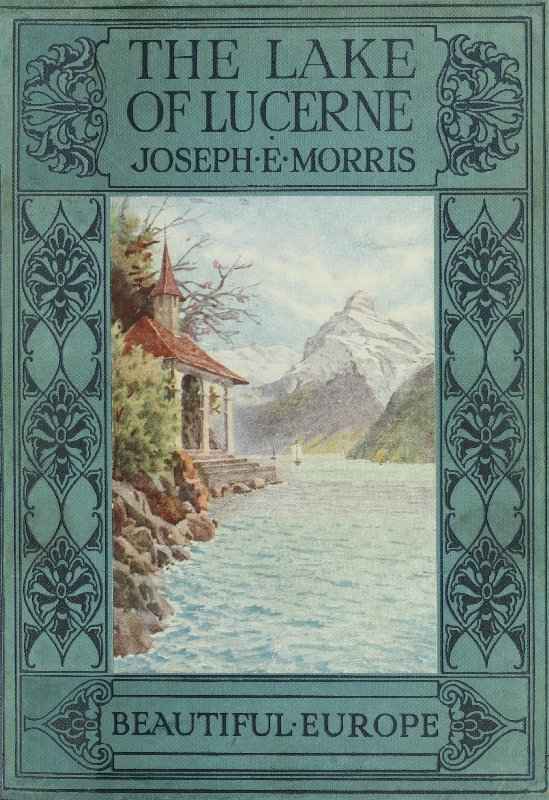
The Project Gutenberg eBook of The Lake of Lucerne
Title: The Lake of Lucerne
Author: Joseph E. Morris
Release date: May 14, 2014 [eBook #45642]
Most recently updated: October 24, 2024
Language: English
Credits: Produced by sp1nd, Charlie Howard, and the Online
Distributed Proofreading Team at http://www.pgdp.net (This
file was produced from images generously made available
by The Internet Archive)
Beautiful Europe
The Lake of Lucerne
By
Joseph E Morris
A. & C. Black, Limited.
Soho Square London W
1919
LIST OF ILLUSTRATIONS
| Flüelen and St. Gothard Valley | Frontispiece |
| FACING PAGE | |
| Pilatus above a Sea of Clouds, from the Base of the Rigi | 9 |
| The Old Bridge, with Shrine, Lucerne | 16 |
| The Gutsch from Lucerne | 19 |
| Old Houses and Bridge at Lucerne | 22 |
| The Seven Towers looking over Lucerne from the Gutsch | 25 |
| Looking across the Lake | 32 |
| Pilatus from Stanstad | 43 |
| Looking up the Lake from Beckenried | 46 |
| Beckenried | 51 |
| Lake Uri from Brunnen | 54 |
| William Tell's Chapel (from a Sketch in 1895) | On the cover |
THE LAKE OF LUCERNE
I
If Lucerne is the most widely advertised lake in the world—if its name, in recent years, has come to be associated, less with ancient gallant exploits of half-legendary William Tells than with cheap Polytechnic Tours and hordes of personally conducted trippers, it has luckily forfeited singularly little of its ancient charm and character, and remains, if you visit it at the right moment—or at any moment, if you are not too fastidious in your claims for solitude and æsthetic exclusiveness—possibly the most beautiful and unquestionably the most dramatic and striking of all the half-dozen or so greater lakes, Swiss or Italian, that cluster round the outskirts of the great central knot of Alps. "Cluster round the outskirts," for it is characteristic of all these lakes, just as it is characteristic of most of our greater English meres at home—of Windermere, for example, or Bassenthwaite, or Ullswater—that, though their upper ends penetrate more or less deeply (and Lucerne and Ullswater more deeply than any) among the bases of the hills, yet their lower reaches, whence discharge the mighty rivers, invariably trail away into open plain, or terminate among mere gentle undulations. Of all this class of lake, then—lakes of the transition—Lucerne is at once the most complex in shape, the least comprehensible in bulk, and the most immediately mountainous in character. The most complex in shape, because, though it is usual to describe this as a cross, yet the cross is so distorted in its lower and major member as practically to lose all really cross-like character, and to remind one rather of a wriggling viper. The least comprehensible in bulk, because there is actually no point on its surface, or on its immediate margin, or perhaps indeed anywhere, whence it is possible to grasp its basin as a whole, as it is possible, for example, in a rough kind of way, to grasp the shape and dimension of such a much larger lake as Geneva from the vineyards in the neighbourhood of Aubonne. The most immediately mountainous in character, because no other big Swiss lake, as already intimated, extends itself so deeply into the heart of giant hills, or is bordered so immediately by steep and rugged mountains. Thus Lucerne gains in surprise and mystery what it loses in simple graciousness; is dramatic and startling where other lakes are tranquil and merely soothing; and is certainly, to sum up, the most splendid and magnificent lake in the Alps, if not the most dignified and beautiful.
II
Those who approach Lucerne directly by the railway fitly approach the most dramatic of lakes by the most dramatic of vestibules. For those who use their eyes, indeed, there are abundant distant hints of the coming splendour; the Alps are first visible, in tolerably clear weather, as we descend the long wall of Jura on to the Aar at Aarberg; and further on, beyond the peaty flats round the Mauensee, and as we quit the lake of Sempach, Pilatus and Rigi, like two tall sentinels—
To sentinel enchanted land"—
come suddenly into view as the railway describes a giant curve, whilst between them, at greater distance, is glimpsed the enchanted land itself, made substantial in the Alps of Unterwalden. Such, too, or something similar, was the young Ruskin's first view of the distant Alps on the Sunday afternoon from the city promenade at Schaffhausen. "Infinitely beyond all that we had ever thought or dreamed—the seen walls of lost Eden could not have been more beautiful to us; not more awful, round heaven, the walls of sacred Death." Yet in spite of these reiterated hints, previsions, and premonitions, when we step finally from the noise, and bustle, and subdued light of the railway-station at Lucerne into the brilliant morning light of the river quays outside, the great vision that then breaks upon us for the first time in its entirety—levels of shining lake, and long, horizontal precipices of wooded Rigi, and beyond, in splendid background, white confusion of shattered Alps,
And snowy dells in a golden air"—
startles and almost shocks us with the same sense of unearthly wonder as when for the first time in childhood the green baize curtain rolls up suddenly, and we gaze, with child's eyes, straight into the green mysteries of fairyland.
This first view, then, of the Vierwaldstättersee from the quays at Lucerne—far more than the first view of Lake Leman from the bridges of Geneva, or of Zurich from the quays of Zurich city—is dramatic in its complete and abrupt transformation, in its turning upside-down, and twisting inside-out, of all our previous conceptions of our commonplace, workaday world! The thing in a way is sensational, but sensational within the modesty of nature, and certainly to be enjoyed at least once in a lifetime, and especially if one happen to be young. If one happen to be older, or has seen the thing before, there is reason good enough to quit the train at Sursee, fifteen miles short of Lucerne, and approach Lucerne thence gradually, on bicycle or foot, by a zig-zag route of gradual introduction that is pursued, I suppose, by hardly anyone, and certainly not by Cook's tourist or Polytechnic student, each of whom has borrowed Atalanta's heels. Sursee itself, though entered by a medieval gateway, has little else to show in the way of particular antiquities. Yet the town itself, in every lane and corner of it, is antiquity itself, and altogether delightful in possession of local colour. This is German Switzerland, and proclaims its Teutonic stamp at every turn: the very gate by which we enter still bears above its arch the double-headed eagle of the Holy Roman Empire. From Sursee inquire your way by the long ascent to the little upland town of Beromünster, where a college for secular canons was founded in the eleventh century. In Murray's invaluable handbook, worth half a dozen Baedekers, it is stated that "the church is eleventh to twelfth century, though much altered in the eighteenth century." The description is misleading, for, though the core may be really old, it is overlaid with later classical work till most traces of medievalism are entirely obscured—the very piers of the nave arcades are monolithic shafts of pink marble. None the less it is well worth visiting, for the sake of its grand Renaissance choir stalls and sunny, silent cloister. Hence to Sempach you may find a pleasant, unfenced lane, through the open pastures and apple-orchards, that falls by easy gradients along the north shore of the placid lake. Sempach is one of the sacred political sites of Switzerland—like Morat, like Morgarten—for here was fought, in 1386, one of those great battles that vindicated her freedom, and linked her name for ever with England's as a synonym for liberty:
One of the mountains."
The legend of Arnold von Winkelried, like that of Tell, has been questioned of recent years; it first appears, more than half a century after the supposed event, "in an interpolated notice in a Zurich chronicle (1438 or later), and a popular song of the latter half of the same century." True or false it will bear retelling, and indicates correctly enough the national spirit, even though it err in narration of historical fact. After all, most children know it by heart: how Arnold von Winkelried, finding it impossible by any other means to break the serried Austrian ranks,
By gath'ring, with a wide embrace,
Into his single heart, a sheaf
Of fatal Austrian spears."
Arnold is said to have come from Stans, where his statue still stands in the market-place; where his armour is still preserved in the Rathhaus; and where it is certain at least that a family of the same name was resident in the neighbourhood at the time of the great fight. His house is also shown on the skirts of the little town—or, more correctly, may be found by those who seek it with much diligence; for though the victory itself is not forgotten in Switzerland, and was, indeed, celebrated with much pomp at its quincentenary in 1886, it is hard to get lucid instructions in Stans itself as to the whereabouts of the national hero's birthplace, or even to authenticate its continued existence. I found it at last—a little old farm in the suburb, "of which one portion, including a low archway with groined entrance and low pillars, may be as old as the time of Winkelried."
Sempach itself, like Sursee, is a picturesque old town, with another quaint old gateway. The lake, though five miles long, is quite outside the mountains, though the splintered crags of Pilatus give a distant hint of Alpine splendour. The remaining nine miles or so to Lucerne are perhaps a trifle dull, and the entrance to the city is through the usual straggling suburb—out of all reasonable proportion to the place itself—that conducts us too frequently to a town in Switzerland.
III
In France I always reckon that a town of less than fifty thousand people is likely to retain untouched its medieval character, or at any rate its atmosphere of the sixteenth or seventeenth century. Exceptions of course occur—I make one in the case of Aix-en-Provence, which seems to have been mostly rebuilt, though in very delightful fashion, as late as the eighteenth century. Mere modern watering-place growths, again, like Biarritz or Vichy, must also be eliminated—they had obviously no character to lose. But apart from towns like these, my general proposition will be acceptable, I think, to anyone who dwells, on the one hand, on places like Beauvais, or Cambrai, or Chartres, or, on the other, on bigger cities, such as Angers, or Orleans, or Tours. In Switzerland, which appears to me, much more than France, to be bursting with prosperity and redundant population, it seems on the whole harder to suggest a general rule. Neuchâtel, for example, with twenty-five thousand people, is virtually a handsome modern town. Berne, on the contrary, with a population of over ninety thousand, preserves its ancient aspect in remarkable degree. Luckily Lucerne, in a middle position, with a population of forty-one-odd thousand souls, leans more to the example of Berne than to that of Neuchâtel or Lausanne. The immediate front to the lake, of course, just as at Geneva, is blatantly new of mode—it is largely, in fact, a conglomerate of palatial modern hotels. But immediately behind—immediately you quit the broad sweep of quays and promenades, and plunge almost anywhere at random into the network of ancient streets—you are able to forget at once, whether you linger in the shadow of the fifteenth-century church of the Bare-foot Friars (the Barfüsserkirche, or Church of the Franciscans); or bask in open sunlight on the narrow quay, at the back of the sixteenth-century Rathhaus, by the side of the green and rushing Reuss; or climb the steep pitch of hill behind the town to the line of ancient walls, with their long line of stately watch-towers (like those at Fribourg and Morat) that stretches with so much picturesque dignity across the base of the blunt angle—so blunt as scarcely to be an angle at all—between the river and the lake; or seek shelter from the glare in the long galleries of the two old wooden bridges, with their mellow red-tiled roofs, that manage to survive across the river—plunge, I repeat, where you will into this labyrinth of old thoroughfares, with their plastered and painted house-fronts, and gaily splashing fountains in courts and corners, and broad eaves that project far across the street, and you are reminded at every step, not of the modern tourist resort of world-wide reputation that is visited by hundreds of thousands of tourists every year, but of that old Lucerne that grew up gradually round the Benedictine monastery that was founded here in the year 750, or thereabouts, by the abbots of Murbach in Alsace, and that gets its name from that St. Leodegar, or Leger, who was patron of the monastery. The monks gave way to a college of secular canons in 1455. Unhappily, of the old collegiate church there are virtually no remains. The twin west spires, indeed, date from the beginning of the sixteenth century, and are good Flamboyant Gothic; but the body of the existing building was erected after a fire in 1633—the date is on the west doorway—and is purely Classical, though quite a good example of its particular style and date. Correspondingly late is the woodwork inside, including the fine stalls in the choir. Other points of interest will be found by those who seek for them: the panels of old glass (one is dated 1650); the ironwork and carving of the great west door; and the two richly sculptured reredoses at the ends of the two aisles, one of which has a Pietà, and one a Death of the Virgin. Even more remarkable is the stately, classical cloister that encompasses the whole church like an Italian Santo Campo. All is very splendid, yet all would be gladly surrendered in exchange for what the relentless flames devoured in 1633. The one is a work of the completed Renaissance—learned, correct, and conscious, but perhaps a trifle cold. The other, we may be certain, though it may have presented to the critic a thousand faults of detail, whispered at least from its dim aisles and chapels "the last enchantments of the Middle Age." The one is the laborious product of the textbook and the studio; the other the inevitable offspring of a vigorous and vital art. The one is the clever expression of an individual talent; the other the collective offering of a people's enthusiasm and faith.
The Hofkirche, then, may be entered casually, examined superficially, and quitted without regret. Time will be better spent in lingering on the old wooden foot-bridges that still span the green and insurgent Reuss at some little distance below its exit from the lake. Formerly there were three; but the longest—the old Hof-brücke—was sacrificed in 1852 to the passion for spurious improvement. Of the two that survive, the Kapell-Brücke is by far the most important, and apparently gets its name from the old St. Peter's Chapel on the north shore of the river, to which it leads diagonally across the clear and voluminous stream. In actual touch with this, but nearer the southern shore, rises the picturesque old Wasserturm, which is said once to have served as a lighthouse (lucerna), and to have given Lucerne its name. The Premonstratensian Abbey of La Lucerne, near Avranches, in Normandy, is stated in Joanne's handbook to have got its title from the same source; but the Swiss Lucerne is perhaps better derived (I do not profess to understand by what strange process of corruption) from the name of its patron, Leodegar. Anyhow, this old Water-Tower is a decidedly striking object, and conspicuous in most photographs and pictures of Lucerne, with its typical octagonal cap. Both the two old wooden bridges, as is common in Switzerland, are protected from the weather by open timber roofs; and inserted in the framing of these last is a series of eighteenth-century paintings, representing, in the case of the Kapell-Brücke, scenes from the history of the city, and from the lives of its patronal saints, St. Mauritius and St. Leodegar; and in the case of the lesser Spreuer, or Mühlen, Brücke a late, post-medieval representation of the grim, medieval humours of the ghastly Dance of Death. This strange memento mori was a favourite morality of the Middle Time; Death in the form of a skeleton (Wordsworth's "Death the Skeleton") presents himself in turn to all kinds and conditions of men—in the great series at the old abbey church of La Chaise-Dieu (Haute-Loire) in France to actually not less than thirty-five, now setting his foot with timid determination on the trailing robe of a sacrosanct Pope; now greeting with mocking glance a Cardinal, who averts his head with hasty terror; now dancing with insolent familiarity in front of an aged man; now laying his bony grasp on a troubadour, who lets his mandoline clatter to the ground in access of sudden fear. These are subjects depicted at La Chaise-Dieu; but just the same spirit of gruesome raillery inspires the danse macabre wherever found:
Est sujet à ses lois;
Et la garde qui veille aux barrières du Louvre
N'en défend pas nos rois."
At Hexham there are still four paintings on panel, representing Death with a Pope, an Emperor, a King, and a Cardinal. Browning tells us in connection with the old revellers of Venice how
Where men never see the sun";
but the Death of the danse macabre at Hexham, as perhaps always, so far from stepping tacitly, is a grinning and grisly contortionist, writhing his repulsive anatomy into a dozen different shapes of derision. The victims alone have dignity, whilst Death is merely the jester or buffoon. Different, indeed, is the shadowy Death of the Apocrypha—"And I saw, and behold, a pale horse, and he that sat upon him, his name was Death"; or the mysterious, shrouded, blood-sprinkled figure (to couple small images with great) of the Masque of the Red Death. These particular paintings at Lucerne are necessarily small in scale, and perhaps not very legible in the dim recesses of the roof. I have never had the patience to decipher them, nor do they perhaps conform, since so unusually late in date, to the stereotyped convention of the fourteenth and fifteenth centuries.
There is just one other spot in Lucerne which ought not to be neglected, and this, though sufficiently far removed from Death in his merely antic aspect—from the Death of "graves, of worms, and epitaphs"—has also to do with Death in his nobler guise, for it is the monument of the twenty-six Swiss officers, and seven hundred and sixty Swiss Guards, who fell in defending the Tuileries and their King on August 10, 1792. "Honour to you, brave men," writes Carlyle, "honourable pity, through long times! Not martyrs were ye; and yet almost more. He was no King of yours, this Louis; and he forsook you like a King of shreds and patches; ye were but sold to him for some poor sixpence a day; yet would ye work for your wages, keep your plighted word. The work now was to die; and ye did it." The monument is fitly a lion, and was hewn out by Lukas Ahorn of Constance, after the model of Thorwaldsen, from a face of living rock; he is pierced by a broken lance and already at point of death, one paw hangs forward limp and helpless, but the other, with claws outstretched, still clutches and guards the Bourbon lilies—a monument of faithfulness to death. The attitude and face of the great lion, "having the most touching expression of broken strength, subdued pain, and courageous self-surrender," are both very grandly conceived. It is sad indeed that the rock itself, though the sculpture is boarded up to protect it from winter frosts, is badly cracked in more than one direction. Closely adjacent to this fine monument, and certainly worth a visit, is the very curious Gletscher Garten, with its wonderful "pot-holes," or "glacier-mills," some of which retain their "mill-stones" still in situ.
IV
Looking eastward from the quays or the lake at Lucerne across the shining expanses of water to the great background of snow-clad Alps—visualizing those Alps in memory as we sit later on at home, by the side of a winter fire—most of us have probably an impression only of a very lovely, and very magnificent, but also very vague and inchoate, huddle of confused and indefinite hills. The highest peak seen at Lucerne from the Schweizerhof Quay is apparently the Tödi (11,887 feet), supreme at the point, or very nearly at the point, where Uri, Glarus, and the Grisons meet, and next to this in actual dignity is perhaps the snowy Titlis (10,627 feet), which rises above Engelberg, and also belongs, like the Tödi, to a bunch of three converging cantons—in this case Uri, Unterwalden, and Berne. Yet these two giants, with their groups of attendant satellites, are so remote from the margin of the lake itself, and so lost amidst the company of their hardly less magnificent peers, that they strike one on the whole with less impress of overwhelming individuality—associate themselves on the whole less easily with our necessarily blurred and imperfect recollections of the Vierwaldstättersee when the lake itself is no longer seen—than two other striking hills of far less elevation, and in one case of far less noble outline, that yet rear themselves more immediately from the exact levels of the lake, and that stand more or less aloof, in conspicuous isolation, not merely from one another, but from the general confraternity of hills. Wordsworth reminds us in an admirable sonnet how
Together in immortal books enrolled"—
yet surely not Pelion and Ossa (I have never seen them) dominate Thessaly more insistently, or confront one another with more marked and divergent character across the intervening valley, than Swiss Rigi and Pilatus confront one another across the blue spaces of the Lake of the Four Forest Cantons, or dominate its waters from the exact margin of its shores!
Of these mountain twins of central Switzerland, Pilatus is by far the more imposing, not merely in point of elevation—the Rigi is less by a thousand feet—and immeasurably in grace of peaked and rocky outline, but also in wealth of legendary lore, and even of actual historical significance. Of legend, because Pontius Pilate, according to one account, smitten with remorse after the crucifixion of Our Saviour, ascended these lonely summits in the course of his miserable wanderings, and drowned himself here in the little pool (which is now dried up) on the Bründlen Alp, which lies on the less well-known slopes of the hill descending from the highest peak, or Tomlishorn (6,995 feet), in the direction of the Rumligbach. According, however, to another version, which first appears in the pages of Eusebius, Pontius Pilate committed suicide at Rome; and it was only after a series of strange vicissitudes and wanderings, recalling, though less hallowed than, those of the body of St. Cuthbert, that his corpse was flung at last, like so much carrion, into this little mountain tarn. First it was thrown into the Tiber, but the evil spirit could not rest, and storms and floods that fell upon Rome necessitated its removal to Vienne, near Lyons, where again it found watery burial in the Rhone. Vienne, however, was now visited in turn by commotions like those at Rome; the Lake of Geneva, the next place of interment, proved equally infelicitous; and it was only finally in untrodden solitudes, beneath the grey limestone peaks of the Frackmünd (or Fractus Mons), that the hateful body, which earth refused to receive in peace, was suffered at last to hide itself in uneasy but permanent sepulchre. For "even here the wicked spirit could not rest from evil-doing. Storm and rain enveloped the mountain, the lake burst its banks, Alps were ruined, and herds swept away. At last a travelling scholar confronted the ghost, and by his magic forced him to accept a pact by which, on condition of one day's freedom, he was to remain at rest for the remainder of the year. The bargain was kept. The land was at peace, but yearly on Good Friday any shepherd who approached the haunted tarn saw, seated on a throne of rock above the water, a terrible figure clad in the red robes of magistracy." One would hasten to suppose that the story had been invented in explanation of the name; but the name Pilatus (perhaps from pileatus, the capped mountain, from its well-known cloud-compelling qualities) is said to date only from the eighteenth century, whilst the story is at least as old as the fourteenth.
So far the realm of legend. The realm of actual history is scarcely less astonishing, and attaches itself to legend by imperceptible ties. It is history that the city of Lucerne in the Middle Ages did actually prohibit the ascent of the mysterious hill: it is history that six priests in 1307 were condemned to several months of imprisonment for daring to visit the forbidden lake. The legend of the pact with the travelling scholar had at least one important variant, for it was believed that by throwing a stone into the pool the spirit could be at any time provoked, and his evil influence set free to work havoc on lake and fell. It was to avert this constant menace at the hands of audacity, or scepticism, that the city fathers promulgated the law by which access to the hill was prohibited. It was only with the Renaissance, and with the birth of the new spirit of rationalism, that the old beliefs became untenable, and that the old terrors were rendered empty—as Gareth cleaves the helm of the silent terror that
and reveals inside "the bright face of a blooming boy." The terrors were already grown more than a little threadbare when Conrad Gesner, the naturalist, ascended the mountain in 1555; they must nearly have vanished altogether in another thirty years, when the Curé of Lucerne, "before a crowd of witnesses, flung stones and rubbish into the lake without raising anything more than a ripple." At the bottom, however, of all these wild stories there is a substratum of truth, for Pilatus is really a great brewer of storms, and the peasants of the neighbourhood still prognosticate the weather from the disposition of the clouds upon its summit. Thus Roseberry Topping, in Cleveland, or what greedy iron-masters have left of it, was supposed as long ago as the time of Camden to foretell the coming storm:
Let Cleveland then beware of a clap."
Roseberry and Pilatus are in other respects curiously analogous; each is of a typically peaked appearance; and each is situated on the extreme edge of the hill group to which it belongs. Pilatus, it may be noted, is now ascended by a railway, and thus heaps of "unappreciative trippers" are now lightly conveyed every fine summer day to the once weirdly mysterious summit, to which the medieval climber won only surreptitiously, and perhaps in awe and terror. It is surely the anti-climax of unromantic common sense.
The Rigi, which confronts Pilatus across the lake in such startling dissimilarity, is perhaps the most popular hill in Europe, and is certainly in a sense the most vulgar. It is bad enough that a hill should be desecrated by a single mountain railway: it is intolerable that it should be degraded by three! How many people ascend to the Rigi Kulm on a day of tolerable weather in August from either Vitznau or Arth-Goldau one would hardly dare to guess; how many are housed at night in one or other of the monster hotels—at Rigi Kulm, at Rigi Kaltbad, at Rigi Staffel, at Rigi Scheidegg—that oppress and burden its weary summits is a matter not to be dwelt on. This is not the place to attempt a dissertation on the quæstio vexata of mountain railways. To the writer (who is prejudiced) the thing seems axiomatic: all that goes to make up mountain grandeur, all that is of the spirit,
And what perceive"—
all that renders a mountain a mountain, as opposed to a mere elevated mass of matter—
Inclined at an angle of xty degrees"—
is gone in a moment when you thus strip a hill of its proper attributes—of its mystery, of its remoteness, of its difficulty of access; and there remains nothing save bulk, which you get in the Great Pyramid; and prospect, which you get from the Eiffel Tower; and a clever bit of engineering (diabolically clever), which is just as well got in the Great Wheel at Kensington. Yet frankly it must be confessed that if something had to be sacrificed to gratify the sensation-mongers, and the lazy, and the impotent, the Rigi might best be immolated. Just this one hill, perhaps, might be spared: but was it necessary to bind to the horns of the altar every other hill of medium size in Switzerland—the Niesen, and the Brienzer, Rothhorn, and the Schynige Platte, and the Beatenberg; to say nothing, on the shores of Lake Lucerne itself, in addition to the Rigi, of the Burgenstock, and Pilatus, and the Stanserhorn; and elsewhere in Switzerland of the deeper crime of the Jungfrau, and in Savoy of the crowning infamy of Mont Blanc?
The Rigi, in fact, owing to its peculiar configuration and structure, is less hurt by this eruption of mountain railways than any other mountain in the Alps. The hill is really a whole agglomeration of hills—of which the Rigi Kulm (5,905 feet) is merely the culminating summit—which occupy very roughly the rectangular area that lies between the lakes of Lucerne, Zug, and Lowerz, and are formed largely of horizontal layers of red conglomerate, or pudding-stone, rock. The hill is thus distinctly of the lumpy type of mountain, as opposed to its rival, Pilatus, which belongs to the vertical, or peaked; and owes what beauty it possesses to its long bands of ruddy precipice, down which dangle short spouts of more or less exiguous cascade, and to the solemn masses of dark wood that gird its middle flanks. The towering crags of Pilatus, like tongues of shivering flame, have here no rival in these long, parallel belts of forest, rock, and open lawn, that rise above the lake in stately tier above tier, and are hardly wilder at their summits than along the margin of the lake:
Shade above shade, a woody theatre
Of stateliest view."
It is not difficult among glades like these for a mountain railway to worm its way obscurely, and to hide its ugly presence beneath the garment of thick woods.
It is the fashion to spend the night on the Rigi, and to witness the sunrise next day. The writer has done it once, but the experience was disappointing: it was already broad daylight, and the whole landscape was already coldly visible, when the little group of shivering penitents was marshalled on the summit to watch the up-burst of a sun that itself seemed cold and grey. It may be better worth the trouble if one rises for actual daybreak, or when the sun issues forth more royally from his chamber in the east. On the whole, perhaps, it is better to avoid the Rigi in its stereotyped sensational aspects, and to investigate its secret—for secret to yield it assuredly has—unconventionally, and out of the season. I have crossed its saddle from Goldau to Weggis, between the Rigi Rotstock and the Schild, during the later days of March, when the track by which I climbed was still white with virgin snow. This was, in fact, the old pilgrim path by which devotees once ascended—may possibly still ascend—to worship at the little upland chapel (rebuilt in 1715–21) of Our Lady of the Snow ("Maria zum Schnee"). This shrine is the centre of a little colony, the oldest and quaintest of all that have developed on the Rigi; and just because it lies in a hollow of the summit peaks, and commands no distant views, has escaped the bitter ravages of modern exploitation. The spot is called Rigi Klösterli, because inhabited all the year round by a little group of Capuchin friars from the community at Arth, who dwell in the little hospice and serve the little chapel. This was an old centre for goat-whey cure, and the inns are delightfully old-fashioned of aspect; the whole appearance of the spot, indeed, is full of local character, whereas most other settlements on the Rigi are cosmopolitan and commonplace. The salvation of the place is its utter lack of view: you must scramble up steep grass slopes, towards the south, to the summit of the saddle, to enlarge your horizon in a few steps from a barrier of green hill-side to a prospect so vast that you seem suddenly to have before you all the kingdoms of the earth and the glory thereof. I do not know, indeed, that the actual range of view is greater than that commanded in France from the top of the Puy-de Dôme—
On verra les portes de Rome"—
and certainly it is not so majestic as many more restricted views of particular groups of Alps, seen—as mountain views are almost always seen to best advantage—from the slopes, or from the summits, of lesser hills. But except from the marble roofs of Milan Cathedral there is perhaps no other generally recognized and easily accessible point of view from which it is possible, merely by turning the head, to command so long a line of crowding Alpine summits, extending from the Sentis, in the extreme east, to Pilatus in the west, for a distance of roughly one hundred and twenty miles—
Yet here, when we stand on the crest in unaccustomed solitude in the first stirrings of the spring, when the giant hotels are still mostly shut and empty, and when the high-level railway between the Kaltbad and the Scheidegg is happily obscured beneath icicle and snowdrift, there is yet no intimate revelation of the true inward spirit of Alpine scenery:
Where the birds dare not build nor insect's wing
Flit o'er the herbless granite."
The Land of Promise lies fair before us; but here, on the saddle of the Rigi, we still linger on the threshold, though the biting morning breeze come, pine-scented, through the forest, and though the musical cow-bells tinkle for ever on the "high mountain pastures, where day first appears."
V
Of the five great primary divisions of the Vierwaldstättersee—and one is driven, however anxious to preserve the configuration of the cross, to recognize a fifth, and separate, division in the Bay, or Lake, of Uri—of the five great divisions of the Lake of Lucerne, that which extends to the quays of Lucerne itself is the most placid and domestic in respect of actual shore-line. True, there is always a background of lofty mountain, sufficiently magnificent and sufficiently near at hand to impress itself on the landscape as a component, and even dominant, feature; but the actual littoral in this compartment of the lake—and Lucerne, unlike Zurich or Geneva, but to some extent like Como, is literally partitioned into compartments—is softly arcadian in character, with low, gently swelling hills of slight, inconclusive contour, knee-deep with hay and flowers, and shoulder-deep with apple-blossom and orchard. Next, I think, in ascending scale is the Bay of Küsnacht, so called from the big village at its head. The north-west shore of this is again of mildly pastoral character; but directly from its south-east margin rise the deep, dark woods of the Rigi, supplying that hint of real Alpine sublimity—it is still merely a hint—that is wholly absent from the immediate shores of the little Lucernersee strictly so-called. The road from Lucerne to Küsnacht, where it skirts this bay beyond the big, scrambling village of Meggen, is one of the pleasantest view-points within easy touch of Lucerne whence to enjoy across the water the noble mountain background that screens the south shore of the main lake. On a mild spring evening, when this splendid landscape is an ætherialized study in black and white; when the snowflakes and cowslips are pushing up in thousands through the quickly growing grass; when the host of margent rushes scarcely quivers in the stillness; and when the opposite mountains are reflected without a ripple in the calm and silent lake, it is hard to believe that all this exquisite beauty, which seems so unearthly and unexplored, is really the much boasted, much advertised, much visited "Lovely Lucerne"—it is difficult to realize that the paddle of a steamer ever churns this unruffled mirror, or that the harsh whistle of the ascending locomotive ever wakes the echoes on steadfast Rigi. Those who visit Lucerne only in the deadly oppression of the high season, when every lake-side quay swarms like an ant-hill, and every village rings like Babel, are apt to carry away wrong impressions of this still absolutely unimpaired lake. The playground at seasons is densely packed, but the place has received no permanent wrong; those who can reconcile Nature and a crowd will be happy here even in August, when