
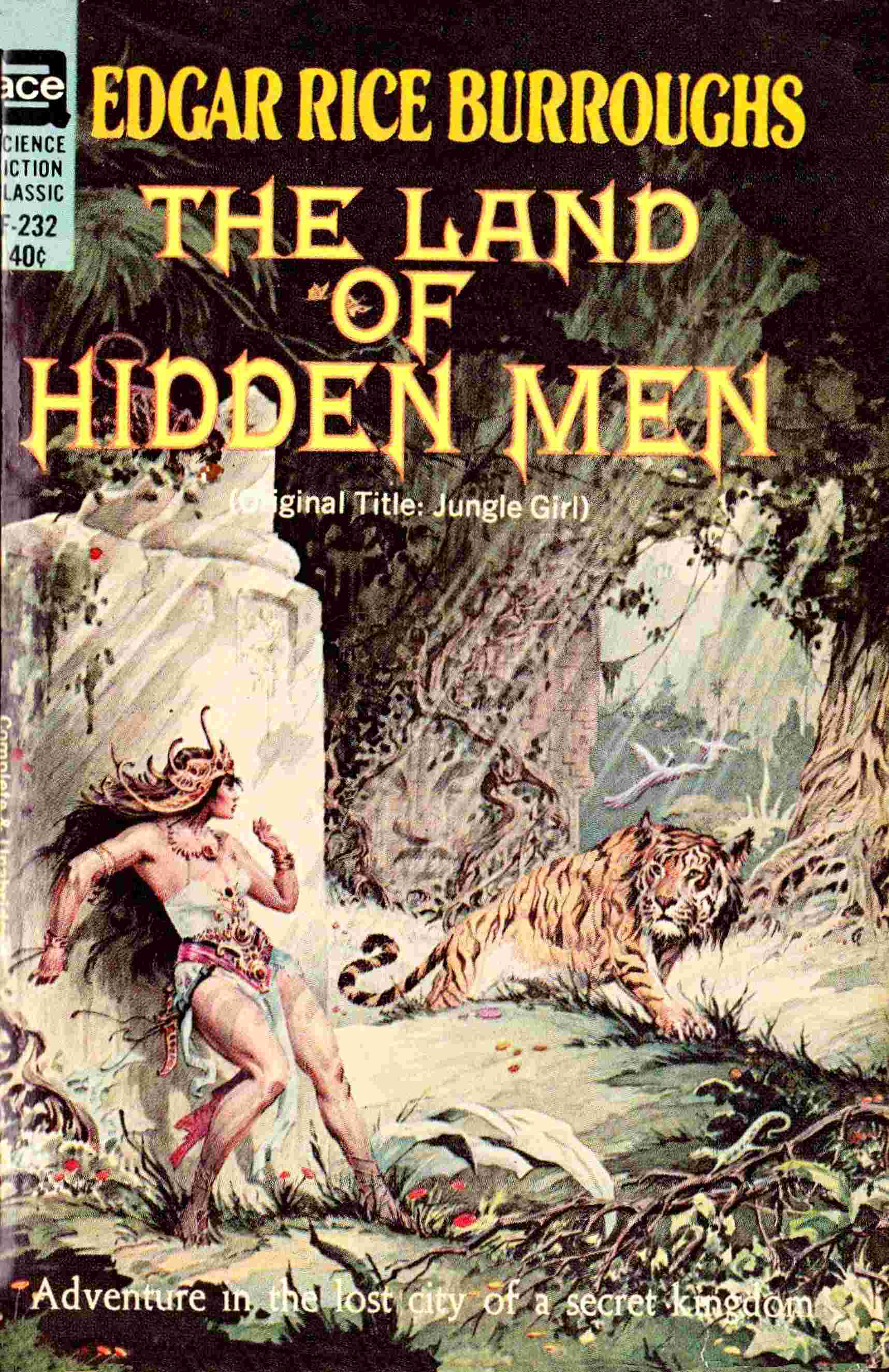
The Project Gutenberg eBook of The land of hidden men
Title: The land of hidden men
Author: Edgar Rice Burroughs
Illustrator: Roy G. Krenkel
Release date: April 12, 2023 [eBook #70536]
Most recently updated: October 21, 2023
Language: English
Original publication: United States: Ace Books, Inc, 1931
Credits: Greg Weeks, Mary Meehan and the Online Distributed Proofreading Team at http://www.pgdp.net
THE LAND OF HIDDEN MEN
EDGAR RICE BURROUGHS
Original Title: Jungle Girl
ACE BOOKS, INC.
1120 Avenue of the Americas
New York 36, N.Y.
This Ace edition follows the text of the first hard-cover edition, published as Jungle Girl in 1932. Original magazine serialization under the title The Land of Hidden Men in Blue Book Magazine in 1931.
Cover art and title-page illustration by Roy Krenkel, Jr.
Printed in U.S.A.
"'There are other things deep in the jungle, my lord, that no man may look upon and live.'
"'What, for example?' demanded King.
"'The ghosts of my ancestors,' answered the Cambodian, 'the Khmers who dwelt here in great cities ages ago. Within the dark shadows of the jungle the ruins of their cities still stand, and down the dark aisles of the forest pass the ancient kings and warriors and little sad-faced queens on ghostly elephants. We might escape My Lord the Tiger and the wild elephants, but no man may look upon the ghosts of the dead Khmers and live.'"
But Gordon King, child of the twentieth century, was not to be frightened away by what seemed foolish superstition. The young American was soon to find that a courageous man might easily enter the treacherous depths of the jungle, but it was quite another matter as to whether he might ever come out again, alive.
THE LAND OF HIDDEN MEN (JUNGLE GIRL)
I
THE JUNGLE
"My Lord, I may go no farther," said the Cambodian.
The young white man turned in astonishment upon his native guide. Behind them lay the partially cleared trail along which they had come. It was overgrown with tall grass that concealed the tree-stumps that had been left behind the axes of the road-builders. Before them lay a ravine, at the near edge of which the trail ended. Beyond the ravine was the primitive jungle untouched by man.
"Why, we haven't even started yet!" exclaimed the white man. "You cannot turn back now. What do you suppose I hired you for?"
"I promised to take my lord to the jungle," replied the Cambodian. "There it is. I did not promise to enter it."
Gordon King lighted a cigarette. "Let's talk this thing over, my friend," he said. "It is yet early morning. We can get into the jungle as far as I care to go and out again before sundown."
The Cambodian shook his head. "I will wait for you here, my lord," he said; "but I may not enter the jungle, and if you are wise you will not."
"Why?" demanded King.
"There are wild elephants, my lord, and tigers," replied the Cambodian, "and panthers which hunt by day as well as by night."
"Why do you suppose we brought two rifles?" demanded the white. "At Kompong-Thom they told me you were a good shot and a brave man. You knew that we should have no need for rifles up to this point. No, sir, you have lost your nerve at the last minute, and I do not believe that it is because of tigers or wild elephants."
"There are other things deep in the jungle, my lord, that no man may look upon and live."
"What, for example?" demanded King.
"The ghosts of my ancestors," answered the Cambodian, "the Khmers who dwelt here in great cities ages ago. Within the dark shadows of the jungle the ruins of their cities still stand, and down the dark aisles of the forest pass the ancient kings and warriors and little sad-faced queens on ghostly elephants. Fleeing always from the horrible fate that overtook them in life, they pass for ever down the corridors of the jungle, and with them are the millions of the ghostly dead that once were their subjects. We might escape My Lord the Tiger and the wild elephants, but no man may look upon the ghosts of the dead Khmers and live."
"We shall be out before dark," insisted King.
"They are abroad both by day and by night," said the Cambodian. "It is the curse of Siva, the Destroyer."
King shrugged his shoulders, stamped out his cigarette and picked up his rifle. "Wait for me here, then," he said. "I shall be out before dark."
"You will never come out," said the Cambodian.
Beyond the ravine, savage, mysterious, rose the jungle, its depth screened from view by the spectral trunks of fromagers and a tangle of bamboo. At first the man could find no opening in that solid wall of vegetation. In its sheath, at his side, hung a heavy knife, but already the young day was so oppressively hot that the man did not relish the idea of exhausting himself at the very outset of his adventure if he could find some easier way. That it would be still hotter he knew, for Cambodia lies but twelve degrees above the equator in the same latitude as Nicaragua, the Sudan, and other places infamous for their heat.
Along the edge of the ravine he searched, until at last he was rewarded by what appeared to be not by any means a trail but a far less formidable growth of bamboo through which he saw that he might easily force his way. Glancing back, he saw his Cambodian guide squatted upon his heels in mournful meditation. For an instant the young man hesitated, as though he was of a mind to try again to persuade the Cambodian to accompany him; but, as though immediately conscious of the futility of any such appeal, he turned again and pushed his way into the jungle.
He had advanced but a short distance when the heavy undergrowth gave way to a much more open forest. The spreading branches of the lofty trees cast upon the ground a perpetual shade, which had discouraged a heavy growth of underbrush.
How different looked the jungle from any picture that his imagination had conjured! How mysterious, but above all, how gloomy and how sinister! A fitting haunt, indeed, for the ghosts of weeping queens and murdered kings. Beneath his breath King cursed his Cambodian guide. He felt no fear, but he did feel an unutterable loneliness.
Only for a moment did he permit the gloom of the jungle to oppress him. He glanced at his watch, opened his pocket compass, and set a course as nearly due north as the winding avenues of the jungle permitted. He may have realised that he was something of a fool to have entered upon such an adventure alone; but it was doubtful that he would have admitted it even to himself, for, indeed, what danger was there? He had, he thought, sufficient water for the day; he was well armed and carried a compass and a heavy knife for trail-cutting. Perhaps he was a little short on food, but one cannot carry too heavy a load through the midday heat of a Cambodian jungle.
Gordon King was a young American who had recently graduated in medicine. Having an independent income, he had no need to practise his profession; and well realising, as he did, that there are already too many poor doctors in the world, he had decided to devote himself for a number of years to the study of strange maladies. For the moment he had permitted himself to be lured from his hobby by the intriguing mysteries of the Khmer ruins of Angkor—ruins that had worked so mightily upon his imagination that it had been impossible for him to withstand the temptation of some independent exploration on his own account. What he expected to discover he did not know; perhaps the ruins of a city more mighty than Angkor Thom; perhaps a temple of greater magnificence and grandeur than Angkor Vat; perhaps nothing more than a day's adventure. Youth is like that.
The jungle that had at first appeared so silent seemed to awaken at the footfall of the trespasser; scolding birds fluttered above him, and there were monkeys now that seemed to have come from nowhere. They, too, scolded as they hurtled through the lower terraces of the forest.
He found the going more difficult than he had imagined, for the floor of the jungle was far from level. There were gulleys and ravines to be crossed and fallen trees across the way, and always he must be careful to move as nearly north as was physically possible, else he might come out far from his Cambodian guide when he sought to return. His rifle grew hotter and heavier; his canteen of water insisted with the perversity of inanimate objects in sliding around in front and bumping him on the belly. He reeked with sweat, and yet he knew that he could not have come more than a few miles from the point where he had left his guide. The tall grasses bothered him most, for he could not see what they hid; and when a cobra slid from beneath his feet and glided away, he realised more fully the menace of the grasses, which in places grew so high that they brushed his face.
At the end of two hours King was perfectly well assured that he was a fool to go on, but there was a certain proportion of bulldog stubbornness in his make-up that would not permit him to turn back so soon. He paused and drank from his canteen. The water was warm and had an unpleasant taste. The best that might be said of it was that it was wet. To his right and a little ahead sounded a sudden crash in the jungle. Startled, he cocked his rifle and stood listening. Perhaps a dead tree had fallen, he thought, or the noise might have been caused by a wild elephant. It was not a ghostly noise at all, and yet it had a strange effect upon his nerves, which, to his disgust, he suddenly realised were on edge. Had he permitted the silly folk tale of the Cambodian to so work upon his imagination that he translated into a suggestion of impending danger every unexpected interruption of the vast silence of the jungle?
Wiping the sweat from his face, he continued on his way, keeping as nearly a northerly direction as was possible. The air was filled with strange odours, among which was one more insistent than the others—a pungent, disagreeable odour that he found strangely familiar and yet could not immediately identify. Lazy air currents, moving sluggishly through the jungle, occasionally brought this odour to his nostrils, sometimes bearing but a vague suggestion of it and again with a strength that was almost sickening; and then suddenly the odour stimulated a memory cell that identified it. He saw himself standing on the concrete floor of a large building, the sides of which were lined with heavily barred cages in which lions and tigers paced nervously to and fro or sprawled in melancholy meditation of their lost freedom; and in his nostrils was the same odour that impinged upon them now. However, it is one thing to contemplate tigers from the safe side of iron bars, and it is quite another thing suddenly to realise their near presence unrestrained by bars of any sort. It occurred to him now that he had not previously considered tigers as anything more serious than a noun; they had not represented a concrete reality. But that mental conception had passed now, routed by the odour that clung in his nostrils. He was not afraid; but realising for the first time, that he was in actual danger, he advanced more warily, always on the alert.
Some marshy ground and several deep ravines had necessitated various detours. It was already almost noon, the time upon which he was determined he must turn back in order that he might reach the point where he had left his guide before darkness fell upon the jungle. Constantly for some time there had lurked within his consciousness a question as to his ability to back-track upon his trail. He had had no experience in woodcraft, and he had already found it far more difficult than he had imagined it would be to maintain a true course by compass; nor had he taken the precautions to blaze his trail in any way, as he might have done by marking the trees with the heavy trail cutter that he carried.
Gordon King was disgusted with himself; he had found no ruins; he was hot, tired and hungry. He realised that he had lost all interest in ruins of any and all descriptions, and after a brief rest he turned back towards the south. It was then, almost immediately, that he realised the proportions of the task that lay ahead of him. For six hours he had been plodding deep into the jungle. If he had averaged two miles an hour, he had covered a distance of twelve miles. He did not know how fast he had walked, but he realised that twelve miles was bad enough when he considered that he had started out fresh and well fortified by a hearty breakfast and that he was returning empty, tired, and footsore.
However, he still believed that he could make the distance easily before dark if he could keep to the trail. He was well prepared physically by years of athletic training, having been a field and track man at college. He was glad now that he had gone in for long distance running; he had won a marathon or two and was never appalled at the thought of long distances to be covered on foot. That he could throw the javelin and hurl the discus to almost championship distances seemed less helpful to him in an emergency of the present nature than his running experience. His only regret on this score was that during the year that he had been out of college he had permitted himself to become soft—a condition that had become increasingly noticeable with every mile that he put behind him.
Within the first minute that Gordon King had been upon the back-trail toward his guide he had discovered that it was absolutely impossible for his untrained eyes to find any sign of the trail that he supposed he had made coming in. The way that he thought he had come, his compass told him, let towards the south-west; but he could find no directing spoor.
With a shake of his head, he resorted again to his compass; but due south pointed into a dense section of jungle through which he was positive he had not come. He wondered whether he should attempt to skirt every obstacle, thereby making long and wide detours or continue straight toward the south, deviating from his direct line only when confronted by insurmountable obstacles. The latter, he felt, would be the shortest way out of the jungle in point of distance, and he was confident that it would bring him as close to his Cambodian guide as any other route that he might elect to follow.
As he approached the patch of jungle that had seemed at first to bar his way completely, he found that it was much more open than he had suspected and that, while the trees were large and grew rather close together, there was little or no underbrush. Glancing often at his compass, he entered the gloomy forest. The heat, which had grown intense, possibly aggravated the fatigue which he now realised was rapidly attaining the proportions of a real menace. He had not appreciated when he stepped out upon this foolish adventure how soft his muscles had become, and as he contemplated the miles and hours of torture that lay ahead of him, he suddenly felt very helpless and alone.
The weight of his rifle, revolver, ammunition, and water represented a definite handicap that he knew might easily defeat his hope of escaping from the jungle before dark. The smell of the great cats was heavy in the air. Against this ever-present premonition of danger, however, was the fact that he had already spent over six hours in the jungle without having caught a glimpse of any of the dread Carnivora. He was convinced, therefore, that he was in little danger of attack by day and that he might have a better chance of getting out of the jungle before dark if he discarded his weapons, which would unquestionably be useless to him after dark.
And then again, he argued, perhaps, after all, there were no man-eaters in the jungle, for he had heard that not all tigers were man-eaters. For the lesser cats, the panthers and leopards, he did not entertain so great a fear, notwithstanding the fact that he had been assured that they were quite as dangerous as their larger cousins. The size, the reputation and the fearful mien of My Lord the Tiger dwarfed his estimate of the formidable nature of the others.
A large, flat stone, backed by denser foliage, suggested that he rest for a moment while deliberating upon the wisdom of abandoning his weapons. The canteen of water, with its depleted store of warm and unpleasant tasting liquid, he knew he must cling to until it had been emptied. Before he sat down upon the stone he leaned his rifle against a tree, and unbuckling the belt which supported his revolver and also held his ammunition, he tossed it upon the ground at his feet. What a relief! Instantly there left him the fear that he might not be able to get out of the jungle before dark. Relieved of what had become a constantly increasing burden, he felt like a new man and equal to any efforts that the return march might demand of him. He seated himself upon the flat rock and took a very small swallow from the contents of his canteen. He had been sparing of his water and he was glad that he had been, for now he was convinced that it would last him through the remainder of the day, giving him strength and refreshment when he would most need them.
As he replaced the screw cap upon his canteen, he chanced to glance at the rock upon which he was sitting and for the first time was struck by the fact that it seemed incongruously out of place in the midst of this jungle of great trees and foliage. Idly he brushed an accumulation of leaf mould from its surface, and what he saw revealed beneath increased his curiosity sufficiently to cause him to expose the entire surface of the rock, disclosing in bold bas-relief the head and shoulders of a warrior.
Here, then, was the reward for which he had struggled; but he found that it left him a little cold. His interest in Khmer ruins seemed to have evaporated beneath the torrid heat of the jungle. However, he still maintained sufficient curiosity to speculate upon the presence of this single relic of the past. His examination of the ruins of Angkor Thom suggested that this must have been a part of some ancient edifice and if this were true the rest must be close at hand—perhaps just behind the screen of jungle that formed the background of this solitary fragment.
Rising, he turned and tried to peer through the foliage, separating the leaves and branches with his hand. A few hours before his heart would have leaped at what he glimpsed vaguely now through the leafy screen—a vast pile of masonry through whose crumbling arches he saw stately columns still defying the ruthless inroads of the jungle in the lonely, hopeless battle they had been waging through the silent centuries.
And then it was that, as he stood gazing, half-fascinated by the tragic magnificence that still clung to this crumbling monument to the transient glories and the vanities of man, his eye was attracted by a movement within the ruins; just a glimpse he got where a little sunlight filtered through a fallen roof—a little patch of fawn with dark brown stripes. In the instant that he saw it, it was gone. There had been no sound, just a passing of something among the ruins. But Gordon King felt the cold sweat upon his brow as hastily he gathered up his belt and buckled it about his waist and seized his rifle. Blessed weight! He thanked God that he had not gone on without it.
Forgotten were the ruins of the Khmers as he strode cautiously on through the forest, constantly alert now, looking to the right and to the left, and turning often a hasty glance behind him. Soft are the pads of the carnivores. They give forth no sound. When the end came, if it did come, he knew that there would be a sudden rush and then the terrible fangs and talons. He experienced the uncanny sensation of unseen eyes upon him. He was sure that the beast was stalking him. It was maddening not to be able to see it again.
He found it necessary to consult his compass frequently in order to keep to his course. His instrument was a small one, constructed like a hunting-case watch. When the catch was released the cover flew open, releasing the needle, which, when the cover was closed, was locked in position, that its bearings might not be injured by sudden changes of position.
King was on the point of checking his direction; but as he held the compass open in his hand, he thought that he heard a slight noise behind him. As he glanced back the toe of his boot struck a rock; and trying to regain his equilibrium, he stumbled into a patch of tumbled sandstone rocks, among which he sprawled heavily upon his face. Spurred by thoughts of the sound that he had heard behind him, he scrambled quickly to his feet; but though he searched the jungle as far as his eyes could reach in every direction, he could discern no sign of any menacing beast.
When he had fallen he had dropped his compass, and now that he was satisfied that no danger lurked in his immediate vicinity, he set about to recover the instrument. He found it quickly enough, but one glance at it sent his heart into his boots—his compass was broken beyond possibility of repair. It was several seconds before the full measure of this calamity unfolded itself to his stunned consciousness.
For a moment Gordon King was appalled by the accident that had befallen him, for he knew that it was a real catastrophe. Practically unversed in woodcraft, he found himself in a jungle overhung by foliage so dense that it was impossible to get his bearings from the sun, menaced by the ever-present danger of the great cats and faced with what he felt now was definite assurance that he would have to spend the night in these surroundings with only a remote likelihood that he ever would be able to find his way out in the event that he did not fall prey to the carnivores or to thirst.
But only momentarily did he permit himself to be crushed by contemplation of his predicament. He was well armed, and he knew that he was resourceful and intelligent. Suddenly there came to him a realisation of something that gave him renewed strength and hope.
Few men know until they are actually confronted by lethal danger whether at heart they are courageous or cowardly. Never before had Gordon King been called upon to make such an appraisal of himself. Alone in this mysterious forest, uninfluenced by the possibilities of the acclaim or reproaches of another, there was borne in upon his consciousness a definite realisation of self-sufficiency. He fully realised the dangers that confronted him; he did not relish them, but he felt no sensation of fear.
A new feeling of confidence pervaded him as he set out again in the direction that he had been going before he had fallen and broken his compass. He was still alert and watchful, but he did not glance behind him as much as he had previously. He felt that he was making good headway, and he was sure that he was keeping a true course toward the south. Perhaps, after all, he would get out before dark, he thought. The condition that irritated him most was his increasing thirst, against which he was compelled to pit every ounce of his will power that he might conserve the small amount of water that remained in his canteen.
The route he was following was much more open than that along which he had entered the jungle, so that he was buoyantly hopeful that he would come out of his predicament and the jungle before night had enveloped the gloomy haunt of the great cats; yet he realised that at best he would win by but a small margin.
He was very tired now, a fact that was borne in upon him by the frequency with which he stumbled, and when he fell he found that each time it was only with increased effort that he rose again to his feet. He was rather angry with himself for this seeming weakness. He knew that there was only one thing that he could do to overcome it, and that thing he could not afford to do, for the fleeting minutes of precious daylight would not pause in their flight while he rested.
As the miles fell slowly and painfully behind him and the minutes raced as though attempting to escape him and leave him to the mercy of the darkness and the tigers, the hope that had been newborn in him for a while commenced to desert him; yet he stumbled wearily on, wondering if the jungle had no end and hoping against hope that beyond the next wall of verdure he would break through into the clearing that would mean life and food and water for him.
"It can't be far now," he thought, "and there must be an hour of full daylight ahead." He was almost exhausted; a little rest would renew his strength, he knew, and there, just ahead of him, was a large, flat rock. He would rest for a moment upon it and renew his strength.
As he seated himself upon this hard resting-place, something upon its surface caught his horrified gaze. It was the head and shoulders of a warrior, cut in bold bas-relief.
II
THE DELIRIUM
There are circumstances in which even the bravest of men experience a hopelessness of utter despair. Such was King's state of mind when he realised that he had wandered in an aimless circle since noon and was back again at his starting-point. Weakened by physical exhaustion and hunger, he contemplated the future with nothing but pessimism. He had had his chance to escape from the jungle, and he had failed. There was no reason to believe that another day might bring greater opportunity. Rest might recoup his strength slightly, but what he needed was food, and on the morrow he would set forth not with a canteen full of water, but with only a few drops with which to moisten his parched throat. He had stumbled through plenty of mud-holes during the day, but he knew that it would doubtless prove fatal to drink from such wells of pollution.
As he stood there with bowed head, searching his mind for some solution of his problem, his eyes gradually returned to focus, and as they did so he saw on the surface of the soft ground beneath his gaze something that, for the moment, drove thoughts of hunger and thirst and fatigue from his mind—it was the pug of a tiger, fresh made in the soft earth.
"Why worry about to-morrow?" murmured King. "If half what that Cambodian told me about this place at night is true, I'll be in luck if I see another to-morrow."
He had read somewhere that tigers started to hunt late in the afternoon, and he knew that they seldom climbed trees; but he was also aware of the fact that leopards and panthers do and that the latter, especially, on account of their size and inherent viciousness, were fully as much to be dreaded as My Lord the Tiger himself. Realising that he must find some sort of shelter as quickly as possible and recalling the ruins that he had seen through the screen of foliage behind the rock before which he stood, he parted the leafy screen ahead of him and forced his way through.
Here the vegetation was less dense, as though the lesser growth of the jungle had halted in fearful reverence before this awe-inspiring work of man. Majestic even in its ruin was the great rectangular pile that loomed clearly now before the eyes of the American. But not all of the jungle had feared to encroach upon its sanctity. Great trees had taken root upon its terraced walls, among its columns and its arches, and by the slow and resistless pressure of their growth had forced aside the supporting foundation and brought much of the edifice into complete ruin.
Just before him rose a tower that seemed better to have withstood the ravages of time than other portions of the building. It rose some sixty feet above the ground, and near the summit was carved in heroic size the face of a god that King suspected was Siva, the Destroyer. A few feet above the rectangular doorway was a crumbling ledge and just above that a smaller opening that might have been a window. Behind it all was dark, but it carried to King's mind the suggestion of a hiding-place—a sanctuary in the very bosom of Siva.
The face of the weather-worn tower offered sufficient foothold for an agile climber, and the way was made easier by the corbelled construction that supported a series of bas-reliefs rising one above another from the ground level to the edge above the doorway. It was not, however, without considerable difficulty that King, already almost exhausted, finally reached the ledge, where he sat down for a moment's rest. Just above him was the opening which he wished to investigate. As he let his thoughts precede him in that investigation of this possible refuge, they discovered, as thoughts are prone to do, enough unpleasant possibilities to cast a pall of gloom over him. Doubtless it was the den of a panther. What more secluded spot could this horrid beast discover in which to lie up after feeding or in which to bear and rear its young?
The suggestion forced him to immediate action. He did not believe that there was any panther there, but he could not endure the suspense of doubt. Cocking his rifle, he arose and approached the opening, the lower sill of which was just about level with his breast as he stood upon the ledge above the doorway. Within all was black and silent. He listened intently. If there were anything hiding there, he should hear it breathe; but no sound broke the utter silence of the tomb-like vault. Pushing his rifle ahead of him, King climbed to the sill, where he remained in silence for a moment until his eyes became accustomed to the gloom of the interior, which was slightly relieved by light filtering in through a crack at one side. A few feet below him was a stone floor, and he could see dimly now that the chamber extended the full breadth and width of the tower. In the centre of the apartment rose something, the nature of which he could not distinguish; but he was sure that it was inanimate.
Stepping down to the floor and advancing cautiously, his rifle ready, King made a complete circuit of the walls. There was no panther there, nor any signs that one ever had been there. Apparently the place had never been entered by any creature since that day of mystery, centuries gone, when the priests and temple girls had departed never to return. Turning toward the object in the centre of the room, King quickly identified it as the symbol of Siva and realised that he was doubtless in the Holy of Holies.
Walking back to the window, he seated himself upon the sill, took a small swallow from his scant store of water and lighted a cigarette; and as the sudden night fell upon the jungle, he heard the crisp fall of padded feet upon dry leaves in the courtyard of the temple beneath him.
His position, well above the floor of the jungle, imparted a feeling of security; and the quiet enjoyment of a cigarette soothed his nerves and, temporarily at least, allayed the gnawing pangs of hunger. He derived a form of mild enjoyment by speculating upon the surprise and consternation of his friends could they visualise his present situation. Perhaps uttermost in his thoughts was Susan Anne Prentice, and he knew that he would be in for a good scolding could she be aware of the predicament into which his silly and ill-advised adventure had placed him.
He recalled their parting and the motherly advice she had given him. What a peach of a girl Susan Anne was! It seemed strange to him that she had never married, for there were certainly enough eligible fellows always hanging around her. He was rather glad that she had not, for he realised that he should feel lost without the promise of her companionship when he returned home. He had known Susan Anne as far back as he could remember, and they had always been pals. In the city of their birth their fathers' grounds adjoined and there was no fence between; at the little lake where they spent their summers they were next-door neighbours. Susan Anne had been as much a part of Gordon King's life as had his father or his mother, for each was an only child and they had been as close to one another as brother and sister.
He remembered telling her, the night before he had left home for this trip, that she would doubtless be married by the time he returned. "No chance," she had said with an odd little smile.
"I do not see why not," he had argued. "I know at least half a dozen men who are wild about you."
"Not the right one," she had replied.
"So there is someone?"
"Perhaps."
He wondered who the fellow could be and decided that he must be an awful chump not to appreciate the wonderful qualities of Susan Anne. In so far as looks were concerned, she had it on all the girls of his acquaintance, in addition whereto she had a good head on her shoulders and was a regular fellow in every other respect. Together they had often bemoaned the fact that she was not a man, that they might have palled around on his wanderings together.
His reveries were blasted by a series of low, coughing roars down there somewhere in the darkness at a little distance from the ruins. They were followed by a crashing sound, as of a large body dashing through underbrush. Then there was a scream and a thud, followed by low growls and silence. King felt his scalp tingle. What tragedy of the jungle night had been enacted in that black, mysterious void?
The sudden and rather terrifying noise and its equally abrupt cessation but tended to impress upon the man and to accentuate the normal, mysterious silence of the jungle. He knew that the jungle teemed with life; yet, for the most part, it moved as silently as might the ghosts of the priests and the temple girls with which imagination might easily people this crumbling ruin of the temple of the Destroyer. Often from below him and from the surrounding jungle came the suggestion of noises—furtive, stealthy sounds that might have been the ghosts of long-dead noises. Sometimes he could interpret these sounds as the cracking of a twig or the rustling of leaves beneath a padded paw, but more often there was just the sense of things below him—grim and terrible creatures that lived by death alone.
And thus the night wore on, until at last day came. He had dozed intermittently, sitting upon the window ledge with his back against its ancient stone frame, his rifle across his lap. He did not feel much refreshed, but when the full light of the day had enveloped the jungle he clambered swiftly down the ruins to the ground and set out once again toward the south, filled with a determination to push on regardless of hunger and fatigue until he had escaped the hideous clutches of this dismal forest, which now seemed to him to have assumed a malignant personality that was endeavouring to foil his efforts and retain him for ever for some sinister purpose of its own. He had come to hate the jungle; he wanted to shout aloud against it the curses that were in his heart. He was impelled to discharge his rifle against it as though it were some creature barring his way to liberty. But he held himself in leash, submerging everything to the desire for escape.
He found that he moved more slowly than he had upon the preceding day. Obstacles were more difficult to surmount, and he was forced to stop more often to rest. These delays galled him; but when he tried to push on more rapidly he often stumbled and fell, and each time he found it more difficult to arise. Then there dawned upon him the realisation that he might not have sufficient strength to reach the edge of the jungle, and for the first time unquestioned fear assailed him.
He sat down upon the ground and, leaning his back against a tree, argued the matter out thoroughly in his own mind. At last his strength of will overcame his fears, so that realisation of the fact that he might not get out that day no longer induced an emotional panic.
"If not to-day, to-morrow," he thought; "if not to-morrow, then the day after. Am I a weakling that I cannot carry on for a few days? Am I to die of starvation in a country abounding in game?"
Physical stamina being so considerably influenced as it is by the condition of the mind, it was with a sense of renewed power that King arose and continued on his way, but imbued now not solely with the desire to escape immediately from the jungle but to wrest from it sustenance and strength that it might be forced to aid him in his escape even though the consummation of his hope might be deferred indefinitely. The psychological effect of this new mental attitude wrought a sudden metamorphosis. He was no longer a hunted fugitive fleeing for his life; he had become in fact a jungle dweller hunting for food and for water. The increasing heat of the advancing day had necessitated inroads upon his scant supply of the latter, yet he still had a few drops left; and these he was determined not to use until he could no longer withstand the tortures of thirst.
He had by now worked out a new and definite plan of procedure; he would work constantly downhill, keeping a sharp look out for game, knowing that eventually he must come to some of the numerous small streams that would ultimately lead him to the Mekong, the large central river that bisects Cambodia on its way to the China Sea; or perchance he might hit upon one of those streams that ran south and emptied into the Tonlé-Sap.
He found it much easier going downhill, and he was glad on this account that he had adopted his present plan. The nature of the country changed a little, too; open spaces were more numerous. Sometimes these flats were marshy, requiring wide detours, and usually they were covered with elephant grass that resembled the cat tails with which he had been familiar as a boy during this summer vacations in the country. He did not like these spaces because they appeared too much the natural habitat of snakes, and he recalled having read somewhere that in a single year there had been sixteen thousand recorded deaths from snake bites in British India alone. This recollection came to him while he was in the centre of a large patch of elephant grass, and consequently he moved very slowly, examining the ground ahead of him carefully at each step. This, of course, necessitated pushing the reeds apart, a slow and laborious procedure; but it also resulted in his moving more quietly; so that when he emerged from the reeds a sight met his eyes that doubtless he would not have seen had he crashed through noisily.
Directly in front of him and maybe fifty paces distant under a great spreading banyan tree lay several wild pigs, all of them comfortably asleep except one old boar, which seemed to be on guard. That King's approach had not been entirely noiseless was evidenced by the fact that the great beast was standing head-on and alert, his ears up-pricked, looking straight at the point at which the man emerged from the elephant grass.
For an instant man and beast stood silently eyeing one another. King saw lying near the boar a half-grown pig, that would make better eating than the tough old tusker. He brought his rifle to his shoulder and fired at the sleeping pig, expecting the remainder of the herd to turn and flee into the jungle; but he had not taken into consideration the violent disposition of the boar. The rest of the herd, awakened with startling suddenness by the unaccustomed report of the rifle, leaped to their feet, stood for an instant in bewilderment, and then turned and disappeared among the undergrowth. Not so the boar. At the crack of the rifle he charged.
There is something rather awe-inspiring in the charge of a wild boar, especially if one happens to be in the path of it, as King was. Perhaps because of his unfamiliarity with the habits of wild boars, the charge was entirely unexpected; and in the brief instant that he had in which to defend himself, he realised that he did not know what was the most vulnerable spot in a boar's anatomy. All that he sensed in that all too short interval were a pair of great flashing tusks, huge jowls, two red-rimmed wicked little eyes, and a stiffly upright tail bearing down upon him with all the velocity and apparently quite the weight of a steam locomotive.
There seemed to be nothing to shoot at but a face. His first shot struck the boar squarely between the eyes and dropped him, but only for an instant. Then he was up again and coming. Giving thanks for a magazine rifle, King pumped three more bullets straight into that terrifying countenance, and to the last one the great beast rolled over against King's feet. None too sure that he had more than stunned him, the man quickly put a bullet through the savage heart.
It had been a close call, and he trembled a little to think what his fate might have been had he been seriously wounded and left there dying in the jungle. Assured that the boar was dead, he went quickly to the pig that had been killed instantly by his first shot. As his knife sank into the flesh, he became suddenly conscious of a change within him. He was moved by urgings that he had never sensed before. He was impelled to bury his teeth in the raw flesh and gorge himself. He realised that this was partially the result of gnawing hunger; but yet it seemed deeper, something primitive and bestial that always had been a part of him but that never before had had occasion to come to the surface. He knew in that brief instant the feeling of the wild beast for its kill. He looked quickly and furtively about to see if there might be any creature bold enough to contest his possession of the fruit of his prowess. He felt the snarling muscles of his upper lip tense and he sensed within him the rumblings of a growl, though no sound passed his lips.
It required a determined effort of will-power to refrain from eating the flesh raw, so hungry was he; but he managed to conquer the urge and set about building a fire, though the meal that he finally produced was scarcely more than a compromise, the meat being charred upon the outside and raw within. After he had eaten he felt renewed strength, but now the tortures of thirst assailed him more poignantly than before. His canteen was empty; and though he had passed by stagnant pools of water during the day, he had been able to resist the temptation to drink, realising, as he did, the germs of terrible fever that lurked in these slimy pools.
The next few days constituted a long nightmare of suffering and disappointment. He found his path toward the Mekong barred by impassable swamps that forced him northward over a broken terrain of ravines and ridges that taxed his rapidly waning strength. For some time after leaving the marshes he had seen no water, but upon the third day he came to a pool in the bottom of a ravine. That it was the drinking-hole of wild beasts was evidenced by the multitude of tracks in the muddy bank. The liquid was green and thick, but not for an instant did the man hesitate. Throwing himself upon his belly, he plunged his hands and face into the foul mess and drank. Neither fever nor death could be worse than the pangs of thirst.
Later that day he shot a monkey and, cooking some of the flesh, appeased his hunger; and thus for several days he wandered, shooting an occasional monkey for food and drinking water wherever he found it. He was always conscious of the presence of the great cats, though only upon one or two occasions did he catch fleeting glimpses of them; but at night he heard them moving softly beneath some tree in which he had found precarious sanctuary, where he crouched nursing the hope that no leopard or panther would discover him. Occasionally he saw small herds of wild elephants, and these he always gave a wide berth. He had long given up all hope of escaping from the jungle, and he could not but wonder at man's tenacity in clinging to life in the face of suffering and hardship when he knew that at best he was but prolonging his agony and only temporarily delaying the inevitable.
Seven days and seven nights he had spent in the jungle, and the last night had been the worst of all. He had dozed intermittently. The jungle had been full of noises, and he had seen strange, dim figures passing beneath him. When the eighth morning broke, he was shivering with cold. His chattering teeth reminded him of castanets. He looked about him for dancers and was surprised that he saw none. Something moved through the foliage of the jungle beneath him. It was yellowish-brown with dark stripes. He called to it and it disappeared. Quite remarkably he ceased to be cold, and instead his body burned as though consumed by internal fires. The tree in which he sat swayed dizzily, and then with an effort he pulled himself together and slipped to the ground. He found that he was very tired and that he was forced to stop to rest every few minutes, and sometimes he shook with cold and again he burned with heat.
It was about noon; the sun was high and the heat terrific. King lay shivering where he had fallen at the foot of a silk-cotton tree, against the bole of which he leaned for support. Far down a jungle aisle he saw an elephant. It was not alone; there were other things preceding it—things that could not be in this deserted primeval jungle. He closed his eyes and shook his head. It was only an hallucination brought on by a touch of fever, of that he was certain. But when he opened his eyes again the elephant was still there, and he recognised the creatures that preceded it as warriors clothed in brass. They were coming closer. King crawled back into the concealing verdure of the underbrush. His head ached terribly. There was a buzzing hum in his ears that drowned all other sounds. The caravan passed within fifty feet of him, but he heard no sound. There were archers and spear men—brown men with cuirasses of burnished brass—and then came the elephant trapped in regal splendour, and in a gorgeous howdah upon its back rode a girl. He saw her profile first, and then as something attracted her attention she turned her face full toward him. It was a face of exquisite and exotic beauty, but a sad face with frightened eyes. Her trappings were more gorgeous than the trappings of the elephant. Behind her marched other warriors, but presently all were gone down the aisles of the jungle in spectral silence.
"Weeping queens on misty elephants!" He had read the phrase somewhere in a book. "Gad!" he exclaimed. "What weird tricks fever plays upon one's brain. I could have sworn that what I saw was real."
Slowly he staggered to his feet and pushed on, whither or in what direction he had no idea. It was a blind urge of self-preservation that goaded him forward; to what goal, he did not know; all that he knew was that if he remained where he was he must inevitably perish. Perhaps he would perish anyway, but if he went on, there was a chance. Figures, strange and familiar, passed in jumbled and fantastic procession along the corridors of his mind. Susan Anne Prentice clothed in brass rode upon the back of an elephant. A weeping queen with painted cheeks and rouged lips came and knelt beside him offering him a draft of cold, crystal-clear water from a golden goblet, but when he lifted it to his lips the goblet became a battered canteen from which oozed a slimy green liquid that burned his mouth and nauseated him. Then he saw soldiers in brass who held platters containing steaming sirloin steaks and French-fried potatoes, which changed magically to sherbert, iced tea, and waffles with maple syrup.
"This will never do," thought King. "I am going absolutely daffy. I wonder how long the fever lasts, or how long it takes to finish a fellow."
He was lying upon the ground at the edge of a little clearing partially hid by the tall grass into which he had sunk. Suddenly everything seemed to whirl around in circles, and then the world went black and he lost consciousness. It was very late in the afternoon when he came to; but the fever seemed to have left him, temporarily at least, and his mind was clear.
"This can't go on much longer," he soliloquised. "If I don't find some place pretty soon where I can lie in safety until after the fever has passed entirely, it will be just too bad. I wonder what it feels like to be mauled by a tiger."
But when he attempted to rise he discovered to his horror that he had not sufficient strength to get to his feet. He still clung to his rifle. He had long since made up his mind that in it lay his principal hope of salvation. Without it, he must go hungry and fall prey to the first beast that attacked him. He knew that if he discarded it and his heavy belt of ammunition he might stagger on a short distance and then, when he fell again, he would be helpless.
As he lay there looking out into the little clearing, speculating upon his fate and trying to estimate the number of hours of life that might remain to him, he saw a strange figure enter the clearing. It was an old man with a straggly white beard growing sparsely upon his chin and upper lip. He wore a long, yellow cloak and a fantastic headdress, above which he carried a red umbrella. He moved slowly, his eyes bent upon the ground.
"Damned fever," muttered King, and shut his eyes.
He kept them closed for a minute or two, but when he opened them the old man was still in sight, though by this time he had almost crossed the clearing, and now there was another figure in the picture. From out of the foliage beyond the clearing appeared a savage, snarling face—a great, vicious, yellow-fanged face; yellowish-white and tan with broken markings of dark brown stripes that looked almost black—a hideous head, and yet, at the same time, a gorgeously majestic head. Slowly, silently the great tiger emerged into the clearing, its gaunt, flat-sided body moving sinuously, its yellow-green eyes blazing terribly at the back of the unconscious old man.
"God, how real!" breathed King. "I could swear that I really saw them both. Only the impossible figure of that old man with the red parasol could convince me that they are both made of the same material as the spectral elephant, the weeping queen, and the brass-bound soldiers."
The tiger was creeping rapidly toward the old man. His speed gradually accelerated.
"I can't stand it," cried King, raising his rifle to his shoulder. "They may be only an hallucination—"
There was a short coughing roar as the tiger charged, and at the same instant King squeezed the trigger of his rifle and fainted.
III
THE HUNTER
Vay Thon, high priest of the temple of Siva in the city of Lodidhapura, was the source of much anxiety on the part of the lesser priests, who felt responsible to Siva and the King for the well-being of Vay Thon. But how might one cope with the vagaries of a weakness so holy and, at the same time, so erratic as that which occasionally claimed the amnesic Vay Thon? They tried to watch over him at all times, but it is difficult to maintain constant espionage over one so holy, whose offices or whose meditations may not lightly be broken in upon by lesser mortals, even though they be priests of the great god, Siva.
All was well when Vay Thon confined himself in his meditations to the innermost sanctum of the Holy of Holies; here, in the safe-keeping of his god, he was isolated from mankind and safe from danger. But the meditations of Vay Thon were not always thus securely cloistered. Often he strolled along the broad terrace beside the mighty temple, where wrapped in utter forgetfulness of himself and of the world he walked in silent communion with his god.
With his long, yellow cloak and his red parasol he was also a familiar figure upon the streets of Lodidhapura. Here he was often accompanied by lesser priests, who walked in cuirasses of polished brass, who marched ahead and in the rear. Of all these symbols of worldly pomp and power, Vay Thon was entirely unconscious. During those periods that he was wrapped in the oblivion of meditation and upon the numerous occasions when he had managed to leave the temple ground unperceived, he had walked through the streets of the city equally unaware of all that surrounded him. Upon three separate and distinct occasions he had been found wandering in the jungle, and Lodivarman, the King, had threatened to wreak dire punishment upon the lesser priests should harm ever befall Vay Thon during one of these excursions.
It so happened that upon this very day Vay Thon had walked out of the city and into the jungle alone. That he had been able to leave a walled city, the gates of which were heavily guarded by veteran warriors, might have seemed a surprising thing to the citizens of Lodidhapura; but not so to the one familiar with the secret galleries that lay beneath the temple and the palace, through which the ancient builders of Lodidhapura might well have expected to flee the wrath of the downtrodden slaves who comprised 75 per cent. of the population. Though times have changed with the passing centuries, the almost forgotten passageways remain. It was through one of these that Vay Thon reached the jungle. He did not know that he was in the jungle. He was as totally oblivious of his surroundings as is one who is wrapped in deep and dreamless sleep.
The last that the lesser priests had seen of Vay Thon was when he had entered the Holy of Holies, which houses the symbol of Siva. As they had noticed a glassy expression in his eyes, they had known that he was entering upon a period of meditation. Therefore, they maintained a watch at the entrance to the chamber, but felt no concern during the passing hours since they knew that Vay Thon was safe. What they did not know of was the loose stone in the flooring of the chamber directly behind the symbol of Siva, or the passageway beneath, which led to a ravine in the jungle beyond the city wall. And so during those hours Vay Thon wandered far into the jungle, and with him, perhaps, walked Siva, the Destroyer.
His rapt meditation, which amounted to almost total unconsciousness of his mundane surroundings, was shattered by a noise of terrific violence such as had never before impinged upon the ears of Vay Thon or any other inhabitant of Lodidhapura. Awakened suddenly as from a deep sleep, the startled priest wheeled about amazed at his surroundings, but more amazed by the sight which greeted his eyes. Wallowing in its own gore scarce three paces behind him lay a great tiger in its death throes; and a little to his right, a wisp of blue smoke rose from some grasses at the edge of the clearing.
When King regained consciousness he was vaguely aware of voices that seemed to be floating in the air about him. The sounds were meaningless, but they conveyed to his fevered brain an assurance of human origin. He opened his eyes. Above him was a brown face. Supporting his head and shoulders he felt the naked flesh of a human arm. His eyes wandered. Standing close was a woman, naked but for a sampot drawn diaperwise between her legs and knotted at the belt. Hiding fearfully behind her was a naked child. The man who supported him spoke to him, but in a language that he could not understand.
From whence had these people come, or were they but figments of his fevered imagination like the old man with the yellow cloak and the red parasol? Were they no more real than the spectral tiger that he had shot at in his delirium? He closed his eyes in an effort to gain control of his senses, but when he opened them again the man and the woman and the child were still there. With a sigh of resignation he gave it up. His throbbing temples were unequal to the demands of sustained thought. He closed his eyes, and his chin dropped upon his breast.
"He is dying," said Che, looking up at the woman.
"Let us take him to our dwelling," replied Kangrey, the woman. "I will watch over him while you lead the holy priest back to Lodidhapura."
As the man lifted King in his arms and turned to carry him away, the American caught a glimpse of an old man in a long, yellow cloak and a strange headdress, who carried above his head a red parasol. The American closed his eyes against the persistent hallucination of his fever. His head swam, and once again he lost consciousness.
King never knew how long he remained unconscious, but when he next opened his eyes he found himself lying upon a bed of grasses in the interior of a dark retreat which he thought, at first, was a cave. Gradually he discerned the presence of a man, a woman, and a child. He did not remember ever having seen them before. The child was naked, and the man and woman were clothed only in sampots. The woman was ministering to him, forcing a liquid between his lips.
Slowly and sluggishly his mind commenced to function, and at last he recalled them—the creatures of the hallucination that had conjured the image of the old man in the yellow cloak with the red parasol, and the charging tiger that he had dreamed of shooting. Would the fever never leave him? Was he to die thus alone in the sombre jungle tortured by hallucinations that might terminate only with his discovery by a tiger?
But yet how real was the feeling and taste of the liquid that the woman was forcing between his lips. He could even feel the animal warmth of the bare arm that was supporting his head and shoulders. Could any figment of a fever-tortured brain be as realistic as these? Repeatedly he closed his eyes and opened them again, but always the same picture was there before him. He raised one hand weakly and touched the woman's shoulder and face. They seemed real. He was almost convinced that they were when he sank again into unconsciousness.
For days Gordon King hovered between life and death. Kangrey, the woman, ministered to him, utilising the lore of the primitive jungle dweller in the brewing of medicinal potions from the herbs of the forest. Of equal or perhaps greater value were certain incantations which she droned monotonously above him.
Little Uda, the child, was much impressed with all these unusual and remarkable occurrences. The stranger with the pale skin was the first momentous event of his little life. The strange clothing that his parents had removed from their helpless charge thrilled him with awe, as did the rifle, the knife, and the revolver, which he rightfully guessed to be weapons, though he had no more conception of the mechanism of the firearms than did his parents. Uda was indefatiguable in his search for the herbs and roots that Kangrey, his mother, required; and when Che returned from the hunt it was always Uda who met him first with a full and complete history of their patient's case brought down to the last minute with infinite attention to details.
At last the fever broke. Though it left King weak and helpless in body, his mind was clear, and he knew at last that the man and the woman and the child were no figments of his imagination. Of course, the old man with the yellow cloak and the red parasol had been but an hallucination of a kind with the charging tiger; but this kindly brown woman, who was nursing him back to health, was real; and his eyes filled as the thanks which he could not voice welled up within his breast.
A day and a night without any return of the fever or hallucination convinced King that the ministration of the kindly natives had rid him of the illness that had nearly killed him, yet he was so weak that he still had little or no hope of ultimate recovery. He had not the strength to raise a hand to his face. It required a real physical effort to turn his head from side to side upon the rough pallet of grasses upon which he lay. He noticed that they never left him alone for long. Either the woman or the child was with him during the day, and all three slept near him upon the floor of their little den at night. In the daytime the woman or the child brushed the flies and other insects from him with a leafy branch and gave him food at frequent intervals. What the food was he did not know except that it was semi-liquid, but now that his fever had passed he was so ravenous that whatever it was they gave him he relished it.
One day when he had been left alone with the little boy longer than usual, the child, possibly tiring of the monotony of brushing insects from the body of the pale one, deserted his post, leaving King alone. King did not care, for much of his time, anyway, was spent in sleep and he had become so accustomed to the insects that they no longer irritated him as they formerly had. He was awakened from a sleep by the feel of a rough hand upon his face. Opening his eyes, he saw a monkey squatting beside him. When King opened his eyes the animal leaped nimbly away, and then the American saw that there were several monkeys in the chamber. They were quite the largest that he had seen in the jungle, and in his helpless condition he knew that they might constitute a real menace to his life. But they did not attack him, nor did they come close to him again; and it soon became evident that their visit was prompted solely by curiosity.
A little later he heard a scraping sound behind him in one corner of the chamber. Having regained his strength during the past few days sufficiently to be able to move his head and hands with comparative ease, he turned his head to see what was going on. The sight that met his eyes would have been highly amusing had it not been fraught with the possibility of such unhappy results.
The monkeys had discovered his weapons and his clothing. All had congregated at the point of interest. They were dragging the things about and chattering excitedly. They seemed to be quarrelling about something; and their chattering and scolding rose in volume until finally one old fellow, who was apparently contesting possession of the rifle with two others, leaped angrily upon them, growling and biting. Instantly the other two relinquished their holds upon the firearm and scurried to a far corner of the chamber; whereupon the victor seized the weapon again and dragged it toward the doorway.
"Hey!" shouted King in the loudest voice he could muster. "Drop that; and get out of here!"
The sound of the human voice seemed to startle the monkeys, but not sufficiently to cause them to relinquish the purpose they had in mind. It is true that they scampered from the chamber, but they gathered up all of King's belongings and took them with them, even to his socks.
King shouted to the boy whom he had heard the parents address as Uda; but when at last the little chap came, breathless and frightened, it was too late to avert or remedy the catastrophe, even if King had been able to explain to Uda what had happened.
The night when she returned, Kangrey found her patient very weak, but she did not guess the cause of it since she could not know that in the mind of the pale one was implanted the conviction that his only hope for eventual escape from the jungle had lain in the protection that the stolen weapons would have afforded him.
The days and nights wore slowly on as gradual convalescence brought returning strength to the sick man. To while away the tedious hours he sought to learn the language of his benefactors; and when, finally, they understood his wish they entered with such spirit into its consummation that he found himself deluged with such a variety of new words that his mind became fogged with information. But eventually some order and understanding came out of the chaos, so that presently he was able to converse with Che and Kangrey and Uda. Thereafter his existence was far less monotonous; but his slow recovery irked and worried him, for it seemed impossible that his strength ever would return. He was so emaciated that it was well for his peace of mind that he had no access to any mirrors.
Yet surely, though slowly, his strength was returning. From sitting up with his back against the wall he came at length to standing upon his feet once more; and though he was weak and tottering, it was a beginning; and each day now he found his strength returning more rapidly.
From talking with Che and Kangrey, King had learned the details of the simple life they led. Che was a hunter. Some days he brought back nothing, but as a rule he did not return without adding to the simple larder. The flesh was usually that of a monkey or bird or one of the small rodents that lived in the jungle. Fish he brought, too, and fruit and vegetables and sometimes wild honey.
Che and Kangrey and Uda were equally proficient in making fires with a primitive fire stick, which they twirled between the palms of their hands. Kangrey possessed a single pot in which all food was cooked. It was a brass pot, the inside of which she kept scrupulously polished, using earth and leaves for this purpose.
Che was, indeed, a primitive hunter, armed with a spear, bow and arrows, and a knife. When King explained to him the merits of the firearms that had been stolen by the monkeys, Che sympathised with his guest in their loss; but he promised to equip King with new weapons such as he himself carried; and King expressed his gratitude to the native, though he could not arouse within himself much enthusiasm at the prospect of facing a long trip through this tiger-infested forest armed only with the crude weapons of primitive man, even were he skilled in their use.
As King's strength had returned, he had tried to keep together in his mind the happenings that had immediately preceded his illness, but he always felt that the old man with the yellow cloak and the red parasol and the charging tiger that had fallen to a single shot were figments of a fever-tortured brain. He had never spoken to Che and Kangrey about this hallucination because it seemed silly to do so; yet he found its memory persisting in his mind as a reality rather than an hallucination, so that at last, one evening, he determined to broach the subject, approaching it in a roundabout way.
"Che," he said, "you have lived in the jungle a long while, have you not?"
"Yes," replied the native. "For five years I was a slave in Lodidhapura, but then I escaped, and all the rest of my life I have spent in the jungle."
"Did you ever see an old man wandering in the jungle," continued King, "an old man who wore a long yellow cloak and carried a red parasol?"
"Of course," replied Che, "and you saw him, too. It was Vay Thon, whom you saved from the charge of My Lord the Tiger."
King looked at the native in open-mouthed astonishment. "Have you had a touch of fever too, Che?" he asked.
"No," replied the native. "Che is a strong man; he is never ill."
"No," Kangrey said proudly. "Che is a very strong man. In all the years that I have known him, he has never been ill."
"Did you see this old man with the yellow cloak and the red parasol, Kangrey?" asked King, sceptically.
"Of course I did. Why do you ask?" inquired the woman.
"And you saw me kill the tiger?" demanded the American.
"I did not see you kill him; but I heard a great noise, and I saw him after he had died. There was a little round hole just behind his left ear; and when Che cut him open to see why he died, he found a piece of metal in his brain, the same metal that the walls of the palace of Lodivarman are covered with."
"That is lead," said Che with an air of superiority.
"Then you mean to tell me that this old man and the tiger were real?" demanded King.
"What do you think they were?" asked Che.
"I thought they were of the same stuff as were the other dreams that the fever brought into my brain," replied King.
"No," said Che, "they were not dreams. They were real. And it was good for you and for me and for Vay Thon that you killed the tiger, though how you did it neither Vay Thon nor I can understand."
"It was certainly good for Vay Thon," said King.
"And good for you and for me, too," insisted Che.
"Why was it so good for us?" asked the American.
"Vay Thon is the high priest of Siva in the city of Lodidhapura. He is very powerful. Only Lodivarman, the King, is more powerful. Vay Thon had wandered far from the city immersed in deep thought. He did not know where he was. He did not know how to return to Lodidhapura. Kangrey and I are runaway slaves of Lodidhapura. Had we been discovered before this happened, we should have been killed; but Vay Thon promised us our freedom if I would lead him back to the city. In gratitude to you for having saved my life he charged Kangrey and me to nurse you back to health and to take care of you. So you see it was good for all of us that you killed the tiger that would have killed Vay Thon."
"And you would not have nursed me back to health, Che, had Vay Thon not exacted the promise from you?" inquired King.
"We are runaway slaves," said the native. "We fear all men, or until Vay Thon promised us our freedom, we did fear all men; and it would have been safer for us to let you die, since you were unknown to us and might have carried word to the soldiers of Lodidhapura and led them to our hiding-place."
For a time King remained in silent thought, wondering, in view of what he had just heard, where the dividing line had lain between reality and hallucination. "Perhaps, then," he said with a smile, "the weeping queen on the misty elephant and the many soldiers in cuirasses of polished brass were real too."
"You saw those?" asked Che.
"Yes," replied King.
"When and where?" demanded the native excitedly.
"It could not have been very long before I saw the high priest and the tiger."
"They are getting close," said Che nervously to Kangrey. "We must search for another hiding-place."
"You forget the promise of Vay Thon," Kangrey reminded him. "We are free now; we are no longer slaves."
"I had forgotten," said Che. "I am not yet accustomed to freedom, and perhaps I think, too, that possibly Vay Thon may forget."
"I do not think so," said the woman. "Lodivarman might forget, but not Vay Thon, for Vay Thon is a good man. Every one in Lodidhapura said so."
"You really believe that I saw an elephant, a queen, and soldiers?" demanded King.
"Why not?" asked Che.
"There are such things in the jungle?" inquired the young man.
"Of course," said Kangrey.
"And this city of Lodidhapura?" demanded King. "I have never heard of it before. Is that close beside the jungle?"
"It is in the jungle," said Che.
King shook his head. "It is strange," he said. "I wandered through the jungle for days and never saw signs of a human being or a human habitation."
"There are many things in the jungle which men do not always see," replied Che. "There are the Nagas and the Yeacks. You may be glad that you did not see them."
"What are the Nagas and the Yeacks?" asked King.
"The Nagas are the Cobra people," replied Che. "They live in a great palace upon a mountain and are very powerful. They have seven heads and can change themselves into any form of creature that they desire. They are workers of magic. It is said that Lodivarman's principal wife is the queen of the Nagas and that she changed herself into the form of a beautiful woman that she might rule directly over the mortals as well as the gods. But I do not believe that, because no one, not even a Naga, would choose to be the queen of a leper. But the Yeacks are most to be feared because they do not live far away upon a mountain-top, but are everywhere in the jungle."
"What are they like?" asked King.
"They are horrible Ogres who live upon human flesh," replied Che.
"Have you ever seen them?" asked King.
"Of course not," replied the native. "Only he who is about to be devoured sees them."
Gordon King listened with polite attention to the folk tales of Che and Kangrey, but he knew that they were only legends of a kind with the fabulous city of Lodidhapura and its Leper King, Lodivarman. He was somewhat at a loss to account for Vay Thon, the high priest, but he decided finally that the old man was an eccentric hermit who had come into the jungle to live and that to him might be attributed many of the fabulous tales that Che and Kangrey narrated so glibly. That his two friends were runaway slaves from the fabulous city of Lodidhapura, King doubted, attributing their story to the desire of primitive minds to inject a strain of romance into their otherwise monotonous lives.