
THE PELLY, THE POWDER AND THE SNAKE
The cowboy's overriding presence in North America's mythology is not difficult to understand.
Perhaps the great lone land ethos of endurance, stamina, self-resourcefulness and "a man's got to do what a man's got to do," John Wayne brand of thoroughness, still endures more so than once admitted. Talking in these terms usually elicits a responsive chord. Everyone has felt that, at one time or the other, only his carabine (wits) stood between him and the fate accorded to the Sundance Kid. As life increases in complexity, in all probability there will be a tendency to create myths or revive tales from the past to help blaze trails. The westerner personifies close shaves with danger. So, too, surviving in the corporate jungle implies a similar fixation in manufacturing responsive heroes to see us through.
In one scenario, the setting of a gruelling contest at the managerial level becomes "highnoon," for the Earp brothers. The plug uglies in the vein of the Claytons are the bush-wackers waiting to play upon any opening. The board room assumes the air of OK Corral with old Doc Halliday leaning on the fence or a tombstone, if the exchange goes dismally.
Most of us would naturally see little identification with the Renaissance condottieri or mercenary or understand the Laager[1] mentality of the white South African. Yet we do have some input into what the bounty hunter is capable of or the ramifications of being dry-gulched by an insensitive or unfeeling person. All have had to cross their Badlands, ride roughshod above the timberline or grab for cover to avoid a ricochet.
The two legged coyotes are still with us no matter how humanitarian we might fancy ourselves.
The Ox-Bow Incident[2] can overtake most anyone, although the saying "meeting one's Waterloo," seems at this writing more commonplace. In ramrodding an outfit to market, or seeing a plan to completion, all must stand clear of brackish water, wolfsbane and loco weed. Place these symbolist terms in their updated context and you will understand a hockey player's nickname "cowboy," and the slow irrelevance of that veneer time.
A primeval instinct beckons through time to the campfire. And I suppose a campfire logic might be said to exist in all of us. The thinking of things out carefully over a second and third cup of coffee, cautious self exploratory reasoning. Today, any job ad will still warn: "Only the aggressive with a proven trail record need apply." Myths and more myths, the saga makers are legends in their own time, recreating themselves shamelessly.
It may be time to pull on the reins, but allow one last indulgence. Who is the modern centurion? The town marshal finds his present niche in foreman, boss man, supervisor(?) The heart is a lonely hunter and amidst renegades, mavericks and poisoned water holes, the modern Cincinnatus[3] or wagon-master will be found contending with an array of tenderfoots, greenhorns and Jimson weeds up the Chisholm Trail through the Cimarron to market.
Chiggers, jerky, sweat beetles and hardtack are but mementoes of this earlier romantic interlude.
at the time of the Utilanders trek across the Transvaal to the Orange
Free State.
[2] Popular novel written in the early nineteen forties.
[3] Legendary Roman hero who safeguarded a vital bridge into the city
from the Etruscans.
JABIRU
Clarence, the pipe stem would grow hot with rage, then become agitated over his apparent inability to stop smoking. You see, he was a misfit in more ways than one. He didn't snap firmly in place when ordered, and more importantly, he resented the appendicular attachment to a place and time not his own choosing.
Clarence would stew near the pipe bowl, rife with burnt ends and hacking smoke. The pipe had a bite and it was he who enlisted its bitter end.
Now Clarence had designs of escaping tobacco road. He envisaged a future free of pool hall smells and the glandular malfunctioning of his predator owner. They say the stem of a pipe pressed against one's tongue for extended periods of time will cause aggravation, perhaps "malignant growths," worse yet, cancer. To Clarence, however, it was he who was sickened by the onrush of brown saliva and halitosis as his compulsive partner pressed his bones to an opened jaw. He felt like Cain and wished he could kill this man with the jawbone of his own ass. At the very least Clarence wanted to be something more than an after dinner pipe. He wished a certain notoriety, a dance on pigeon feathers, to be a pipe of Nordic proportions--a yard's length of smoke. If he was to be engrossed in smoke, he at least wished it to arrive in exotic blends, from textures rich with the warmth of their climes. Turkish root, jabiru, all were curiously better than the stuffy domestics he had come to know.
But alas, Clarence for all his fuming saw nothing ahead but more of the depressing humidor. His lot was to be a rack in a provincial smokehouse kept aglow by a poor man's fervour for post-natal security. The additive was relaxation and his world was to be as commonplace as the hearth. Home was a blackened stem yellowing with age against a bewhiskered face. There was no knowing when a pang of nicotine might hit, so he spent his off hours in a coat pocket or a sleeve's rear end eyeing the world from a very shaky distance. Life was indeed strange when one was rudely hauled out of near hibernation into the brunt of day, stuffed into an asphyxiating batch of tacky powder, then pressed into open flame. Afterwards, further indignities were exacted as one's head was slammed against the pavement or struck on the heal of a manured boot. Existing was not sweet (barring Prince Albert) but likely to be hellishly warm or worse, infuriatingly commonplace. Still, he comforted himself on the knowledge Alex the cigarette could sense his end more dreadfully as a butt in some pool-side urinal. At least, his demise would be a trifling more dignified--or so he assumed.
Now it came to pass that Clarence's owner was passing through a metamorphosis of sorts where he believed a meerschaum pipe would ease the tobacco habit. At once, Clarence faced the twin prospect of being not only redundant but phased out as an aging health risk. This was clearly the siren call to action.
Clarence thought of suicidal urges. He would lodge himself in his owner's windpipe. He would fall from grace with a thud, enmeshing himself in a thousand pieces at his distant relative's feet. Least-wise, he would rot in a sewer near a busy bus stop replete with all the dronings of archaic feet. Or, or he reasoned, he would outwit his opponent and maintain his old hegemony. Oblivion seemed a more forbidding fate than drudgery.
For sometime, Clarence had watched the new meerschaum from a distance. Its lily white figure elicited a plan. He would disgorge from the pit of his favourite ashtray all the toxins lodged in the burnt up tobacco. He would prove white was an aberration. He and he alone would disfigure her perfection. A good pipe should camouflage its owner's hazards. He had only to tar and weather his rival or await the smoke to cloud the delicate perfection of that effeminate form.
Reveling in the sense of this new found power, Clarence became puffed up with more than his own smoke, and his thoughts fell into a dry rattle. The owner feeling this unaccustomed rush of heat and experiencing hard drawing from his companion, vigorously tapped the stem against an open door's edge. He muttered something to the effect about the clogged nature of his old instrument and how refreshing his next smoke promised to be.
And so it would, without the residue of filth lodged inside the once trusty pipe.
ADUA
Adua had never regarded his life as a pantomime. He wanted so much to please. As a dandelion, he thought of himself as little brother to the sun catching her yellow butter in his eyes.
It came as no small surprise, then, when Adua learned of the world's misgivings toward him. Other flowers, far less nobly constructed, seemed held in such greater esteem. The first shred of evidence of this that Adua was indeed not a bountiful plant came when cattle distained his presence. Later, a smelly herbicide was used in his presence and Adua knew all was not well. Most discomforting, however, was the manner in which other flowers measured up in comparison to Adua. Even flowers that Adua considered quite ordinary seemed, tongue in cheek, to fare much more prettily.
"Adua, Adua as the wind blows so do the poppies grow."
Somehow, Adua heard that refrain while nodding his head in the summer heat. He had grown accustomed to the red blotches that spilled their colour so near to his own colony. To him, their mauve crimsons were gaudy, a shrieking red quite unlike his gentle yellow nectar. He was feeling quite smug that, at least compared to that recluse, his kind were visibly better.
But then, proximity to the poppy family started him thinking. Firstly, unlike his brothers, the poppies were well tended. A dutiful human watered and caressed the plants commenting on the fullness of the pod and the grandeur of their petals. Yet, all Adua could see was a lot of goitered looking droopy herbage. As time went on, it became painfully obvious that the big house and her attendants had established clearly a floral arrangement that did not include dandelions. Adua grudgingly admitted some of his cousins, in careful manicured garden beds, deserved their swooning praise. But not, not the poppies. Why, they were not even solid North Americans like himself. They had no native roots in the solid soil of his pastureland. The poppy was an Oriental import, too foreign to be assimilated. And what of its reputation for buccaneering. In some countries it was illegal even to grow them! Wasn't it worse than the demon weed since its seeds carried the substance necessary for narcotics? Surely, anything brewed of opium should be shunned in real life. Convinced of his moral superiority, Adua could at least comfort himself with the realization his breed was of a fine upstanding kind, even if reduced by circumstance to humble origins. His kind went about their business peacefully enough.
As summer ripened into fall after all dandelions had long stopped blooming, Adua was content to pass his declining months as a stringy plant. It was then Adua came to learn more painful truths stalked the earth. Other flowers were plucked for corsages, arrayed in stately carriages for banquets, had toasts drunk to them and found themselves into the hair of pretty maidens. The most Adua had ever seen his dandelions construed for in the spring was a mere ringlet chain. True, hardy souls brewed a concoction of dandelion wine but what good was that if it was rebuked with taunts of "too bitter," or "how crass,"?
As the cold winds licked about him, gone were the memories of his tussled gold headdress worn a season ago. He was about to commandeer the last of his strength before frost demanded his shop close for the winter. Through progeny produced months before, his kind would spend the cold in tolerable warmth as a seed. Germination was such a marvelous adventure. And what of poppy'? Instead of feeling that burst of speed and sense of the unknown flitting across creation as he had like a parachutist ages ago, her brood had to stay bundled up in a pod. How dull, thought Adua.
Then, as Adua prepared to tuck himself in for the winter, life handed him but one more setback. It was nearing the eleventh of November, and a curious custom was presenting itself. To be sure, Adua had seen real flowers adorn lapels of both men and women as well as bridal wreathes of the most exquisite colours. Yet, never had he seen a poppy, living or otherwise, at the centre of adoration. He was mortified now to see imitation ones worn as a symbol of remembrance, John MacRae notwithstanding. How could she symbolize the dead of Canadian wars when he, Adua, was a native son? Why, if you wanted to get technical about it, even his name contained reference to a lion and to his mind that meant courage. He was perplexed to see how Britain, with all her reliance on that beast, had not seen fit to incorporate his kind as the founding race should have done into her coat of arms. The Scots had their order of the garter and a thistle, of all things, was emblematic to that northerly land. Why not a dandelion even if it were a bit of a dandy all dressed in that, shudder, colour of cowardice, yellow'? People were so emotional choosing a red flower simply because its colour reminded them of shed blood.
Adua was hurt to the quick and could bring no comfort to himself either in hope of future aerial flights or the prospect of his greens being eaten next season as tasty helpings.
There was nothing to do but sport a brown coat, suggestive of the treatment the world had seen to give him.
RIP
Rip, an inarticulate dog with a namesake derivative of more.
Rip arrives as a pup, large, abounding with energy though somewhat clumsy in his gait. But Rip is no matter of fact bowser--the type that woofs approvingly at your presence then is content to carry himself off to a corner and deliver up his bulk with an unrelieved sigh. Nevertheless, one does suspect his nose is wet (or as shiny) as a washcloth but such familiarities are not extended to strange dogs.
Rip's progress in his new home is eventful. Early in his stay, he gleefully corners a porcupine and gets a face full of quills for violating that one inescapable fact accorded to all life on this planet; introductions are always in order in untried situations. One must proceed with due caution through proper channels or suspicion will ensue. Rip nurses a bandaged nose, sees the inside of a vet's garage (replete with a scourge of animals more reminiscent of a concentration camp than an infirmary) is duly horrified, then droops off to a needle. While recovering, a kitten perches on his upper abdomen and goes to sleep. A thoughtful child covers Rip with an old rug. Rip's tongue nearly flattens the mat as it lolls from his mouth. The edge of his jaw is ringed with a black, tarry substance that grows more viscous the longer Rip is under sedation. Rip's education proceeds apace.
By a queer turn of events, big Rip was to become associated with a number of incontestable oddities, each sufficient to besmirch his name. Firstly, Rip's very name popped up with annoying frequency. How, the family queried, had the name "Rip," been chosen anyway? Of this, no one seemed certain. The father remembered some vacation talk when references were being made to a rip roaring time and that, perhaps, a pup would soon be in the offing. Apart from this, Rip's name and how they had deigned to associate that foppish hound with "Rip," remained a mystery. The children in their homework, moreover, were increasingly being made aware of the times "Rip," seemed to get in the semantics of the language, English orthography and even the warp and woof of history itself. Certainly, Rip or someone like him, had been outstanding.
Rip Van Winkle's first disclosure caused one such stir. One child particularly pressed for explanations. Had this other Rip been doggishly inclined? Did Rumpelstiltskin have a brother named Rip? No, repeated the mother unless the child's inference was to Rip's great doggish capacity for sleep or Rumpelstiltskin's spinning or spilling of hair or food. A second child, not meaning to be overly precocious, similarly unearthed a red herring. Rip Taylor, the comedian, had Rip's name. Was he, too, er . . . like Rip? The mother smiled. Only in his buffoonery, but she, again, was unsure why either Rip had been so named.
Some days later, the children heard one of the older boys in public school boasting of being "ripped," the weekend before. The younger child, wary of being ridiculed but curious as to this new utterance of the family pet's name, pressed for some explanation. Utter derision. The child shame-facedly brought the problem home. The mother, not trained in the lore of schoolyard vernacular, thought the boy in question had escaped a whipping for tearing something and was boasting of his prowess in side-stepping authority. The father thought not. He gently told the child that the wine the parents were enjoying could be, well, "abused." One child immediately thought abused was a reference to abusing one's body through self-exploration or playing doctor but the father clarified that matter. A touchy exchange followed over how something pleasurable caused harm. The mother retreated into a homily--"all things in moderation," and told the children they would understand as they grew older. The elder son persisted, however, in questioning how something bad, if included under the "all," as stated, could be either moderate or good depending on the circumstances. He further demanded what reception the schoolyard braggart would have given such sagacious counsel.
Events were kept on slow boil over the following week. It began to appear as if the issue was becoming only remotely curious. Rip still dozed before the fire and wagged a buffoonish tail in servile recognition. Then one day, on researching a project, the son happened upon the term rip-tide. Further inquiries followed. The hound, of course, had not the remotest connection with ocean currents. Yet the origin of his nickname was as puzzling as ever. Ripcords and ripoffs deepened the controversy. The rippling effects of wind on sand, too, had to be dismissed out of hand as a key to Rip's misnomer. Strange, too, that no one thought to question the nickname Sandy as a touchstone for unraveling Rip's dilemma.
Perplexity next turned to one Rin Tin Tin. He, too, had a nonsensical name but his sanity and reputation escaped unscathed, perhaps for no other reason than the sonorous incantation of his vowels. To be called Rip, it seemed, was nakedly plebian--a type of proletarian churl of the canine underworld. Besides, substituting Rip for Rin seemed too openly imitative and it didn't begin to solve what prompted the naming of the family pet. It began to look as if all coupling of objects and titles was, by its nature, inexplicable.
The father then proceeded to bring a certain sophistication to the broadening quandary. People, he ascertained, grew towards their names. Positive, intriguing names were an asset. Awkward, embarrassing ones, moreover, were definite obstacles to progression in life. Did not Jack the Ripper have infamy forever etched within his name? Maybe none ever took Doctor Cream (alias the Ripper) seriously. And whose idea was it to substitute R.I.P. on tombstones? But then a certain Ripley made a name for himself by documenting the unusual so Rip wasn't the only one that lived in a dog eat dog world. However, the evidence was not in as to whether a dog could labour under a name's handicap.
Then one afternoon, while engaging in the bravado of chasing cars and attempting to bite their hubcaps, Rip miscued and ran headlong under the wheels. Rip's entire frame rippled with the impact of the collision. Thereafter, Rip indeed became an oddity for more reasons than his name. Some say he became psychotic, if indeed dogs are capable of such things. Barking at imaginary postmen, baying like a banshee at cars, baring his teeth at passersby, word travelled about this insufferable dog. The father, skilled in avoiding unpleasantness, had Rip put to sleep. The children seemed to understand.
And of Rip? He went to his end as uncomprehendingly as he had sat through the entire deliberation on his title and existence.
REVIEW
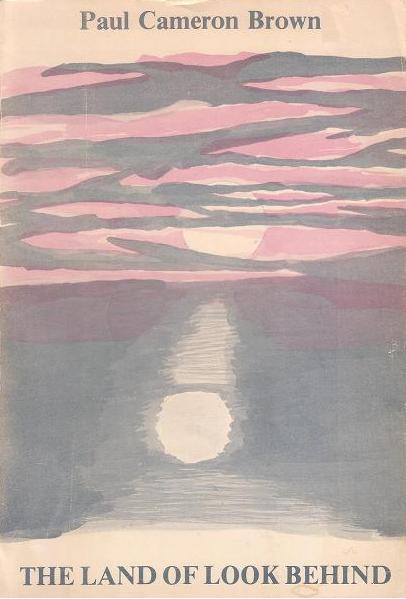
THE LAND OF LOOK BEHIND represents a third volume of work written by Paul Cameron Browne. His two previous books, Whispers and Eyeshine have been reviewed in Malahat Review, Quarry and The Canadian Author and Bookman:
"An exquisite revelation of detail."
"Excellent control and imagery."
"Original observations."
END