
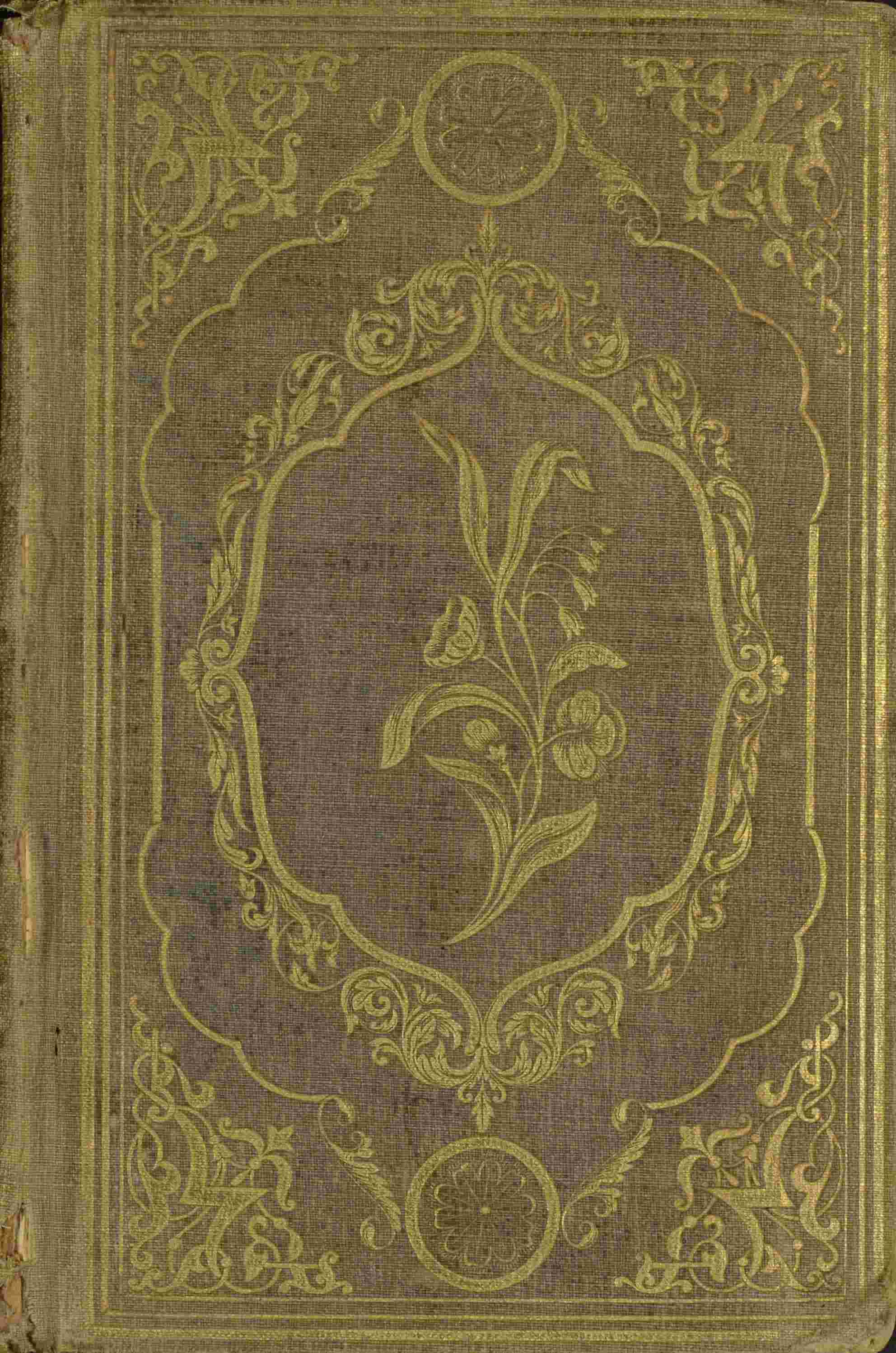
The Project Gutenberg eBook of The language of flowers
Title: The language of flowers
The floral offering ; a token of affection and esteem ; comprising the language and poetry of flowers
Author: Henrietta Dumont
Release date: October 2, 2023 [eBook #71779]
Language: English
Original publication: Philadelphia: H. C. Peck & Theo. Bliss, 1851
Credits: Chuck Greif and The Online Distributed Proofreading Team at https://www.pgdp.net (This file was produced from images generously made available by The Internet Archive)
Preface.
Contents.
Dictionary of Flowers,
The Calendar of Flowers.
The Dial of Flowers.
THE LANGUAGE OF FLOWERS.
ROSE, BLUE VIOLET, JASMINE MOSS ROSE, BUD.
Your beauty, modesty and amiability,
Have drawn from me a confession of love.
THE
FLORAL OFFERING:
A
TOKEN OF AFFECTION AND ESTEEM;
COMPRISING
WITH COLOURED ILLUSTRATIONS, FROM ORIGINAL DRAWINGS.
————
By HENRIETTA DUMONT.
————
PHILADELPHIA:
H. C. PECK & THEO. BLISS.
1851.
Entered according to Act of Congress, in the year 1851, by
H. C. PECK & THEO. BLISS,
in the Clerk’s Office of the District Court of the Eastern District of
Pennsylvania.
STEREOTYPED BY L. JOHNSON AND CO.
PHILADELPHIA.
Preface.
Why has the beneficent Creator scattered over the face of the earth such a profusion of beautiful flowers—flowers by the thousand and million, in every land—from the tiny snowdrop that gladdens the chill spring of the north, to the gorgeous magnolia that flaunts in the sultry regions of the tropics? Why is it that every landscape has its appropriate flowers, every nation its national flowers, every rural home its home flowers? Why do flowers enter and shed their perfume over every scene of life, from the cradle to the grave? Why are flowers made to utter all voices of joy and sorrow in all varying scenes, from the chaplet that adorns the bride to the votive wreath that blooms over the tomb?
It is for no other reason than that flowers have in themselves a real and natural significance. They have a positive relation to man, his sentiments, passions, and feelings. They correspond to actual emotions. They have their mission—a mission of love and mercy. They have their language, and from the remotest ages this language has found its interpreters.
In the East the language of flowers has been universally understood and applied “time out of mind.” Its meaning finds a place in their poetry and in all their literature, and it is familiarly known among the people. In Europe it has existed and been recognised for long ages among the people, although scarcely noticed by the literati until a comparatively recent period. Shakspeare, however, whom nothing escaped which was known to the people, exhibits his intimate acquaintance with the language of flowers in his masterly delineation of the madness of Ophelia.
Recent writers in all languages recognise the beauty and propriety of this language to such an extent, that an acquaintance with it has now become indispensable as a part of a polished education.
Our little volume is devoted to the explanation of this beautiful language. We have made it as complete as our materials and limits would permit. We present it to our readers in the humble hope that we shall increase the means of elegant and innocent enjoyment by our “Floral Offering.”
Contents.
| PAGE | |
| Acacia, (Friendship) | 123 |
| Acanthus, (The arts) | 140 |
| Almond Blossom, (Indiscretion) | 22 |
| Aloe, (Grief) | 28 |
| Althea, (Consumed by love) | 162 |
| Amaranth, (Immortality) | 100 |
| Anemone, (Forsaken) | 122 |
| Ash Tree, (Grandeur) | 222 |
| Box, (Stoicism) | 63 |
| Broom, (Humility) | 179 |
| Cactus, (Ardent love) | 26 |
| Camellia Japonica, (Modest merit) | 156 |
| Chamomile, (Energy in adversity) | 225 |
| China Aster, (Variety) | 200 |
| Citron, (Estrangement) | 227 |
| Columbine, (Desertion) | 87 |
| Common Thistle, (Misanthropy) | 243 |
| Corn, (Riches) | 186 |
| Cowslip, (Pensiveness) | 113 |
| Coxcomb, (Singularity) | 235 |
| Cranberry, (Cure for the heartache) | 188 |
| Crocus, (Youth) | 23 |
| Cypress, (Mourning) | 49 |
| Dahlia, (Elegance and dignity) | 154 |
| Daisy, (Innocence) | 39 |
| Dandelion, (The rustic oracle) | 132 |
| Dead Leaves, (Death) | 217 |
| Dew Plant, (Serenade) | 246 |
| Dragon Plant, (You are near a snare) | 229 |
| Dyer’s Weed, (Relief) | 166 |
| Fennel, (Strength) | 233 |
| Fir, (Time) | 238 |
| Forget-me-not | 116 |
| Grass, (Submission) | 236 |
| Hawthorn, (Hope) | 52 |
| Hazel, (Peace, reconciliation) | 204 |
| Heliotrope, (Devoted affection) | 106 |
| Holly, (Foresight) | 195 |
| Hollyhock, (Ambition) | 96 |
| Hyacinth, (Constancy) | 59 |
| Ice Plant, (Frigidity) | 25 |
| Ivy, (Constancy) | 193 |
| Jasmine, (Amiability) | 109 |
| Juniper, (Protection) | 203 |
| Lady’s Slipper, (Capricious beauty) | 160 |
| Larkspur, (Flights of fancy) | 164 |
| Laurel, (Glory) | 98 |
| Lavender, (Distrust) | 36 |
| Lichen, (Solitude) | 254 |
| Lilac, (First emotions of love) | 46 |
| Lily, (Majesty) | 67 |
| Lily of the Valley, (Modesty) | 58 |
| Love-lies-bleeding, (Deserted love) | 55 |
| Marigold, (Grief) | 72 |
| Marvel of Peru, (Timidity) | 143 |
| Meadow Saffron, (My best days are past) | 198 |
| Mezereon, (Coquetry, desire to please) | 13 |
| Mignonette, (Your qualities surpass your charms) | 108 |
| Mistletoe, (I climb to greatness) | 220 |
| Moss, (Maternal love) | 125 |
| Moss Rose, (Confession of love) | 69 |
| Myrtle, (Love) | 56 |
| Narcissus and Daffodil, (Self-love) | 65 |
| Nasturtion, (Patriotism) | 168 |
| Nettles, (Cruelty) | 86 |
| Nightshade, or Bitter-sweet, (Truth) | 170 |
| Oak, (Nobility) | 206 |
| Oak Geranium, (Friendship) | 150 |
| Orchis, (A belle) | 61 |
| Pansy, (Think of me) | 37 |
| Passion Flower, (Faith) | 89 |
| Peony, (Anger) | 85 |
| Periwinkle, (Tender recollections) | 43 |
| Pimpernel, (The weather-glass) | 133 |
| Pine, (Pity) | 248 |
| Pink, (Pure love) | 91 |
| Poppy, (Consolation) | 135 |
| Primrose, (Early grief) | 20 |
| Red Rose, (Beauty and love) | 77 |
| Reed, (Single blessedness) | 231 |
| Rosemary, (Remembrance) | 120 |
| Sage, (Domestic virtues) | 251 |
| Scarlet Geranium, (Stupidity) | 147 |
| Sensitive Plant, (Chastity) | 92 |
| Snowdrop, (Hope) | 15 |
| Starwort, American, (Welcome) | 202 |
| St. John’s Wort, (Superstition) | 181 |
| Stock, (Lasting beauty) | 145 |
| Strawberry, (Perfection) | 102 |
| Sweet-Brier, or Eglantine, (Poetry) | 45 |
| Sweet-Flag—Acorus Calamus, (Grace) | 172 |
| Sunflower, (False riches) | 104 |
| Thorn-Apple, (Deceitful charms) | 158 |
| Thyme, (Activity) | 94 |
| Tuberose, (Dangerous love) | 152 |
| Tulip, (Declaration of love) | 48 |
| Valerian, (An accommodating disposition) | 142 |
| Vervain, (Enchantment) | 184 |
| Violet, (Modest worth) | 31 |
| Wall-Flower, (Fidelity in adversity) | 51 |
| White Water-Lily, (Purity) | 70 |
| White Rose, (I would be single) | 74 |
| Woodbine, or Honeysuckle, (Affection) | 111 |
| Wormwood, (Absence) | 30 |
| Yellow Rose, (Jealousy) | 75 |
| Yew, (Sorrow) | 215 |
| Death of the Flowers | 257 |
| Dictionary of Flowers | 259 |
| Calendar of Flowers | 268 |
| Dial of Flowers | 293 |
The Floral Offering.
Mezereon.... Coquetry—Desire to please.
This shrub, clothed in its showy garb, appears amidst the snow, like an imprudent and coquettish female, who, though shivering with cold, wears her spring attire in the depth of winter. The stalk of this shrub is covered with a dry bark, which gives it the appearance of dead wood. Nature, to hide this deformity, has encircled each of its sprays with a wreath of red flowers, terminating in a tuft of leaves. These flowers give out a peculiar and offensive smell.
The gilded toy whom fashion idolizes;
Heartless and fickle, swelled with self-conceit,
Avoiding alway what good sense advises.
Who flutters like the butterfly while burns his sun,
Nor afterwards is missed when life is done.
They keep us in suspense and doubt;
Yet oft perverse, like woman-kind,
Are seen to scud against the wind.
Is not this lady just the same?
For who can tell what is her aim?
When crowned with the flower and the gem,
But thy lover’s smile should be dearer praise
Than the incense thou prizest from them.
And gay is the playful tone,
As to the flattering voice thou respondest;
But what is the praise of the cold and unknown
To the tender blame of the fondest?
’Twas I that gave thee thy renown:
Thou hadst, in the forgotten crowd
Of common beauties, lived unknown,
Had not my verse exhaled thy name,
And with it impt the wings of Fame.
That killing power is none of thine,
I gave it to thy voice and eyes:
Thy sweets, thy graces, all are mine;
Thou art my star, shin’st in my skies!
Then dart not from thy borrowed sphere
Lightning on him that fixed thee there.
Snowdrop. ... Hope.
The Snowdrop is looked upon as the herald of the approach of flower-wreathed Spring. The north winds howl; the naked branches of the trees are white with frost; the earth is carpeted with the virgin snow; the feathered musicians are silent; and stern Winter’s icy hand chills the rivulet till it ceases to murmur. At this season, a tender flower springs up amid the snow, expands its blossoms, and leads thought to the verdant hours to come. This beautiful sign of awakening Nature may aptly be considered as the emblem of Hope.
Awakes to life bedewed with tears,
And flings around its fragrance mild;
And, where no rival flowerets bloom,
Amidst the bare and chilling gloom
A beauteous gem appears.
All weak and wan, with head inclined,
Its parent breast the drifted snow,
It trembles, while the ruthless wind
Bends its slim form; the tempest lowers,
Its emerald eye drops crystal showers
On its cold bed below.
Where’er I find thee, gentle flower,
Thou still art sweet and dear to me;
For I have known the cheerless hour,
Have seen the sunbeams cold and pale,
Have felt the chilling wintry gale,
And wept and shrunk, like thee!
No one so utterly desolate,
But some heart, though unknown,
Responds unto his own;
Responds, as if with unseen wings
An angel touched its quivering strings,
And whispers in its song,
“Where hast thou stayed so long?”
And smile the phantoms of Despair to flight.
Our first of flowerets bright?
For the Christmas Rose came long before,
So did the Aconite.”
I know the yellow Aconite;
I know the Christmas Rose:
But neither one nor other e’er
Within my garden grows.
They seem to me presumptuous things,
That rudely hurry on,
And struggle for the precedence
A fairer flower hath won.
When I was but a wee, wee thing,
A young Snowdrop I nursed,
And I loved it when they told me how
It always blossomed first.
I marked its tiny, trembling stem,
And dainty little bell,
And, oh! so tenderly enjoyed
Its faint, delicious smell.
It was not only fair and sweet,
’Twas the first flower that came;
So said they then, and there is none
I could love now the same.
The Aconite may deck with gold
Its merry little face—
The Christmas Rose at Christmas bloom,
But none can fill her place.
Within my garden’s small domain
The Snowdrop still shall find
Herself the earliest flower. She leads,
The others come behind.
And, lo! above the heaving mould
The clustering bells hang here;
Like foam upon the storm-black wave,
Or pearls in Ethiop’s ear.
And I know where they’re crowding thick,
With none their wealth to note;—
All o’er that woody isle, that lies
Girt by the ancient moat.
There, under tall, dark crested firs,
The Snowdrops spring each year;
And shed about that gloomy place
A lightness pale and clear.
A grand old Manor House once stood
On that dim moated isle;
But long years since have floated by,
And its story died the while.
Yet roses, cultured ones, run wild,
And fruits, grown rough and sour,
That linger still around, tell tales
Of garden and of bower.
And so the Snowdrops may have dwelt
In borders neat and trim,
And gentle beings tended them,
Though now all’s drear and dim.
The brave and beautiful have died,
Not e’en a name is known:—
Time hath laid low the stately house,—
Ye cannot find a stone.
But still there runneth brightly there
The little sedgy stream
Into the moat, that lieth still
And shadowy as a dream.
And still there groweth plenteously
The fragile Snowdrop’s bell:—
Oh, human pride! that thou wouldst list
The tale these small things tell!
And on her golden anchor leant,
Watching below the angry flood,
While Winter, mid the dreariment
Half-buried in the drifted snow,
Lay sleeping on the frozen ground,
Not heeding how the wind did blow,
Bitter and bleak on all around:
She gazed on Spring, who at her feet
Was looking on the snow and sleet.
Spring sighed, and through the driving gale
Her warm breath caught the falling snow,
And from the flakes a flower as pale
Did into spotless whiteness blow.
Hope, smiling, saw the blossom fall,
And watched its root strike in the earth:
“I will that flower the Snowdrop call,”
Said Hope, “in memory of its birth:
And through all ages it shall be
In reverence held, for love of me.”
“And ever from my hidden bowers,”
Said Spring, “it first of all shall go,
And be the herald of the flowers,
To warn away the sheeted snow.
Its mission done, then by thy side
All summer long it shall remain.
While other flowers I scatter wide,
O’er every hill, and wood, and plain,
This shall return, and ever be
A sweet companion, Hope, for thee.”
Hope stooped and kissed her sister Spring,
And said, “For hours, when thou art gone,
I’m left alone without a thing
That I can fix my heart upon:
’Twill cheer me many a lonely hour,
And in the future I shall see
Those who would sink raised by that flower;
They’ll look on it, then think of thee:
And many a sadful heart shall sing,
The Snowdrop bringeth Hope and Spring.”
Primrose. ... Early Grief.
The Primrose is one of the earliest flowers of spring. It was anciently called Paralisos, the name of a beautiful youth, who died of grief for the loss of his betrothed Melicerta, and was metamorphosed by his parents into this flower, which has since been a favourite of the poets.
Whilst summer last, and I live here, Fidele,
I’ll sweeten thy sad grave: thou shalt not lack
The flower that’s like thy face, pale Primrose.
And cloudless is thy day,
While past and present joys unite
To cheer thee on thy way;
While fond companions round thee move,
To youth and nature true,
And friends whose looks of anxious love
Thy every step pursue.
This firstling of the infant year;
Ask me why I send to you
This Primrose all bepearled with dew:
I straight will whisper in your ears,
The sweets of love are washed with tears.
Ask me why this flower doth show
So yellow, green, and sickly too;
Ask me why the stalk is weak
And bending, yet it doth not break:
I must tell you these discover
What doubts and fears are in a lover.
On the banks of moss where thy childhood played,
By the household tree through which thine eye
First looked in love to the summer sky;
By the dewy gleam, by the very breath
Of the Primrose-tufts in the grass beneath,
Upon thy heart there is laid a spell,
Holy and precious—oh, guard it well!
Yes! when thy heart in its pride would stray
From the first pure loves of its youth away;
When the sullying breath of the world would come
O’er the flowers it brought from its native home;
Think thou again of the woody glade,
Of the sound by the rustling ivy made;
Think of the tree at thy father’s door,
And the kindly spell shall have power once more.
Almond Blossom. ... Indiscretion.
The Almond tree is the first of the trees to put forth its blossoms, when spring breathes the breath of life through nature. It has been made the emblem of indiscretion, from flowering so early that frosts too often give a death-chill to the precocious germs of its fruit. In ancient times, the abundance of blossoms upon the Almond tree was considered to promise a fruitful season. The following is the fabulous account of the origin of this tree:—Demophoon, son of Theseus and Phædra, in returning from the siege of Troy, was thrown by a storm on the shores of Thrace, where then reigned the beautiful Phyllis. The young queen graciously received the prince, fell in love with him, and became his wife. When recalled to Athens by his father’s death, Demophoon promised to return in a month, and fixed the day. The loving Phyllis counted the hours of his absence, and, at last, the appointed day arrived. Nine times she repaired to the shore; but, losing all hope of his return, she died of grief, and was converted into an Almond tree. Soon afterwards, Demophoon returned. Overwhelmed with sorrow, he offered a sacrifice at the sea-side, to appease the manes of his bride. The Almond tree instantly put forth its blossoms, and seemed to sympathize with his repentance.
The lessons of my father’s tongue,
(The deep laborious thoughts he drew
From all he saw, and others knew,)
I might have been,—ah, me!
Thrice sager than I e’er shall be.
For what says Time?
Alas! he only shows the truth
Of all that I was told in youth.
Crocus. ... Youth.
The Crocus is one of the earliest of the spring flowers, and, therefore, a fit emblem of the spring of life. It is a small flower, of variegated hues; the principal being purple, yellow, and white. The Crocus Vernus, or Spring Crocus, is a wild flower now in various parts of England, though not considered to be really a native of the country. We learn from the favourite writers, Mr. and Mrs. Howitt, that they are plentiful about Nottingham, “gleaming at a distance like a perfect flood of lilac, and tempting very many little hearts, and many graver ones too, to go out and gather.”
In far and richer lands;
But high in my affection e’er
The beautiful Crocus stands.
I love their faces, when by one
And two they’re looking out;
I love them when the spreading field
Is purple all about.
I loved them in the by-gone years
Of childhood’s thoughtless laughter,
When I marvelled why the flowers came first,
And the leaves the season after.
I loved them then, I love them now—
The gentle and the bright;
I love them for the thoughts they bring
Of spring’s returning light;
When, first-born of the waking earth,
Their kindred gay appear,
And, with the Snowdrop, usher in
The hope-invested year.