
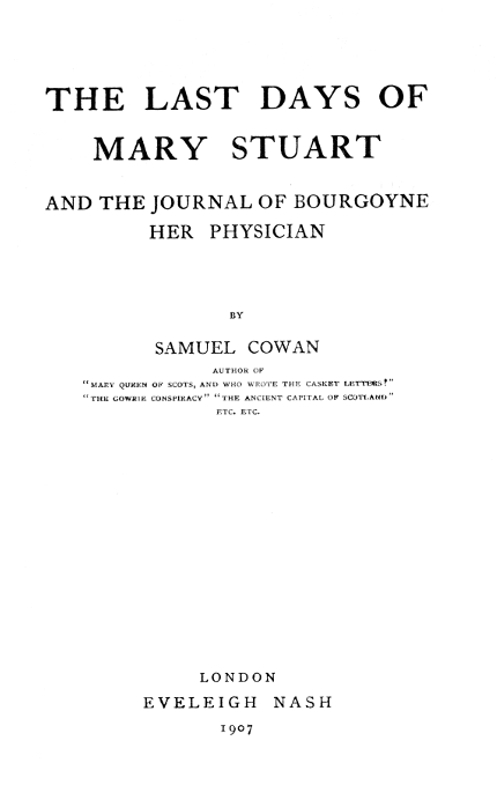
The Journal of Bourgoyne, which I had meant originally to be the text of this volume, is a work of some importance in helping us to elucidate the life and later days of the Queen of Scots. I have considered it necessary, for the benefit of the reader, to reproduce also a Summary of the voluminous correspondence which took place during the same period between Queen Mary and her confrères, and Elizabeth, and the leading ministers and secretaries of the Crown of England. The correspondence discloses the political manœuvres and secret negotiations of that eventful time—the last six months of Queen Mary's life: and the Summary occupies the first half of the volume. It has been impossible to restrict it further and convey to the reader what is meant to be conveyed—an intelligible estimate of her prison life, with all its painful vicissitudes. The letters have an important bearing on the character of the Scottish Queen, and illustrate the situation better than can be done by any criticism.
The fascination of Mary Stuart as the central figure of the greatest drama in Scottish history is an additional reason for putting another volume before the public, even though the literature on the subject is abundant; while Bourgoyne's Journal, now specially translated, we must remember, has not been much in evidence in its original form. It is really a domestic, not a political or daily, record, and is the only such record we possess, for no historian has attempted to give more than an outline of her public career. In this Journal there are entries of which we have hitherto been unaware; entries which manifest the cunning and deception of that age; chiefly and more particularly the administration of the Crown of England—thrilling reading—Elizabeth occupying the foreground and swaying the sceptre in a manner that must be read to be appreciated.
A large portion of the matter in this volume is published now for the first time, and to the rising generation the entire narrative will be quite new. The greatest point of historical importance resulting from a study of this Journal is its determination, and settlement of all doubt, of the innocence of Queen Mary of having had any connection with any plot against the life of Elizabeth; or with that huge fraud the Babington Conspiracy. How this is established the reader will realise from the accompanying recital.
S. C.
Perth, 1st January 1907.