
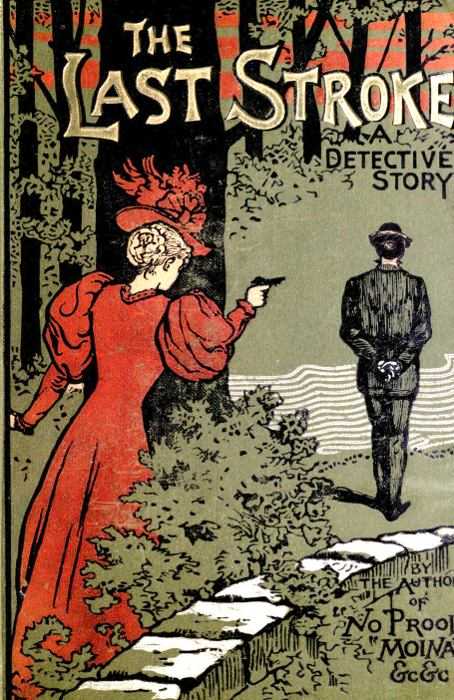
CHAPTER XXI. "QUARRELSOME HARRY."
The Lucania had been in port forty-eight hours, and Mrs. Myers and her party had been snugly quartered in one of London's most charming rural nooks, at Hampton Court, with Robert Brierly close at hand, before Ferrars ventured to visit the city.
Mr. Myers had discreetly remained in London, going from thence to meet his friends at Hampton Court, but Ferrars, for reasons which he did not explain, went to the city, as soon as he had assured himself of the comfort and safety of his party, this assurance including the provision of a watchful aid, who kept guard whenever Robert Brierly, himself now well convinced of the need of caution, ventured abroad.
Leaving Mr. Myers thus to enjoy an evening with his wife and friends, Ferrars hastened to "the city," where every stone seemed familiar, and many faces were those of friends or foes, well known and well remembered. To escape recognition his own countenance had been simply but sufficiently hidden behind a disguise of snowy hair and rubicund visage, both assumed as soon as he had parted from the group at Hampton Court, for Ferrars realised that the battle was now on, and he had no idea of giving the foe the chance possibility of an encounter. He was well known at Scotland Yard, as well as to the chief of the department of police, and it was to one of these officials that he made his way, for he had two reasons of his own for hastening on, in advance of the party.
Not long before leaving the "States," he had received a dainty notelet. It could not have been called a letter. It came through the hands of Doctor Barnes, and it was signed, "Lotilia K. Jamieson."
It is late afternoon when Ferrars reaches Oxford Street, after his interview with several official personages, during which he has bestowed upon each a number of typewritten cards, bearing what seems to be a brief descriptive list, and as many photographs, faithful and enlarged copies of the "snap shot" furnished him by the hand of Samuel Doran.
He alights from an omnibus at the end of Regent Street, and stands, for a moment, looking down Oxford Street. He is not in haste, for he lets cabs and omnibuses rattle by him, or stand, waiting for fares, and walks slowly on and on. A mile and a quarter of shops, that is Oxford Street, but Ferrars foots it sturdily. Past the Circus, beyond the region of Soho, and he slackens his pace and consults a tiny memorandum book. Who ever saw Frank Ferrars produce a letter or card, for reference, in the streets of a crowded city? Then he smiles and paces on.
Bloomsbury. He is walking slowly now, and under his low-drawn hat his eyes are very alert.
And now he is in that portion of Bloomsbury where, earlier, very early in the century, the wealthy, and those of high degree resided. It is comfortable and middle class now, and our pedestrian passes a certain pleasant semi-detached house—not large, but eminently respectable—with a stealthy, lingering glance, pausing, before he has walked quite beyond it, as if to note some object of fleeting interest. Two or three times, within the hour, he passes that house, now on this side, now on that; once on the top of an omnibus, once in a cab, and driving very slowly, and as close as possible.
It is fairly dusk when he slowly ascends the well scrubbed steps, with the reluctant air of a man by no means sure of himself. He carries a small package beneath his arm, and a card between the fingers of his left hand, to which he shifts the package as he rings the bell.
"I beg your pardon, young Miss." It is a sour-faced damsel of uncertain age who melts perceptibly under this adjective. "Will you tell me if Mrs.—Mrs.——" He peers near-sightedly at the card he holds, and slowly pronounces a name.
"No, sir; this is not the place."
"But, doesn't the lady stop here, Miss? It's some'res in this here block, and somehow they've forgot the number, you see. Is there a lady guest maybe, or a boarder belike?"
But the maid, quite melted now, shakes her head, and tells him that beside her mistress, whom she names, and her mistress' niece, who stops with them, "off and on," there are no ladies in the house.
The detective blunders on down the street, and, when the lamps are lit he passes the house again. The lamps are lighted in the little dining room now, and through a window which projects upon the corner, he can see a table set for two. And now at last he is rewarded, for a maid enters and places something upon the table; a lady follows, glances at the table, walks to the window, and turns, with a quick, imperious gesture, toward the maid; a little lady, with a fair face, pale, fleecy hair and wearing a flowing silken gown of some soft violet shade. She sweeps past the maid and seats herself at the head of the table, while the young person—it is the same who attended so lately at the door—comes forward to close the curtain. Slowly it is drawn together, shutting in the lights, the table and the violet-clad figure, but not until the watcher outside has caught a glimpse of a man, tall and, yes, handsome, in a dark fierce fashion, who is entering at the door on the other side of the room.
The watcher passes on. He has seen, once more, the woman who has, according to his own confession, aroused in him "a profound interest." And he has also seen, whom and what? A brother? A lover? A rival, perhaps? Ferrars hails a passing cab now, and is driven swiftly towards his room in the Strand, and as he rolls along, this comment, which may mean much or little, passes his lips.
"So my little lady has doffed her mourning. I wonder what that may mean?"
"I'm very sorry, Ferrars, but I fear there's a great disappointment in store for you."
"A disappointment! How? And in what respect, Mr. Myers?"
Ferrars was seated opposite Mr. Myers in the office of Wendell Haynes, solicitor, in Middle Temple Lane, where he had hastened on the morning after his little adventure in Bloomsbury, and so prompt and eager had he been that he had encountered the American lawyer at the very threshold, Mr. Myers having just arrived, with equal haste and promptness, from Hampton Court.
Solicitor Haynes and the English detective were not unknown to each other, and when they had exchanged greetings, the solicitor left the others together in his inner office. He was, by this time, fully acquainted with all the facts, so far as they were known to Mr. Myers, and he left them with a promise to rejoin them soon, when they should have compared notes and gone over the ground already known to the busy solicitor.
There was a look of suppressed eagerness upon the face of Ferrars, as he seated himself opposite the shrewd American lawyer. His face, his manner, his very silence and alertness as he held himself erect upon his chair, a picture of calm force, long suppressed, but now out of leash and ready for anything—anything except inaction; and that, his very attitude seemed to say was past.
Mr. Myers had waited a moment, after they were left alone together, for Ferrars to speak the first word, but the latter only sat still and waited, and the lawyer, with characteristic directness, spoke straight to the point. He had what he felt to be bad news to impart, and he did not delay or play with words in the doing it.
But if he had expected disappointment or any change to cross that keenly questioning face, he looked in vain. Ferrars only sat leaning slightly toward him, waited a moment, and repeated his last words.
"In what manner? How disappointed?" And then, as the lawyer still hesitated, he went on. "You find the case as it should be, eh?"
"The case! Oh, yes!"
"Are there any flaws?"
"No," broke in the lawyer.
"Any unexpected delays?"
"No."
"Any new claimants?"
"No, Ferrars. The Hugo Paisley will case is one of the simplest and clearest of its kind. The last incumbent surely must have had a wonderfully clear idea of how to do the thing he meant to do. Once the claim is proven, and he makes that work easy, there need be no delays, no chancery, no holding back for big fees. The agents in the case are paid according to their expedition, and have every incentive to haste. With the proofs in hand the heir could step at once into his fortune, a matter of £200,000."
"An American millionaire, eh?" Ferrars smiled. "That, then, is quite as it should be, especially as the young lady is here. Well, then, you advertised, according to your report?"
"Yes, we advertised. A very craftily worded document calculated to arouse the dilatory claimants to prompt action."
"And, did it not?"
"It did, yes."
"Then, in heaven's name why must I be disappointed in any way?"
"Because I fear the claimant—we have seen but one—is not the person you hoped to find."
Ferrars actually smiled. "Describe the person," he said.
Without speaking, the lawyer held out to him across the table a visiting card, a lady's card, correct according to the London mode of the hour, and bearing a name which Ferrars read aloud with no sign of emotion in his face.
"Mrs. Gaston Latham." He looked up with the card still between his fingers. "Is she the solitary heir?"
"No; there are two children; girls of twelve and nine."
"And her proofs?"
"Seem to be perfect, making her the next in line of succession after——"
"After the Brierlys, of course."
Mr. Myers nodded and the detective looked down again at the address upon the card.
"Lives in the city, I see! Are the children with her here?"
"Only the younger, I am told. The elder has 'an infirmity,' and is at present in an institution. It seems a great cross to the mother; in fact her anxiety and distress, because of this child, have made her almost indifferent about this business of the fortune. In short"—and here the lawyer glanced askance at his vis-à-vis—"I'm afraid she is not the—the sort of claimant you have expected to see. And there seems to be no one of the other sex in the family."
"Well, well!" Ferrars threw himself back in the big office chair, assuming an easy and almost careless attitude.
"Tell me all about her, Myers. Is she old, or young? Handsome or not?"
The face of the lawyer was overspread with a cynical smile. He had expected to see disappointment, consternation, perhaps, in the face of the detective, when he heard that the English claimant to the Paisley fortune was a woman lorn and lone. His heart was in the work they were engaged upon. Robert Brierly's interests were his own; but, still, this cool, emotionless detective, whom he liked well, had more than once piqued and puzzled him. He believed that Ferrars was quite prepared to meet with, and hear of, quite another sort of claimant, and he was now looking to see him at last stirred out of his provoking calm.
"Mrs. Gaston Latham is not a claimant to whom one could object, upon the ground of unfitness. She would make a very handsome and gracious dispenser of the Paisley thousands."
"Too bad that she will never get them!" And Ferrars smiled.
"She is a woman of medium height, and rather—well—plump, and while her hair is snowy white, she does not look a day over forty. She has the fine, fresh English colour, blue eyes, that require the aid of strong eyeglasses, and a voice that is very high-pitched for an Englishwoman, and that sounds, I am sorry to say—for she's really a very intelligent and winning little lady—somewhat affected at times. She dresses in soft grays and pale lavenders, as you may be interested to know." And here the lawyer smiled broadly.
"That," commented Ferrars, with no cessation of his own gravely indifferent manner, "for a 'plump' woman, is a great mistake. A plump person should never assume light colours." And then the eyes of the two men met, and over each face there slowly crept a smile that grew into a laugh.
"Upon my soul, Ferrars," exclaimed the elder, "I believe you have heard of this Mrs. Latham!"
"Not to make a mystery of it, Mr. Myers, I'll explain that I have heard of Mrs. Latham. But, I give you my word, I did not look to find her the claimant. You have heard us, some, or all, speak of Mrs. Jamieson!"
The lawyer nodded and a smile of meaning crossed his face.
"Well, I have lately learned that she might be found at a certain number in Bloomsbury, and addressed, in case of her temporary absence, in care of Mrs. Gaston Latham, an old family friend."
"I see!" The lawyer was silent a moment. Then he looked the detective frankly in the face. "To be perfectly candid with you, Ferrars," he said, "I have thought that you looked to see a different sort of claimant, more than one perhaps, and that this lady could not, by any possibility, be the expected one. I fancied this would trouble, perhaps hinder, if not quite balk you."
"Honestly, Myers, I have wondered not a little what sort of claimant I should meet, and I am neither surprised nor disappointed. I see what is in your mind; you looked to see the conclusion of the game here and soon, eh?"
"I admit it."
"And I hoped it. I do hope it. We must strike our final blow now if ever. We can depend upon Mr. Haynes."
"Entirely."
"And you have fully enlightened him?"
"To the extent of my own knowledge?"
"Then let's call him in, and I will put my cards upon the table. We shall need his help, but I'll explain that later."
When the English solicitor had joined them, Ferrars briefly reviewed the events surrounding and connected with the death of Charles Brierly, and the attempt upon Robert's life; and when he was sure that they understood each other, thus far, and that the English lawyer was deeply interested in the case and had committed himself to it, he summed up the situation thus.
"You will see, of course, that I might make a bold stroke and arrest my suspects at once; or, at least, as soon as we could lay our hands upon them, but the case is a complicated one, and having it in my power to make our quarry commit themselves altogether, I do not intend to leave them a loophole of escape. I have not been entirely open with you; you must take my word for some things. I have put the Scotland Yard men on the lookout for our man; I do not know his name, but I think they will have no trouble in finding him, by acting upon my hints. There is much which even I do not understand, in his connection with the case. I do not believe him to be the master spirit, and I want to let him have his fling over here."
"Do you mean," broke in the solicitor, "that you do not intend to arrest him, as soon as found?"
"He must be kept under close espionage, when traced, but so long as he does not leave London, he must be left quite free to come and go at will. There is much that is still hazy, concerning his appearance in Glenville, and I look to him to lead me to another—to the other, in fact."
"And," urged the solicitor, "do you feel safe in venturing this? May he not shun those places?"
"Listen! The man's name I do not know, but I know what he is. There are plotting villains in this world, who might scheme forever and still be often penniless. This man is a gambler. In Chicago he pawned the watch stolen from Charles Brierly's room, knowing that there was risk in so doing, but desperate for the money it would bring. He won soon after, and aware of danger ahead, for he had good reason to think himself followed over there, he at once redeemed his pledge. He does not dream that we are here, and the finances at headquarters, I have reason to think, are running low. To play he must have money, and when he has lost he will either pledge or sell the remainder of the jewels stolen from the writing desk. They were of considerable value, as I have discovered."
"Ah!" Mr. Myers looked up quickly.
"Oh, that's no secret. Hilda Grant saw the jewels, and knew their value."
"May I ask why you presume that all the stolen jewels are in this man's possession?" asked the solicitor.
"Because they were stolen, in the first place, not for plunder's sake, but to mislead; and the party who took them lost no time, I am sure, in passing them on, and out of the town. It is hardly likely they would have divided them."
"Then you look upon this man as in truth little more than a cat's paw?"
"In some respects, yes. He does not take this view, however, and now I want to hear all about your interview with this lady, Mrs. Gaston Latham."
"According to your instructions," said Mr. Myers, "I remained in the background. Mr. Haynes was the spokesman."
Ferrars turned toward the solicitor, who began at once.
"There is really very little to tell. Of course I quite understand that the claimant was to be held off, and the next interview to take place in your presence."
Ferrars shook his head. "I fear we must change our plans somewhat. The fact is," here he glanced up and met the eye of Mr. Haynes, a queer smile lighting his own, "I have found just now, that I knew a lady who seems to be a friend of this Mrs. Gaston Latham, and an inmate of her house in Bloomsbury. Now it might be a little awkward for me to appear before my—the lady in question, as the opponent of her friend. In fact, I must not appear in the matter—not yet, at any rate. And, upon my word, Mr. Myers, since our friend has taken up the rôle of Spokesman-in-chief, you and I will both stand aside, just at first. May we count upon you?"
"I shall need some coaching, of course," suggested the solicitor.
"Of course; and that you shall have at once. But first, when is she to call again?"
"When I give the word."
"Give it at once, then; to-morrow at 2 p.m. Tell her to come alone. You can arrange for us to hear the interview, I dare say?"
The solicitor swung about in his big chair. "You see those two doors?" he asked, quite needlessly pointing at the two doors, at opposite corners of the inner wall, "They open upon my private chamber of horrors. Formerly there was a partition, and two smaller rooms The partition has been removed. In the morning I will have my man move that tall bookcase across the door at the right. The door, behind it, can then stand open, and you can hear very well. I will have my desk and the chairs moved nearer that corner. Will that do?"
"Excellently; only I must see the lady in some way."
"Then, if you will come in some slight disguise, you can sit at my clerk's desk, over by that window, with your back to the light. I will dismiss you, and you can go out to join Mr. Myers, through the left-hand door."
They inspected the inner room, and Ferrars, gauging the distance with his quick eye, made a suggestion or two regarding the placing of the desks, and the visitor's chair, and then they sat down to discuss the part the solicitor must take in the coming interview.
That evening when Ferrars strolled into his room after an early dinner, he found a note from a certain police inspector, in whose charge he had left the hunt, or rather, the watch for the suspected stranger. The note contained a summons, brief and peremptory, and he hastened to present himself before Inspector Hirsch.
"We have found your man," were the inspector's first words, when the detective was left alone with him. "And it was an easy trick, too, for all your fears to the contrary. I tell you, Ferrars, when a sport who lives only to gamble and bet on horses, comes back to London after any long absence, he's sure to go to one of a dozen flush places I can name, as soon as he can get there. And, if he's heeled he'll go to them all. Just give him time. I didn't neglect the houses of mine uncle, but I also sent a squad around to these other places."
"And you found him?"
"We found him. And that's not all. We have found a name for him."
"Good! What is it?"
"He goes by the name of 'Quarrelsome Harry' among his kind. Harry Levey is the way he writes it."
Ferrars pondered a moment "M—m—I'm not surprised," he said finally. "I was sure he was that kind. What's his specialty besides being quarrelsome?"
"Cards, and crooked bookmaking, I fancy. But Smithson, who seems to have known him of old, says he's up to most sorts of shady business, when his luck's down."
And the inspector went on describing the search for "Quarrelsome Harry" who had been "spotted" at a time when he was in a fair way to prove his right to his sobriquet. For he had been losing money all the previous night, and had sought his room in a dingy house in Soho, in a very black mood.
Here, so the shadow had reported, "Quarrelsome Harry" had remained until late noonday, emerging then to lunch at a coffee-house, and to take his way, for what purpose the watcher could only guess, to Houndsditch, where he seemed quite at home among the Jews in several cafés and "club rooms," where he tarried for a greater or shorter time, and seemed to be looking for some one—some one whom he did not find, it would seem, for he left the neighbourhood as he came, alone and with a lowering face.
"Looking for a loan, I'll wager," declared Ferrars. "By to-morrow he'll be visiting my uncle. I'll have to leave him to your men to-night, I suppose, Hirsch, but to-morrow I will go on guard myself."
He made a note of the Soho street and number, where Harry Levey had lodged, and then he took out his cigar case and the two men sat down together to talk about London, and compare notes. For they were old acquaintances, and could find much to say, one to another.
An hour later, when Ferrars arose to go, the inspector looked at his watch.
"By Jove! Frank, you don't mind my calling you that, eh? It seems like old times, half a dozen years ago. Say, it's almost the hour for the Swiss to report. He's on duty now looking after your man; wait till he comes in. Hobson must already have gone to relieve him, if he can find him. Harry was airing himself along the embankment when last heard from."
It was nearing ten o'clock, but Ferrars resumed his seat and his cigar very willingly, and Inspector Hirsch set out a very pretty decanter of something which he described, while pouring it into the glasses, as both light and pleasant.
At half-past ten "the Swiss," as rank an Englishman as ever ignored his h's, came in beaming.
He had left "'Arry," as he familiarly called the man he had been set to guard, in a front seat in the gallery of the Vaudeville theatre in the Strand, and Hobson was sitting just three seats away, and nearest the "halley."
"E's got a sort of green lookin' young duffer with 'im," went on the Swiss, "and they seem to be goin' to 'ave a night of it."
Ferrars got up quickly. "Come out with me, inspector," he said. "I may want you to call off your man. And, say, let me have one of your badges. It may come handy."
CHAPTER XXII. IN NUMBER NINE.
As the inspector and Ferrars approached the theatre they were obliged to slacken their pace, for, although the performance must have been well on its way, there was a crowd about the entrance.
"It's a first night for some new 'stars,' now that I think of it, and you'll find a lot of the sporting gentry here whenever a new and pretty face, that has had the right kind of advertising, is billed. That accounts for our friend's presence here, of course," said the inspector.
They made slowly their way toward the entrance, and as they reached it, and were about to pass within the brilliantly lighted vestibule, Inspector Hirsch grasped his companion's arm and pulled him back within the shadow of a friendly bill board.
"H'sh!" he whispered. "Here's Hobson!" He drew Ferrars still further out of the crowd. "He must have lost his man, or else—hold on, Ferrars; I'll speak to him." And he glided into the crowd and Ferrars saw him pause by the side of a flashily-dressed young fellow, who seemed utterly absorbed in trying to revive a smouldering cigar stump. He gave no sign of recognition as the inspector paused beside him, and seemed engrossed with his cigar and his own thoughts, but Inspector Hirsch was back in a moment with a grin upon his face.
"Your man has tired of the Vaudeville," he said, "and Hobson got close enough behind him—the other chap's still with him, too—to hear them planning to go on to the Savoy for a short time. Harry's evidently doing the theatres with his 'young duffer,' as the Swiss calls the fellow, and will probably pluck him if nothing intervenes." He looked hard at Ferrars. "My man won't lose sight of them. Want to go on to the Savoy?"
"By all means," replied Ferrars, and they set out, noting, as they skirted the crowd, that Hobson was no longer visible.
Crossing the street, they hastened their steps, and upon arriving at the Savoy, took up their station near the entrance once more. The crowd here was not dense, and they had not long to wait before two men approached from the direction of the Vaudeville, walking slowly, and entered the vestibule of the Savoy.
The taller of the two was broad shouldered, dark and handsome, after a coarse fashion, while the other was smaller, with a weak face and uncertain manner. Both were in evening dress, and when they entered the theatre Ferrars and the inspector followed.
"I can stay with you an hour longer," said the latter. "Then I must go about my own affairs."
Ferrars nodded. He was watching "Quarrelsome Harry" closely, and after a time, as that personage began to look about as if in search of some expected face, he procured an opera glass, and with its aid began to sweep the house.
Then, suddenly, he started, and, after a long look at a certain point in the dress circle, he turned quickly toward the inspector.
"Do you know any one in authority here?" he asked.
"I know the head usher over there; or, rather, he knows me."
"That will do. Just call him, won't you? Introduce me. Tell him I'm after a crook who is up to mischief here, and ask him to help me."
After a time this was accomplished, and soon after the inspector took his leave.
And now came the entre-acte, and a number of ladies left their places and went, some to the cloak-room, some to the foyer. The two men in whom Ferrars was interested went out among many others, and Ferrars followed. In the refreshment room they took places at the side, and the detective, contrary to his usual plan, passed them, and took a place midway between that occupied by the two men and a certain table, further down, where a party of six were seated.
To the waiter, who came to serve him, Ferrars said: "Send me your chief waiter," and slipped a coin into his willing hand.
When the chief waiter came, the two exchanged some whispered sentences, and then, as the man withdrew, our detective addressed himself to his light repast. He had been careful to keep himself unseen, so far as Harry Levey was concerned; and he had now chosen his seat behind a pillar, which hid him from view, while he still could, by moving slightly, look around it.
It was while taking one of his frequent peeps around this pillar that Ferrars saw "Quarrelsome Harry" tear a leaf from a small pocket-book and write a few words upon it, doing this in the most unobtrusive manner possible, with the bit of paper upon his knee.
Since they had exchanged those few whispered words together, Ferrars and the head waiter had not lost sight of each other, and now a slight movement of the brows brought the man to Ferrars' table.
"Now," whispered the detective, "and be sure you are not observed."
The man nodded and passed on, seeming to scan, with equal interest, each table as he passed it. Nevertheless, he saw a note slipped into the hand of a vacant faced young waiter, and a few words of instruction given. Then the young man turned away, and began to move slowly toward the opposite side of the room.
A little beyond Ferrars' table he encountered the head waiter, present arbiter of his destiny.
"Kit," said this personage, in a low tone, "slip that note you carry into my hand and wait behind the screen yonder until I give it back to you. Quick! No nonsense, man; and mum's the word!"
As between a stranger with a liberal tip, and the august commander of the dining-room corps, Kit did not hesitate, and a moment later the head waiter dropped the note into Ferrars' palm with one hand, while he placed a bottle of wine beside his plate with the other.
Putting the bit of paper between the two leaves of the menu card, Ferrars boldly read its pencilled message.
"Drive to the Café Royal. Ask to be shown to No. 9. I will join you there soon."
A moment later this note was placed, by Kit, beside the plate of the one for whom it was intended. The next, Ferrars, having tossed off his glass of light wine, arose and sauntered out of the refreshment room.
But he did not return to the theatre. Instead, he took a cab and was driven to the Café Royal.
Here again he sought out a person in authority, to whom he exhibited his star, and a card from Inspector Hirsch, and was at once shown to No. 8.
"If questions are asked," he said, as he slipped a goodly fee into the hand of authority, "remember that No. 8 is vacant, but is engaged for an hour later."
Left to himself, Ferrars moved a chair close to the wall between himself and number nine. It was but a flimsy barrier of wood and he nodded his approval, turned down the jet of gas, until it was the merest speck, and sat himself down to wait. But not for long; soon he heard the next door open, a sweeping, rustling sound, and the scraping of a chair. Then a bright light flashed up, the door closed, and all was still for a short time.
Then, again the door opened, there was a heavy step, low voices, and Ferrars knew that he might, if he would, lay his hand upon those whom he had sought so long, and, for a time, it had seemed, so hopelessly.
"Are we quite alone here, do you suppose?" It was a man's voice, strong and somewhat gruff. "Let us see." And he rang the bell. The man who had admitted Ferrars, and who had no mind to fall out with the police, responded, and at once showed conclusively that the adjoining rooms, Nos. 8 and 10, were quite deserted, although, he admitted, he had locked No. 8 in order to secure it for a party at midnight; whereupon wine was ordered and he was at once dismissed.
"Well," began the heavier voice again, "why in the name of goodness haven't you pushed things more? I told you, from the first, that all was safe. There will be no crossing the big pond now. How long do you mean to dally?"
"We can't dally now," replied the lighter voice. "Didn't you see the notice in the papers? They are calling for the heirs. I don't understand it, but they tell me that unless we come forward now, the matter will be referred to some other court, and then there must be a long delay. No, I must produce those papers now, and if there should be any question, any flaw——"
"Pshaw!"
"Or if they should call for further proof of identity, you know. Suppose some one should be found, at the last moment, acquainted with her!"
"Bosh! How foolish!"
"Or who remembered me!"
"I tell you this is folly! Latham's first wife died so long ago, and at a Swedish spa. And she never had many friends. As for relatives, well, we know there are none now."
"Sometimes I fear the children will remember; that it will all come back to them, some day."
"I tell you this is simply idiotic; the time has come, and everything is in train. You have all the papers, certificate of marriage, copy of will, and who is to prove that the first Mrs. Latham died, and that she was the last of the Paisley line, on this side, or the other? You were married abroad, you have all her family papers and her jewels. Her children call you mother."
"And hate me!"
"Well, that won't cut any figure. Besides, we must have money. You and I have put our little all into this scheme. How much longer can we live decently unless you claim this estate soon? I must have money! Do you mean to see your brother starve?"
"Hush! You are not my brother, remember that; only my brother-in-law."
"All right. How lucky that Latham's brother never came back. Now, what did you especially want to say to-night?"
"This. I must meet those lawyers to-morrow."
"Oh! And I as nearest male kin, must be your escort, and support you through the trying ordeal."
"Not at all. I am especially requested to come alone."
"The d——!"
"But they will want corroborative testimony, and I want to beg of you not to take anything to-morrow, and not to stay out the rest of the night. Much depends upon the impression we make. And if we should fail——"
"We can't fail; or you can't. Aren't you next-of-kin?"
Ferrars got up and crept noiselessly to the door. He had heard enough, and he had much to do. A new enquiry to open up. He knew that he should find Hobson, who had not been dismissed, outside and near, and he meant to leave "Quarrelsome Harry" to him once more.
"Look after him sharp, Hobson," he said, when he had found the man in the outer room. "And ask the inspector to have a warrant ready in the morning. We must arrest him to-morrow. He is to be taken for conspiracy and attempted murder. That will do for a beginning." And leaving the pair in No. 9 to their plotting, and to the watchful care of Hobson, Ferrars hastened from the place.
CHAPTER XXIII. TWO INTERVIEWS.
And now let us turn the clock back a few hours, that we may relate how Hilda and Ruth made the well-laid plans of Ferrars of no effect, so far as himself and another were concerned.
Mr. Myers had left the ladies of his party safe in their snug quarters at Hampton Court, and went early to the city to meet Ferrars, as has already been related; but if he expected them to remain in statu quo on such a day, and in easy reach of Bond Street, it speaks ill for his knowledge of women, especially of Ruth Glidden, who knew her London well, and who—when Mrs. Myers began to long to see the inside of Howells and James, and their royal array of painted and other rare china, and Hilda looked yearningly over the guide-books for the city—took matters into her own hands.
There was no reason why they should not go to town, especially, so she privately informed Mrs. Myers, as Hilda was moping. She could guide them anywhere where they might wish to go.
And this is how the three ladies came to be seen at Marshall and Snelgrove's, linen drapers, so called; at Redmayne's and Redfern's, and at Jay's, for Hilda's sombre bedecking. Jay's has been called the "mourning warehouse" of the world, not because Jay keeps on tap a perennial and unfailing supply of tears, but because "all they (feminine) that mourn" may be suitably clad—at enormous expense, by the way—by Jay and Co.
And here it was that our little party, sweeping into one of the superb parlours where models display Jay's sombre wares, came face to face with Mrs. Jamieson, who, seated upon a broad divan, was gazing at a little blonde, of her own size and colouring, who displayed for her benefit a flowing tea-gown of soft, black silk, lighted up here and there with touches of gleaming white.
Of course there were greetings and exclamations, and such converse as may be held in so public a place; and Ruth, who, somehow, made herself spokesman for the party, exclaimed that they had "just run over for that little outing, and because Hilda needed the change. Oh, yes, they were well escorted; Mr. Myers was with them, and also Mr. Grant."
At the name, which was the only one by which she knew Ferrars, Mrs. Jamieson flushed and paled, and the smile with which she received this news was slightly tremulous. And then she told them how she was stopping, for a short time, with a friend in Bloomsbury. Her husband's business affairs, that had called her so suddenly back to England, were now almost settled. And then she should leave London for a time. She had been thinking of a place in Surrey; she hoped to be in possession soon, and then surely they would not return too soon for a visit to her among the Surrey Downs? And where were they stopping?
Upon which Ruth confided the fact that they were not yet in permanent quarters. They must be settled soon; however, meantime, etc., etc., etc.
They parted soon, and it was only when they were riding homeward that it occurred to them that Robert Brierly's name had not been spoken, and that Ferrars, perhaps, would not be best pleased to know of their unpremeditated excursion.
As for the little widow, she went back to Bloomsbury in a state of excitement unusual for her.
To know that "Ferriss Grant" was in London, and that she might see him soon, set her pulses beating, and her brain teeming with plans for their meeting. What had brought him to London just now? What, indeed, save herself? Unless—and here she paled, and her little hands were clenched till the black gloves burst across the dainty palms—unless it were Ruth Glidden.
What was Ruth Glidden to the Grants? she asked herself futilely, and why were they together? And then for ten minutes Mrs. Jamieson wished she had never seen Ferriss Grant.
"I was very well content until then," she assured herself. "And my future seemed all arranged; and now——" she longed to meet him, and yet—
"If he had but waited, or if I had not been so hesitating! Now I must go on, and he must not know. A month later and I might have received them all in my sweet Surrey home, have met him with full hands, and there would have been no need of explanation, while now!" She struck her hands together, and set her lips in firm lines. "I must see him once, and then we need not meet until all is arranged. If I only knew where to send a note."
She had been absent since luncheon, and upon her arrival at home she found this brief note awaiting her:
It was late when she reached Bloomsbury, and she had little time to dress for dinner and the evening, for she was going out again, but she replied to this note, bidding him come, and assuring him of his welcome at any hour. Then, reluctantly, and with a look of distaste, amounting almost to repugnance upon her face, she began to dress for the evening.
When Ferrars reached his rooms, after leaving the café, his lips were set, and his eyes gleamed dangerously, for a little time he paced the floor, and then, impelled by some thought, he looked to see if any letters had arrived during his absence. Yes, there they were, half a dozen of them. He glanced at their superscriptions, and then opened a little perfumed and black-bordered envelope. It was Mrs. Jamieson's reply to his note of the afternoon, and he read it and put it down slowly.
"I shall be prompt," he said to himself, "to keep that appointment, and I wonder whether its outcome will make me more or less her friend. If it will alter or modify my plans; and if, having met this once I shall have the courage, the hardihood to meet her again, and to say what I must say if we meet." He put down the little note and took up the one next in interest.
The handwriting was that of Ruth Glidden, and the stationery that of a fashionable Piccadilly dressmaker.
"Dear Mr. F."—so ran the note—
"I am aware that you did not wish us, any of us, to be seen of men in London until certain things were accomplished, and I take upon myself all the blame of the little journey we, Mrs. Myers, Hilda, and myself, took this afternoon. We felt quite safe in visiting a few shops 'for ladies only,' but at the third we met Mrs. Jamieson. This may, or may not, be of moment to you. At all events, I have eased my conscience, and Hilda's, by letting you know. Nothing of any moment was said on either side, and no questions were asked.
"Yours penitently,
"Ruth G."
Over this womanlike note Ferrars wrinkled his brows, and finally smiled.
"I had not meant that they should meet until—but pshaw! What does it matter? Everything seems urging me on and shaping my course. So be it! It is time for the last stroke, and to-morrow, before this hour, I shall be a free man, or a failure."
Ferrars was prompt in his appearance at the Bloomsbury cottage, and Mrs. Jamieson had been for a long half-hour awaiting him alone in the little drawing-room Her face was somewhat pale, and there was a hint of agitation in her greeting, and a shade of gravity in his.
She talked of Hilda, and was full of pleasure at their meeting; and by and by she spoke of Ruth, her beauty, her grace, and style. Was it true that she was an heiress? And was she not, in some way, related to Miss Hilda and himself. Or perhaps to the Brierlys?
It was the first mention of that name by either, and Ferrars, looking into her eyes, answered:
"She bore the same relation to Robert Brierly that Hilda bore to Charles. They had been lovers since childhood."
"How sad, strange, and romantic! How pitiful!"
"The sadness outweighs the romance, and it is strange that the same hand should have struck at the happiness of both their friends. I have asked myself," he went on musingly, "what would be the fate of the destroyer of so much happiness, if these two girls could be made judge and jury, with the slayer at their mercy."
"Ugh!" The lady shuddered and turned her face away. "The thought is unnatural!"
"I don't know; women have been dread enemies before now, and are generally good haters. They make great criminals, too. But I fancy a woman must always betray——"
"Mercy!" She crossed the room suddenly to change the position of a translucent screen through which the sun had begun to filter. "You are positively gruesome, Mr. Grant! Let us change the subject. Or, first let me ask if they have found any trace of the cr— the person?"
"The clues have been very unsatisfactory for the most part. But the ladies both hope to see justice done yet. We all hope it, in fact."
"And what is most lacking?"
"From the first, the motive seemed most difficult to discover. But we won't dwell upon this longer now, Mrs. Jamieson."
"Ah! And I was just getting up courage to ask you to tell me what had been done, what progress had been made; I was so near to being a witness, you know, and——"
"And of course you are interested, I quite understand that. If you really care to hear, Mrs. Jamieson, I will tell you the whole story when next we meet. It is quite interesting. I will tell you that and other things." He arose and stood before her. "I must not tarry now. Shall you be at liberty this afternoon?"
"I am so sorry. I am promised to my hostess. She thinks I live too secluded a life. But I am about to make a change." She brightened visibly as she told of her Surrey prospects, and her hope of seeing his party, and himself, there. And then her smile faded.
"I fear I may not see you again for at least a fortnight. I have promised Mrs. Latham, my hostess, that I would go over to Paris with her. She has been very good to me," she faltered. "How long shall you remain in England?" she added.
"More than a fortnight at least."
"I shall see you again?"
"Mrs. Jamieson, never doubt it." He was drawing on a glove, as he uttered the words, and across the busy fingers he looked into her eyes. "It was to see you that I came to England, and so——" he bowed low, "till we meet." He caught up his hat and stick, and before she could put out a hand had bowed himself from the room, and she heard his quick receding step across the little vestibule.
For many moments after, she sat where she had sunk down at his sudden going, and presently the slow tears fell upon the hands that supported her bowed face.
For years she had been an unhappy woman, living an unloved, unloving life. Then ambition and hope had taken hold of her mind, and she had tested herself, and found, in that small body, the strength to dare much, and to risk much; and now—how she thrilled at the thought—wealth, success, and love; all would come to her together. What else could his words mean? She had only to be courageous and firm for a little while. To be patient for a few more days, and then—— She sprang to her feet and flung her arms aloft. She wanted to shout for triumph. "Victory!" she said aloud. "Is there another woman in all the world who can say that she has conquered fate, and gained all the good she has worked and wished for?"
And just then, the maid's voice broke in upon her dream.
"Madam, the charwoman is here for the money. Do you still wish me to give her the little suit?"
The woman turned as suddenly as if Nemesis had spoken.
"Yes!" she said, and the voice was husky, and the face almost terror stricken.
"Ruth."
Robert Brierly came up the piazza steps, where Ruth sat alone, and dropped upon the topmost one, at her feet. "I have just received a note from Ferrars."
Ruth looked up from her bit of needlework. There was a note of suppressed excitement in his tone, which she was quick to observe.
"He seems to have changed his mind," Brierly went on, "and bids me come up with Myers."
"To-day?" The work fell from her hands.
"Now. In half an hour."
"But Robert, after all his caution!"
"Let me read the note, dear," he said, unfolding the sheet he had held in his hand. "It is very brief and pointed:
"'Dear Brierly,—Come up with Myers, and be sure that you are not observed when you enter Haynes' office. He will know what to do with you. If I have not been an awful bungler—and I don't think I have this time—you will stand a free man to-night, able to go up and down the earth without menace from the assassin's knife, and will have come into your own, which means a fortune.
"'Ferrars.'"
"Ruth," he spoke softly, "Do you know what that means?"
"Better than you do, perhaps." She spoke hurriedly, as if to gain time, and her cheeks were already aflame. "Your mind was so entirely set upon finding Charlie's murderer, Rob, that they thought it best not to risk a new anxiety by telling you too much about the other; besides, there could be nothing certain, you know, until Mr. Myers had investigated. You had a hint of it."
"Oh, to be sure. And I have not been quite blind to their kindly cunning. Will it be a very great fortune, Ruthie?" He caught her hand, and held it fast.
"Very!"
"Because if it is, I intend to come back and lay it all at your feet, formally, abjectly, and with utmost speed."
Ruth wrestled away the imprisoned hand and gave her chair a backward push.
"Robert Brierly, if you dare to come to me and offer me a fortune, a hateful old English fortune—that I despise; if you only ask me to accept you after you are sure of that money, I won't! I will not! Never!"
"Ruthie!" She sprang up, but he was before her. "Oh, you can't escape now. I intend to propose to you this minute. I'll run no risks, after such a threat as that. Ruth, if you run away, I will shout it after you, and Mrs. Myers and Hilda are half way down the stairs now. Quick, Ruth, dear, will you marry me? I sha'n't let you go until you say yes."
And then, in spite of herself, Ruth's laughter bubbled over.
"You stupid! As if we hadn't been engaged for years! At least I have."
Half an hour later when Mr. Myers and Brierly came out upon the piazza together they found Ruth awaiting them there, equipped for a journey.
"Why, Ruth," said the lawyer, "are you going to the city?"
"I am going with you!" the girl replied firmly. "You need not argue. I mean to go. And Mr. Ferrars will not object. He will need me."
CHAPTER XXIV. MRS. GASTON LATHAM.
Solicitor Wendell Haynes sat at his desk, at half past two, seemingly busy, while across the room, at a smaller desk, sat a second person, with his shoulder toward the outer door, and a screen partially concealing him. From the inner room came the low hum of voices. At the side of the room where the clerk's desk stood, and the tall bookcase towered before the concealed door, the curtains were lowered; but there was a strong light upon the solicitor's corner, and upon the chair, placed near his desk, manifestly, for a visitor.
When Ferrars appeared without the disguise he was expected to wear, the solicitor wondered. But the detective explained in a few words. He had made certain discoveries which would enable him to end a very unpleasant piece of business at once, he hoped. And his disguise would only hamper him.
"I must ask you, however, to add something to your rôle," he said finally, and at once made plain what more would be required of the solicitor.
As for Ruth Glidden, she had waited in dignified silence, and much to the wonder of the politely reserved solicitor, until Ferrars appeared, and then she went straight to his side.
"Mr. Ferrars," she said, so low that the others caught only the soft murmur, "It came to me, almost at the last moment, that a woman might not be amiss here now if she comes alone. You can trust me, surely?"
Ferrars gave her a sudden look of gratitude. "Thank you for showing me my own brutality," he replied. "I can trust you, and I do thank you; there could have been no one else." And Ruth went back to the inner room smiling a little, as she met her lover's eye.
To guard against all emergencies, the detective had left with the inspector a card telling him, and his men, where a telegram would reach him at different hours of the day, and at a quarter past two a message arrived, bearing the signature of the Swiss.
"Q. H. and a lady on the way to meet you now."
So it ran, and having read it, Ferrars asked:
"Is your boy safe, Mr. Haynes? and trusty?"
"Quite. I find him really valuable."
"Then please instruct him to go and bring a brace of policemen, as soon as he has shown the next arrivals in." And he held out the telegram by way of explanation, adding, as the solicitor read and returned it, "The man is coming, too. I can't just see why. But we will soon know. By the way, that door on the north side, in the inner room; where does it lead one?"
"Into a side hall, connecting with the other."
"I thought so. Then, as soon as they are in, I will just slip out, myself, and see my man, who won't be far from your door, you may be sure, once his quarry is inside. He will be needed, perhaps, to serve the warrant, which he carries, ready for an emergency. Hist!"
There was the sound of an opening door, and, as Ferrars seated himself, the office boy entered and announced the two visitors.
The lady, who entered and bowed in stately fashion to the solicitor, was all in gray, except where, here and there, a bit of violet protruded. The hair, which was white, rather than gray, was worn low about the ears, and rolled back from the centre of the forehead, giving an effect of length to the face. The eyes looked dark, behind their gold rimmed glasses, and seemed set far back, in dark hollows. The mouth was slightly sunken, but the cheeks and chin, though pale, were sound and smooth, and the brow showed a scarcely perceptible wrinkle, beneath a veil of gray gauze spotted with black. She had a plump figure, its fulness accentuated by her rustling gray silk gown, with its spreading mantle glittering with steel beads, and finished with a thick, outstanding ruche at the neck. Atop of the high coifed white hair, sat a dainty Parisian bonnet, all gray beads and violets, and the small hands were daintily gloved, in pearl gray.
"I have taken the liberty of bringing my husband's brother, Mr. Haynes," she said, as she advanced into the room, "Mr. Harry Latham."
The tall, dark fellow behind her advanced, and proffered a hand with an air of easy geniality.
"Mrs. Latham," he explained, "fancied I might be of some use by way of identification. I hope my presence is not de trop; if so——"
"You are very welcome, sir. Sit down, pray, and we will begin our little inquiry. You have brought the papers, Mrs. Latham?"
Mrs. Latham, who had been looking with something like disapproval upon her aristocratic face, toward the partly visible person behind the screen, turned toward the speaker, and, as she advanced to lay a packet of papers, produced from a little bag, upon the desk, the solicitor called out, as if by her suggestion, "Richards, I shall not need you for an hour or more." And before the lady could turn toward him again, the man at the desk had vanished through the door just at his back.
Glancing toward this closed door, the lady seated herself, and drew the packet toward her. "I suppose we may begin with these?" she said, untying the packet with deft fingers, and laying the papers one by one upon the desk before the solicitor, as she talked. "I think all the needed proofs are here; my marriage certificate, and that of my mother as well; other family papers that may, or may not, be of use—letters relating to family matters and to the Paisleys of an earlier day—a copy of the will of Hugo Paisley the first, letters announcing the deaths of various members of the family; also a copy of my grandfather's will. I think you will find them quite correct, and conclusive." She stopped, and looked at him inquiringly. "You will need to examine them, of course, if only for form's sake?" she asked, somewhat crisply.
"Possibly, yes. All in good time, madam." The solicitor took up one of the papers, and glanced at the first words.
"I would like to ask," now spoke Harry Latham, "how soon—supposing of course all things are correct, and Mrs. Latham's claim proved—how soon can she take personal and complete possession of the property? I am a busy man, myself, and my time——"
"I fancy you will not be needed after to-day," broke in Mr. Haynes, somewhat abruptly. "As to the property, once the claim is proven there need not be a day's delay. The late incumbent was a very far-seeing person." He turned abruptly to Mrs. Latham. "Madam, may I ask why you were not more prompt in putting forward your claim to so fine an estate?"
She turned toward him with a slow smile.
"That is a most natural question. I did not at first imagine myself a claimant; a certain Hugo Paisley, the younger, or his heirs, was before me in the line of succession, and I have waited to see if they would not be heard from. I had no wish to claim that which might not have been mine."
"And you are satisfied now that no such heirs exist? Of course this must be proven."
"Of course, I have been at some pains, and to much expense, to learn if there were such heirs. With the help of friends we made inquiry in the United States, where Hugo went years ago. He was never heard of again."
"And was your search rewarded by definite news?"
"By an accident we learned of a member of the family, and through him traced all the remaining ones. They were three, a mother, the great granddaughter of Hugo Paisley, and two sons. The mother has been dead some years. They were not a rugged family."
"Consumption," came from the dark man at her elbow.
"Yes, consumption. The two sons died within a few months of each other."
"I see. And of course you have the proofs of death?"
"They can readily be proved at need," the lady coldly answered.
"Then there remains but one more question, where you are concerned. Supposing your claim to be disputed, could you prove beyond a doubt that you are the Bessie Cramer, who was the last descendant in this country of the Paisleys, your mother having been a Paisley?"
"Of course!"
"And you are then able to furnish proof that there was no other Mrs. Gaston Latham? That Gaston Latham married only one wife?"
A loud laugh broke upon this speech, and the man arose.
"Would the word of Gaston's only brother be of any worth as a witness to the marriage, the only marriage of his only brother? Fortunately I knew Miss Bessie Cramer as a slim young girl. I was a boy in roundabouts then."
Solicitor Haynes arose, and looked gravely down upon his client, ignoring the man's words, and even his presence.
"I must tell you, Mrs. Latham, that there has been a claim set up by the American heirs."
"There are no heirs!" warmly.
"Only yesterday I had a visit from an American gentleman, a Mr. Myers, attorney-at-law. Do you know of him?"
"I know no Americans, and very little of the country."
"Then you have never crossed the ocean?"
"No, indeed! It's quite enough for me to cross the channel."
"Mr. Myers has presented a claim." The solicitor's eyes were narrowing.
"For whom?"
"For—a—I think the name is Brierly; as I was about to say, having made an appointment with you, I thought it best that you should meet him." He touched the bell at his side, as he spoke the last word.
"But," interposed the man, "this is some old claim, or else a fraud! The Brierlys are dead!" The last words harshly guttural.
The office boy had entered now, and Mr. Haynes quietly gave his order.
"See if Mr. Myers is in number seventeen, William."
"Mr. Haynes," said Mrs. Latham, with a touch of haughtiness, "Why should I need to see this man? These deaths can be proved."
The solicitor bowed formally. "So much the worse for Mr. Myers and his claim," he said. "Of course you must meet him; there's no other alternative. He is a gentleman, and he certainly believes in his claim."
"He's not up to date, then," interposed the brother-in-law, somewhat coarsely, and even as he spoke the door opened, and Mr. Myers, having taken his way around by the side hall, entered, hat in hand.