
“Your questions, my boy, are getting too free,”
The Kaiser with anger protested—
“Your impudence borders on Lésé Majesté;
Be off, or I’ll have you arrested.”
THE TOUCHING BALLAD OF GENERAL VON BEERS
To the Tune of W. S. Gilbert
Major Fritz-Schinkenwurst Hofbrau Von Beers
Was the pride and the joy of the Pruss Grenadiers.
You’ve guessed him a Prussian, shrewd reader, at sight,
And a glance at his manners will prove you are right.
In his fervour for “Frightfulness” Major Von Beers
Acknowledged no betters and precious few peers.
And every one envied his well-earned repute
For arson and pillage and rapine and loot.
No symphony held such delectable tones
For the ears of Von Beers as the shrieks and the groans
Of women and children bombarded with shell,
Or the crash of a hospital tumbling pell-mell.
One day from Berlin came the order “Refrain
For the present from Frightfulness. Start Press Campaign.
Von Bernstorff has wired we’re getting in wrong
With the Yankees, so play up HUMANITY strong.”
Loud, loud were the wailings of Hofbrau Von Beers.
But duty is duty, so drying his tears,
He purchased a volume by Peter F. Dunne
On “How to be Civilised, though you’re a Hun.”
He swatted up Honour, and Peace and Good-will
For a year seven months and a fortnight until,
You’ll scarcely believe it, that Hun I declare
Acquired a sort of a civilised air.
It was balky, spasmodic and apt to take flight
When a press correspondent was nowhere in sight.
It was clumsy, uncertain and crude, I’m aware,
Yet distinctly suggested a civilised air.
He started at once a colossal campaign
And filled correspondents with fibs and champagne,
And the press correspondents all voted Von Beers
A prince of good fellows, ’mid deafening cheers.
Thenceforth when a soldier forgot to salute,
Von Beers would use kindness instead of his boot.
And he lectured a laggard he’d rather have shot,
If a newspaper man chanced to be on the spot.
If a sentinel, smoking, he happened to catch,
Instead of a hiding he gave him a match.
A caress took the place of a clout on the ear,
That is, when a war correspondent was near.
He distributed photos of Godfearing Huns
Feeding babies with Beef Broth, Bananas and Buns,
And snapshots of Willie that caught his gay glance
And others depicting him weeping for France.
And the Kaiser, All Highest, ’mid deafening tears
Pinned a cast-iron Halo on Major Von Beers.
AN IMPERIAL SNEEZE
A Sniffle in One Act
CHARACTERS
The German Emperor ...
Others not to be mentioned in the same cast.
SCENE
A luxurious dressing room adjoining the Emperor’s Bedroom.
TIME
This morning. The Emperor is discovered standing before a Cheval Glass. He is dressed in what is known as “Athletic Underwear,” with plain black socks, upheld by Boston Garters.
Emperor:
It is not often that one sees
An Emperor in B. V. D.’s.
A knock is heard on the door.
Emperor:
Herein!
A high officer enters with a telegram.
A wire?
Officer:
Yes, Sire, a wire!
Emperor: Tears open envelope.
You may retire.
Reads
Von Hindenburg has wired to say
Our noble troops have won the day
Captured a Russian Samovar
And several tons of caviar
Vodka a fabulous amount
And Droskys more than we can count
The greatest battle of the war,
Won by the Fourteenth Army Corps
All honour to the Lord therefore,
Likewise the Fourteenth Army Corps.
Chorus of Officers:
All honour to the Lord therefore,
Not to speak of the Fourteenth Army Corps.
Emperor:
The Lord Be Praised! This cheering news
Will cure my cold and banish my blues.
I haven’t felt anything like so well
Since my gallant Navy with shot and shell
Bombarded the Scarborough Infant School
And the Orphan Asylum at Hartlepool.
Chorus of Officers:
He hasn’t felt anything like so well
Since the Babes were bombarded with shot and shell.
Emperor:
Enough! Enough! Less cheering please
With my nervous system it disagrees.
Alas! My joy
Is not without alloy.
Looks at telegram sadly.
Oh wretched me! On this glorious day
When I should have been in the thick of the fray
I lay in bed
With a cold in my head:
Hot water bottles, Quinine and Squills
Mustard Plasters, and Camphor Pills.
And when they tell of this victory
They do not so much as mention ME!
While peans of praise and plaudits pour
On the Lord—and the Fourteenth Army Corps!
Weeps.
Enter chorus of Highborn Lady Nurses bearing clinical thermometers.
First Nurse:
Oh Sire we entreat!
Second Nurse:
This is most indiscreet!
Third Nurse:
A temperature we dread—
Fourth Nurse:
Oh please go back to bed—
First Nurse:
Please do as you are told,
You have an awful cold.
Emperor: Furious.
A cold!!
Nurse:
I meant to say
Broncho-Pneumonia.
Emperor:
Mine was no common plebeian ill,
’Twas a Pneumo-Psycho-Bronchial chill
According to my medical adviser
I caught it when I walked upon the Yser.
Nurse:
You walked!
Emperor:
I should have said I tried—
You see it was high tide
And I was much annoyed
To find the bridge destroyed.
But never at a loss
I tried to walk across.
Angrily
But by the Eternal One
I swear it can’t be done
And never was——
Stops suddenly and makes as if about to sneeze.
Nurses regard him apprehensively.
Emperor sneezes.
First Nurse:
Ach! Himmel! what a sneeze!
Second Nurse:
Oh Sire! Please!——
Third Nurse:
Oh please!
Fourth Nurse:
Your cold’s gone to your head!
All Together:
You MUST go back to bed!
They seize the Emperor and pull him, struggling, through the door leading to the bedroom.
Emperor:
Nein! Nein! Unhand me, wenches!
My place is in the trenches.
Enter High Officer.
High Officer: Looks about him cautiously.
’Tis an ill wind they say
That profits nobody,
And this Imperial sneeze
May bring us victories,
With Him in bed there’ll be
Some chance for strategy.
If on the other hand——
Emperor: Heard off stage
What ho! My horse!
The Emperor enters
High Officer: Anxiously
You go?
Emperor: Haughtily
Of course!
CURTAIN
THE RUBAIYAT OF BILLI KAISAM
Surnamed the Tentbreaker
I
Ah, Franz! Could you and I with Gott conspire
To grab this sorry little globe entire,
Would we not shatter it to bits, and then
Remould it nearer to our heart’s desire?
II
You all know how, the world to overwhelm
I made a second Sparta of my realm
And “dropped the Pilot” from my ship of State
To lay my own mailed fist upon the helm.
III
And how myself did eagerly frequent
Councils of war and heard great argument
About it and about, and every year
Came out with great and greater armament.
IV
For though in ME and MINE I set great store
And THEE and THINE are terms that I abhor,
Of all that one should care to fathom, I
Was never deep in anything but—war.
V
Bernhardi, Nietzsche, Treitschke, who discussed
Of the “Next War,” so wisely, they are thrust
Like foolish prophets forth, their words to scorn
Are scattered and their mouths are stopped with dust.
VI
With them the seed of warfare did I sow,
And with mine own hand wrought to make it grow.
And this is all the Harvest I have reaped:
“I came like thunder—and like wind I go!”
VII
And lately from Hell’s Cavern Door rose up
A shape Titanic, ravening to sup
On Living Human Fodder, and he bade
Me give him taste of it; and ’twas—The Krupp.
VIII
The Krupp that can with Logic absolute
The plans of modern Strategists confute
The steel iconoclast that in a trice
The strongest Fortress into Dust transmute.
IX
The Krupp no question makes of Aye and No,
But strikes alike Cathedral or Château
And I who send it out into the Field—
I know about it all—I know—I know!
X
And much as War has made an infidel
Of me, and robbed me of my honour, well
I often wonder what the Devil has
One half so devilish as I—In Hell!
XI
Ah, but my innovations people say
Placed war upon a sounder basis? Nay,
’Twas only striking from War’s lexicon
The terms TRUTH, HONOUR, DECENCY, FAIR PLAY.
XII
The Treaties that I set my seal upon
Are turned to dust and ashes, which anon
Like snowflakes falling in a muddy street
Lighting a little hour or two are gone.
XIII
What if my sword can fling the Sheath aside
And naked plunge into the crimson tide,
Were’t not a shame, were’t not a shame for me,
By a “mere scrap of paper” to abide?
XIV
Indeed, indeed, continually I swore
For Peace—but was I solemn when I swore?
And then—then came the Day and sword in hand
My threadbare piety apieces tore.
XV
From Europe’s centre, through the Belgian gate
I rode and at the Door of Paris sate.
And many a city ravished by the road,
But Paris—she is still immaculate.
XVI
Here was the Gate to which I found no key;
Here was the Wall o’er which I might not see.
Some little talk awhile of strategy
There was, and then—good afternoon, Paree!
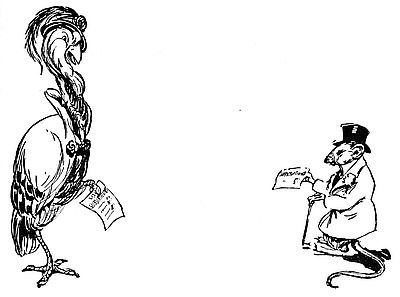
“Can you spare a Threepenny bit,
Dear Miss Turkey,” said Sir Mouse,
“For Job’s Turkey’s benefit?
I’ve engaged the Opera House!”
“Alas! I’ve naught to spare!”
Said Miss Turkey, “save advice,
I am getting up a Fair,
To relieve the Poor Church Mice.”
SUMMER MASS
In the cloisters of the grass,
Lit by buttercups and daisies,
Celebrants of summer mass,
Little creatures sing their praises.
From a myriad throbbing throats
Rises up their song of Love,
Like a mist of golden motes,
To the Golden Throne above.
And the good Lord, bending nigh,
Quite forgets his house of stone
Where the frightened sinners cry,
And the frowning priests intone,
And the saints (if saints they be)
Smile and smile in effigy.
ABOUT PEOPLE I HAVE MET
ABOUT PEOPLE I HAVE MET
J. M. BARRIE
A Round Robin from His Humble and Devoted Servants the Alphabet
The Lord forgive if we transgress
Thus to familiarly address
One of our betters.
But, Jamie, do you no recall
The slate whereon you learned to scrawl
Your Humble Letters?
Well we remember how you drew
Our shapely features all askew,
Unflattering really.
You made A lame and B too fat.
And C too curly—what of that!
We loved you dearly.
From that first day we owned your spell.
And just because you used us well
We served you blindly.
Why, even when you put us through
A fearsome Scottish reel, we knew
You meant it kindly.
Jamie, ’tis said Grand Tales there be
Still biding in the A B C—
If this be true,
Quick, Jamie! Cast your golden net.
Maybe we have the grandest yet
In store for you.
THE HORSE
The Horse, I don’t mind telling you,
Is not an easy thing to do.
With Cats and Lions, I confess,
I’ve had a measure of success;
Likewise with Camels, Mice and Snails
And Frogs and Butterflies and Whales.
Eels and Rhinoc’ruses and Ants
And Porcupines and Elephants
And Bees and Yaks and Owls. But when
I try to draw a Horse, my pen
Sputters and scares the high-strung steed,
Who gallops off at such a speed
You have to take the beast on trust—
You can not see him for the dust.
THE TOWN CAT
The melancholy days are come,
The saddest of the year;
Of houses closed and doorbells dumb
And windows dark and drear.
Now Dives to his country seat
Has hied himself away,
And Tabby turned into the street
Must shift as best she may.
No more the cushion soft as silk,
The catnip ball no more;
No more the saucer full of milk
Behind the pantry door.
Nor shall she in the temple prey
Upon the lean church mouse;
The good Lord, too, has gone away
And closed his city house.
When Dives hies him back once more
To his town house, oh, shame!
Tabby will greet him at the door,
But not—no, not the same.
TOWSER
My hair hangs down on either side
Like a Niagara small.
Why is it this, my greatest pride,
Should bring about my fall?
Why is it that my well brushed hair,
That now so smoothly lies,
As soon as I descend the stair
Always gets in my eyes?
No wonder, thus deprived of sight,
I step on empty air
And to the bottom of the flight
Rebound from stair to stair.
I’m not the sort of dog that cares
To make a fuss when hit;
But falling down a flight of stairs
Is not the worst of it.
As there I lie completely out
Of breath and very flat,
Why is it always some one stout
That takes me for a mat?
THE OYSTER
In Autumn, when the leaves are dead,
They take us from our Oyster-bed,
And all the winter long they keep
Us up, without a wink of sleep—
And doesn’t it seem hard to you
When Spring is here, and skies are blue,
And we should like so much to stay,
We have to be in bed by May?
THE MOUSE
A Study in Egotisms
Scene: A drawing-room.
Persons: Clarissa, the Mouse, Purrline.
Clarissa: Help! Help! A Mouse!
Mouse: Don’t be alarmed! I’m here!
I hurried when I heard you scream—
Clarissa: Oh, dear!
If it jumps up at me I shall expire!
Mouse: If I may be permitted to enquire,
Why are you standing there in such a fright,
Upon a chair, clutching your frock so tight
About your—
Clarissa: Help! Oh dear! I wonder what
That girl’s about! Good heavens! I forgot
It’s Jane’s day out. There’s no one in the house
But me—
Mouse: Fair lady! I am but a Mouse,
A simple Mouse, but underneath this fur
There beats a heart whose motto is Sans Purr.
To see a lovely female in distress
Rouses in me the spirit of Noblesse.
To her protection instantly I fly.
No common Mus Domesticus am I!
You may have heard—
Clarissa: If only Jane were here!
What shall I do?
Mouse: Dear lady, have no fear!
As I was saying, doubtless you’ve heard tell
How once a Mountain bore a Mouse-child. Well,
I was that Child! Or rather, to be more
Strictly veracious, ’twas my Ancestor;
And sometimes when I dream of deeds Titanic
I think that Mountain must have been Volcanic!
So have no fear! If any one should dare
Molest you, I am here beneath your chair,
Ready to spring—
Clarissa: Mercy! I wonder why
It squeaks like that! It’s crazy! I shall die
If it—
Mouse: Sweet lady! Though I cannot guess
From your queer speech the cause of your distress,
Your voice, quite meaningless to my Mouse ear,
Is strangely sweet and musical and clear;
And, though they violate our beauty-laws,
I never saw such shapely hinder paws
As yours, so smooth and beautiful to see,
So silky white, like sticks of celery.
Upon each side a tender sprig of gold—
Gold as pure Cheese, and toothsome to behold—
Climbs up and up! ’Tis called, so I am told
By Mice more versed in lady-lore, a Clock.
Once, it is said, a Mouse named Dickery Dock
Ran up the—
Clarissa: Ouch!!!
Mouse: I wonder if I dare!
Only the brave deserve—
Clarissa: O Lord! This chair
Is giving way! If it should break!—What’s that?
It’s Purrline’s mew! Here, Puss! Puss!—
Mouse: What? The Cat!
I’d love to meet him! But it’s getting late.
My wife’s expecting me. I musn’t wait!
(Exit)
Purrline: Me-ouw!
Clarissa: And is that all you’ve got to say?
Did you expect the Mouse to wait all day?
For all you care, I might have died of fright!
My! But I’m glad it got away all right!
CURTAIN
PEOPLE I HAVE NOT MET
PEOPLE I HAVE NOT MET
THE TURTLE
I never wasted any love
On turtles, but the turtle-dove
Is quite another thing;
When I have nothing else to do,
I love to hear them bill and coo
While mating in the spring.
There’s something in their plaintive note
That brings a lump into my throat
And makes my pulses stir;
Something between a smothered snore
And the shrill creaking of a door,
That soothes me, as it were.
How strange is Nature’s alchemy,
To think that living in the sea
Should change a creature so!
The turtle of the finny kind
That swims the sea, is to my mind
The lowest of the low.
And yet, O inconsistency!
Although the turtle is to me
A most obnoxious beast,
When on a menu card I spy
“Green Turtle, Soup,” though it comes high,
I take two plates at least!
MICHAEL O’LEARY
When forming one of a storming party which advanced against an enemy’s barricade, O’Leary rushed to the front and himself killed five Germans who were holding the first barricade, after which he attacked the second barricade, about sixty yards further on, which he captured after killing three of the enemy and making prisoners of two more.
You may talk of the Rebels of Ulster
And the shindy we had to chuck;
But we don’t give a rap for a family scrap
Whin the Prooshuns is running amuck.
Did you hear how Lance Corporal O’Leary,
Mike O’Leary of the Guards,
Wid his own two mits, tore a forthress to bits
Like a blissed conthraption of cards.
He’d a shmile, had Mike, that ’ud span a dyke,
And a fist that ’ud fell a horse,
And he ripped through the mire of blood and barbed wire,
Like a bull through a bunch of gorse.
Whin he waded in, sure ’twas a sin,
The way that he bashed and bruk ’em;
He dropped on thim Huns like forty tons,
And they niver knew what had struck ’em.
“Poor dears,” says Mike, “I’m thinking belike
All the news they’ve been told is lies,
So it’s up to me, ’ere it’s kilt they be,
To put the poor divils wise.
“Thim Huns, I’m told, while outrageous bold
Is over a trifle dull.
Sure, if that’s a fact, ’tis a friendly act
To hammer it through their skull.
“So here’s for insulting old Erin,
By thinking a thraitor she’d be!
And here’s for your Imperor sneerin’!
‘Contemptible army,’ says he.
“Here’s one for the mothers whose pleadin’
You stopped with a shot and a curse,
And one for the girls dead and bleedin’
And the girls that you spared—for worse.
“For the churches you shelled and the priests you felled
Here’s one! And the women, too,
You held for a shield on the battle field,
And the innocent babes you slew.”
Whin O’Leary had done, there was divil a one
Left to tumble to what he said—
Barrin’ only ten, which I’m wrong again,
For eight av the ten was dead.