
WeRead Powered by ReaderPub
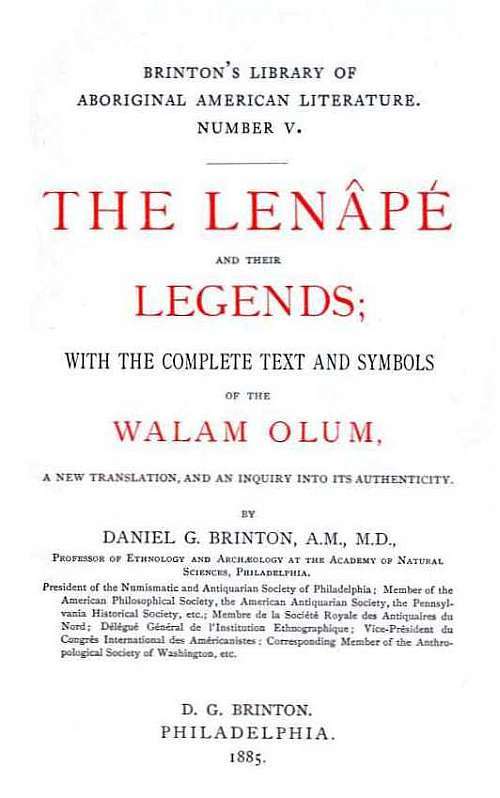
The Lenâpé and Their Legends / With the complete text and symbols of the Walam olum, a new translation, and an inquiry into its authenticity cover

The Lenâpé and Their Legends / With the complete text and symbols of the Walam olum, a new translation, and an inquiry into its authenticity

Chapter 59: II.
Open in WeRead

About This Book

A collection of ethnological studies that situates the Lenape within broader Algonkin and Iroquoian contexts and traces regional relationships and migrations. It details Lenape social organization, material culture, subsistence, crafts, religious beliefs, ceremonies, totems, burial practices, and mnemonic picture-writing. The volume supplies extensive linguistic material: vocabularies, dialect comparisons, grammatical notes, and discussions of manuscript sources. A principal feature is the complete presentation, translation, and philological analysis of the Walam Olum, including its phonetics, metrical form, pictographic elements, and questions of authenticity. Supplementary notes, a vocabulary, appendices, and indices support the historical, cultural, and linguistic examinations.

Metrical Form.

Even to an ear not acquainted with the language, the chants of the Walam Olum are obviously in metrical arrangement. The rhythm is syllabic and accentual, with frequent effort to select homophones (to which the correct form of the words is occasionally sacrificed), and sometimes alliteration. Iteration is also called in aid, and the metrical scheme is varied in the different chants.

All these rhythmical devices appear in the native American songs of many tribes, though I cannot point to any other strictly aboriginal production in Algonkin, where a tendency toward rhyme is as prominent as in the Walam Olum. It is well to remember, however, that our material for comparison is exceedingly scanty, and also that for nearly three fourths of a century before this song was obtained, the music-loving Moravian missionaries had made the Delawares familiar with numerous hymns in their own tongue, correctly framed and rhymed.

Pictographic System

The pictographic system which the Walam Olum presents is clearly that of the Western Algonkins, most familiar to us through examples from the Chipeways and Shawnees. It is quite likely, indeed, that it was the work of a Shawnee, as we know that they supplied such songs, with symbols, to the Chipeways, and were intimately associated with the Delawares.

At the time Rafinesque wrote, Tanner's Narrative had been in print several years, and the numerous examples of Algonkin pictography it contains were before him. Yet it must be said that the pictographs of the Walam Olum have less resemblance to these than to those published by the Chipeway chief, George Copway, in 1850, and by Schoolcraft, in his "History and Statistics of the Indian Tribes." There is generally a distinct, obvious connection between the symbol and the sense of the text, sufficient to recall the latter to one who has made himself once thoroughly familiar with it. I have not undertaken a study of the symbols; but have confined myself to a careful reproduction of them, and the suggestion of their more obvious meanings, and their correspondences with the pictographs furnished by later writers. I shall leave it for others to determine to what extent they should be accepted as a pure specimen of Algonkin pictographic writing.

Derivation of Walam Olum.

The derivation of the name Walam Olum has been largely anticipated on previous pages. I have shown that wâlâm (in modern Minsi, wâlumin) means "painted," especially "painted red." This is a secondary meaning, as the root wuli conveys the idea of something pleasant, in this connection, pleasant to the eye, fine, pretty. (See ante p. 104.)

Olum was the name of the scores, marks, or figures in use on the tally-sticks or record-boards. The native Delaware missionary, Mr. Albert Anthony says that the knowledge of these ancient signs has been lost, but that the word olum is still preserved by the Delaware boys in their games when they keep the score by notches on a stick. These notches— not the sticks—are called to this day olum—an interesting example of the preservation of an archaic form in the language of children.

The name Wâlâm Olum is therefore a highly appropriate one for the record, and may be translated "Red Score."

The MS. of the Walam Olum.

The MS. from which I have printed the Walam Olum is a small quarto of forty unnumbered leaves, in the handwriting of Rafinesque. It is in two parts with separate titles. The first reads:—

Walamolum

First Part of the painted-engraved ║ traditions of the Linni linapi,&c. ║ containing ║ the 3 original traditional poems ║ 1 on the Creation and Ontogony, 24 verses ║ 2 on the Deluge, &c. 16 v ║ 3 on the passage to America, 20 v ║ Signs and Verses, 60 ║ with the original glyphs or signs ║ for each verse of the poems or songs ║ translated word for word ║ by C S Rafinesque ║ 1833

The title of the second part is:—

Walam-olum

First and Second Parts of the ║ Painted and engraved traditions ║ of the Linni linapi

II Part

Historical Chronicles or Annals ║ in two Chronicles

1 From arrival in America to settlement in Ohio, &c. 4 chapters each of 16 verses, each of 4 words, 64 signs

2d From Ohio to Atlantic States and back to Missouri, a mere succession of names in 3 chapters of 20 verses—60 signs

Translated word for word by means of Zeisberger and Linapi Dictionary. With explanations, &c.

By C S Rafinesque 1833

When Rafinesque died, his MSS. were scattered and passed into various hands. Prof. Haldeman, in his notice above referred to (p. 150), stated that he and "Mr. Poulson of Philadelphia" had a large part of them.

This particular one, and also others descriptive of Rafinesque's archaeological explorations in the southwest, his surveys of the earthworks of Kentucky and the neighboring states, and the draft of a work on "The Ancient Monuments of North and South America," came into the possession of the Hon. Brantz Mayer, of Baltimore, distinguished as an able public man and writer on American subjects, from whose family I obtained them.

He loaned them all to Mr. E. G. Squier, who made extensive use of Rafinesque's surveys, in the "Ancient Monuments of the Mississippi Valley," giving due credit.

In June, 1848, Mr. Squier read before the New York Historical Society a paper entitled, "Historical and Mythological Traditions of the Algonquins; with a translation of the 'Walum-Olum,' or Bark Record of the Linni-Lenape." This was published in the "American Review," February, 1849, and has been reprinted by Mr. W. W. Beach, in his "Indian Miscellany" (Albany, 1877), and in the fifteenth edition of Mr. S. G. Drake's "Aboriginal Races of North America."

This paper gave the symbols, original text and Rafinesque's translation of the first two songs, and a free translation only, of the remainder. The text was carelessly copied, whole words being omitted, and no attempt was made to examine the accuracy of the translation; the symbols were also imperfect, several being reversed. Hence, as material for a critical study of the document, Squier's essay is of little value.

At the close of the second part of the MS. there are four pages, closely written, with the title:—

"Fragment on the History of the Linapis since abt 1600 when the Wallamolum closes translated from the Linapi by John Burns."

This was printed by Rafinesque and Squier, but as it has no original text, as nothing is known of "John Burns," and as the document itself, even if reasonably authentic, has no historic value, I omit it.

General Synopsis of the Walam Olum.

The myths embodied in the earlier portion of the Walam Olum are perfectly familiar to one acquainted with Algonkin mythology. They are not of foreign origin, but are wholly within the cycle of the most ancient legends of that stock. Although they are not found elsewhere in the precise form here presented, all the figures and all the leading incidents recur in the native tales picked up by the Jesuit missionaries in the seventeenth century, and by Schoolcraft, McKinney, Tanner and others in later days.

In an earlier chapter I have collected the imperfect fragments of these which we hear of among the Delawares, and these are sufficient to show that they had substantially the same mythology as their western relatives.

The cosmogony describes the formation of the world by the Great Manito, and its subsequent despoliation by the spirit of the waters, under the form of a serpent. The happy days are depicted, when men lived without wars or sickness, and food was at all times abundant. Evil beings, of mysterious power, introduced cold and war and sickness and premature death. Then began strife and long wanderings.

However similar this general outline may be to European and Oriental myths, it is neither derived originally from them, nor was it acquired later by missionary influence. This similarity is due wholly to the identity of psychological action, the same ideas and fancies arising from similar impressions in New as well as Old World tribes. No sound ethnologist, no thorough student in comparative mythology, would seek to maintain a genealogical relation of cultures on the strength of such identities. They are proofs of the oneness of the human mind, and nothing more.

As to the historical portion of the document, it must be judged by such corroborative evidence as we can glean from other sources. I have quoted, in an earlier chapter, sufficient testimony to show that the Lenape had traditions similar to these, extending back for centuries, or at least believed by their narrators to reach that far. What trust can be reposed in them is for the archaeologist to judge.

Authentic history tells us nothing about the migrations of the Lenape before we find them in the valley of the Delaware. There is no positive evidence that they arrived there from the west; still less concerning their earlier wanderings.

Were I to reconstruct their ancient history from the Walam Olum, as I understand it, the result would read as follows:—

At some remote period their ancestors dwelt far to the northeast, on tide-water, probably at Labrador (Compare ante, p. 145). They journeyed south and west, till they reached a broad water, full of islands and abounding in fish, perhaps the St. Lawrence about the Thousand Isles. They crossed and dwelt for some generations in the pine and hemlock regions of New York, fighting more or less with the Snake people, and the Talega, agricultural nations, living in stationary villages to the southeast of them, in the area of Ohio and Indiana. They drove out the former, but the latter remained on the upper Ohio and its branches. The Lenape, now settled on the streams in Indiana, wished to remove to the East to join the Mohegans and other of their kin who had moved there directly from northern New York. They, therefore, united with the Hurons (Talamatans) to drive out the Talega (Tsalaki, Cherokees) from the upper Ohio. This they only succeeded in accomplishing finally in the historic period (see ante p. 17). But they did clear the road and reached the Delaware valley, though neither forgetting nor giving up their claims to their western territories (see ante p. 144).

In the sixteenth century the Iroquois tribes seized and occupied the whole of the Susquehanna valley, thus cutting off the eastern from the western Algonkins, and ended by driving many of the Lenape from the west to the east bank of the Delaware (ante p. 38,).

Synopsis of the separate parts.

I.

The formation of the universe by the Great Manito is described. In the primal fog and watery waste he formed land and sky, and the heavens cleared. He then created men and animals. These lived in peace and joy until a certain evil manito came, and sowed discord and misery.

This canto is a version of the Delaware tradition mentioned in the Heckewelder MSS. which I have given previously, p. 135. The notion of the earth rising from the primal waters is strictly a part of the earliest Algonkin mythology, as I have amply shown in previous discussions of the subject. See my Myths of the New World, p. 213, and American Hero Myths, Chap. II.

II.

The Evil Manito, who now appears under the guise of a gigantic serpent, determines to destroy the human race, and for that purpose brings upon them a flood of water. Many perish, but a certain number escape to the turtle, that is, to solid land, and are there protected by Nanabush (Manibozho or Michabo). They pray to him for assistance, and he caused the water to disappear, and the great serpent to depart.

This canto is a brief reference to the conflict between the Algonkin hero god and the serpent of the waters, originally, doubtless, a meteorological myth. It is an ancient and authentic aboriginal legend, shared both by Iroquois and Algonkins, under slightly different forms. In one aspect, it is the Flood or Deluge Myth. For the general form of this myth, see my Myths of the New World, pp. 119, 143, 182, and American Hero Myths, p. 50, and authorities there quoted; also, E. G. Squier, "Manabozho and the Great Serpent; an Algonquin Tradition," in the American Review, Vol. II, Oct., 1848.

III.

The waters having disappeared, the home of the tribe is described as in a cold northern clime. This they concluded to leave in search of warmer lands. Having divided their people into a warrior and a peaceful class, they journeyed southward, toward what is called the "Snake land." They approached this land in winter, over a frozen river. Their number was large, but all had not joined in the expedition with equal willingness, their members at the west preferring their ancient seats in the north to the uncertainty of southern conquests. They, however, finally united with the other bands, and they all moved south to the land of spruce pines.

IV.

The first sixteen verses record the gradual conquest of most of the Snake land. It seems to have required the successive efforts of six or seven head chiefs, one after another, to bring this about, probably but a small portion at a time yielding to the attacks of these enemies. Its position is described as being to the southwest, and in the interior of the country. Here they first learned to cultivate maize.

The remainder of the canto is taken up with a long list of chiefs, and with the removal of the tribe, in separate bands and at different times, to the east. In this journey from the Snake land to the east, they encountered and had long wars with the Talega. These lived in strong towns, but by the aid of the Hurons (Talamatans), they overcame them and drove them to the south.

V.

Having conquered the Talegas, the Lenape possessed their land and that of the Snake people, and for a certain time enjoyed peace and abundance. Then occurred a division of their people, some, as Nanticokes and Shawnees, going to the south, others to the west, and later, the majority toward the east, arriving finally at the Salt sea, the Atlantic ocean. Thence a portion turned north and east, and encountered the Iroquois. Still later, the three sub-tribes of the Lenape settled themselves definitely along the Delaware river, and received the geographical names by which they were known, as Minsi, Unami and Unalachtgo (see ante, p. 36). They were often at war with the Iroquois, generally successfully. Rumors of the whites had reached them, and finally these strangers approached the river, both from the north (New York bay) and the south. Here the song closes.


THE WALUM OLUM

or

RED SCORE,

of the

LENÂPÉ.


I.


1. Sayewi talli wemiguma wokgetaki, 2. Hackung kwelik owanaku wak yutali Kitanitowit-essop. 3. Sayewis hallemiwis nolemiwi elemamik Kitanitowit-es-sop. 4. Sohalawak kwelik hakik owak[259] awasagamak. 5. Sohalawak gishuk nipahum alankwak. 6. Wemi-sohalawak yulik yuchaan. 7. Wich-owagan kshakan moshakwat[260] kwelik kshipe-helep. 8. Opeleken mani-menak delsin-epit.
1. At first, in that place, at all times, above the earth, 2. On the earth, [was] an extended fog, and there the great Manito was. 3. At first, forever, lost in space, everywhere, the great Manito was. 4. He made the extended land and the sky. 5. He made the sun, the moon, the stars. 6. He made them all to move evenly. 7. Then the wind blew violently, and it cleared, and the water flowed off far and strong. 8. And groups of islands grew newly, and there remained
9. Lappinup Kitanitowit manito manitoak. 10. Owiniwak angelatawiwak chichankwak wemiwak. 11. Wtenk manito jinwis lennowak mukom. 12. Milap netami gaho owini gaho. 13. Namesik milap,tulpewik milap, awesik milap, cholensak milap. 14. Makimani shak sohalawak makowini nakowak amangamek.
9. Anew spoke the great Manito, a manito to manitos, 10. To beings, mortals, souls and all, 11. And ever after he was a manito to men, and their grandfather. 12. He gave the first mother, the mother of beings. 13. He gave the fish, he gave the turtles, he gave the beasts, he gave the birds. 14. But an evil Manito made evil beings only, monsters,
15. Sohalawak uchewak, sohala-wak pungusak. 16. Nitisak wemi owini w delsinewuap. 17. Kiwis, wunand wishimanitoak essopak 18. Nijini netami lennowak, ni goha netami okwewi nan tinewak. 19. Gattamin netami mitzi nijini nantine. 20. Wemi wingi-namenep, wemi ksin-elendamep, wemi wullatemanuwi. 21. Shukand eli-kimi mekenikink wakon powako init'ako.
15. He made the flies, he made the gnats. 16. All beings were then friendly. 17. Truly the manitos were active and kindly 18. To those very first men, and to those first mothers; fetched them wives, 19. And fetched them food, when first they desired it. 20. All had cheerful knowledge, all had leisure, all thought in gladness. 21. But very secretly an evil being, a mighty magician, came on earth,
22. Mattalogas pallalogas maktaton owagan payat-chik yutali. 23. Maktapan payat, wihillan payat, mboagan payat. 24. Won wemi wiwunch kamik atak kitahikan netamaki epit.
22. And with him brought badness, quarreling, unhappiness, 23. Brought bad weather, brought sickness, brought death. 24. All this took place of old on the earth, beyond the great tide-water, at the first.

II.


1. Wulamo maskanako anup lennowak makowini essopak. 2. Maskanako shingalusit nijini essopak shawelendamep eken shingalan. 3. Nishawi palliton, nishawi machiton, nishawi matta lungundowin. 4. Mattapewi wiki nihanlowit mekwazoan.
1. Long ago there was a mighty snake and beings evil to men. 2. This mighty snake hated those who were there (and) greatly disquieted those whom he hated. 3. They both did harm, they both injured each other, both were not in peace. 4. Driven from their homes they fought with this murderer.
5. Maskanako gishi penauwelendamep lennowak owini palliton. 6. Nakowa petonep, amangam petonep, akopehella petonep. 7. Pehella pehella, pohoka pohoka, eshohok eshohok, palliton palliton. 8. Tulapit menapit Nanaboush maskaboush owinimokom linowimokom. 9. Gishikin-pommixin tulagis-hatten-lohxin. 10. Owini linowi wemoltin, Pehella gahani pommixin, Nahiwi tatalli tulapin.
5. The mighty snake firmly resolved to harm the men. 6. He brought three persons, he brought a monster, he brought a rushing water. 7. Between the hills the water rushed and rushed, dashing through and through, destroying much. 8. Nanabush, the Strong White One, grandfather of beings, grandfather of men, was on the Turtle Island. 9. There he was walking and creating, as he passed by and created the turtle. 10. Beings and men all go forth, they walk in the floods and shallow waters, down stream thither to the Turtle Island.
11. Amanganek makdopannek alendyuwek metzipannek. 12. Manito-dasin mokol-wichemap, Palpal payat payat wemichemap. 13. Nanaboush Nanaboush wemimokom, Winimokom linnimokom tulamokom. 14. Linapi-ma tulapi-ma tulapewi tapitawi. 15. Wishanem tulpewi pataman tulpewi poniton wuliton. 16. Kshipehelen penkwihilen, Kwamipokho sitwalikho, Maskan wagan palliwi palliwi.
11. There were many monster fishes, which ate some of them. 12. The Manito daughter, coming, helped with her canoe, helped all, as they came and came. 13. [And also] Nanabush, Nanabush, the grandfather of all, the grandfather of beings, the grandfather of men, the grandfather of the turtle. 14. The men then were together on the turtle, like to turtles. 15. Frightened on the turtle, they prayed on the turtle that what was spoiled should be restored. 16. The water ran off, the earth dried, the lakes were at rest, all was silent, and the mighty snake departed.

III.


1. Pehella wtenk lennapewi tulapewini psakwiken woliwikgun wittank talli. 2. Topan-akpinep, wineu-akpinep, kshakan-akpinep, thupin akpinep.
1. After the rushing waters (had subsided) the Lenape of the turtle were close together, in hollow houses, living together there. 2. It freezes where they abode, it snows where they abode, it storms where they abode, it is cold where they abode.
3. Lowankwamink wulaton wtakan tihill kelik meshautang sili ewak. 4. Chintanes-sin powalessin peyachik wikhichik pokwihil. 5. Eluwi-chitanesit eluwi takau wesit, elowi chiksit, elowichik delsinewo. 6. Lowaniwi, wapaniwi shawaniwi, wunkeniwi, elowichik apakachik. 7. Lumowaki, lowanaki tulpenaki elowaki tulapiwi lina-piwi. 8. Wemiako yagawan tendki lakkawelendam nakopowa wemi owenluen atam. 9. Akhokink wapaneu wemoltin palliaal kitelendam aptelendam.
3. At this northern place they speak favorably of mild, cool (lands), with many deer and buffaloes. 4. As they journeyed, some being strong, some rich, they separated into house-builders and hunters; 5. The strongest, the most united, the purest, were the hunters. 6. The hunters showed themselves at the north, at the east, at the south, at the west. 7. In that ancient country, in that northern country, in that turtle country, the best of the Lenape were the Turtle men. 8. All the cabin fires of that land were disquieted, and all said to their priest, "Let us go". 9. To the Snake land to the east they went forth, going away, earnestly grieving.
10. Pechimuin shakowen[261] nungihillan lusasaki pikihil pokwihil akomenaki. 11. Nihillapewin komelendam lowaniwi wemiten chihillen winiaken. 12. Namesuagipek pokhapockhapek guneunga waplanewa ouken waptumewi ouken. 13. Amokolon nallahemen agunouken pawasinep wapasinep akomenep.[262] 14. Wihlamokkicholenluchundi, Wematam akomen luchundi. 15. Witehen wemiluen wemaken nihillen. 16. Nguttichin lowaniwi, Nguttichin wapaniwi, Agamunk topanpek Wulliton epannek. 17. Wulelemil w'shakuppek, Wemopannek hakhsinipek, Kitahikan pokhakhopek.
10. Split asunder, weak, trembling, their land burned, they went, torn and broken, to the Snake Island. 11. Those from the north being free, without care, went forth from the land of snow, in different directions. 12. The fathers of the Bald Eagle and the White Wolf remain along the sea, rich in fish and muscles. 13. Floating up the streams in their canoes, our fathers were rich, they were in the light, when they were at those islands. 14. Head Beaver and Big Bird said, "Let us go to Snake Island," they said. 15. All say they will go along to destroy all the land. 16. Those of the north agreed, Those of the east agreed. Over the water, the frozen sea, They went to enjoy it. 17. On the wonderful, slippery water, On the stone-hard water all went, On the great Tidal Sea, the muscle-bearing sea.
18. Tellenchen kittapakki nillawi, Wemoltin gutikuni nillawi, Akomen wapanawaki nillawi, Ponskan, ponskan, wemiwi olini. 19. Lowanapi, wapanapi, shawa-napi, Lanewapi, tamakwapi, tume-wapi, Elowapi, powatapi, wilawapi, Okwisapi, danisapi, allumapi, 20. Wemipayat gunéunga shinaking, Wunkenapi chanelendam payaking, Allowelendam kowiyey tulpaking.
18. Ten thousand at night, All in one night, To the Snake Island, to the east, at night, They walk and walk, all of them. 19. The men from the north, the east, the south, The Eagle clan, the Beaver clan, the Wolf clan, The best men, the rich men, the head men, Those with wives, those with daughters, those with dogs, 20. They all come, they tarry at the land of the spruce pines; Those from the west come with hesitation, Esteeming highly their old home at the Turtle land.

IV.


1. Wulamo linapioken manup shinaking. 2. Wapallanewa sittamaganat yukepechi wemima, 3. Akhomenis michihaki wellaki kundokanup.
1. Long ago the fathers of the Lenape were at the land of spruce pines. 2. Hitherto the Bald Eagle band had been the pipe bearer, 3. While they were searching for the Snake Island, that great and fine land.
4. Angomelchik elowichik elmusichik menalting. 5. Wemilo kolawil sakima lissilma. 6. Akhopayat kihillalend akhopokho askiwaal. 7. Showihilla akhowemi gandhaton mashkipokhing. 8. Wtenkolawil shinaking sakimanep wapagokhos. 9. Wtenk nekama sakimanep janotowi enolowin. 10. Wtenk nekama sakimanep chilili shawaniluen.
4. They having died, the hunters, about to depart, met together. 5. All say to Beautiful Head, "Be thou chief." 6. "Coming to the Snakes, slaughter at that Snake hill, that they leave it." 7. All of the Snake tribe were weak, and hid themselves in the Swampy Vales. 8. After Beautiful Head, White Owl was chief at Spruce Pine land. 9. After him, Keeping-Guard was chief of that people. 10. After him, Snow Bird was chief, he spoke of the south,
11. Wokenapi nitaton wullaton apakchikton. 12. Shawaniwaen chilili, wapaniwaen tamakwi. 13. Akolaki shawanaki, kitshinaki shabiyaki. 14. Wapanaki namesaki, pemapaki sisilaki. 15. Wtenk chilili sakimanep ayamek weminilluk. 16. Chikonapi akhonapi makatapi assinapi.
17. Wtenk ayamek tellen sakimak machi tonanup shawapama.
11. That our fathers should possess it by scattering abroad. 12. Snow Bird went south, White Beaver went east. 13. The Snake land was at the south, the great Spruce Pine land was toward the shore; 14. To the east was the Fish land, toward the lakes was the buffalo land. 15. After Snow Bird, the Seizer was chief, and all were killed, 16. The robbers, the snakes, the evil men, the stone men.
17. After the Seizer there were ten chiefs, and there was much warfare south and east.
18. Wtenk nellamawa sakimanep langundowi akolaking. 19. Wtenk nekama sakimanep tasukamend shakagapipi. 20. Wtenk nekama sakimanep pemaholend wuhtowin. 21. Sagimawtenk matemik, sagimawtenk pilsohalm. 22. Sagimawtenk gunokeni, sagimawtenk mangipitak. 23. Sagimawtenk olumapi, leksahowen sohalawak. 24. Sagimawtenk taguachi shawamwaen mmihaking. 25. Sakimawtenk huminiend mimgeman sohalgol.
18. After them, the Peaceable was chief at Snake land. 19. After him, Not-Black was chief, who was a straight man. 20. After him, Much-Loved was chief, a good man. 21. After him, No-Blood was chief, who walked in cleanliness. 22. After him, Snow-Father was chief, he of the big teeth. 23. After him, Tally-Maker was chief, who made records. 24. After him, Shiverer-with-Cold was chief, who went south to the corn land. 25. After him, Corn-Breaker was chief, who brought about the planting of corn.
26. Sakimawtenk alkosohit sakimachik apendawi. 27. Sawkima tenk shiwapi, sakimatenk penkwonwi. 28. Attasokelan attaminin wapaniwaen italissipek. 29. Oligonunk sisilaking nallimetzin kolakwammg. 30. Wtenk penkwonwi wekwochella, wtenk nekama chingalsuwi. 31. Wtenk nekama kwitikwond, slangelendam attagatta, 32. Wundanuksm wapanickam[263] allendyachick kimimikwi.
33. Gunehunga wetatamowi wakaholend sakimalanop.
26. After him, the Strong-Man was chief, who was useful to the chieftains. 27. After him, the Salt-Man was chief; after him the Little-One was chief. 28. There was no rain, and no corn, so they moved further seaward. 29. At the place of caves, in the buffalo land, they at last had food, on a pleasant plain. 30. After the Little-One (came) the Fatigued; after him, the Stiff-One. 31. After him, the Reprover; disliking him, and unwilling (to remain), 32. Being angry, some went off secretly, moving east.
33. The wise ones who remained made the Loving-One chief.
34. Wisawana lappi wittank michi mini madawasim. 35. Weminitis tamenend sakimanep nekohatami. 36. Eluwiwulit matemenend wemi linapi nitis payat. 37. Wtenk wulitma maskansisil sakimanep w'tamaganat. 38. Machigokloos sakimanep, wapkicholen sakimanep. 39. Wingenund sakimanep powatanep gentikalanep. 40. Lapawin sakimanep, waliama sakimanep. 41. Waptipatit sakimanep, lappi mahuk lowashawa.
34. They settled again on the Yellow river, and had much corn on stoneless soil. 35. All being friendly, the Affable was chief, the first of that name. 36. He was very good, this Affable, and came as a friend to all the Lenape. 37. After this good one, Strong-Buffalo was chief and pipe-bearer. 38. Big-Owl was chief; White-Bird was chief. 39. The Willing-One was chief and priest, he made festivals. 40. Rich-Again was chief, the Painted-One was chief. 41. White-Fowl was chief; again there was war, north and south.
42. Wewoattan menatting tumaokan sakimanep. 43. Nitatonep wemi palliton maskansim nihillanep. 44. Messissuwi sakimanep akowmi pallitonep. 45. Chitanwulit sakimanep lowanuski pallitonep. 46. Alokuwi sakimanep towakon pallitonep. 47. Opekasit sakimanep sakhelendam pallitonepit. 48. Wapagishik yuknohokluen makeluhuk wapaneken.
49. Tsehepieken nemassipi[264] nolandowak gunehunga.
42. The Wolf-wise-in-Counsel was chief. 43. He knew how to make war on all; he slew Strong-Stone. 44. The Always-Ready-One was chief; he fought against the Snakes. 45. The Strong-Good-One was chief; he fought against the northerners. 46. The Lean-One was chief; he fought against the Tawa people. 47. The Opossum-Like was chief; he fought in sadness, 48. And said, "They are many; let us go together to the east, to the sunrise."
49. They separated at Fish river; the lazy ones remained there.
50. Yagawanend sakimanep talligewi wapawullaton. 51. Chitanitis sakimanep wapawaki gotatamen. 52. Wapallendi pomismep talegawil allendhilla. 53. Mayoksuwi wemilowi palliton palliton. 54. Talamatan nitilowan payatchik wemiten. 55. Kinehepend sakimanep tamaganat sipakgamen. 56. Wulatonwi makelima pallihilla talegawik. 57. Pimokhasuwi sakimanep wsamimaskan talegawik. 58. Tenchekentit sakimanep wemilat makelinik.
50. Cabin-Man was chief; the Talligewi possessed the east. 51. Strong-Friend was chief; he desired the eastern land. 52. Some passed on east; the Talega ruler killed some of them. 53. All say, in unison, "War, war". 54. The Talamatan, friends from the north, come, and all go together. 55. The Sharp-One was chief; he was the pipe-bearer beyond the river. 56. They rejoiced greatly that they should fight and slay the Talega towns. 57. The Starrer was chief, the Talega towns were too strong. 58. The Fire-Builder was chief; they all gave to him many towns.