
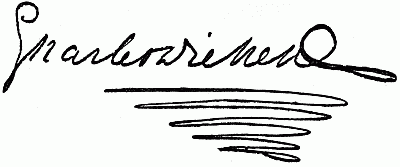
In acknowledging the safe receipt of your kind donation in behalf of poor Mr. Elton's orphan children, I hope you will suffer me to address you with little ceremony, as the best proof I can give you of my cordial reciprocation of all you say in your most welcome note. I have long esteemed you and been your distant but very truthful admirer; and trust me that it is a real pleasure and happiness to me to anticipate the time when we shall have a nearer intercourse.
Faithfully your Servant.
Devonshire Terrace, October 13th, 1843.
I want very much to see you, not having had that old pleasure for a long time. I am at this moment deaf in the ears, hoarse in the throat, red in the nose, green in the gills, damp in the eyes, twitchy in the joints, and fractious in the temper from a most intolerable and oppressive cold, caught the other day, I suspect, at Liverpool, where I got exceedingly wet; but I will make prodigious efforts to get the better of it to-night by resorting to all conceivable remedies, and if I succeed so as to be only negatively disgusting to-morrow, I will joyfully present myself at six, and bring my womankind along with me.
Devonshire Terrace, November 13th, 1843.
Pray tell that besotted —— to let the opera sink into its native obscurity. I did it in a fit of d——ble good nature long ago, for Hullah, who wrote some very pretty music to it. I just put down for everybody what everybody at the St. James's Theatre wanted to say and do, and that they could say and do best, and I have been most sincerely repentant ever since. The farce I also did as a sort of practical joke, for Harley, whom I have known a long time. It was funny—adapted from one of the published sketches called the "Great Winglebury Duel," and was published by Chapman and Hall. But I have no copy of it now, nor should I think they have. But both these things were done without the least consideration or regard to reputation.
I wouldn't repeat them for a thousand pounds apiece, and devoutly wish them to be forgotten. If you will impress this on the waxy mind of —— I shall be truly and unaffectedly obliged to you.
1844.
NARRATIVE.
Mr. Macready went to America and returned in the autumn, and towards the end of the year he paid a professional visit to Paris.
Charles Dickens's letter to his wife (26th February) treats of a visit to Liverpool, where he went to take the chair on the opening of the Mechanics' Institution and to make a speech on education. The "Fanny" alluded to was his sister, Mrs. Burnett; the Britannia, the ship in which he and Mrs. Dickens made their outward trip to America; the "Mrs. Bean," the stewardess, and "Hewett," the captain, of that same vessel.
The letter to Mr. Charles Knight was in acknowledgment of the receipt of a prospectus entitled "Book Clubs for all readers." The attempt, which fortunately proved completely successful, was to establish a cheap book club. The scheme was, that a number of families should combine together, each contributing about three halfpennies a week; which contribution would enable them, by exchanging the volumes among them, to have sufficient reading to last the year. The publications, which were to be made as cheap as possible, could be purchased by families at the end of the year, on consideration of their putting by an extra penny a week for that purpose. Charles Dickens, who always had the comfort and happiness of the working-classes greatly at heart, was much interested in this scheme of Mr. Charles Knight's, and highly approved of it. Charles Dickens and this new correspondent became subsequently true and fast friends.
"Martin Chuzzlewit" was dramatised in the early autumn of this year, at the Lyceum Theatre, which was then under the management of Mr. and Mrs. Robert Keeley. Charles Dickens superintended some rehearsals, but had left England before the play was acted in public.
The man "Roche," alluded to in his letter to Mr. Maclise, was the French courier engaged to go with the family to Italy. He remained as servant there, and was with Charles Dickens through all his foreign travels. His many excellent qualities endeared him to the whole family, and his master never lost sight of this faithful servant until poor Roche's untimely death in 1849.
The Rev. Edward Tagart was a celebrated Unitarian minister, and a very highly esteemed and valued friend.
The "Chickenstalker" (letter to Mrs. Dickens, November 8th), is an instance of the eccentric names he was constantly giving to his children, and these names he frequently made use of in his books.
In this year we have our first letter to Mr. (afterwards Sir Edwin) Landseer, for whom Charles Dickens had the highest admiration and personal regard.
Devonshire Terrace, January 3rd, 1844.
You know all the news, and you know I love you; so I no more know why I write than I do why I "come round" after the play to shake hands with you in your dressing-room. I say come, as if you were at this present moment the lessee of Drury Lane, and had —— with a long face on one hand, —— elaborately explaining that everything in creation is a joint-stock company on the other, the inimitable B. by the fire, in conversation with ——. Well-a-day! I see it all, and smell that extraordinary compound of odd scents peculiar to a theatre, which bursts upon me when I swing open the little door in the hall, accompanies me as I meet perspiring supers in the narrow passage, goes with me up the two steps, crosses the stage, winds round the third entrance P.S. as I wind, and escorts me safely into your presence, where I find you unwinding something slowly round and round your chest, which is so long that no man can see the end of it.
Oh that you had been at Clarence Terrace on Nina's birthday! Good God, how we missed you, talked of you, drank your health, and wondered what you were doing! Perhaps you are Falkland enough (I swear I suspect you of it) to feel rather sore—just a little bit, you know, the merest trifle in the world—on hearing that Mrs. Macready looked brilliant, blooming, young, and handsome, and that she danced a country dance with the writer hereof (Acres to your Falkland) in a thorough spirit of becoming good humour and enjoyment. Now you don't like to be told that? Nor do you quite like to hear that Forster and I conjured bravely; that a plum-pudding was produced from an empty saucepan, held over a blazing fire kindled in Stanfield's hat without damage to the lining; that a box of bran was changed into a live guinea-pig, which ran between my godchild's feet, and was the cause of such a shrill uproar and clapping of hands that you might have heard it (and I daresay did) in America; that three half-crowns being taken from Major Burns and put into a tumbler-glass before his eyes, did then and there give jingling answers to the questions asked of them by me, and knew where you were and what you were doing, to the unspeakable admiration of the whole assembly. Neither do you quite like to be told that we are going to do it again next Saturday, with the addition of demoniacal dresses from the masquerade shop; nor that Mrs. Macready, for her gallant bearing always, and her best sort of best affection, is the best creature I know. Never mind; no man shall gag me, and those are my opinions.
My dear Macready, the lecturing proposition is not to be thought of. I have not the slightest doubt or hesitation in giving you my most strenuous and decided advice against it. Looking only to its effect at home, I am immovable in my conviction that the impression it would produce would be one of failure, and a reduction of yourself to the level of those who do the like here. To us who know the Boston names and honour them, and who know Boston and like it (Boston is what I would have the whole United States to be), the Boston requisition would be a valuable document, of which you and your friends might be proud. But those names are perfectly unknown to the public here, and would produce not the least effect. The only thing known to the public here is, that they ask (when I say "they" I mean the people) everybody to lecture. It is one of the things I have ridiculed in "Chuzzlewit." Lecture you, and you fall into the roll of Lardners, Vandenhoffs, Eltons, Knowleses, Buckinghams. You are off your pedestal, have flung away your glass slipper, and changed your triumphal coach into a seedy old pumpkin. I am quite sure of it, and cannot express my strong conviction in language of sufficient force.
"Puff-ridden!" why to be sure they are. The nation is a miserable Sindbad, and its boasted press the loathsome, foul old man upon his back, and yet they will tell you, and proclaim to the four winds for repetition here, that they don't need their ignorant and brutal papers, as if the papers could exist if they didn't need them! Let any two of these vagabonds, in any town you go to, take it into their heads to make you an object of attack, or to direct the general attention elsewhere, and what avail those wonderful images of passion which you have been all your life perfecting!
I have sent you, to the charge of our trusty and well-beloved Colden, a little book I published on the 17th of December, and which has been a most prodigious success—the greatest, I think, I have ever achieved. It pleases me to think that it will bring you home for an hour or two, and I long to hear you have read it on some quiet morning. Do they allow you to be quiet, by-the-way? "Some of our most fashionable people, sir," denounced me awfully for liking to be alone sometimes.
Now that we have turned Christmas, I feel as if your face were directed homewards, Macready. The downhill part of the road is before us now, and we shall travel on to midsummer at a dashing pace; and, please Heaven, I will be at Liverpool when you come steaming up the Mersey, with that red funnel smoking out unutterable things, and your heart much fuller than your trunks, though something lighter! If I be not the first Englishman to shake hands with you on English ground, the man who gets before me will be a brisk and active fellow, and even then need put his best leg foremost. So I warn Forster to keep in the rear, or he'll be blown.
If you shall have any leisure to project and put on paper the outline of a scheme for opening any theatre on your return, upon a certain list subscribed, and on certain understandings with the actors, it strikes me that it would be wise to break ground while you are still away. Of course I need not say that I will see anybody or do anything—even to the calling together of the actors—if you should ever deem it desirable. My opinion is that our respected and valued friend Mr. —— will stagger through another season, if he don't rot first. I understand he is in a partial state of decomposition at this minute. He was very ill, but got better. How is it that —— always do get better, and strong hearts are so easy to die?
Kate sends her tender love; so does Georgy, so does Charlie, so does Mamey, so does Katey, so does Walter, so does the other one who is to be born next week. Look homeward always, as we look abroad to you. God bless you, my dear Macready.
Devonshire Terrace, January 4th, 1844.
I cannot thank you enough for the beautiful manner and the true spirit of friendship in which you have noticed my "Carol." But I must thank you because you have filled my heart up to the brim, and it is running over.
You meant to give me great pleasure, my dear fellow, and you have done it. The tone of your elegant and fervent praise has touched me in the tenderest place. I cannot write about it, and as to talking of it, I could no more do that than a dumb man. I have derived inexpressible gratification from what I know was a labour of love on your part. And I can never forget it.
When I think it likely that I may meet you (perhaps at Ainsworth's on Friday?) I shall slip a "Carol" into my pocket and ask you to put it among your books for my sake. You will never like it the less for having made it the means of so much happiness to me.
Faithfully your Friend.
Liverpool, Radley's Hotel, Monday, Feb. 26th, 1844.
I got down here last night (after a most intolerably wet journey) before seven, and found Thompson sitting by my fire. He had ordered dinner, and we ate it pleasantly enough, and went to bed in good time. This morning, Mr. Yates, the great man connected with the Institution (and a brother of Ashton Yates's), called. I went to look at it with him. It is an enormous place, and the tickets have been selling at two and even three guineas apiece. The lecture-room, in which the celebration is held, will accommodate over thirteen hundred people. It was being fitted with gas after the manner of the ring at Astley's. I should think it an easy place to speak in, being a semicircle with seats rising one above another to the ceiling, and will have eight hundred ladies to-night, in full dress. I am rayther shaky just now, but shall pull up, I have no doubt. At dinner-time to-morrow you will receive, I hope, a facetious document hastily penned after I return to-night, telling you how it all went off.
When I came back here, I found Fanny and Hewett had picked me up just before. We all went off straight to the Britannia, which lay where she did when we went on board. We went into the old little cabin and the ladies' cabin, but Mrs. Bean had gone to Scotland, as the ship does not sail again before May. In the saloon we had some champagne and biscuits, and Hewett had set out upon the table a block of Boston ice, weighing fifty pounds. Scott, of the Caledonia, lunched with us—a very nice fellow. He saw Macready play Macbeth in Boston, and gave me a tremendous account of the effect. Poor Burroughs, of the George Washington, died on board, on his last passage home. His little wife was with him.
Hewett dines with us to-day, and I have procured him admission to-night. I am very sorry indeed (and so was he), that you didn't see the old ship. It was the strangest thing in the world to go on board again.
I had Bacon with me as far as Watford yesterday, and very pleasant. Sheil was also in the train, on his way to Ireland.
Give my best love to Georgy, and kisses to the darlings. Also affectionate regards to Mac and Forster.
OUT OF THE COMMON—PLEASE.
Dickens against The World.
Charles Dickens, of No. 1, Devonshire Terrace, York Gate, Regent's Park, in the county of Middlesex, gentleman, the successful plaintiff in the above cause, maketh oath and saith: That on the day and date hereof, to wit at seven o'clock in the evening, he, this deponent, took the chair at a large assembly of the Mechanics' Institution at Liverpool, and that having been received with tremendous and enthusiastic plaudits, he, this deponent, did immediately dash into a vigorous, brilliant, humorous, pathetic, eloquent, fervid, and impassioned speech. That the said speech was enlivened by thirteen hundred persons, with frequent, vehement, uproarious, and deafening cheers, and to the best of this deponent's knowledge and belief, he, this deponent, did speak up like a man, and did, to the best of his knowledge and belief, considerably distinguish himself. That after the proceedings of the opening were over, and a vote of thanks was proposed to this deponent, he, this deponent, did again distinguish himself, and that the cheering at that time, accompanied with clapping of hands and stamping of feet, was in this deponent's case thundering and awful. And this deponent further saith, that his white-and-black or magpie waistcoat, did create a strong sensation, and that during the hours of promenading, this deponent heard from persons surrounding him such exclamations as, "What is it! Is it a waistcoat? No, it's a shirt"—and the like—all of which this deponent believes to have been complimentary and gratifying; but this deponent further saith that he is now going to supper, and wishes he may have an appetite to eat it.