
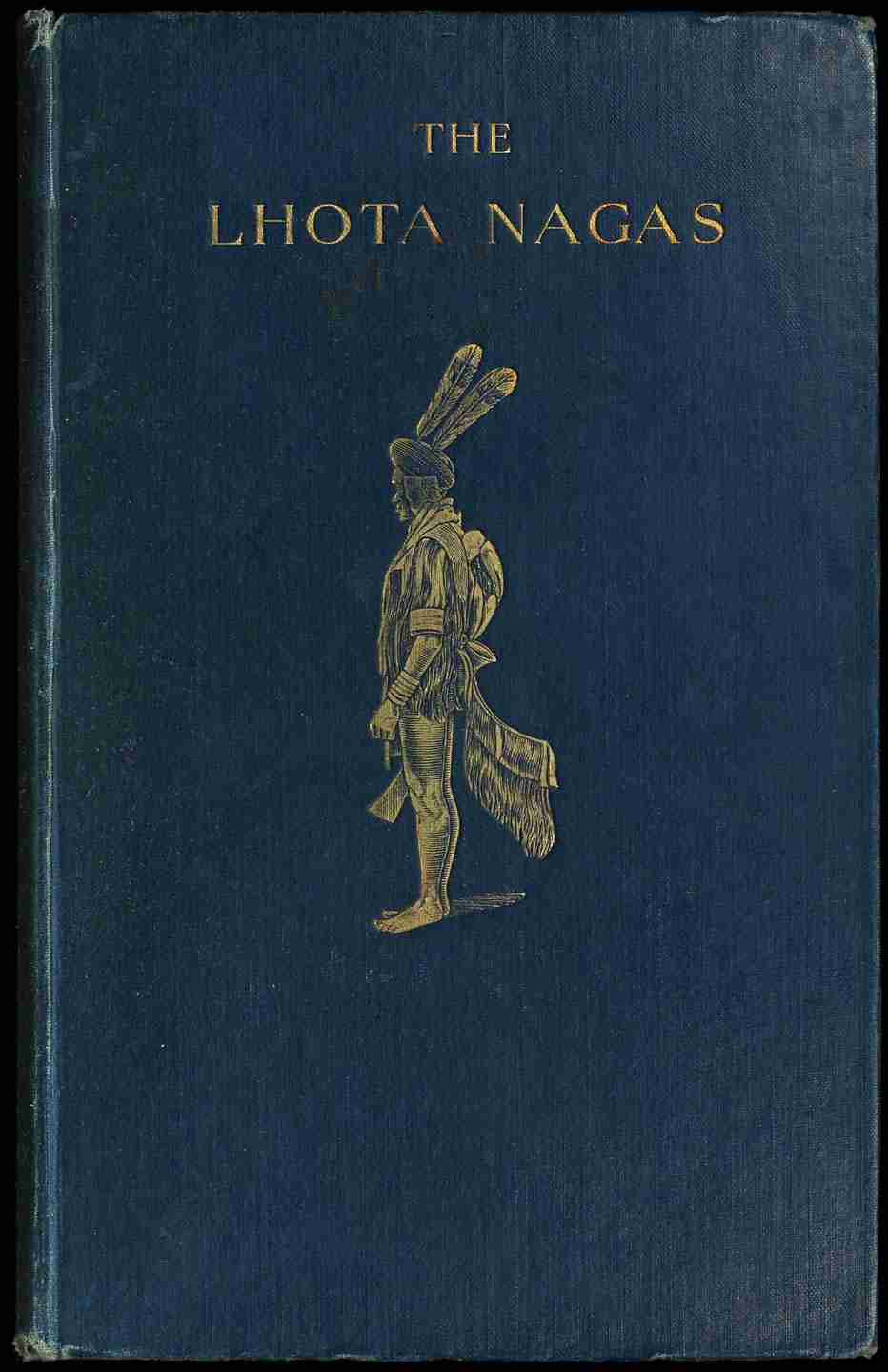
THE LHOTA NAGAS
MACMILLAN AND CO., Limited
LONDON · BOMBAY · CALCUTTA MADRAS · MELBOURNE
THE MACMILLAN COMPANY
NEW YORK · BOSTON · CHICAGO · DALLAS SAN FRANCISCO
THE MACMILLAN CO. OF CANADA, Ltd.
TORONTO
The Puthi of Lakhuti in ceremonial dress.
MACMILLAN AND CO., LIMITED
ST. MARTIN’S STREET, LONDON
1922
PREFACE
I have attempted in this monograph to give some account of the Lhota Nagas, a tribe whose dour attitude towards inquirers has caused them to be somewhat neglected in the past. Boasting no great knowledge of anthropology, I have avoided theories and confined myself to facts. During some three years’ residence at Mokokchung as Assistant Commissioner I have had considerable opportunity of becoming acquainted with the habits and customs of this tribe, many individual members of which are now my personal friends.
The generosity of the Assam Government has made the publication of this monograph possible, and my thanks are due to my many friends who have assisted me in the preparation of it. But for the encouragement and advice of Mr. J. H. Hutton, Deputy Commissioner of the Naga Hills and Director of Ethnography in Assam, it would probably never have been written. He has helped me throughout in every possible way, and has contributed a most valuable introduction and notes. I am further indebted to Mr. Hutton for six photographs and a drawing, while for two other photographs my thanks are due to Mr. S. G. Butler. I have further to thank Miss A. M. Grace of Hove for the coloured frontispiece and Miss E. M. Paterson for the drawing of the median bands of the two types of rükhusü. Lt.-Col. J. Shakespear has been kind enough to do the index for me.
It is through the hearty co-operation of my Lhota friends that I have been able to make some record of their tribal customs and beliefs, and my thanks are especially due [vi]to Etsisao and Chongsemo of Okotso, Asao and Chamimo of Pangti, Santemo of Niroyo, Ranchamo of Seleku, Yanasao of Akuk, and Shambemo of Tsingaki. Tsansao, of the staff of the Sub-divisional Officer, Mokokchung, gave me invaluable assistance in recording folk-tales and typing my manuscript.
The only previous account of Lhota customs which I have seen is that given by Mr. Hutton on pp. 362–370 of The Angami Nagas (Macmillan, 1921). Other investigators of Naga customs have, as a rule, dismissed them with a few words. Dr. W. E. Wither’s Outline Grammar of the Lhota Naga Language (Calcutta, 1888) I found most useful.
J. P. Mills. [vii]
CONTENTS
PAGE
Introduction xi
PART I
General 1
Introductory—Origin and Migrations—Appearance—Dress—Ornaments—Weapons—Character.
PART II
The Village—The “Morung”—The Head-Tree—The House—The Contents—Manufactures—Trade—Loans—Agriculture and the Ceremonies connected with it—Live-stock—Hunting—Fishing—Food—Drink—Medicine—Drugs—Games—Music—Daily Life.
PART III
Exogamy—Polity and Village Organization—Property—Inheritance—Adoption—Settlement of Disputes—Oaths—Friendships—War and Head-hunting—Slavery—Position of Women.
PART IV
Religion 113
Religion—Deities and Spirits—The Soul and Life after Death—Magic—Religious Officials—Public Ceremonies—Individual Ceremonies—Ceremonies for Illness—Social “gennas”—Birth—Marriage—Divorce—Death—Miscellaneous Beliefs. [viii]
PART V
PART VI
Language 207
PART VII
Appendix A—The Lhota Calendar 226
Appendix B—Mensuration 228
Appendix C—Human Sacrifice 230