
CHAPTER XXIV.
Recollections, Reminiscences and Testimonies.
Many statements which have come down to us from the generation in which Elias Hicks lived, warrant the conclusion that he was a natural orator. He possessed in a large degree what the late Bishop Simpson, of the Methodist Episcopal Church, called "heart power." We are able to give the personal impression of a venerable Friend[206] now living, who as a boy of eleven heard Elias preach twice.
[206] Dr. Jesse C. Green, of West Chester, Pa., now in his 93d year. Doctor Green almost retains the sprightliness of youth.
One of the sermons was delivered at Center, Del., on the 8th of Twelfth month, 1828, and the other the day before at West Chester. This was on his last long religious visit, which took him to the then "far west," Ohio and Indiana.
Doctor Green says that the manner of Elias Hicks when speaking was very impressive. In person he is described by this Friend "as above medium height, rather slim, and with a carriage that would attract universal attention." He wore very plain clothes of a drab color.
With no education in logic, and no disposition to indulge in forensic debate, he was, nevertheless a logician, and had he indulged in public disputation, would have made it interesting if not uncomfortable for his adversary.
If he occasionally became involved, or got into verbal deep water, he always extricated himself, and made his position clear to his hearers. Doctor Green tells us that he had an uncle, not a member of meeting, but a good judge of public speaking, who considered Elias Hicks the most logical preacher in the Society of Friends. On one occasion he heard Elias when he became very much involved in his speaking, and as this person put it, he thought Elias had "wound himself up," but in a few minutes he came down from his verbal flight, and made every point so clear that he was understood by every listener.
Henry Byran Binns, Whitman's English biographer, gives the following estimate of the preaching of Elias Hicks:
"With grave emphasis he pronounced his text: 'What is the chief end of man?' and with fiery and eloquent eyes, in a strong, vibrating, and still musical voice, he commenced to deliver his soul-awakening message. The fire of his fervor kindled as he spoke of the purpose of human life; his broad-brim was dashed from his forehead on to one of the seats behind him. With the power of intense conviction his whole presence became an overwhelming persuasion, melting those who sat before him into tears and into one heart of wonder and humility under his high and simple words."[207]
[207] "A Life of Walt Whitman," Henry Byran Binns, p. 16.
We have another living witness who remembers Elias Hicks. This Friend says that she, with the members of her family, were constant attenders of the Jericho meeting. Speaking of Elias she remarks: "His commanding figure in the gallery is a bright picture I often see in my mind. His person was tall, straight and firm; his manner dignified and noble and agreeable; his voice clear, distinct and penetrating—altogether grand."[208]
[208] Extract of letter from Mary Willis, of Rochester, N. Y., dated Ninth month 7, 1910. This Friend is 92 years old. The letter received was entirely written by her, and is a model of legible penmanship and clear statement.
We quote the following interesting incidents from the letter of Mary Willis:
"One other bit I recall was a talk, or sermon, to the young especially. He related that once he threw a stone and killed a bird, and was struck with consternation and regret at killing an innocent bird that might be a parent, and its young perish for the need of care. He appealed feelingly to the boys to refrain from giving needless pain.
"He was guardian to my mother, sisters and brother, and they and their mother returned his loving care with warm affection, always, as did my father.
"One of his characteristics was his kindness to the poor. Not far from his home (three miles, perhaps) was a small colony of colored people on poor land, who shared his bounty in cold, wintry weather, in his wagon loads of vegetables and wood, delivered by his own hand."
Probably one of the most appreciative, and in the main discriminative estimates of Elias Hicks, was made by Walt Whitman. The "notes (such as they are) founded on Elias Hicks," for such the author called them, were written in Camden, N. J., in the summer of 1888. Elias Hicks had been dead nearly half a century. Whitman's impressions of the famous preacher were based on the memory of a boy ten years old, for that was Whitman's age when he heard Elias Hicks preach in Brooklyn. But personal memory was supplemented by the statements of his parents, especially his mother, as the preaching of their old Long Island neighbor was undoubtedly a subject of frequent conversation in the Whitman home.
As to the manner of the preacher Whitman says: "While he goes on he falls into the nasality and sing-song tone sometimes heard in such meetings; but in a moment or two, more as if recollecting himself, he breaks off, stops, and resumes in a natural tone. This occurs three or four times during the talk of the evening, till he concludes."[209]
[209] "The Complete Works of Walt Whitman," Vol. 3, p. 259.
The "unnamable something behind oratory," Whitman says Elias Hicks had, and it "emanated from his very heart to the heart of his audience, or carried with him, or probed into, and shook or aroused in them a sympathetic germ."[210]
[210] The same, p. 264.
There are a good many anecdotes regarding Elias Hicks current in Jericho, going to show some of his characteristics. It is stated that at one time he found that corn was being taken, evidently through the slats of the crib. One night he set a trap in the suspected place. Going to the barn in the morning he saw a man standing near where the trap was set. Elias passed on without seeming to notice the visitor. On returning to the house he stopped, spoke to the man, and released him from the trap. Elias would never tell who the man was.
Illustrating his feeling regarding slavery, and his testimony against slave labor, the following statement is made: Before his death, and following the fatal paralytic stroke, he noticed that the quilt with which he was covered contained cotton. He had lost the power of speech, but he pushed the covering off, thus indicating his displeasure at the presence of an article of comfort which was the product of slave labor.
There is an anecdote which illustrates the spirit of the man in a striking way. He is said to have had a neighbor with whom it did not seem possible to maintain cordial relations. One day Elias saw this neighbor with a big load of hay stalled in a marsh in one of his fields. Without a word of recognition Elias approached the man in the slough and hitching his own ox team to the load in front of the other team proceeded to pull the load out of the slough. It was all done in characteristic Quaker silence. The result was the establishment of cordial relations between the two neighbors.
In bestowing his benefactions, he was exceedingly sensitive, not wishing to be known in the matter, and especially not desiring to receive ordinary expressions of gratitude. His habitual custom was to take his load of wood or provisions, as the case might be, leave them at the door or in the yard of the family in need, and without announcement or comment silently steal away.
During the Revolutionary War, Elias Hicks, in common with other Friends, had property seized in lieu of military service or taxes. The value does not seem to have been great in any of the cases which were reported to the monthly meeting. We copy the following cases from the records:
"On the 28th of Eighth month, 1777, came Justice Maloon, Robert Wilson, Daniel Wilson, and Daniel Weeks, sergeant under the above Captain (Youngs) and took from me a pair of silver buckles, worth 18 shillings; two pair of stockings worth 15 shillings; and two handkerchiefs worth 5 shillings, for my not going at the time of an alarm.—Elias Hicks, Jericho, 24th of Ninth month, 1777."[211]
[211] Westbury Monthly Meeting: "A Record of Marriages, Deaths, Sufferings, etc.," p. 231.
The "silver buckles" were either for the shoes or the knees. They were evidently more ornamental than useful, and how they comported with the owner's rather severe ideas of plainness is not for us to explain. The price put on these stockings may surprise some twentieth century reader, but it should be remembered that they were long to reach to the knees, and went with short breeches called in the vernacular of the time, "small clothes."
"The 3d of Twelfth month, 1777, there came to my house George Weeks, sergeant under said Captain (Thorne) with a warrant, and demanded twelve shillings of me toward paying some men held to repair the forts near the west end of the island, and upon my refusing to pay, took from me a great coat, worth one pound and six shillings.—Elias Hicks."[212]
[212] The same, p. 234.
We continue the "sufferings," only remarking that the "great coat" was an overcoat, the price at the equivalent of about six dollars and a half was not overdrawn.
"The Sixth month, 1778, taken from Elias Hicks by order of Captain Daniel Youngs, for refusing to pay toward hiring of men to work on fortifications near Brooklyn Ferry, a pair of stockings worth 5 shillings; razor case and two razors, worth 4 shillings."[213]
[213] The same, p. 242.
The next record of "suffering" is more than ordinarily interesting in that it shows that the seizures of property were very arbitrary, and it also gives the price of wheat on Long Island at that time. We quote:
"About the middle of Tenth month, 1779, came George Weeks, by order of Captain Daniel Youngs, and I being from home demanded from my wife three pounds, for not assisting to build a fort at Brooklyn Ferry, for which he took two bags with three bushels of wheat, worth one pound, ten shillings."[214]
[214] The same, p. 254.
At this rate the market price of wheat was $2.50 per bushel. Possibly this was during the period of scarcity, referred to in the introduction.
In 1794 Elias Hicks was influential in establishing in Jericho an organization, the scope of which was described in its preamble as follows: "We, the subscribers, do hereby associate and unite into a Society of Charity for the relief of poor among the black people, more especially for the education of their children."[215]
[215] This organization has been in continuous existence since its inception. Meets regularly every year, and distributes the proceeds of an invested fund in accordance with its original purpose.
This society was almost revolutionary at the time of its inception, showing how far-seeing its projectors were. Its constitution declared that the society was rendered necessary because of the injustice and lack of opportunity which the colored people suffered. The hope was expressed that the time would come when the black people would cease to be a submerged and oppressed race. It was provided that in case the original need for the society should disappear, its benefits might be distributed in any helpful way. It may be interesting to note that at the meetings of the society the scarcity of colored children attending the school was mentioned with regret. So far as we know, the Jericho society was the first organized Friendly effort in negro education. Elias Hicks contributed $50 to the invested funds of the organization.
Friends' Burying Ground, Jericho. The second head-stone from the right marks the grave of Elias Hicks.
CHAPTER XXV.
Putting Off the Harness.
During the series of visits, reported in the twenty-second chapter, Elias was ill a number of times, and was forced to rest from his labors. On the return trip from central and western New York, he visited for the last time the Hudson Valley meetings which he attended on his first religious journey in 1779.
He arrived in New York the 8th of Eleventh month, attending the mid-week meeting at Hester Street that day. On First-day, the 15th, he attended the Rose Street meeting in the morning and Hester Street in the afternoon. Second-day evening, the 16th, a largely attended appointed meeting was held in Brooklyn. He then proceeded toward Jericho, arriving home on Fourth-day, the 18th of Eleventh month, 1829.
The "Journal" is singularly silent regarding this Brooklyn meeting. Henry Byran Binns, on what he considers good authority, says, "Elias Hicks preached in the ball-room of Morrison's Hotel on Brooklyn Heights." To this statement he has added this bit of realistic description:
"The scene was one he (Whitman) never forgot. The finely fitted and fashionable place of dancing, the officers and gay ladies in that mixed and crowded assembly, the lights, the colors and all the associations, both of the faces and of the place, presenting so singular contrast with the plain ancient Friends seated upon the platform, their broad-brims on their heads, their eyes closed; with silence, long continued and becoming oppressive; and most of all, with the tall, prophetic figure that rose at length to break it."[216]
[216] "A Life of Walt Whitman," p. 16.
Whitman's own reference to this meeting is still more striking. He says that he, a boy of ten, was allowed to go to the Hicks meeting because he "had been behaving well that day." The "principal dignitaries of the town" attended this meeting, while uniformed officers from the United States Navy Yard graced the gathering with their presence. The text was, "What is the chief end of man?" Whitman says: "I cannot follow the discourse, it presently becomes very fervid and in the midst of its fervor, he takes the broad-brim hat from his head and almost dashing it down with violence on the seat behind, continues with uninterrupted earnestness. Though the differences and disputes of the formal division of the Society of Friends were even then under way, he did not allude to them at all. A pleading, tender, nearly agonizing conviction and magnetic stream of natural eloquence, before which all minds and natures, all emotions, high or low, gentle or simple, yielded entirely without exception, was its cause, method and effect. Many, very many, were in tears."[217]
[217] "The Complete Writings of Walt Whitman." Issued under the editorial supervision of his Literary Executors, 1902, Vol. 3, p. 258.
With the account of this journey of 1829 his narrative in the "Journal" closed. This paragraph formed a fitting benediction:
"The foregoing meetings were times of favor, and as a seal from the hand of our gracious and never-failing helper, to the labor and travail which he has led me into, and enabled me to perform, for the promotion of this great and noble cause of truth and righteousness in the earth, as set forth in the foregoing account, and not suffering any weapon formed against me to prosper. 'This is the heritage of the servants of the Lord, and their righteousness is of me, saith the Lord.' For all these unmerited favors and mercies, in deep humiliation my soul doth magnify the Lord, and return thanksgiving and glory to his great and excellent name; for his mercy endureth forever."[218]
[218] "Journal," p. 438.
It should be remembered that Elias Hicks was then past his eighty-first year. He started on this last long religious visit, Sixth month 24th, and was therefore absent from home one week less than five months. He says himself, in the last sentence of the "Journal": "We traveled in this journey nearly fifteen hundred miles." These are words as impressive as they are simple.
During this trip many families were visited from the Valley of the Genesee to the City of New York, where he tarried several days that he might see his friends in their homes. Whatever may have been their mind in the case, he doubtless felt that they would look upon his face no more.
But Elias Hicks was not yet free from his religious concerns, for on First month 21, 1830, he asked for a minute, which was granted by Jericho Monthly Meeting, and is as follows:
"Our beloved Friend, Elias Hicks, presented a concern to make a religious visit to the families of Friends and some Friendly people (as way may open), within the compass of this and Westbury Monthly Meeting, which claimed the solid attention of this meeting, was united with, and he left at liberty to pursue his prospect accordingly."
This is the last minute ever asked for by Elias Hicks. But evidently the visits contemplated were never undertaken, for about that time he had a slight attack of paralysis, which affected his right side and arm. Still the next day he attended a meeting at Bethpage, and a little later quarterly and monthly meetings in New York. In both he performed ministerial service with his usual power and clearness. From a little brochure printed in 1829, we quote:
"In the Monthly Meeting, he took a review of his labors in the city for many years; and then expressed a belief that his religious services were brought nearly to a close.
"After adverting to the great deviations that had taken place in the Society, from that plainness and simplicity into which our principles would lead us, he added, 'but if I should live two or three years longer, what a comfort it would be to me to see a reformation in these respects.' He then spoke in commemoration of the goodness of his Heavenly Father, and closed with these memorable words: 'As certainly as we are engaged to glorify him in all our works, he will as certainly glorify us.'"[219]
[219] "Life, Ministry, Last Sickness and Death of Elias Hicks," Philadelphia, J. Richards, printer, 130 North Third Street.
But the time of putting off the harness was near at hand. On the 14th of Second month, 1830, he suffered a severe attack of paralysis which involved the entire right side, and deprived him of the use of his voice. When attacked he was alone in his room, but succeeded in getting to his family in an adjoining apartment. He declined all medical aid. In a condition of helplessness he lingered until Seventh-day the 27th, when he quietly passed away. Although he could only communicate by signs, consciousness remained until near the end.
The funeral was held in the meeting house at Jericho, on Fourth-day, Third month 3d. Without a storm raged in strange contrast to the peace and quiet within. A large company braved the elements, to pay their respects to his worth, as a man and a minister, while a number of visiting ministering Friends had sympathetic service at the funeral, after which the burial took place in the ground adjoining the meeting-house, where he had long worshipped and ministered.
The last act performed by Elias Hicks before the fatal stroke came, was to write a letter to his friend Hugh Judge,[220] of Barnesville, Ohio. Between the two men a singular sympathy had long existed, and to Hugh, Elias unburdened his spirit in this last word to the world. In fact the letter fell from the hand of the writer, after the shock. It was all complete with signature and postscript.
[220] Hugh Judge was born about 1750 of Catholic parents. Joined Friends in his young manhood in Philadelphia. Removed to Ohio in 1815. Died Twelfth month 21, 1834. He died while on a religious visit to Friends in Philadelphia Yearly Meeting. Was buried at Kennett Square. He was a recorded minister for many years.
This letter really summarizes the doctrine, and states the practical religion which inspired the ministry and determined the life and conduct of this worthy Friend. It may be well, with its suggestive postscript, to close this record of the life and labors of Elias Hicks:
"Jericho, Second month 14th, 1830.
"Dear Hugh: Thy very acceptable letter of the 21st ultimo was duly received, and read with interest, tending to excite renewed sympathetic and mutual fellow-feeling; and brought to my remembrance the cheering salutation of the blessed Jesus, our holy and perfect pattern and example, to his disciples, viz: 'Be of good cheer, I have overcome the world.' By which he assured his disciples, that, by walking in the same pathway of self-denial and the cross, which he trod to blessedness, they might also overcome the world; as nothing has ever enabled any rational being, in any age of the world, to overcome the spirit of the world, which lieth in wickedness, but the cross of Christ.
"Some may query, what is the cross of Christ? To these I answer, it is the perfect law of God, written on the tablet of the heart, and in the heart of every rational creature, in such indelible characters that all the power of mortals cannot erase nor obliterate. Neither is there any power or means given or dispensed to the children of men, but this inward law and light, by which the true and saving knowledge of God can be obtained. And by this inward law and light, all will be either justified or condemned, and all be made to know God for themselves, and be left without excuse; agreeably to the prophecy of Jeremiah, and the corroborating testimony of Jesus in his last counsel and command to his disciples, not to depart from Jerusalem until they should receive power from on high; assuring them that they should receive power when they had received the pouring forth of the spirit upon them, which would qualify them to bear witness to him in Judea, Jerusalem, Samaria, and to the uttermost parts of the earth; which was verified in a marvellous manner on the day of Pentecost, when thousands were converted to the Christian faith in one day. By which it is evident that nothing but this inward light and law, as it is heeded and obeyed, ever did, or ever can make a true and real Christian and child of God. And until the professors of Christianity agree to lay aside all their non-essentials in religion, and rally to this unchangeable foundation and standard of truth, wars and fightings, confusion and error will prevail, and the angelic song cannot be heard in our land, that of 'glory to God in the highest, and on earth peace and good will to men.' But when all nations are made willing to make this inward law and light the rule and standard of all their faith and works, then we shall be brought to know and believe alike, that there is but one Lord, one faith, and but one baptism; one God and Father, that is above all, through all, and in all; and then will all those glorious and consoling prophecies, recorded in the scriptures of truth, be fulfilled. Isaiah 2:4. 'He,' the Lord, 'shall judge among the nations, and rebuke many people; and they shall beat their swords into plough-shares, and their spears into pruning-hooks; nation shall not lift up sword against nation; neither shall they learn war any more.' Isaiah 11. 'The wolf also shall dwell with the lamb, and the leopard shall lie down with the kid; and the calf, and the young lion, and the fatling together; and a little child shall lead them. And the cow and the bear shall feed; their young ones shall lie down together; and the lion shall eat straw like the ox. And the sucking child shall play on the hole of the asp, and the weaned child put his hand on the cockatrice's den. They shall not hurt nor destroy in all my holy mountain; for the earth,' that is our earthly tabernacles, 'shall be full of the knowledge of the Lord, as the waters cover the sea.'
"These scripture testimonies give a true and correct description of the gospel state, and no rational being can be a real Christian and true disciple of Christ until he comes to know all these things verified in his own experience, as every man and woman has more or less of all those different animal propensities and passions in their nature; and they predominate and bear rule, and are the source and fountain from whence all wars, and every evil work, proceed, and will continue as long as man remains in his first nature, and is governed by his animal spirit and propensities, which constitute the natural man, which Paul tells us, 'receiveth not the things of the spirit of God, for they are foolishness unto him, neither can he know them, because they are spiritually discerned.' This corroborates the declaration of Jesus to Nicodemus, that 'except a man be born again he cannot see the kingdom of God;' for 'that which is born of the flesh is flesh, and that which is born of the spirit is spirit.'
"Here Jesus assures us, beyond all doubt, that nothing but spirit can either see or enter into the kingdom of God; and this confirms Paul's doctrine, that 'as many as are led by the spirit of God are the sons of God, and joint heirs with Christ.' And Jesus assures us, by his declaration to his disciples, John 14:16-17; 'if ye love me keep my commandments; and I will pray the Father and he shall give you another comforter, that he may abide with you forever, even the spirit of truth, whom the world cannot receive;' that is, men and women in their natural state, who have not given up to be led by this spirit of truth, that leads and guides into all truth; 'because they see him not, neither do they know him, but ye know him, for he dwelleth with you, and shall be in you.' And as these give up to be wholly led and guided by him, the new birth is brought forth in them, and they witness the truth of another testimony of Paul's, even that of being 'created anew in Christ Jesus unto good works,' which God had foreordained that all his new-born children should walk in them, and thereby show forth, by their fruits and good works, that they were truly the children of God, born of his spirit, and taught of him; agreeably to the testimony of the prophet, that 'the children of the Lord are all taught of the Lord, and in righteousness they are established, and great is the peace of his children.' And nothing can make them afraid that man can do unto them; as saith the prophet in his appeal to Jehovah: 'Thou wilt keep him in perfect peace, whose mind is stayed on thee, because he trusteth in thee.' Therefore let every one that loves the truth, for God is truth, 'trust in the Lord forever, for in the Lord Jehovah there is everlasting strength.'
"I write these things to thee, not as though thou didst not know them, but as a witness to thy experience, as 'two are better than one, and a threefold cord is not quickly broken.'
"I will now draw to a close, with just adding, for thy encouragement, be of good cheer, for no new thing has happened to us; for it has ever been the lot of the righteous to pass through many trials and tribulations in their passage to that glorious, everlasting peace and happy abode, where all sorrow and sighing come to an end; the value of which is above all price, for when we have given all that we have, and can give, and suffered all that we can suffer, it is still infinitely below its real value. And if we are favored to gain an inheritance in that blissful and peaceful abode, 'where the wicked cease from troubling, and the weary are at rest,' we must ascribe it all to the unmerited mercy and loving kindness of our Heavenly Father, who remains to be God over all, blessed forever!
"I will now conclude, and in the fulness of brotherly love to thee and thine, in which my family unite, subscribe thy affectionate friend,
"ELIAS HICKS.
"To Hugh Judge:
"Please present my love to all my friends as way opens."
APPENDIX.
A
DESCENDANTS OF ELIAS HICKS.
The only lineal descendants of Elias Hicks are through his daughters, Abigail and Sarah. Abigail's husband, Valentine, was her cousin, and Sarah's husband, Robert Seaman, was a relative on the mother's side.
Descendants of Valentine and Abigail Hicks.
CHILDREN OF THE ABOVE.
Grandchildren of Elias Hicks.—Caroline, married Dr. William Seaman; Phebe, married Adonijah Underhill (no children); Elias Hicks, married Sarah Hicks; Mary (unmarried).
GREAT-GRANDCHILDREN OF ELIAS HICKS.
Children of Dr. William Seaman and Caroline Hicks.—Valentine Hicks Seaman, married Rebecca Cromwell; Sarah Seaman, married Henry B. Cromwell; Samuel Hicks Seaman, married Hannah Husband.
Children of Elias Hicks and Sarah Hicks.—Mary, married Peter B. Franklin; Elias Hicks (unmarried), deceased; Caroline (unmarried), deceased.
GREAT-GREAT-GRANDCHILDREN OF ELIAS HICKS.
Children of Valentine H. and Rebecca C. Seaman.—William, married Addie W. Lobdell; Caroline (infant);[221] Henry B.,[222] married Grace Dutton; Edwin H. (infant); Howard (unmarried), deceased; Valentine H. (unmarried); Emily C. (unmarried); Frederic C., married Ethel Lobdell.
[221] Note—Those marked "(infant)" died in infancy. Those without notation are under age and living.
[222] Henry B. Seaman is a graduate of Swarthmore College, class of 1881, and received degree of C. E. in 1884. Was for three years Chief Engineer of the Public Service Commission of Greater New York. He resigned this position Tenth month 1, 1910, because he could not approve estimates desired by the authorities. Since then these estimates have been held up as excessive.
Children of Henry B. and Sarah Seaman Cromwell.—George[223] (unmarried); Henry B. (unmarried), deceased.
[223] When Greater New York was incorporated George Cromwell was elected President of the Borough of Richmond. Although this borough is normally Democratic in its politics, George Cromwell has been re-elected, and is the only president the borough has ever had. He and Henry B. Seaman are double first cousins.
Children of Samuel H. and Hannah H. Seaman.—Joseph H. (unmarried); Caroline Hicks, married William A. Read; Mary T. (unmarried); Franklin (unmarried), deceased; Sarah, married Lloyd Saltus.
Children of Peter B. and Mary Hicks Franklin.—Anne M., married Walter A. Campbell.
GREAT-GREAT-GREAT-GRANDCHILDREN OF ELIAS HICKS.
Children of William and Addie Seaman.—Howard L. (unmarried); Jessie M. (unmarried).
Children of Henry B. and Grace D. Seaman.—Ayres C.; Henry Bowman.
Children of Frederic C. and Ethel L. Seaman.—Esther....
Children of William A. and Caroline Seaman Read.—William Augustus; Curtis Seaman; Duncan Hicks; R. Bartow; Caroline Hicks; Bancroft (infant); Bayard W.; Mary Elizabeth; Kenneth B. (infant).
Children of Lloyd and Sarah Seaman Saltus.—Mary Seaman; Ethel S.; Seymour; Lloyd.
Children of Walter Allison and Anne M. Franklin Campbell.—Franklin Allison; Mary Elizabeth.
Descendants of Robert Seaman and Sarah, Daughter of Elias Hicks.
CHILDREN OF THE ABOVE.
Grandchildren of Elias Hicks.—Phebe (died); Hannah, married Matthew F. Robbins; Willet (died); Elizabeth, married Edward Willis; Elias H., married Phebe Underhill; Willet H., married Mary Wing; Mary H., married Isaac Willis.
GREAT-GRANDCHILDREN OF ELIAS HICKS.
Children of Hannah and Matthew F. Robbins.—Caroline, married Sidney W. Jackson; Walter, married Sarah E. Hubbs.
Children of Elizabeth and Edward Willis.—Sarah R.; Mary S. (died); Caroline H. (died); Henrietta, married Stephen J. Underhill.
Children of Elias H. and Phebe Seaman.—Mary (died); Samuel J., married Matilda W. Willets; Sarah (died); Anna; Robert, married Hannah W. Willets; William H., married Margaret J. Laurie; James H., married (1) Bessie Bridges; (2) Florence Haviland.
Children of Willet H. and Mary Seaman.—Edward W.; Willet H.; Frank W.
Children of Mary H. and Isaac Willis.—Henry, married June Barnes; Robert S.
GREAT-GREAT-GRANDCHILDREN OF ELIAS HICKS.
Son of Caroline and Sidney W. Jackson.—M. Franklin, married Annie T. Jackson.
Children of Walter and Sarah E. Jackson.—Caroline J., married William G. Underhill; Annie H., married Thomas Rushmore; Cora A., married John Marshall.
Children of Henrietta and Stephen J. Underhill.—Edward W., married Emeline Kissam; Hannah W.; Henry T., married Dorothy Vernon; Arthur.
Children of Samuel J. and Matilda W. Seaman.—Mary W., married Leon A. Rushmore; Samuel J., married Ethelena T. Bogart; Anna Louise; Frederick W.; Lewis V. (died).
Daughter of Robert and Hannah W. Seaman.—Phebe U.
Children of William H. and Margaret L. Seaman.—William Laurie; Faith Frances (died).
Children of James H. and Bessie B. Seaman.—George B.; Elias Haviland.
Children of James H. and Florence H. Seaman.—Bertha Lucina; Willard H.; Helen U.
GREAT-GREAT-GREAT-GRANDCHILDREN OF ELIAS HICKS.
Daughter of M. Franklin and Annie T. Jackson.—Marion F.
Children of Caroline J. and William G. Underhill.—Mildred; Irene; Margaret.
Children of Annie H. and Thomas Rushmore.—Lillian A.; Elizabeth A.
Son of Cora A. and John Marshall.—John W.
Daughter of Henry T. and Dorothy Underhill.—Winifred.
Son of Mary S. and Leon A. Rushmore.—Leon A.
B
Letter to Dr. Atlee.[224]
Copy of a letter from Elias Hicks to Dr. Edwin A. Atlee, of Philadelphia:
"Jericho, Ninth mo. 27, 1824.
"My Dear Friend:
"Thy very acceptable letter of the 29th ultimo came duly to hand, and I have taken my pen not only to acknowledge thy kindness, but also to state to thee the unfriendly and unchristian conduct of Anna Braithwaite toward me, not only as relates to that extract, but in her conversation among Friends and others, traducing my religious character, and saying I held and promulgated infidel doctrines, etc.—endeavoring to prejudice the minds of Friends against me, behind my back, in open violation of gospel order. She came to my house, as stated in the extract thou sent me, after the quarterly meeting of ministers and elders at Westbury in First month last. At that meeting was the first time I saw her, which was about five or six months after her arrival in New York. And as I had heard her well spoken of as a minister, I could have had no preconceived opinion of her but what was favorable, therefore, I treated her with all the cordiality and friendship I was capable of. She also, from all outward appearance, manifested the same; and, after dinner, she requested, in company with A. S., a female Friend that was with her, a private opportunity with me. So we withdrew into another room, where we continued in conversation for nearly two hours. And being innocent and ignorant of any cause that I had given, on my part, for the necessity of such an opportunity, I concluded she had nothing more in view than to have a little free conversation on the state of those select meetings.
"But, to my surprise, the first subject she spoke upon, was to call in question a sentiment I had expressed in the meeting aforesaid, which appeared to me to be so plain and simple, that I concluded the weakest member in our society, endued with a rational understanding, would have seen the propriety of. It was a remark I made on the absence of three out of four of the representatives appointed by one of the preparative meetings to attend the quarterly meeting. And I having long been of the opinion, that much weakness had been introduced into our society by injudicious appointments, I have often been concerned to caution Friends on that account. The remark I made was this: that I thought there was something wrong in the present instance—for, as we profess to believe in the guidance of the Spirit of Truth as an unerring Spirit, was it not reasonable to expect, especially in a meeting of ministers and elders, that if each Friend attended to their proper gifts, as this Spirit is endued with prescience, that it would be much more likely, under its divine influence, we should be led to appoint such as would attend on particular and necessary occasion, than to appoint those who would not attend?
"This idea, she contended, was not correct; and the sentiments she expressed on this subject really affected me. To think that any, professing to be a gospel minister, called from a distant land to teach others, and to be so deficient in knowledge and experience, in so plain a case, that I could not well help saying to her, that her views were the result of a want of religious experience, and that I believed if she improved her talent faithfully, she would be brought to see better, and acknowledge the correctness of my position. But she replied, she did not want to see better. This manifestation of her self-importance, lowered her character, as a gospel minister, very much in my view; and her subsequent conduct, while she was with us, abundantly corroborated and confirmed this view concerning her. As to her charge against me, in regard to the Scriptures, it is generally incorrect, and some of it false. And it is very extraordinary, that she should manifest so much seeming friendship for me, when present, and in my absence speak against me in such an unbecoming manner. Indeed, her conduct toward me, often reminds me of the treachery of Judas, when he betrayed his Master with a kiss. And, instead of acting toward me as a friend or a Christian, she had been watching for evil.
"As to my asserting that I believe the Scriptures were held in too high estimation by the professors of Christianity in general, I readily admit, as I have asserted it in my public communications for more than forty years, but, generally, in opposition to those that held them to be the only rule of faith and practice; and my views have always been in accordance with our primitive Friends on this point. And at divers times, when in conversation with hireling teachers, (and at other times) I have given it as my opinion, that so long as they held the Scriptures to be the only rule of faith and practice, and by which they justify wars, hireling ministry, predestination, and what they call the ordinances, viz: water baptism and the passover supper, mere relics of the Jewish law, so long the Scriptures did such, more harm than good; but that the fault was not in the Scriptures, but in their literal and carnal interpretation of them—and that would always be the case until they came to the Spirit that gave them forth, as no other power could break the seal, and open them rightly to us. Hence I have observed, in my public communications, and in conversation with the members of different denominations, and others, who held that the Scriptures are the primary and only rule of faith and practice—that, according to the true analogy of reasoning, 'that for which a thing is such—the thing itself is more such'—as the Spirit was before the Scriptures, and above them, and without the Spirit they could not have been written or known. And with this simple but conclusive argument, I have convinced divers of the soundness of our doctrine in this respect—that not the Scriptures but the Spirit of Truth, which Jesus commanded his disciples to wait for, as their only rule, they would teach them all things, and guide them into all truth, is the primary and only rule of faith and practice, and is the only means by which our salvation is effected.
"The extract contains so much inconsistency, and is so incorrect, that, as I proceed, it appears less and less worthy of a reply, and yet it does contain some truth. I admit that I did assert, and have long done it, that we cannot believe what we do not understand. This the Scripture affirms, Deut. xxix. 29—'The secret things belong unto the Lord our God, but the things that are revealed belong unto us and our children forever, that we may do all the words of this law'—and all that is not revealed, is to us the same as a nonentity, and will forever remain so, until it is revealed; and that which is revealed, enables us, agreeably to the apostle's exhortation, to give a reason of the hope that is in us, to honest inquirers. I also assert, that we ought to bring all doctrines, whether written or verbal, to the test of the Spirit of Truth in our minds, as the only sure director relative to the things of God; otherwise, why is a manifestation of the Spirit given to every man if it not to profit by; and, if the Scriptures are about the Spirit, and a more certain test of doctrines, why is the Spirit given, seeing it is useless? But this doctrine, that the Scriptures are the only rule of faith and practice, is a fundamental error, and is manifested to be so by the Scriptures themselves, and also by our primitive Friends' writings. It would seem that Anna Braithwaite has strained every nerve in exaggerating my words, for I have not said more than R. Barclay, and many others of our predecessors, respecting the errors in our English translation of the Bible. Hence it appears, that she was determined to criminate me at all events, by striving to make me erroneous for saying that the Gospel handed to us, was no more authentic than many other writings. Surely a person that did not assent to this, must be ignorant indeed.
"Are not the writings of our primitive Friends as authentic as any book or writing, and especially such as were written so many centuries ago, the originals of which have been lost many hundred years? And are not the histories of passing events, written by candid men of the present age, which thousands know to be true, as authentic as the Bible?
"Her assertions, that I asked if she could be so ignorant as to believe in the account of the creation of the world, and that I had been convinced for the last ten years, that it was only an allegory, and that it had been especially revealed to me at a meeting in Liberty Street about that time; that I asked her if she thought Adam was any worse after he had eaten the forbidden fruit than before, and that I said I did not believe he was; and also her asserting, that I said that Jesus Christ was no more than a prophet, and that I further said, that if she would read the Scriptures attentively she would believe that Jesus was the son of Joseph: these assertions of hers, are all false and unfounded, and must be the result of a feigned or forced construction of something I might have said, to suit her own purpose. For those who do not wish to be satisfied with fair reasoning, there is no end to their cavilling and misrepresentation. As to what she relates as it regards the manner of our coming into the world in our infant state, it is my belief, that we come into the world in the same state of innocence, and endowed with the same propensities and desires that our first parents were, in their primeval state; and this Jesus Christ has established, and must be conclusive in the minds of all true believers; when he took a little child in his arms and blessed him, and said to them around him that except they were converted, and become as that little child, they should in no case enter into the kingdom of heaven. Of course, all the desires and propensities of that little child, and of our first parents in their primeval state, must have been good, as they were all the endowments of their Creator, and given to them for a special purpose. But it is the improper and unlawful indulgence of them that is evil.
"I readily acknowledge, I have not been able to see or understand, how the cruel persecution and crucifixion of Jesus Christ, by the wicked and hard-hearted Jews, should expiate my sins; and never have known anything to effect that for me, but the grace of God, that taught me, agreeably to the apostle's doctrine, to deny all ungodliness and the world's lusts, and do live soberly, righteously, and godly in this present world; and as I have faithfully abode under its teachings, in full obedience thereto, I have been brought to believe that my sins were forgiven, and I permitted to sit under the Lord's teaching, as saith the prophet: 'that the children of the Lord are all taught of the Lord, and in righteousness they are established, and great is the peace of his children.' And so long as I feel this peace, there is nothing in this world that makes me afraid, as it respects my eternal condition. But if any of my friends have received and known benefit from any outward sacrifice, I do not envy them their privilege. But, surely, they would not be willing that I should acknowledge as a truth, that which I have no kind of knowledge of. I am willing to admit, that Divine Mercy is no doubt watching over his rational creation for their good, and may secretly work at times for their preservation; but, if, in his infinite wisdom and goodness, he sees meet to hide it from us, as most consistent with his wisdom and our good, let us have a care that we do not, in the pride of our hearts, undertake to pry into his secret counsels, lest we offend; but be content with what he is pleased to reveal to us, let it be more or less, and, especially, if he is pleased to speak peace to our minds. And when he graciously condescends to do this, we shall know it to be a peace that the world cannot give, with all its enjoyments, neither take away, with all its frowns.
"I shall now draw to a close, and, with the salutation of gospel love, I subscribe myself thy affectionate and sympathizing friend and brother.
"Elias Hicks."
To Edwin A. Atlee.
C
The Portraits.
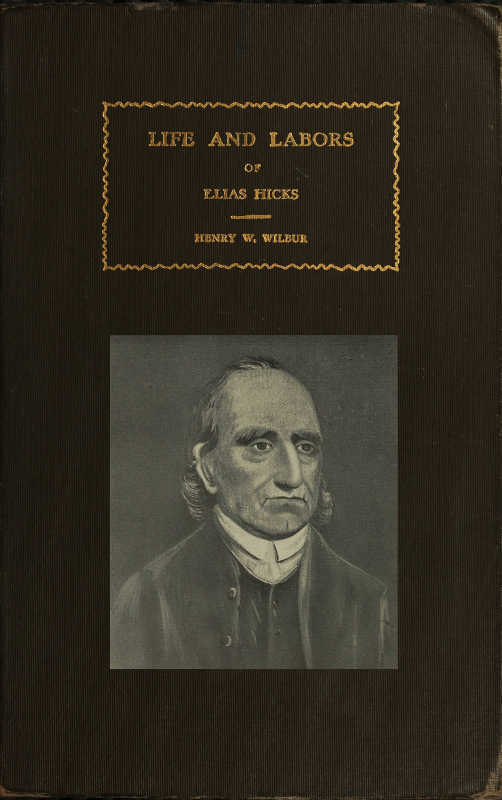
The cut facing page 121 is a photograph from the painting by Henry Ketcham. This was sketched by the artist who was in the public gallery of the meeting house at different times when Elias Hicks was preaching, his presence being unknown to the preacher. It was originally a full-length portrait, but many years ago was injured by fire, when it was cut down to bust size. For some time it was in the home of the late Elwood Walter, of Englewood, N. J. For many years it has been in the family of Henry B. Seaman. It is believed that the pictures made under direction of the late Edward Hopper, had this portrait as their original. The engravings in the "History of Long Island" and in the "Complete Works of Walt Whitman," are probably based on this portrait. They have passed through such a "sleeking-up" process, however, as to lack the individuality of the more crude production.
The frontispiece is from a photograph of the bust of Elias Hicks, by the sculptor, William Ordway Partridge, and was made for Henry B. Seaman. In making the bust the artist used the oil painting referred to above, and all of the other pictures of Elias Hicks in existence, including the full-length silhouette. He also had the bust, said to have been taken from the death mask, and from them all attempted to construct what may be termed the "ideal" Elias Hicks.
D
The Death Mask.
Much has been written about the death mask of Elias Hicks, from which the bust in Swarthmore College, in the New York Friend's Library and other places was made. That such a mask was taken admits of no doubt, and the only clear statement regarding the matter is given below. The bust is in the possession of Harry B. Seaman. The issue of "Niles Register" referred to was published only six weeks after the death of Elias Hicks.
"We understand an Italian artist of this city, has secretly disinterred the body of Elias Hicks, the celebrated Quaker preacher, and moulded his bust. It seems he had applied to the friends of the deceased to take a moulding previous to his interment, but was refused. Suspicion being excited that the grave had been disturbed, it was examined, and some bits of plaster were found adhering to the hair of the deceased. The enthusiastic Italian was visited, and owned that, as he had been denied the privilege of taking a bust before interment, he had adopted the only method of obtaining one. We have heard nothing more on the subject, except that the bust is a most excellent likeness."[225]
[225] Quoted from New York Constellation, in "Niles Weekly Register," April 10, 1830, p. 124.
E
A Bit of Advertising.
As showing the way the presence of ministering Friends was advertised in Philadelphia eighty-eight years ago, we reproduce the following, which appeared in some of the papers[226] of that period:
[226] The Cabinet, or Works of Darkness Brought to Light. Philadelphia, 1824, p. 33.
"Arrived in this city on the 7th inst., Elias Hicks, a distinguished minister of the gospel, the Benign Doctrines of which he is a faithful embassador, has for many years past practically endeavored (both by precept and example) to promulgate in its primeval beauty and simplicity, without money and without price. Those who are Friends to plain truth and evangelical preaching, that have heretofore been edified and comforted under his ministry, will doubtless be pleased to learn of his arrival, and avail themselves of the present opportunity of attending such appointments as he, under the direction of Divine influence, may see proper to make in his tour of Gospel Love, to the inhabitants of this city and its vicinity.
"A Citizen."
Philadelphia, December 9, 1822.
F
Acknowledgment.
The author of this book acknowledges his indebtedness in its preparation to the following, who either in furnishing data, or otherwise assisted in its preparation: William and Margaret L. Seaman, and Samuel J. Seaman, Glen Cove, N. Y.; Robert and Anna Seaman, Jericho, N. Y.; Henry B. Seaman, Brooklyn, N. Y.; Dr. Jesse H. Green, West Chester, Pa.; Mary Willis, Rochester, N. Y.; Ella K. Barnard and Joseph J. Janney, Baltimore, Md.; Henry B. Hallock, Brooklyn, N. Y.; John Comly, Philadelphia, Pa.
G
Sources of Information.
In making this book the following are the main sources of information that have been consulted; which are referred to those who may wish to go into the details of the matter involved:
Journal of Elias Hicks, New York, 1832. Published by Isaac T. Hopper.
The Lundy Family. By William Clinton Armstrong. New Brunswick, 1902.
The Quaker; A Series of Sermons by Members of the Society of Friends, Philadelphia, 1827-28. Published by Marcus T. C. Gould.
A Series of Extemporaneous Discourses, etc., by Elias Hicks. Philadelphia, 1825. Published by Joseph and Edward Parker.
Letters of Elias Hicks. Philadelphia, 1861. Published by T. Ellwood Chapman.
An Account of the Life and Travels of Samuel Bownas. Edited by J. Besse. London, 1756.
Ante-Nicene Fathers. Vol. II. Buffalo, N. Y., 1885. The Christian Literature Publishing Company.
The Quakers. By Frederick Storrs Turner. London, 1889. Swan, Sounenschein & Co.
A Review of the General and Particular Causes Which Have Produced the Late Disorders in the Yearly Meeting of Friends Held in Philadelphia. By James Cockburn. Philadelphia, 1829.
Foster's Report. Two volumes. By Jeremiah J. Foster, Master and Examiner in Chancery. Philadelphia, 1831.
Rules of Discipline of the Yearly Meeting of Friends Held in Philadelphia, 1806.
The Friend; or Advocate of Truth. Philadelphia, 1828. Published by M. T. C. Gould.
An Apology for the True Christian Divinity, etc. By Robert Barclay. Philadelphia, 1877. Friends' Book Store.
Memoirs of Anna Braithwaite. By her son, J. Bevan Braithwaite. London, 1905. Headley Brothers.
The Christian Inquirer. New York, 1826. Published by B. Bates.
J. Bevan Braithwaite; A Friend of the Nineteenth Century. By His Children. London, 1909. Hodder & Stoughton.
Sermons by Elias Hicks, Ann Jones and Others of the Society of Friends, etc. Brooklyn, 1828.
Journal of Thomas Shillitoe. London, 1839. Harvey & Darton.
Memorials of John Bartram and Humphrey Marshall. By William Darlington. Philadelphia, 1849.
The American Conflict. By Horace Greeley. Hartford, Conn., 1864. O. D. Case & Co.
Memoirs of Life and Religious Labors of Edward Hicks. Philadelphia, 1851.
Life of Walt Whitman. Henry Bryan Binns.
Complete Works of Walt Whitman. 1902.
History of Long Island.
Proceedings of the Manchester Conference. 1895.
Stephen Grellett. By William Guest. Philadelphia, 1833. Henry Longstreth.