
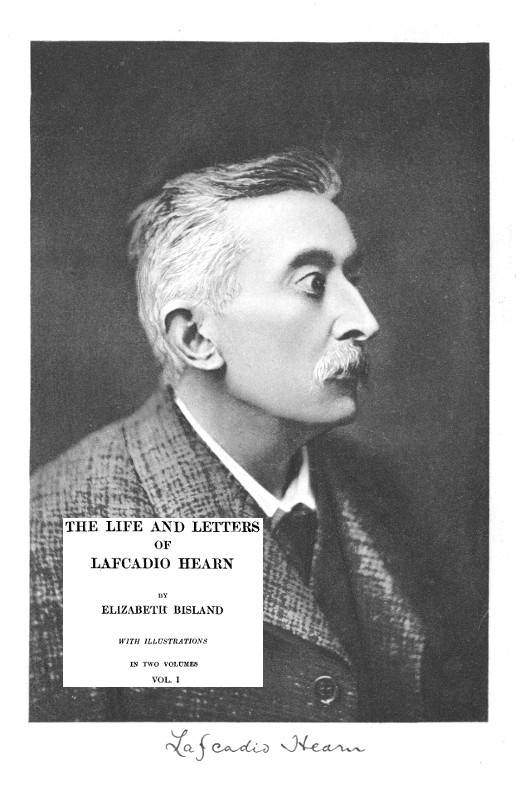
Λαρκαδιη.
TO H. E. KREHBIEL
New Orleans, 1877.
My Dear Krehbiel,—I am charmed with your letter,—your paper, and your exquisite little jocose programme. The “Fantaisie Chinoise” was to me something that really smacked of a certain famous European art-cenacle where delightful little parties of this kind were given. That cenacle was established by the disciples of Victor Hugo,—les Hugolâtres, as they were mockingly but perhaps also nobly named; and the records of its performances are some of the most delicate things in French literature. Hector Berlioz was one of the merry crowd,—and Berlioz, by the way, had written some fine romances as well as fine musical compositions.
There is a touch, a brilliant touch, of real art in all these little undertakings of yours, which gives me more enjoyment than I could tell you. Remember I am speaking of the tout-ensemble. Were I to make any musical observations you might rightly think I was talking about something of which I am disgracefully ignorant. Do you know, however, that I have never forgotten that pretty Chinese melody I heard at the club that day; and I sometimes find myself whistling it involuntarily.
I am indeed delighted to know that you have got Char Lee’s instruments, and are soon to receive others. Were there any Indian instruments in use among the Choctaws here, I could get you some, but they are no longer a musical people. The sadness that seems peculiar to dying races could not be more evident than in them. Le Père Rouquette, their missionary, tells me he has seen them laugh; but that might have been half a century ago. He is going to take me out to one of their camps on Lake Pontchartrain soon, and I shall try to pick you up something queer.
As yet I have not received the Chinese Play, etc., but will write when I do, and return it as promptly as possible.
I am just recovering from a week’s sickness—fever and bloody flux—and I don’t believe I weigh ninety pounds. You never saw such a sight as I am. I have been turned nearly black; and my face is so thin that I can see every bone as if it had only a piece of parchment drawn over it. And then all my hair is cut close to the skin. I have had hard work to crawl out of bed the last few days, but am getting better now. If I were to get regular yellow fever now I would certainly go to the cemetery; for I am only a skeleton as it is.
The newspaper generally gives only wages to its employees, and small wages,—and literary reputation to its capitalists; although in France the opposite condition exists. There are exceptions, of course, when a man has exceedingly superior talent; and his employer, knowing its value, allows its free exercise. That has been your case to a certain degree; you have not only won a reputation for yourself, but have given a tone and a standing to the paper which in my opinion has been of immense value to it.
I have got everything here down to a fine point—three hours’ work a day!
There is but one thing here to compensate for the abominable heat—Figs. They are remarkably cool, sweet, juicy, and tender. Unfortunately they are too delicate to bear shipment. The climate is so debilitating that even energetic thought is out of the question; and unfortunately the only inspiring hour, the cool night, I cannot utilize on account of gaslight. When the night comes on here it is not the night of Northern summers, but that night of which the divine Greek poet wrote,—“O holy night, how well dost thou harmonize with me; for to me thou art all eye,—thou art all ear,—thou art all fragrance!”
The infinite gulf of blue above seems a shoreless sea, whose foam is stars, a myriad million lights are throbbing and flickering and palpitating, a vast stillness filled with perfume prevails over the land,—made only more impressive by the voices of the night-birds and crickets; and all the busy voices of business are dead. The boats are laid up, cotton presses closed, and the city is half empty. So that the time is really inspiring. But I must wait to record the inspiration in some more energetic climate.
Do you get Mélusine yet? You are missing a great deal if you are not. Mélusine is preserving all those curious peasant songs with their music,—some of which date back hundreds of years. They would be a delightful relish to you.
Yours à jamais,
TO H. E. KREHBIEL
New Orleans, 1877.
“O-me-taw-Boodh!”—Have I not indeed been much bewitched by thine exotic comedy, which hath the mild perfume and yellow beauty of a Chinese rose? Assuredly I have been enchanted by the Eastern fragrance of thy many-coloured brochure; for mine head “is not as yellow as mud.” In thy next epistle, however, please to enlighten my soul in regard to the mystic title-phrase,—“Remodelled from the original English;“ for I have been wearing out the iron shoes of patience in my vain endeavour to comprehend it. What I most desired, while perusing the play, was that I might have been able to hear the musical interludes,—the barbaric beauty of the melodies,—and the plaintive sadness of thy serpent-skinned instruments. I shall soon return the MSS. to thy hands.
By the bye, did you ever hear a real Chinese gong? I don’t mean a d—d hotel gong, but one of those great moon-disks of yellow metal which have so terrible a power of utterance. A gentleman in Bangor, North Wales, who had a private museum of South Pacific and Chinese curiosities, exhibited one to me. It was hanging amidst Fiji spears beautifully barbed with shark’s teeth, which, together with grotesque New Zealand clubs of green stone and Sandwich Island paddles wrought with the baroque visages of the Shark-God, were depending from the walls. Also there were Indian elephants in ivory, carrying balls in their carven bellies, each ball containing many other balls inside it. The gong glimmered pale and huge and yellow, like the moon rising over a Southern swamp. My friend tapped its ancient face with a muffled drumstick, and it commenced to sob, like waves upon a low beach. He tapped it again, and it moaned like the wind in a mighty forest of pines. Again, and it commenced to roar, and with each tap the roar grew deeper and deeper, till it seemed like thunder rolling over an abyss in the Cordilleras, or the crashing of Thor’s chariot wheels. It was awful, and astonishing as awful. I assure you I did not laugh at it at all. It impressed me as something terrible and mysterious. I vainly sought to understand how that thin, thin disk of trembling metal could produce so frightful a vibration. He informed me that it was very expensive, being chiefly made of the most precious metals,—silver and gold.
Let me give you a description of my new residence. I never knew what the beauty of an old Creole home was until now. I do not believe one could find anything more picturesque outside of Venice or Florence. For six months I had been trying to get a room in one of these curious buildings; but the rents seemed to me maliciously enormous. However, I at last obtained one for $3 per week. Yet it is on the third floor, rear building;—these old princes of the South built always double edifices, covering an enormous space of ground, with broad wings, courtyards, and slave quarters.
The building is on St. Louis Street, a street several hundred years old. I enter by a huge archway about a hundred feet long,—full of rolling echoes, and commencing to become verdant with a thin growth of bright moss. At the end, the archway opens into a court. There are a few graceful bananas here with their giant leaves splitting in ribbons in the summer sun, so that they look like young palms. Lord! How the carriages must have thundered under that archway and through the broad paved court in the old days. The stables are here still; but the blooded horses are gone, and the family carriage, with its French coat of arms, has disappeared. There is only a huge wagon left to crumble to pieces. A hoary dog sleeps like a stone sphinx at a corner of the broad stairway; and I fancy that in his still slumbers he might be dreaming of a Creole master who went out with Beauregard or Lee and never came back again. Wonder if the great greyhound is waiting for him.
The dog never notices me. I am not of his generation, and I creep quietly by lest I might disturb his dreams of the dead South. I go up the huge stairway. At every landing a vista of broad archways reëchoes my steps—archways that once led to rooms worthy of a prince. But the rooms are now cold and cheerless and vast with emptiness. Tinted in pale green or yellow, with a ceiling moulded with Renaissance figures in plaster, the ghost of luxury and wealth seems trying to linger in them. I pass them by, and taking my way through an archway on the right, find myself on a broad piazza, at the end of which is my room.
It is vast enough for a Carnival ball. Five windows and glass doors open flush with the floor and rise to the ceilings. They open on two sides upon the piazza, whence I have a far view of tropical gardens and masses of building, half-ruined but still magnificent. The walls are tinted pale orange colour; green curtains drape the doors and windows; and the mantelpiece, surmounted by a long oval mirror of Venetian pattern, is of white marble veined like the bosom of a Naiad. In the centre of the huge apartment rises a bed as massive as a fortress, with tremendous columns of carved mahogany supporting a curtained canopy at the height of sixteen feet. It seems to touch the ceiling, yet it does not. There is no carpet on the floor, no pictures on the wall,—a sense of something dead and lost fills the place with a gentle melancholy;—the breezes play fantastically with the pallid curtains, and the breath of flowers ascends into the chamber from the verdant gardens below. Oh, the silence of this house, the perfume, and the romance of it. A beautiful young Frenchwoman appears once a day in my neighbourhood to arrange the room; but she comes like a ghost and disappears too soon in the recesses of the awful house. I would like to speak with her, for her lips drop honey, and her voice is richly sweet like the cooing of a dove. “O my dove, that art in the clefts of the rock, in the secret hiding-places of the stairs, let me see thy face, let me hear thy voice, for thy voice is sweet and thy countenance is comely!”
Let me tell thee, O Bard of the Harp of a Thousand Strings, concerning a Romance of Georgia. I heard of it among the flickering shadow of steamboat smoke and the flapping of sluggish sails. It has a hero greater, I think, than Bludso; but his name is lost. At least it is lost in Southern history; yet perhaps it may be recorded on the pages of a great book whose leaves never turn yellow with Time, and whose letters are eternal as the stars. But the reason his name is not known is because he was a “d—d nigger.”
TO H. E. KREHBIEL
New Orleans, 1878.
My dear Musician,—I wrote you such a shabby, disjointed letter last week that I feel I ought to make up for it,—especially after your newsy, fresh, pleasant letter to me, which came like a cool Northern breeze speaking of life, energy, success, and strong hopes.
I am very much ashamed that I have not yet been able to keep all my promises to you. There is that Creole music I had hoped to get copied by Saturday, and could not succeed in obtaining. But it is only delayed, I assure you; and New Orleans is going to produce a treat for you soon. George Cable, a charming writer, some of whose dainty New Orleans stories you may have read in Scribner’s Monthly, is writing a work containing a study of Creole music, in which the songs are given, with the musical text in footnotes. I have helped Cable a little in collecting the songs; but he has the advantage of me in being able to write music by ear. Scribner will publish the volume. This is not, of course, for publicity.
My new journalistic life may interest you,—it is so different from anything in the North. I have at last succeeded in getting right into the fantastic heart of the French quarter, where I hear the antiquated dialect all day long. Early in the morning I visit a restaurant, where I devour a plate of figs, a cup of black coffee, a dish of cream-cheese,—not the Northern stuff, but a delightful cake of pressed milk floating in cream,—a couple of corn muffins, and an egg. This is a heavy breakfast here, but costs only about twenty-five cents. Then I slip down to the office, and rattle off a couple of leaders on literary or European matters and a few paragraphs based on telegraphic news. This occupies about an hour. Then the country papers,—half French, half English,—altogether barbarous, come in from all the wild, untamed parishes of Louisiana. Madly I seize the scissors and the paste-pot and construct a column of crop-notes. This occupies about half an hour. Then the New York dailies make their appearance. I devour their substance and take notes for the ensuing day’s expression of opinion. And then the work is over, and the long golden afternoon welcomes me forth to enjoy its perfume and its laziness. It would be a delightful existence for one without ambition or hope of better things. On Sunday the brackish Lake Pontchartrain offers the attraction of a long swim, and I like to avail myself of it. Swimming in the Mississippi is dangerous on account of great fierce fish, the alligator-gars, which attack a swimmer with ferocity. An English swimmer was bitten by one only the other day in the river, and, losing his presence of mind, was swept under a barge and drowned.
Folks here tell me now that I have been sick I have nothing more to fear, and will soon be acclimatized. If acclimatization signifies becoming a bundle of sharp bones and saddle-coloured parchment, I have no doubt of it at all. It is considered dangerous here to drink much water in summer. For five cents one can get half a bottle of strong claret, and this you mix with your drinking water, squeezing a lemon into it. Limes are better, but harder to get,—you can only buy them when schooners come in from the Gulf islands. But no one knows how delicious lemonade can be made until he has tasted lemonade made of limes.
I saw a really pleasing study for an artist this morning. A friend accompanied me to the French market, and we bought an enormous quantity of figs for about fifteen cents. We could not half finish them; and we sought rest under the cool, waving shadow of a eunuch banana-tree in the Square. As I munched and munched a half-naked boy ran by,—a fellow that would have charmed Murillo, with a skin like a new cent in colour, and heavy masses of hair massed as tastefully as if sculptured in ebony. I threw a fig at him and hit him in the back. He ate it, and coolly walked toward us with his little bronze hands turned upward and opened to their fullest capacity, and a pair of great black eyes flashed a request for more. You never saw such a pair of eyes,—deep and dark,—a night without a moon. Spoke to him in English,—no answer; in French,—no response. My friend bounced him with Spak-ne Italiano, or something of that kind, but it was no good. We asked him by signs where he came from, and he pointed to a rakish lugger rocking at the Picayune pier. I filled his little brown hands with figs, but he did not smile. He gravely thanked us with a flash of the eye like a gleam of a black opal, and murmured, “Ah, mille gratias, Señor.” Why, that boy was Murillo’s boy after all, propria persona. He departed to the rakish lugger, and we dreamed of Moors and gipsies under the emasculated banana.
TO H. E. KREHBIEL
New Orleans, 1878.
My dear Krehbiel,—Your letter took a long week to reach me; perhaps by reason of the quarantine regulations which interpose some extraordinary barriers, little Chinese walls, across the country below Memphis. Thus am I somewhat tardy in responding.
The same sentiment which caused me so much pleasure on reading your ideas on the future of musical philosophy occasioned something of sincere regret on reading your words,—“I am not a thoroughly educated musician,” etc. I had hoped (and still hope, and believe with all my heart, dear Krehbiel) that the Max Müller of Music would be none other than yourself. Perhaps you will therefore pardon some little observations from one who knows nothing about music.
I fancy that you have penetrated just so far into the Temple of your Art that, like one of the initiates of Eleusis, you commence to experience such awe and reverence for its solemn vastness and its whispers of mystery as tempt you to forego further research. You suddenly forget how much farther you have advanced into the holy precincts than most mortals, who seldom cross the vestibule;—the more you advance the more seemingly infinite becomes the vastness of the place, the more interminable its vistas of arches, and the more mysterious its endless successions of aisles. The Vatican with its sixty thousand rooms is but a child’s toy house compared with but one of the countless wings of Art’s infinite temples; and the outer world, viewing only the entrance, narrow and low as that of a pyramid, can no more comprehend the Illimitable that lies beyond it than they can measure the deeps of the Eternities beyond the fixed stars. I cannot help believing that the little shadow of despondency visible in your last letter is an evidence of how thoroughly you have devoted yourself to Music, and a partial contradiction of your own words. It would be irrational in you to expect that you could achieve your purposes in the very blush of manhood, as it were; but you ought not to forget altogether that you already stand in knowledge on a footing with many grey-haired disciples and apostles of the art, whose names are familiar in musical literature. I believe you can become anything musical you desire to become; but in art-study one must devote one’s whole life to self-culture, and can only hope at last to have climbed a little higher and advanced a little farther than anybody else. You should feel the determination of those neophytes of Egypt who were led into subterranean vaults and suddenly abandoned in darkness and rising water, whence there was no escape save by an iron ladder. As the fugitive mounted through heights of darkness, each rung of the quivering stairway gave way immediately he had quitted it, and fell back into the abyss, echoing; but the least exhibition of fear or weariness was fatal to the climber.
It seems to me that want of confidence in one’s self is not less a curse than it appears to be a consequence of knowledge. You hesitate to accept a position on the ground of your own feeling of inadequacy; and the one who fills it is somebody who does not know the rudiments of his duty. "Fools rush in,” etc., and were you to decline the situation proffered by Mr. Thomas, merely because you don’t think yourself qualified to fill it, I hope you do not imagine that any better scholar will fill the bill. On the contrary, I believe that some d—d quack would take the position, even at a starvation salary, and actually make himself a reputation on the mere strength of cheek and ignorance. However, you tell me of many other reasons. Of course, —— is a vast and varied ass,—a piebald quack of the sort who makes respectability an apology for lack of brains; but I fancy that you would be sure to find some asses at the head of any institution of the sort in this country. The demand for art of any kind is new, and so long as people cannot tell the difference between a quack and a scholar, the former, having the cheek of a mule and a pompous deportment, is bound to get his work in. I don’t think I should care much about the plans and actions of such people, but content myself, were I in your place, by showing myself superior to them. There is one thing in regard to a position like that you speak of,—it would afford you large opportunity for study, and in fact compel study upon you as a public instructor. At least it seems so to me. Then, again, remember that your connection with the Gazette leaves you in the position of the Arabian prince who was marbleized from his loins down. As an artist you are but half alive there; one half of your existence is paralyzed; you waste your energies in the creation of works which are coffined within twelve hours after their birth; your power of usefulness is absorbed in a direction which can give you no adequate reward hereafter; and the little time you can devote to your studies and your really valuable work is too often borrowed from sleep. From the daily press I think you have obtained about all you will get from it in the regard of reputation, etc.; and there is no future really worth seeking in it. Even the most successful editors live a sort of existence which I certainly do not envy, and I am sure you would soon sicken of. Do you not think, too, that any situation like that now offered you might lead to a far better one under far better conditions? It would certainly introduce you to many whose friendship and appreciation would be invaluable. I do not believe that Cincinnati is your true field for future work, and I cannot persuade myself that the city will ever become a permanent artistic centre; but I am satisfied that you will drift out of the newspaper drudgery before long, and if you have an opportunity to obtain a good footing in the East, I would take it. Thomas ought to be capable of making an Eastern pedestal for you to light on; for, judging by the admiration expressed for him by the Times, Tribune, World, Herald, Sun, etc., he must have some influence with musical centres. Then Europe would be open to you in a short time with its extraordinary opportunities of art-study, and its treasures of musical literature, to be devoured free of cost. Your researches into the archæology of music, I need hardly say, must be made in Europe rather than here; and I hope you will before many twelvemonths be devouring the Musical Department of the British Museum, and the libraries of Paris and the Eternal City.
However, I do not pretend to be an adviser,—only a suggester. I think your good little wife would be a good adviser; for women seem blessed with a kind of divine intuition, and I sometimes believe they can see much farther into the future than men. You must not get disgusted with my long letter. I could not help telling you what interest your last excited in me regarding your own prospects.
Let me tell you something that I have been thinking about the bagpipe. Somewhere or other I have read that the bagpipe was a Roman military instrument, and was introduced into Scotland by the Roman troops, together with the “kilt.” It must have occurred to you that the Highland dress bears a ghostly resemblance to that of the Roman private as exhibited on the Column of Trajan. I cannot remember where I have read this, but you can doubtless inform me.
I am still well, although I have even had the experience of nursing a friend sick of yellow fever. The gods are sparing me for some fantastic reason. I enclose some specimens of the death notices which sprinkle our town, and send a copy of the last Item.
My eyes are eternally played out, and I shall have to abandon newspaper work altogether before long. Perhaps I shall do better in some little business. What is eternally rising up before me now like a spectre is the ?—“Where shall I go?—what shall I do?” Sometimes I think of Europe, sometimes of the West Indies,—of Florida, France, or the wilderness of London. The time is not far off when I must go somewhere,—if it is not to join the “Innumerable Caravan.” Whenever I go down to the wharves, I look at the white-winged ships. O ye messengers, swift Hermæ of Traffic, ghosts of the infinite ocean, whither will ye bear me?—what destiny will ye bring me,—what hopes, what despairs?
TO H. E. KREHBIEL
New Orleans, 1878.
My dear Krehbiel,—I received your admirable little sketch. It pleased me more than the others,—perhaps because, having to deal with a simpler subject, you were less hampered by mechanical details and could maintain your light, gossipy, fresh method of instruction in all its simple force.
I recognized several of the cuts. That of the uppermost figure at the right-hand corner was of the god Terminus, a most ancient deity, and his instrument is of corresponding antiquity perhaps, although in country districts the Termina were generally characterized by a certain sylvan rudeness. The earliest Termina were mere blocks of wood or stone. Among the ancients a circle of ground, or square border—it was set by law in Rome at two feet wide—surrounded every homestead. This was inviolate to the gods, and the Termina were placed at intervals along its borders, or at the corners. At certain days in the year the proprietor made the circuit, pushing victims before him, and chanting hymns to the god of boundaries. The same gods existed among the ancient Hindoos, with whom the Greeks and Romans must have had a close relationship in remote antiquity. The Greeks called these deities the θεοὶ ὁρίοι. I do not know whence you got the figure; but I know it is a common one of Terminus; and such eau-forte engravers as Gessner, who excelled in antique subjects, delighted to introduce it in sylvan scenes. I have an engraving by Leopold Flameng,—called La Satyresse,—a female satyr playing on the double flute (charming figure) and old Terminus with his single flute accompanies her in the background,—smiling from his pedestal of stone.
The first flute-player on the left-hand side, at the lower corner, is evidently from a vase, as the treatment of the hair denotes—I should say a Greek vase; and the second one, with the mouth-bandage, in spite of the half-Egyptian face, appears to be an Etruscan figure. The treatment of the eyes and profile looks Etruscan. Some of the flutes in the upper part of the drawing are much more complicated than I had supposed any of the antique flutes were.
You will find a charming version of the Medusa story in Kingsley’s "Heroes”—for little ones. Of course he does not tell why Medusa’s hair was turned into snakes. There are several other versions of the legend. I prefer that in which the sword is substituted for the sickle,—a most unwarlike weapon, and a utensil, moreover, sacred to the Goddess of Harvests. The sword given by Hermes to Perseus is said to have been that wherewith he slew the monster Argus,—a diamond blade. Like the Runic swords forged by the gnomes under the roots of the hills of Scandinavia, this weapon slew whenever brandished.
Fever is bad still. I had another attack of dengue, but have got nearly over it. I find lemon-juice the best remedy. All over town there are little white notices pasted on the lamp-posts or the pillars of piazzas, bearing the dismal words:—
and so on. The death notices are usually surmounted by an atrocious cut of a weeping widow sitting beneath a weeping willow—with a huge mausoleum in the background. Yellow fever deaths occur every day close by. Somebody is advocating firing off cannon as a preventive. This plan of shooting Yellow Jack was tried in ’53 without success. It brings on rain; but a rainy day always heralds an increase of the plague. You will see by the Item’s tabulated record that there is a curious periodicity in the increase. It might be described by a line like this—
You have doubtless seen the records of pulsations made by a certain instrument, for detecting the rapidity of blood-circulation. The fever actually appears to have a pulsation of graduated increase like that of a feverish vein. I think this demonstrates a regularity in the periods of germ incubation,—affected, of course, more or less by atmospheric changes.
Hope you will have your musical talks republished in book form. Send us Golden Hours once in a while. It will always have a warm notice in the Item. Yours in much hurry, with promise of another epistle soon.
Regards to all the boys.
TO H. E. KREHBIEL
New Orleans, 1878.
My dear Krehbiel,—I received yours, with the kind wishes of Mrs. Krehbiel, which afforded me more pleasure than I can tell you,—also the Golden Hours with your instructive article on the history of the piano. It occurs to me that when completed your musical essays would form a delightful little volume, and ought certainly to find a first-class publisher. I hope you will entertain the suggestion, if it has not already occurred to you. I do not know very much about musical literature; but I fancy that no work in the English tongue has been published of a character so admirably suited to give young people a sound knowledge of the romantic history of music instruments as your essays would constitute, if shaped into a volume. The closing observations of your essay, markedly original and somewhat startling, were very entertaining. I have not yet returned your manuscript, because Robinson is devouring and digesting that Chinese play. He takes a great interest in what you write.
I send you, not without some qualms of conscience, a copy of our little journal containing a few personal remarks, written with the idea of making you known here in musical circles. I have several apologies to make in regard to the same. Firstly, the Item is only a poor little sheet, in which I am not able to obtain space sufficient to do you or your art labour justice; secondly, I beg of you to remember that if I have spoken too extravagantly from a strictly newspaper standpoint, it will not be taken malicious advantage of by anybody, as the modest Item goes no farther north than St. Louis.
The Creole rhymes I sent you were unintelligible chiefly because they were written phonetically after a fashion which I hold to be an abomination. The author, Adrien Rouquette, is the last living Indian missionary of the South,—the last of the Blackrobe Fathers, and is known to the Choctaws by the name of Charitah-Ima. You may find him mentioned in the American Encyclopædia published by the firm of Lippincott & Co. There is nothing very remarkable about his poetry, except its eccentricity. The “Chant d’un jeune Créole” was simply a personal compliment,—the author gives something of a sketch of his own life in it. It was published in Le Propagateur, a French Catholic paper, for the purpose of attracting my attention, as the old man wanted to see me, and thought the paper might fall under my observation. The other, the “Moqueur-Chanteur,”—as it ought to have been spelled,—or "Mocking Singer,” otherwise the mocking-bird, has some pretty bits of onomatopœia. (This dreamy, sunny State, with its mighty forests of cedar and pine, and its groves of giant cypress, is the natural home of the mocking-bird.) These bits of Creole rhyming were adapted to the airs of some old Creole songs, and the music will, perhaps, be the most interesting part of them.
I am writing you a detailed account of the Creoles of Louisiana, and their blending with Creole emigrants from the Canaries, Martinique, and San Domingo; but it is a subject of great latitude, and I can only outline it for you. Their characteristics offer an interesting topic, and the bastard offspring of the miscegenated French and African, or Spanish and African, dialects called Creole offer pretty peculiarities worth a volume. I will try to give you an entertaining sketch of the subject. I must tell you, however, that Creole music is mostly negro music, although often remodelled by French composers. There could neither have been Creole patois nor Creole melodies but for the French and Spanish blooded slaves of Louisiana and the Antilles. The melancholy, quavering beauty and weirdness of the negro chant are lightened by the French influence, or subdued and deepened by the Spanish.
Yes, I did send you that song as something queer. I had only hoped that the music would own the charming naiveté of the words; but I have been disappointed. But you must grant the song is pretty and has a queer simplicity of sentiment. Save it for the words. (Alas! Mélusine—according to information I have just received from Christern of New York—is dead. Poor, dear, darling Mélusine! I sincerely mourn for her with archæological and philological lament.) L’Orient is in Brittany, and the chant is that of a Breton fisher village. That it should be melancholy is not surprising; but that it should be melancholy without weirdness or sweetness is lamentable. Mélusine for 1877 had a large collection of Breton songs, with music; and I think I shall avail myself of Christern’s offer to get it. I want it for the legends; you will want, I am sure, to peep at the music. Your criticism about the resemblance of the melody to the Irish keening wail does not surprise me, although it disappointed me; for I believe the Breton peasantry are of Celtic origin. Your last letter strengthened a strange fancy that has come to me at intervals since my familiarity with the Chinese physiognomy,—namely, that there are such strong similarities between the Mongolian and certain types of the Irish face that one is inclined to suspect a far-distant origin of the Celts in the East. The Erse and the Gaelic tongues, you know, are very similar in construction, also the modern Welsh. I have heard them all, and met Irish people able to comprehend both Welsh and Gaelic from the resemblance to the Erse. I suppose you have lots of Welsh music, the music of the Bards, some of which is said to have had a Druidic origin. Tell me if you have ever come across any Scandinavian music—the terrible melody of the Berserker songs, and the Runic chants, so awfully potent to charm; the Raven song of the Sweyn maidens to which they wove the magic banner; the death-song of Ragnar Lodbrok, or the songs of the warlocks and Norse priests; the many sword-songs sung by the Vikings, etc. I suppose you remember Longfellow’s adaptation of the Heimskringla legend:—
I am delighted to hear that you have got some Finnish music. Nothing in the world can compare in queerness and all manner of grotesqueness to Finnish tradition and characteristic superstition. I see an advertisement of “Le Chant de Roland,” price $100, splendidly illustrated. Wonder if the original music of the Song of Roland has been preserved. You know the giant Taillefer sang that mighty chant as he hewed down the Saxons at the battle of Hastings.
With grateful regards to Mrs. Krehbiel, I remain
Yours à jamais,
TO H. E. KREHBIEL
New Orleans, 1878.
My dear Krehbiel,—That I should have been able even by a suggestion to have been of any use to you is a great pleasure. Your information in regard to Père Rouquette interested me. The father—the last of the Blackrobe Fathers—is at present with his beloved Indians at Ravine-les-Cannes; but I will see him on his return and read your letter to the good old soul. If the columns of a good periodical were open to me, I should write the romance of his life—such a wild strange life—inspired by the magical writings of Châteaubriand in the commencement; and latterly devoted to a strangely beautiful religion of his own—not only the poetic religion of Atala and Les Natchez, but that religion of the wilderness which flies to solitude, and hath no other temple than the vault of Heaven itself, painted with the frescoes of the clouds, and illuminated by the trembling tapers of God’s everlasting altar, the stars of the firmament.
I have received circular and organ-talk. You are right, I am convinced, in your quotation of St. Jerome. To-day I send you the book—an old copy I had considerable difficulty in coaxing from the owner. It will be of use to you chiefly by reason of the curious list of writers on mediæval and antique music quoted at the end of the volume.
If you do not make a successful volume of your instructive “Talks,” something dreadful ought to happen to you,—especially as Cincinnati has now a musical school in which children will have to learn something about music. You are the professor of musical history at that college. Your work is a work of instruction for the young. As the professor of that college, you should be able to make it a success. This is a suggestion. I know you are not a wire-puller—couldn’t be if you tried; but I want to see those talks put to good use, and made profitable to the writer, and you have friends who should be able to do what I think.
Your friend is right, no doubt, about the
I asked my black nurse what it meant. She only laughed and shook her head,—“Mais c’est Voudoo, ça; je n’en sais rien!” “Well,” said I, "don’t you know anything about Voudoo songs?” “Yes,” she answered, “I know Voudoo songs; but I can’t tell you what they mean.” And she broke out into the wildest, weirdest ditty I ever heard. I tried to write down the words; but as I did not know what they meant I had to write by sound alone, spelling the words according to the French pronunciation:—
I have undertaken a project which I hardly hope to succeed in, but which I feel some zeal regarding, viz., to collect the Creole legends, traditions, and songs of Louisiana. Unfortunately I shall never be able to do this thoroughly without money,—plenty of money,—but I can do a good deal, perhaps.
I must also tell you that I find Spanish remarkably easy to acquire; and believe that at the end of another year I shall be able to master it,—write it and speak it well. To do the latter, however, I shall be obliged to spend some time in some part of the Spanish-American colonies,—whither my thoughts have been turned for some time. With a good knowledge of three languages, I can prosecute my wanderings over the face of the earth without timidity,—without fear of starving to death after each migration.
After all, it has been lucky for me that I was obliged to quit hard newspaper work; for it has afforded me opportunities for self-improvement which I could not otherwise have acquired. I should like, indeed, to make more money; but one must sacrifice something in order to study, and I must not grumble, as long as I can live while learning.
I have really given up all hope of creating anything while I remain here, or, indeed, until my condition shall have altered and my occupation changed.
What material I can glean here, from this beautiful and legendary land,—this land of perfume and of dreams,—must be chiselled into shape elsewhere.
One cannot write of these beautiful things while surrounded by them; and by an atmosphere, heavy and drowsy as that of a conservatory. It must be afterward, in times to come, when I shall find myself in some cold, bleak land where I shall dream regretfully of the graceful palms; the swamp groves, weird in their ragged robes of moss; the golden ripples of the cane-fields under the summer wind, and this divine sky—deep and vast and cloudless as Eternity, with its far-off horizon tint of tender green.
I do not wonder the South has produced nothing of literary art. Its beautiful realities fill the imagination to repletion. It is regret and desire and the Spirit of Unrest that provoketh poetry and romance. It is the North, with its mists and fogs, and its gloomy sky haunted by a fantastic and ever-changing panorama of clouds, which is the land of imagination and poetry.
The fever is dying. A mighty wind, boisterous and cool, lifted the poisonous air from the city at last.
I cannot describe to you the peculiar effect of the summer upon one unacclimated. You feel as though you were breathing a drugged atmosphere. You find the very whites of your eyes turning yellow with biliousness. The least over-indulgence in eating or drinking prostrates you. My feeling all through the time of the epidemic was about this: I have the fever-principle in my blood,—it shows its presence in a hundred ways,—if the machinery of the body gets the least out of order, the fever will get me down. I was not afraid of serious consequences, but I felt conscious that nothing but strict attention to the laws of health would pull me through. The experience has been valuable. I believe I could now live in Havana or Vera Cruz without fear of the terrible fevers which prevail there. Do you know that even here we have no less than eleven different kinds of fever,—most of which know the power of killing?
I am very glad winter is coming, to lift the languors of the air and restore some energy to us. The summer is not like that North. At the North you have a clear, dry, burning air; here it is clear also, but dense, heavy, and so moist that it is never so hot as you have it. But no one dares expose himself to the vertical sun. I have noticed that even the chickens and the domestic animals, dogs, cats, etc., always seek shady places. They fear the sun. People with valuable horses will not work them much in summer. They die very rapidly of sunstroke.
In winter, too, one feels content. There is no nostalgia. But the summer always brings with it to me—always has, and I suppose always will—a curious and vague species of homesickness, as if I had friends in some country far off, where I had not been for so long that I have forgotten even their names and the appellation of the place where they live. I hope it will be so next summer that I can go whither the humour leads me,—the propensity which the author of “The Howadji in Syria” calleth the Spirit of the Camel.
But this is a land where one can really enjoy the Inner Life. Every one has an inner life of his own,—which no other eye can see, and the great secrets of which are never revealed, although occasionally when we create something beautiful, we betray a faint glimpse of it—sudden and brief, as of a door opening and shutting in the night. I suppose you live such a life, too,—a double existence—a dual entity. Are we not all doppelgängers?—and is not the invisible the only life we really enjoy?
You may remember I described this house to you as haunted-looking. It is delicious, therefore, to find out that it is actually a haunted house. But the ghosts do not trouble me; I have become so much like one of themselves in my habits. There is one room, however, where no one likes to be alone; for phantom hands clap, and phantom feet stamp behind them. "And what does that signify?” I asked a servant. “Ça veut dire, Foulez-moi le camp”—a vulgar expression for “Git!”
There is to be a literary (God save the mark!) newspaper here. I have been asked to help edit it. As I find that I can easily attend to both papers I shall scribble and scrawl and sell ’em translations which I could not otherwise dispose of. Thus I shall soon be making, instead of $40, about $100 per month. This will enable me to accumulate the means of flying from American civilization to other horrors which I know not of—some place where one has to be a good Catholic (in outward appearance) for fear of having a navaja stuck into you, and where the whole population is so mixed up that no human being can tell what nation anybody belongs to. So in the meantime I must study such phrases as:——