
Dear Ball,—Hope you will like the above rough prose version—of course all the unison is gone, all the soul of it has exhaled like a perfume;—this is a faded flower, pressed between the leaves of a book,—not the exquisite blossom which grew from the heart of Théophile Gautier.
TO REV. WAYLAND D. BALL
New Orleans, 1883.
Dear Ball,—So far from your last being a “poor letter,” as you call it, I derived uncommon pleasure therefrom; and you must not annoy yourself by writing me long letters when you have much more important matters to occupy yourself. To write a letter of twelve pages or more is the labour equivalent to the production of a column article for a newspaper; and it would be unreasonable to expect any correspondent to devote so much time and labour to letter-writing more than once in several months. I have always found the friends who write me short letters write me regularly, and all who write long letters become finally weary and cease corresponding altogether at last. Nevertheless a great deal may be said in a few words, and much pleasure extracted from a letter one page long.
I should much like to hear of your being called to a strong church, but I suppose, as you say, that your youth is for the time being a drawback. But I certainly would not feel in the least annoyed upon that score. You have all your future before you in a very bright glow, and I do not believe that any one can expect to obtain real success before he is thirty-five or forty. You cannot even forge yourself a good literary style before thirty; and even then it will not be perfectly tempered for some years. But from what I have seen of your ability, I should anticipate a more than common success for you, and I believe you will create yourself a very wide and strong weapon of speech. And your position is very enviable. There is no calling which allows of so much leisure for study and so many opportunities for self-cultivation. Just fancy the vast amount of reading you will be able to accomplish within five years, and the immense value of such literary absorption. I have the misfortune to be a journalist, and it is hard work to study at all, and attend to one’s diurnal duty. Another misfortune here is the want of a good library. You have in Boston one of the finest in the world, and I believe you will be apt to regret it if you leave. Speaking of study,—you know that science has broadened and deepened so enormously of late years, that no man can thoroughly master any one branch of any one science, without devoting his whole life thereunto. The scholars of the twentieth century will have to be specialists or nothing. In matters of literary study, pure and simple, a fixed purpose and plan must be adopted. I will tell you what mine is, for I am quite young too, comparatively speaking, and have my “future” before me, so to speak. I never read a book which does not powerfully impress the imagination; but whatever contains novel, curious, potent imagery I always read, no matter what the subject. When the soil of fancy is really well enriched with innumerable fallen leaves, the flowers of language grow spontaneously. There are four things especially which enrich fancy,—mythology, history, romance, poetry,—the last being really the crystallization of all human desire after the impossible, the diamonds created by prodigious pressure of suffering. Now there is very little really good poetry, so it is easy to choose. In history I think one should only seek the extraordinary, the monstrous, the terrible; in mythology the most fantastic and sensuous, just as in romance. But there is one more absolutely essential study in the formation of a strong style—science. No romance equals it. If one can store up in his brain the most extraordinary facts of astronomy, geology, ethnology, etc., they furnish him with a wonderful and startling variety of images, symbols, and illustrations. With these studies I should think one could not help forging a good style at least—an impressive one certainly. I give myself five years more study; then I think I may be able to do something. But with your opportunities I could hope to do much better than I am doing now. Opportunity to study is supreme happiness; for colleges and universities only give us the keys with which to unlock libraries of knowledge hereafter. Isn’t it horrible to hold the keys in one’s hands and never have time to use them?
Don’t write again until you have plenty of time;—I know you must be busy. But whenever you would like to hear anything about anything in my special line of study, let me have a line from you, as I might be able to be of some use in matters of reference.
TO REV. WAYLAND D. BALL
New Orleans, 1883.
My dear Ball,—I suppose you are quite disgusted with my silence; but you would excuse it were you to see how busy I have been, especially since our managing editor has gone on a vacation of some months.
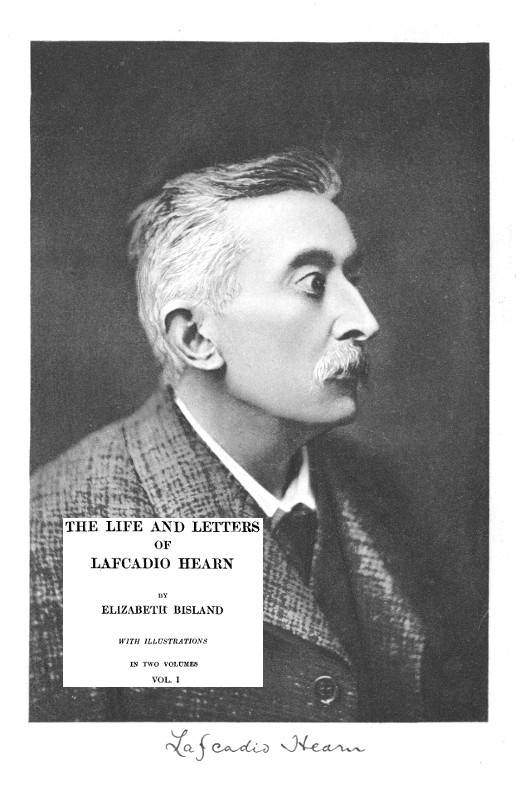
I was amused at your ideal description of me. As you supposed, I am swarthy—more than the picture indicates; but by no means interesting to look at, and the profile view conceals the loss of an eye. I am also very short, a small square-set fellow of about 140 pounds when in good health.
I read with extreme pleasure your essay, and while I do not hold the same views, I believe yours will do good. Furthermore, if you familiarize the public with Buddhism, you are bound to aid in bringing about the very state of things I hope for. Buddhism only needs to be known to make its influence felt in America. I don’t think that works like those of Sinnett, or Olcott’s curious “Buddhist Catechism,” published by Estes & Lauriat, will do any good;—they are too metaphysical, representing a sort of neo-gnosticism which repels by its resemblance to Spiritualistic humbug. But the higher Buddhism,—that suggested by men like Emerson, John Weiss, etc.,—will yet have an apostle. We shall live, I think, to see some strange things.
I am sorry I cannot gratify you by my reply about your projected literary sketches. The policy of the paper has been to give the preference to lady writers on such subjects, with a few exceptions to which some literary reputation has been attached. You would have a much better chance with theosophic essays; but you would be greatly restricted as to space. You did not write, it appears, to Page; and he is now at Saratoga, where he will remain about two months. Anyhow, I would personally advise you—if you think my advice worth anything—to devote your literary impulse altogether to religious subjects. By a certain class of sermons and addresses you can achieve in a few years much more success than the slow uphill work of professional journalism or literature would bring you in a whole decade. With leisure and popularity you could then achieve such literary work as you could not think of attempting now. As for me, if I succeed in becoming independent of journalism in another ten years, I shall be luckier than men of much greater talent,—such as Bayard Taylor
TO REV. WAYLAND D. BALL
New Orleans, June, 1883.
My dear Friend,—You have been very kind indeed to give me so pleasant an introduction to your personality;—I already feel as if we were more intimate, as if I knew you better and liked you more. A photograph is generally a surprise;—in your case it was not;—you are very much as I fancied you were—only more so.
I read with pleasure your article. The introduction was especially powerful. I must now, however, tell you frankly what I think would be most to your interest. When I wrote before I had no definite idea as to the scope or plan of your essay, nor did I know the Inter-Ocean desired it. Now I think it your duty to give the next article to that paper,—as the first is incomplete without it. It does not contain more than the parallel. However, the publication of your writing in the Inter-Ocean, even though unremunerative, will do you vastly more good than would the publication in our paper at a small price. The Inter-Ocean circulation is very large; and you must be advertised. It is not necessary to seek it, but it would be unwise to refuse it. In the mean time I shall call attention to you in our columns occasionally,—briefly of course. I only proposed T.-D. with the idea you might have need of a medium to publish your opinions and ideas. But so long as the Inter-Ocean takes an interest in you,—even without compensating you,—you have a right to congratulate yourself, as you are only beginning to make your voice heard in the wilderness. I shall bring your paper to Page Baker to-night,—who has just returned to town. Will send photo when I write again.
I would scarcely advise you to quote from my book. I am still too small a figure to attract any attention; and I think it would be best for you only to cite generally recognized authorities. Needless to say that I should feel greatly honoured and very grateful; but I think it would not be strictly to your interest to notice me until such time as I am recognized as a thinker, if such time shall ever arrive. With you it is very different;—your cloth—as we say in England—gives every gamin the right to review and praise you as a public teacher
TO W. D. O’CONNOR
New Orleans, February, 1883.
Dear Sir,—Mr. Page M. Baker, managing editor of the Times-Democrat, to whose staff I belong, handed me your letter relative to the article on Gustave Doré—stating at the same time that it seemed to him the handsomest compliment ever paid to my work. I hasten to confirm the statement, and to thank you very sincerely for that delicate and nevertheless magistral criticism; for no one could have uttered a more forcible compliment in fewer words. As the author of a little volume of translations from Théophile Gautier I received a number of very encouraging and gratifying letters from Eastern literary men; but I must say that your letter upon my editorial gave me more pleasure than all of them, especially, perhaps, as manifesting an artistic sympathy with me in my admiration for the man whom I believe to have been the mightiest of modern artists.
TO W. D. O’CONNOR
New Orleans, March, 1883.
My dear Mr. O’Connor,—My delay in answering your charming letter was unavoidable, as I have been a week absent from the city upon an excursion to the swampy regions of southern Louisiana, in company with Harpers’ artist, for whom I am writing a series of Southern sketches. As I am already on good terms with the Harpers, your delicate letter to them cannot have failed to do me far more good than would have been the case had I been altogether unknown. I don’t know how to thank you, but trust that I may yet have the pleasure of trying to do so verbally, if you ever visit New Orleans.
Your books came to hand; and do great credit to your skill—I am myself a compositor and have held the office of proof-reader in a large publishing house, where I tried to establish an English system of punctuation with indifferent success. Thus I can appreciate the work. As yet I have not had time to read much of the report, but as the Life-Saving Service has a peculiar intrinsic interest I will expect to find much to enjoy in the report before long.
You are partly right about Gautier, and, I think, partly wrong. His idea of work was to illustrate with a mosaic of rare and richly-coloured words. But there is a wonderful tenderness, a nervous sensibility of feeling, an Oriental sensuousness of warmth in his creations which I like better than Victor Hugo’s marvellous style. Hugo, like the grand Goth that he is, liked the horrible, the grotesqueness of tragic mediævalism. Gautier followed the Greek ideal so potently presented in Lessing’s “Laocoön,” and sought the beautiful only. His poetry is, I believe, matchless in French literature—an engraved gem-work of words. Well, you can judge for yourself a little, by reading his two remarkable prose-fantasies—“Arria Marcella" and “Clarimonde”—in my translations of him, which you will receive from New York in a few days. Something evaporates in translation of course, and as the book was my first effort, there will be found divers inaccuracies and errors therein; but enough remains to give some idea of Gautier’s imaginative powers and descriptive skill. Will also forward you paper you ask for.
I regret having to write very hurriedly, as I have a great press of work upon my hands. You will hear from me again, however, more fully. A letter to my address as above given will reach me sooner than if sent to the Times-Democrat office
TO W. D. O’CONNOR
New Orleans, August, 1883.
My dear Mr. O’Connor,—I had feared that I had lost a rare literary friend. Your charming letter undeceived me, and your equally charming present revealed you to me in a totally new light. I had imagined you as a delicate amateur only: I did not recognize in you a Master. And after I had read your two articles,—articles written in a fashion realizing my long-cherished dream of English in splendid Latin attire,—I felt quite ashamed of my own work. You have a knowledge, too, of languages unfamiliar to me, which I honestly envy, and which is becoming indispensable in the higher spheres of literary criticism—I mean a knowledge of Italian and German. As for your long silence, it only remains for me to say that your letter filled me with that sympathy which, in certain sad moments, expresses itself only by a silent and earnest pressure of the hand,—because any utterance would sound strangely hollow, like an echo in some vast dim emptiness.
Your beautiful little book came like a valued supplement to an edition of “Leaves of Grass” in my library. I have always secretly admired Whitman, and would have liked on more than one occasion to express my opinion in public print. But in journalism this is not easy to do. There is no possibility of praising Whitman unreservedly in the ordinary newspaper, whose proprietors always tell you to remember that their paper “goes into respectable families,” or accuse you of loving obscene literature if you attempt controversy. Journalism is not really a literary profession. The journalist of to-day is obliged to hold himself ready to serve any cause,—like the condottieri of feudal Italy, or the free captains of other countries. If he can enrich himself sufficiently to acquire comparative independence in this really nefarious profession, then, indeed, he is able freely to utter his heart’s sentiments and indulge his tastes, like that æsthetic and wicked Giovanni Malatesta whose life Yriarte has written.
I do not think that I could ever place so lofty an estimate upon the poet’s work, however, as you give,—although no doubt rests in my mind as to your critical superiority. I think that Genius must have greater attributes than mere creative power to be called to the front rank,—the thing created must be beautiful; it does not satisfy me if the material be rich. I cannot content myself with ores and rough jewels. I want to see the gold purified and wrought into marvellous fantastic shapes; I want to see the jewels cut into roses of facets, or turned as by Greek cunning into faultless witchery of nude loveliness. And Whitman’s gold seems to me in the ore: his diamonds and emeralds in the rough. Would Homer be Homer to us but for the billowy roar of his mighty verse,—the perfect cadence of his song that has the regularity of ocean-diapason? I think not. And did not all the Titans of antique literature polish their lines, chisel their words, according to severest laws of art? Whitman’s is indeed a Titanic voice; but it seems to me the voice of the giant beneath the volcano,—half stifled, half uttered,—roaring betimes because articulation is impossible.
Beauty there is, but it must be sought for; it does not flash out from hastily turned leaves: it only comes to one after full and thoughtful perusal, like a great mystery whose key-word may only be found after long study. But the reward is worth the pain. That beauty is cosmical—it is world-beauty;—there is something of the antique pantheism in the book, and something larger too, expanding to the stars and beyond. What most charms me, however, is that which is most earthy and of the earth. I was amused at some of the criticisms—especially that in the Critic—to the effect that Mr. Whitman might have some taste for natural beauty, etc., as an animal has! Ah! that was a fine touch! Now it is just the animalism of the work which constitutes its great force to me—not a brutal animalism, but a human animalism, such as the thoughts of antique poets reveal to us: the inexplicable delight of being, the intoxication of perfect health, the unutterable pleasures of breathing mountain-wind, of gazing at a blue sky, of leaping into clear deep water and drifting with a swimmer’s dreamy confidence down the current, with strange thoughts that drift faster. Communion with Nature teaches philosophy to those who love that communion; and Nature imposes silence sometimes, that we may be forced to think:—the men of the plains say little. “You don’t feel like talking out there,” I heard one say: “the silence makes you silent.” Such a man could not tell us just what he thought under that vastness, in the heart of that silence: but Whitman tells us for him. And he also tells us what we ought to think, or to remember, about things which are not of the wilderness but of the city. He is an animal, if the Critic pleases, but a human animal—not a camel that weeps and sobs at the sight of the city’s gates. He is rude, joyous, fearless, artless,—a singer who knows nothing of musical law, but whose voice is as the voice of Pan. And in the violent magnetism of the man, the great vital energy of his work, the rugged and ingenuous kindliness of his speech, the vast joy of his song, the discernment by him of the Universal Life,—I cannot help imagining that I perceive something of the antique sylvan deity, the faun or the satyr. Not the distorted satyr of modern cheap classics: but the ancient and godly one, “inseparably connected with the worship of Dionysus,” and sharing with that divinity the powers of healing, saving, and foretelling, not less than the orgiastic pleasures over which the androgynous god presided.
I see great beauty in Whitman, great force, great cosmical truths sung of in mystical words; but the singer seems to me nevertheless barbaric. You have called him a bard. He is! But his bard-songs are like the improvisations of a savage skald, or a forest Druid: immense the thought! mighty the words! but the music is wild, harsh, rude, primæval. I cannot believe it will endure as a great work endures: I cannot think the bard is a creator, but only a precursor—only the voice of one crying in the wilderness—Make straight the path for the Great Singer who is to come after me!... And therefore even though I may differ from you in the nature of my appreciation of Whitman I love the soul of his work, and I think it a duty to give all possible aid and recognition to his literary priesthood. Whatsoever you do to defend, to elevate, to glorify his work you do for the literature of the future, for the cause of poetical liberty, for the cause of mental freedom. Your book is doubly beautiful to me, therefore: and I believe it will endure to be consulted in future times, when men shall write the “History of the Literary Movement of 1900,” as men have already written the "Histoire du Romantisme.”
I don’t think you missed very much of my work in the T.-D. I have not been doing so well. The great heat makes one’s brain languid, barren, dusty. Then I have been making desperate efforts to do some magazine work. Thanks for your praise of “The Pipes of Hameline.” I wish, indeed, that I could drag myself out of this newspaper routine,—even though slowly, like a turtle struggling over uneven ground. Journalism dwarfs, stifles, emasculates thought and style. As for my translation of Gautier, it has many grave errors I am ashamed of, but it is not castrated. My pet stories in it are “Clarimonde” and “Arria Marcella.”
Victor Hugo was indeed the Arthur of the Romantic Movement, and Gautier was but one of his knights, though the best of them—a Lancelot. I think his “Emaux et Camées” surpass Hugo’s work in word-chiselling, in goldsmithery; but Hugo’s fancy overarches all, like the vault of the sky. His prose is like the work of Angelo—the paintings in the Sistine Chapel, the figures described by Emilio Castelar as painted by flashes of lightning. He is one of those who appear but once in five hundred years. Gautier is not upon Hugo’s level. But while Hugo wrought like a Gothic sculptor, largely, weirdly, wondrously, Gautier could create mosaics of word-jewelry without equals. The work is small, delicate, elfish: it will endure as long as the French language, even though it figure in the Hugo architecture only as arabesque-work or stained glass or inlaid pavement.
Oh yes! you will catch it for those articles! you will have the fate of every champion of an unpopular cause,—thorns at every turn, which may turn into roses.
I hope to see you some day. Will always have time to write. Sometimes my letter may be short; but not often. Believe me, sincerely,
TO JOHN ALBEE
New Orleans, 1883.
Dear Sir,—Your very kind letter, forwarded to me by Mr. Worthington, was more of an encouragement and comfort than you, perhaps, even desired. One naturally launches his first literary effort with fear and trembling; and at such a time kind or unkind words may have a lasting effect upon his future hopes and aims.
The little stories were translated five years ago, in the intervals of rest possible to snatch during reportorial duty on a Western paper. I was then working fourteen hours a day. Subsequently I was four years vainly seeking a publisher.
Naturally enough, the stories are not even now all that I could wish them to be; but I trust that before long I may escape so far from the treadmill of daily newspaper labour as to produce something better in point of literary execution. It has long been my aim to create something in English fiction analogous to that warmth of colour and richness of imagery hitherto peculiar to Latin literature. Being of a meridional race myself, a Greek, I feel rather with the Latin race than with the Anglo-Saxon; and trust that with time and study I may be able to create something different from the stone-grey and somewhat chilly style of latter-day English or American romance.
This may seem only a foolish hope,—unsubstantial as a ghost; but with youth, health and such kindly encouragement as you have given me, I believe that it may yet be realized. Of course a little encouragement from the publishers will also be necessary. Believe me very gratefully yours,
TO H. E. KREHBIEL
New Orleans, September, 1883.
Dear Krehbiel,—I trust you will be able to read the hideously written music I sent you in batches,—according as I could find leisure to copy it. The negro songs are taken from a most extraordinary book translated into French from the Arabic, and published at Paris by a geographical society. The author was one of those errant traders who travel yearly through the desert to the Soudan, and beyond into Timbuctoo occasionally, to purchase slaves and elephants’ teeth from those almost unknown Arab sultans or negro kings who rule the black ant-hills of Central Africa. I have only yet obtained the great volume relating to Ouaday; the volume on Darfour is coming. Perron, the learned translator, in his “Femmes Arabes” (published at Algiers), gives some curious chapters on ancient Arab music which I must try to send you one of these days. The Japanese book—a rather costly affair printed in gold and colours—is rapidly becoming scarce. I expect soon to have some Hindoo music; as I have a subscription for a library of folk-lore and folk-lore music of all nations, of which only 17 volumes are published so far—Elzevirians. These mostly relate to Europe, and contain much Breton, Provençal, Norman, and other music. But there will be several volumes of Oriental popular songs, etc. Some day, I was thinking, we might together get up a little volume on the musical legends of all nations, introducing each legend by appropriate music.
I have nearly finished a collection of Oriental stories from all sorts of queer sources,—the Sanscrit, Buddhist, Talmudic, Persian, Polynesian, Finnish literatures, etc.,—which I shall try to publish. But their having been already in print will militate against them.
Couldn’t get a publisher for the fantastics, and I am, after all, glad of it; for I feel somewhat ashamed of them now. I have saved a few of the best pieces, which will be rewritten at some future time if I succeed in other matters. Another failure was the translation of Flaubert’s “Temptation of Saint Anthony,” which no good publisher seems inclined to undertake. The original is certainly one of the most exotically strange pieces of writing in any language, and weird beyond description. Some day I may take a notion to print it myself. At present I am also busy with a dictionary of Creole Proverbs (this is a secret), four hundred or more of which I have arranged; and, by the way, I have quite a Creole library, embracing the Creole dialects of both hemispheres. I have likewise obtained favour with two firms, Harpers’, and Scribners’—both of whom have recently promised to consider favourably anything I choose to send in. You see I have my hands full; and an enormous mass of undigested matter to assimilate and crystallize into something.
So much about myself, in reply to your question.... Your Armenian legend was very peculiar indeed. There is nothing exactly like it either in Baring-Gould’s myths (“Mountain of Venus”) or Keightley’s “Fairy Mythology,” or any of the Oriental folk-lore I have yet seen. The ghostly sweetheart is a universal idea, and the phantom palace also; but the biting of the finger is a delightful novelty. Many thanks for the pretty little tale.
I don’t think you will see me in New York this winter. I shudder at the bare idea of cold. Speak to me of blazing deserts, of plains smoking with volcanic vapours, of suns ten times larger, and vast lemon-coloured moons,—and venomous plants that writhe like vipers and strangle like boas,—and clouds of steel-blue flies,—and skeletons polished by ants,—and atmospheres heavy as those of planets nearer to the solar centre!—but hint not to me of ice and slush and snow and black-frost winds. Why can’t you come down to see me? I’ll show you nice music: I’ll enable you to note down the musical cries of the Latin-faced venders of herbs and gombo fève and calas and latanir and patates.
If you can’t come, I’ll try to see you next spring or summer; but I would rather be whipped with scorpions than visit a Northern city in the winter months. In fact few residents here would dare to do it,—unless well used to travelling. Some day I must write something about the physiological changes produced here by climate. In an article I wrote for Harper’s six months ago, and which ought to appear soon (as I was paid for it), you will observe some brief observations on the subject; but the said subject is curious enough to write a book about. By the way, I have become scientific—I write nearly all the scientific editorials for our paper, which you sometimes see, no doubt. Farney ought to spend a few months here: it would make him crazy with joy to perceive those picturesquenesses which most visitors never see.
I thought I would go to Cincinnati next week or so; but I’m afraid it’s too cold now. If I do go, I’ll write you.
As to your protest about correspondence, I think you’re downright wrong; but I won’t renew the controversy. Anyhow I suppose we keep track of each other, with affectionate curiosity. I am quite sorry you missed my friend Page Baker: he is a splendid type,—you would have become fast friends at once. Never mind, though! if you ever come down here, we’ll make you enjoy yourself in earnest. Please excuse this rambling letter
P. S. By the bye, have you the original music of the Muezzin’s call,—as called by the first of all Muezzins, Bìlâl the Abyssinian, to whom it was taught by Our Lord Mohammed? Bìlâl the black Abyssinian, whose voice was the mightiest and sweetest in Islam. In those first days, Bìlâl was persecuted as the slave of the persecuted Prophet of God. And in the "Gulistan,” it is told how he suffered. But after Our Lord had departed into the chamber of Allah,—and the tawny horsemen of the desert had ridden from Medina even to the gates of India, conquering and to conquer,—and the young crescent of Islam, slender as a sword, had waxed into a vast moon of glory that filled the world,—Bìlâl still lived with that wonderful health of years given unto the people of his race. But he only sang for the Kalif. And the Kalif was Omar. So, one day, it came to pass, that the people of Damascus, whither Omar had travelled upon a visit, begged the Caliph, saying: “O Commander of the Faithful, we pray thee that thou ask Bìlâl to sing the call to prayer for us, even as it was taught him by Our Lord Mohammed.” And Omar requested Bìlâl. Now Bìlâl was nearly a century old; but his voice was deep and sweet as ever. And they aided him to ascend the minaret. Then, into the midst of the great silence burst once more the mighty African voice of Bìlâl,—singing the Adzan, even as it has still been sung for more than twelve hundred years from all the minarets of Islam:
And Omar wept and all the people with him.
This is an outline. I’d like to have the music of that. Sent to London for it, and couldn’t get it.
TO H. E. KREHBIEL
New Orleans, 1883.
I’m so delighted with that music that I don’t know what to do.
First, I went to my friend Grueling, the organist, and got him to play and sing it. “It is very queer,” he said; “but it seems to me like chants I’ve heard some of these negroes sing.” Then I took it to a piano-player, and he played it for me. Then I went to a cornet-player—I think the cornet gives the best idea of the sound of a tenor voice—and he played it exquisitely, beautifully. Those arabesques about the name of Allah are simply divine! I noticed the difference clearly. The second version seems suspended, as a song eternal,—something never to be finished so long as waves sing and winds call, and worlds circle in space. So I thought of Edwin Arnold’s lines:—
I believe I’ll use both songs. The suspended character of the second has a great and pathetic poetry in it. Please tell me in your next letter what kind of voice Bìlâl ought to have—being a woolly-headed Abyssinian. I suppose I’ll have to make him a tenor. I can’t imagine a basso making those flourishes about the name of the Eternal.
Next week I’ll send you selections of Provençal and other music which I believe are new. My library is very fine. I have a collection worth a great deal of money which you would like to see.
If you ever come down here, you could stay with me nicely, and have a pleasant artistic time.
TO H.E. KREHBIEL
New Orleans, October, 1883.
My dear Krehbiel,—I have been too sick with a strangling cold to write as I had wished, or to copy for you something for which I had already obtained the music-paper. Nevertheless I am going to ask another favour. I hope you can find time to copy separately for me the Arabic words of the Adzan: I prefer Villoteau. As for Koran-reading, it would delight me; but please give me the number of the sura, or chapter, from which the words are taken.
My article on Bìlâl is progressing: the second part being complete. I am dividing it into four Sections. But I do not feel quite so hopeful now as I did before. Magazine-writing is awful labour. Six weeks at least are required to prepare an article, and then the probability is that the magazine editor will make beastly changes: my article on Cable suffered at his hands. The Harpers change nothing; but they keep an article over for twelve months and more. One of mine is not yet published. I have been hoping that if my “Bìlâl” takes, you might follow it up with an article on Arabic music generally: the open letter department of Scribner’s pays well, and the Harpers pay even better. I would like to see you with a series, which could afterward be united into a volume: you could copyright each one. This is only a suggestion.
I will not make much use of the Koran-reading in “Bìlâl:” I want to leave that wholly to you. I feel even guilty for borrowing your pithy and forcible observation upon the cantillado.
If you have a chance to visit some of your public libraries, please see whether they have Maisonneuve’s superb series: “Les Littératures populaires de toutes les nations.” I have fourteen volumes of it, rich in musical oddities. If they have it not, I will send you extracts from time to time. Also see if they have Mélusine: my volume of it (1878) contains the music of a Greek dance, older than the friezes of the Parthenon. Of course, if you can see them, it will be better than the imperfect copying of an ignoramus in music like me.
I grossly offended a Creole musician the other day. He denied in toto the African sense of melody. “But,” said I, “did you not tell me that you spent hours trying to imitate the notes of a roustabout-song on your flute?” “I did,” he replied, “but not because it pleased me—only because I was curious to learn why I could not imitate it: it still baffles me, but it is nevertheless an abomination to my ear!” “Nay!” said I, “it hath a most sweet sound to me; and to the ethnologist a most fascinating interest. Verily, I would rather listen to it, than hear a symphony of Beethoven!” ... Whereupon he walked away in high fury; and now ... he speaketh to me no more!
TO H.E. KREHBIEL
New Orleans, 1883.
My dear Krehbiel,—There is nothing in magazine-work in the way of profit; for the cent-a-word pay does not really recompense the labour required: but the magazines introduce one to publishers, and publishers select men to write their books. Magazine-work is the introduction to book-work; and book-work pays doubly—in money and reputation. I hope to climb up slowly this way—it takes time, but offers a sure issue. You could do so much more rapidly.
I find in my Oriental catalogues “Villoteau—Mémoire sur la Musique de l’antique Egypte.—Paris: Maisonneuve & Cie, 1883 (15 fr.).” Wonder if you have the work in any of your public libraries. If you have not, and you would like to get it, I can obtain it from Paris duty-free next time I write to Maisonneuve, from whom I am obtaining a great number of curious books.
You must have noticed in the papers the real or pretended discovery of an ancient Egyptian melody,—the notes being represented by owls ascending and descending the musical scale. Hope you will get to see it. I have been thinking that we might some day, together, work up a charming collection of musical legends: each legend followed by a specimen-melody, with learned dissertation by H. Edward Krehbiel. But that will be for the days when we shall be “well-known and highly esteemed authors.” I think I could furnish some singular folk-lore.
Meanwhile “Bìlâl” has been finished. I wrote to Harper’s Magazine;—the article was returned with a very complimentary autograph letter from Alden, praising it warmly, but recommending its being offered to the Atlantic, as he did not know when he could “find room for it.” Find room for it! Ah, bah!... I am sorry: because I had written him about your share in it, and hoped, if successful, it would tempt him to write you. It is now in the hands of another magazine. I used your Koran-fragment in the form of a musical footnote.
I notice you called it a “brick.” Are you sure this is the correct word? Each sura (or chapter) indeed signifies a “course of bricks in a wall;” but also signifies “a rank of soldiers”—and the verses, which were never numbered in the earlier MSS., are so irregular that the poetry of the term “brick” could scarcely apply to them. However, I may be wrong.
I was delighted with your delight, as expressed in your beautiful letter upon the Hebrew ceremonial. Hebrew literature has been my hobby for some time past: I have Hershon’s “Talmudic Miscellany;” Stauben’s “Scènes de la Vie Juive” (full of delicious traditions); Kompert’s “Studies of Jewish Life,” which you have no doubt read in the original German; and Schwab’s French translation of the beginning of the Jerusalem Talmud (together with the Babylonian Berachoth), 5 vols. I confess the latter is, as a whole, unreadable; but the legends in it are without parallel in weirdness and singularity. Such miscellaneous reading of this sort as I have done has given new luminosity to my ideas of the antique Hebrew life; and enabled me to review them without the gloom of Biblical tradition,—especially the nightmarish darkness of the Pentateuch. I like to associate Hebrew ceremonies rather with the wonderful Talmudic days of the Babylonian rabbonim than with the savage primitiveness of the years of Exodus and Deuteronomy. There are some queer things about music in the Talmud; but they are sometimes extravagant as that story about the conch-shell blown at the birth of Buddha—“where of the sound rolled on unceasingly for four years!” The swarthy fishermen of our swampy lakes do blow conch-shells by way of marine signalling; and whenever I hear them I think of that monstrous conch-shell told of in the Nidānakathā.
As I write it seemeth to me that I behold, overshadowing the paper, the most Dantesque silhouette of one who walked with me the streets of the far-off Western city by night, and with whom I exchanged ghostly fancies and phantom hopes. Now in New York! How the old night-forces have been scattered! But is it not pleasant to observe that the members of the broken circle have been mounting higher and higher toward the supreme hope? Perhaps we may all meet some day in the East; whence as legendary word hath it—“lightning ever cometh.” Remember me very warmly to my old comrade Tunison.
But I think it more probable I shall see you here than that you shall see me there. New York has become something appalling to my imagination—perhaps because I have been drawing my ideas of it from caricatures: something cyclopean without solemnity, something pandemoniac without grotesqueness,—preadamite bridges,—superimpositions of iron roads higher than the aqueducts of the Romans,—gloom, vapour, roarings and lightnings. When I think of it, I feel more content with my sunlit marshes,—and the frogs,—and the gnats,—and the invisible plagues lurking in visible vapours,—and the ancientness,—and the vast languor of the land. Even our vegetation here, funereally drooping in the great heat, seems to dream of dead things—to mourn for the death of Pan. After a few years here the spirit of the land has entered into you,—and the languor of the place embraces you with an embrace that may not be broken;—thoughts come slowly, ideas take form sluggishly as shapes of smoke in heavy air; and a great horror of work and activity and noise and bustle roots itself within your soul,—I mean brain. Soul = Cerebral Activity = Soul.
I am afraid you have read the poorest of Cable’s short stories. “Jean-ah Poquelin,” “Belles-Demoiselles,” are much better than “Tite Poulette.” There is something very singular to me in Cable’s power. It is not a superior style; it is not a minutely finished description—for it will often endure no close examination at all: nevertheless his stories have a puissant charm which is hard to analyze. His serial novel—“The Grandissimes”—is not equal to the others; but I think the latter portion of “Dr. Sevier” will surprise many. He did me the honour to read nearly the whole book to me. Cultivate him, if you get a chance.
Baker often talks with me about you. You would never have any difficulty in obtaining a fine thing here. Perhaps you will be the reverse of flattered by this bit of news; but the proprietors here think they can make the T.-D. a bigger paper than it is, and rival the Eastern dailies. For my part I hope they will do it; but they lack system, experience, and good men, to some extent. Now good men are not easily tempted to cast their fortunes here at present. It will be otherwise in time; the city is really growing into a metropolis,—a world’s market for merchants of all nations,—and will be made healthier and more beautiful year by year.
Good-bye for the present